Italian Family Traditions
20 Questions to Ask Your Italian Grandparents Before It’s Too Late
The family story is still there — in the town names, the kitchen smells, the sayings, the sacrifices, and the memories nobody has thought to ask about. These questions help you begin before the details disappear.
⏱ 10 minute read
You know you should ask. You’ve been meaning to for years — to sit down with your grandmother, or your mother, or whoever in your family still holds the story, and finally say: tell me everything.
But you haven’t. Not because you don’t care — you care deeply. You just don’t know how to start. You don’t know which question to ask first, or how to get past the surface answers, or how to unlock the stories nobody tells unless you ask exactly the right way.
And the window is closing. Every year the details get softer. Every year the voice gets quieter. Every year there is a little less of the story left to save.
These twenty questions to ask your Italian grandparents are designed to change that. They are organized to start easy and go deep — from basic facts to sensory memories to the questions that unlock things your family has never said out loud. You don’t need to ask all twenty. Start with one. The right one will carry you to the rest.
Print this page. Bring it to the table. Bring food — because an Italian does not sit down for something important without eating. Press record on your phone. And start.
The Short Version
Every Italian family has stories that will be lost if nobody asks for them. If you are looking for meaningful questions to ask your Italian grandparents, this list moves from easy conversation starters to the questions that unlock everything. Use it to record your family’s heritage while the people who remember are still here to tell you. Print the list. Set a date. Sit down with the oldest person in your family. Start with question one.
Before You Go Further
These 20 questions are from the Italian Family Heritage Kit — a 133-page guided book for recording your family’s complete story. The Kit includes over 120 interview questions, structured fill-in pages for recipes, names, traditions, remedies, and sayings, plus space for photographs and a letter to the next generation.
Learn More — Italian Family Heritage Kit →In This Article
- Before You Start — How to Have the Conversation
- Questions 1–5: Where We Came From
- Questions 6–10: Who We Were
- Questions 11–15: How We Lived
- Questions 16–20: What It All Means
- After the Conversation — What to Do Next
- FAQ
Before You Start — How to Have the Conversation
This is not an interrogation. It is a meal.
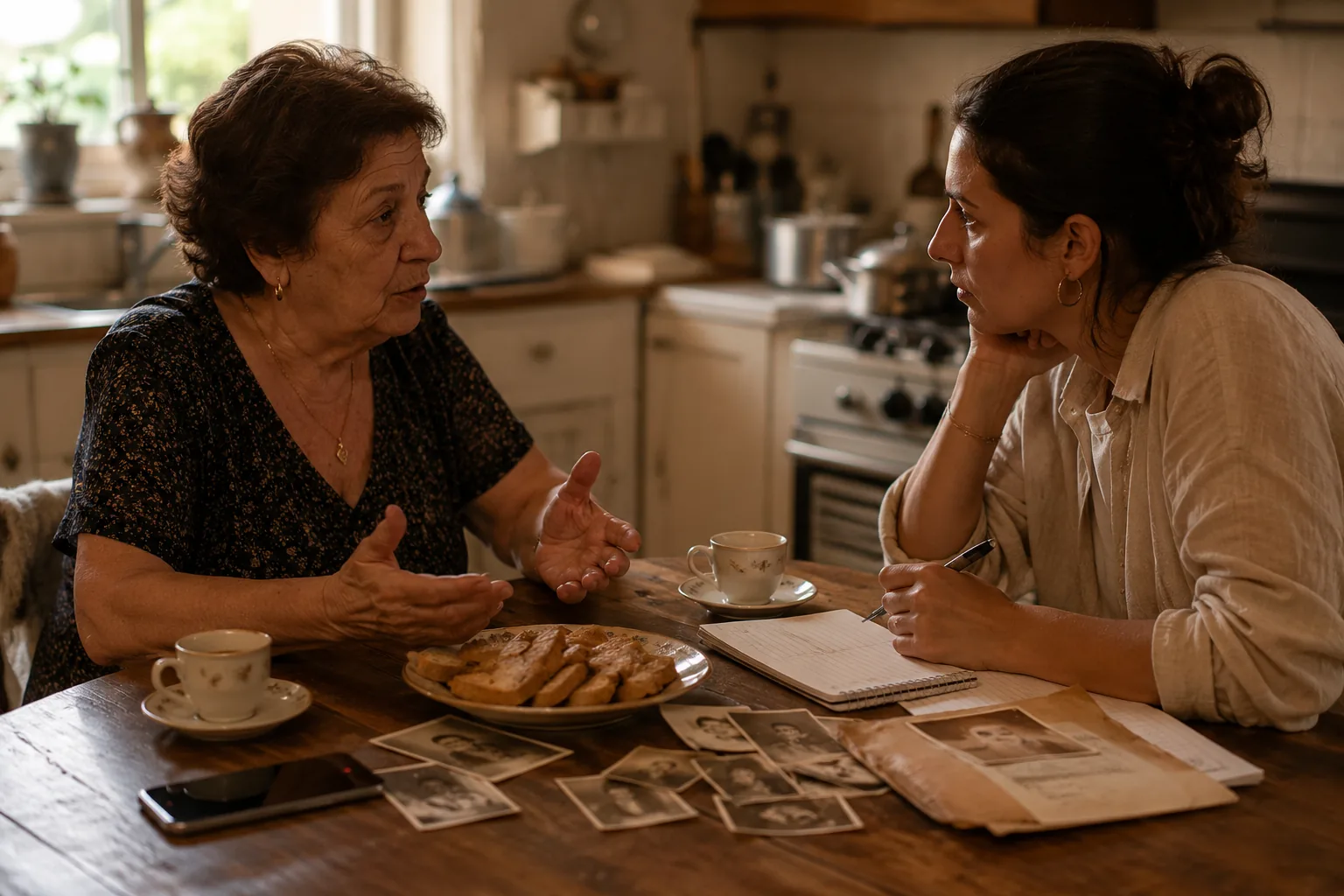
Choose one person — the oldest, the one who remembers the most, the one whose stories you are most afraid of losing. Call them and say: “I want to hear the story. All of it. Can I come over on Sunday?”
Bring food. Bring wine. Bring your phone to record — not to film them, but to press record and set it face-down on the table so they forget it’s there. The best stories come when people forget they’re being recorded.
Don’t start with the hard questions. Start with the facts — the town, the year, the journey. Let them warm up. The deep questions come later, after the food, after the second glass, after the silence that tells you they’ve stopped performing and started remembering.
A Note Worth Keeping
You do not need to ask all twenty questions in one sitting. One Sunday, five questions, and a pot of sauce on the stove is enough to start. The conversation you begin today will continue — if you start it.
Questions 1–5: Where We Came From
Start Here — the Facts
These are the warm-up questions. They feel easy, factual, and safe. But they often surprise people — because the answers are more specific, more detailed, and more emotional than anyone expects. The question “why did they leave?” sounds like a history question. It is not. It is a question about loss, fear, courage, and a decision that shaped every generation that followed.
1. What was the exact name of the town our family came from — and what did it look like?
2. Why did the family leave Italy? Whose decision was it?
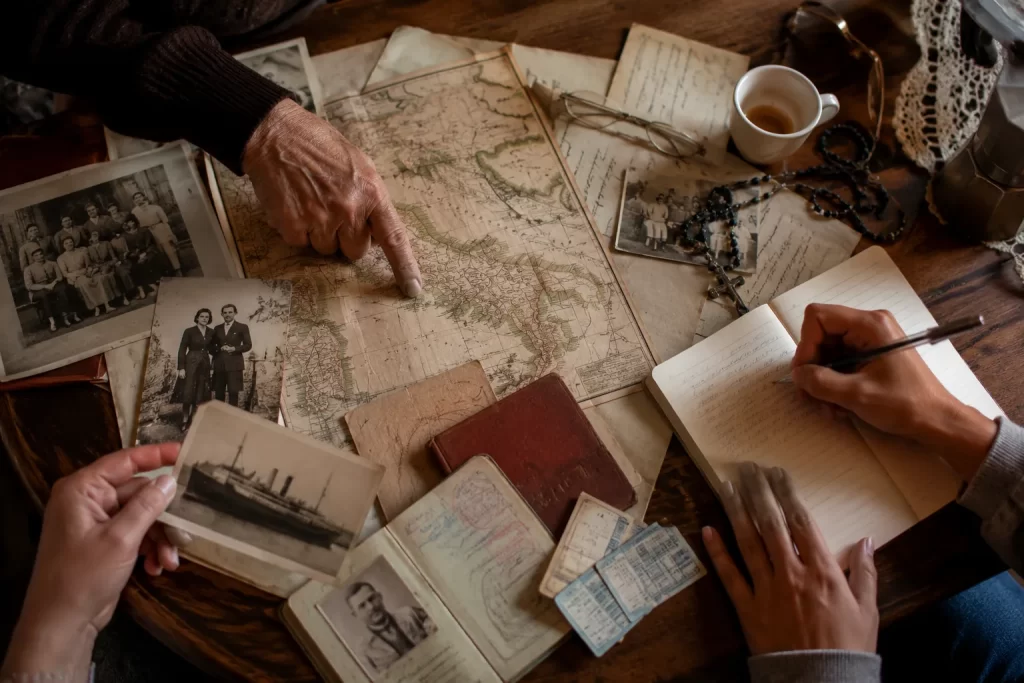
3. What do you remember about the journey — the ship, the arrival, the first days?
4. What did you bring with you? What do you wish you had brought?
5. What was the hardest part of starting over in a new country?
Question 4 is the one that opens the door. “What did you bring?” gives you the suitcase. “What do you wish you had brought?” gives you the heart.
Research Tip
If the conversation gives you a ship name, arrival year, town, or old address, use it as a starting point. The Canadian Museum of Immigration at Pier 21 explains how to investigate a family’s immigration history, while the Library and Archives Canada genealogy portal provides access to passenger lists, census records, citizenship resources, and other family-history collections.
Questions 6–10: Who We Were
Go Deeper — the People
These questions ask about people, not events. They are designed to produce the kind of detail that turns a name on a family tree into a person you can almost see — the way she stood, the way he held his coffee cup, the sound of her voice when she was tired. These details fade faster than facts. Ask for them now.
6. What was your mother like — describe her, not as a mother, but as a person?
7. What did your father do with his hands — the work, the garden, the things he built?
8. What did they call each other — the nickname, the pet name, the dialect version?
9. What did your home smell like when you were a child?
10. What is the one thing about your parents you want us to never forget?
Question 9 seems strange. It is the most powerful question on this page. Smell is the sense most directly connected to memory. When someone answers “what did the house smell like?” — they are not remembering a fact. They are standing in the doorway again. Everything else follows.
Questions 11–15: How We Lived
The Traditions, the Kitchen, the Sunday Table
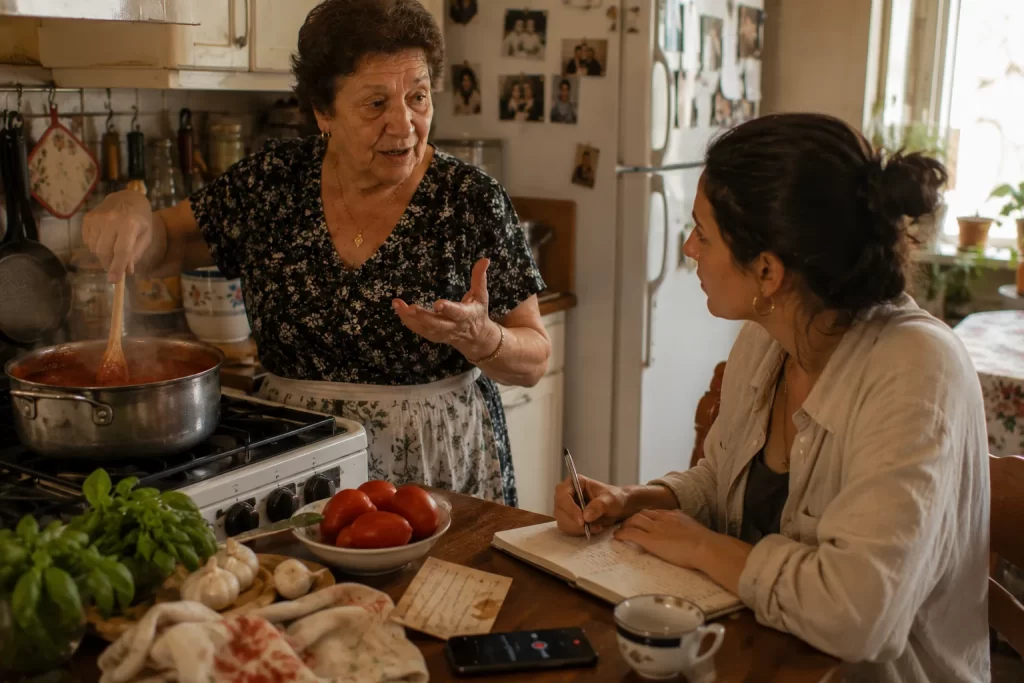
These questions capture how the family lived every day — not the big events, but the ordinary rhythms that made your family Italian. The remedies, the superstitions, the kitchen rules, the Sunday routine. These are the traditions that feel permanent until they’re not — until the last person who did them is gone, and you realize nobody learned how.
11. What did your mother make when someone was sick — the first thing, before the doctor?
12. What superstitions did your family follow — and which ones do you still believe?
13. What was Sunday like — the cooking, the table, the family?
14. What was the kitchen rule that was never broken?
15. What food can you still taste in your memory that nothing here has ever matched?
Question 15 is the one that gets quiet. There is always a food — something from the old country, or something their mother made, that tasted a specific way that has never been replicated. Not because the recipe is lost. Because the kitchen is gone, the water was different, the tomatoes came from a different soil. When they answer this one, write down every word.
🇮🇹 Join the Family
Stories, traditions, and recipes from Italian families — delivered to your inbox.
Questions 16–20: What It All Means
The Ones That Matter Most
These are the questions you save for last — after the food is eaten, after the easy questions have loosened the memories, after the room has settled into the kind of quiet where real things can be said. These questions ask not what happened, but what it meant. They are the ones most people never ask. They are the ones that matter most.
16. What is the tradition you most want this family to keep — no matter what?
17. What proverb or saying did your father live by — the one you hear in your head?
18. What did leaving Italy cost you that you never got back?
19. What are you most proud of about what this family became?
20. If you could tell your great-grandchildren one thing about where they came from — what would it be?
Question 18 is the hardest question on this list. Most people have never been asked it. Most people have never answered it — not even to themselves. If they answer it, write it down exactly as they say it. You will never hear anything more honest.
After the Conversation — What to Do Next
Go home. Write everything down. Tonight — not tomorrow. You will lose details by tomorrow that you hold perfectly right now. Write while the voice is still in your ears, while the expressions are still fresh, while you can still remember the exact way they said the thing they said.
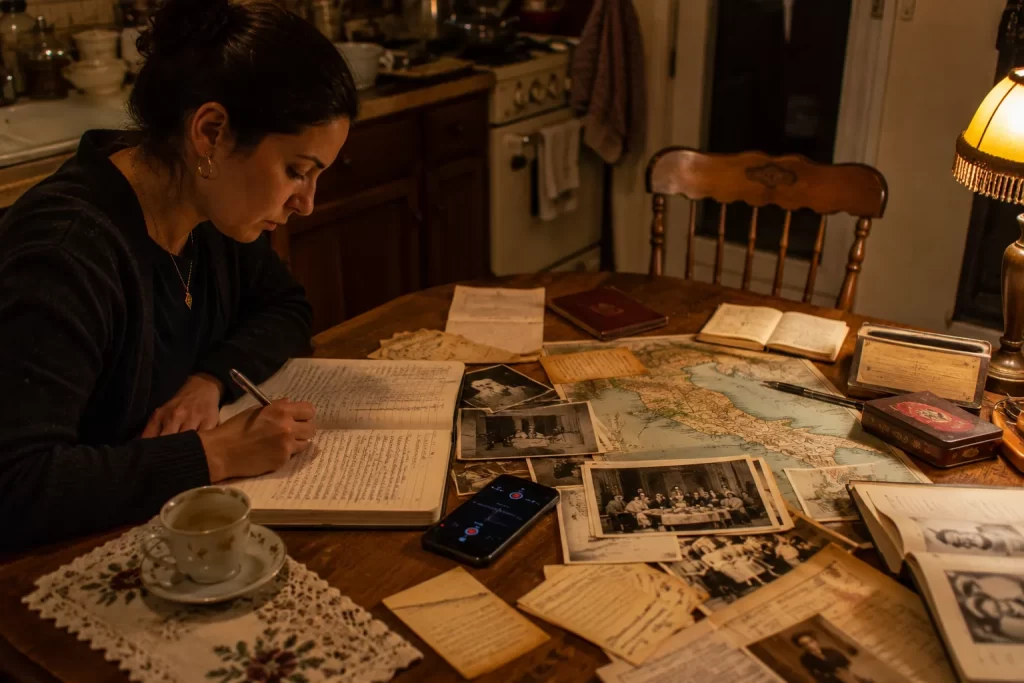
If the conversation surprised you — if something came out that you never knew, a story you had never heard, a feeling they had never shared — write that first. That is the rescue. That is why you asked.
And if you started but didn’t finish — if you only got through five questions, or three, or one — that is not a failure. That is a beginning. Call them next Sunday. Pick up where you left off. The conversation you began today will continue — because now they know you care enough to ask.
A Note Worth Keeping
The best thing you can do after this conversation is press record next time. Not video — just audio. Set your phone face-down on the table and let it run. Their voice answering these questions, in their accent, with their pauses and their laughter and their silence — that recording will become the most valuable audio your family owns.
These 20 questions are just the beginning.
The Full Family-Story System
Give every answer a place before the details disappear.
The Italian Family Heritage Kit contains over 120 interview questions, plus structured pages for recording recipes, names, traditions, remedies, sayings, photographs, and a letter to the next generation. 133 pages. Everything your family needs to make sure the story survives.
Get the Italian Family Heritage Kit — $19.99Instant digital download. Print it and complete it with your family.
📌 In Summary
Your family’s story lives in the people who remember it. These twenty questions are not a quiz — they are a bridge between you and the people who hold everything you don’t want to lose. Print this page. Set a date. Bring food. Start with question one.
And if you want the full system — 120+ questions, structured pages for every part of your heritage, recipe cards, tradition checklists, and space for photographs and a letter to the future — the Italian Family Heritage Kit was built for exactly this.
💬 Which question are you going to ask first? And what is the one story from your family that you are most afraid of losing? Tell us in the comments — every family’s story matters, and sharing yours might remind someone else to start asking before it’s too late.
Frequently Asked Questions
What if my grandparents have already passed away?
Start with what you have — your own memories, old photographs, documents, letters. Then call your parents, your aunts, your oldest cousins. Each person holds different pieces of the same story. Between several imperfect memories, you can reconstruct something remarkably close to complete. The Italian Family Heritage Kit is designed to guide you through this process even if the primary sources are gone.
How do I get them to open up? My grandparents don’t like talking about the past.
Start with the easy questions — the town, the food, the kitchen. Don’t begin with emotion. Begin with facts and let the emotion come on its own. Food helps enormously. If they are cooking while you ask, or eating while you talk, the formality drops and the real stories surface. The question “what did your home smell like when you were a child?” works better than “tell me about your childhood” because it gives them a specific sensory anchor instead of a blank canvas.
Should I record the conversation?
Yes — audio, not video. Set your phone face-down on the table, press record, and let them forget it’s there. Video makes people perform. Audio captures how they actually talk. Their voice answering these questions, in their accent, with their pauses — that recording is irreplaceable.
What is the best question to start with?
Of all the questions to ask your Italian grandparents, begin with question 1: “What was the exact name of the town our family came from — and what did it look like?” It is factual, it is safe, and it opens the door to everything else. If they hesitate, try question 9: “What did your home smell like when you were a child?” That one gives them a specific sensory memory to follow.
How do I preserve what they tell me?
Write it down the same day — while the words are fresh and you can still hear their voice in your head. A notebook works. The Italian Family Heritage Kit gives you structured pages organized by topic — recipes, names, traditions, remedies, photographs — so everything has a place and nothing falls through the cracks.
What if I can only ask a few questions?
Ask questions 1, 9, 15, and 20. Those four cover the town, the sensory memory of home, the food that can never be replicated, and the one thing they want the family to remember. Four questions, one Sunday, and a pot of sauce on the stove. That is enough to begin.

Marco Ricci is an Italian-Canadian writer and the grandson of Calabrian immigrants. He created Italian Family Traditions to document the customs, feast days, and family rituals Italian families carried from Italy to North America — and to understand what they actually meant. He is based in Montreal.