Italian Family Traditions
How to Keep Italian Family Traditions Alive Without Turning It Into a History Lesson
The fear is real: what if the family story fades with us? The good news is that tradition does not need perfection to survive. It needs a few small things, done with love, done again.
There is a fear that lives in the back of a lot of Italian-American and Italian-Canadian parents’ minds. It is not usually said out loud. It goes something like this: what if we are the generation that lets it go? What if the Sunday rhythms stop with us? What if our kids grow up knowing they are Italian the way someone knows their blood type — technically true, occasionally relevant, never felt?
That fear is real. And it is worth taking seriously.
Because some of those things you are afraid of losing are already thinner than they were a generation ago. The language faded first, in most families. Then the dialect words. Then the specific reasons behind the customs — why the breadcrumbs, why the fava beans, why the good plates came out only twice a year and not for ordinary Sundays. Then the customs themselves start to blur at the edges.
It happens one busy year at a time. Nobody decides to let it go. Life just moves fast and tradition does not insist on itself.
Tradition does not fight for its own survival. That part is up to you.
But here is what is also true: you do not need to revive every custom. You do not need to become the official curator of all Italian heritage before next Sunday. You do not need a nonna on standby and a three-hour sauce and a house full of people every single week.
What you need is intention. A few things, chosen deliberately, done again and again until they belong to your children as naturally as their own name.
That is it. That is the whole project. This is how you do it.
Why this matters more than people think
Before we get to the how, let’s be honest about the why — because if the why is not clear, the how never sticks.
Italian family traditions were not decorative. They were not the cultural equivalent of putting a flag in the front yard once a year and calling it done. They were structural. They were the architecture of family life. Sundays had a rhythm. Holidays had a rhythm. Greetings had a rhythm. Visits had a rhythm. Children did not sit through heritage lessons. They lived inside a pattern, and that pattern quietly told them who they were.
No speech was necessary. No one gathered the children and said “Today we will discuss what it means to be Italian.” The identity was transmitted through repetition — through who got served first, how guests were welcomed, which holidays felt different, what the house smelled like in December, who was always in the kitchen and who was never allowed to leave without eating something.
My mother could not have explained Italian culture in an essay. She could not have told you the history of La Vigilia or the theology behind St. Joseph’s Table. But she knew, without thinking, how to make a house feel like a place someone was truly welcomed. She knew how to make a meal feel like an event. She knew how to make a table feel like it was expecting you. I did not know she had taught me any of that. I only noticed when I had my own house and started doing the same things.
That is what is at stake. Not recipes. Not dialect words. Not a checklist of customs. The way a home feels. The way a family moves. The values that live inside the habits so quietly that children absorb them without knowing it. That is what you are trying to pass on. And it is absolutely passable — even now, even with modern schedules, even without the old neighborhood and the extended family three buildings away.
What preserving tradition actually means — and what it does not
Let’s clear something up before it becomes a source of guilt.
Preserving Italian family traditions does not mean recreating 1965 exactly. It does not mean pretending your family still lives in a Calabrian village, or that your children need to eat baccalà and speak only Italian to be properly Italian. That kind of rigidity kills traditions faster than neglect does, because it makes them feel like costumes rather than lived life.
What it actually means is preserving the meaning inside the custom — and finding the form that lets that meaning live in your actual life today.
My grandmother’s Sunday table sat fourteen people every week without fail. My version seats four on a good Sunday and maybe eight when we make the effort. For a long time I felt like I was doing it wrong — like I was already failing at something I had not even been handed properly. Then I realized the value was never the number of people. It was the deliberate pause. The one day that felt different. The signal to everyone at the table: this time is protected. That value is completely portable. It fits a table of four as well as it fit a table of fourteen.
Your grandmother gathered every Sunday. Maybe you gather once a month. Fine. She spoke dialect. Maybe you know ten words and you use them. Fine. She made everything from scratch. Maybe you buy the colomba and make one other thing yourself. Fine.
The question is not “Did I copy the past exactly?” The better question is “Did I pass on the value?”
The six things that actually work
Not twenty. Not a comprehensive curriculum. Six things, any one of which is enough to start, and all of which compound over time.
| # | What to do | Why it works |
|---|---|---|
| 01 | Repeat a few rituals | Children remember what repeats. One Sunday meal, one holiday custom, one greeting that never changes — done consistently — becomes the architecture of their identity. |
| 02 | Explain the why | Not “this is what we do” but “this is why we do it.” Context turns a custom into a value. Values survive long after the exact custom has changed. |
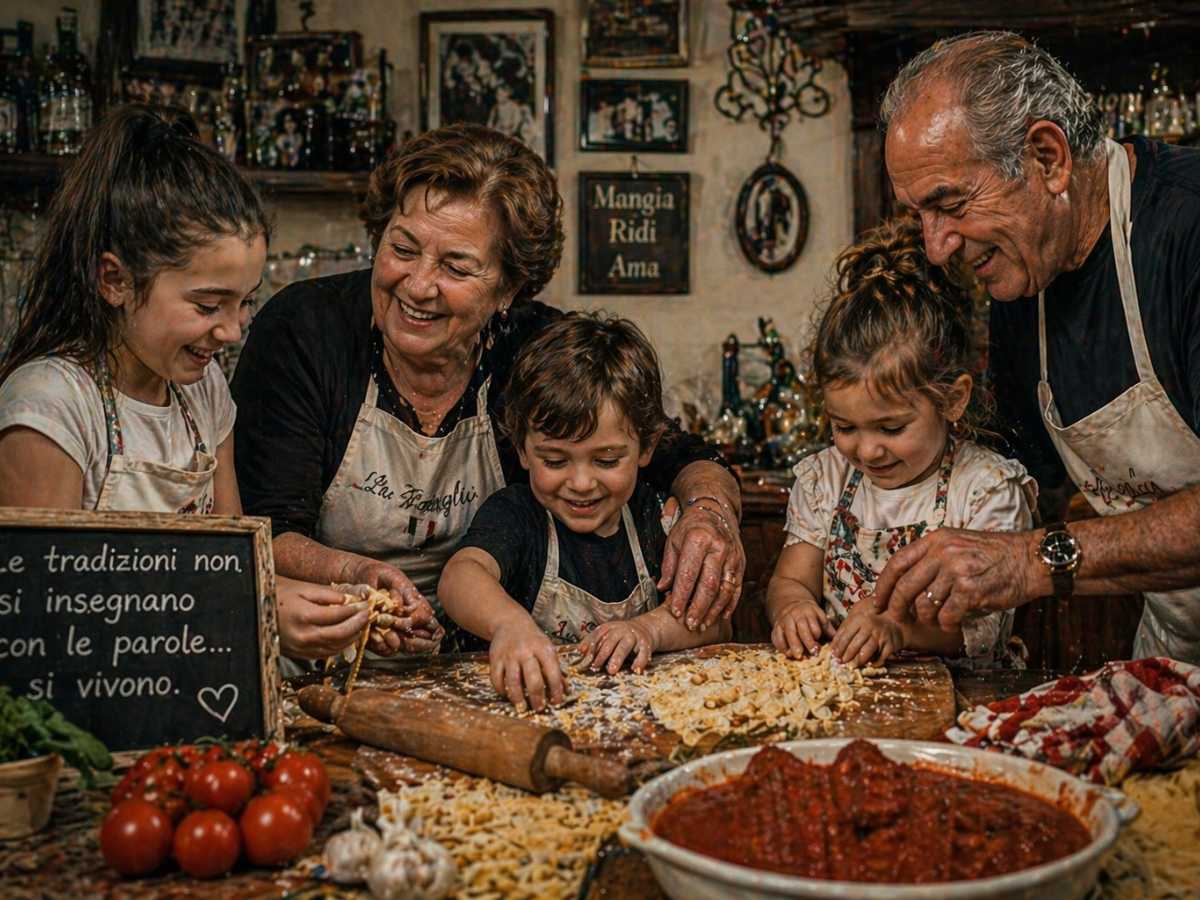
| 03 | Give kids a role | Participation creates ownership. A child who sets the table owns the table. A child who stirs the sauce owns the sauce. Ownership is what makes memory last. |
| 04 | Tell the real stories | Not the polished ones — the funny, difficult, human ones with real personalities in them. Heritage connects fastest when it comes with actual faces and actual quirks. |
| 05 | Keep some language | Even ten words is enough. A greeting, a name, a phrase at the table. Language carries feeling that translation loses — it marks the family as a place with a specific history. |
| 06 | Make heritage visible | A photo, a recipe notebook, a holiday object. Children notice what surrounds them constantly. Visible heritage does not need a speech — its presence is already the explanation. |
On repeating rituals
This is the most important one. A few simple things done often will do more for your children’s sense of heritage than one elaborate effort done once a year. Tradition is built on repetition, not performance. The child who has Sunday dinner together twenty times a year does not experience it as “Italian culture.” They experience it as normal life. And that is exactly the goal.
My aunt used to make a specific tomato salad every summer — just tomatoes, basil, olive oil, a little salt, the bread to soak up the juice. Nothing remarkable on paper. But she made it every summer for forty years, always in the same bowl, always on the back porch, always with the same running commentary about whether this year’s tomatoes were better or worse than last year’s. Her grandchildren now make it. They do not make it because someone told them it was an Italian tradition. They make it because it is their family’s summer, and always has been.
On explaining the why
Children who know the reason behind a custom are far more likely to carry it forward. Not because they are obedient, but because the story makes the custom feel real rather than arbitrary.
Do not just say “this is what we do.” Say “your great-grandparents came from a place where the family was everything they had. When they came to this country, the one thing they could not lose was each other. This meal is one of the ways we still say that.”
Now the meal has weight. Now skipping it feels like skipping something that matters, not just missing dinner.
On giving kids a role
Children do not need to master the tradition. They need a place inside it. Something that is theirs — a task, a job, a small piece of ownership over the ritual.
My cousin’s daughter is seven. She cannot cook. She cannot explain La Vigilia. But she is the one who arranges the candles on the Christmas Eve table, and she takes this responsibility with a seriousness that would shame most adults. She checks the candles three times. She adjusts them. She has opinions about which ones go where. She will remember that table her entire life — not because anyone taught her its history, but because part of it was hers.
On telling the real stories
This is the one most parents underestimate. Stories carry culture better than instructions ever will. Not the polished family legend version — the real ones, with real personalities in them.
Tell your kids about the great-uncle who had an opinion about everything and was wrong about half of it and beloved anyway. Tell them about the grandmother who gave everybody a nickname that somehow stuck for sixty years. Tell them about the relative who emigrated with nothing and built something anyway — not the inspirational poster version, but the specific, true, unglamorous version with the actual details in it.
Heritage connects fastest when it comes with faces, quirks, and humor. A child who knows real family stories feels descended from real people. And that feeling of descent — of coming from somewhere — is the deepest root a tradition has.
The funny stories matter as much as the serious ones. Possibly more. Humor is also heritage.
On keeping some language
Not every family can pass down fluent Italian. That ship, for most of us, has sailed. But a few words are not nothing.
The name for grandparents. The greeting before a meal. The phrase your grandmother used when she was proud of something. One saying that appears at the table and nowhere else. These things carry texture that plain English cannot replicate. They mark the family as a specific place with a specific history. They make children feel that their background has an actual sound to it — not just an adjective on a census form.
On making heritage visible
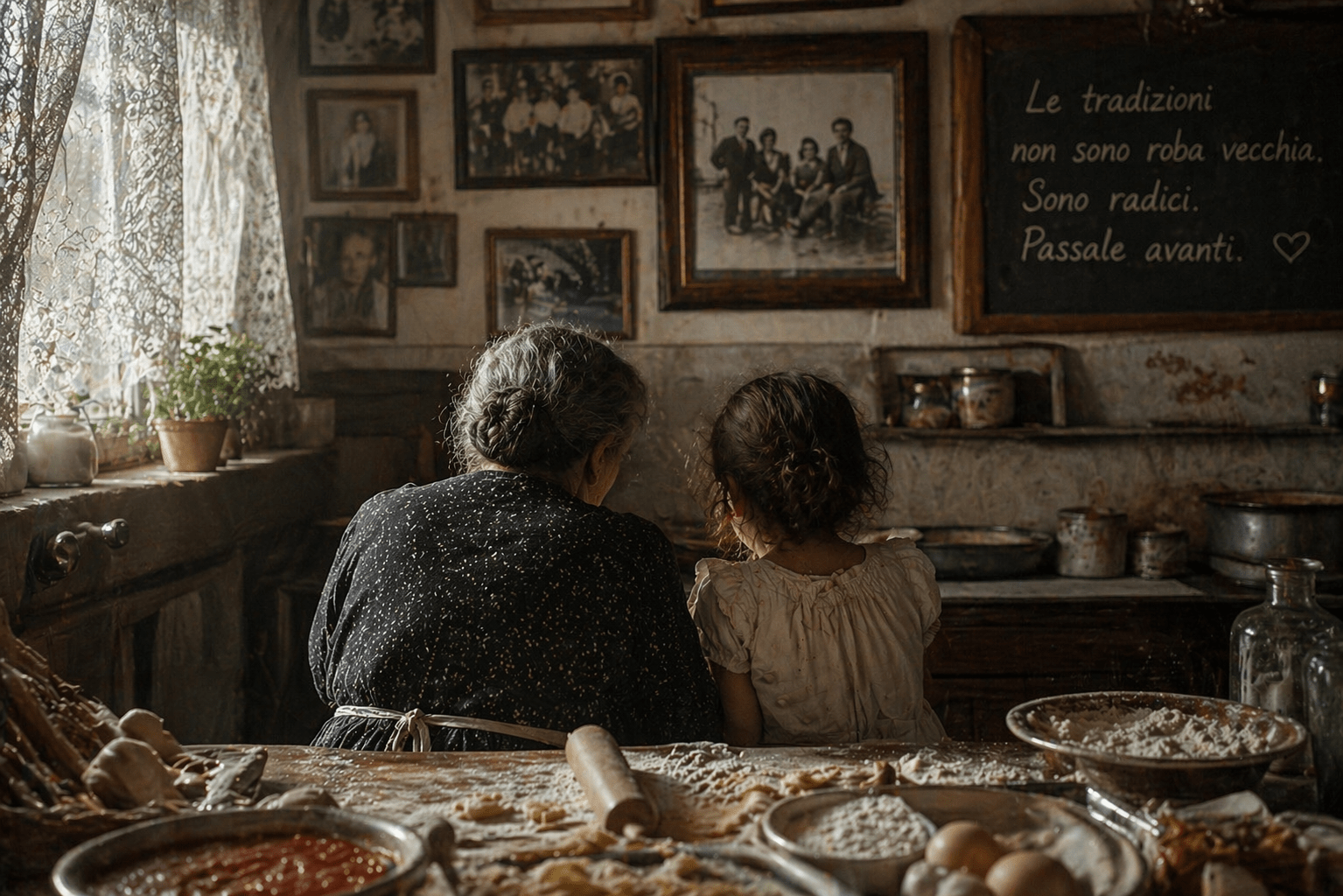
Children spend most of their lives in the home, and they notice everything that is there. A framed family photo from the village. A recipe notebook in Nonna’s handwriting, even if you cannot read all of it. A Christmas decoration that has been coming out of the same box for forty years. A saint’s prayer card tucked behind something on a shelf.
These things do not need explanations every time. Their presence is already the explanation. They tell children, quietly and constantly: this family has a history, and the history is worth keeping visible.
The trap: making tradition feel like homework
Here is where good intentions go wrong, and it is worth naming directly.
Once tradition starts to feel stiff, mandatory, or overly solemn, children can sense it immediately. Nobody wants to sit through heritage as a performance. Nobody wants to feel like they are being managed toward an outcome. The moment family culture becomes something that is done at children rather than something they are invited into, it loses them.
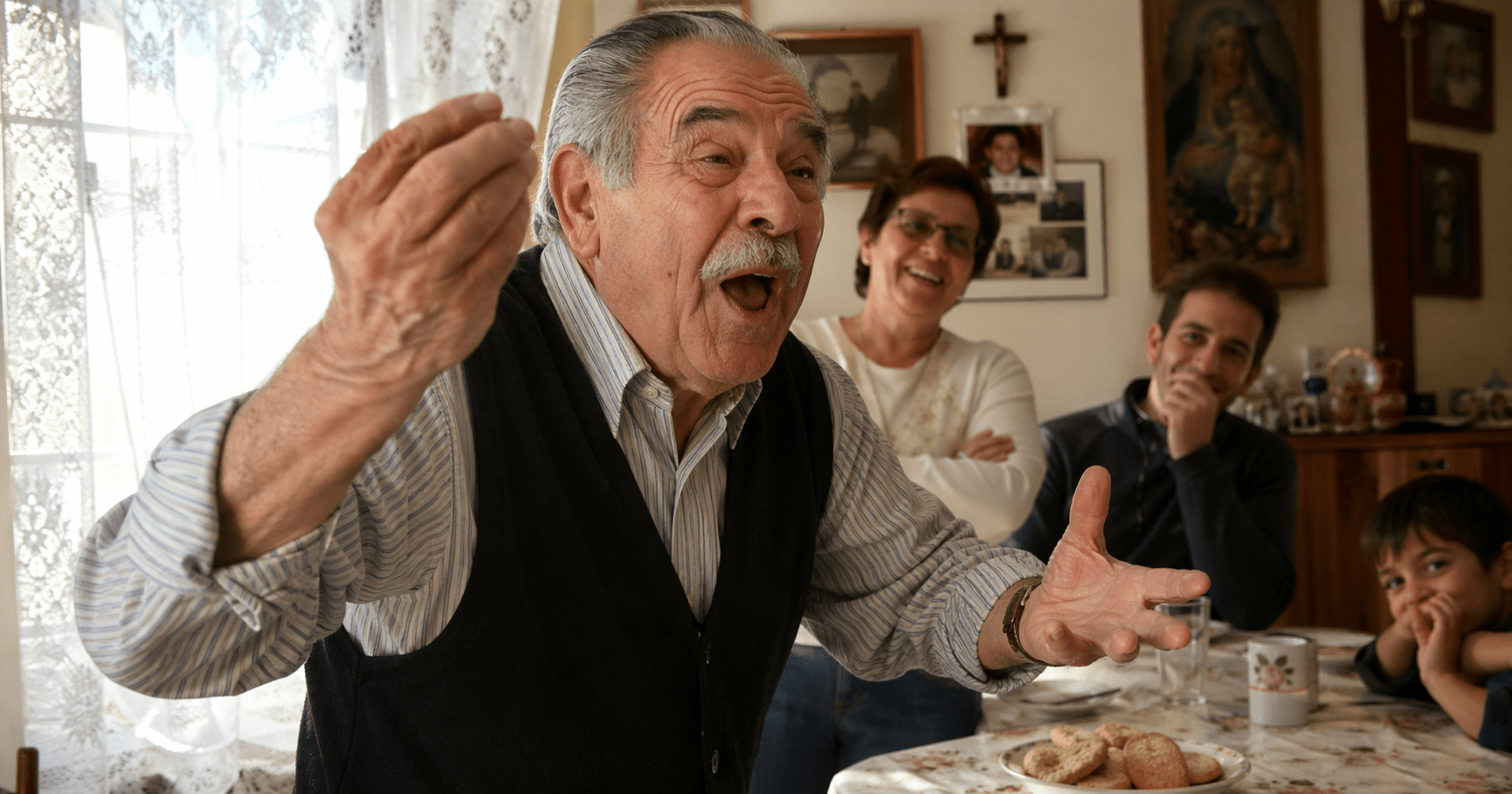
I know a family where the father was so determined to preserve Italian culture that every Sunday dinner included a formal explanation of whatever dish was being served — its regional origins, its historical significance, its correct preparation. The children sat through this with the expressions of people enduring a mild but relentless punishment. None of them cook Italian food now. They associate it with lectures. Meanwhile, my own family had no formal cultural curriculum whatsoever. My grandmother just cooked, told stories, and laughed loudly. All of her grandchildren cook Italian food. They do not know why. They just do.
Warmth works better than structure. Atmosphere works better than instruction. Let the table be loud. Let the stories wander. Let the children ask strange questions. Let them laugh. Let them roll their eyes at the story being told for the fourteenth time. The things children find most annoying in the moment are often the exact things they miss most desperately later.
Think less museum, more living room. Less reenactment, more relationship. That one shift changes everything about how tradition lands.
What happens when it works
Here is the payoff, because there is one, and it is real and worth the effort.
Children who grow up inside a living family tradition develop something genuinely hard to build any other way: a felt sense of who they are. Not a theoretical identity — not “I am Italian-American” as an answer on a form — but a visceral, embodied knowledge of belonging to something specific. A family with a specific smell in December. A table with a specific feeling on Sunday. A name for their grandmother that no one else’s grandmother has. A story about a great-grandparent who crossed an ocean with almost nothing and made something anyway.
That rootedness matters. It matters for children navigating adolescence. It matters for adults navigating difficulty. It matters for the versions of yourself that need to know, in the wordless and fundamental way, that you come from somewhere and that somewhere was good.
My daughter is twelve. She has never been to Italy. She does not speak Italian beyond a handful of words. She has grown up in a city where her school friends come from a dozen different backgrounds and “Italian” is not something anyone notices or remarks on. But she knows who her people are. She knows the stories. She knows the food. She knows what the table is supposed to feel like. She knows — in the way that only repetition can teach — that family time is not optional and that feeding people is one of the most direct ways to love them. I did not teach her that. I just kept doing it, and she absorbed it the way children absorb everything that surrounds them constantly. That is the whole method.
You are not trying to preserve the past exactly. You are trying to keep the meaning alive — in a form your children can actually live.
One meal. One story. One greeting. One child who grows up knowing this part of them matters. That is enough to start. That is enough to keep going.
FAQ
What is the best way to preserve Italian family traditions with kids?
Repeat a few meaningful rituals consistently, explain the reason behind them, and give children a real role in them. Grand one-time efforts do not build tradition — repetition does. A simple Sunday meal done twenty times a year will do more than one elaborate event done once. Start small, start specific, and stay consistent.
Why are Italian family traditions important for children?
They build something genuinely hard to create any other way: a felt sense of identity, belonging, and roots. Children who grow up inside living family traditions know where they come from in the embodied sense — not as information, but as experience. That rootedness matters throughout life in ways that are difficult to quantify and impossible to fake.
How can I keep Italian traditions alive if I do not speak Italian?
Language is one carrier of tradition, but not the only one. Food, stories, greetings, holiday rituals, family photographs, and even a few meaningful Italian words can all carry strong cultural feeling. The goal is not fluency — it is texture. The sense that your family’s life has a specific quality and history that belongs to it alone. That is achievable without Italian.
Do traditions need to stay exactly the same as what my grandparents did?
No — and insisting on exact replication often kills traditions faster than adaptation does. The form of a tradition can change considerably while the meaning stays intact. A Sunday dinner once a month instead of every week still protects the value of regular family time. A simplified Christmas Eve still honors the vigil. What matters is not fidelity to the exact form, but continuity of the meaning inside it.
What are simple Italian family traditions to start with kids?
The simplest and most durable: a regular family meal that feels different from the rest of the week, a few holiday rituals done the same way every year, the habit of telling family stories at the table, proper greetings with older relatives, and one or two Italian words or phrases that belong to your household. None of these require expertise. All of them compound over time into something children feel as part of themselves.

Marco Ricci is an Italian-Canadian writer and the grandson of Calabrian immigrants. He created Italian Family Traditions to document the customs, feast days, and family rituals Italian families carried from Italy to North America — and to understand what they actually meant. He is based in Montreal.