Italian Family Traditions
What Is the Italian Digestivo? Why Italians Drink After Every Meal
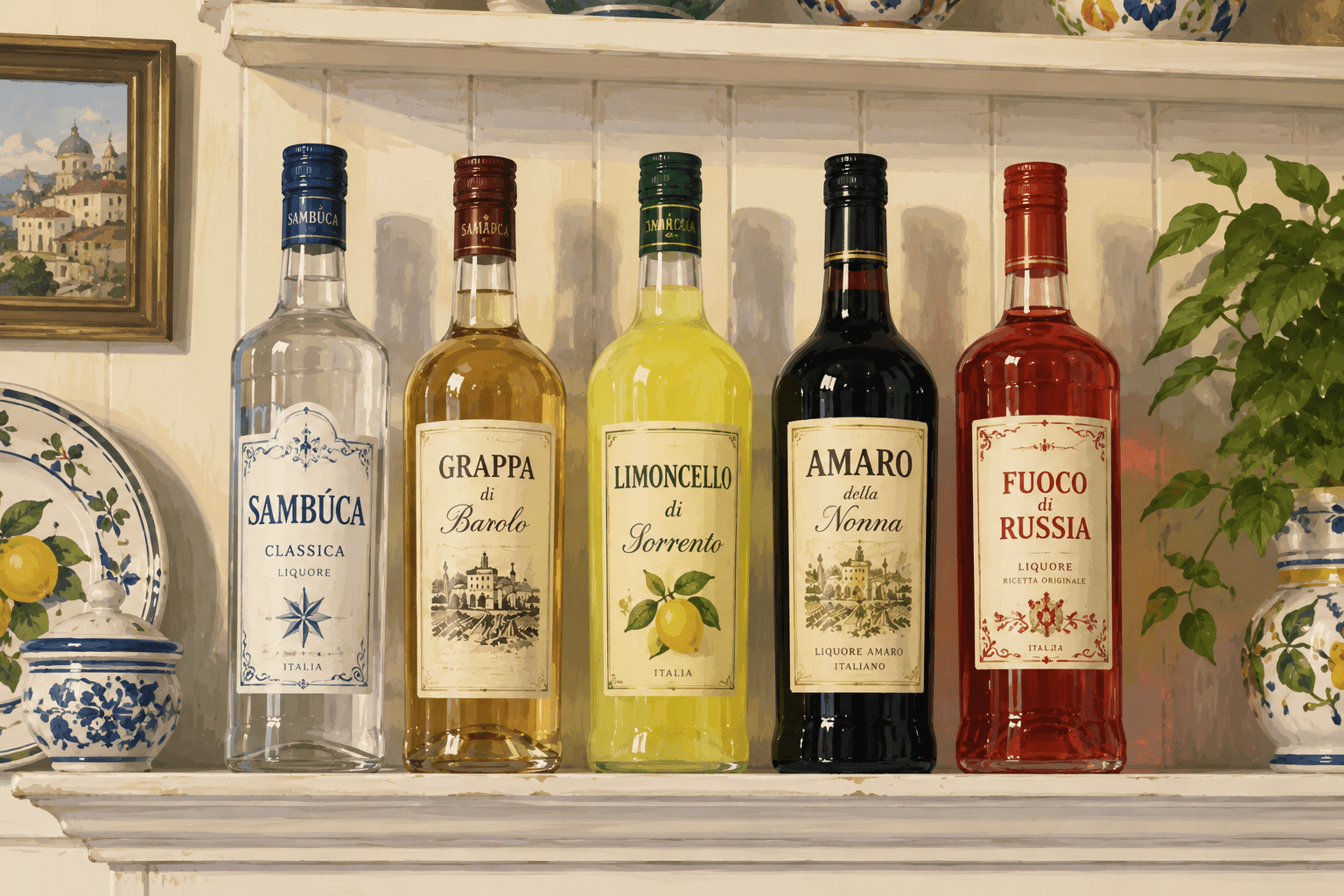
My grandfather had a hierarchy. Sambuca with espresso was the everyday choice of Italian digestivo. Grappa came out for special occasions. And on the nights he really wanted to show off, he reached for something called Fuoco di Russia — Fire of Russia — a bright red liqueur that was 70 percent alcohol and exactly as serious as the name suggests.
⏱ 7 minute read
📋 What you will learn in this post
- What an Italian digestivo actually is and why Italians drink one after every meal
- The full hierarchy — which digestivo for which occasion
- Where the tradition came from and whether there is real science behind it
- The most popular digestivi and what makes each one different
- How to build your own digestivo tradition at home
Table of Contents
- What is a digestivo?
- The hierarchy — which digestivo for which occasion
- Fuoco di Russia — the one he busted out to show off
- Where the tradition came from
- The main digestivi explained
- Digestivo in Italian-Canadian families
- How to build your own digestivo tradition
- FAQ
The meal was over. The plates were cleared. The espresso had already come and gone in its small cup. And then my grandfather would get up from the table, walk to the cabinet that held the bottles nobody touched on an ordinary Tuesday, and make his decision.
Most nights it was sambuca, poured alongside or into the last of the espresso, the clear anise liqueur that he treated as simply part of how dinner ended — not a separate event, just the final note. On special occasions, a bottle of grappa appeared, and the mood at the table shifted slightly, because grappa meant something was being marked. And then there were the rare nights — a milestone, an argument won, a guest he wanted to impress — when he went further still and brought out the Fuoco di Russia, the bright red 70-percent liqueur that he poured with the specific ceremony of a man who knew exactly what effect he was about to produce.
None of this was explained to me as a child. It did not need to be. The digestivo was simply how an Italian meal ended — as fixed a part of the structure as the antipasto was at the beginning. What I did not understand until much later was that this entire ritual had a name, a history, and a logic that stretched back centuries before my grandfather ever poured his first glass.
What is a digestivo?
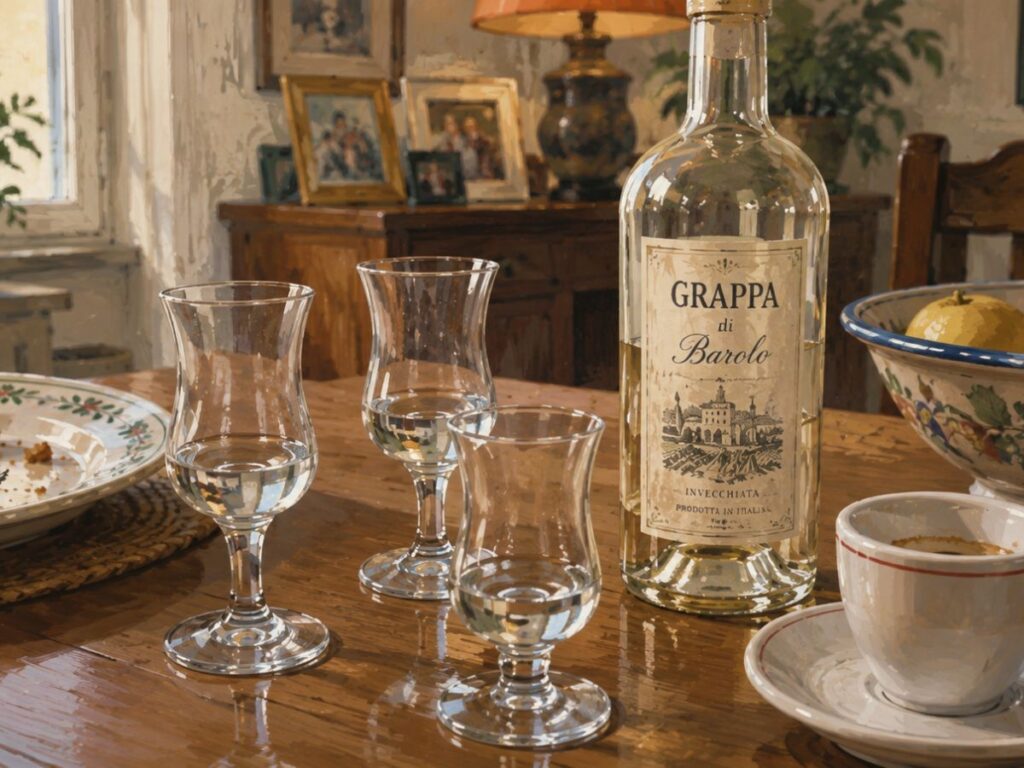
A digestivo is a small, often high-alcohol drink served at the very end of an Italian meal — after dessert, after coffee — meant to settle the stomach and close the meal properly.
Eating Around Italy describes it precisely: an Italian digestivo is a small to high alcoholic drink served after dinner meant to aid in digestion. The list of common digestivi is long — amaro, limoncello, mirto, sambuca, and grappa are the most popular and widespread types.
The timing matters as much as the drink itself. An Italian digestivo should be consumed after coffee, at the very end of the meal — never before, never alongside the food. This is the opposite of an aperitivo, which opens a meal and is meant to stimulate appetite. The digestivo closes the meal and is meant to do the reverse — settle everything that came before it.
The hierarchy — which italian digestivo for which occasion
Not every digestivo was equal. Which bottle came out told you exactly how seriously the evening was being taken.
In my grandfather’s house, the choice of digestivo was never random. It was a signal — read instantly by everyone at the table — about what kind of evening this was.
| Occasion | What typically comes out | What it signals |
|---|---|---|
| Ordinary weeknight | Sambuca, often with espresso | Routine. The meal is ending the way it always ends. |
| Midday, lighter moment | Limoncello | Bright, citrusy, less serious — a smaller gesture for a smaller moment |
| Special occasion | Grappa, or a well-known amaro like Amaro Averna or Vecchio Amaro del Capo | Something is being marked. Pay attention. |
| The “serious” bottle, reserved for guests | Fernet-Branca — intense, bitter, and instantly recognized by anyone who knows Italian amari | This is the bottle that separates the casual drinkers from the committed. Watch the reaction. |
Every family has its own version of that fourth tier — the bottle that comes out specifically to make an impression. Fernet-Branca, made in Milan since 1845 from a secret blend of 27 herbs, roots, and spices, is the one most widely recognized across Italy and the diaspora for that role — known for its elevated alcohol content and deliberately medicinal bitterness. For families with southern Italian roots, Vecchio Amaro del Capo from Calabria fills the same role, with the specific regional pride of a bottle that says exactly where the family is from.
My grandfather’s version of that fourth tier was something rarer still — a bright red, 70-percent liqueur called Fuoco di Russia, which most people outside specific Italian communities have never heard of. That is part of what made it his. Not every family’s “serious bottle” is the same one. The category matters more than the specific name — the bottle that exists purely to mark a moment and produce a reaction.
🇮🇹 Did you know? Offering a complimentary digestivo at the end of a meal is a common custom in Italian restaurants — one of the small but consistent details that signals genuine hospitality rather than just a transaction.
That hierarchy was never written down or explained. You simply learned to read it — the same way you learned to read which Sunday lunch would run two hours and which would run five. The digestivo was the final word on what kind of evening you had just been part of.
Fuoco di Russia — the one he busted out to show off
Fuoco di Russia is exactly as serious as its name. Fire of Russia. Seventy percent alcohol, bright red, and not for an ordinary Tuesday.
This is a real Italian liqueur — first distilled in Brescia in 1886, sold today at roughly 70 proof and known for its brilliant red color and intense aroma, traditionally enjoyed as a digestivo after meals and, somewhat surprisingly, also drizzled over gelato.
When my grandfather reached for the Fuoco di Russia, everyone at the table understood what was happening. This was not a drink for digestion. This was a drink for effect. He would pour it with a small flourish, watch the reaction of whoever was trying it for the first time, and enjoy that reaction more than the liqueur itself. It was theater. It was hospitality with a bit of mischief built in. And it worked every single time — nobody who tried Fuoco di Russia at my grandfather’s table forgot the experience.
There was a specific look he got right before pouring the Fuoco di Russia — somewhere between pride and mischief, the look of a man who knew exactly what was about to happen and was looking forward to it more than anyone else at the table. He never warned people. That was part of it. The surprise was the point.
Where the italian digestivo tradition came from
The digestivo is not a modern invention. It traces back to ancient Rome and was refined by monks for over a thousand years.
Vinodelice traces the ritual back to ancient Rome, where plant-based liqueurs were already consumed to aid digestion. Later, monks in the Middle Ages perfected these recipes, giving rise to the amari and other Italian elixirs that are still produced today using closely guarded monastery recipes.
Rimping adds an important detail: Italians commonly drank bitter beverages, both coffee and alcoholic drinks, after dinner to aid digestion, and during the Renaissance, as scientific and medical knowledge flourished, pharmacists began to become distillers — experimenting with herbs, spices, and botanicals to create drinks specifically designed to aid digestion. Amari were originally sold in pharmacies as health tonics before they became the after-dinner ritual we know today.
That medicinal origin explains why so many digestivi taste the way they do — bitter, herbal, intense. They were never designed primarily to taste pleasant. They were designed to do a job. The pleasure came later, once the job and the ritual had fused into something families looked forward to rather than endured.
The main digestivi explained
Five digestivi appear at almost every Italian table. Each one has a completely different character.
| Digestivo | What it’s made from | How it’s served |
|---|---|---|
| Sambuca | Anise seed, first commercially produced by Luigi Manzi in the 19th century | Neat, or “con la mosca” — with coffee beans floating in it, chewed to balance the sweetness. Often added to espresso as a caffè corretto. |
| Grappa | Distilled pomace — the skins, seeds, and stems left over from winemaking. 35-60% alcohol by volume, legally a minimum of 37.5%. | Neat in a small glass, or in the Veneto tradition called resentin, poured directly into an empty espresso cup to “rinse” it |
| Limoncello | Lemon peel steeped in alcohol and sugar, originating from the Amalfi Coast | Ice cold, straight from the freezer, in small chilled glasses |
| Amaro Averna / Vecchio Amaro del Capo | Bitter herbal liqueurs from monastery traditions — Averna from Sicily, Vecchio Amaro del Capo from Calabria | Neat, served as the classic regional bitter close to a meal |
| Fernet-Branca | A secret blend of 27 herbs, roots, and spices, made in Milan since 1845 | Neat — intensely bitter and considered the benchmark “serious” amaro by enthusiasts |
For anyone wanting to build a proper home digestivo collection, a starter set of Italian amari is the easiest way to taste the range — from the more approachable Averna to the famously intense Fernet-Branca. And the right glassware matters more than people expect: small traditional digestivo glasses are part of the ritual, not just the container for it.
Digestivo in Italian-Canadian families
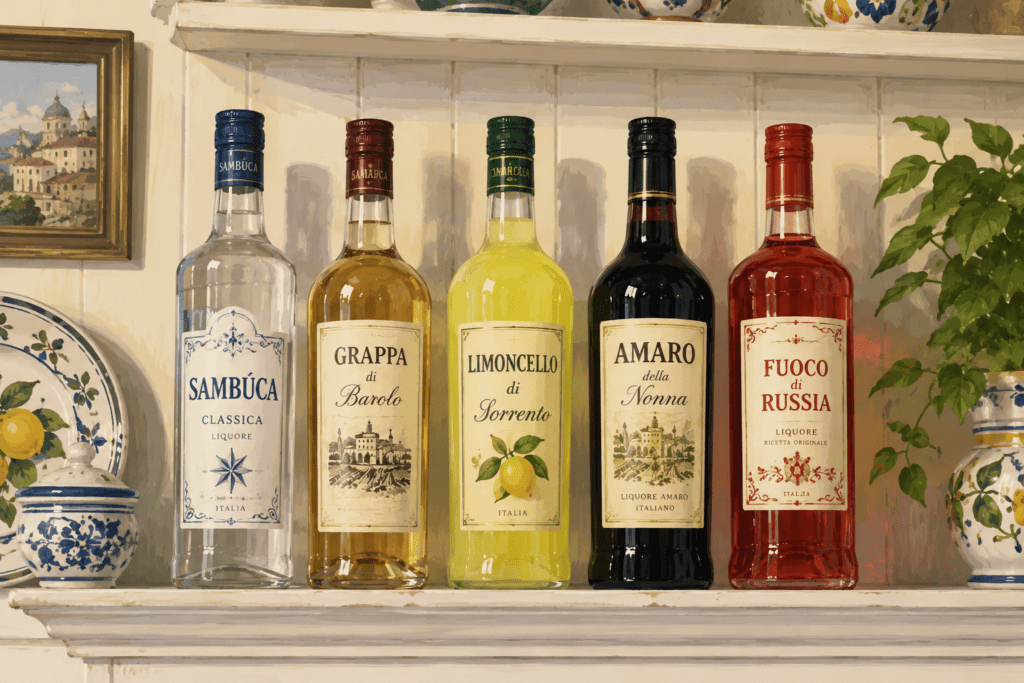
The digestivo cabinet traveled to Montreal intact — every bottle, every occasion, every unspoken rule about which one came out when.
In Italian-Canadian households, the digestivo cabinet was a permanent and serious fixture — a specific cupboard or sideboard shelf reserved for the bottles that did not get touched on ordinary days. The sambuca was there. The grappa was there, sometimes homemade by a relative with the right equipment and the right reputation for it. The limoncello, made or bought, lived in the freezer rather than the cabinet, ready for the moment it was needed.
The ritual did not weaken in immigration. If anything, it sharpened. The digestivo was one of the easiest pieces of Italian identity to maintain in a new country — it required no garden, no specialized ingredients beyond what could be ordered or imported, and no permission from anyone. You simply needed the bottle and the knowledge of when to bring it out. That knowledge — the hierarchy, the timing, the specific theater of a Fuoco di Russia poured for a guest who had no idea what was coming — traveled in memory, the same way the recipe for the Sunday ragù traveled. Nobody wrote it down. Nobody needed to.
This connects to the same Italian understanding of food and timing found in the cappuccino after 11am rule — the conviction that certain things belong at certain moments in a meal, and that moving them out of order disrupts something real. The digestivo closes the meal the same way the espresso after lunch closes it. Nothing in an Italian meal happens by accident.
How to build your own digestivo tradition
You do not need an Italian cellar full of bottles. You need three or four, and the discipline to save them for the right moment.
Start with one everyday option and one special-occasion option. Sambuca or a simple amaro for the routine close to a meal. Something with more presence — a good grappa, or if you are feeling like my grandfather, something with real theatrical value — reserved for the nights that deserve it.
Keep limoncello in the freezer always. It is the easiest digestivo to love immediately, and ice cold is non-negotiable — it should arrive at the table cold enough that the glass frosts slightly the moment you pour it.
For your own “serious bottle” — the one reserved for guests and milestones — Fernet-Branca is the most widely available and most universally recognized choice. If your family has roots in Calabria or southern Italy, Vecchio Amaro del Capo carries the same weight with added regional meaning. And if you want to go further and track down something genuinely rare — the way my grandfather did with his Fuoco di Russia — that search is its own kind of tradition. Finding the bottle nobody else has is half the fun of pouring it.
For the broader Italian food traditions that the digestivo closes out, read about the Italian Sunday lunch and why Italians don’t drink cappuccino after 11am — two more pieces of the same coherent system of Italian meal timing.
Sambuca with espresso on an ordinary night. Grappa for something worth marking. And on the nights he really wanted to show off — Fuoco di Russia, poured with no warning and a look that said he already knew exactly what was about to happen. That was the whole hierarchy. He never explained it. He never needed to.
The digestivo tradition connects to why Italians don’t drink cappuccino after 11am and the broader Italian understanding of meal timing. It connects to the colpo d’aria tradition’s focus on the body and digestion. For the Sunday meal the digestivo always closed, read about Italian Sunday lunch. And for the cantina that often stored the homemade versions of these liqueurs, read about the Italian cantina.
📌 Quick summary
- What it is: A small, often strong drink served after coffee at the very end of an Italian meal
- Why: Traditionally believed to aid digestion — roots trace to ancient Rome and medieval monasteries
- The hierarchy: Sambuca for routine, limoncello for lighter moments, grappa or a well-known amaro for special occasions, and an intense bottle like Fernet-Branca reserved for guests and milestones
- Most popular: Sambuca, grappa, limoncello, and regional amari like Averna, Vecchio Amaro del Capo, and Fernet-Branca
- How to serve: Small glass, after coffee, never alongside the meal itself
FAQ
What is an Italian digestivo?
A digestivo is a small, often high-alcohol drink served at the very end of an Italian meal, after dessert and coffee, traditionally believed to aid digestion. Eating Around Italy describes it as a small to high alcoholic drink served after dinner meant to aid in digestion, with amaro, limoncello, mirto, sambuca, and grappa being the most popular and widespread types. It is the closing counterpart to the aperitivo, which opens a meal and stimulates appetite — the digestivo closes the meal and settles everything that came before it.
Is there real science behind drinking a digestivo after meals?
Eating Around Italy notes there is no firm scientific evidence proving a digestivo aids digestion, though amari made with bitter flavors and limoncello are widely considered by Italians to help. The tradition’s roots are medicinal — Rimping documents that pharmacists in the Renaissance era became distillers, experimenting with herbs and botanicals specifically to create drinks meant to aid digestion, and amari were originally sold in pharmacies as health tonics before becoming an after-dinner ritual. Whether the digestion benefit is real or placebo, the ritual itself — a deliberate pause at the end of a meal — has genuine value for slowing down and signaling that the meal is properly finished.
What is the difference between sambuca and grappa?
Sambuca is a clear, anise-flavored liqueur first commercially produced by Luigi Manzi in the 19th century, often served with coffee beans floating in it (con la mosca) or added to espresso as a caffè corretto. Grappa is a pomace brandy distilled from the skins, seeds, and stems left over from winemaking, typically 35-60% alcohol by volume, often colorless but sometimes aged to a pale or deep yellow. Sambuca is sweet and licorice-flavored. Grappa is stronger, more spirit-forward, and historically associated with rural farming communities before being refined by modern distillers into a more delicate product.
What is Fuoco di Russia?
Fuoco di Russia — Fire of Russia — is an Italian liqueur first distilled in Brescia in 1886, known for its bright red color and high alcohol content around 70 percent. It is traditionally served as a digestivo after meals and is also sometimes used as a topping for gelato. The name and red color reference Brescia’s history with fire. It is considered one of the more intense and theatrical Italian digestivi — the kind reserved for special occasions or for making an impression on guests trying it for the first time.
Why is limoncello served ice cold?
Limoncello, made by steeping lemon peels in alcohol and sugar along the Amalfi Coast tradition, is traditionally stored in the freezer and served ice cold because the cold tempers its sweetness and intensifies its bright, citrus character. Mom in Italy notes it is sometimes called limoncino in the North of Italy and limoncello in the South, but the preparation and serving method are the same. Unlike grappa or amaro, which are typically served at room temperature, limoncello specifically depends on being served cold to deliver its signature refreshing finish.
What is a caffè corretto and how does it relate to digestivo?
A caffè corretto — “corrected coffee” — is an espresso with a small measure of grappa, sambuca, or another spirit added directly to it. It is one of the most common ways Italians combine the espresso ritual with the digestivo tradition into a single closing gesture at the end of a meal. In the Veneto region, a related tradition called resentin involves pouring grappa directly into an empty espresso cup to “rinse” the last traces of coffee — drinking the result as a final, combined close to the meal.
Did Italian-Canadian families keep the digestivo tradition?
Yes, and often with remarkable consistency. The digestivo cabinet — sambuca, grappa, limoncello, and regional specialties like Fuoco di Russia — was a standard fixture in Italian-Canadian households in Montreal, Toronto, and other cities with established Italian communities. The tradition required no garden, no special equipment beyond what could be imported or sourced locally, and travelled easily in memory: the specific hierarchy of which bottle came out for which occasion, passed down the same way recipes were passed down, without ever being formally written.
What are the most popular Italian digestivi?
The most widely consumed Italian digestivi are sambuca, grappa, limoncello, and amaro — with amaro itself covering a wide range of regional bitter liqueurs including Averna, Montenegro, Fernet-Branca, and Cynar. Regional specialties add further variety: mirto from Sardinia, Strega from Benevento, nocino made from green walnuts, and Fuoco di Russia from Brescia. Each region of Italy tends to have its own signature digestivo, often tied to local herbs, fruits, or historical distilling traditions specific to that area.
💬 What was in your family’s digestivo cabinet? Sambuca, grappa, something homemade by an uncle with a still nobody talked about? Leave a comment below — these family hierarchies are exactly the kind of detail worth recording before they’re forgotten.

Marco Ricci is an Italian-Canadian writer and the grandson of Calabrian immigrants. He created Italian Family Traditions to document the customs, feast days, and family rituals Italian families carried from Italy to North America — and to understand what they actually meant. He is based in Montreal.