Italian Family Traditions
Italian Sunday Dinner: Why It Was Never Really About the Food
Once a week, everything stopped. The sauce went on. The family came back. And somehow, that was everything.
Let me set the scene for you. It is 9 o’clock on a Sunday morning. You are still half-asleep. And then it hits you — not an alarm, not your phone, not a notification from anything — but a smell. Garlic hitting olive oil. A pot lid clanging. The low murmur of someone talking to themselves in the kitchen, which in an Italian household means either your grandmother is cooking or she is narrating her cooking to an invisible audience that absolutely agrees with every decision she is making.
That smell meant one thing: Sunday was officially underway.
Not Sunday as in the day before Monday. Sunday as in The Day. The weekly event that the whole household reorganized itself around. The one that started before most of the family was even awake and ended three hours after everyone swore they were done eating.
Nobody in the history of Italian Sunday dinner has ever actually left when they said they were leaving.
You knew this. You accepted it. You planned for it. And somewhere deep down, you were grateful for it.
The morning ritual nobody talked about but everyone followed
Here is something that does not get enough attention: the prep.
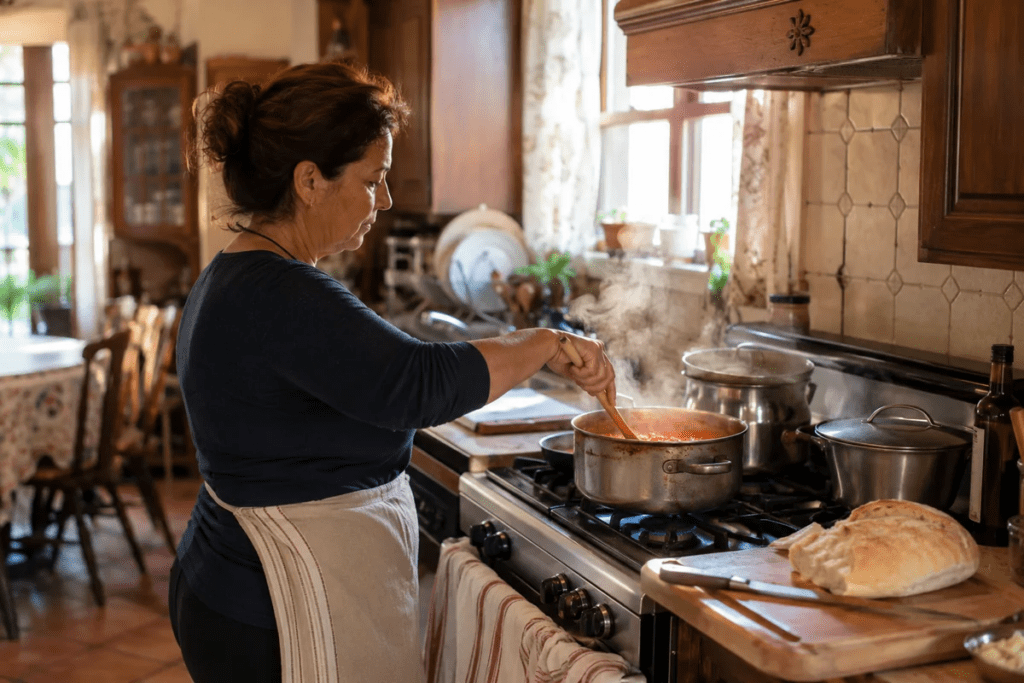
Sunday dinner did not just appear on the table. It was built across an entire morning with the quiet, focused energy of someone who had been doing this for forty years and had strong opinions about every single step of it.
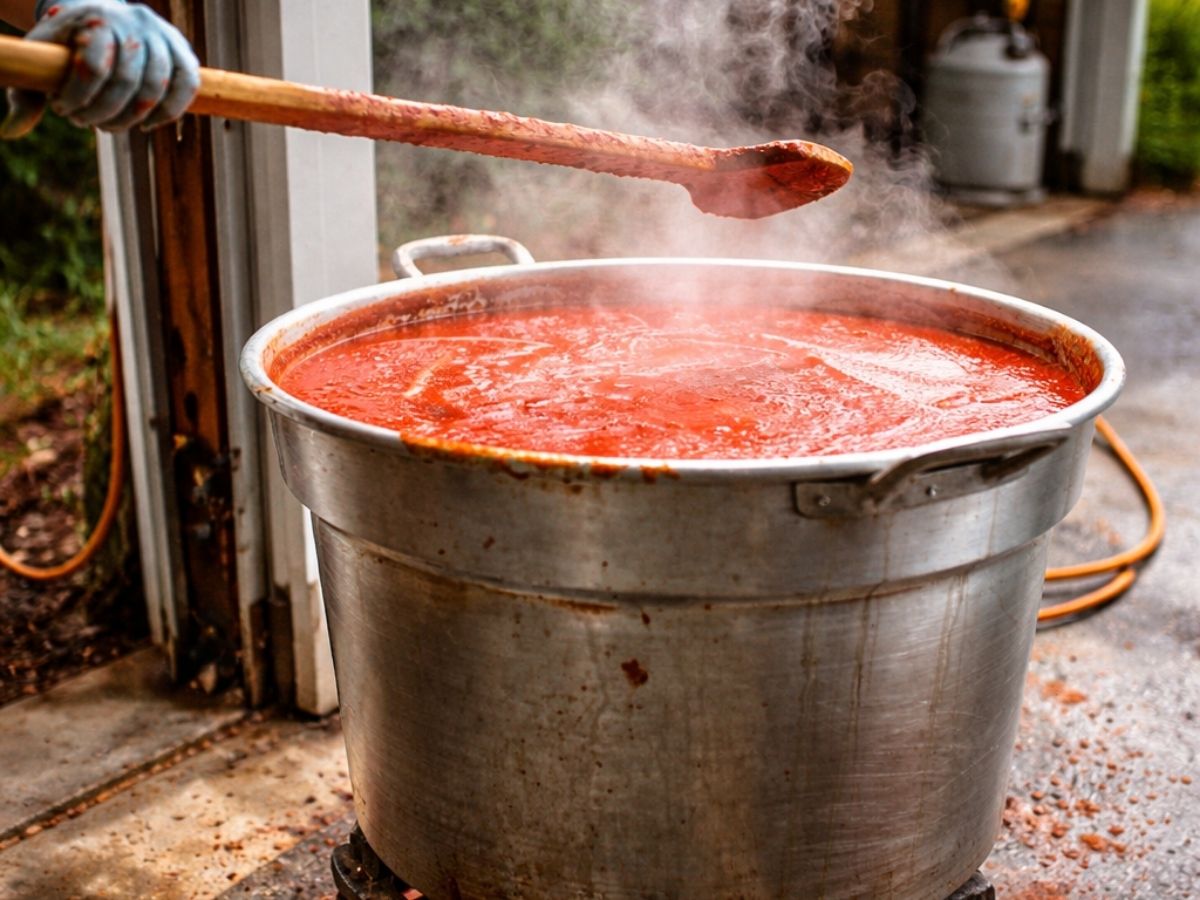
My grandmother started the gravy — we called it gravy, not sauce, and that was non-negotiable — before anyone else was out of bed. By the time I wandered downstairs in my pajamas at 10am, it had already been going for an hour. She would look at me, gesture vaguely at the stove, and say something like “I just put a little something together.” There were four pots on the stove. The little something was going to feed eleven people.
The prep had rules. Unspoken ones, but rules nonetheless. You did not hover too close. You did not suggest alterations. You absolutely did not say “can I help?” unless you were prepared to be handed a task immediately and then gently corrected on your technique for the next twenty minutes.
But you also did not stay away entirely. Because the kitchen on a Sunday morning was the best room in the house. It was warm and loud and full of commentary on everything. The news. The neighbors. What happened at church. Whether the butcher had given a good cut this week. (He had not, apparently.)
What Italian Sunday dinner actually was
In Italy, this tradition was typically Sunday lunch — the midday meal that stretched into the afternoon while the day slowed down around it. When Italian families came to North America, the clock shifted. Work schedules, school routines, longer commutes — everything pushed the gathering later. Sunday lunch became Sunday dinner. But the spirit? That stayed exactly the same.
This was not a casual meal. This was the meal.
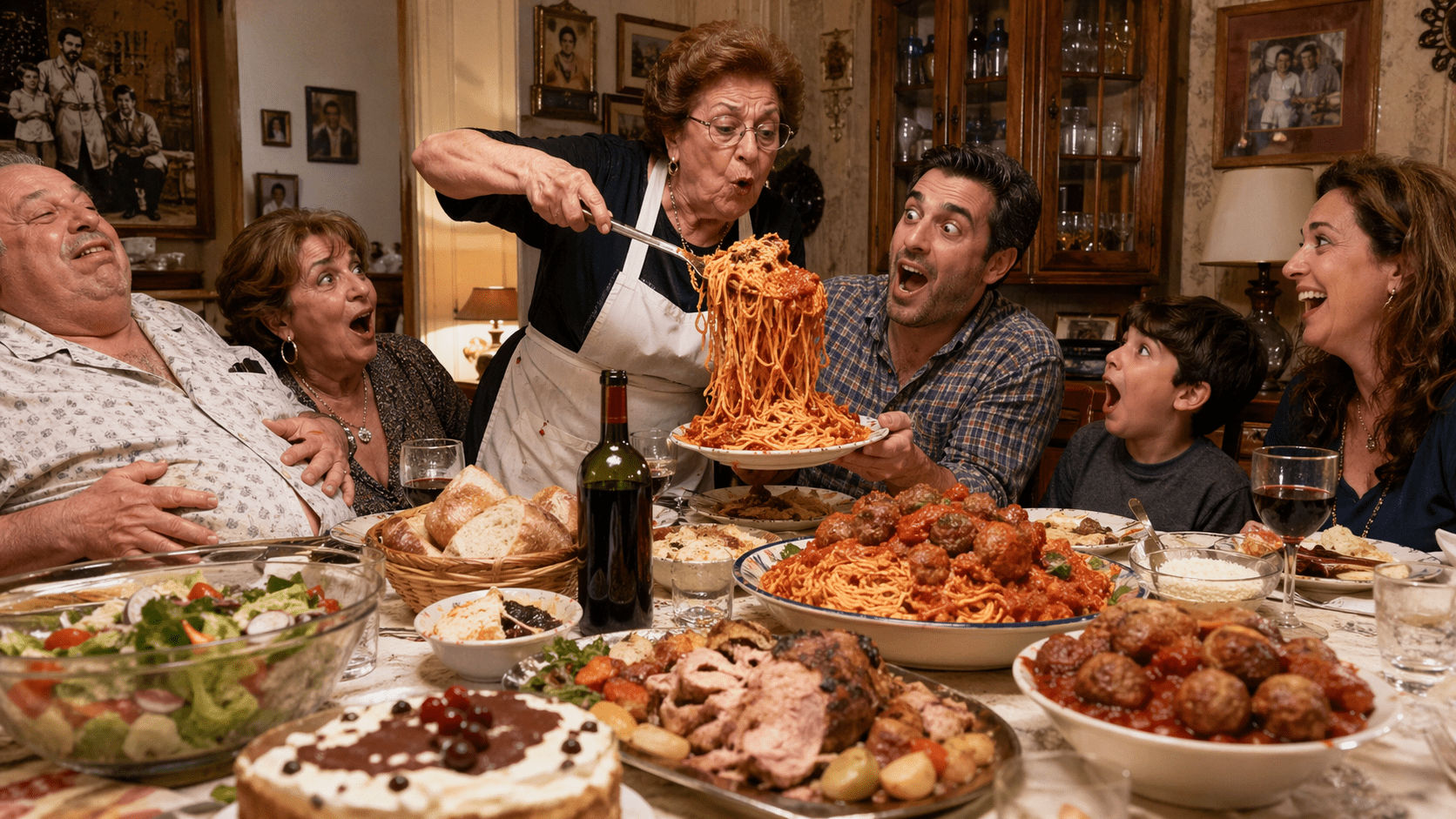
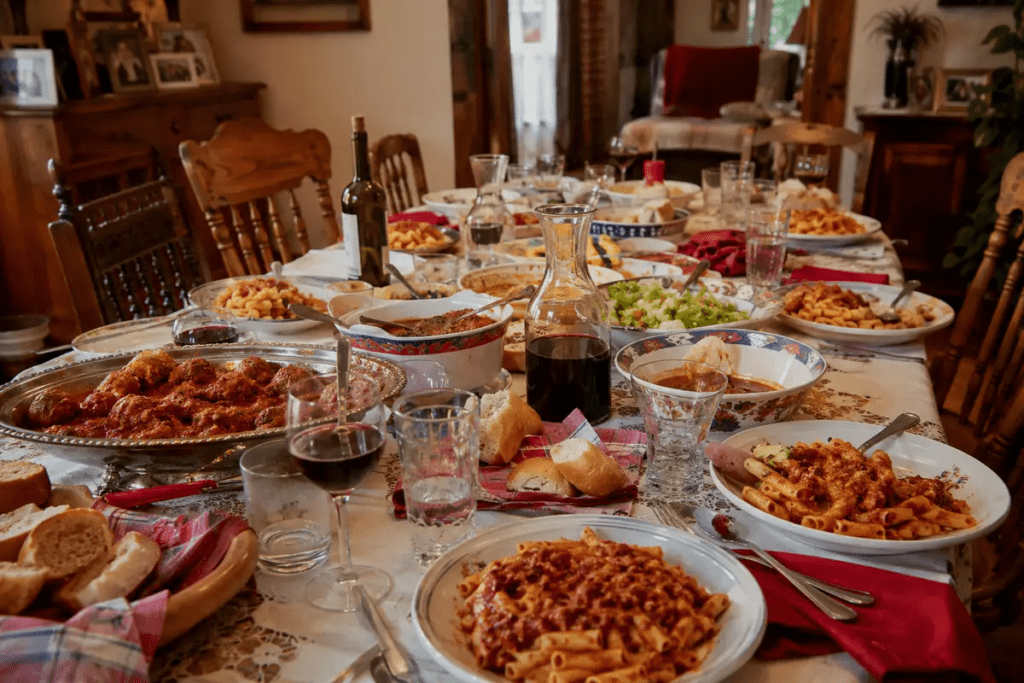
The one with a proper tablecloth. The one where someone brought out the good glasses even though there was always a brief debate about whether the occasion merited the good glasses. (It always did. It was Sunday.) The one where extra chairs were dragged in from other rooms and arranged around a table that was technically too small for this many people but somehow worked every time.
There was always one chair that was slightly wobblier than the rest. It rotated through the youngest cousin or the most recently arrived guest like some kind of rite of passage. Nobody mentioned it. You just adjusted your balance and got on with eating.
The food itself was never simple. There was pasta — usually first. Then a second course. Then bread that had not been placed on the table so much as deployed there. Then something sweet. Then fruit. Then espresso. Then a little something extra because apparently the meal had not fully proven its love for you yet.
And through all of it, there was the sound. Plates passing. Voices overlapping. Someone laughing too loud. Someone telling a story that started in 1987 and was still going. Children being told to sit down for the fourth time. Someone asking if anyone wanted more. Everyone wanting more.
The unspoken curriculum of the Sunday table
Here is what nobody tells you about Italian Sunday dinner: you were being taught things the entire time. You just did not realize it because the lessons were disguised as lunch.
You were learning:
- How to show up for people, even when the week had worn you out
- That feeding someone is one of the most direct ways to say I love you
- That sitting with people — really sitting, not scrolling — is its own kind of gift
- That family can be completely chaotic and deeply comforting at the exact same time
- That the same stories, told again at the same table, are somehow never old
My uncle told the same fishing story every single Sunday for probably fifteen years. I cannot tell you the number of times I heard it. I can tell you that the fish got bigger every single year, that the punchline never changed, and that my grandmother laughed at it every single time like it was the first time she had ever heard it. That laugh was the real tradition.
You also learned the family’s interior logic — who was the peacemaker, who stirred things up, who served first, who always took the last piece of bread and acted surprised there was no bread left. You learned how disagreements sounded and how they resolved (usually with someone being offered food). You learned that showing up was the most important thing, and that the table kept no absences secret.
If you missed Sunday dinner without a very good reason, people noticed. Your empty chair noticed.
What happened after the plates were cleared
This is the part that outsiders never quite understood.
Dinner was not over when the food was gone. Not even close.
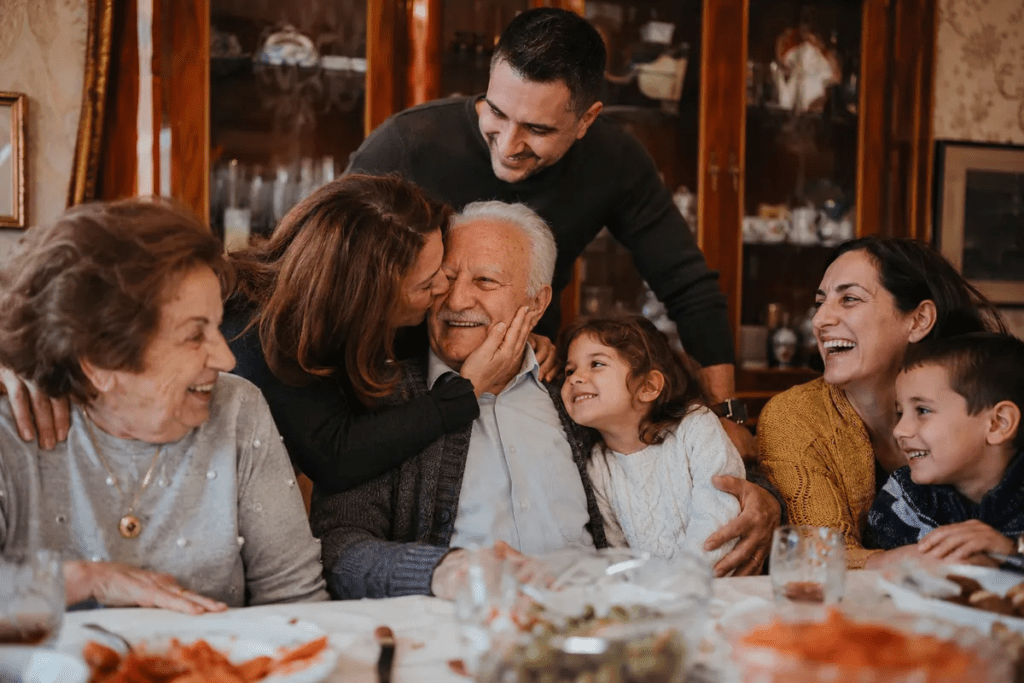
After the plates were cleared, the table somehow became even more occupied. Espresso appeared. Someone brought out pastries that had been quietly waiting in a box on the counter. A little limoncello materialized from somewhere. The conversation, which had been running at full volume all through the meal, actually got louder — more relaxed, more sprawling, more willing to go anywhere.
In autumn, the meal often ended with roasted chestnuts instead of dessert; in high summer, it became the Ferragosto feast.
The best conversations I ever heard in my life happened after Sunday dinner, when the adults thought the kids were bored or distracted. We were not. We were sitting very still and listening to everything. The real stories — the old ones, the complicated ones, the ones about relatives who had been dead for thirty years — those came out after the espresso. I still know things about my family that I was technically not supposed to know. I regret nothing.
The after-dinner stretch was where the day truly lived. Arguments got settled or, more accurately, tabled until next Sunday. Old photographs came out. Somebody’s kid did something that needed to be discussed at length. Someone fell asleep in the armchair. Somebody else mentioned they should probably get going and then did not move for another forty-five minutes.
That was Sunday. Long, full, and reluctant to end.
How it changed when families moved to America and Canada
Italian immigrants carried Sunday with them the way you carry something precious — carefully, and with full intention of protecting it.
But life in a new country does what it does. It reshapes things.
Suddenly the ingredients were different — some things simply did not exist yet, or cost more, or tasted wrong. The kitchens were different. English started blending into conversations that used to happen entirely in Italian. Regional differences that had mattered back in Italy — you from Naples, them from Sicily, the others from Calabria — got compressed under one roof in a single city block in Brooklyn or Hamilton or Toronto.
My great-grandmother apparently spent years trying to recreate a specific tomato from her village using whatever she could find at the market in New Jersey. She never quite got it right, by her own account. She made something better instead, which she refused to admit until her final years. Her daughter told me this story at a Sunday dinner in the nineties, laughing so hard she could barely finish it.
And yet — and this is the remarkable part — the heart of Sunday held. Families still gathered. The table still anchored everything. The food still took all morning. The meal still ran long. The argument over who made the best gravy continued across an ocean and several generations without resolution.
Italian-American and Italian-Canadian Sunday dinner was not a perfect replica of what had been left behind. It was something new that had grown from the same roots. It adapted. It absorbed. It mixed in new ingredients, new voices, new neighbors who got invited and never quite left.
That, in itself, is very Italian.
Why this hits so hard for people who grew up with it
If you were raised in an Italian household — or adjacent to one, or close enough to have been fed by one — you know exactly what I mean when I say that Sunday dinner is not just a memory. It is a sensory archive.
The weight of a specific plate. The particular sound of a pot being set on a burner. The way afternoon light came through a certain window at a certain angle. The exact pitch of a specific person’s laugh. The smell — always the smell — that meant you were home.
When people say they miss Sunday dinner, they are not missing food. They are missing a feeling. And feelings, it turns out, do not have recipes.
That is why so many Italian descendants in North America feel this particular ache when they think about the tradition. Something was being preserved at those tables beyond the recipes and the rituals. The family’s sense of itself. The evidence that they mattered to each other. The weekly proof that whatever had scattered them through the week, they would come back.
How to keep the spirit alive — without needing ten pots and a nonna on standby
Here is the honest truth: you do not need to recreate the whole production.
You do not need the formal dining room, the four-hour sauce, or the ancient relatives who judge your pasta water by appearance alone. You do not need to serve seven courses or own the right bread or know the exact recipe your great-grandmother used and never wrote down because she kept it in her head on purpose, thank you very much.
What you need is intention. And a little stubbornness about showing up.
- Pick one Sunday and make it feel different from the rest of the week
- Cook something that means something — even if it is simple
- Sit longer than you need to. Then sit a little longer still.
- Tell the story again. Yes, the same one. It is better the second hundred times.
- Get the kids in the kitchen, even if they make an absolute disaster of it
- Put the phones away for one hour. Just one. See what happens.
- Use the good plates. It is Sunday. It counts.
Last year I started doing a small version of Sunday dinner with whoever could make it — sometimes four people, sometimes eight, sometimes just me and one other person who happened to be free. I make something with sauce. I make it take a while. I make the table look like it matters. And without fail, people stay longer than they said they would. They always do. That part, at least, has not changed at all.
Because the real tradition — underneath the food and the noise and the glorious, wonderful chaos — was always just one thing.
The tradition was never a big Italian meal. That is too small.
The real tradition was: we come back to each other.
And that, honestly, might be the part most worth keeping.
A lot of those unwritten dinner rules connect directly to Italian table manners and the family rules many of us grew up with. And if you want the bigger picture of how family meals fit into the immigrant experience, read my article on Italian-American traditions and what changed after immigration.
If you want to rebuild the Sunday sauce from scratch — properly, the way it was actually made — Lidia’s From Our Family Table to Yours: More Than 100 Recipes Made with Love for All Occasions: A Cookbook is where to start. It is the book that taught more Italian-American families how to cook like their grandmothers than any other cookbook ever written. The ragù Bolognese recipe alone is worth the price.
The Sunday pasta was almost always made by hand in the houses that took it seriously. The Marcato Atlas 150 pasta maker— made in Italy, the same machine that has been in Italian kitchens since 1930 — is the closest thing to what your grandmother used. If you are going to do Sunday lunch properly, this is where it starts.
The Sunday table also had its own dishes. Not the everyday ones. If you want to give your Sunday lunch the right frame, a set of Italian-style pasta bowls does exactly what the right dish always did — it tells everyone at the table that this meal was worth preparing for.
No plate left that table clean until someone did fare la scarpetta — wiping up the last of the sugo with a torn piece of bread.
The sauce at the centre of it all began months earlier, with the making of passata — the family’s tomato harvest sealed into jars for winter.
FAQ
Was Italian Sunday dinner really dinner, or lunch?
In Italy, it was almost always Sunday lunch — a long, multi-course midday affair that stretched well into the afternoon. When Italian families settled in North America, practical realities (different work schedules, longer Sundays, new rhythms) slowly shifted it later in the day. Sunday lunch became Sunday dinner. The clock changed. The meaning absolutely did not.
Did every Italian family do it the same way?
Not even close — and anyone who tells you otherwise has never met a family from a different Italian region. Italy has enormous regional variation in food, customs, dialect, and temperament. A Sunday table in Naples looked nothing like one in Venice. But the underlying logic — gather, eat, stay, connect — showed up everywhere with remarkable consistency.
Was it mainly about the food?
The food was spectacular and absolutely central — we are not dismissing the pasta here. But it was the vehicle, not the destination. Sunday dinner was really about family identity, continuity, memory, and the weekly act of choosing each other. The food just made it impossible to say no.
How do I keep the tradition alive now?
Start small. One Sunday, one meal, one table that feels intentional. Make it warm. Make it regular. Make it a place people are expected — and want — to come back to. The rest figures itself out from there.

Marco Ricci is an Italian-Canadian writer and the grandson of Calabrian immigrants. He created Italian Family Traditions to document the customs, feast days, and family rituals Italian families carried from Italy to North America — and to understand what they actually meant. He is based in Montreal.