Italian Wedding Traditions Explained: Customs Families Still Keep
An Italian wedding is never just a wedding.
It’s a family event, a food event, a cultural event, and—if we’re being completely honest—a logistics operation that would impress most military planners. Two people are getting married, yes. But somewhere in the background, grandparents are getting emotional, parents are getting very involved, cousins are appearing from places nobody knew existed, envelopes are quietly changing hands, pastries are multiplying by the hour, and at least one zia is asking why the photographer is taking so long because the food is getting cold.
That’s part of the beauty of it.
I still remember my cousin Marco’s wedding back when I was about twelve. The ceremony ended at noon. We didn’t sit down to eat until almost four. And somewhere in between, I watched my grandmother corner the bride’s mother in the church parking lot to interrogate her about the seating chart—specifically, why a certain second cousin had been placed at table fourteen instead of table eight, which everyone apparently knew was the real family table. The bride’s mother handled it with the patience of a saint. My grandmother walked away satisfied. The seating chart did not change. But honor had been preserved on both sides, and that was what mattered.
That, in one small moment, is an Italian wedding.
For many Italian families—whether in Italy, Canada, the United States, Australia, or anywhere else the diaspora landed—weddings have always meant more than a ceremony. They carry memory. They carry pride. They carry old customs that may have softened over time but still feel important. Even when modern couples simplify things, there’s almost always a quiet desire to keep something of the old spirit alive.
That’s what makes Italian wedding traditions worth talking about.
They’re not only about how people celebrated. They’re about what families believed mattered: faith, abundance, beauty, respect, support, and doing something in a way that felt meaningful, generous, and shared.
Why Italian Wedding Traditions Matter So Much
One of the biggest mistakes people make when talking about Italian weddings is treating them like a list of cute customs.
They’re so much more than that.
Traditionally, an Italian wedding wasn’t only about the couple. It was about the union of two families. Marriage was seen as serious, sacred, and social all at once. A wedding was the moment when values became visible—you saw them in the ceremony, in the food, in the guest list, in the favors, in the music, and in the way people showed up for the couple.
That’s why so many traditions stayed alive.
Some survived because they were beautiful. Some survived because they were practical. And some survived because no family wanted to be the one that suddenly said, “Actually, let’s skip all of that,” while Nonna sat there in silence with that look. (If you grew up Italian, you know the look. It can end conversations, marriages, and entire family branches.)
Even after immigration, these Italian wedding traditions often grew stronger rather than weaker. In Italian-Canadian and Italian-American families especially, traditions became anchors. When the language softened over generations, when neighborhoods changed, when everyday life became more North American, weddings often stayed one of the clearest places where Italian family culture still showed up in full color.
My uncle once told me something I never forgot. He came over from Abruzzo in the 1960s and built a life in a city where almost nothing reminded him of home. “But at a wedding,” he said, “for one day, I am back. The food, the noise, the people, the kissing on both cheeks. For one day, I am home again.” He was eighty-three when he said that, and he still went to every wedding he was invited to, no matter how distant the cousin.
The Wedding Is Not Just a Ceremony — It’s a Full Family Production
This is one of the things that makes an Italian wedding feel different from the start.
It’s rarely a small private moment that stays small.
It grows.
Parents are involved. Aunts are involved. Uncles are involved. Grandparents are definitely involved. People have opinions about the church, the dress, the food, the seating chart, the hall, the music, the flowers, the pastries, and whether so-and-so really needed to be invited after what happened in 2009. (Nobody talks about 2009. But everybody remembers 2009.)
And then there’s the guest list.
In many families, the guest list is where reality leaves the room. A couple may begin with a calm, modern idea of a small wedding—maybe seventy, eighty people, just close family and friends. Within a week, that number has somehow climbed to two hundred. Within two weeks, it’s pushing three hundred. By the time the invitations go out, you’ve got family friends, godparents, neighbors from the old block, your mother’s hairdresser of thirty years, your father’s cousin who lives in Italy and might fly in, and the entire baptism circuit from your childhood parish.
I once watched my aunt argue for forty minutes that the man who fixed her boiler in 1987 absolutely had to be on the list because “he’s like family.” She won. He came. He brought his wife and three adult children. They stayed until 2 a.m.
This isn’t just chaos. It reflects something real.
Italian weddings have traditionally been communal. They’re meant to be witnessed. They’re meant to be shared. They’re not just about personal taste. They’re about family recognition and family participation.
That can be stressful. It can also be beautiful. Often, it’s both at the same time.
Before the Reception: The Italian Wedding Traditions People Forget to Explain
Most articles jump straight from the ceremony to the reception, but that misses one of the most recognizable parts of the day.
The in-between.
After the ceremony, there’s almost always a stretch of time that feels like its own event. People gather outside the church. There are hugs, kisses on both cheeks, congratulations, auguri, photos, little family clusters forming and reforming, and a lot of standing around while nobody is quite seated and nobody is quite finished talking.
This is where the mood shifts.
The ceremony itself feels formal, emotional, sacred. The time before the hall begins to loosen things up. The couple slips away for photos. Guests start mingling. People begin looking for drinks and small bites. In modern weddings, this often becomes the cocktail hour or aperitivo—a bridge between the serious part of the day and the celebration that’s about to open up.
I have such clear memories of this in-between time as a kid. The men would loosen their ties and gather in clusters near the cars, smoking and talking in low voices about politics or soccer or who had recently bought a new house. The women would stand in their own groups, comparing dresses, asking after each other’s children, occasionally darting in to fix the bride’s veil or rearrange a flower. The kids—us—would be running around the church steps in our uncomfortable shoes, getting yelled at periodically and ignoring it cheerfully.
This part matters because it tells you what an Italian wedding really is.
It’s not one single moment. It’s a sequence. It unfolds in stages. It breathes. It builds.
And somewhere in this stretch, there’s almost always at least one older relative quietly asking when everyone is finally going inside, because enough talking has happened and now it is time to eat.
The Reception Hall: Where the Wedding Becomes a Full Family Event
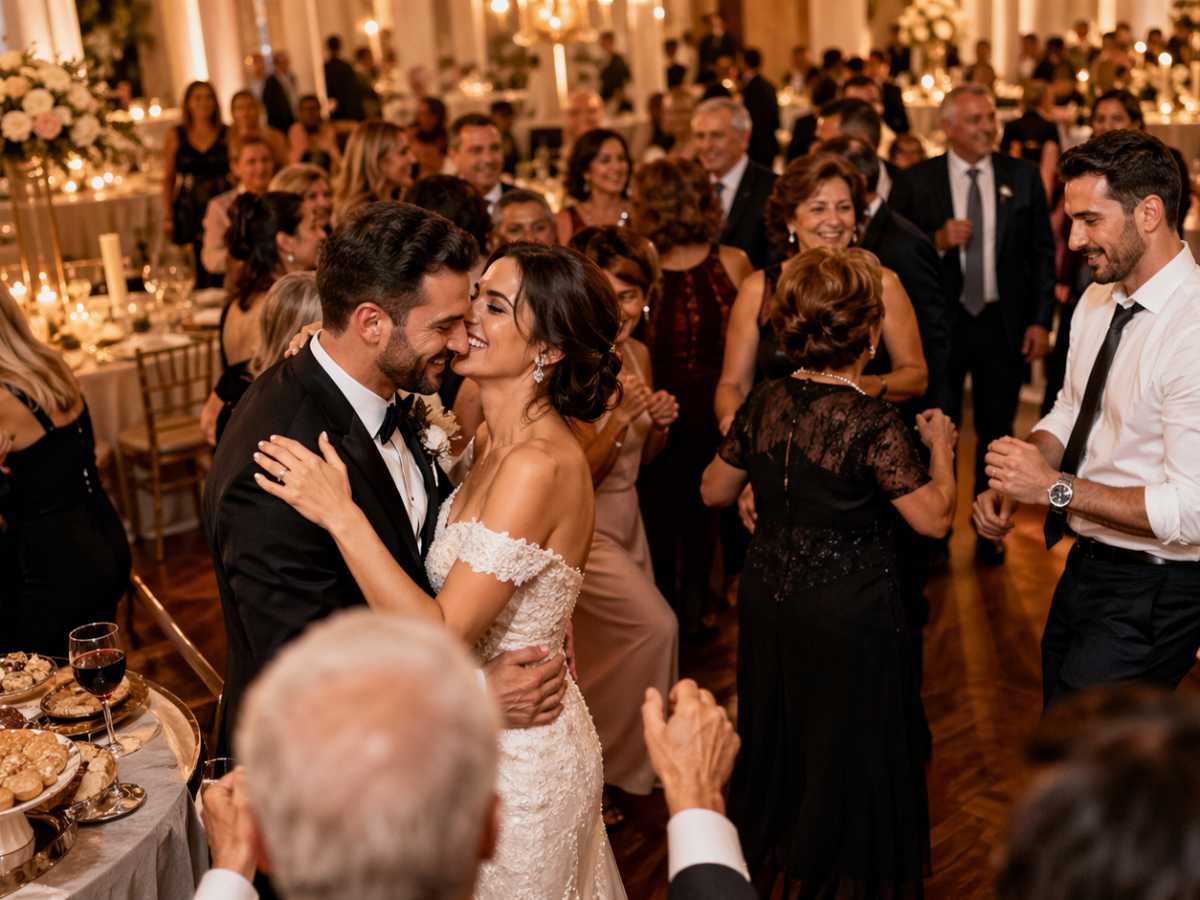
For many Italian families, the reception hall is where the wedding truly comes alive.
The church makes the marriage official. The reception hall makes the wedding feel official.
This is where the scale of the event becomes visible. The room. The tables. The towering centerpieces. The grand entrance. The live band tuning up. The waiters moving in choreographed patterns. The noise level slowly climbing. The children already running in circles around the dessert table. The older relatives watching everything from their seats with quiet, judging authority.
It all starts to feel bigger than a private celebration. It feels like something a community is doing together.
The hall is also where culture shows up in practical ways.
You see it in how people greet each other—the double kiss, the long hug, the hand on the cheek for the elderly relatives. You see it in who sits where (and who’s offended by where they sit). You see it in the size of the meal, the number of courses, the pacing of the night, and the balance between elegance and pure abundance.
Even when modern couples go contemporary with design and style—string lights, minimalist florals, a curated playlist—the reception almost always still carries that very Italian idea of what a proper celebration should feel like: full, warm, loud, generous, and a little bit out of control in the best possible way.
La Busta: The Envelope Italian Wedding Tradition Everybody Understands
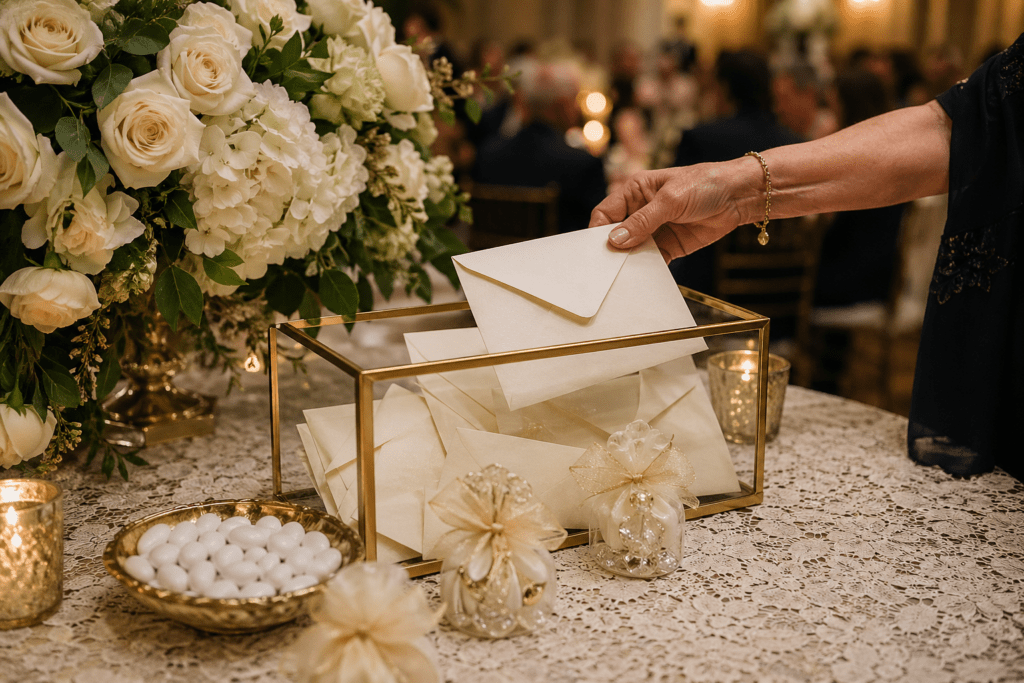
One of the most recognized customs at any Italian wedding is la busta—the envelope of money given to the couple.
To outsiders, this can sometimes seem blunt or even awkward. To Italian families, it’s simply practical and deeply respectful.
Long before online registries and digital wish lists existed, Italian families had already worked out a straightforward system: help the couple start their life together in a way that’s actually useful. Instead of giving them five serving bowls and two strange lamps that didn’t match anything, guests gave money. Personal, direct, and genuinely helpful.
That practicality says something important about Italian family culture.
A wedding wasn’t only symbolic. It was also a transition into married life—a moment when the couple was setting up a home, maybe a business, maybe their first apartment, maybe paying off the wedding itself. Supporting them in that transition mattered. The gift had purpose.
There’s a whole quiet social rhythm around la busta, too. In some families, there’s a beautifully decorated box at the entrance. In others, there’s a special table with a little card holder. In older-school versions, there’s a trusted parent, sibling, or zio sitting nearby with the focus of a bank manager and the protective instincts of a hawk, making mental notes about every envelope that comes in.
I’ll never forget my zio Pino at my cousin’s wedding in 1998. He was the designated busta watchman. He sat in a chair near the gift table for the entire night, only getting up twice—once for dinner, once for the bathroom, and even then he had my older cousin take his place like a prison guard rotation. By the end of the night, the box was overflowing, and he carried it personally to the bride’s father’s car like he was transporting state secrets.
It’s tradition. But it’s also family logistics at a very high level.
The Food: One of the Most Important Italian Wedding Traditions
Now we come to the heart of the matter.
The food.
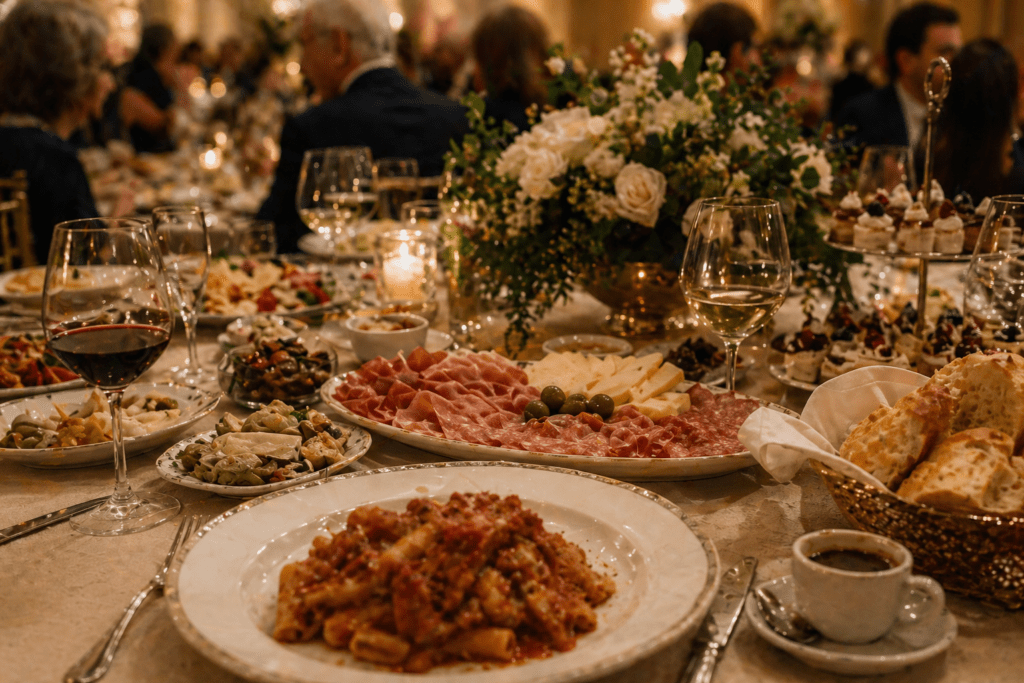
At an Italian wedding, the meal is not a side detail. It’s not something squeezed between speeches and dancing. It is one of the main ways love, pride, and hospitality are expressed. It’s the centerpiece of the entire experience.
And it is rarely just one plate.
In many weddings, the food unfolds in layers like chapters of a novel:
- The aperitivo — drinks and small bites to open the appetite
- The antipasti — cured meats, cheeses, marinated vegetables, seafood, often arranged on tables so abundant they look almost theatrical
- The primo — pasta, risotto, sometimes both
- The secondo — meat or fish, often with sides
- Contorni — vegetables and salads
- The wedding cake
- The sweet table — pastries, cookies, fruit, gelato
- Caffè and digestivi — espresso, sambuca, amaro, grappa
- And then somehow, more food appears after you’d already decided you were finished forty minutes ago
I once attended a wedding in Toronto that had eleven distinct food moments. I counted, because by the time we hit the sweet table, I genuinely couldn’t believe it was still happening. There was a cheese station I hadn’t even noticed during cocktails. The midnight panini cart appeared out of nowhere around 1 a.m. By 2 a.m., my uncle was eating a porchetta sandwich while simultaneously dancing to “Mambo Italiano.”
This structure isn’t excess for the sake of excess. It reflects something deep in Italian culture.
Food is care. Food is generosity. Food is dignity. Food is family showing you that you are welcome, that this day matters, and that no expense or effort has been spared in honoring your presence.
At an Italian wedding, abundance is part of the message itself.
Nobody should leave hungry. Nobody should feel like corners were cut. The table should feel full. The night should feel rich. The whole experience should say, without words, “We are happy you are here, and we are going to treat you accordingly.”
That’s why the meal so often becomes the most memorable part of the entire wedding. People remember the seafood antipasto. The pasta course. The veal. The late-night pastries. The espresso that arrived exactly when they needed it. The table that was already too full but somehow still made room for one more platter.
Dinner isn’t one moment at an Italian wedding.
It’s a storyline.
The Sweet Table, Bomboniere, and Confetti
By the time dessert arrives, most guests have already eaten enough food to require a quiet, thoughtful walk afterward. And yet, this is often when one of the most visually beautiful parts of the whole wedding begins.
The sweets.
Italian wedding traditions are famous for pastries, cookies, cakes, fruit, espresso, and dessert tables that seem to defy all known laws of human appetite. There are cannoli. Sfogliatelle. Tiramisu. Bignè. Pignoli cookies. Mini cassate. Honey balls. A whole tray of frutta martorana shaped to look like fruit. Sometimes, a chocolate fountain just because.
This is not accidental. Sweets play an important symbolic and social role at the end of the meal. They bring elegance, joy, and a sense of festive excess to the closing chapters of the night.
Then there are the bomboniere.
These small wedding favors are one of the classic details many Italian families still keep, even when they’ve simplified everything else. They’re a thank-you to guests, but they’re also a sign of refinement, remembrance, and care. A little keepsake to take home and hold onto.
Inside almost every bomboniera, you’ll find confetti. And here’s where it gets confusing for non-Italians: in Italian wedding tradition, confetti doesn’t mean the paper kind you throw in the air. It means sugared almonds.
Those almonds may look small, but they carry a lot of meaning. They’re traditionally given in odd numbers—usually five—and each almond represents a wish for the couple: health, wealth, happiness, fertility, and long life. The bittersweet nature of the almond itself (a sugar shell over a slightly bitter nut) is meant to symbolize the bittersweet nature of marriage—that life will bring sweetness and difficulty both, and the couple is meant to face them together.
I still have a bomboniera from my parents’ wedding sitting on a shelf in my apartment. The almonds inside are over forty years old at this point. Nobody is going to eat them. But nobody is going to throw them out either. They mean something now that has nothing to do with candy.
Music, Dancing, and the Joyful Chaos of the Night
After the meal begins to loosen its grip on the room, the wedding changes again.
This is where the celebration fully opens up.
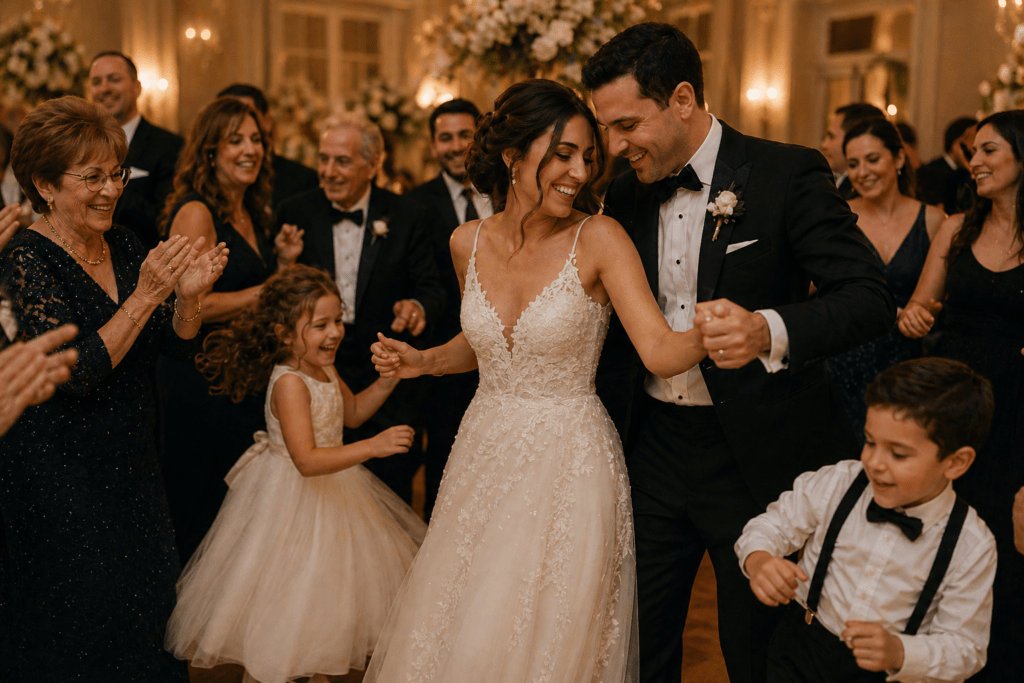
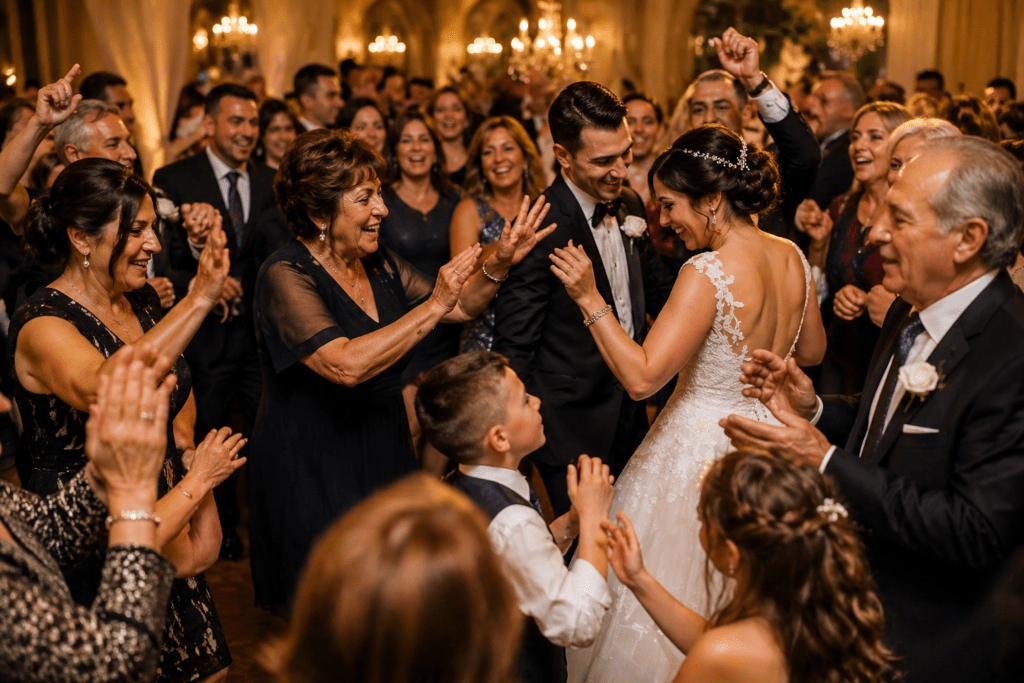
The first dance often begins with elegance—the couple swaying gently to a slow song while parents wipe their eyes and grandparents look on like proud generals reviewing their troops. But eventually, the energy expands. More guests join in. Generations mix. Children dance badly and proudly. Uncles become more confident than the music justifies. Aunts somehow know every word to every song from 1962 to the present day. Older relatives who claimed they were too tired to even attend find new life when the right tarantella starts playing.
I have a vivid memory of my Nonno at a family wedding when I was about ten. He had spent the entire ceremony complaining about his back. He had spent dinner saying he was going home early. Then the band played a song from his hometown in Calabria, and he was on his feet faster than I’d ever seen him move, dragging my Nonna onto the floor while she pretended to protest. They danced for the next forty-five minutes. He was eighty-one years old.
The tranatella
The tarantella itself is one of the most enduring musical Italian traditions at Italian weddings—a fast folk dance that pulls everyone, regardless of age or ability, into a circle. There’s no skill required. You hold hands. You move. You laugh. It’s almost impossible not to smile when it’s happening around you.
Then there’s the moment in many Italian-North American weddings when the band switches gears—maybe to “That’s Amore,” maybe to a Lucio Battisti song, maybe to “Volare,” and suddenly the entire room is singing along at the top of their lungs. Even the kids who don’t speak Italian know the chorus. Even the in-laws who married into the family are belting it out.
This part matters because joy itself is part of the tradition.
Italian wedding culture isn’t only about ceremony and symbolism. It’s also about celebration. About making happiness visible and shared. A wedding isn’t meant to feel restrained from start to finish. It’s meant to open up into something warm, loud, memorable, and alive.
The Money Dance and Other Regional Customs
Different regions of Italy—and different immigrant communities abroad—have their own specific customs that show up at weddings, and they’re worth knowing about.
In some Italian-American and Italian-Canadian communities, especially those with Southern Italian roots, there’s the money dance (sometimes called the tarantella dei soldi in family lore). Guests pin money to the bride’s dress while she dances with them. It’s another version of practical generosity—a way to contribute to the new couple’s life directly, with celebration built into the act itself.
In some traditions, the bride carries a small satin pouch (the borsa) where she collects envelopes throughout the night.
In Sicily and parts of the south, there’s the tradition of the groom carrying a piece of iron in his pocket on the wedding day to ward off evil spirits and bad luck. Some grooms still do this even now, even when they don’t fully believe in it, because their grandfather told them to and that was reason enough.
There’s also the cutting of the bride’s veil or the groom’s tie into pieces, which guests then “buy” for a small donation to the couple. It’s playful, it’s practical, and it usually descends into chaos within minutes.
Not every family does every custom. Different regions, different villages, different family histories all bring their own variations. That’s part of what makes Italian wedding traditions so rich—there isn’t one single template. There are dozens of overlapping ones, all with their own little quirks and reasons.
What Changed After Immigration
Here’s where the story gets even more interesting.
Italian wedding traditions didn’t simply stay frozen in time after families crossed oceans to Canada, the United States, Argentina, or Australia. They evolved. Some customs softened. Some disappeared entirely. Some blended with local habits. But many stayed remarkably recognizable.
In some cases, they actually became more important.
Why? Because traditions abroad often do more than preserve a ritual. They preserve identity. They become a way of saying, “This is still who we are.”
That’s why so many Italian-Canadian and Italian-American weddings have kept strong elements like the big reception, the long meal, la busta, the sweets table, the heavy emphasis on family presence, and the firm expectation that a wedding should feel abundant. Even when language faded across generations, even when regional details blurred, those big visible customs remained.
They were easier to carry forward. They were also harder to forget.
My friend Antonella got married a few years ago. Her grandparents had immigrated from Puglia in the 1950s. She’s third-generation. She doesn’t speak much Italian. She grew up entirely in suburban Toronto. Her wedding venue was modern. The flowers were minimalist. The DJ played mostly current music.
But there were still bomboniere. There was still la busta. There was still a five-course meal. There was still her ninety-year-old great-aunt at the head table, watching everything with that ancient, satisfied expression, occasionally leaning over to tell someone in Italian that the food was good but not as good as her mother’s. The traditions had been streamlined—but the essence was completely intact.
That’s how culture survives across generations. Not by perfect preservation, but by carrying forward what matters most.
How Modern Families Still Keep These Traditions Alive Today
Not every modern couple wants a huge hall, a guest list of three hundred, or seven food events disguised as one dinner.
That’s understandable. Times change. Budgets are tighter. Couples often live differently than their parents and grandparents did.
The good news is that keeping a tradition alive doesn’t mean recreating the past perfectly. It means preserving the meaning in a way that still fits your life.
A family may keep la busta but simplify the rest. Another may have a smaller wedding but still serve classic family pastries that nobody else makes anymore. Another may skip the church but include grandparents in a visible and meaningful role. Another may go fully modern with décor, music, and format while still keeping bomboniere, multi-course dining, and strong family participation as their non-negotiables.
I went to a wedding last summer where the entire ceremony was held outside, the dinner was a single elegant plated meal, and there was no traditional band—just a DJ and a curated playlist. By every measure, it was a “modern” wedding. But at the end of the night, the bride’s mother came around to every single table with a basket of homemade taralli and pizzelle she had made over the course of three weeks. People wept. It was the most Italian moment of the entire night, and it had nothing to do with anything that had been planned.
That’s how traditions survive.
Not by staying frozen, but by staying recognizable.
A tradition doesn’t lose its value because it adapts. In many cases, adaptation is exactly what allows it to continue at all.
What Italian Wedding Traditions Really Teach Us
At their core, Italian wedding traditions teach something simple and powerful.
They teach that marriage isn’t only private. It’s communal. The community holds the couple up. The community witnesses the promise. The community participates in the joy and shares in the responsibility of supporting the new family.
They teach that celebration should feel generous. That if you’re going to mark a moment, you mark it properly. With food, with people, with music, with care.
They teach that food, ritual, beauty, and family presence are not extras. They are part of how meaning is expressed. A wedding without a long meal would feel like something was missing—not because of the food itself, but because of what the food represents.
They teach that practical support matters as much as symbolism. That’s why envelopes matter. That’s why family help matters. That’s why the day is built not only around emotion, but around real, tangible care for the couple’s future.
Most of all, they teach that Italian wedding traditions are one of the ways families carry memory forward.
A bomboniera. No Italian wedding ends without the bomboniera, the favor of five sugared almonds given to every guest. Or, a tray of pastries someone stayed up two nights making. A hall full of relatives, half of whom you only see at weddings and funerals. A grandmother watching the dance floor with that deep, satisfied look. A carefully handed envelope. An espresso at the end of a long, loud night.
None of these things are random details. They are small acts of continuity. They quietly say: this is how we celebrate. This is how we honor a big moment. This is how we keep something of our people with us.
Final Thoughts
Italian wedding traditions last because they do more than decorate a celebration.
They create structure around joy. They turn marriage into a family event rather than a private one. They express love through food, beauty, symbolism, and support. And even when modern couples change the format, the heart of these customs can remain very much alive—often in ways that surprise even the couples themselves.
That’s what makes them worth keeping.
Not because every family must do everything the old way. Not because tradition should be a burden. But because, in a world where so much gets simplified, sped up, scrolled past, and forgotten, there’s something quietly powerful about a tradition that still says:
Gather everyone. Bless the couple. Feed them well. Celebrate loudly. Make the day mean something.
That isn’t old-fashioned.
That’s continuity.
And for many Italian families—mine included—that’s exactly the point.

Marco Ricci is an Italian-Canadian writer and the grandson of Calabrian immigrants. He created Italian Family Traditions to document the customs, feast days, and family rituals Italian families carried from Italy to North America — and to understand what they actually meant. He is based in Montreal.