Italian Family Traditions
Malocchio: The Italian Evil Eye and the Grandmothers Who Took It Seriously
It was never just a superstition. It was a whole family system — of watching, protecting, and knowing when something was not quite right in the room.
There was a neighbor my grandmother did not trust. She never said why explicitly. The woman smiled too much and complimented too loudly and always asked questions about the children in a way that felt — off. Not threatening, exactly. Just too interested. Too sweet. The kind of interest that made older Italian women pull the babies a little closer and change the subject and reach, almost unconsciously, for the small gold horn at the base of their throat.
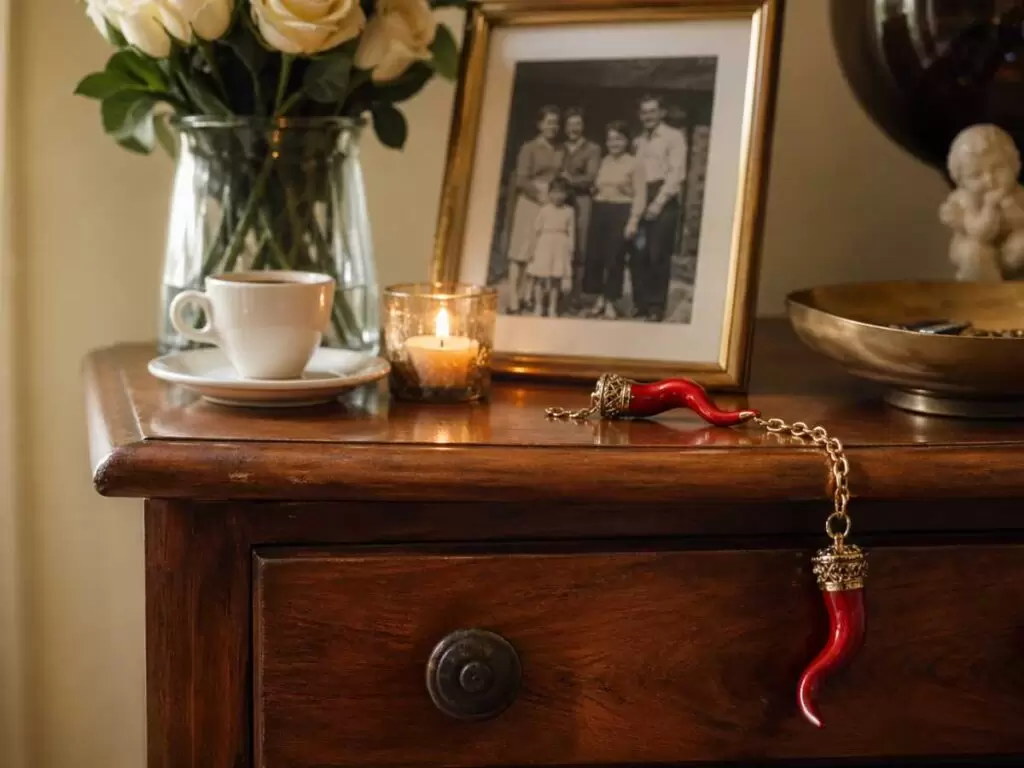
That horn was my grandmother’s cornicello. She wore it every day of her life that I can remember. Not as jewellery. Not as fashion. As armour. And the specific neighbor who prompted that reaching gesture, that protective reflex — she would have said, if you had asked her directly, that she was watching for the malocchio.
The evil eye.
The bad glance. The sideways look. The compliment that felt like something else underneath. The attention that landed on a child, a pregnancy, a new house, or a piece of good news and left something heavy behind when it lifted.
In my grandmother’s world, not every look was innocent. Some people admired you strangely. Some people smiled at your child too long. That was the territory where malocchio lived.
If you grew up in an Italian family, you know this territory. You may not have believed in it exactly. But you knew the rules. You knew not to boast too much about good fortune. You knew that when a certain kind of compliment hung in the air, someone older would either mutter something or reach for something or subtly change the energy of the room. You knew that the women who held this knowledge were not superstitious fools. They were women who had watched carefully for a very long time and had their reasons.
This is the story of malocchio — what it was, where it came from, what it meant in real Italian family life, and why it still reverberates in the memories of descendants who may not quite believe and still cannot quite dismiss it.
What malocchio actually means
The word is simple. Mal — bad. Occhio — eye. Bad eye. Evil eye. The harmful power of a gaze. Treccani defines malocchio as the harmful power attributed to certain people or animals to cause physical or moral harm through the force of their look — and notes that the belief may involve the gaze being exercised knowingly or unknowingly, which is the detail that changes everything.
Because malocchio was never primarily about deliberate curses. It was not a movie villain pointing a finger and willing destruction. The more intimate and more honest version of the belief was this: envy, admiration, and resentment can do damage even without meaning to. A look loaded with jealousy could harm. A compliment powered by hidden desire could harm. Even excessive genuine admiration — looking too hard at something beautiful — could harm the thing being looked at.
That is a much more sophisticated idea than “someone cast a spell on you.” It is a folk theory of how emotional energy moves between people and what it does when it lands somewhere vulnerable.
When my son was born my mother-in-law came to the hospital and the first thing she did, before she held him, was make the sign of the cross over him and say something very quietly in a dialect I did not understand. I asked her later what she said. She thought about it and said, “Something to keep him covered.” I nodded. I did not ask further. Some knowledge is not meant to be translated — it is meant to be respected as it is.
The evil eye is not uniquely Italian. Oxford’s museum of amulets describes it as one of the world’s oldest and most widespread beliefs. Treccani says it appears across cultures on every continent. What is distinctly Italian is the specific way the idea settled into family life — the particular charms, the specific rituals, the exact social situations that triggered the protective reflex, and above all the role of grandmothers and older women as the guardians of that knowledge.
Why Italians believed in it — the answer is simpler than you think
Because envy was taken seriously.
That may be the cleanest explanation there is.
Much of Italian folk thinking around malocchio connects directly to the social reality of envy — the idea that wanting what someone else has, or resenting their good fortune, or admiring them too intensely, could produce a kind of negative force that affected the envied person. Treccani says the harmful gaze may be used unconsciously or out of ill will and envy. Anthropologist Sabina Magliocco writes that in Italy the evil eye can be given accidentally through admiration, which is why careful people avoided praising a child, an animal, or somebody’s good fortune too directly or too enthusiastically.
The compliment that felt wrong was not necessarily a lie. It may have been completely sincere. But sincere admiration from the wrong person, in the wrong emotional state, directed at something fragile — that was exactly the danger zone.
In communities where people lived close together, knew each other’s business, and could watch each other’s fortunes rise and fall in real time, this kind of anxiety made perfect sense. Not everyone who admired your new baby wished them well in the fullest sense. Not every neighbor who praised your garden was free of the small, human twinge of wanting what you had. Folk belief gave that reality a name and a set of responses.
Babies were thought to be especially vulnerable. So were pregnant women, new mothers, beautiful children, newlyweds, and people at moments of obvious good fortune. Oxford notes that children and domestic animals have often been considered especially exposed to the evil eye. Recent reporting from rural Italy says babies and their mothers are still seen as particularly at risk. The pattern makes sense — these are the moments when life is most precious and most visible, when admiration from others is most intense, and when the stakes of harm feel highest.
My grandmother had specific rules about new babies. You did not comment on how healthy they looked. You did not say they were beautiful, at least not without immediately touching the child and saying something that counteracted the compliment — a specific prayer, a gesture, something that broke the charge of the admiring gaze before it could settle. If a visitor praised the baby too enthusiastically and did not know to do this, my grandmother would handle it herself the moment they left. Water. A prayer. Sometimes the cornicello brought close to the baby’s skin. She was matter-of-fact about it. Not dramatic. Just thorough.
What symptoms told a family that malocchio had happened
This is where the belief becomes genuinely interesting from a psychological and cultural perspective.
The symptoms in folk understanding were always vague enough to fit real life: sudden headaches, general heaviness, stomach upset, sleeplessness, inconsolable crying in babies, irritability, a run of minor bad luck, or simply the sense that something was off — that the energy of the day or the household had turned wrong without obvious cause.
That vagueness was not a weakness of the belief. It was part of why the belief worked. Life regularly produces exactly these experiences — a bad day that has no single explanation, a baby who cries all evening, a headache that arrives from nowhere, a general feeling of things being slightly wrong. Folk traditions are strongest in the gray areas, in the experiences that medicine and logic cannot fully account for in the moment. Malocchio gave those experiences a name and, crucially, a remedy.
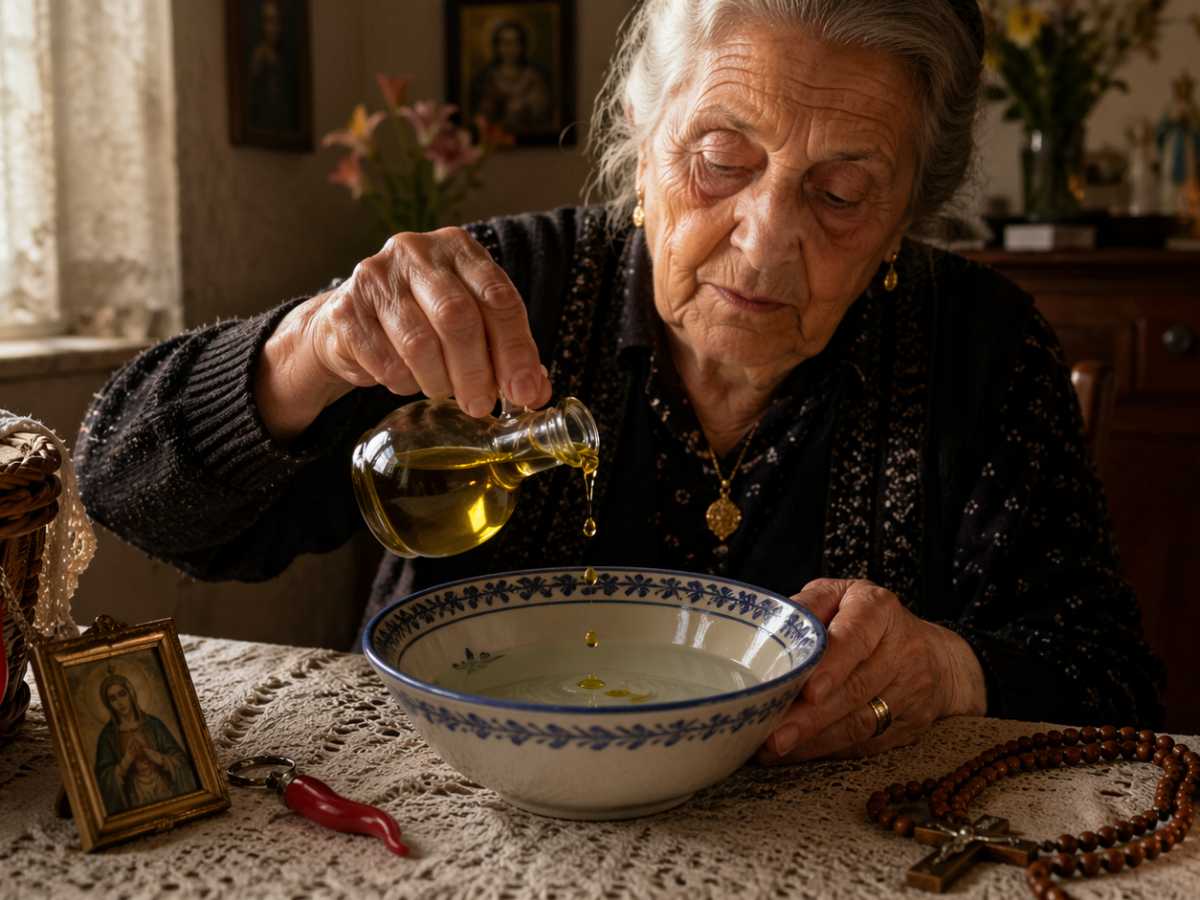
My wife’s grandmother had what the family called her “reading.” If someone was not right — if they had a headache that would not shift, if something bad had happened with no clear cause, if someone seemed heavy in a way they could not explain — she would bring out a bowl, fill it with water, and drip olive oil from a spoon. Then she would watch what the oil did on the surface. Whether it spread, whether it formed shapes, whether it broke into drops or held together. She would study it the way a doctor reads test results. Quietly. Seriously. Then she would say what she saw and begin the process of addressing it. I watched her do this. The person in the chair always left looking lighter. Whether you believe the mechanism or not, the care was completely real.
How families protected themselves — the charms, the gestures, the rituals
If malocchio was the fear, protection was the family answer — and Italian families built elaborate, practical, tactile systems of protection that lived in everyday objects, everyday gestures, and everyday prayers.
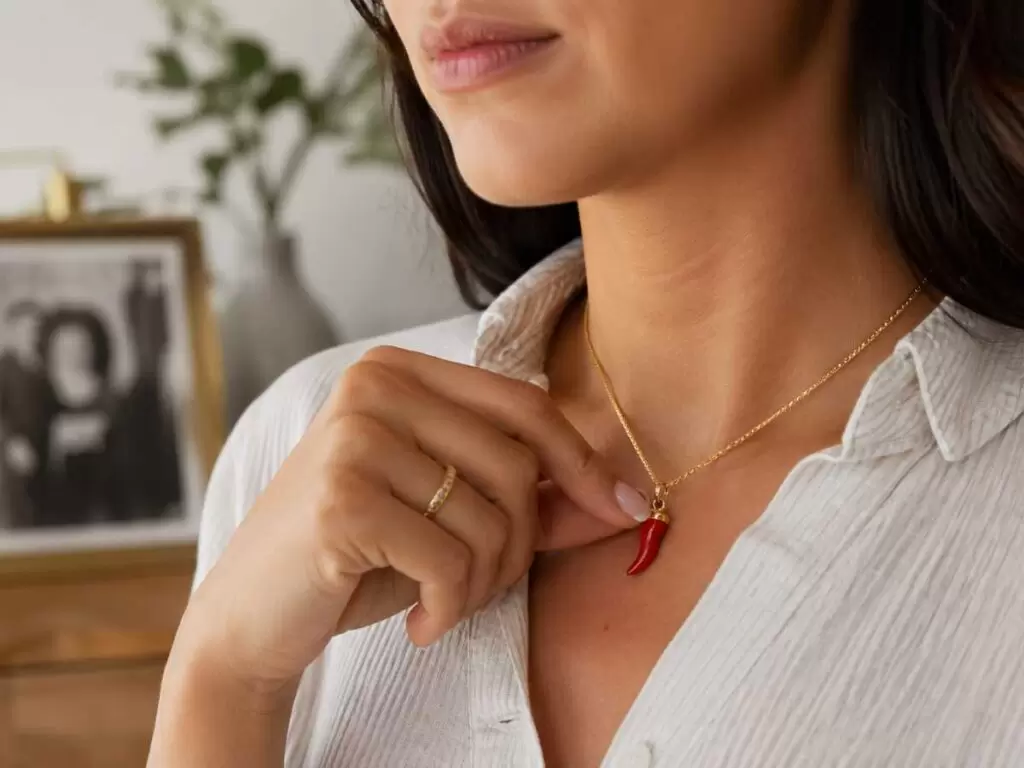
The most famous protective object is the cornicello — the small horn-shaped charm associated especially with Naples and southern Italy. AP has described it as a Neapolitan amulet believed to bring luck and protect against the evil eye. In gold, in coral, in red horn, in plastic — it appears on necklaces, on keychains, on rearview mirrors, hung in kitchens, tucked into baby carriages. The material changes. The purpose does not.
My grandmother’s cornicello was gold. Small. She had worn it so long that the clasp had been replaced twice. When she died it went to my mother, who wore it for a year and then passed it to my aunt, who has it now. Nobody discussed this process. It was simply understood that the cornicello belonged to whoever needed it most at any given moment. That logic itself tells you something about how the object was understood — not as an heirloom exactly, but as a working tool that needed to be in use.
There is also the mano cornuta — the horned hand gesture or amulet, made by extending the index and little finger while curling the others. Oxford’s amulets collection says the mano cornuta is thought to be of ancient Italian origin and is used against the evil eye. Related to it is the mano fica — another protective hand gesture with deep roots in Italian folk practice.
What is wonderful about this whole system of protection is how physical it is. How immediate. How completely unabstract.
- A charm in your hand or at your throat
- A gesture made under the table when something felt wrong
- A quiet sign made after a compliment that landed strangely
- A bowl of water and oil on the kitchen table
- A prayer said in a dialect only certain women knew
- A pin or needle used to cut the surface of something harmful
The healing rituals specifically — the removal of malocchio once it was thought to have settled — followed patterns that varied by family and region but shared a core. Scholarly work on vernacular magic in Italy describes water and olive oil as central to the most widespread forms of evil eye removal, while other research notes that healing formulas were often passed on at specific times: Christmas Eve, the Feast of San Giovanni, significant calendar moments when the transfer of old knowledge to younger hands was considered appropriate and safe.
My wife’s grandmother’s version used a bowl, water, olive oil, and a needle. The needle was significant — not as a weapon but as a cutting tool. The belief underlying it was that the malocchio, once named and identified, needed to be pierced or broken or symbolically severed. The oil hit the water. The surface changed. The shapes formed. She read them. She knew what they meant. Then the remedy proceeded.
You do not have to believe in the mechanism to see the care in it. Someone was not feeling right. An older woman took the problem seriously. She brought her knowledge to bear. She worked with everything she had to make things better. That is not superstition. That is love in a specific and very old form.
Why it was always the grandmothers

If you ask anyone about malocchio, a grandmother appears in the story almost immediately. That is not random. That is the shape of how this tradition was held and transmitted.
Recent reporting from Italy says these rituals are performed by women and passed down through maternal lines. Magliocco’s work describes mothers, grandmothers, and aunts as the people most commonly named as the healers and protectors in everyday Italian family conversation about the evil eye. Healing formulas were passed from one woman to another at calendrically significant times — at Christmas Eve, at the Feast of San Giovanni — in private moments of transmission that felt closer to initiation than instruction.
This was women’s knowledge. A household inheritance. A quiet expertise maintained across generations not in books or institutions but in kitchens, bedrooms, and back rooms, whispered between women who understood that what they were passing on was both practical and sacred.
The formula my wife’s grandmother used — she had received it from her own grandmother, who had received it from hers. She said you could only learn it properly at a specific time of year. That you had to receive it from someone who already carried it. That if you tried to learn it the wrong way it would not work. She was not mystical about this. She said it the way a craftsperson talks about technique — there is a right way to learn it, and shortcuts produce inferior results. I found that completely convincing. Not because I am sure the formula works, but because I am completely sure she was sure.
Understanding this — that malocchio knowledge belonged to women and traveled through maternal lines — explains why so many descendants feel such specific emotion about it. The tradition is not just a belief. It is a memory of being protected by a particular person. The grandmother who wore the horn. The aunt who knew the prayer. The older woman who could take it off with water and oil and a needle and absolute confidence that what she was doing was necessary and real.
When that person is gone, the protection feels less certain. The knowledge may have been imperfectly transmitted or not transmitted at all. And what people feel then is not the loss of a superstition — it is the loss of a guardian.

The same grandmothers who read the oil and water also turned to the saints for protection. Our Italian Saint Prayer Cards gather eleven of those saints on beautifully designed santini, each with a traditional prayer in Italian and English.
$9.49
Instant digital download
Get the Saint Cards →What changed after immigration — and what refused to change
When Italian families came to North America, malocchio came with them — not as a neat, preserved tradition but as a living habit of mind, a set of anxieties and protective reflexes that had no reason to stop just because the address changed.
Encyclopedia.com notes that Italian immigrants brought devotion to saints alongside folk practices including belief in malocchio. The Financial Times reports that the belief and its rituals still persist in modern Italy as something people turn to in moments of stress, illness, uncertainty, and family concern — and that for many people the rituals provide psychological relief and cultural connection even in a skeptical age.
In North America, the public, communal dimension of the tradition shrank. The village context was gone. The shared social understanding that made certain gestures immediately legible was gone. But the family dimension concentrated and intensified — the way immigrant traditions often do when they are cut off from their broader context and have to survive in smaller, more private spaces.
So malocchio became:
- A cornicello in a drawer that nobody could quite bring themselves to throw away
- A horn on the rearview mirror that the children found slightly embarrassing
- A half-joking warning — “be careful who you tell, people get jealous”
- A ritual that only one aunt still performed, and only when asked directly
- A belief you might deny in public and still reach for privately when things went wrong
- A story about Nonna that sounded like family mythology until something happened and it suddenly sounded like family wisdom
My cousin went through a run of bad luck a few years ago — nothing dramatic, just a sustained period where nothing quite worked. Job problems. A relationship that ended badly. A minor health thing that lingered longer than it should have. His mother, who had grown up watching her own mother do these things, sat him down one evening with a bowl of water and a bottle of olive oil and said she was going to check. He is a grown man. He has a university degree. He sat very still and did not say a word while she worked. When it was done he said he felt better. He still wears a cornicello now. Not as a fashion statement.
Why it still matters — even for people who do not fully believe
This is the part that most articles about malocchio miss entirely.
They treat it as a superstition to be debunked or a cultural curiosity to be described from a comfortable scholarly distance. What they miss is that for millions of Italian-American and Italian-Canadian descendants, malocchio is neither of those things. It is a memory of being cared for in a specific way. It is a tradition that encoded a whole set of values about envy, vulnerability, protection, and family responsibility. And it is one of the places where Italian family culture was most itself — most specific, most embodied, most untranslatable into abstract principles.
You can stop believing in malocchio and still carry its lessons. Do not invite envy. Protect what is precious. Take seriously the idea that some attention is not harmless. And never dismiss the old women who watched carefully. They had their reasons.
The emotional truth that malocchio encoded was not magical at all. It was this:
- Some people look at your good fortune and feel something complicated
- Fragile things deserve extra protection
- Babies, new mothers, and people at turning points in life are more vulnerable than usual
- Boasting is unwise not because of superstition but because of how it affects the people around you
- Old women who have watched carefully for seventy years probably know some things younger people do not
None of those are superstitions. They are social intelligence encoded in folk tradition. And that is why the tradition lasted, and why it still resonates, and why people who cannot say they believe in it still feel something when they see the cornicello or hear about the olive oil ritual or remember exactly how their grandmother looked when a certain neighbor left the room.
It said some things are fragile. It said envy is real. It said family should protect its own. And it kept one older woman, in almost every Italian family, treating those truths with the seriousness they deserved.
That is not superstition. That is a tradition doing exactly what traditions are built to do.
If your grandparents passed down other warnings, charms, and protective beliefs alongside malocchio, you may also like the full story of the cornicello and what it really meant, or the complete guide to Italian superstitions.
The cornicello is still the most immediate and most personal way to carry this tradition forward. If you want one that is made the traditional way — red, horn-shaped, the kind that actually hung around Italian grandmothers’ necks rather than sat in a display case — a handcrafted Italian cornicello is worth keeping. It is not decoration. It is what it always was.
If you want to understand the full system of Italian folk belief that malocchio belongs to — the charms, the rituals, the specific regional differences between how Calabria, Sicily, and Naples understood the evil eye — The Evil Eye: The History, Mystery, and Magic of the Quiet Curse is the most thorough English-language account of the tradition that shaped what your grandparents believed.
Finally, for those who prefer something worn rather than gestured, an Italian evil eye bracelet serves the same purpose — a daily physical reminder that the tradition of watching and protecting is still alive in your family.
FAQ
What does malocchio mean in Italian?
Malocchio means “bad eye” or “evil eye” — the harmful power believed to belong to a gaze. Treccani defines it as the harmful power attributed to certain people to cause physical or moral harm through the force of their look, whether exercised knowingly or unknowingly. The unknowing part is crucial: in Italian folk belief, even innocent admiration could harm if it was loaded with envy or directed too intensely at something vulnerable.
Is malocchio the same as the evil eye?
Yes — malocchio is the Italian name for the evil eye tradition. The belief itself is not uniquely Italian and appears across many cultures, but the specific charms, rituals, family practices, and social contexts around it are distinctly Italian in their form and feeling.
What causes malocchio?
In folk belief, malocchio can be caused by envy, ill will, or even excessive admiration. Several scholarly sources note that it may happen unintentionally — not only through deliberate harm but through a gaze loaded with strong emotion, whether negative or intensely positive. This is what made it so difficult to guard against: the person causing it might not have known they were doing so.
How do Italians protect themselves from malocchio?
Common protections include the cornicello (the small horn-shaped charm particularly associated with Naples), the mano cornuta gesture or amulet, family prayers, and healing rituals involving water and olive oil. The rituals for removing malocchio once it had settled typically involved older women, specific formulas passed through maternal lines, and symbolic acts of cutting or breaking the harmful force. The exact form varied by family and region.
Is malocchio an official Catholic belief?
No. It is better understood as a folk belief that lived alongside Catholic family life in southern Italy and diaspora communities — sometimes blending with prayers and blessings, but not part of official Church doctrine. Recent reporting notes that the national Italian clergy often frowned upon it even as it became woven into regional religious practice. The tradition belongs to the category of folk wisdom and protective customs rather than theology.
Do Italians still believe in malocchio today?
Some do, some do not, and many sit in the middle — neither fully believing nor willing to dismiss it entirely. Recent reporting shows the belief and its rituals still persist in parts of Italy and in diaspora families, particularly as cultural inheritance, comfort, and a form of connection to the women who held this knowledge before. The cornicello in particular remains widely worn, by believers and non-believers alike, as both cultural identity and instinctive protection.

Marco Ricci is an Italian-Canadian writer and the grandson of Calabrian immigrants. He created Italian Family Traditions to document the customs, feast days, and family rituals Italian families carried from Italy to North America — and to understand what they actually meant. He is based in Montreal.