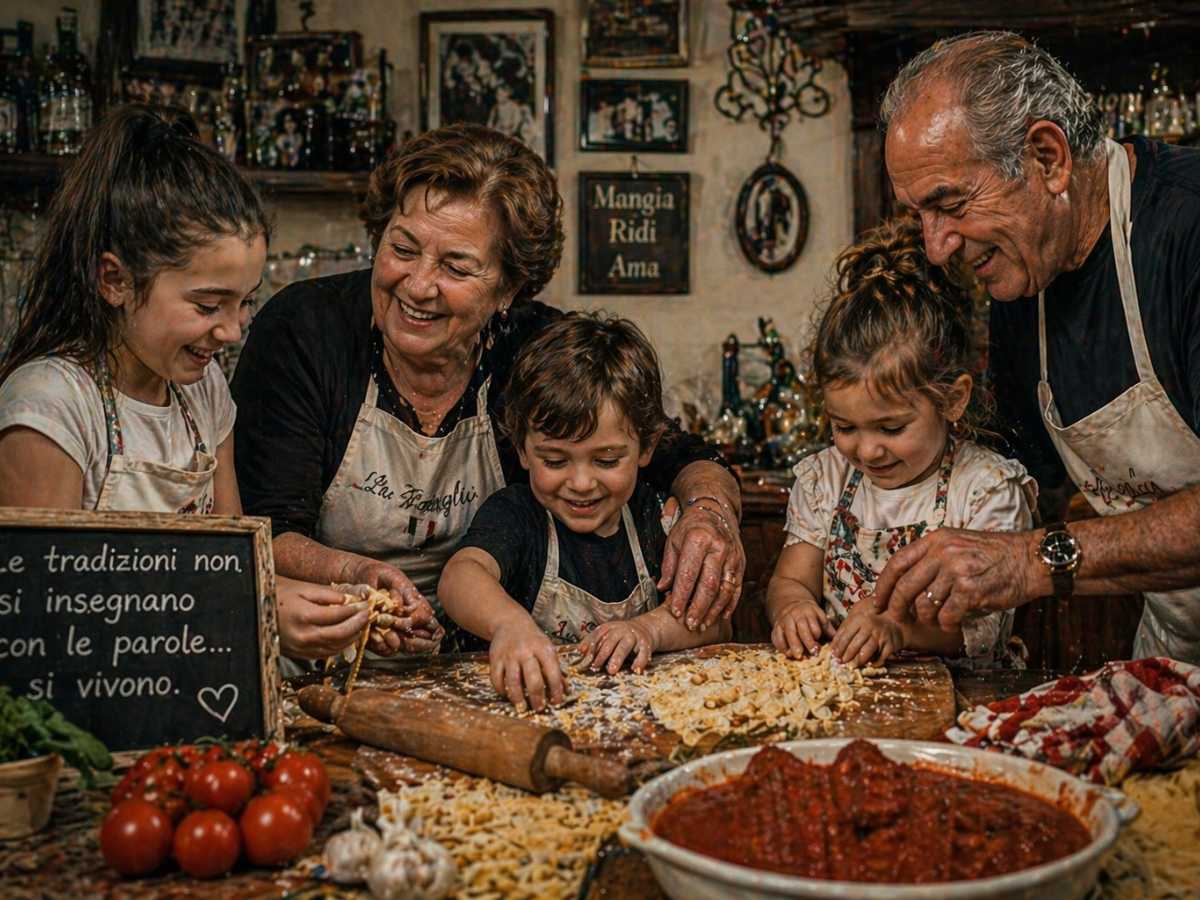
Italian Family Traditions
How to Record Your Parents’ and Grandparents’ Family Stories Before They’re Lost
Most families assume the stories will still be there later. Later this summer. Later next year. Later when someone gets organized. Then later gets smaller — and a name goes first, then a town, then the exact way your grandmother used to tell the story.
My mother kept a small cassette recorder in a kitchen drawer for years. She had bought it specifically to record her mother — to preserve her voice, her stories, her Calabrian dialect, the specific way she pronounced certain words in Italian that nobody else in the family still used. She kept the recorder in the drawer, ready, intending to use it at the next visit or the one after that, and she never used it once. My grandmother died in 2003 and the recorder stayed in the drawer and the voice it was supposed to preserve is gone except in the memories of people who are themselves getting older and whose memories of her voice are becoming less precise every year. The cassette recorder is still in the drawer. My mother cannot bring herself to throw it away. I think she keeps it because throwing it away would mean admitting that the thing she intended to do and did not do is now permanently undone.
That recorder in the drawer is the reason this article exists.
Not because you need to feel guilty about conversations you have not had yet. But because the recorder-in-the-drawer feeling — the sense that you meant to and didn’t and now the window has changed — is one of the most specific and painful regrets that families carry. And it is almost entirely preventable. Not by buying equipment. By having the conversation. By pressing record. By understanding that the conversation you are already having over coffee or at the kitchen table is the archive — if you treat it like one.
A decent recording that exists is infinitely better than the perfect recording you never make. The bar is lower than you think. The cost of waiting is higher than you know.
Why the voice matters as much as the facts
When people think about saving family history they usually think about facts: names, dates, places, relationships. Those matter. But oral history organizations have been making a different and more important argument for decades: the voice itself is part of the record. The phrasing, the pauses, the way someone laughs before a particular story, the specific emotion that surfaces when they mention a certain person — all of that is historical information that a family tree or a written summary cannot preserve.
The Library of Congress describes oral history as learning about the past through recorded interviews with people who experienced it directly. The Smithsonian calls it a way to preserve original, historically meaningful information through people’s own memories and voices. Both framings emphasize the same thing: the person telling the story is not a data source. They are the record. And when the record is gone, the information it contained cannot be reconstructed from other sources.
I know what my grandfather said about certain things because I heard him say them, multiple times, in his specific voice with his specific Calabrian inflection. I know nothing about how his mother said the same things because nobody recorded her. She existed as a name in a family tree and a face in two photographs and an approximate birth year in a document. She was a full person who spoke a specific dialect and held specific opinions and told specific stories. None of that is recoverable. My grandfather is barely recoverable — in the sense that his voice is recoverable — because the recordings we have of him are incidental ones, made at family gatherings for other purposes, where he can be heard in the background. We preserved him by accident. We did not preserve his mother at all. That gap is not neutral. It is a specific loss with specific dimensions.
The window — and why most people misread how large it is
The most common mistake families make is not carelessness. It is a misreading of time. The window for these conversations feels larger than it is — not because people are naive but because memory loss and physical decline are often gradual enough that there always seems to be another visit, another Christmas, another quiet afternoon when the conditions will be right.
Memory does not usually disappear all at once. It thins. A date goes first. Then a street name. Then the reason someone left a town. Then the name of the cousin in the photo. Then the exact way your grandfather used to tell a particular story. Then the story itself. And finally the voice — not through death necessarily, but through the specific clarity of recall that makes a story told this year richer than the same story told five years from now, when the details have softened and the names have blurred.
My aunt recorded her mother — my grandmother’s sister — when she was in her late seventies. She used a portable recorder and sat at the kitchen table for three Saturday afternoons in a row and asked questions and let the conversation go where it went. The recordings are an hour each, roughly. They contain the name of the village in Calabria, the name of the church where her parents were married, the name of the ship she came on, and the specific story about the first winter in Montreal that the family had always referenced in the abstract but had never actually heard in full. My aunt made those recordings in 2009. Her mother died in 2014. The recordings exist. The voice exists. Three Saturday afternoons in 2009 produced something that will outlast everyone currently alive in the family. That is the scale of what you are doing when you press record.
What to record — and what vanishes fastest
You do not need to record someone’s entire life story in one sitting. You need to capture the things that vanish fastest — the things that live in no document, no database, no official record anywhere.
- Full names and nicknames — the name someone was born with, the name they were called at home, the name that changed at immigration and what it changed from
- The exact town in Italy — not “southern Italy” or “Calabria” but the specific village. FamilySearch’s Italy guidance is clear: Italian records are local, and without the municipality you cannot access the archives that hold your family’s history
- The immigration story — who came first, why they left, whether they planned to stay, whether anyone went back, what they missed and never stopped talking about
- The people before them — parents, grandparents, the relatives who were already old when your grandparents were young and who exist now only in what your grandparents still remember
- The traditions and how they worked — what Sunday looked like, what feast days the family observed, what foods meant what occasions, what stayed from Italy and what changed. Read more about what Italian-American families kept after immigration
- The language — which dialect words the older generation used, which Italian expressions survived immigration, which sayings got repeated and what they meant. For a guide to the sayings most often heard, read Italian grandparent sayings and what they really meant
- The hard parts — the sacrifices, the things that were never talked about openly but everyone knew, and what the older generation is proud of that nobody ever thought to ask about
How to prepare — without overcomplicating it
The biggest obstacle to recording family stories is not equipment or time. It is the feeling that you need to prepare perfectly before you begin. That feeling produces the recorder-in-the-drawer outcome. Here is the preparation that actually matters.
1. Pick one person and one theme. Not “the whole family history.” One person. One topic area — immigration, or childhood, or how they met, or the traditions they observed. Narrowing the scope makes the conversation richer and less exhausting for both of you.
2. Tell them what you want to talk about beforehand. Not as a formal announcement — just enough that they can mentally open the right drawer. StoryCorps recommends sharing questions in advance so the person can think before the conversation. A lot of grandparents tell better stories when they are not ambushed.
3. Choose a quiet place at a calm time. Not a busy holiday. Not a crowded room. A kitchen table on a weekday afternoon, with coffee, with no particular place to be. The Smithsonian recommends a quiet setting specifically because memory opens differently in calm than in noise.
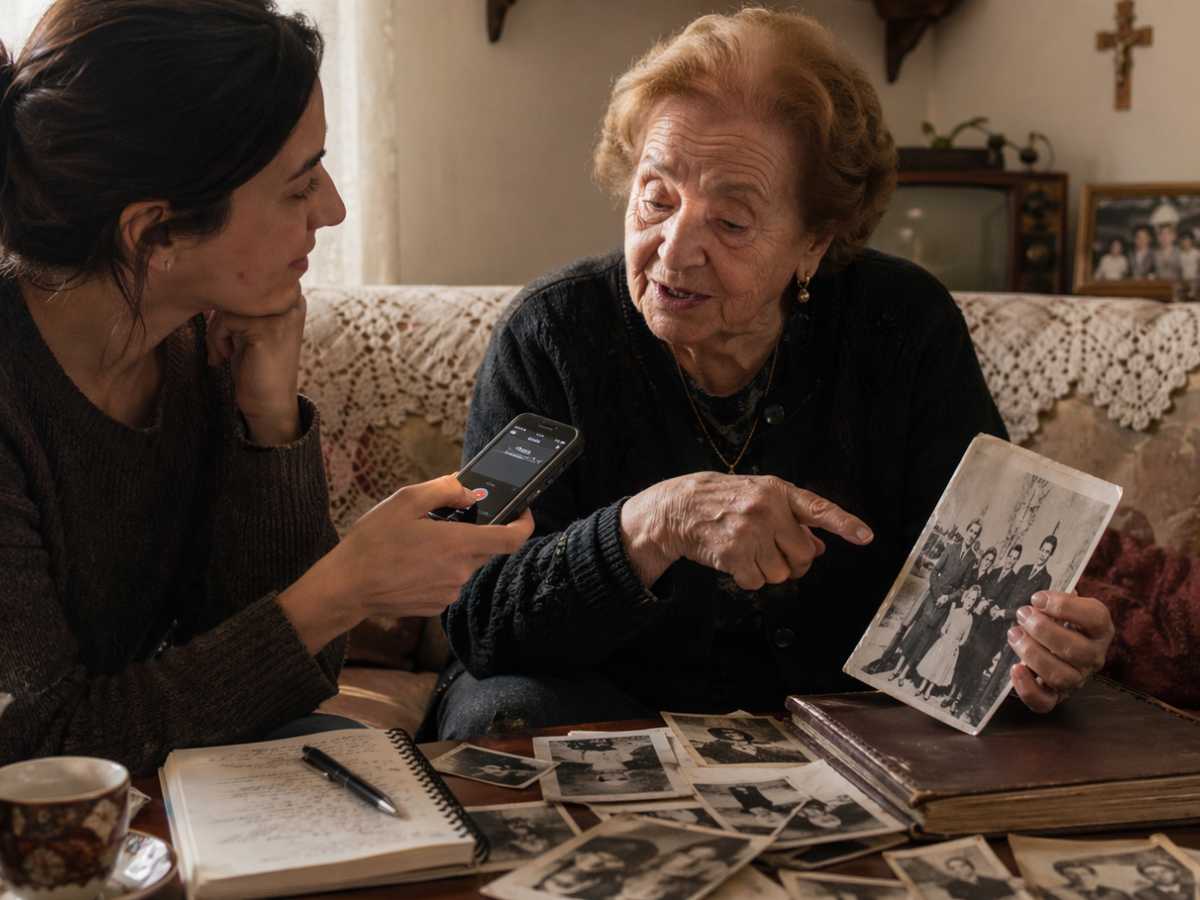
4. Bring something physical. An old photo, a prayer card, a recipe notebook, a religious medal, a kitchen object. The Smithsonian and NMAAHC both recommend visual and physical prompts to stimulate memory. One unlabeled photograph can open more than twenty questions. For how to use old photos as memory triggers, read how to use old photos to preserve your Italian family history.
5. Put your phone on the table and press record. A modern smartphone in a quiet room captures family conversation well enough for family purposes. Do a short test. Check the audio. Then put it slightly to the side and let them forget it is there. The recording that exists is infinitely better than the one you never made.
How to ask questions that open stories — not close them
This is where most family history conversations go wrong. People ask questions that can die in one word. The Smithsonian, StoryCorps, and other oral history guides all emphasize the same principle: open-ended questions invite story; closed questions invite data. Here is the difference in practice:
| Instead of this | Ask this |
|---|---|
| Did you like your childhood? | What do you remember most clearly about your childhood home — the sounds, the smells, who was there? |
| Did your parents talk about Italy? | What did your parents say about the town they came from? Did they talk about it often, or almost never? |
| Did you have family traditions? | What did Sundays look like when you were young — who was there, what was cooked, how long did people stay? |
| Was it hard when you immigrated? | When you first arrived, what surprised you most — what was nothing like you expected? |
| Were you close with your grandmother? | Tell me about your grandmother. What was she like? |
The Smithsonian also notes that how someone chooses to tell a story is often as important as the content itself. Let the pauses happen. Let them wander. Let one memory lead to another. A family story is not always linear, and the unexpected detour is sometimes where the most important material lives.
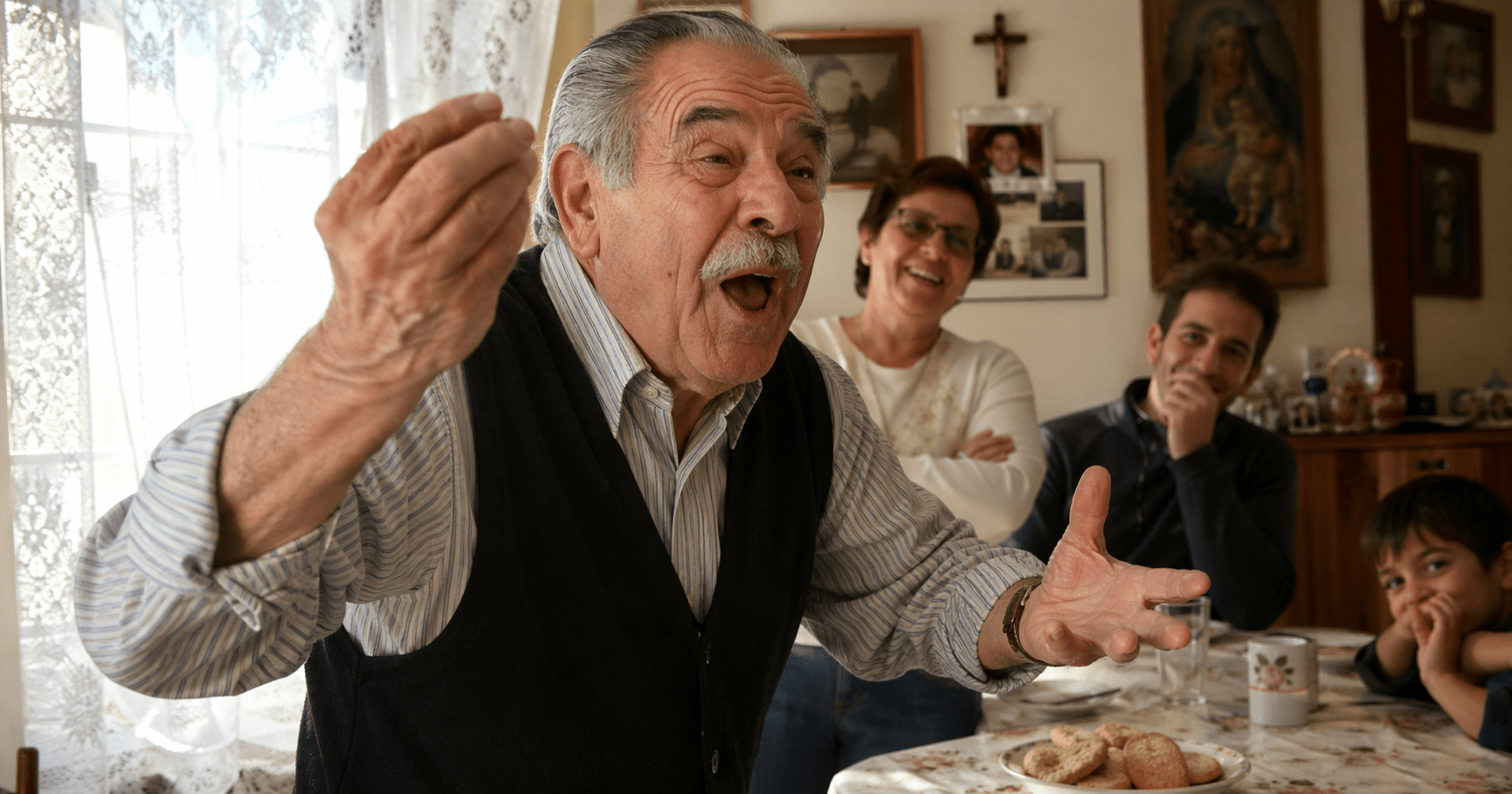
The best question I ever asked in a family history conversation was not on any list I had prepared. My grandfather had been answering my questions competently but flatly — accurate, not illuminating — and then I asked, more or less accidentally, “What is the thing from that time that you still think about?” He was quiet for a long time. Then he said something I had not expected — not a memory exactly, more like a feeling he had carried for sixty years about a specific decision made at a specific moment during the immigration period. He had never said it to anyone. Not because it was shameful or secret. Because nobody had ever asked a question that made room for it. The fact-based questions I had been asking did not make room for feelings. One different question did. That is what you are looking for. The question that makes room.
A structure that works — three phases in about an hour
StoryCorps suggests setting aside about an hour. The Smithsonian notes that interviews often become tiring after 90 minutes to two hours. A loosely three-phase structure within that hour produces the best results.
Phase one — warm up (ten minutes). Easy, familiar questions. Where were you born. What was the neighborhood like. Who was in the house when you were young. The goal is not information yet — it is opening. You are helping the person find the part of their memory where this material lives. Do not rush through this.
Phase two — the main theme (thirty to forty-five minutes). Whatever you came to talk about. Immigration. Childhood. The traditions. Follow the answers rather than the list. When something surprising or emotionally charged comes up, slow down rather than moving on. Ask the follow-up: “Tell me more about that.” “What happened after?” “What did that feel like?” Those follow-up questions are often more valuable than the opening ones.
Phase three — closing questions (ten minutes). These are often the most emotionally resonant. Ask: What do you hope the family remembers about you? What do you wish someone had asked your own parents? What family tradition do you most hope survives? What are you proud of that you have never been asked about? What do younger people not understand about what your generation actually went through?
My cousin asked her grandmother what she hoped the family would remember about her. Her grandmother was quiet for a while. Then she said she hoped they would remember that she had always tried to keep people close — that she had never let anyone in the family feel like they were on the outside looking in, no matter what had happened between them. She said she had worked at that her whole life and she did not know if she had succeeded but she had worked at it. My cousin did not know this about her grandmother. Nobody in the family knew it was something she thought about. It came out because of one closing question. That is the kind of thing that does not live in any document anywhere. It lives in the person, and if you ask the right question, they will tell you, and if you are recording when they do, it will last.
Immediately after — the preservation steps most people skip
The conversation is not the end of the work. What you do in the first hour after determines how much of it survives the next ten years.
- Rename the file immediately — not “Voice memo 47” but “Grandma_Rosa_Montreal_April2026_immigration_childhood”
- Back it up in two places right now — cloud storage and a physical drive. One backup is not a backup. Two is the minimum. NMAAHC specifically recommends making at least one backup copy immediately
- Write a short summary within the hour — who was interviewed, what topics came up, every town name and spelling mentioned, every name that surfaced, follow-up questions for next time
- Photograph any documents, photos with writing on the back, or objects that were discussed while you are still there
- Note which relatives were mentioned as holding additional knowledge — and contact them this week, not eventually
- Send a warm follow-up and one specific question within a few days while the conversation is still fresh for both of you
The Library of Congress’s personal archiving guidance makes a point worth carrying: not everyone in the family may care about this material right now. But if you preserve it well, it will be there for the cousin, child, or grandchild who will care deeply about it twenty years from now and be profoundly grateful it exists. You are not recording for yourself. You are recording for the family member who has not yet grown old enough to want this.
Common mistakes — and what they actually cost
- Trying to cover everything at once — exhausts the person and produces a scattered recording that is hard to use later. One theme per session, always
- Asking only fact-based questions — produces names and dates but loses the person. Mix factual questions with emotional and reflective ones in the same conversation
- Interrupting and correcting — shuts the story down. Even if a date is wrong, let the story finish first. The Smithsonian is explicit: the way someone tells a story matters, and interrupting changes what you get
- Waiting for the right time — this is the recorder-in-the-drawer mistake. The right time is a quiet Tuesday afternoon with coffee. It has probably already happened. Do not wait for it to happen again
- Not backing up the file — a phone that breaks, a laptop that fails, a cloud service that changes its terms. Two backups minimum. Always. Right away
- Treating it as a single event — one conversation is good. Several conversations over months or years, each focused on one theme, build an archive that is qualitatively different from a single session. Plan for return visits
The cassette recorder stayed in the drawer. The voice it was supposed to preserve is gone. The information it was supposed to hold exists now only in the softening memories of people who heard it and are themselves getting older. You are not recording for yourself. You are recording for the family member who will want this twenty years from now and be grateful beyond what they can say that someone thought to do it.
Pick the person. Pick the theme. Put the phone on the table. Say: tell me that story again — this time I’m recording it.
For the specific questions to ask once you are recording, read what to ask your grandparents about your Italian family history. For the traditions the recordings will likely uncover, explore Italian-American traditions: what changed and what stayed. For the sayings you may hear, read Italian grandparent sayings and what they really meant. And for how to keep those traditions alive with the next generation after the recording is made, read how to preserve Italian family traditions with kids today.
FAQ
What is the best way to record family stories?
A smartphone in a quiet room is sufficient for family purposes. What matters more than equipment is preparation — choosing a quiet setting, picking one theme per session, bringing physical memory triggers like old photos, using open-ended questions, and backing up the recording immediately afterward. The Smithsonian and StoryCorps both emphasize that comfort, relationship, and good questioning produce richer recordings than professional equipment used in the wrong environment.
How long should a family story recording session be?
About an hour is a strong target. StoryCorps suggests setting aside roughly one hour, and the Smithsonian notes that interviews often become tiring after 90 minutes to two hours. A focused hour on one theme produces better material than an exhausting three-hour session that tries to cover everything. Plan for multiple sessions over time rather than one comprehensive interview — each focused on a different aspect of the family story.
Should I record audio or video?
Either works well. Audio is often less intimidating and can produce a more relaxed, natural conversation because the camera is not watching. Video preserves facial expressions, gestures, and the physical presence of the person — which can be powerful for future generations. The most important factor is that the person feels comfortable enough to talk openly. If video makes them stiff or performative, audio produces better material.
What kinds of questions bring out the best family stories?
Open-ended questions that invite story rather than data. Instead of “Did you like your childhood?” ask “What do you remember most clearly about your childhood home?” Instead of “Did your parents talk about Italy?” ask “What did your parents say about the town they came from?” The Smithsonian, StoryCorps, and NMAAHC all recommend prompts that begin with “Tell me about,” “What was that like,” and “Describe.” Follow-up questions — “Tell me more about that,” “What happened after?” — are often as important as opening questions.
What should I do right after recording a family story?
Rename the file immediately with names, date, and topic. Back it up in at least two places — cloud storage and a physical drive — before doing anything else. Write a short summary of what was covered: every town name, every name that surfaced, follow-up questions for next time. Photograph any documents or objects that were discussed while you are still there. Contact any relatives mentioned as holding additional knowledge within the week. These preservation steps are not separate from the oral history process — they are part of it.
What if my parent or grandparent is reluctant to be recorded?
Start without the recording — just have the conversation, build the trust, let them see that you are genuinely interested rather than conducting an interview. Often the recording can be introduced gradually once the person feels comfortable. Some people who refuse to be recorded will consent to audio-only rather than video. And some people who initially decline become willing after a few conversations when they understand the goal is preservation rather than performance. Start with relationship. The recording follows.
Who should I record first?
The person who is oldest, whose health is most uncertain, or who holds the most unique information about the oldest generations — whichever of those criteria is most pressing in your family right now. Do not record the person who is easiest to record. Record the person whose information is most at risk of being lost. The Library of Congress frames oral history as preserving firsthand memory for the future — which means the urgency belongs with the person whose firsthand memory is most fragile.
Why is recording family stories important?
Because oral history preserves what no document can: the voice, the phrasing, the specific way someone laughed before a certain story, the emotion that surfaced when a particular name came up. The Library of Congress frames oral history as preserving firsthand experience that disappears when the person disappears. Your grandparents’ names and birth dates can be found in records. The reason they left Italy, what they missed, what they were proud of that nobody ever asked about, the specific dialect word they always used for a particular thing — that information lives only in them, and when they are gone it is gone unless someone pressed record.

Marco Ricci is an Italian-Canadian writer and the grandson of Calabrian immigrants. He created Italian Family Traditions to document the customs, feast days, and family rituals Italian families carried from Italy to North America — and to understand what they actually meant. He is based in Montreal.