Italian Family Traditions
St. Joseph’s Day: The Feast Built on a Promise
In the middle of Lent, on a cold March day, Italian families built a table piled with food — and then gave most of it away. This is the story of why.
Not every Italian feast day announces itself loudly. Christmas arrives with noise and tinsel and twelve kinds of fish. Easter builds all week like a tide coming in. But St. Joseph’s Day — March 19 — has always had a different quality. Quieter. More solemn. The kind of holiday that feels like it belongs to your grandmother more than to anyone else, and that you only fully understand years later, when she is gone and you finally think to ask what the fava beans were for.
The answer, it turns out, is everything.
The beans were for survival. The table was for gratitude. The zeppole were for joy. And the whole feast — from the shaped bread to the open door to the powdered sugar everywhere — was built on a promise somebody made to a saint during a very dark time, and kept, every year, long after the crisis had passed.
St. Joseph’s Day is not the loudest feast on the Italian calendar. It is one of the most honest.
That is why it has lasted. And that is why, even now, when most of the theology has faded and all that remains is a white bakery box of zeppole and a vague feeling that March 19 matters, the tradition is still doing its job.
Let’s tell the whole story. The one that starts with a famine and ends with powdered sugar on your shirt.
Who St. Joseph was — and why Italians trusted him so completely
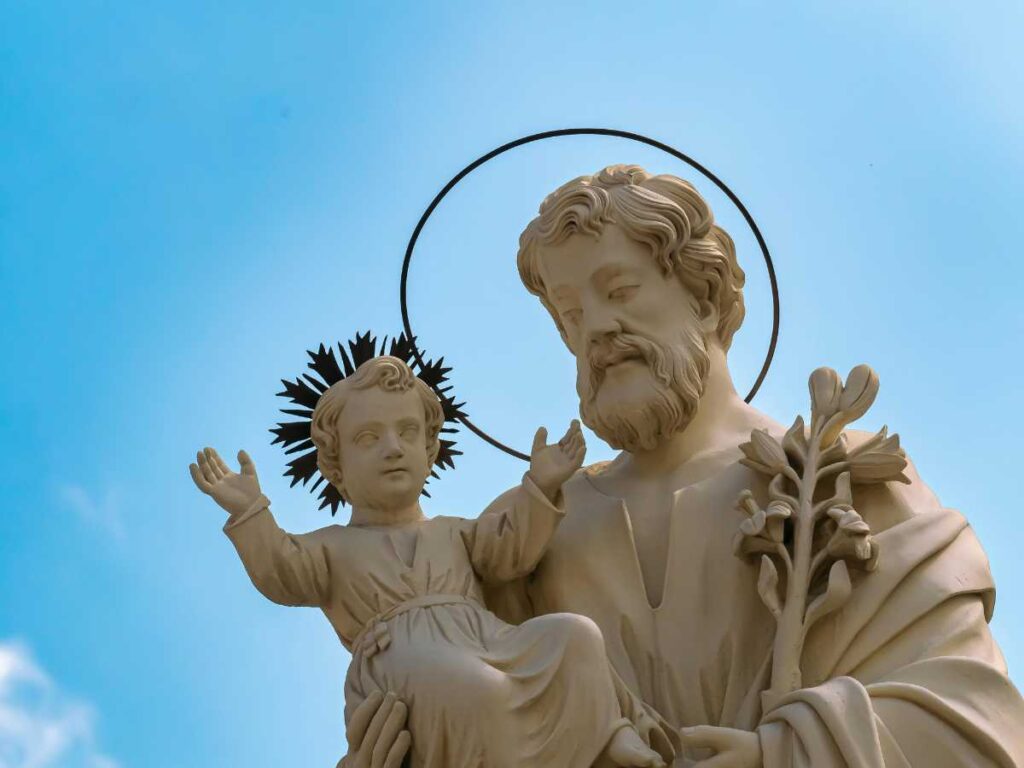
Joseph is not a flashy saint. He never gave a great sermon. He never performed a dramatic miracle on a hilltop in front of a crowd. He worked with his hands, kept his family safe, and did not make a fuss about any of it. In the Catholic calendar, March 19 is his solemnity — and Vatican sources describe him as Protector of Families, Patron Saint of Workers, and Patron of the Universal Church. The feast was officially tied to March 19 in the late 15th century and became obligatory in 1621.
That resume — families, workers, protection — tells you exactly why ordinary Italian people, especially in southern Italy and Sicily, felt so close to him. He was not the saint of kings and crusades. He was the saint of the man who woke up early, did the work, fed his family, and went to bed tired. He was the saint of the father who held things together quietly while everyone else got the credit.
My grandfather never talked about saints the way some people do — dramatically, at length. He just had a small image of San Giuseppe near the door. Every March 19, he would stop in front of it before dinner and say something I could never quite hear. He did not explain it. I did not ask. Now I wish I had asked. I think he was paying a debt nobody else remembered he owed.
In Italy, March 19 carries a second meaning that deepens everything: it is also Festa del Papà — Father’s Day. Which makes the feast simultaneously a saint’s day and a celebration of every father who ever held a family together without making a speech about it. That double meaning is very Italian. Very specific. And very moving when you sit with it.
The famine story — and why it changes how the whole feast feels
To understand St. Joseph’s Day traditions, you need to know the story that started it. Or at least the version that most Italian families have carried for generations.
There was a famine. A drought. The land was failing, the crops were gone, and people were desperate. In Sicily — and the story belongs most to Sicily — people prayed to St. Joseph. They made a promise: if you intercede for us, if the rains come, if we survive this, we will feed others in your name. We will set a table and share what we have.
The rains came. The crops survived. And the fava bean, which had endured when other crops failed, became a symbol of that rescue — lucky, humble, and indestructible in the way that only the food that saved you can be.
A woman I knew kept a small dish of dried fava beans near her kitchen door every March. Not to eat — just to have there. She said her mother had done it, and her mother before that. When I asked her what they were for, she said “luck.” When I asked her luck for what, she thought about it and said “for remembering.” I think that is exactly right. The beans are there to make you remember that someone, a long time ago, was very afraid, and then was not.
Once you know that story, everything about the feast makes a different kind of sense. The table piled with food is not abundance for its own sake. It is a promise kept. The open door is not hospitality as a social grace — it is gratitude made physical. The sharing is not generosity in the abstract. It is the direct echo of a vow: we were helped, so we help.
The whole feast is really about what happens after you survive something. You cook. You share. You remember. You do it again next year so nobody forgets.
That gives St. Joseph’s Day and its traditions an emotional weight that most food-centered holidays never quite achieve. Because the food here is not the celebration. The food is the testimony.
The St. Joseph’s Table — a promise made visible
The Table — or altar, depending on your family’s word for it — is the physical heart of the feast. And it is worth understanding what it actually was before it became a beautiful decoration.
A St. Joseph’s Table was a vow fulfilled.
Families promised to prepare one if a prayer was answered: a sick child recovered, a husband came home from war, a pregnancy ended safely, work was found after months without it. The table was not thrown together the night before because it seemed like a nice tradition. It was prepared in thanksgiving for something specific. Something that had genuinely frightened the family and then relented. The Library of Congress describes St. Joseph’s Day traditions & tables in Sicilian-American communities as a charitable feast offered to honor the saint, open to anyone, with food also given to charity.
That last part is important enough to say slowly.
Open to anyone.
The table was not a private family dinner. It was a public act of gratitude. Neighbors came through. The poor were welcome. Food went outward. Louisiana Folklife documents the same tradition in Sicilian communities where altars in private homes were publicly visited and shared — which means a family that had been helped was now the family doing the helping, and doing it in front of the whole community.
My great-aunt hosted a St. Joseph’s Table twice in her life. Once when my great-uncle came back from the war. Once when her youngest son recovered from something the doctors had not been optimistic about. She did not explain either table in religious terms when she talked about them. She just said: “I made a promise, and I kept it.” The table was the keeping. Everybody in the neighborhood knew that when they walked through her door.
What the symbols on the table actually meant
Every element on a proper St. Joseph’s Table was there for a reason. None of it was decorative in the shallow sense — each piece was doing theological, historical, or emotional work.
| Symbol | What it meant |
|---|---|
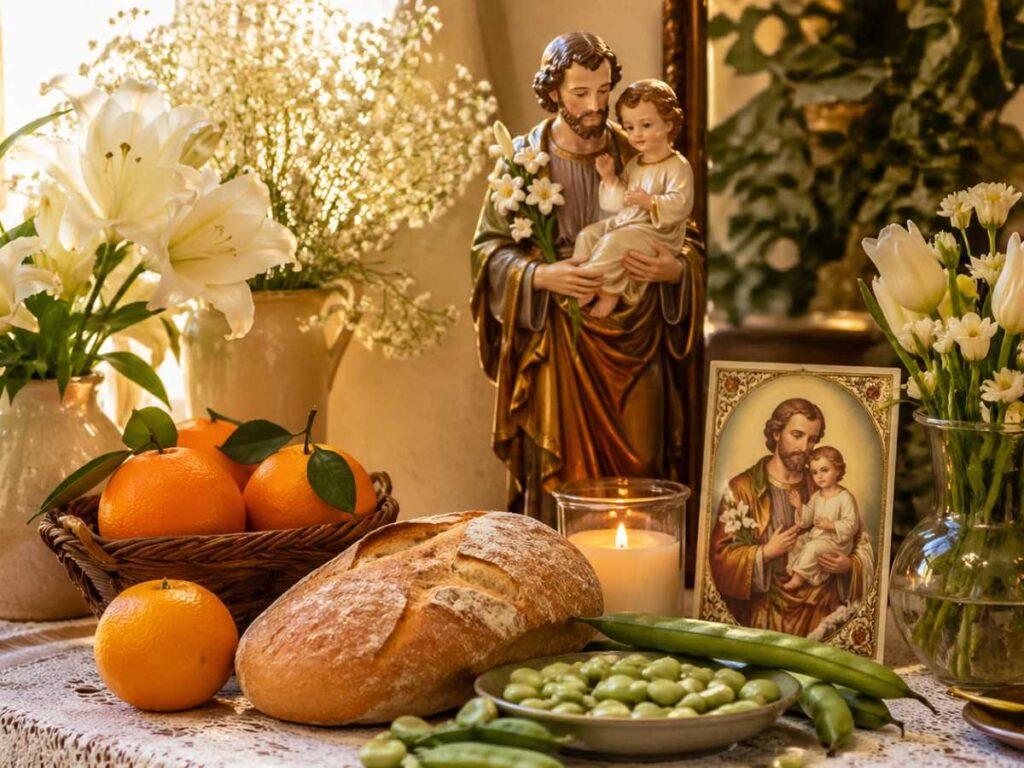
| Breadcrumbs | Joseph was a carpenter. Breadcrumbs stand in for sawdust from his workshop — a humble detail that keeps him close to ordinary work and ordinary people. |
| Fava beans | The crop that survived the famine. Still given out as tokens of luck on the feast day. To receive one is to carry a little piece of the rescue story home with you. |
| Citrus and flowers | Spring, abundance, renewal. The feast lands in March — the whole table says winter is over and the earth is generous again. |
| Shaped breads | Crosses, crooks, lambs, wreaths — each form carries its own meaning. Baked by hand, offered to the saint, shared with every guest who comes through the door. |
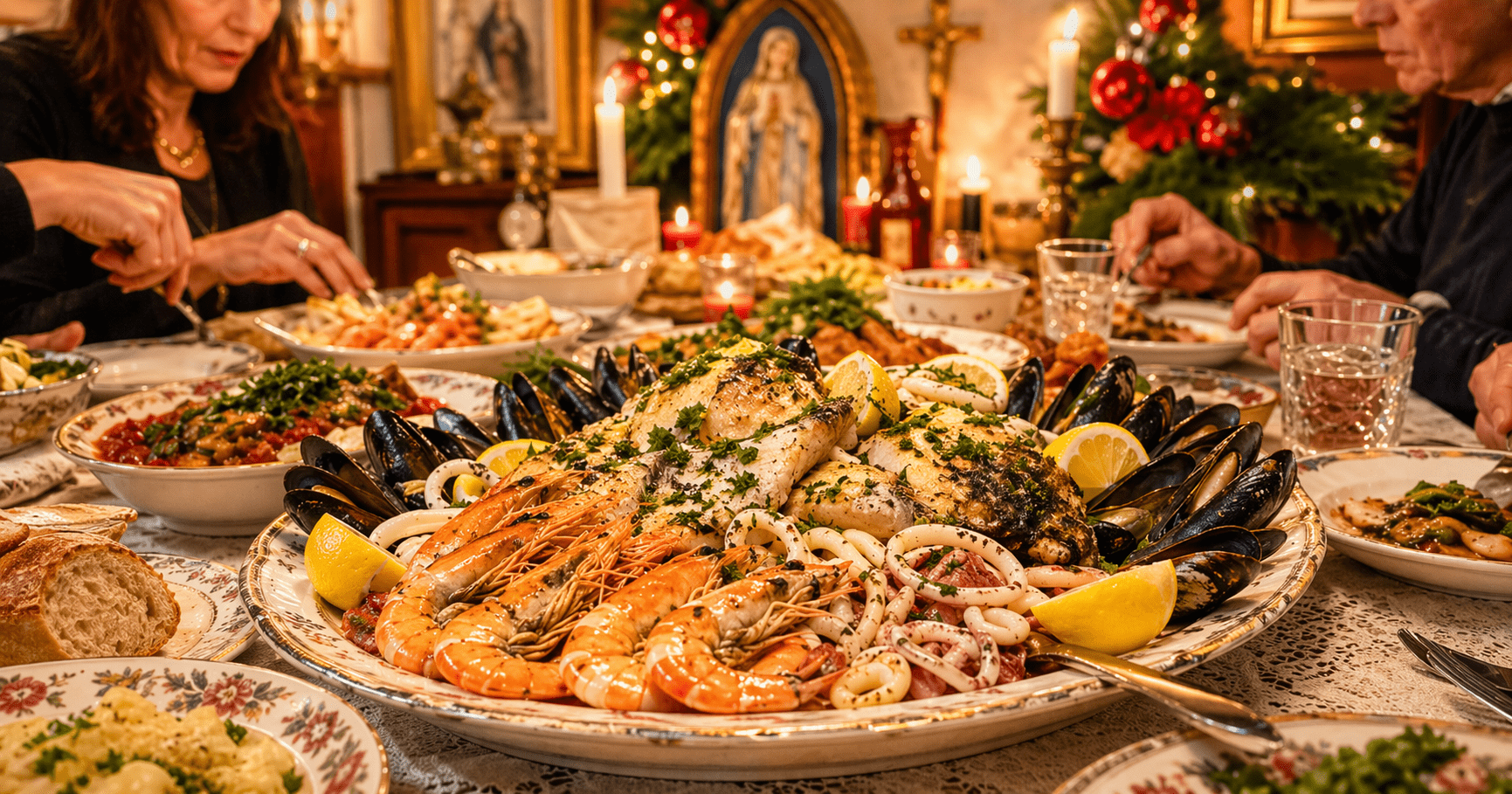
| Fish, no meat | The feast falls in Lent. The table is meatless — but still generous. A very Italian solution: keep the rule and cook magnificently anyway. |
| Candles and the saint | The image or statue of St. Joseph presides over everything. The candles say: this meal is an offering, not just dinner. |
There were also communities that reenacted the search for shelter — Mary and Joseph being turned away before they are finally welcomed in — which turned the feast into something theatrical, communal, and deeply moving. Italian-American accounts of the feast still describe this ritual hospitality very vividly: the door opened, the family received, the table shared. The same story the feast was built on, performed again in a living room in Montreal or Brooklyn or New Orleans or Pueblo, Colorado.
Now, the zeppole — because they have earned their moment
We have talked about famine and promises and carpenter’s sawdust. Now we can talk about the thing everyone actually looks forward to.
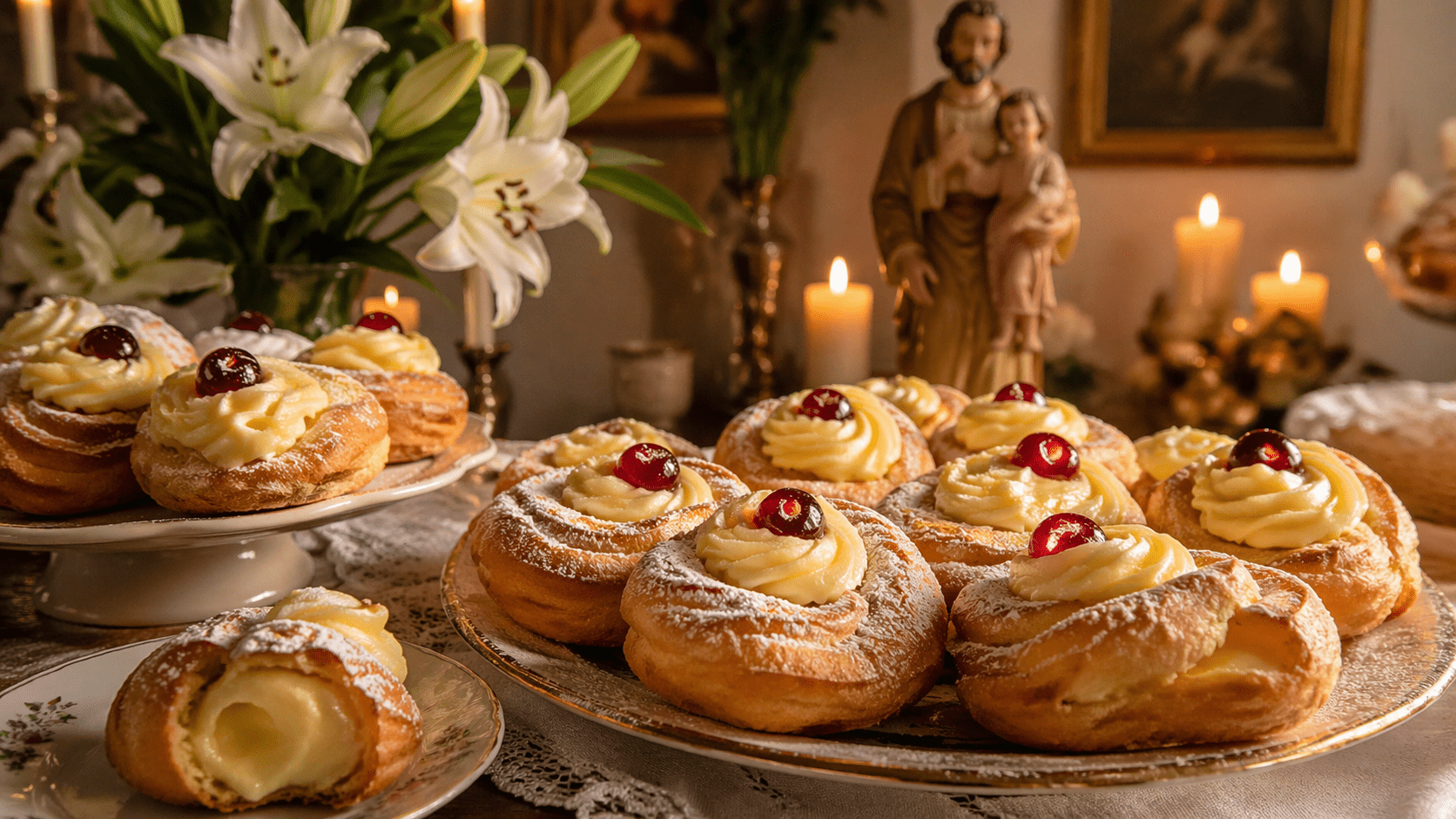
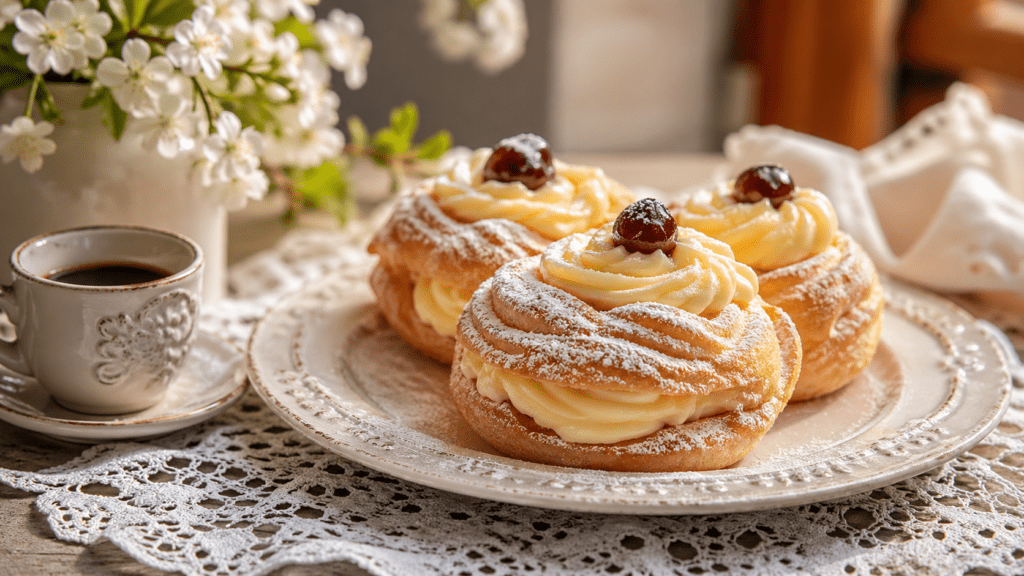
Zeppole di San Giuseppe are one of the signature pastries of March 19 and of Father’s Day in Italy — ring-shaped, fried or baked, filled or crowned with pastry cream, dusted with powdered sugar, and finished with a dark amarena cherry that sits on top like it knows exactly how important it is. Multiple Italian sources describe them as the classic pastry of the feast. They are not a subtle dessert. They are an announcement.
Every March 19, my grandmother would bring home a flat white box tied with string from the Italian bakery on the corner, and she would set it on the counter without opening it — for hours, through the whole meal — which required a level of collective willpower I still find impressive. When she finally opened the box the table went quiet in that specific way it only does when something is genuinely worth waiting for. The zeppole were always slightly too large, slightly too rich, and completely perfect. I have never once had one as good since she stopped making the trip.
Their history is delightfully tangled, which suits them. One modern Italian source says the zeppole di San Giuseppe known today were likely formalized in Naples in the 19th century before spreading through Italy. Older legends connect them to ancient fried wheat sweets, spring bonfires, or even to the Holy Family’s flight into Egypt, when Joseph supposedly sold fried sweets to support the family. Those older stories are legend, not documented history — but they are the right kind of legend. They explain why this particular pastry feels sacred in a way that no other March dessert manages.
A zeppola is not just a pastry. It is the feast’s permission slip. When it arrives on the table, March 19 is officially real.
And then there is the Sicilian wrinkle, which matters enormously if your family is from Palermo or western Sicily: the classic St. Joseph’s day traditions sweet there is often the sfincia di San Giuseppe, not the Neapolitan-style zeppola. La Cucina Italiana describes it as a large fried beignet topped with sweetened ricotta, chocolate, pistachios, candied fruit, and cherries — a richer, more elaborate construction with roots deep in Sicilian pastry tradition.
Which means that somewhere in North America right now, there are two Italian-American cousins having the exact same argument their grandmothers had, about which pastry is correct.
They are both correct. That is also very Italian.
How the feast crossed the ocean — and what survived
When Sicilian and southern Italian families came to North America, they brought San Giuseppe with them the way you carry something you are afraid to put down even for a moment.
The altar tradition traveled remarkably well. The Library of Congress documents Sicilian immigrants in Pueblo, Colorado maintaining St. Joseph’s Day traditions and tables as communal charitable feasts. Louisiana Folklife records how Sicilian families in New Orleans and Baton Rouge kept the custom alive for decades in private homes and churches. Italian Sons and Daughters of America notes the tradition became established across New York, Colorado, Louisiana, California, and Texas.
That spread matters. This was not a custom that stayed politely in Little Italy and went nowhere. It moved. It took root. It rebuilt itself in church basements and private dining rooms and front parlors in cities that had never heard of Sicily until the ships started arriving.
My grandmother’s neighbor — not Italian, not Catholic, not anything close — was invited to a St. Joseph’s Table in the 1960s by the Sicilian family next door. She told me about it fifty years later. She remembered the statue. She remembered the bread shapes. She remembered being handed a fava bean at the door and told to keep it for luck. She still had it. In a small dish on her windowsill. She could not have told you a single thing about the theology. She remembered that she had been welcomed, and that the food was extraordinary, and that she felt the weight of something old and serious in that room. That is tradition doing exactly what it is supposed to do.
What got thinner after immigration was the ritual architecture around the feast. The specific vow. The public charitable dimension. The community procession. The full symbolic language of the table. In many families, the feast narrowed from a communal act of gratitude into a family dinner with a specific pastry. Italian Sons and Daughters of America notes that the altar custom is now less common in some places, especially outside older Sicilian circles.
But the thread did not break. A zeppola from the bakery. A saint card on the refrigerator. A dish of fava beans on the counter. An aunt who still knows what the breadcrumbs mean. One grandmother who still sets out flowers. That is enough to keep the feast alive. Not fully. But enough.
How to keep St. Joseph’s Day traditions alive — really, today, in your house
Much like other feast-day traditions (think San Giovanni), here is the truth about traditions like this one: they do not need to be perfect to be real. They need to be intentional.
You do not need a museum-quality altar. You do not need to bake your own bread into cross shapes at midnight. You do not need to host the entire neighborhood. What you need is to stop treating March 19 like any other Tuesday.
- Set out a small table with flowers, a candle, bread, and a picture of the saint — even a simple one
- Put out fava beans and tell your children the story of why they are lucky
- Cook one meatless dish, even if it is simple — observe the Lenten side of the feast
- Get the zeppole — homemade or from the bakery, both count
- Invite somebody over, or send food to somebody who needs it — the charitable dimension is the heart of the whole thing
- Tell the famine story, even in a few sentences, so the feast is not just food
- If your family made a vow at some point — if there was a St. Joseph’s Table prepared for a specific reason — find out what it was and say it out loud at dinner
- Write any of this down before the person who remembers it is no longer here to ask
The danger with heritage traditions is not only that we stop doing them. It is that we keep doing them without knowing why. St. Joseph’s Day without the famine story is just a pastry. With the story, it is something else entirely.
And if your St. Joseph’s Day traditions have already narrowed to one white bakery box of zeppole — that is not nothing. That box still lands on a specific day for a specific reason, and everyone at the table knows it. The thread is still there. You just have to pull it a little further.
Under the powdered sugar and the fava beans and the shaped bread and the open door, St. Joseph’s Day traditions were always saying one thing: we were helped, so we give. We do this again every year so nobody forgets.
That is heritage with backbone. And zeppole on top.
If you love feast-day traditions that combine food, devotion, and family identity, read Italian Easter traditions and the Feast of San Giovanni.
St. Joseph is the patron of workers, fathers, and a peaceful death — find the right saint for any need in the patron saint finder, or pray a novena to him.
FAQ
What is St. Joseph’s Day in Italy?
St. Joseph’s Day is celebrated on March 19 and honors Joseph, the husband of Mary and earthly father of Jesus. In Italy, it doubles as Father’s Day — Festa del Papà — giving the feast both a religious and a deeply domestic dimension. The Vatican describes St. Joseph as Protector of Families and Patron of Workers, which tells you exactly why ordinary Italian families felt so close to him.
Why is St. Joseph so important in Italian tradition?
He is the saint of steady, quiet people doing hard work without recognition. In Sicily and southern Italy especially, his feast is inseparable from the famine story — the belief that he interceded during a time of great suffering and that the response to that help is the feast itself: cook, share, give. He is not a dramatic saint. He is a reliable one, which may be exactly what families needed most.
What is a St. Joseph’s Table?
A St. Joseph’s Table or altar is a food offering prepared in thanksgiving after a prayer was answered — a recovery, a safe return, a pregnancy, a job. It is meant to be shared with others, including strangers, and often includes a charitable dimension. The Library of Congress documents the tradition in Sicilian-American communities as a communal feast open to anyone, with food given to charity. It is a promise made visible.
Why do Italians eat zeppole on St. Joseph’s Day?
Zeppole di San Giuseppe are the classic pastry of March 19 and of Father’s Day in Italy — ring-shaped, filled with pastry cream, dusted with sugar, crowned with an amarena cherry. Their documented history is tied to Naples in the 19th century, though older legends connect them to ancient fried sweets and popular devotion to St. Joseph. Whatever their precise origin, they have become the edible signature of the day: if you see them, you know it is March 19.
Are zeppole and sfingi the same thing?
Not quite. In many Italian-American families the terms overlap, but regionally they are distinct. The Neapolitan-style St. Joseph pastry is the zeppola — lighter, often baked or fried, filled with pastry cream. In Palermo and western Sicily, the famous St. Joseph sweet is the sfincia — a larger fried beignet topped with sweetened ricotta, chocolate, pistachios, candied fruit, and cherries. Both are extraordinary. Arguments about which is correct are traditional and ongoing.
How can I keep St. Joseph’s Day traditions alive with my family?
Start with one intentional thing: a small altar, a meatless meal, fava beans on the table, zeppole from the bakery, food shared with someone who needs it, or the famine story told at dinner. What matters most is keeping the meaning alive — gratitude, hospitality, the idea that if you have been helped, you help others. The rest follows naturally from that.

Marco Ricci is an Italian-Canadian writer and the grandson of Calabrian immigrants. He created Italian Family Traditions to document the customs, feast days, and family rituals Italian families carried from Italy to North America — and to understand what they actually meant. He is based in Montreal.