Italian Family Traditions
Feast of San Giovanni: The Italian Tradition Behind June 24
June 24 was never just a saint’s day on a calendar. It was a summer threshold, a night of flowers in water, and — if your grandfather happened to be named Giovanni — the one day of the year when “we’ll see” was not an acceptable answer.
My grandfather’s name was Giovanni. In Montreal, in a family that still took feast days seriously, that meant June 24 was never an abstract entry on a saint’s calendar. It was a date that had weight. It had planning. It had a phone call that came a week ahead — not quite a formal summons but close enough that you understood the difference between an invitation and an expectation. Were you available? Were you coming? Did you understand that “we’ll see” was not a real answer?
My grandfather never asked these questions directly himself. He did not have to. Other family members handled that part. He simply waited, in the way that older Italian men of a certain generation waited for things they knew were coming — without anxiety, without demanding, with a settled confidence that the people who should be there would be there, because they understood what the day was.
And we were always there.
San Giovanni was never only the Church’s feast. It was also Nonno Giovanni’s day. And those two things somehow made each other stronger.
That is the particular beauty of Italian feast days — the way the liturgical and the personal blur together until you cannot quite separate them. The saint’s day gives the family day its gravity. The family day gives the saint’s day its warmth. And the whole thing survives, generation after generation, because it is felt rather than explained.
This is the full story of San Giovanni — the saint, the summer night, the herbs in water, the walnuts, the regional variations, and what it all meant when it crossed the ocean and became something new in cities far from Italy.
This feast makes even more sense when you see how food, faith, and family stayed central in Italian-American traditions after immigration.
What the Feast of San Giovanni actually is

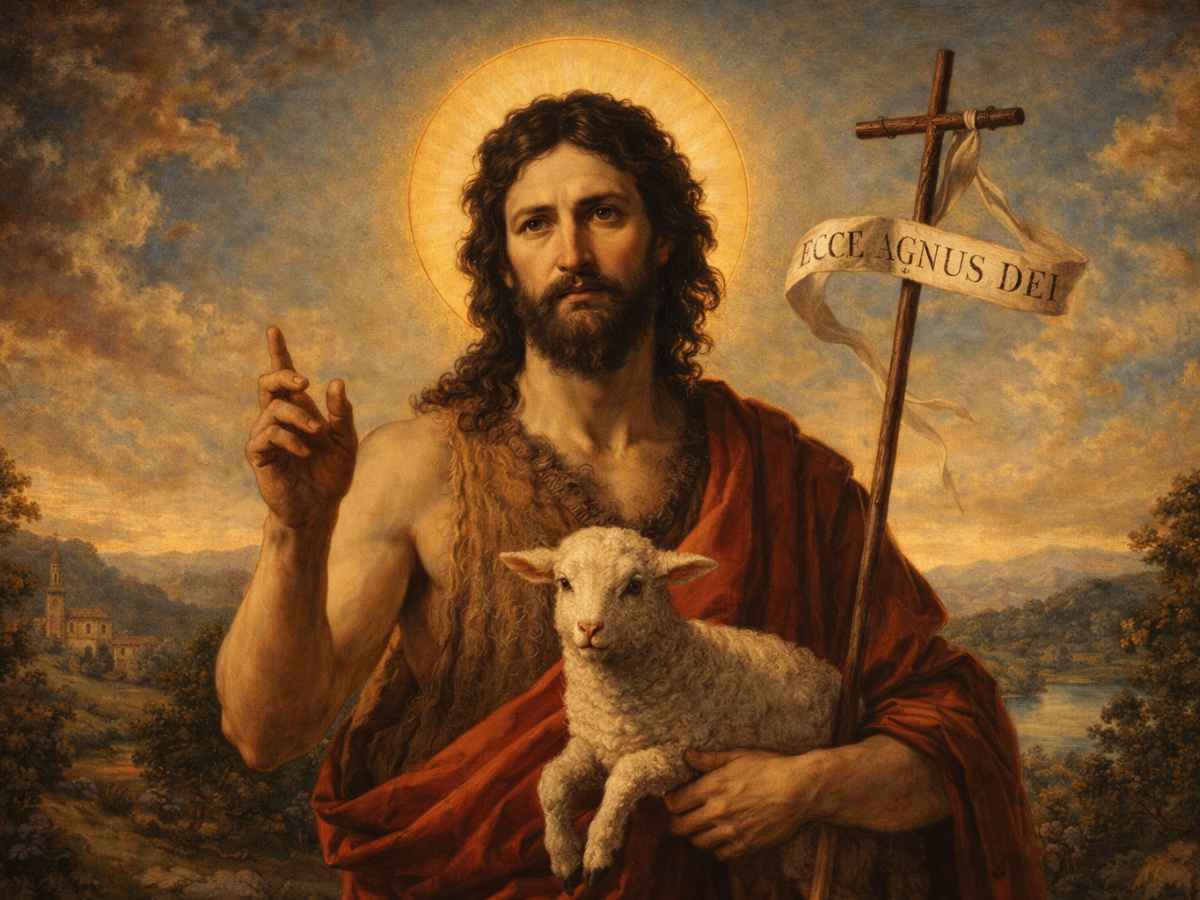
At the most basic level, the Feast of San Giovanni is the June 24 solemnity of the Nativity of Saint John the Baptist. Santiebeati gives the feast directly as June 24 and calls it a solemnity. Vatican News marks the same date and presents John the Baptist as the precursor — the one who prepared the way, the voice in the wilderness that announced what was coming.
That already makes it unusual in the Catholic calendar. Most saints are celebrated on the day of their death, understood as their birth into eternal life. John the Baptist is different. Santiebeati explicitly notes that he is the only saint, besides Mary, whose earthly birth the Church celebrates liturgically. Not his martyrdom — his birth. The beginning of his life on earth rather than the end of it.
That distinction matters because it changes the feeling of the feast. Most saints’ days carry the weight of sacrifice and death transformed into glory. San Giovanni carries something different — the energy of arrival, of preparation, of something beginning. John was born to point toward someone else. His feast is the celebration of a beginning that was itself a beginning.
My grandfather had been named Giovanni after his own grandfather, who had been born on June 24. That kind of naming — the child born on the saint’s day who carries the saint’s name forever after — was not unusual in southern Italian families. It meant the feast day and the birthday were one and the same. Three reasons to celebrate compressed into one, and the family treated all three simultaneously, with an enthusiasm that was entirely appropriate to the occasion.
Love these Italian traditions?
Get new stories about Italian customs, folk beliefs, and family traditions — plus our free printable calendar of the Italian year.
The onomastico — why the name day mattered as much as the birthday
Before going further into the feast itself, it is worth understanding the tradition that gave San Giovanni so much of its personal weight in Italian families: the onomastico — the name day.
In Italian culture, every name on the Catholic calendar has its feast day, and the person who carries that name celebrates on that day. The onomastico was not a birthday — it was something different, and in many traditional Italian families it was treated with equal or greater seriousness than the birthday itself. Birthdays were private, biological, about the individual. The onomastico was communal, calendar-based, connected to a saint and therefore to something larger than the person.
On your onomastico, people called. They visited. They brought something — a bottle of wine, a cake, flowers, or simply themselves. The person being honored received attention with the specific warmth that Italian families reserve for occasions that carry genuine meaning. And critically, the attention came not because the person had done something to earn it that year, but simply because of who they were and what name they carried. There is something beautiful about that logic. You are honored not for achievement but for identity.
My grandfather never made a fuss about his onomastico in the sense of demanding attention. He simply became slightly more available on June 24. He might sit in the garden rather than working in it. He might accept a second glass of wine without the usual mild protest. He received the phone calls and visits with a dignity that was itself a kind of ceremony — the dignity of a man who understood that this day had his name on it and that receiving the family’s attention properly was part of honoring the occasion. He was not performing gratitude. He was inhabiting the day correctly.
In a family with a Giovanni, the onomastico and the feast of San Giovanni were the same day, which doubled its significance. The religious calendar and the family calendar coincided. The saint’s name and the grandfather’s name were the same. June 24 was not just another day on the liturgical year — it was his day, confirmed by centuries of Catholic tradition, and the family treated it accordingly.
For Italian-American and Italian-Canadian families who maintained the onomastico tradition, it was one of the clearest surviving expressions of the old country’s relationship between faith and family. You did not need to be deeply devout to observe it. You just needed to know the name, know the date, and show up.
Why June 24 — and why the night before matters as much as the day
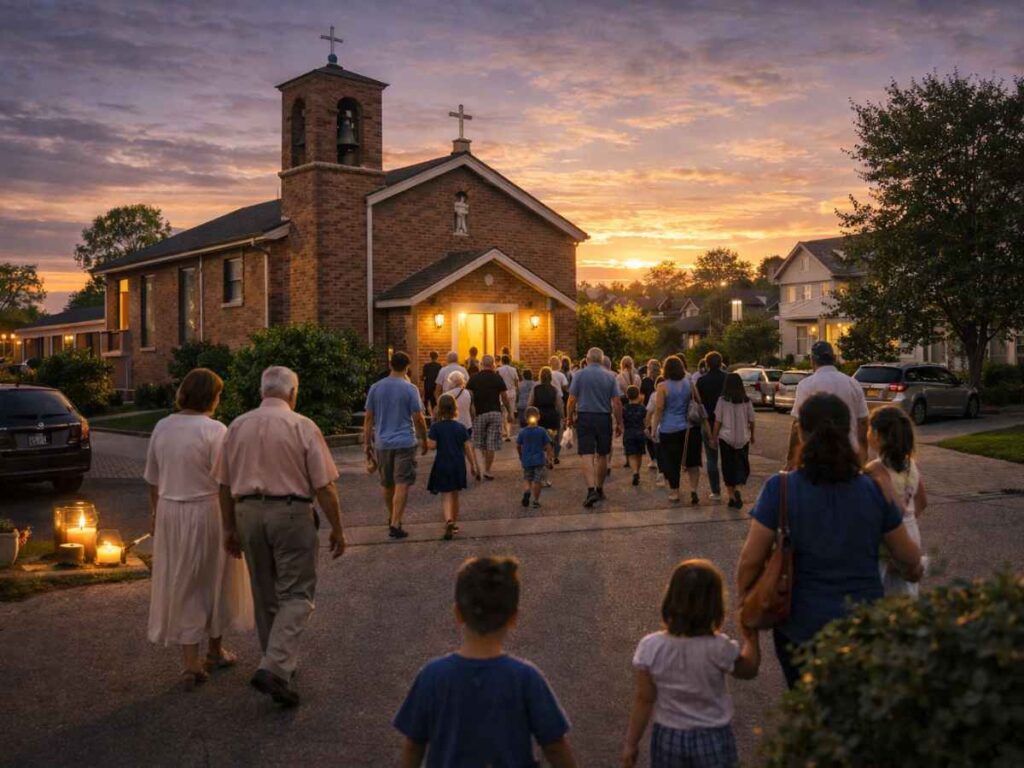
June 24 sits very close to the summer solstice, and that is not coincidental to how the feast gathered its particular atmosphere. The night before — the night between June 23 and 24 — is still widely known in Italy as one of the most symbolically charged nights of the entire year. Multiple cultural sources describe it as a moment where Christian observance and much older seasonal rites overlapped so completely that it became impossible to separate them cleanly.
The saint is Catholic. The feast is liturgical. But the atmosphere around the eve of the feast carries older logic entirely — the logic of midsummer, of the longest light, of nature at its peak, of herbs and dew and fire and the ancient human instinct to mark a seasonal threshold with ritual. Vatican News’ feature on the feast describes it as “richissima di tradizioni” — extraordinarily rich in popular traditions — and notes the ancient beliefs and symbols that have gathered around the night over centuries.
It was not just “today is June 24.” It was “tonight means something.” And the family responded to that meaning without needing it explained.
The rituals of the night — what families actually did
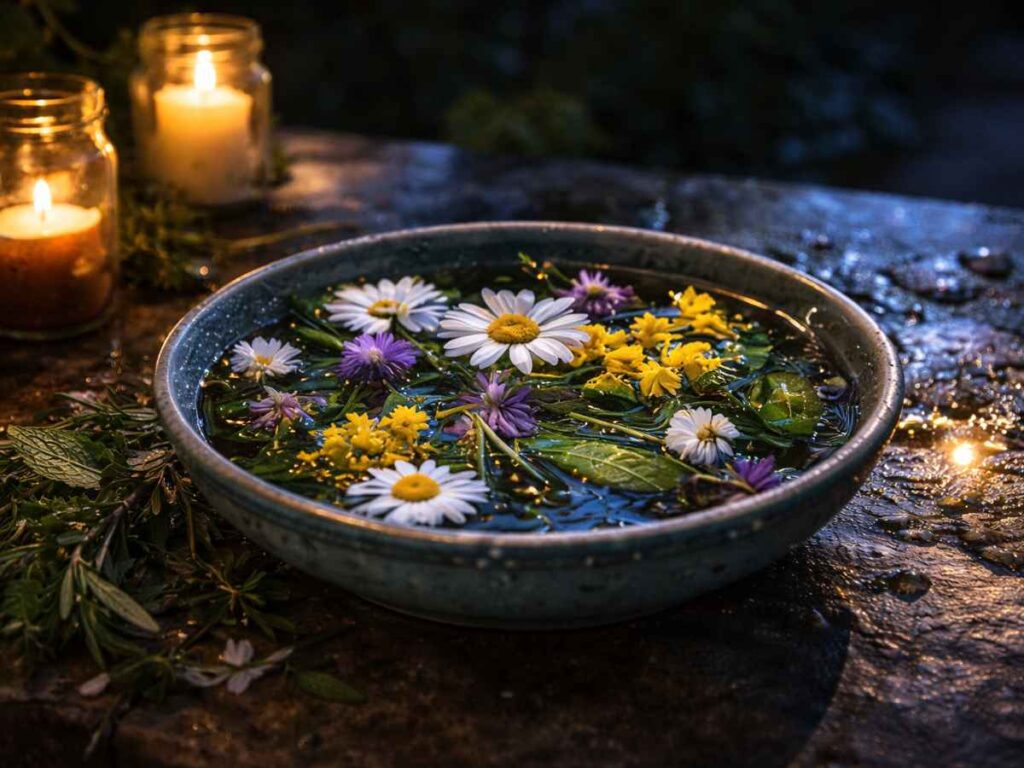
The rituals of San Giovanni were not grand or complicated. They were domestic, sensory, and deeply connected to the natural world at midsummer. That is partly why they survived for so long — they required nothing more than attention to the season and a willingness to repeat the gesture.
| Tradition | What it was and what it meant |
|---|---|
| Acqua di San Giovanni | Flowers and herbs left in a bowl of water outdoors overnight. Used the next morning to wash the face for protection, beauty, and renewal. The most widely practiced San Giovanni tradition across Italy and the diaspora. |
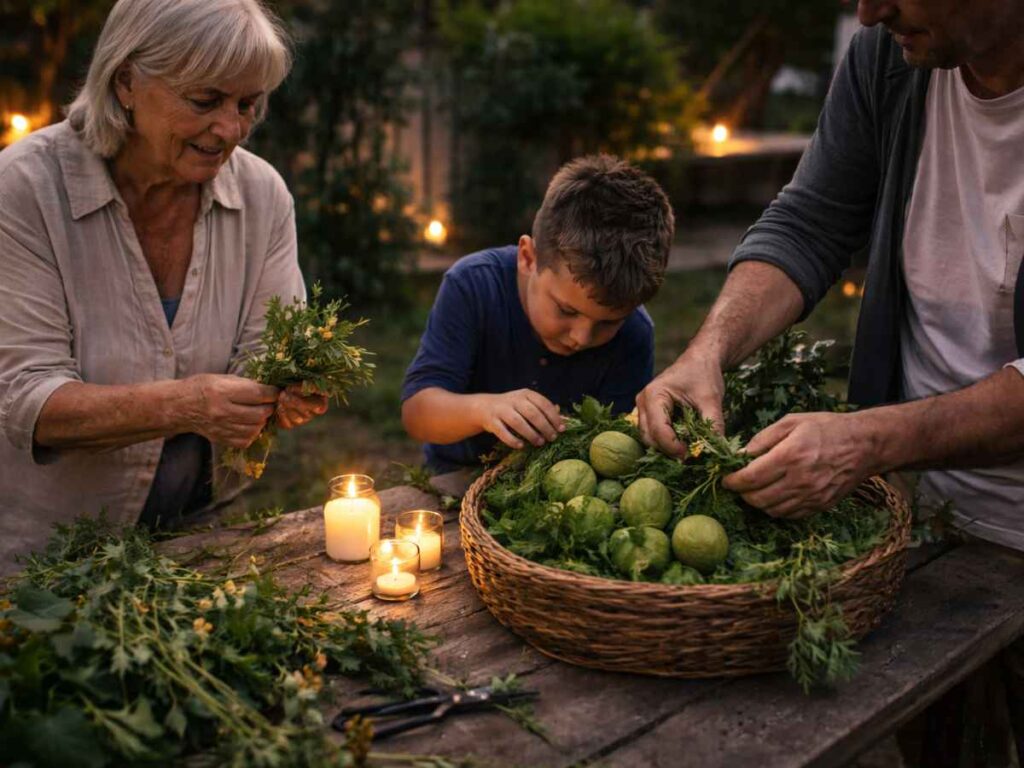
| Green walnut gathering | Unripe walnuts gathered specifically around June 24 for making nocino — the dark walnut liqueur that would be ready by November. From one saint’s feast to another, connected by a jar of walnuts in a dark cantina. |
| Herb gathering | Herbs collected at midsummer were believed to be especially potent. Rosemary, lavender, St. John’s wort — gathered, dried, and used for protection and healing through the year. |
| Bonfires | In some regions, bonfires on the eve of June 24 marked the summer threshold — purification through fire, the old midsummer rite dressed in a saint’s name. |
| The dew | Morning dew on San Giovanni was considered especially powerful — collected from grass or flowers and used for healing and protection through the summer. |
| Nocino | The dark walnut liqueur begun on San Giovanni — forty green walnuts, forty days steeping, then months aging. Deep, bitter, intensely Italian. Ready by November. A gift from one saint’s day to another. |
How to make Acqua di San Giovanni — the step by step
Acqua di San Giovanni is the most practiced and most portable of all the San Giovanni traditions. Here is exactly how it works:
- On the evening of June 23 — gather wildflowers and herbs. Traditionally these include rose petals, lavender, rosemary, chamomile, mint, and whatever else is blooming near you. The specific flowers matter less than the intention and the season.
- Fill a wide bowl with water — a ceramic or terracotta bowl is traditional but any bowl works. Place the flowers and herbs in the water.
- Leave it outside overnight — on a balcony, windowsill, garden step, or anywhere it can gather the night air, the dew, and the moonlight. The outdoor placement is essential to the ritual.
- On the morning of June 24 — bring the bowl in. Use the water to wash your face as a gesture of blessing, protection, and renewal for the year ahead.
- While you wash — say the name of the saint, say the names of the people you want to protect, or simply be quiet and present with the gesture. The ritual works through repetition and intention, not through complexity.
My wife’s grandmother did this every year until she was very old. Not in Italy — in a flat in Toronto, with herbs from her kitchen windowsill and flowers from whatever was blooming in the building’s courtyard in late June. She put the bowl on the balcony on the night of the 23rd. She brought it in the next morning. She used the water to wash her face. She never explained this to her grandchildren in theological terms. She just did it, and they watched her do it, and eventually some of them started doing it too — not because they had been instructed to, but because they had seen it enough times that it felt like something that belonged to late June in the same way that certain smells belong to certain seasons. That is how the best traditions survive. Not through explanation. Through witnessing.
Erba di San Giovanni — St. John’s wort and why it belongs to this night
Of all the herbs associated with San Giovanni, one carries the saint’s name itself: erba di San Giovanni — St. John’s wort, known botanically as Hypericum perforatum. This is not a coincidence. The plant blooms at midsummer, precisely around the feast of June 24, which is why it acquired the saint’s name in the first place. In Italian folk tradition, erba di San Giovanni was gathered on the eve of the feast when it was believed to be at its most powerful — charged by the midsummer light and the specific sacred quality of the night.
The Botanical Garden of Padua notes that St. John’s wort is tied to midsummer and local protective traditions. In Italian folk medicine, the plant was used for healing, for protection against negative forces, and for its association with light at the darkest and brightest points of the year. The bright yellow flowers, blooming at the peak of summer light, made it a natural symbol for the feast of a saint whose whole role was to be a light pointing toward greater light.
Families that gathered herbs on San Giovanni night almost always included erba di San Giovanni among them. Dried and hung in the kitchen or doorway, it served both a practical function — the plant has real medicinal properties that have been documented for centuries — and a symbolic one, marking the house as a place that had observed the feast properly and received its protection.
How to make nocino — from San Giovanni to San Martino
Nocino is one of the most specifically Italian products of the San Giovanni season — a dark, bittersweet walnut liqueur that begins on June 24 and ends, traditionally, when it is first drunk on San Martino’s Day, November 11. The tradition runs from one saint to another across the full arc of summer, autumn, and the approach of winter.
The process is straightforward but requires patience, which is itself very Italian:
- Gather forty green walnuts on or around June 24 — they must be unripe, the shell not yet hardened, soft enough to pierce with a knife. The number forty is traditional and symbolic.
- Quarter the walnuts and place them in a large glass jar with one litre of grain alcohol or vodka, along with spices — typically cinnamon, cloves, and sometimes lemon zest or vanilla, depending on the family recipe.
- Seal and leave in the sun for forty days, shaking occasionally. The liquid will turn a deep, almost black brown as the tannins from the walnuts infuse into the alcohol.
- After forty days — around early August — strain the liquid, add a sugar syrup, and bottle it. Then leave it to age in a dark place for at least another two to three months.
- Open it on San Martino’s Day — November 11 — as tradition dictates. Pour a small glass. Taste what the summer has become. That continuity, from one saint’s feast to another, is the whole point.
Nocino tastes like nothing else — intensely bitter, warming, dark, with a complexity that takes most people by surprise. Once you have made it yourself, from walnuts gathered on San Giovanni, you will never quite look at November 11 the same way. The two feast days become linked in your personal experience of the Italian calendar year.
What families ate — and why it was always different depending on where they came from
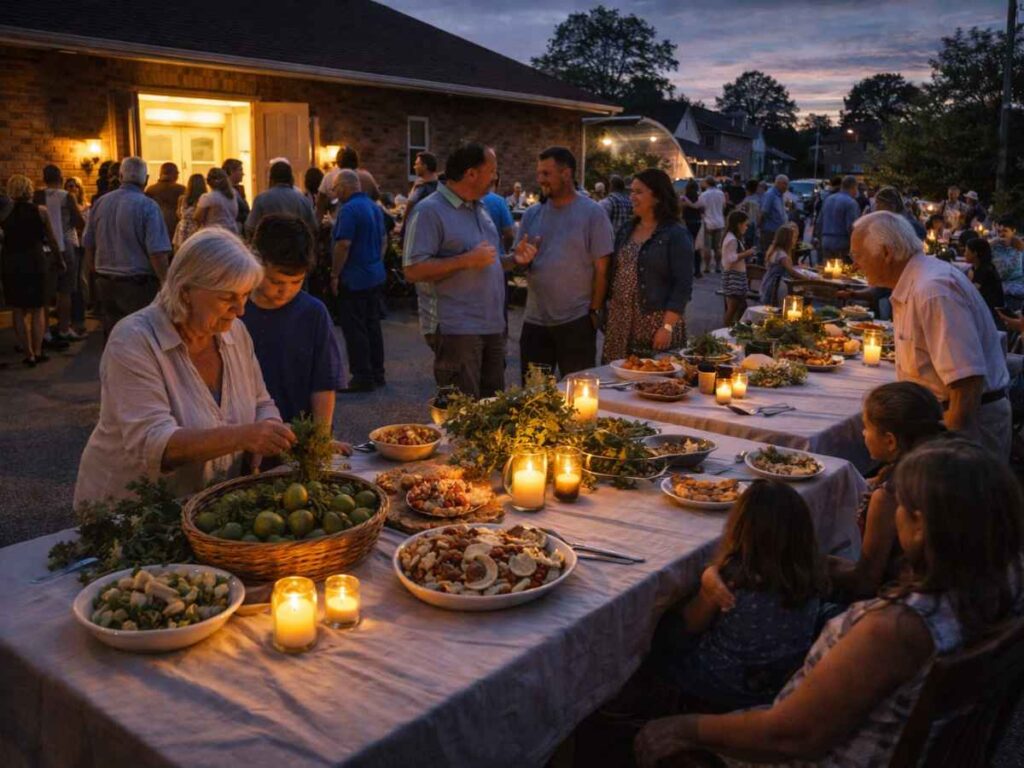
Like almost everything in Italian food culture, what people ate on San Giovanni varied enormously by region. There is no single national San Giovanni menu. Instead, the feast gathered very specific local customs around it — dishes that belonged to particular cities or valleys and nowhere else.
In Parma, tortelli verdi — the filled fresh pasta made with greens — are traditionally eaten on the night of San Giovanni. In Rome, Tourism Rome documents an older custom of eating snails on the eve of the feast, tied to the city’s specific San Giovanni legends and the neighborhood celebrations that once transformed the area around the basilica. Those two examples alone — tortelli in Parma, snails in Rome — tell you everything about Italian regional food culture. The same feast. The same saint. The same date. Completely different table. And both completely convinced that their version is the correct one.
In our Montreal version, the food on Giovanni’s day was simpler in its logic. It was whatever he liked best. Whatever he had been thinking about, or mentioned wanting, or would be surprised and pleased to find on the table. The feast day became a vehicle for expressing care through food — not historically authenticated, not regionally specific, just specific to him. Which is arguably the most Italian approach of all.
How the feast looked across different cities
One of the most interesting things about San Giovanni is how completely it transforms depending on where you are standing when the date arrives.
Florence — the city that made it a spectacle
In Florence, San Giovanni Battista is the city’s patron saint, and June 24 is one of the great civic occasions of the Florentine year. Visit Tuscany describes the full program: a historical parade through the city in medieval and Renaissance costume, a solemn offering of candles at the Baptistery, Mass, and then — most extraordinarily — the final match of Calcio Storico Fiorentino.
Calcio Storico deserves its own moment of explanation for anyone who has not encountered it. It is a form of football that predates modern soccer by centuries, played in the Piazza Santa Croce on a sand pitch, in which four teams representing Florence’s historic neighborhoods — wearing sixteenth century historical costume — compete in a game that is part football, part wrestling, and entirely unlike anything else on earth. There are fifty players per side. There are almost no rules. Punching is permitted. It is extraordinarily violent and extraordinarily beautiful and it has been played continuously since 1530. On San Giovanni’s night, the winning team is celebrated across the city with the same intensity other cities reserve for championship sport.
Then come the famous fochi di San Giovanni — the fireworks over the Arno that light the Florentine sky as darkness falls. Watched from rooftops, bridges, and the streets themselves, embedded in the city rather than observed from a safe distance. Florence makes San Giovanni into a full public spectacle that belongs to the city as much as to the Church.
I once watched the San Giovanni fireworks from a rooftop in Florence. What struck me was not the visual spectacle — though it was extraordinary — but the sound of the city around it. People were watching from inside the city, because it was their feast and their night. I thought about my grandfather watching the same sky from a different country, in a different June, in a city that was not Florence. The saint was the same. The night was the same. Everything else was different. Both versions were real.
Rome — the city that gave it legends
Rome carried a completely different atmosphere. Tourism Rome documents how until the late nineteenth century, San Giovanni was one of the city’s major public holidays — beginning on the eve with what became known as the “night of the witches,” tied to old legends about Herodias and Salome, the figures connected to the Baptist’s death. The celebration in Rome had an edge of darkness and legend to it that the Florentine version — civic, magnificent, patron-saint-proud — did not quite share.
Turin, Genoa, and beyond — the patron’s wider reach
Florence is not the only major Italian city that claims John the Baptist as patron. Turin — Torino — also honors San Giovanni as its patron saint, and the feast there carries its own civic significance. Genoa has historic connections to the Baptist as well. For families whose roots lie in these cities, San Giovanni was never simply a national feast day — it was their city’s day, the day that belonged to them specifically in the way that patron saint feasts belong to the places that claim them. If you have Torinese or Genovese heritage and June 24 felt especially significant in your family, now you know exactly why.
What survived the ocean — the small things that never needed a piazza
When Italian families came to North America, the great civic spectacles of San Giovanni stayed in Italy. The Florence fireworks stayed in Florence. The Roman snail tradition stayed in Rome. The Calcio Storico stayed in the Piazza Santa Croce. These things are bound to specific places, specific streets, specific centuries of accumulated local meaning. They cannot be transplanted.
What could travel — and did — were the household customs. The small, domestic, nature-based rituals that required nothing more than a bowl, some flowers, a handful of herbs, and the intention to repeat what the person before you had done. Acqua di San Giovanni traveled. The walnut gathering traveled wherever walnut trees could be found. The onomastico traveled with every family that had a Giovanni in it.
The huge public spectacle fades. The bowl on the kitchen table remains. And that may be the most beautiful form of survival.
After my grandfather Giovanni died, the first San Giovanni without him was strange in a way that was hard to describe. The feast still existed. June 24 still came. But the center of gravity was gone. We had gathered for years around his name day — not to honor the saint exactly, or not only the saint — but to honor him through the saint. When he was gone, we had to figure out what the day meant without that specific person at the middle of it. My mother made Acqua di San Giovanni that year for the first time. She put the flowers out the night before. She said it was something his mother had done, which he had mentioned once, years ago, in passing. She had remembered it. The bowl on the balcony was her way of keeping something of him in the day even after he was no longer in it. I have not forgotten that.
That story says everything about how traditions survive immigration and loss and time. They shift shape. They find new carriers. They sometimes go quiet for a generation and then come back through a single person who remembered one detail — a bowl of flowers, a phrase, a gesture seen once and never forgotten — and decided to repeat it.
How to keep the spirit of San Giovanni alive today
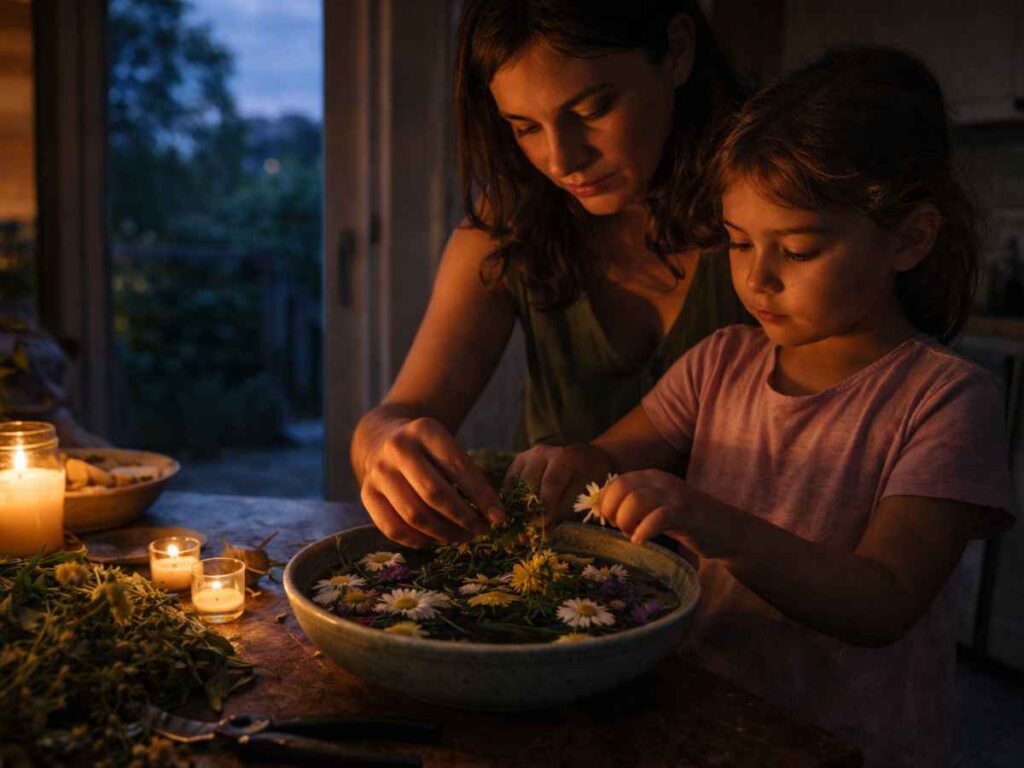
The good news about San Giovanni is that it is one of the easiest Italian feast days to keep alive, because its most essential traditions require almost nothing in the way of preparation or expense.
- Make Acqua di San Giovanni on the evening of June 23 — gather wildflowers and herbs, place them in a bowl of water, leave it outside overnight, use the water to wash your face the next morning. Take thirty seconds to explain what it is to whoever is watching
- If you have access to green walnuts in late June, gather forty of them on or around San Giovanni and begin a batch of nocino — it will be ready by November, a gift from one saint’s day to another
- Look for erba di San Giovanni — St. John’s wort — blooming near you in late June. Gather a small bunch, dry it, and hang it in the kitchen. It belonged to this night for centuries and it is easy to find
- Honor the onomastico — if you have a Giovanni, a Gianni, a Jean, a John, or any variation in your family, treat June 24 as their name day with the seriousness it deserves. Call ahead. Show up. Make the dinner deliberate
- Cook something specific for the occasion — tortelli if your family has northern Italian roots, or whatever the Giovanni in your life would have chosen
- Tell the story — whatever your family’s version of San Giovanni was, tell it. Even if the version is simply “our grandfather was named Giovanni and this was his day,” that is a story worth passing forward
The saint arrived six months before Christmas, pointing toward something greater. The summer night around his feast was charged with herbs and dew and fire and the old human desire to mark a threshold properly. And in families where someone was named Giovanni, the day became the most personal kind of feast — the one where the saint and the grandfather blurred together, and both were honored at the same table.
Not only because of the calendar. Because of who was waiting for you to arrive.
For another Italian feast day where food, faith, and family come together in exactly this way, read St. Joseph’s Day traditions and the meaning of the feast. And if you want to understand the protective folk customs that surrounded nights like this one, read what malocchio is and how Italian families protected themselves through the year.
FAQ
What is the Feast of San Giovanni in Italy?
The Feast of San Giovanni is the June 24 solemnity of the Nativity of Saint John the Baptist — one of the most important feast days in the Catholic calendar and one of the most symbolically rich nights in Italian popular tradition. Santiebeati lists it as a solemnity on June 24. In Italian family life it was also the name day — the onomastico — for every Giovanni, Gianni, and variant, which meant the saint’s feast and a deeply personal family celebration occupied the same day.
What is an onomastico in Italian tradition?
The onomastico is the Italian name day — the feast day of the saint whose name you carry. In traditional Italian family culture, the onomastico was often treated with equal or greater seriousness than a birthday. On your name day, people called, visited, and brought attention. The occasion was not about individual achievement but about identity — who you were and what name you carried. For anyone named Giovanni, the onomastico fell on June 24, the feast of John the Baptist.
Why is San Giovanni celebrated on June 24?
Because June 24 is the liturgical solemnity of the birth of Saint John the Baptist. Santiebeati notes that John is one of the only saints, besides Mary, whose earthly birth is celebrated by the Church rather than the date of death. This makes the feast unusual — it celebrates a beginning rather than a martyrdom — and its proximity to the summer solstice gave it additional seasonal significance that gathered centuries of folk tradition around it.
What is the Night of San Giovanni?
The Night of San Giovanni is the eve between June 23 and 24 — a night traditionally filled across many parts of Italy with folk customs involving herbs, dew, flowers, water, bonfires, and protective rites. Vatican News describes the feast as extraordinarily rich in popular traditions. The night sits very close to the summer solstice and gathered both Christian observance and much older seasonal rites around it, giving it a character that feels simultaneously sacred and ancient.
What is Acqua di San Giovanni?
Acqua di San Giovanni is the most widespread San Giovanni tradition — a bowl of water filled with wildflowers and herbs, left outside overnight on the eve of June 24 so it gathers dew. The water is then used the next morning to wash the face as a sign of blessing, protection, beauty, and renewal. It requires nothing more than a bowl, some flowers and herbs, and the willingness to leave them outside overnight. That simplicity is probably why it has survived for centuries.
What is erba di San Giovanni?
Erba di San Giovanni is the Italian name for St. John’s wort — Hypericum perforatum — a plant that blooms at midsummer, precisely around June 24, which is why it acquired the saint’s name. In Italian folk tradition it was gathered on the eve of the feast when it was believed to be most powerful, and used for healing, protection, and its association with the midsummer light. It is one of the most specifically Italian connections between the feast and the natural world.
Why are walnuts gathered on San Giovanni?
Green walnuts are traditionally gathered on or around San Giovanni for making nocino — the dark, bittersweet walnut liqueur associated especially with central and northern Italy. The walnuts must be unripe and gathered at midsummer, steeped in alcohol with spices for forty days, then aged until November. Traditionally nocino is first drunk on San Martino’s Day — November 11 — completing a seasonal arc that runs from one saint’s feast to another across the whole arc of summer and autumn.
What is nocino and how is it made?
Nocino is a dark Italian walnut liqueur made from forty green walnuts gathered around San Giovanni, steeped in grain alcohol or vodka with spices for forty days, then sweetened with sugar syrup and aged for at least two to three months. The result is intensely bitter, warming, and complex — unlike anything else. It is one of the most satisfying things you can make from the Italian seasonal calendar, and beginning it on June 24 connects you to a tradition that has linked San Giovanni and San Martino across the Italian year for generations.
How is San Giovanni celebrated in Florence?
Florence celebrates San Giovanni as the feast of its patron saint with one of the great civic occasions of the Florentine year — a historical parade, a solemn offering of candles at the Baptistery, Mass, and the final match of Calcio Storico Fiorentino. Calcio Storico is a form of football played since 1530, with fifty players per side in sixteenth century costume, in which punching is permitted and almost no other rules apply. It is followed by the famous fochi di San Giovanni fireworks over the Arno. Visit Tuscany documents the full programme. Florence makes San Giovanni into a full public spectacle that belongs to the whole city.
What did Italian-American families keep from San Giovanni traditions?
The civic spectacles tied to specific Italian cities generally did not cross the ocean intact. What survived most reliably were the small household customs — the Acqua di San Giovanni water ritual, the walnut gathering for nocino, the herb collecting including erba di San Giovanni, and above all the onomastico observance for every family member named Giovanni. These portable, domestic traditions required no piazza and no procession — just a bowl, some flowers, and the willingness to say the name out loud and treat the day as something that mattered.

Marco Ricci is an Italian-Canadian writer and the grandson of Calabrian immigrants. He created Italian Family Traditions to document the customs, feast days, and family rituals Italian families carried from Italy to North America — and to understand what they actually meant. He is based in Montreal.