Italian Family Traditions
The Italian Mother-in-Law — La Suocera, Explained
She shows up unannounced. She prunes your plants without asking. She fills your fridge when it’s already full. She once hit me with a shoe. And I know — with absolute certainty — that every bit of it is love.
7 minute read
Let me tell you about the shoe.
I don’t remember what I did. I’m sure I deserved it — or at least, she was sure I deserved it, which in an Italian household amounts to the same thing. What I remember is the speed. One moment she was standing there, talking. The next moment the shoe was off her foot and in the air and connecting with some part of me before I had time to form the thought she is throwing a shoe at me.
She is not a violent woman. She is, in fact, one of the most loving people I know. But she is an Italian mother-in-law — a suocera — and an Italian suocera loves you with an intensity that occasionally, under the right conditions, expresses itself through footwear.
I should clarify something: I get it from both sides. I am both a grandson and a son-in-law, and both women — my grandmother and my wife’s mother — operate from the same playbook. The same unannounced visits. The same unsolicited opinions. The same food arriving whether or not you asked for it. It is not a coincidence. It is a cultural institution, and it has rules as firm as any I’ve written about on this site.
The Short Version
The Italian mother-in-law — la suocera — is not a stereotype. She is a force: opinionated, unannounced, relentless in her feeding, and impossible to argue with. She judges your cooking, rearranges your house, prunes your garden, and shows up with food when your fridge is already full. She drives you slightly mad. And underneath every uninvited visit, every unsolicited opinion, and every shoe thrown in frustration is a love so fierce it doesn’t know how to sit still.
What’s in this guide
- Who la suocera really is
- The unannounced arrival
- The food — always the food
- The judging
- Your house is her house
- You need patience
- The baby — her territory
- What’s underneath all of it
- FAQ
Who la suocera really is
The Italian mother-in-law is not a person who married into your life. She is a person who considers your life an extension of hers — and manages it accordingly.
La suocera. The word itself carries weight. In Italian families, the mother-in-law occupies a role that goes far beyond the English definition. She is not a background relative who appears at holidays. She is present — physically, emotionally, and operationally — in your daily life, whether you invited her into it or not. And you did not invite her. She simply arrived.
This is because the Italian suocera does not believe in boundaries the way the modern world understands them. She does not believe your household is separate from hers. She does not believe your kitchen is your own. She does not believe that her job ended when her child grew up and married. In her understanding, her job expanded — because now there are more people to look after, and looking after people is what she does. It is what the Italian nonna has always done, and the suocera is simply the nonna before she earns the softer title.
The unannounced arrival
An Italian mother-in-law does not call ahead. Calling ahead implies she needs permission to enter your life, and she does not accept that premise.
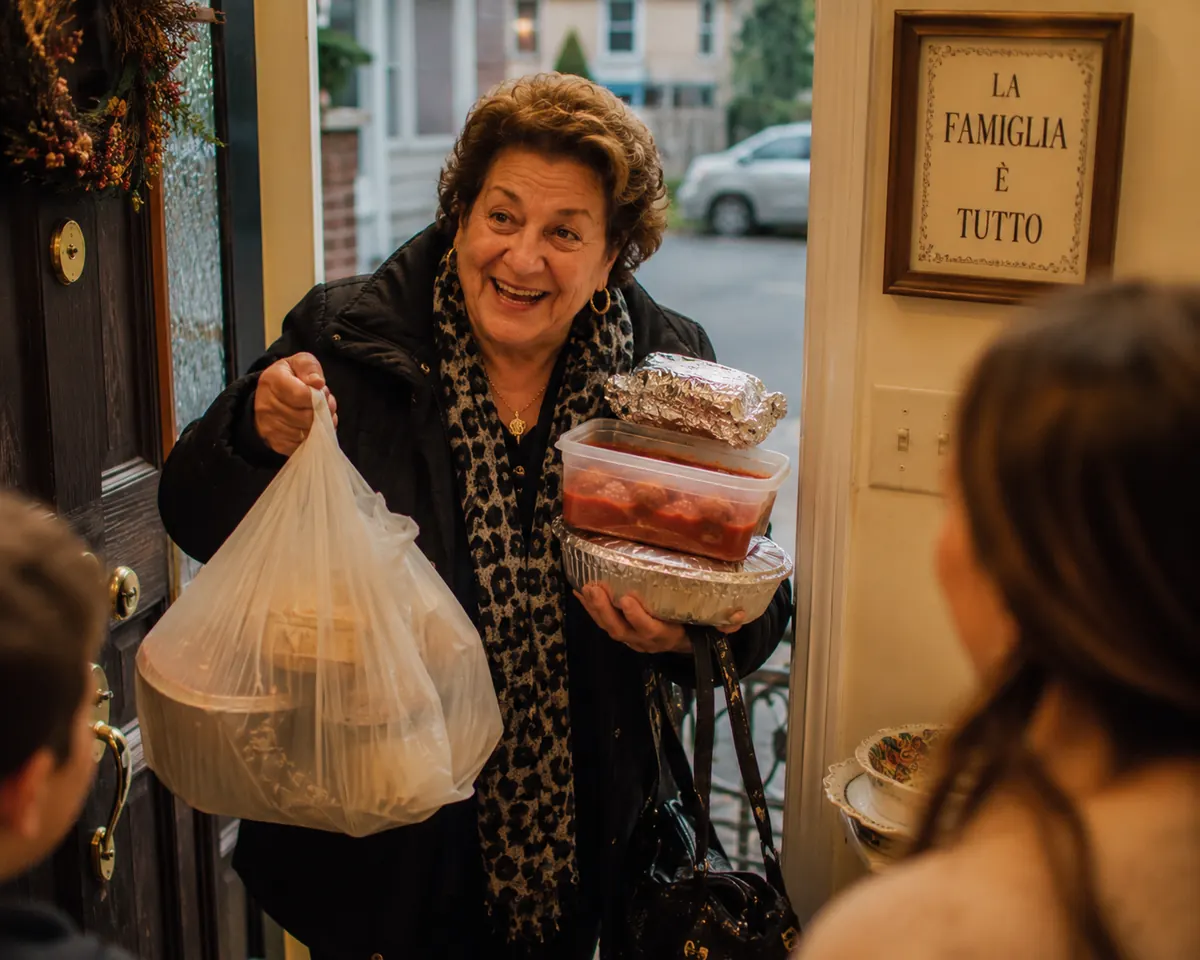
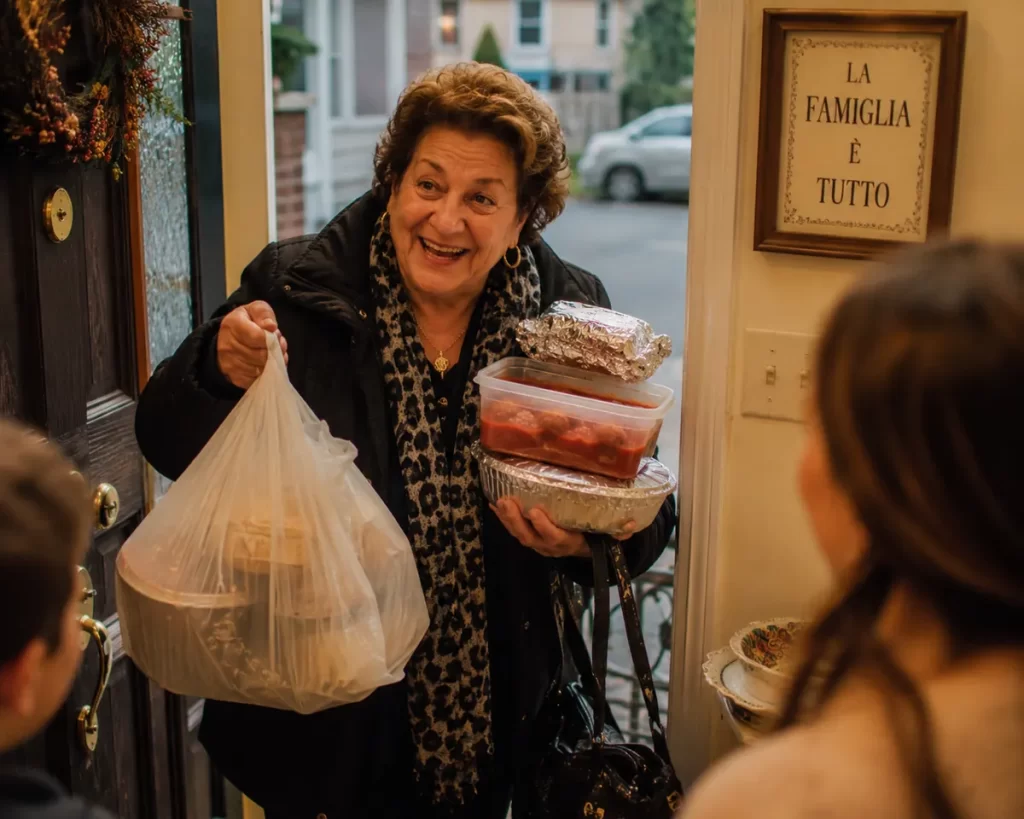
She shows up. The doorbell rings or — more commonly — the door simply opens, because she has a key, or because she tried the handle and it was unlocked and that was invitation enough. She is carrying bags. She is already talking. She is in your kitchen before you have finished processing the fact that she is in your house.
This is not rudeness. To her, it is closeness. The idea that family should announce themselves before visiting is, in the Italian understanding, a sign of coldness — of distance that should not exist between people who love each other. You do not knock on the door of your own family’s house. And your house is her family’s house, whether the deed has her name on it or not.
She doesn’t knock. She doesn’t call. She arrives — because family does not need an appointment.
Love these Italian traditions?
Get new stories about Italian customs, folk beliefs, and family traditions — plus our free printable calendar of the Italian year.
The food — always the food
An Italian mother-in-law expresses love primarily through food — and she does not care that your fridge is already full.
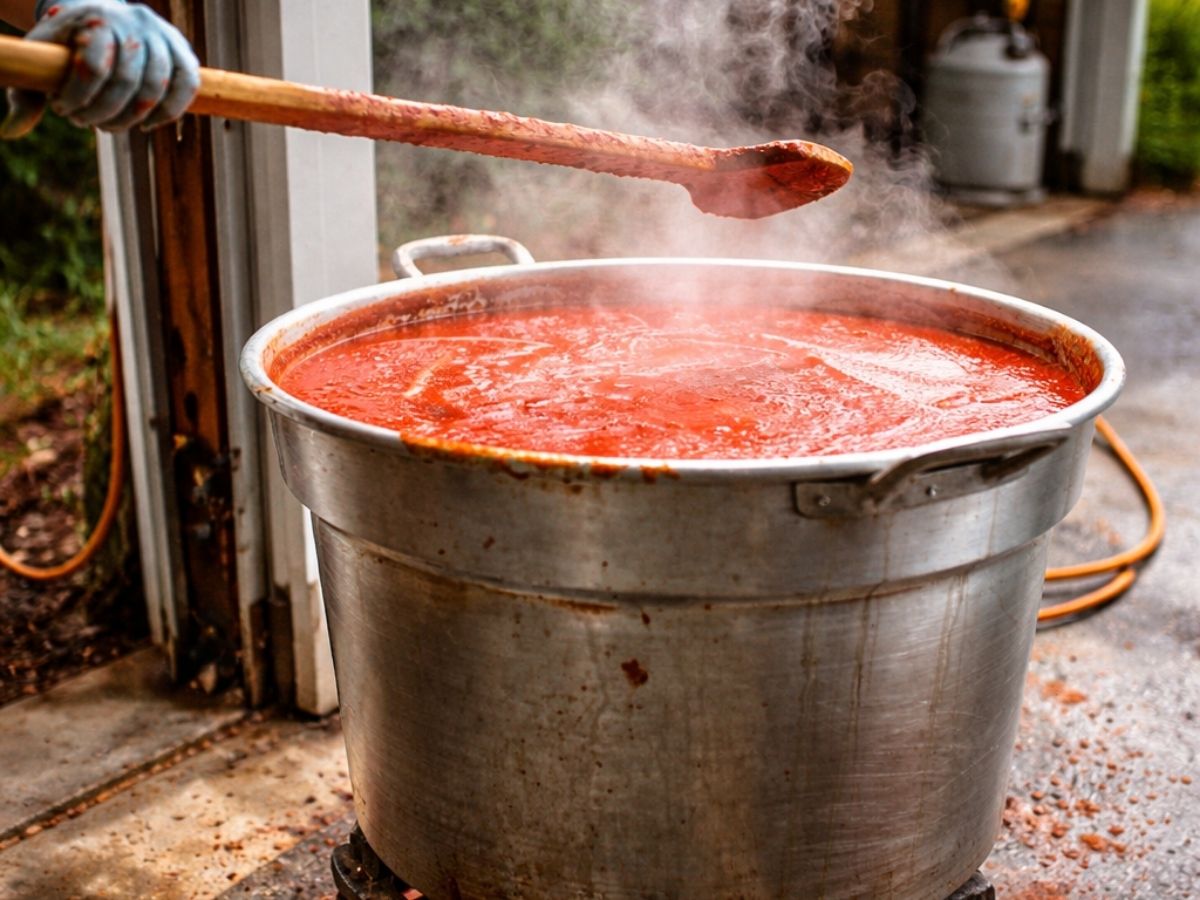
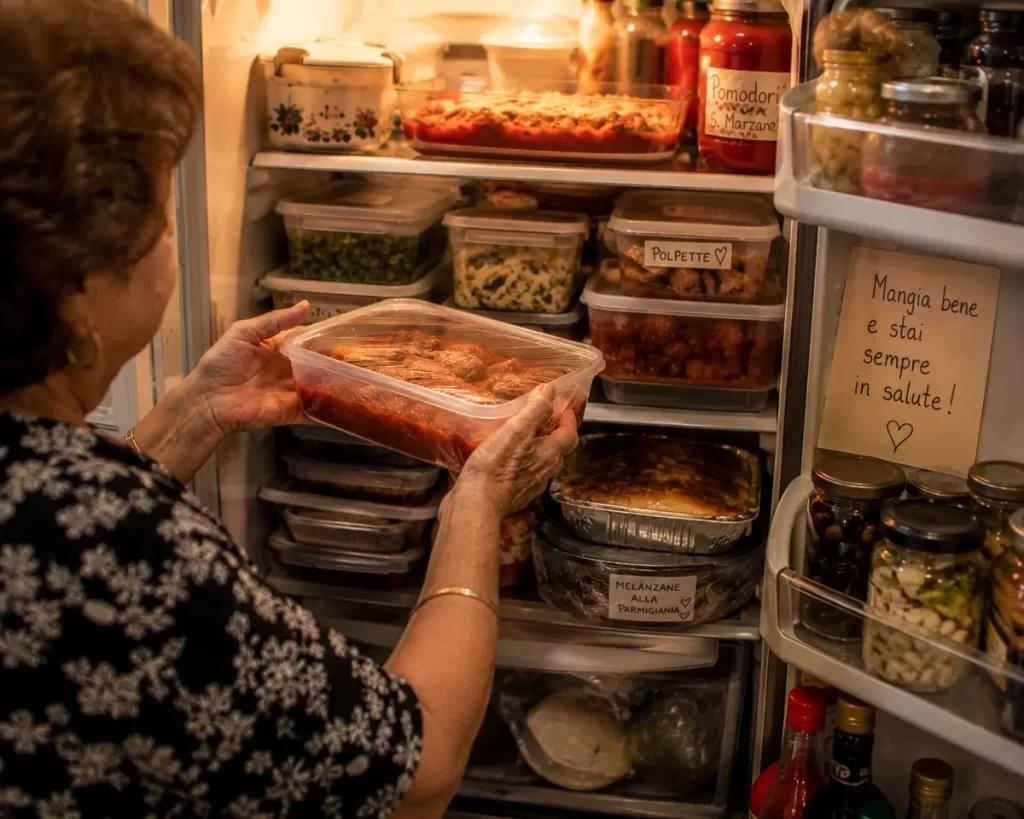
She brings food. Every time. Without being asked. Without checking whether you need it. She brings containers of sauce, trays of lasagna, bags of fruit, cuts of meat, entire meals wrapped in foil. She throws food at you like there’s no tomorrow, even when your refrigerator is physically incapable of holding another thing. She will find room. She will rearrange your fridge to make room. She will throw out your food to make room for hers, because hers is better.
This is not generosity in the casual sense. It is compulsion — a deep, inherited certainty that feeding people is the most important thing a person can do, and that the people she loves must never, under any circumstances, be unfed. The full fridge is irrelevant. The full fridge is your problem. Her problem is making sure you eat, and she will solve it regardless of your input.
It comes from the same place as everything in the Italian kitchen — from a world where food was survival, where feeding someone was the most direct expression of love, and where an empty stomach was a personal failure of whoever was supposed to be looking after you. The suocera is simply making sure that failure never happens on her watch.
The judging
An Italian mother-in-law has opinions about everything you do — your cooking, your garden, your housework, your parenting — and she does not believe in keeping them to herself.
She judges how I do the garden. She judges my cooking. She judges how much work I put into the household and the family. These are not observations delivered gently over coffee. They are assessments — quick, specific, delivered with the confidence of someone who has been doing this longer than you have been alive and sees no reason to pretend your way is as good as hers.
The garden is not pruned correctly. The sauce needs more of something. The children need more of something. The house needs more of something. There is always more of something — always a gap between what you are doing and what she believes should be done, and she will identify that gap with the precision of an engineer and the diplomacy of a hammer.
What took me years to understand is that the judging is not criticism. It is investment. She judges because she cares — because your household is her household, your children are her grandchildren, your garden is her garden. If she did not care, she would say nothing. The silence of an Italian mother-in-law is the thing to truly worry about, because silence means she has given up. The opinions mean she is still fighting for you.
When she stops having opinions, that’s when you worry. The opinions are proof she hasn’t given up on you.
Your house is her house
An Italian mother-in-law does not recognize the boundary between her home and yours. She treats your house as a satellite office of her own — and acts accordingly.
She cleans your house randomly. You come home and the floors are mopped, the counters are wiped, and something has been reorganized in a way you did not ask for and cannot undo because she has already left. She prunes your plants without asking — walks into your garden, decides something needs cutting, and cuts it, with the quiet authority of someone who does not require your consent to improve your property.
She moves things. She rearranges shelves. She folds laundry that was not hers to fold. And if you raise this — gently, carefully, with the diplomatic skill of a hostage negotiator — she looks at you with genuine confusion, because in her mind she was helping. Why would you not want help? Why would you not want your house cleaner, your plants tidier, your life more organized? What kind of person refuses care?
The answer, of course, is that no one is refusing care. You are requesting autonomy. But autonomy and the Italian suocera have never been formally introduced, and the meeting is not going well.
A note worth keeping — The Italian suocera’s refusal to respect household boundaries is not a personality flaw. It is a cultural inheritance. In the southern Italian world she came from, extended family lived together or very close, and the idea of separate households with separate rules barely existed. A grandmother walking into her son’s home and cleaning it was not intrusion — it was simply being family. The modern expectation of independence is what’s foreign, not her behaviour.
You need patience
If there is one phrase the Italian mother-in-law repeats more than any other, it is this: you need patience with the kids.
She says it constantly. She says it when the children are difficult. She says it when the children are fine. She says it as a greeting, as advice, as a closing statement, as a philosophy of life compressed into six words. You need patience. As if patience were a vitamin she suspects you are deficient in, and she is prescribing it daily.
And the maddening thing is that she is right. She is almost always right, because she has already raised children, already survived the sleepless years and the difficult years, and she is looking at you from the other side of something you are only halfway through. She is not being condescending. She is being experienced. The advice just happens to arrive in the tone of a woman who has been right about most things for several decades and has stopped pretending otherwise.
When she told me I needed patience, I rolled my eyes — the same way I rolled my eyes at my grandfather’s advice as a child. And like his advice, hers lodged somewhere deep and surfaced later, when I needed it, precisely because it had been repeated so many times it became impossible to forget.
You need patience with the kids. She said it so often it stopped being advice and became weather — always present, impossible to argue with, and usually accurate.
The baby — her territory
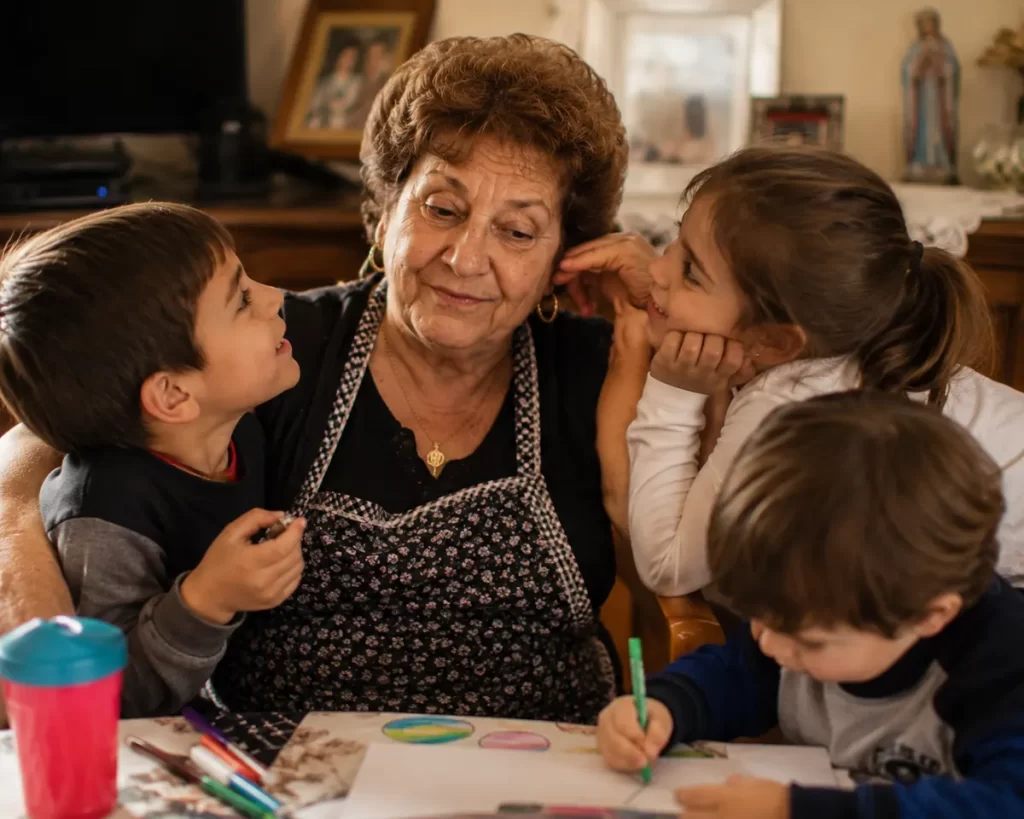
When a baby arrives, the Italian mother-in-law activates fully — and there is no force on earth that will stop her from being first through the door.
She was the first to see the baby when our children were born. Not asked to be. Not invited to be. Simply first — because a new grandchild is not a family event she attends. It is a family event she runs. She arrived with food. She arrived with opinions. She arrived with the absolute certainty that she knew what the baby needed better than anyone in the room, including the medical professionals, because she had done this before and they had merely studied it.
The first to provide food. The first to hold. The first to tell you what you’re doing wrong and the first to fix it without waiting for you to agree. A new baby in an Italian family does not just belong to the parents. It belongs to the grandmother — and particularly to the suocera, who sees the child as both a gift and a project, and who will oversee that project with the intensity of someone whose entire life has been preparation for this moment.
And here is the thing no one tells you: you are grateful. In the fog of new parenthood, when you have not slept and do not know what you are doing and the baby will not stop crying — the woman who shows up without being asked, who takes the baby confidently, who feeds you while you recover, who knows what she is doing because she has done it — that woman is not an intrusion. She is a rescue. You just cannot admit it until later.
The suocera who showed up for the baby also prayed for the baby. Our printable Italian saint prayer cards carry eleven of the saints Italian families turned to — each with a traditional prayer in Italian and English. A gift she would understand.
$9.49
Instant digital download
What’s underneath all of it
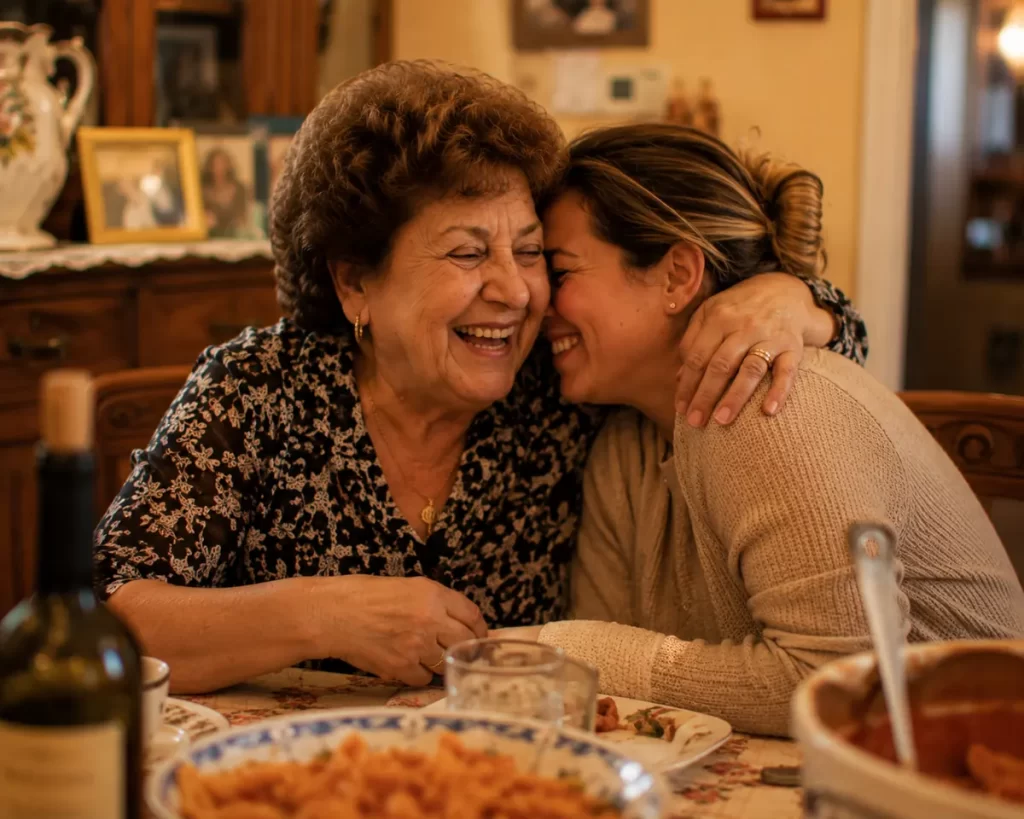
Underneath the opinions, the unannounced visits, the pruned plants, and the shoe — underneath all of it — is a woman who does not know how to love quietly.
She loves you. That is the thing that is easy to forget when she is rearranging your kitchen or telling you the garden needs more work. She loves you with a force that has no off switch and no volume control, a love inherited from generations of women who showed devotion through action, not words, and whose actions were loud and constant and sometimes infuriating and always, always rooted in care.
She cleans your house because she cannot sit in your home and not help. She brings food because she cannot imagine you going without. She judges your work because she wants it to be good — genuinely good, by the standard she has spent a lifetime perfecting. She tells you to have patience because she learned patience the hard way and wants to save you the hardest parts of the lesson.
And she threw the shoe because, in that moment, love looked like a shoe. That is the Italian suocera. She is impossible and she is irreplaceable, and if you are lucky enough to have one — truly lucky, even on the days it doesn’t feel like luck — then you have something that cannot be bought or built or replicated: a woman who will never, ever stop showing up for you, whether you asked her to or not.
She is impossible. She is irreplaceable. And in the end, she was right about the patience.
In Summary
- La suocera is not a background relative — she is an active, daily presence in your household
- She arrives unannounced because family does not need an invitation
- She brings food whether you need it or not — feeding is loving
- She judges everything — your cooking, your garden, your housework — because she cares enough to have opinions
- She cleans your house and prunes your plants without asking, because helping is not optional
- “You need patience” is her constant refrain — and she is usually right
- When the baby arrives, she is first through the door and the last to leave
- Underneath all of it is a love that does not know how to be quiet or sit still
FAQ
What does suocera mean in Italian?
Suocera is the Italian word for mother-in-law. The male equivalent (father-in-law) is suocero. In Italian family culture, the suocera occupies a far more active and present role than the term typically implies in English — she is deeply involved in her children’s households, their cooking, their child-rearing, and their daily lives, often treating their home as an extension of her own.
Why are Italian mothers-in-law so involved?
The Italian suocera’s intense involvement comes from a culture where extended family lived together or very close, where grandmothers were central to child-rearing, and where helping your family was not optional but expected. The modern Western concept of separate households with firm boundaries is relatively recent and foreign to the southern Italian family model. The suocera’s involvement is not interference — it is the continuation of a family structure that saw closeness, not distance, as the sign of a healthy family.
Why do Italian mothers-in-law bring so much food?
Food is the primary language of love in Italian culture. Feeding someone is the most direct way to show you care, and the Italian suocera carries this instinct to its fullest expression — bringing food constantly, regardless of whether it was requested, and regardless of how full the fridge already is. This comes from a deep cultural memory of scarcity, where making sure your family was fed was the most important job a woman could do.
How do you deal with an Italian mother-in-law?
With patience — which, coincidentally, is exactly what she keeps telling you. The key to navigating the Italian suocera is understanding that her behaviour comes from love, not control, even when it feels like control. Accepting some of the help gracefully (especially with food and new babies) while gently establishing the boundaries that matter most to you tends to work better than fighting the entire system. Many families find that the intensity softens over time into something genuinely valuable — a grandmother who is deeply, actively present in her grandchildren’s lives.
Is the Italian mother-in-law stereotype true?
Like most stereotypes, it is rooted in truth but not the whole truth. Italian mothers-in-law tend to be more involved, more opinionated, and more present than the North American norm — this is a genuine cultural pattern, not an invention. But the stereotype often misses the love underneath the intensity. The Italian suocera’s involvement is not possessiveness or control for its own sake — it is a form of devotion so strong it doesn’t know how to express itself at low volume.
What has your suocera done? The unannounced visit, the unsolicited garden pruning, the food that arrived when the fridge was full — share it in the comments. Everyone has a story. And underneath every one of them is a woman who refused to stop showing up.

Marco Ricci is an Italian-Canadian writer and the grandson of Calabrian immigrants. He created Italian Family Traditions to document the customs, feast days, and family rituals Italian families carried from Italy to North America — and to understand what they actually meant. He is based in Montreal.