Italian Family Traditions
What Is the Tarantella? The Meaning Behind Italy’s Folk Dance Tradition
One minute people are eating, talking, cutting cake, or pretending they are too tired to dance. Then the music starts. The clapping starts. And somehow the whole room gets pulled in — even the people who swore they were just watching.
My grandfather danced the tarantella the way he did most things that mattered to him — without announcing it first. One moment he was at the table, glass in hand, following a conversation with half his attention. Then the music changed and he was on his feet, moving to the center of whatever space there was, and the room reorganized itself around him without anyone deciding to do that. He was not the best dancer in the room by any technical measure. He was something better than that: he was the one who made everyone else want to dance.
Nonno grew up in Calabria, where the tarantella was not something you learned in a class or performed for an audience. It was something you absorbed — at weddings, at festivals, at family gatherings where the music was live and the floor was whatever surface happened to be available. He brought it to Montreal the way he brought other things: not as a museum piece to be preserved but as something that still worked, that still did the job it had always done, which was to take a room full of people who were sitting separately and make them, for a few minutes, genuinely together.
The tarantella is not really a dance you perform. It is a dance you deploy — at the exact moment when the event has eaten its dinner, finished its speeches, and needs someone to remind it that it is actually a party.
What the tarantella is
The tarantella is a traditional folk dance of southern Italy, known for its fast tempo, light quick steps, playful interaction between dancers, and driving rhythm in 6/8 time. Encyclopaedia Britannica describes it as a couple dance with teasing, flirtatious behavior and lively music, while Treccani calls it a dance of southern Italy known since at least the 14th century, marked by vivid rhythm and strongly associated with the tambourine.
That formal definition is accurate and also completely insufficient for understanding what the tarantella actually is in a room full of Italian family members at ten o’clock at night when the dinner plates have been cleared and someone has decided the evening is not over yet.
In family life the tarantella is not a dance form. It is a social event with a dance inside it — the moment when a gathering stops being a gathering and becomes something more specific, more alive, more communal, more recognizably Italian. You can feel it coming before the music starts. Someone clears a space. Someone else is already moving toward it. A tambourine appears from somewhere. And then it begins, and it carries everyone in the room along whether they intended to participate or not.
Where the tarantella comes from — and the spider at the center of it
The tarantella has roots in southern Italy and a history that is part music tradition, part folklore, and part genuinely strange popular belief worth knowing because it explains something about the dance’s character.
Britannica connects the name and origin to tarantism — a condition or form of hysteria documented in southern Italy between the 15th and 17th centuries, associated with the bite of the tarantula spider. According to popular belief, a person bitten — called a tarantata — would fall into a frenzied state and could only be cured by dancing continuously and intensely until the venom was sweated out. Eataly describes this as the “dance of the spider” — the afflicted person dancing in a trance-like state, sometimes for days, surrounded by musicians whose job was to keep the rhythm going. Treccani notes that the name may derive from either Taranto, the city in Puglia, or from the tarantula itself.
Whether tarantism was a genuine medical condition, a mass psychosomatic phenomenon, a culturally sanctioned form of emotional release, or some combination of all three is still debated by scholars. What is clear is that the dancing was real, the music was real, and the tradition that grew from it was one of the most physically intense and emotionally expressive in the Italian south.
Over time the dance separated from its darker origins and became a form of celebration. As Eataly explains, it shifted from a ritual of cure into a couple’s dance used at feasts and festivities. The frenzy remained. The intensity remained. The sense that dancing is a necessary physical release remained. But the occasion changed from crisis to celebration — which is arguably what made the tradition last for six centuries and counting.
I looked up tarantism properly for the first time years after I had already seen the tarantella danced at a dozen weddings and family parties. The connection between the frenzied spider-cure ritual and the tambourine-and-clapping circle at a reception hall in Montreal was not immediately obvious. But the more I thought about it, the more it made sense. Both versions of the dance share the same underlying logic: that there are states of feeling — grief, joy, stress, celebration, the accumulated weight of a long event — that the body needs to discharge through movement, and that music is the mechanism that makes this possible. The cure and the celebration are not so different. They are both saying: dance until you feel different than you did before.
How the tarantella changed across Italy — the regional variations
One of the things that makes the tarantella such a rich subject is that it was never one single dance. It developed differently across the regions of southern Italy, and those regional variations are still distinct enough today that a Calabrian tarantella sounds and feels different from a Neapolitan one, which sounds different again from the Apulian pizzica.
| Region | Version | Character |
|---|---|---|
| Calabria | Tarantella calabrese | Fast, energetic, often danced in groups. Strong tambourine presence. The version most commonly seen at diaspora weddings and family parties in North America. |
| Naples / Campania | Tarantella napoletana | The most internationally recognized version — lighter, more theatrical, often performed as a couple’s dance with handkerchiefs. The version most commonly seen in formal performances and on stage. |
| Puglia | Pizzica | The version most directly connected to the tarantism tradition. More trance-like and hypnotic in character, with a ritual quality the other versions largely shed. Still performed at festivals in Puglia today. |
| Sicily | Tarantella siciliana | Slower and more melodic than the Calabrian version, with a distinctive musical character. Less commonly seen in the diaspora but recognizable to Sicilian families. |
For Italian-Canadian and Italian-American families, the version most likely to appear at a wedding or family party is the Calabrian tarantella — fast, circular, driven by tambourine and accordion, with everyone pulling each other onto the floor. The Neapolitan version is what most people imagine when they think “tarantella” in the abstract. The pizzica is what the tarantism tradition actually looked like at its most intense. All three are the same tradition expressing itself through different regional temperaments.
What the tarantella looks and feels like in a room
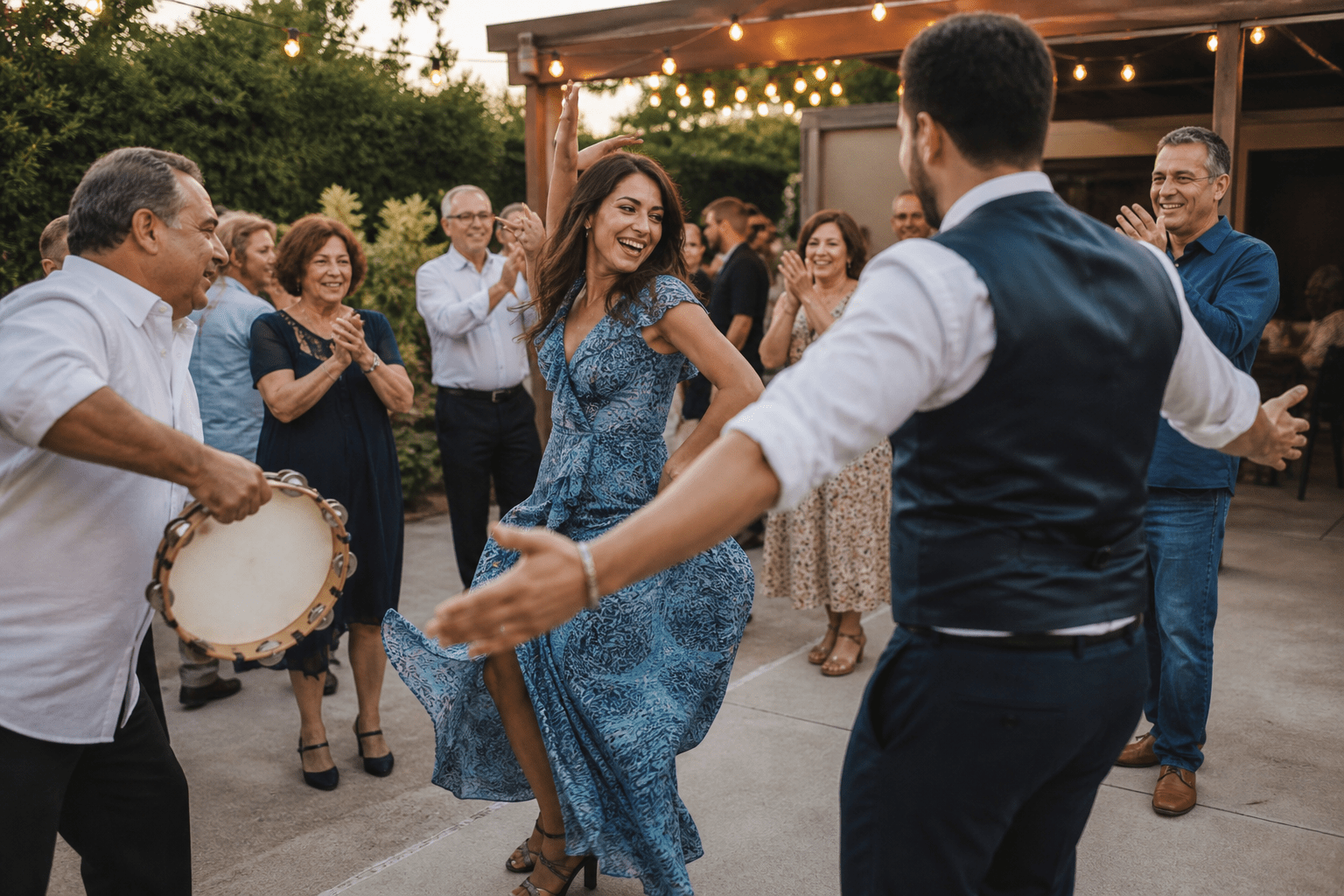
If you have never seen it in person, the easiest description is this: fast feet, quick turns, bright rhythm, a tambourine being shaken with purpose, and a quality of playful challenge between the people dancing that makes everyone watching want to join.
Britannica describes the teasing, flirtatious interaction between partners as central to the dance. Eataly emphasizes the light rapid steps in 6/8 time and the expressiveness of the movement. Treccani highlights the tambourine, the mandolin, the guitar, the accordion — the popular instruments that give the tarantella its specific sound.
What those descriptions don’t capture is the social physics of it. The tarantella works at family parties because it has exactly the right structure for a mixed-age crowd: enough form that it feels like a real tradition, enough looseness that anyone can join without knowing the steps. The circle format means there is always room for one more. The accelerating tempo means the energy builds rather than plateaus. And the tambourine means there is always something for the people who want to participate without dancing — they can clap, they can shake, they can call people in from the edges.
At the best tarantella I ever witnessed — at a wedding reception in a hall in Montreal’s north end, Calabrian family on one side, Sicilian family on the other — the circle started with four people and ended with forty. Nobody organized this. Nobody announced that the tarantella was beginning. The music changed, my grandfather stood up, two or three others followed him, and then the gravitational pull of it did the rest. I watched a man in his eighties pull his thirty-year-old granddaughter onto the floor. I watched a child of about six figure out the basic step by watching the adults and then replicate it with the specific serious concentration that children bring to things they actually want to learn. I watched people who had been sitting separately for three hours suddenly laughing with each other. That is what the tarantella does. It is not choreography. It is chemistry.
Why the tarantella shows up at weddings
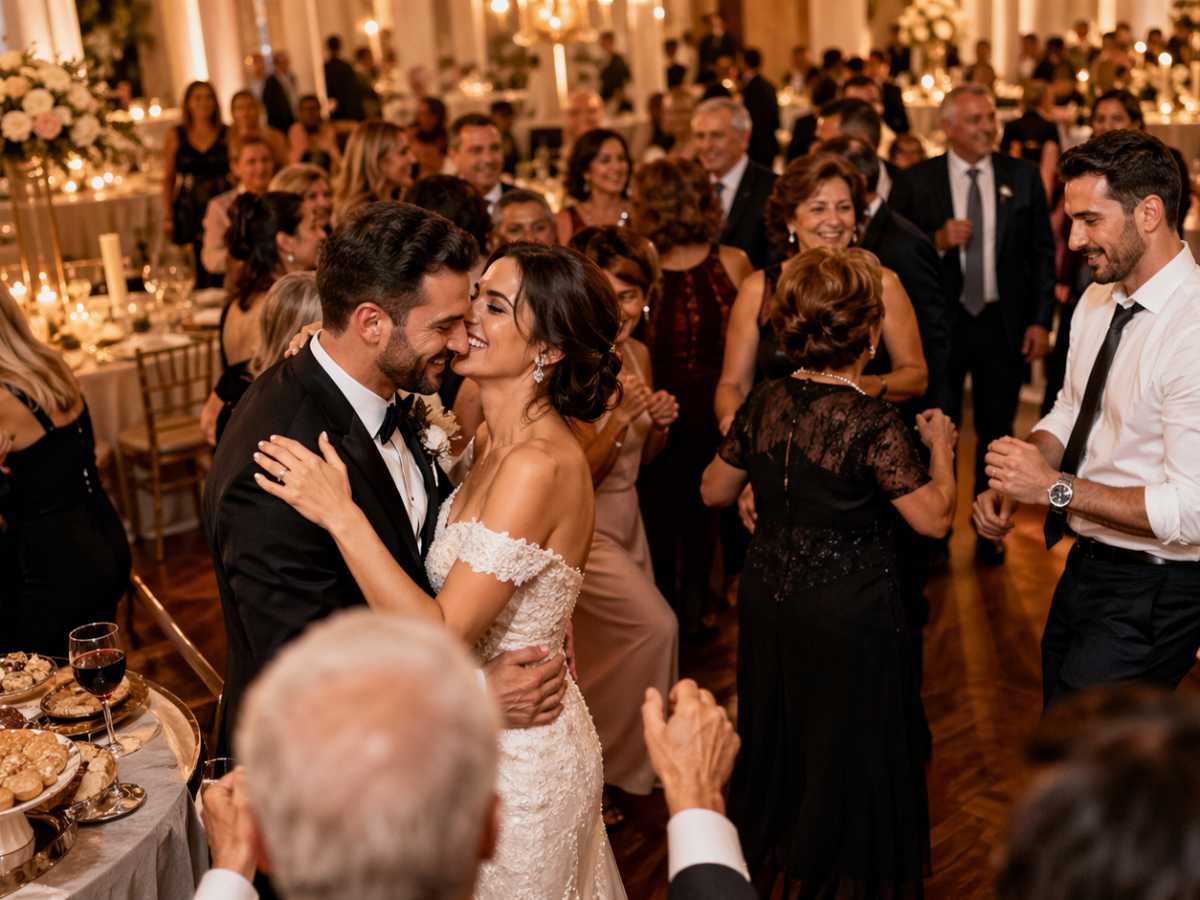
The tarantella became the Italian wedding dance for reasons that make complete sense once you understand what it does to a room. Italy Magazine says it is typically performed at Italian weddings as a way of wishing the couple good luck, and describes the familiar circle format with dancers changing direction as the tempo speeds up. Eataly confirms that most people today think of it primarily as a wedding or celebration dance.
Beyond the symbolic good luck element, the tarantella works at weddings because of its timing and social function. It arrives after the formal parts of the evening — the ceremony, the dinner, the speeches — when the room has fulfilled its obligations and is ready to become something looser and more genuinely celebratory. The tarantella is the hinge between the formal event and the real party. It signals that the night has shifted. It gives the older generation something they recognize and love. The tarantella gives the younger generation something physical and exciting. And it gives the couple a moment of collective joy that is distinctly, specifically theirs.
For Italian diaspora families, it also carries the additional weight of heritage — a dance that connects the wedding in Montreal or New York or Toronto to the weddings of generations before it, in Calabrian villages and Neapolitan courtyards and Sicilian town squares. It is a thread that runs backward through time and shows up, improbably and perfectly, in a banquet hall on a Saturday night.
The tarantella in Italian-Canadian and Italian-American life
The tarantella crossed the ocean and adapted, the way the best traditions do — keeping its essential character while shedding the parts that didn’t travel well. What it kept was the music, the circle, the tambourine, the accelerating tempo, and above all the social function: the ability to pull a room together at the moment when it most needed pulling.
In Montreal’s Italian community — in Little Italy, in Saint-Michel, in the reception halls of Rivières-des-Prairies — the tarantella appeared at every significant gathering. It was not scheduled or announced. It simply arrived when the conditions were right: the dinner finished, the energy restless, someone with enough authority to stand up and start it. Often that person was the oldest man in the room. Often he had grown up dancing it in a village where the music was live and the floor was dirt. He brought it to a linoleum floor in a Montreal suburb without apology or self-consciousness, and the room followed him because that is what the tarantella does when someone dances it properly.
That survival is part of the broader story of Italian-American and Italian-Canadian traditions after immigration — what changed and what, at the root, stayed.
How to keep the tarantella alive today
The good news is that the tarantella is one of the easiest Italian traditions to maintain, because it does not require equipment, a venue, or a formal lesson. It requires music, space, and someone willing to be the first person standing.
Play it at weddings and family gatherings — not as a scheduled performance but as a moment that arrives organically when the room is ready. Tell children what it is before it starts. Not a long lecture, just a sentence: “This is the tarantella — it’s a dance from southern Italy that your great-grandparents danced at every party, and now we do too.” That sentence, heard once at the right moment, is enough.
Children who hear the tarantella remember it for life.
Let people join imperfectly. Some traditions die because they become too precious, too technically demanding, too intimidating to attempt without instruction. The tarantella survives because the circle always has room for one more and nobody is checking technique. The child who figured out the step by watching the adults is doing it correctly. The man who has been dancing it for sixty years and the teenager doing it for the first time are in the same circle, and both of them belong there.
For how to get children genuinely engaged with traditions like this one, read how to get your kids interested in their Italian heritage.
The music changed. He was on his feet. The room reorganized itself around him without anyone deciding to do that. The tarantella is not choreography. It is chemistry — the specific Italian ability to turn a room full of people sitting separately into something genuinely together, for a few minutes, through music and movement and the accumulated joy of being in the same place at the same time.
Play the music. Clear the space. Be the first one standing. The room will follow.
The tarantella belongs to the same Italian celebration tradition as tombola — one keeps the family at the table, the other gets them out of their chairs. For the broader story of how Italian traditions survived immigration, read Italian-American traditions: what changed and what stayed. For how to record the family memories these traditions carry, read how to record family stories before they’re lost. And for how to get children engaged with their Italian heritage, read how to get your kids interested in their Italian heritage.
FAQ
What is the tarantella?
The tarantella is a traditional folk dance of southern Italy, known for its fast tempo, light quick steps, playful interaction between dancers, and driving rhythm in 6/8 time. Britannica describes it as a couple dance with teasing, flirtatious behavior and lively music. Treccani places its origins in southern Italy dating back to at least the 14th century. In family life it functions as much more than a dance form — it is the social mechanism that transforms a gathering into a party, pulls mixed-age crowds together, and carries a direct thread back to the village celebrations of previous generations.
Why is it called the tarantella?
The name is most commonly connected to either Taranto — the city in Puglia — or to the tarantula spider, whose bite was believed in southern Italian folk tradition to cause a frenzied condition called tarantism. Britannica and Treccani both document this connection. According to popular belief, the afflicted person could only be cured by dancing intensely until the venom was sweated out. The dance that grew from this ritual eventually shed its therapeutic context and became a form of celebration — but kept the intensity, the tambourine-driven rhythm, and the sense of communal participation that made the original so powerful.
Is the tarantella a wedding dance?
Very often, yes — especially in southern Italian and diaspora tradition. Italy Magazine says it is typically performed at Italian weddings as a way of wishing the couple good luck, and Eataly notes that most people today think of it primarily as a wedding or celebration dance. It works at weddings because of its timing and social function: it arrives after the formal parts of the evening and signals that the night has shifted from obligation to genuine celebration. For Italian diaspora families it also carries the weight of heritage — connecting the wedding in Montreal or New York to the weddings of generations before it.
What are the different regional versions of the tarantella?
The major versions are the tarantella calabrese (fast, energetic, circular — the version most commonly seen at diaspora weddings), the tarantella napoletana (lighter and more theatrical, the version most often performed on stage), the pizzica from Puglia (the version most directly connected to the tarantism tradition, with a hypnotic character still performed at festivals), and the tarantella siciliana (slower and more melodic). For Italian-Canadian and Italian-American families, the Calabrian version is most likely to appear at family gatherings, though the Neapolitan version is what most people picture when they imagine the dance in the abstract.
What instruments are used in the tarantella?
The tambourine is the most distinctive and most essential instrument — Treccani, Britannica, and Eataly all emphasize it. The tambourine was traditionally played by the dancers themselves, especially women, giving the dance its characteristic percussive sound. Other instruments typically include accordion, mandolin, guitar, and in some regional versions, flute or bagpipes. The tambourine’s role is not decorative — it is structural. The rhythm it drives is what makes the tarantella’s accelerating tempo possible and what gives the dance its physical urgency.
How do you dance the tarantella?
The basic structure is a circle of dancers moving in one direction, then reversing, with partners interacting playfully — approaching, retreating, spinning, challenging each other. The steps are light and quick, driven by the 6/8 rhythm. As the tempo accelerates the energy intensifies. Women traditionally held tambourines. The circle format means there is always room for more dancers, and the accelerating tempo means the experience builds rather than plateaus. For family gatherings, perfect technique matters far less than genuine participation — the tarantella’s social function works regardless of whether everyone knows the exact steps.
How can I keep the tarantella tradition alive today?
Play it at weddings and family gatherings — not as a scheduled performance but as a moment that arrives when the room is ready. Tell children what it is before it starts: one sentence is enough. Let people join imperfectly — the circle always has room for one more and nobody is checking technique. Be the first person standing when the music starts, because the tarantella only needs one person to begin it and then it takes care of itself. The tradition survives not because anyone preserved every technical detail but because someone was always willing to stand up first and let the room follow.

Marco Ricci is an Italian-Canadian writer and the grandson of Calabrian immigrants. He created Italian Family Traditions to document the customs, feast days, and family rituals Italian families carried from Italy to North America — and to understand what they actually meant. He is based in Montreal.