Italian Family Traditions
What Is Acqua di San Giovanni? The Summer Tradition Italian Families Brought With Them
Some traditions need a church, a feast table, and half the neighborhood. This one just needs a bowl, a few flowers, and one summer night. That is exactly why it survived immigration better than almost anything else.
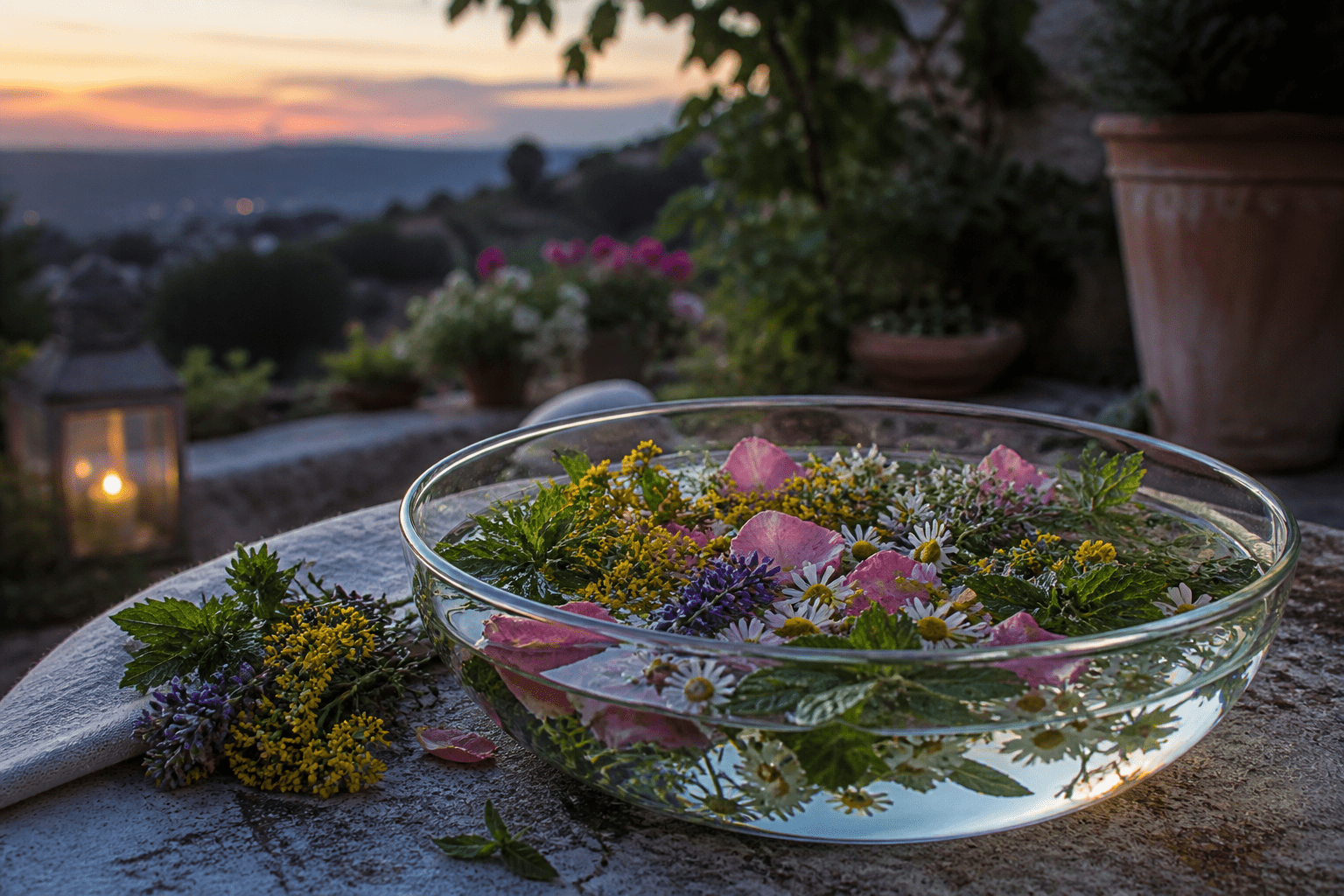
Every family has a tradition that nobody fully explains but everyone somehow knows. In our house it was this one. Late June, the evening still warm, and my grandmother would start moving through the kitchen with a particular kind of quiet purpose — the kind that meant something was about to happen that had happened every year before I was born and would happen every year after. She would cut mint from the garden. She would collect rose petals. She would find whatever else was growing close enough to reach. Then she would fill the big ceramic bowl — the one usually reserved for things more serious than flowers — and she would carry it outside and set it on the step as if it had a very important appointment with the night air.
Nobody announced this. Nobody explained it to the children in advance. You simply noticed that the bowl was outside, and you understood, in the way that children understand things they have not been formally taught, that this was what June 23 meant in this house. The bowl belonged to the night. In the morning it would belong to us again, and there would be a specific way of using the water, and my grandmother would have something brief and certain to say about what it meant — blessing, protection, renewal, the season beginning properly — and then breakfast would continue as normal.
Acqua di San Giovanni is the tradition that fits in a bowl. That is exactly why families carried it across the ocean — it asked almost nothing, cost almost nothing, and meant everything it was supposed to mean.
What Acqua di San Giovanni is
Acqua di San Giovanni is a traditional Italian bowl of water filled with flowers and herbs, left outside on the night of June 23 so it can gather the summer dew overnight, then used the following morning — the feast of Saint John the Baptist — as a gesture of blessing, protection, purification, and seasonal renewal.
As La Cucina Italiana explains, the flowers and herbs are placed in water after sunset on June 23 and left outdoors overnight, while Ravenna Turismo describes it as an old rural custom still rooted in Italian seasonal life. FAI, Intoscana, and Publiacqua all document the same essential ritual.
The technical description is accurate. The family description is better. It was summer water with meaning — one of those small customs that made a regular evening feel slightly enchanted. No giant production. No formal announcement. Just a bowl, some flowers, and the quiet feeling that tomorrow morning was going to be different from ordinary mornings.
What the flowers and herbs symbolized
There was no single fixed recipe — every family made their version from whatever was growing and whatever felt right. But certain plants appeared again and again because their symbolic associations were well understood.
| Flower or herb | Why it mattered |
|---|---|
| Mint | Freshness, vitality, and that clean summer feeling that makes everything seem awake again |
| Sage | Wisdom, cleansing, and protection — the herb that appeared in every serious household ritual |
| Rosemary | Memory, strength, and blessing for the home — the plant that remembered everything |
| Lavender | Calm, peace, and a sense of softness after the intensity of late June heat |
| Rose petals | Love, beauty, and affection — Italian traditions rarely say no to a little romance |
| Elderflower | Seasonal abundance and the fullness of early summer at its peak |
| Mallow | Gentleness, comfort, and healing |
| St. John’s wort | Protection, light, and the strongest symbolic tie to the feast of San Giovanni itself |
That table looks orderly. Our bowl rarely was. The real family version was more like this: if it smelled good, looked beautiful, and seemed vaguely like something a grandmother would approve of, it had an excellent chance of ending up in the bowl. My grandmother was never precious about it. The point was the intention, not the precision.
Why families made it on the night of June 23
This tradition mattered because it sat exactly where faith, nature, and everyday home life meet — which is where the best Italian traditions always live.
The Christian side is clear: the ritual is tied to the eve of the feast of Saint John the Baptist, one of the most significant feast days in the Catholic calendar. The older side is also clear. Ravenna Turismo says the custom reaches back to ancient rural and pre-Christian celebrations linked to the summer solstice, while Intoscana describes June 24 as a feast that absorbed older propitiatory rites tied to nature, crops, and midsummer energy. L’Italo-Americano connects it to the summer solstice and describes the water as a symbol of purity, rejuvenation, and abundance.
That layering explains a lot. This was never only about washing your face with flower water. It was about timing — about catching a specific night when summer had fully arrived and the world felt, briefly, like it was holding its breath before tipping into something abundant and warm. Italian folk culture understood that certain nights were different from ordinary nights, and it built rituals that acknowledged the difference.
My grandmother never explained the solstice connection or the pre-Christian history. She explained it the way she explained most things: in terms of what you did and what it meant. You make the bowl on June 23. You leave it outside. In the morning you use the water to wash your face. It is for blessing. It is for protection. It brings good things into the season. That is the explanation. The scholarly version came later, from books, and confirmed everything she already knew — in the way that books sometimes confirm what grandmothers have always known.
How Italian families made Acqua di San Giovanni at home
The method was simple, which is one reason the tradition survived so well. You gathered herbs and flowers on June 23, often in the evening or at sunset. You placed them in a bowl or pitcher of water and left the container outside all night to catch the dew. On the morning of June 24, you used the water to wash the face and hands as a gesture of blessing, purification, and renewal. La Cucina Italiana, FAI, Intoscana, and Ravenna Turismo all describe the same sequence.
At home, ours was never glamorous. Nobody was composing the bowl like a magazine photo shoot. We used what we had. Mint almost always made the cut. Rose petals nearly always did. Rosemary too. Sometimes the bowl looked gorgeous. Other times it looked like someone had sprinted through the yard with kitchen scissors and genuine panic. That is probably closer to the true spirit of family tradition anyway.
The part I loved most as a child was putting it outside. That small moment changed everything. A bowl inside the kitchen is just a bowl. A bowl left outside overnight suddenly feels like it belongs to something larger — the season, the sky, the story. My grandmother would carry it to the step herself, set it down with a specific deliberateness that communicated this was not like setting down groceries, and then go back inside without ceremony. I would look at it from the window before bed and feel, in the particular way that children feel things they cannot name, that the night was doing something to it. That something important was being gathered from the dark air and the dew and the specific quality of late June. In the morning the water would be different. Not visibly. But different.
Why families brought this tradition with them
Acqua di San Giovanni is exactly the kind of custom families could carry across oceans because it needed almost nothing that an ocean crossing would take away.
It does not require a village square, a procession, or a parish organization. It does not require specific regional ingredients or tools. The simplicity documented by La Cucina Italiana and Ravenna Turismo explains why it survived beautifully in immigrant life — whether that meant a backyard in Montreal’s Little Italy, a fire escape in New York, or a few herbs growing in a container on a balcony in Saint-Michel.
A lot of traditions got smaller when families left Italy. Many required ingredients, spaces, or community structures that simply did not exist in the same form in North America. This one was already small. So it stayed alive without needing to shrink very much at all. It adapted to whatever container was available, whatever herbs were growing, whatever space the family had — and it kept its meaning through every adaptation. That portability is part of the broader story of how Italian-American and Italian-Canadian traditions survived immigration.
Acqua di San Giovanni in Italian-Canadian and Italian-American families
In Montreal’s Italian community — in the houses of Little Italy, in Saint-Michel, in Rivières-des-Prairies — Acqua di San Giovanni appeared each June in households where the folk traditions had traveled as carefully as the recipes. It was practiced quietly, without fanfare, by women who had grown up with it and continued it because it was June 23 and that was what June 23 meant.
The children who grew up in those houses often did not know what they were participating in. They knew there was a bowl. They knew it went outside. They knew there was something to do with the water in the morning. The full explanation — the feast of San Giovanni, the solstice history, the folklore of dew and midsummer blessing — came later, if it came at all. What arrived first was the sensory memory: the smell of mint and roses in a ceramic bowl, the specific weight of a summer evening in late June, the sound of the back door opening and closing as the bowl was carried out.
That sensory memory is the real vessel the tradition traveled in. Not books or explanations. The smell of it. The feel of the water in the morning. The particular quality of a June 24 when the bowl had been outside all night. For how to give children exactly that kind of sensory entry point into Italian heritage, read how to get your kids interested in their Italian heritage.
How to keep Acqua di San Giovanni meaningful today
The nicest thing about this tradition is that it still works exactly as it always did. You do not need to overcomplicate it.
On the evening of June 23, gather whatever herbs and flowers you have — mint, rosemary, rose petals, lavender, sage, or whatever is growing or easy to find. Fill a bowl with water. Add the plants. Set the bowl outside — on a step, in a garden, on a balcony — and leave it overnight. On the morning of June 24, use the water to wash your face and hands as a small deliberate gesture of blessing and renewal. Tell children what you are doing. Tell them about San Giovanni. Tell them about the solstice. Tell them that this is what this night has meant in Italian families for centuries. Then let the morning continue normally.
Do not worry if your version looks homemade. Ours never looked polished either. It looked like us — a little uneven, a little improvised, very fragrant, very sincere. That may be the most Italian part of all.
Publiacqua notes that old beliefs around health and luck belong to folklore and that the practice survives today because of its deep symbolic value. That feels exactly right. Not everything has to be lab-tested to deserve a place in family memory. Some things are allowed to be beautiful, seasonal, and worth repeating simply because they make people feel connected — to the season, to the saint, to the family that did this before them, and to the children who will do it after. For how to record the memory of this tradition before it fades, read how to record family stories before they’re lost.
She carried it to the step. She set it down with that specific deliberateness. She went back inside. The bowl stayed. The traditions people carry the farthest are not always the biggest ones. Sometimes they are the ones that fit in a bowl — a little mint, some rose petals, one summer night, and the quiet conviction that morning will be better for it.
Make the bowl on June 23. Leave it outside. Use the water in the morning. That is all it asks.
Acqua di San Giovanni belongs to the same Italian midsummer and folk tradition as malocchio and the Italian evil eye and la smorfia and its folk wisdom. For the June feast day this tradition belongs to, see the June entries in our 2026 Italian Family Traditions Calendar. For how to preserve the seasonal family memories these traditions carry, read what to ask your grandparents about your Italian family history. And for the broader story of how Italian folk traditions survived immigration, read Italian-American traditions: what changed and what stayed.
Explore more of the saints Italian families turned to with the patron saint finder, and learn the prayers every family knew.
FAQ
What is Acqua di San Giovanni?
Acqua di San Giovanni is a traditional Italian ritual of placing herbs and flowers in a bowl of water on the night of June 23, leaving it outside overnight to gather dew, then using the water on the morning of June 24 — the feast of Saint John the Baptist — as a gesture of blessing, protection, purification, and seasonal renewal. La Cucina Italiana, FAI, Intoscana, Ravenna Turismo, and Publiacqua all document the same essential practice. It is one of the most portable Italian folk traditions — requiring almost nothing to perform and carrying a meaning that survived immigration intact in many Italian-Canadian and Italian-American households.
When do you make Acqua di San Giovanni?
It is prepared on the evening of June 23 — the eve of the feast of Saint John the Baptist — and used on the morning of June 24. The timing is specific and intentional: the overnight period is when the water gathers the summer dew that gives the ritual its symbolic force. La Cucina Italiana and FAI both document this sequence. In practice, the bowl is typically assembled at sunset or shortly after and brought back inside after sunrise the following morning.
What goes into Acqua di San Giovanni?
There is no single fixed recipe — the tradition was always adaptable to what was growing and available. Common ingredients include mint, sage, rosemary, lavender, rose petals, elderflower, mallow, and St. John’s wort, which has the strongest symbolic connection to the feast of San Giovanni itself. La Cucina Italiana and other Italian sources document these associations. The family version was typically made from whatever combination smelled right, looked beautiful, and felt seasonally appropriate — the intention always mattered more than the exact ingredients.
Why do Italians leave it outside overnight?
The overnight exposure is the ritual’s essential act. According to tradition, the water gathers the summer dew overnight, and that dew is what gives the water its blessing and symbolic force. FAI and Ravenna Turismo both connect the night of June 23 to midsummer folklore and older seasonal beliefs about what the air, dew, and specific quality of that particular night could transfer into water. The outdoor placement also transforms the bowl from a domestic object into something that belongs to the season itself — a distinction that matters for the ritual’s symbolic effect.
Is Acqua di San Giovanni religious or pagan?
Both, layered together in the way many Italian folk traditions are. The ritual is explicitly tied to the feast of Saint John the Baptist on June 24. But Ravenna Turismo and Intoscana both trace the tradition back to older pre-Christian midsummer rites connected to the summer solstice, fertility, protection, and the harvest season. L’Italo-Americano also makes the solstice connection directly. The Christian feast absorbed and transformed older seasonal practices without erasing them — which is the story of many Italian Catholic traditions.
Did Italian-Canadian and Italian-American families keep this tradition?
Many did, particularly those from regions of Italy where the tradition was strongest. Acqua di San Giovanni was one of the easiest Italian folk customs to maintain in the diaspora because it required almost nothing that immigration would have taken away — no specific regional ingredients, no village infrastructure, no community organization. A bowl, some water, a few plants, and one summer evening were enough. It was practiced quietly in homes across Italian communities in Montreal, New York, Toronto, and other North American cities, often passed from grandmother to grandchild through direct participation rather than formal instruction.
How can I start this tradition in my family today?
On the evening of June 23, gather herbs and flowers — mint, rosemary, rose petals, lavender, sage, or whatever is available and growing. Fill a bowl with water, add the plants, and place the bowl outside overnight. On the morning of June 24, use the water to wash your face and hands as a gesture of blessing and renewal. Tell children what you are doing and why — about San Giovanni, about the solstice, about the families who did this before you. The tradition asks almost nothing and gives back the specific pleasure of a ritual that connects a summer morning to centuries of Italian family life.

Marco Ricci is an Italian-Canadian writer and the grandson of Calabrian immigrants. He created Italian Family Traditions to document the customs, feast days, and family rituals Italian families carried from Italy to North America — and to understand what they actually meant. He is based in Montreal.