Italian Family Traditions
What Is the Italian Cantina? The Room That Kept the Family Fed All Year
You opened the door and the smell of the Italian cantina hit you before anything else. Cured meat, wine, aged cheese, cool air, and something underneath all of it that had no name — the specific smell of a room that had been doing serious work for a very long time. I could have stayed in there all day. Sometimes I did.
My grandfather’s cantina was not dark. That is the first thing I want to correct about how people imagine these rooms. It was not a gloomy basement corner or a damp stone cellar or anything that belongs in a horror film. It was warm light and wooden shelves and the specific organized abundance of a man who took his responsibilities seriously and expressed them in jars. The light was right — not bright, not dim, but the particular quality of light that makes a room feel like it is keeping a secret worth knowing. The air conditioning unit in the corner kept the temperature exactly where the soppressata needed it to be. Nothing in that room was accidental.
The smell reached you before you reached it. You would open the door at the top of the stairs and it would rise to meet you — cured meat and wine and aged cheese and something underneath all of that which I have never been able to properly name. It was the smell of preservation. The smell of work already done. The smell of a family that had prepared for the winter before the winter had any idea it was coming.
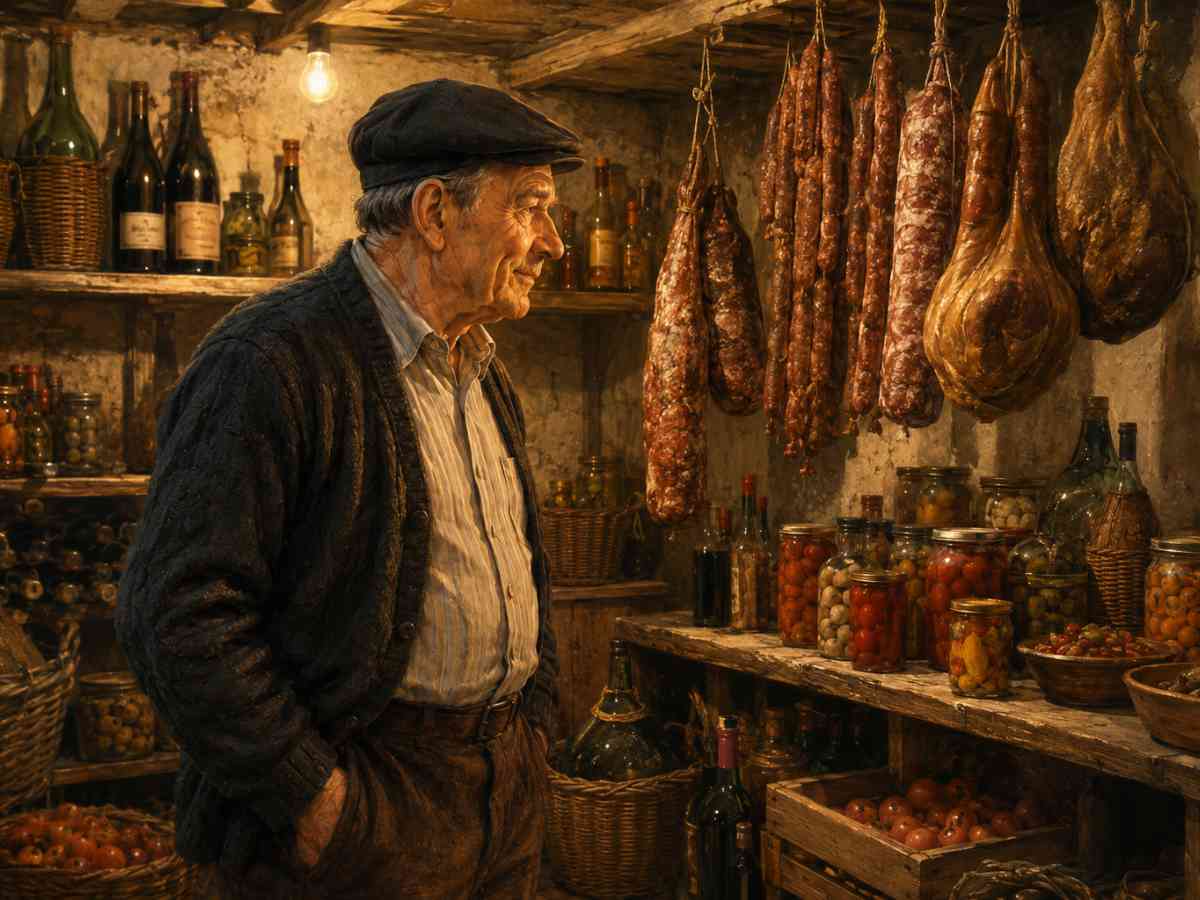
Above your head, when you went in, the ceiling was occupied. Soppressata in their tight casings, dark and firm, hanging at intervals that suggested deliberate spacing rather than random placement. Capicolo beside them — the neck cut, spiced and cured, the kind that sliced paper-thin and melted in a way that commercially produced versions never quite manage. Other things too, in various stages of their curing — because the cantina was not a static place. It was a living one. Things went in. Things came out. The inventory changed with the season and the year and whatever my grandfather had decided that November needed to produce.
The cantina was not storage. Every Italian family understood the difference. Storage is where you put things you might need someday. The cantina was where you put things you had made — things that represented work and knowledge and the specific confidence of a family that knew how to take care of itself through whatever the year was going to bring.
What the Italian cantina actually is
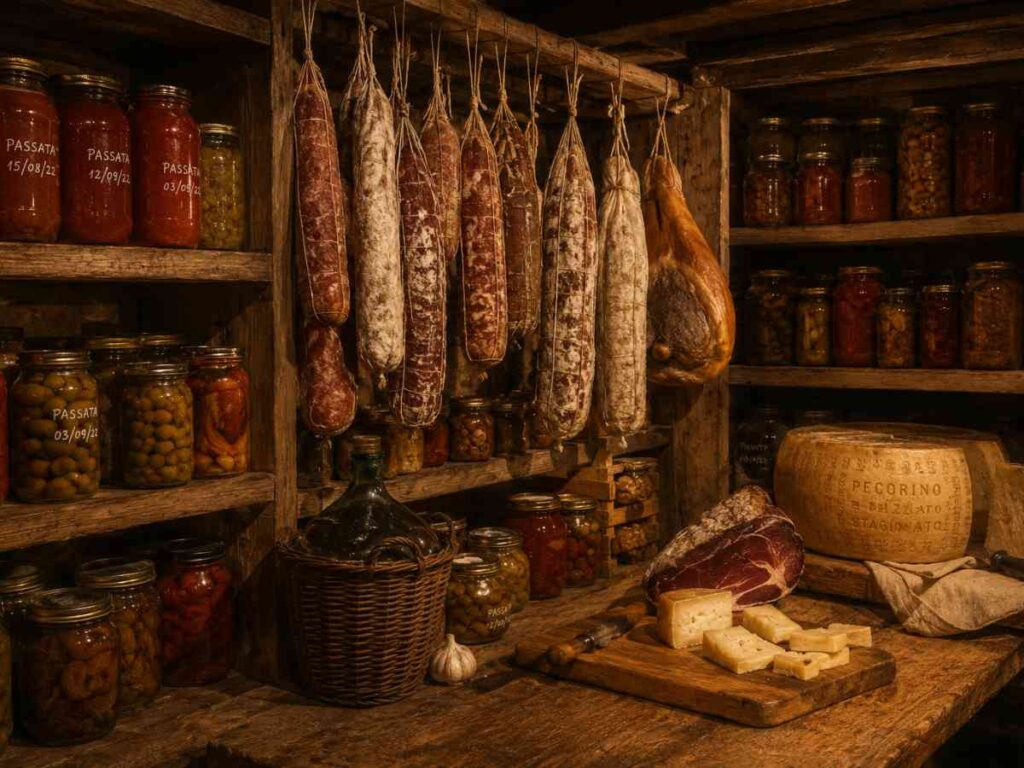
The word cantina translates as cellar or wine cellar — but that translation loses almost everything that matters about what the room actually was in Italian family life. A wine cellar holds wine. The Italian cantina held everything the family had made, preserved, cured, stored, and prepared for the months ahead. Wine was there, yes — demijohns of it, large glass vessels in their wicker baskets, plus empty bottles standing ready for filling when the time came. But the wine was one element in a room that also contained soppressata and capicolo and other cured meats hanging from the ceiling, jars of passata on shelves dated in permanent marker, wheels or wedges of aged cheese in their appropriate corners, potatoes and other vegetables in baskets on the floor, and whatever else the family’s particular traditions had produced that year.
Alida’s Italian Kitchen describes the cantina as the place where cured meats were hung so they would keep well for a long time — a cool space where pancetta, salami, soppressata, and other preserved meats could complete their curing undisturbed. Markys notes that the practice of curing meats sustained Italian communities during harsh winters and became an integral part of regional culinary traditions that persist to this day. Wine and Travel Italy connects the cured meat tradition directly to the Italian principle that no part of the animal should be wasted — that every cut had its purpose and its place, and the cantina was where that purpose was fulfilled over weeks and months of patient waiting.
In Calabria specifically — the region my family came from — the cantina tradition was inseparable from the pig slaughter that happened every November. The pig provided the raw material. The family provided the knowledge. The cantina provided the conditions. And the result, months later, was soppressata and capicolo and ‘nduja and all the other specifically Calabrian cured products that had been part of the family’s food culture since before anyone in the family could remember exactly when they started.
What was inside — and what everything meant
The contents of the cantina were not random. Every element had a reason for being there, a place within the room, and a relationship to the family’s needs through the coming months. Here is what the fully stocked Italian cantina contained and why:
| What was in the cantina | Why it was there |
|---|---|
| Soppressata | The Calabrian pressed salami — spiced with chili, dense, complex, and nothing like the commercial version. Made in November from the pig, hung to cure through winter, ready by spring. The cantina’s most important occupant. |
| Capicolo | The neck and shoulder cut, cured whole in salt and spices, then hung. Sliced paper-thin it was extraordinary. It asked for patience — months of it — and the cantina provided the conditions that patience required. |
| Other salumi | Whatever the family’s specific Calabrian tradition produced — pancetta, lonza, other cuts — all hanging at intervals, all at different stages of their cure, all being monitored by someone who knew what they were looking at. |
| Passata jars | Rows of them on shelves, dated in permanent marker — August of this year, September of last year. The tomato sauce made on passata day, preserved and waiting for the winter kitchen. |
| Other preserved jars | Vegetables in oil, pickled things, dried things, the products of the garden that had been put up through summer and autumn for exactly this purpose. |
| Wine — demijohns | The large glass vessels in their wicker baskets, full of wine made from the autumn grape harvest. The cantina kept them at the right temperature for the wine to develop properly through the winter. |
| Empty bottles | Lined up and waiting. The wine would be bottled when it was ready, which was a judgment made by whoever in the family had earned the right to make it. |
| Aged cheese | Wheels or wedges in their appropriate corner — Pecorino, Caciocavallo, or whatever the family’s Calabrian tradition favored — aging slowly in the cantina’s consistent temperature. |
| Potatoes and vegetables | In baskets on the floor — the harvest stored for winter. Potatoes, onions, garlic. Not glamorous but essential. The cantina held the basics alongside the extraordinary. |
What that table represents is not a collection of products. It is a complete food system — everything a family needed to eat well through the winter, produced by their own hands, stored under their own roof, available without a trip to any shop. The cantina was the family’s food security made physical and visible.
The smell — the thing nobody ever forgets
Everyone who grew up around an Italian cantina remembers the smell before anything else. It is specific, complex, and completely unlike anything else in the house or anywhere outside it. It is the smell of curing meat — that particular combination of salt and spice and time that the soppressata and capicolo produce as they hang. It is the smell of wine in large vessels, the particular yeasty sweetness of wine still working through its process. It is the smell of aged cheese doing what aged cheese does, which is smell significantly more intense than it did when it was young. It is the smell of the passata jars — sealed, sterile, but still carrying the ghost of late August’s tomato processing.
I could walk into that cantina and tell you, without looking at anything, roughly what stage the soppressata was at. Not because I was particularly expert — I was a child — but because I had been going in there often enough that the smell had become a kind of calendar. The fresh-cured smell of November was different from the deep developed smell of February. The cantina kept its own time, and the smell told you where you were in it. I have never smelled anything exactly like it anywhere since. If I smelled it now, wherever I was, I would know immediately what room I was in, what family I belonged to, and exactly how old I was the first time I understood that this was something worth paying attention to.
That smell — irreproducible, unmistakable, absolutely tied to a specific place and family — is why the cantina occupies such a strong place in Italian family memory. It is sensory rather than intellectual. You do not need to be told what the cantina was. You remember what it smelled like and everything follows from that.
The cantina as the family’s work made visible
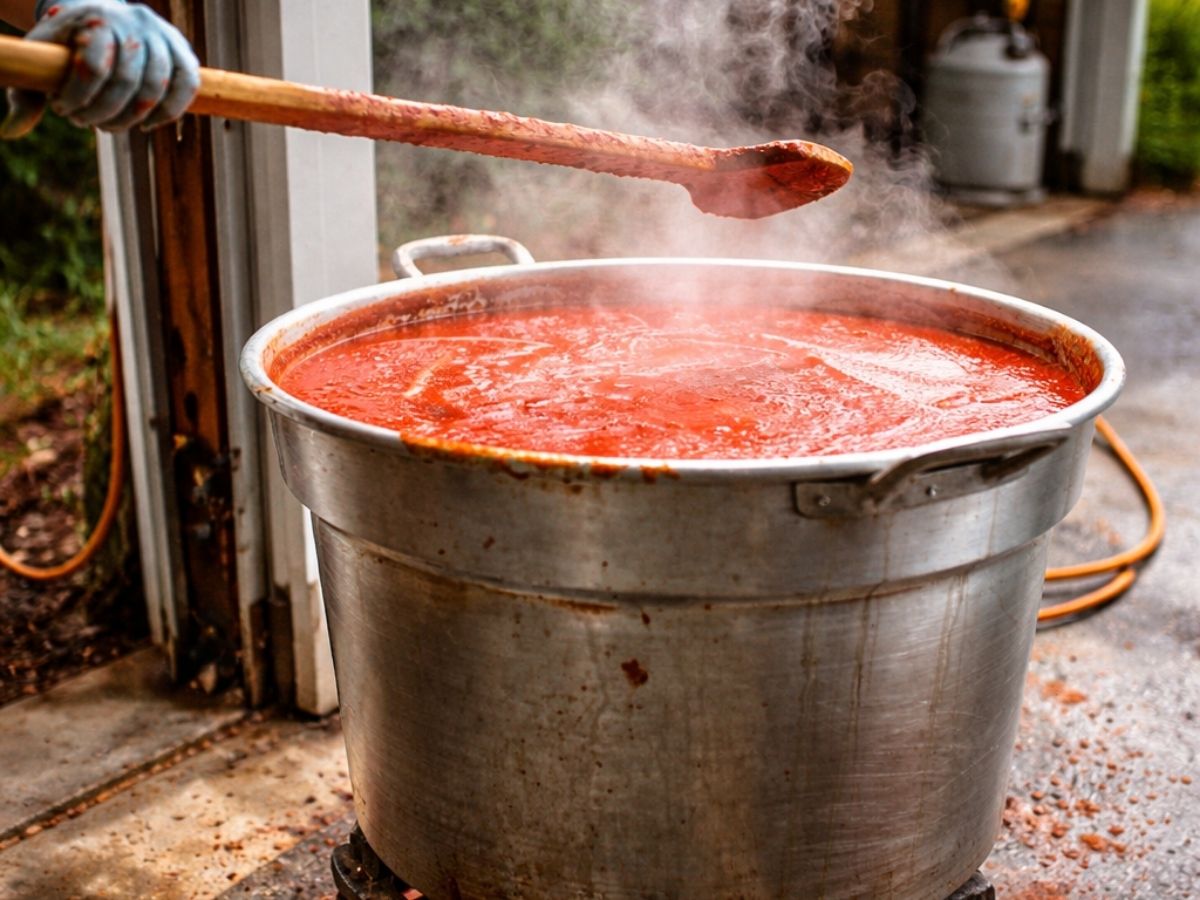
Every jar on those shelves, every salume hanging from the ceiling, every demijohn of wine represented a specific moment of work earlier in the year. The passata jars came from passata day in late August — the whole family assembled, the tomatoes going through the mill, the steam and smell filling the house. The soppressata and capicolo came from the November pig slaughter and the weeks of salting, spicing, and preparing that followed. The wine came from the September grape harvest and the pressing and the months of patient monitoring that turned crushed fruit into something drinkable. The preserved vegetables came from the orto — the family vegetable garden that had been tended since spring and harvested through summer and autumn.
The cantina was where all of that work came to rest. You walked in and you could see the year behind you. The jars dated August told you when the tomatoes had been good. The soppressata hanging in November told you the pig had been right. The wine in the demijohn told you the harvest had been worth it. The cantina was a record as much as a larder — a physical account of what the family had done and how it had gone and whether there would be enough.
My grandfather checked it the way other men checked their finances. Not anxiously — he was not an anxious man — but with the specific regular attention of someone who understood that what was in that room had a direct relationship to what the family would eat from November through the following summer. He would go down in the evenings sometimes, not to take anything out, just to look. To assess. To make the small adjustments that only someone with decades of experience would know to make. Whether the temperature was right. Whether a particular salume needed more time. Whether the wine was developing the way it should. The cantina was his domain in the specific way that the kitchen was my grandmother’s — not because anyone had formally assigned it, but because he was the one who knew it best and took responsibility for it accordingly.
The Calabrian cantina — what made it specific
Every Italian region had its cantina tradition, but the Calabrian version had specific characteristics that reflected the region’s climate, its agricultural economy, and its particular relationship with preserved meat and wine.
Calabria is the toe of the Italian boot — hot in summer, mild in winter, with a food culture that developed around the need to preserve through the summer heat what was produced in cooler months. Markys notes that Calabria’s signature contribution to Italian cured meat culture is soppressata — the pressed salami spiced with Calabrian chili — which reflects both the region’s agricultural traditions and its specific climate requirements for curing. The spice was not merely for flavor. Chili had preservative properties that made it valuable in a region where the summer could otherwise be a threat to cured products.
The Calabrian cantina’s wine was typically homemade — Gaglioppo-based reds from grapes that had grown in the region for centuries, pressed in autumn and stored in the demijohns that became a permanent feature of Italian immigrant basements across North America. The cheese was typically Pecorino or Caciocavallo — firm, aged, intensely flavored varieties that traveled well and kept long, which made them the natural choices for a room designed around the idea of duration.
The Montreal cantina — how the tradition crossed the ocean
When Calabrian families came to Montreal they brought the cantina with them. Not the room itself — they built a new version in whatever space the new house provided. But the knowledge traveled intact: what to hang, where to hang it, how long to wait, what temperature was right, how to tell when the soppressata had finished and when it needed more time.
The Montreal cantina adapted to the new environment with the same practical intelligence that Italian immigrant food culture always brought to adaptation. The Canadian winter was colder than Calabria — which in some ways was an advantage, providing natural refrigeration for the months when the soppressata needed consistent cool. The summer was hotter than Calabria — which required the air conditioning unit that my grandfather had installed in the corner of his cantina with the same matter-of-fact practicality with which he approached every technical problem. The technology was North American. The purpose was Calabrian. The result was a room that smelled exactly as it should.
In Saint-Michel and Saint-Léonard and Rivières-des-Prairies, in the Italian households that had put down roots in those neighborhoods through the 1950s and 1960s and 1970s, the cantina was a standard feature of Italian domestic life. You visited another Italian family and at some point during the visit the host would take you downstairs, or into the back room, or wherever they had found the space, to show you what was there. The showing was not boasting. It was sharing — the specific Italian generosity of opening the most private and productive room in the house to someone whose judgment of its contents you respected. You looked. You commented on the soppressata. You were given something to taste. You left with something under your arm. This was the protocol and everyone understood it.
That tradition — of keeping, of producing, of sharing what you had made — belongs to the same story of what Italian families carried after immigration and what they chose to protect. The cantina was not nostalgia. It was infrastructure — the physical expression of a food philosophy that understood self-sufficiency, preparation, and quality as things worth working for regardless of what the supermarket offered.
How to create your own cantina today
You do not need a basement or a stone cellar or a Calabrian pig to start. The cantina scales down to whatever space and ambition you have available.
The minimum version is a cool, consistent space — a basement corner, a spare room, even a large pantry — where temperature stays between 10 and 15 degrees Celsius year-round, or can be maintained there with a small air conditioning unit. That temperature range is what the soppressata and the wine and the cheese all need, which is why Italian immigrants reached for the same solution regardless of where they settled. The cantina’s requirements are not complicated. They are just specific.
Start with what you can make or source. A few jars of homemade passata from passata day on a dedicated shelf, dated and lined up. A demijohn of wine if you make your own — a traditional Italian demijohn is the most authentic vessel for home wine and the most direct visual connection to what your grandfather’s cantina looked like — or a few good bottles if you do not. Some aged Italian cheese — Pecorino, Caciocavallo, Parmigiano-Reggiano — that improves with time in consistent cool. And if you can source good quality Italian salumi to hang — or make your own soppressata, which is not as difficult as it sounds with the right guidance — a good Italian charcuterie and salumi guide will walk you through the process that Calabrian families have been following for centuries.
The point is not to replicate exactly what your grandfather had. It is to understand what it was for and to keep some version of that understanding alive in your own household. A room where things are made and stored and monitored and shared. A room that smells like the work you have done. A room where you can go in the evening and look at what you have prepared and feel the specific satisfaction of a family that has taken care of itself. For how to get children involved in the kind of food traditions the cantina supported, read how to get your kids interested in their Italian heritage. And for how to record the specific knowledge older relatives carry about what the cantina contained and how it worked, read how to record family stories before they’re lost.
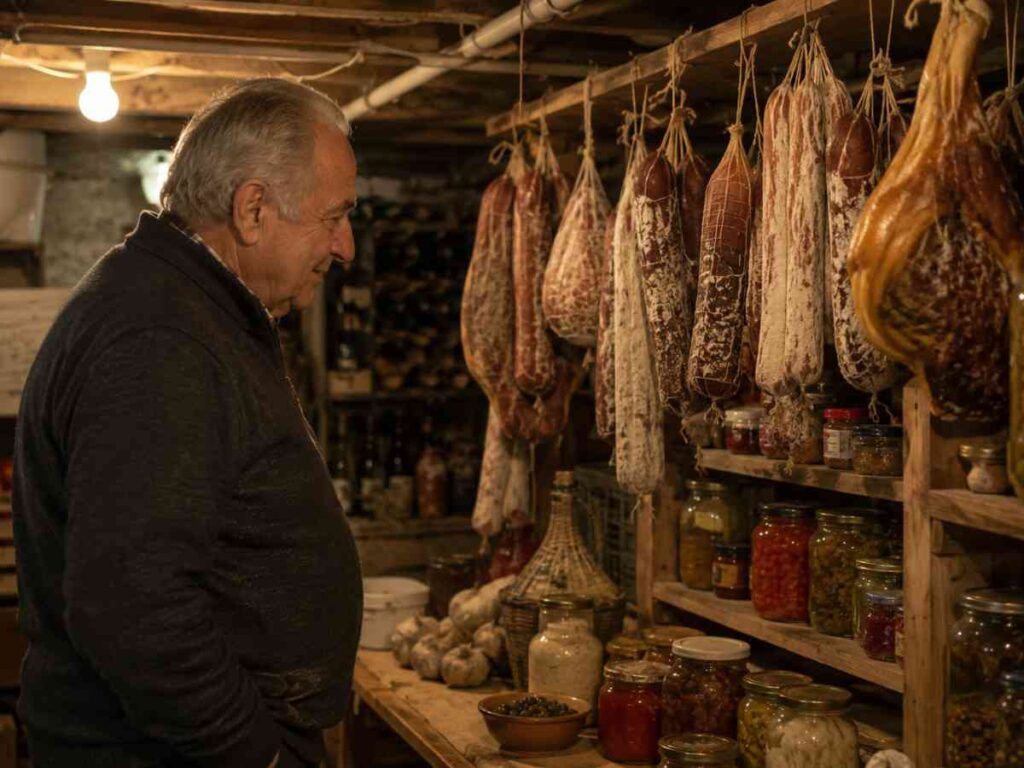
You opened the door and the smell hit you before anything else. Cured meat and wine and aged cheese and something underneath all of it that had no name. The soppressata hung from the ceiling in their tight casings. The passata jars lined the shelves with their dates. The demijohns stood in their wicker baskets waiting. And my grandfather would sometimes go down there in the evenings — not to take anything out, just to look. To assess. To be in the room where the year’s work was resting. I could stay in there all day. I understood, even as a child, that this room was the point of everything else.
The cantina connects to every other Italian preservation tradition — to passata day that filled its shelves, to the Italian vegetable garden that grew what the jars contained, to San Martino in November when the new wine was tasted and the cantina inventory checked. For the specific Calabrian cured meat tradition it sustained, read about the November traditions that produced the soppressata and capicolo that hung from its ceiling. And for the broader story of how Italian families built self-sufficient food systems in a new country, read Italian-American traditions: what changed and what stayed.
Finally, the cantina wasn’t only for wine and passata — it’s where the autumn stores were kept, in the same season families were roasting chestnuts. And if you made wine, this is how much wine your grapes would yield.
FAQ
What is the Italian cantina?
The Italian cantina is the family cellar or storage room — but the word loses its full meaning in translation. In Italian family life, the cantina was not simply a storage space. It was the room where everything the family had made, preserved, cured, and prepared for the year ahead was kept. It held wine in demijohns, cured meats hanging from the ceiling, rows of passata jars on shelves, aged cheese, potatoes and root vegetables, empty bottles waiting to be filled, and whatever else the family’s particular regional tradition produced. It was a physical record of the year’s work and a guarantee of the year ahead — the room that made Italian family self-sufficiency visible and concrete.
What did Italian families keep in the cantina?
The fully stocked Italian cantina contained cured meats hanging from the ceiling — soppressata, capicolo, pancetta, and other regional specialties depending on the family’s origin — wine in large glass demijohn vessels plus empty bottles for filling, rows of preserved tomato passata on shelves dated by year, aged cheese in its appropriate corner, preserved vegetables in oil or brine, and fresh vegetables like potatoes and onions in baskets on the floor. Alida’s Italian Kitchen documents the cured meat hanging tradition specifically. The exact contents varied by region and family tradition, but the principle was the same everywhere: the cantina held what the family had produced and what the family would need.
What temperature should an Italian cantina be?
Between 10 and 15 degrees Celsius year-round — cool enough to prevent spoilage and support the curing process for hanging meats, but not so cold that fermentation and aging stop entirely. In Italy, traditional cantinas were built below ground level or in naturally cool stone spaces that maintained this temperature without mechanical assistance. In North American homes, Italian immigrant families achieved the same result with insulated basement rooms and — when necessary — small air conditioning units that maintained the right conditions regardless of the season outside. The temperature requirement explains why the cantina was typically a basement room rather than a ground-floor one.
What is soppressata and why was it in the cantina?
Soppressata is a pressed Italian cured salami — the most characteristic product of Calabrian cured meat tradition — made from pork seasoned with salt, spices, and Calabrian chili, then pressed and hung to cure over several months. Markys notes that soppressata of Calabria is one of Italy’s most distinctive regional cured meat products, reflecting both the region’s agricultural traditions and its specific approach to preservation. The cantina provided the consistent cool temperature and air circulation that soppressata required during its curing period — typically hung in November after the pig slaughter and ready to eat anywhere from two to four months later depending on the specific family recipe and the conditions that year.
Did Italian-Canadian families keep the cantina tradition?
Yes — and with remarkable fidelity. Italian immigrant families in Montreal, Toronto, Hamilton, and other Canadian cities recreated the cantina in whatever space their new homes provided, adapting to the different climate with practical solutions like small air conditioning units where necessary. The knowledge of what to hang, how long to wait, what temperature was required, and how to tell when the soppressata was ready traveled intact from Calabria and Sicily and other regions of origin. In the Italian neighborhoods of Montreal — Saint-Michel, Saint-Léonard, Rivières-des-Prairies — the cantina was a standard feature of Italian domestic life through the 1950s, 60s, and 70s, and visiting another Italian family often included being taken to see what was in their cantina as a specific act of hospitality and mutual respect.
How do I create an Italian cantina today?
Start with a cool, consistent space — a basement corner, spare room, or large pantry where temperature can be maintained between 10 and 15 degrees Celsius year-round. A small air conditioning unit handles this in most North American homes. Then stock it gradually with what you make: passata jars from your annual tomato processing, wine if you make your own, aged Italian cheeses that improve in consistent cool, and eventually cured meats if you learn the process. A good Italian charcuterie guide will walk you through soppressata and other cured meats that the cantina tradition was built around. The goal is not to replicate exactly what your grandfather had — it is to understand what it was for and keep some version of that understanding alive in your own household.
What is the relationship between the cantina and passata day?
The cantina was the destination that passata day was working toward. The entire late August ritual of assembling the family, processing the tomatoes, filling the jars, sealing them, and boiling them for preservation produced a specific thing: rows of passata jars that would line the cantina shelves, dated and counted, for use throughout the year. The cantina shelves were the reason the passata jars existed and the passata jars were a major reason the cantina shelves existed. They were two parts of the same annual food cycle — the production and the preservation, the making and the keeping — that structured Italian family food life through the calendar year.

Marco Ricci is an Italian-Canadian writer and the grandson of Calabrian immigrants. He created Italian Family Traditions to document the customs, feast days, and family rituals Italian families carried from Italy to North America — and to understand what they actually meant. He is based in Montreal.