Italian Family Traditions
What Is La Befana? The Italian January Tradition That Made Santa Claus Irrelevant
I made the mistake once of mentioning Santa Claus to my grandmother. She looked at me with the expression of someone who had just been told something both incorrect and slightly insulting. “Santa Claus,” she said. “I don’t know who that is. He doesn’t exist.” She paused. “La Befana exists.”
That was the end of the Santa Claus conversation. There was no debate, no negotiation, no acknowledgment that the jolly man in the red suit might have any standing in this household whatsoever. My grandmother had grown up in a village outside Cosenza, in Calabria, with eight siblings — nine children in total — and in that house, in those winters, the night of January 5 was the night that mattered. Not December 24. Not December 25. January 5. The night La Befana flew.
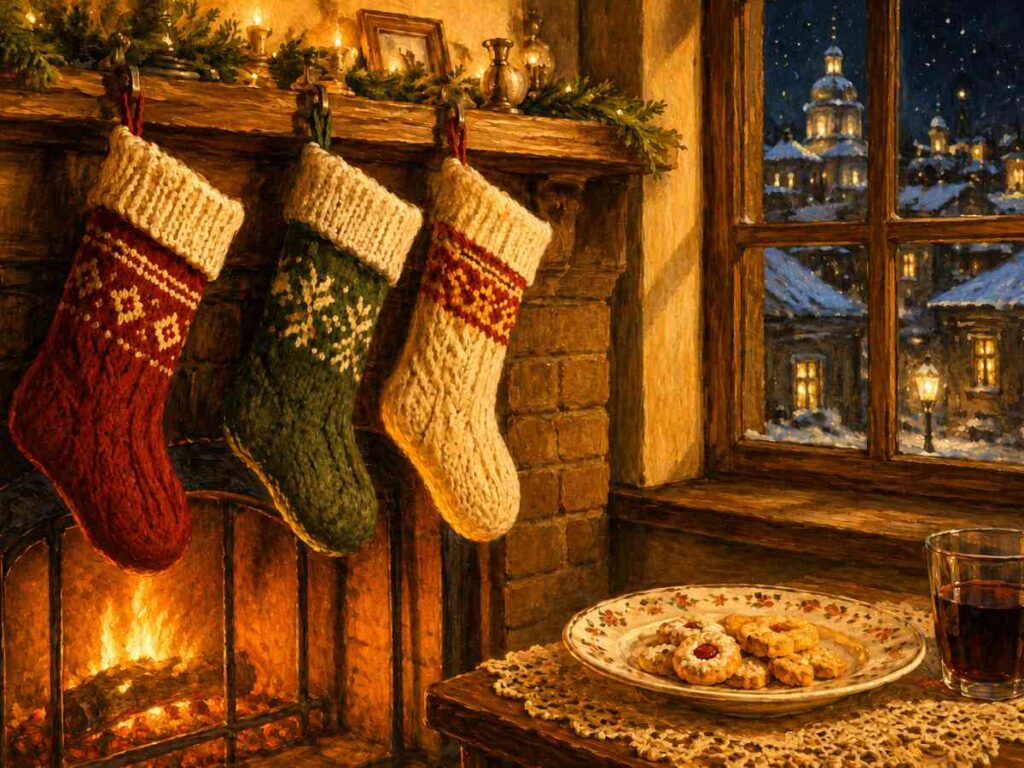
She would tell me about it the way she told me about everything from her childhood — not as nostalgia exactly, but as information. As things that were true and worth knowing. She and her siblings would prepare the night before with a seriousness that the occasion demanded. The stockings hung. The shoes left out in some years, the calza in others, depending on what the family had and what the custom was that particular winter. Nobody slept particularly well. Nine children in a Calabrian house in January, all of them aware that something was coming through the chimney overnight — not sleep was not a realistic outcome.
In the morning, whatever was in the stocking told you what kind of year you had had. Sweets meant you had been good. Coal meant the Befana had an opinion. The coal, my grandmother told me, was real coal in those years — not the sugar kind, not the chocolate version that Italian specialty shops sell today. Real coal, which communicated the message with a directness that left nothing to interpretation. She said this without apparent trauma. It was the tradition. The Befana knew. You accepted her judgment and tried to do better.
La Befana is not the Italian version of Santa Claus. She is something older, more specific, and more honest. Santa Claus brings gifts because it is Christmas. La Befana brings gifts because she has been watching — and she has an opinion about what she saw.
What La Befana actually is
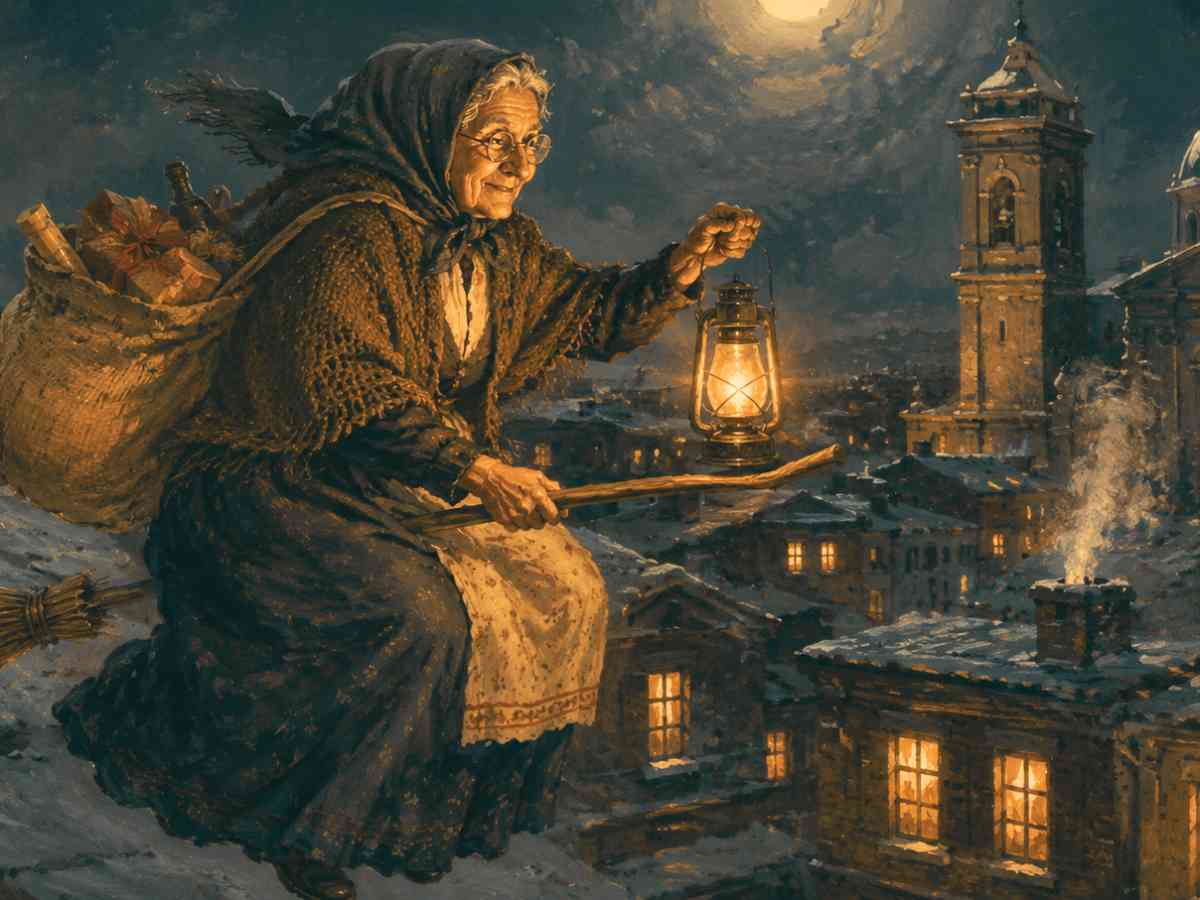
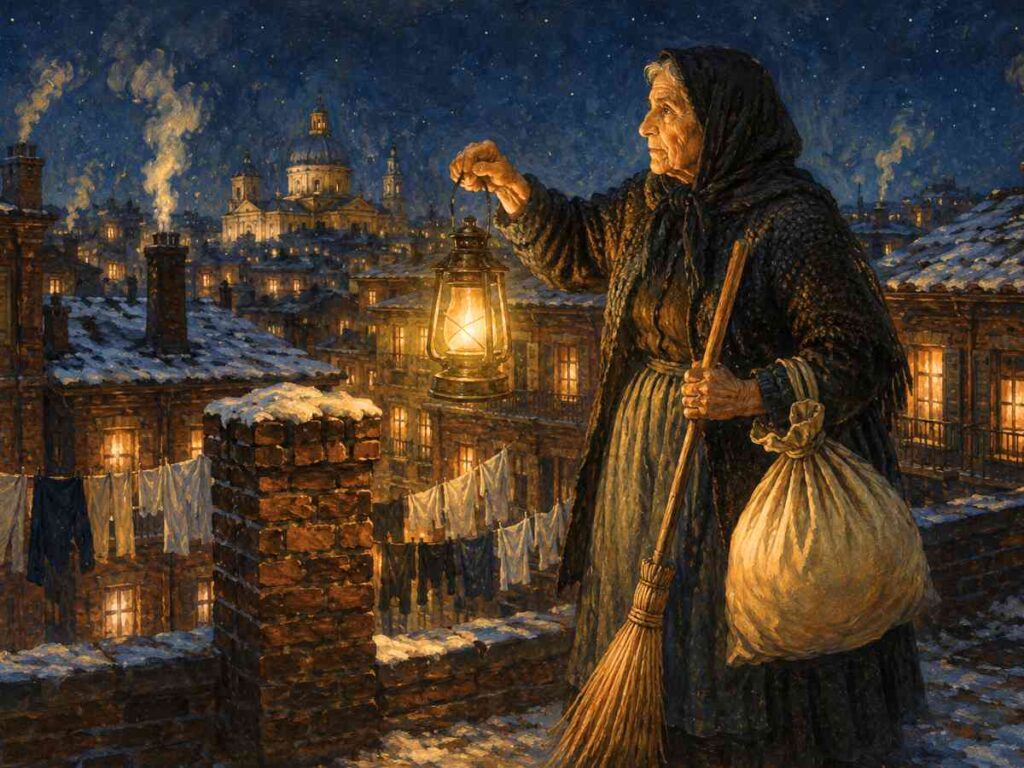
La Befana is a legendary old woman who travels on a broomstick during the night between January 5 and January 6 — the eve of the Epiphany — visiting children throughout Italy and leaving sweets and gifts for the good ones and coal for those who have misbehaved. Italia.it describes her as the world’s most famous old lady — an old woman who fills the stockings left hanging in homes all over the country. Hidden Marche adds that despite her witch-like appearance, Befana is the very opposite of evil. Her broom represents not dark magic but cleansing — sweeping away the old year to make room for the new one. Her sack of sweets is a symbol of abundance and kindness. The soot on her face comes from her long nights traveling through chimneys.
The name itself comes from the word Epifania — Epiphany — the Christian feast of January 6 commemorating the arrival of the Three Wise Men at the stable in Bethlehem. Italian Language Centre explains that over time, Epifania evolved in popular dialect into Befania and eventually became Befana. The word and the figure were shaped by the same forces — centuries of folk tradition layering on top of Christian observance, pagan agricultural ritual absorbed into the feast day calendar, the specific Italian instinct for making something official into something lived.
In many parts of Italy — especially in the south, especially in Calabria — Befana was historically more significant for children than Christmas. The gifts came on January 6, not December 25. Christmas was a religious and family occasion. Epiphany was the children’s day. That distinction mattered enormously to the children of my grandmother’s generation, for whom the stocking on January 6 was the event the entire holiday season had been building toward.
The legend — why Befana is still searching
The story behind La Befana is one of the most quietly melancholy in Italian folk tradition, which is part of what gives her such staying power.
According to the legend documented by La Cucina Italiana, the Three Wise Men stopped at her home on their journey to Bethlehem to visit the Christ child. They invited her to join them. She declined — she was too busy with housework, with her broom, with the domestic obligations that had always defined her life. But soon after they left, she regretted her decision. She set off to find them, bringing with her an assortment of sweets she had been making. She never found the infant. She never found the Magi. And so, still searching, still carrying her gifts, she flies every year on January 5 — leaving sweets for good children in every house she visits, just in case one of them happens to be that special child she has been looking for since the beginning.
That story — the woman who said no once and has been making amends ever since — says something true about how Italian folk tradition understood generosity. It is not always given freely from the beginning. Sometimes it is given because you said no when you should have said yes, and the only way to live with that is to keep giving forever. La Befana’s generosity is the generosity of someone who regrets. That is a very human kind of generosity, and children who grew up with the story understood something about it without being told to understand it.
The night before — nine children and no sleep
My grandmother’s childhood Befana preparations were not elaborate by modern standards. They did not need to be. Nine children in a Calabrian village outside Cosenza in the mid-twentieth century were not expecting the contents of a toy shop. They were expecting the stocking. Whatever was in the stocking was the event.
The preparation the night before was the part she remembered most vividly. The hanging of the stockings — each child’s, carefully placed, because the Befana needed to know where to go. The specific atmosphere of a house where nine children were all supposedly going to sleep but none of them actually were, each one lying in the particular stillness of a child pretending to be asleep while listening as hard as they possibly could for any sound that might indicate arrival. No sound came. It never came. The Befana was too old and too experienced to be caught arriving. But the listening was part of the ritual as much as anything else. You lay there in the dark with your siblings and you listened and you believed and you waited.
She told me that in the morning, the first one to the stockings had an advantage that no amount of older-sibling authority could override — the specific privilege of the child who got there first and saw everything before anyone else could. There was always one who got there first. There was always a moment of absolute silence after they looked in, before they turned around and the rest of the family understood from their face whether Befana had been generous or had something specific to say. Nine children. One broomstick. One night. My grandmother told me this with the smile of someone revisiting something that had been real in a way that very few things since had managed to be.
What went into the calza — and what the coal really meant
The calza della Befana — Befana’s stocking — was the physical center of the tradition. What it contained was the tradition’s verdict on the year just passed.
| What was in the calza | What it meant |
|---|---|
| Sweets and candy | The Befana had seen you and approved. The year had been good enough. This was the outcome everyone was working toward. |
| Small toys or gifts | In more prosperous households, the calza contained small practical items — a coin, a small toy, something useful. Nothing extravagant. The point was the gesture, not the value. |
| Oranges and mandarins | Common in Calabrian and southern Italian calze — fruit in January was a gift, not a consolation. Something sweet, seasonal, and real. |
| Nuts and dried fruit | Abundance in compact form. Walnuts, hazelnuts, dried figs — the calza as a seasonal harvest carried into January. |
| Coal — real | In earlier generations, actual coal. A direct and unambiguous communication. The Befana had watched. She had conclusions. You knew what you needed to improve. |
| Coal — sweet | The modern version — black sugar candy shaped like coal, sold in Italian specialty shops every December. The message softened but the symbolism intact. Even the naughty children got something sweet, which says something about how the tradition evolved. |
The real coal of my grandmother’s childhood Cosenza winters was not symbolic in the way the sugar coal is today. It was actual coal — black, heavy, cold — and its appearance in a stocking communicated the Befana’s assessment with a clarity that required no explanation. Children understood. The adults who had put it there understood. The conversation it started at the breakfast table was probably the most effective behavioral correction the family had access to, and it cost nothing.
Where La Befana came from — older than Christmas
La Befana is one of those Italian traditions that reveals, on examination, just how many layers of history are packed into what looks like a simple folk story.
Top Travel and Food traces the origins of Befana back to ancient Roman agricultural rituals marking the end of the farming year after the winter solstice — a period the Romans understood as a time of transition, renewal, and offering. Hidden Marche notes that when Christianity spread through Italy, many of these pagan customs were absorbed into new religious celebrations. The Befana — with her broom, her bag of gifts, and her kindly but unsentimental spirit — survived as a blend of both worlds: a symbol of transition between the old year and the new, carrying Christian meaning in her association with Epiphany and older meaning in her broom, her soot, and her long solitary flight through the winter night.
The saying that has accompanied the feast for generations — L’Epifania tutte le feste porta via, Epiphany takes all the holidays away — captures the tradition’s position in the calendar perfectly. Dolce Terra explains it: after January 6, the holiday season is over. The decorations come down. Normal life resumes. Befana is the closing ceremony — the final gift, the final stocking, the final acknowledgment that something special has been happening and is now, properly and finally, complete.
That role — closer of the season, sweeper of the old year — gives La Befana a dignity that purely gift-giving figures do not always have. She is not just bringing things. She is marking the end of something and the beginning of something else. Her broom is not incidental. It is the point.
Befana versus Santa Claus — why my grandmother had no interest in the comparison
The moment I mentioned Santa Claus to my grandmother was educational in several ways simultaneously.
She was not hostile to Santa Claus. She simply had no relationship with him. He was a figure from a different tradition — an Anglo-American one, a department store one, one that had arrived in Montreal from the outside rather than coming from inside the family. She had not grown up with him. Her mother had not grown up with him. Her village outside Cosenza had not celebrated him. He was, in her assessment, a person she did not know — and La Befana was a person she did know, intimately, from the inside, from the particular feeling of January 5 in a house with nine children who were all awake and pretending not to be.
The comparison itself was the mistake. They are not the same figure. Nada’s Italy notes that while La Befana is similar to Santa Claus in the mechanics — the stockings, the night visit, the gifts for the good and coal for the not-so-good — she is something quite different in character and meaning. Santa Claus is jolly. La Befana is wise. Santa Claus arrives on a sleigh with reindeer and a general atmosphere of festivity. La Befana arrives alone, on a broomstick, through the chimney, at night, carrying a sack and a lantern and several centuries of accumulated judgment. Santa Claus gives gifts because it is Christmas. La Befana gives gifts because she regrets something and has been making amends ever since.
My grandmother understood this distinction without articulating it. She simply knew which one was real — which one had been in that house in Cosenza on the morning of January 6, which one her mother had talked about, which one had put something in her stocking and left before dawn. That was La Befana. Santa Claus could exist wherever he wanted to exist. He did not exist here.
La Befana in Italian-Canadian families — how the tradition traveled
Befana came to Montreal with the families who knew her. She did not need a parade or a community organization or an official heritage event to survive the crossing. She needed stockings and a night in January and parents who remembered what the morning of January 6 had felt like when they were children in Calabria or Sicily or Campania, and who were not prepared to let their own children grow up without knowing that feeling.
In Italian-Canadian households in Saint-Michel and Saint-Léonard and Little Italy, January 6 had a specific quality that January 7 did not. The stockings went up on January 5. The children were put to bed with the specific instruction that the Befana was coming and would know whether they were asleep. The morning of January 6 had the particular electricity of a morning when something has happened overnight in your house and you are about to find out what. That electricity is not a North American Christmas electricity. It is older and quieter and more specific — and the families who carried it across the ocean were not going to let a man in a red suit make it irrelevant.
In households where both traditions coexisted — Santa Claus on December 25 and La Befana on January 6 — the children had the excellent situation of receiving things twice. But in the more traditional households, La Befana was the event and Santa Claus was the North American holiday that happened to occur in the same general season. My grandmother’s position on this hierarchy was clear and she maintained it consistently for as long as I knew her.
That continuity — the stocking, the night, the morning, the calza carried from a village outside Cosenza to a house in Montreal — belongs to the same story of what Italian families carried after immigration and what they chose to protect. For the Christmas traditions that Befana shares the season with, read about La Vigilia and the Italian Christmas Eve and the Italian presepe tradition. For the January feast day that follows close behind, read about the Italian feast day calendar and how it structured the year.
How to keep La Befana alive in your family today
The tradition is simpler to keep than most Italian customs because it requires almost nothing that is hard to find.
Hang a stocking on January 5. Tell children who La Befana is — tell them the legend, tell them she was busy sweeping when the Magi came and has been making up for it ever since, tell them she knows how the year went and will have something to say about it. Let them go to bed knowing she is coming. Fill the stocking after they are asleep — sweets for the good behavior you genuinely observed during the year, and a piece of sweet coal from an Italian specialty shop for the moments that were less distinguished. In the morning, let them find it themselves. Let the first one there have their moment before anyone else knows what is inside.
The sweet coal is widely available at Italian specialty food shops and online in the weeks before Epiphany. Italian sweet coal candy — the black sugar version that replaced real coal in the modern tradition — makes the point clearly enough without the message being quite as permanent as a lump of actual carbon. Even children who receive it understand what it means. The Befana had an opinion. The opinion has been delivered in edible form. The conversation that follows is useful.
And tell the stories. Tell them about the village outside Cosenza. Tell them about nine children awake in a January house, pretending to sleep, listening for a sound that never came because the Befana was too experienced to be caught. Tell them about the coal that was real coal and communicated clearly. Tell them that she exists — with the specific certainty my grandmother used when she told me, the certainty of someone who had received her visit personally and repeatedly and who considered the matter entirely settled.
For how to record these specific family stories about how Befana was observed in your grandparents’ house before the memories fade, read how to record family stories before they’re lost. And for how to bring children into these traditions in a way that makes them feel real rather than performed, read how to get your kids interested in their Italian heritage.
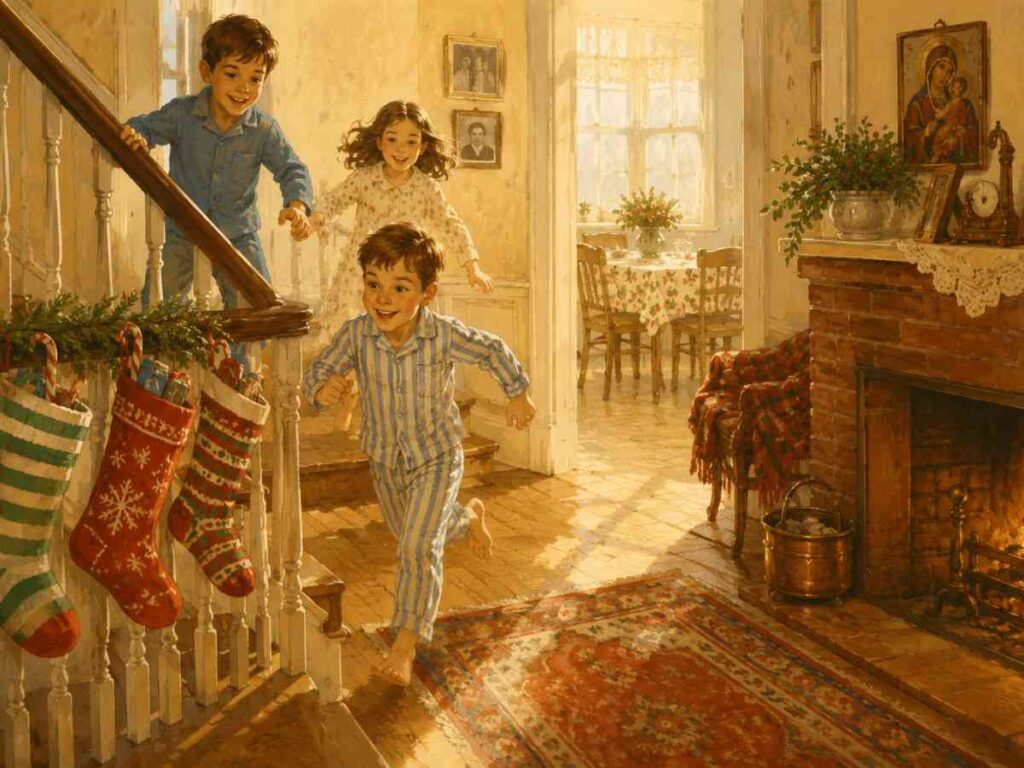
“Santa Claus,” she said. “I don’t know who that is. He doesn’t exist.” A pause. “La Befana exists.” That was the end of the conversation. Nine children. One broomstick. One night in January. One morning that told you what the year had been worth. She had been there for it. She knew.
La Befana belongs to the same Italian feast day calendar as the onomastico tradition — the understanding that the calendar was populated with specific days that meant specific things. For the December traditions she closes the door on, read about La Vigilia and the Italian presepe. For the Calabrian folk traditions she shares her spirit with, read about the malocchio and Acqua di San Giovanni — the summer tradition that shares her quality of being absolutely certain and absolutely right. And for the broader story of how Italian traditions survived immigration, read Italian-American traditions: what changed and what stayed.
FAQ
What is La Befana?
La Befana is a legendary old woman in Italian folklore who travels on a broomstick on the night of January 5 — the eve of the Epiphany — visiting children throughout Italy and filling their stockings with sweets and gifts for the good ones and coal for those who misbehaved. Italia.it describes her as the world’s most famous old lady. Hidden Marche notes that despite her witch-like appearance, Befana is a benevolent and maternal figure — her broom represents not dark magic but cleansing, sweeping away the old year to make room for the new one. She is one of the most beloved figures in Italian folk tradition and remains central to the Epiphany celebration on January 6.
When does La Befana come?
La Befana arrives during the night between January 5 and January 6 — the eve of the Epiphany. Children hang their stockings on January 5 and find them filled on the morning of January 6. In Italy, January 6 is a public holiday and is treated by many families as the true closing of the Christmas season. The saying L’Epifania tutte le feste porta via — Epiphany takes all the holidays away — reflects her role as the final celebration before normal life resumes. After January 6, the decorations come down, the season ends, and the year properly begins.
Why does La Befana bring coal?
Because La Befana has been watching and has an opinion. According to the tradition, children who behaved well during the year receive sweets and small gifts. Children who did not behave well receive coal — a direct and unambiguous assessment of the year just passed. In earlier generations, in Calabrian villages and across southern Italy, the coal was real coal. In the modern Italian tradition it is typically sweet black sugar candy made to look like coal, sold in Italian specialty shops every December. The message is softened but the symbolism is intact: even the coal is edible now, which says something about how the tradition evolved while keeping its essential honesty.
What is the legend of La Befana?
According to the legend documented by La Cucina Italiana, the Three Wise Men stopped at La Befana’s home on their journey to Bethlehem and invited her to join them. She declined — she was too busy with her housework and her broom. But soon after they left, she regretted her decision. She set off to find them, carrying sweets she had been making. She never found the Christ child. She never found the Magi. And so she continues her search every year on January 5, flying through the night and leaving sweets for good children in every house she visits — just in case one of them is that special child she has been looking for. Her generosity is the generosity of someone who said no once and has been making amends ever since.
Is La Befana the same as Santa Claus?
No — and Italian families who grew up with La Befana are generally clear about this distinction. They are similar in mechanics: both visit children at night, both leave gifts in stockings, both have an opinion about behavior. But they are different in character and meaning. Santa Claus is jolly and festive. La Befana is wise and specific. Santa Claus gives gifts because it is Christmas. La Befana gives gifts because she regrets a decision she made centuries ago and has been compensating ever since. Nada’s Italy notes the similarity in tradition while recognizing the fundamental difference in spirit. For the Italian families who grew up with La Befana as their primary gift-giving tradition, the comparison itself was sometimes taken as a mild misunderstanding of something they considered entirely real and distinct.
Did Italian-Canadian families keep the Befana tradition?
Many did — particularly families from southern Italy where La Befana was historically more significant than Christmas for children. In Italian-Canadian households in Montreal, Toronto, and Hamilton, January 6 maintained its specific quality: the stockings hung on January 5, the children put to bed with the understanding that La Befana was coming, the morning of January 6 with the particular electricity of a morning when something has happened overnight. In the most traditional households, La Befana was the primary gift-giving tradition and Santa Claus was the North American holiday that happened to occur in the same general season. In others, both traditions coexisted and children received the considerable benefit of two gift-giving occasions separated by twelve days.
How do I celebrate La Befana with my family today?
Hang a stocking on January 5. Tell children who La Befana is and why she comes — the legend, the regret, the ongoing search. Let them go to bed knowing she will arrive. Fill the stocking after they are asleep — sweets for the good behavior genuinely observed during the year, and sweet coal from an Italian specialty shop or online for the moments that were less distinguished. In the morning, let them find it themselves. And tell the stories — about how the tradition was observed in your family, in your grandparents’ house, in the village they came from. The stocking is easy. The story is what makes it last.

Marco Ricci is an Italian-Canadian writer and the grandson of Calabrian immigrants. He created Italian Family Traditions to document the customs, feast days, and family rituals Italian families carried from Italy to North America — and to understand what they actually meant. He is based in Montreal.