Italian Family Traditions
The Feast of the Seven Fishes Meaning and Why Nobody Can Agree on the Number
It starts with frying oil at noon and ends with chestnuts at midnight. In between, Christmas Eve becomes something your family will spend the rest of their lives trying to recreate.
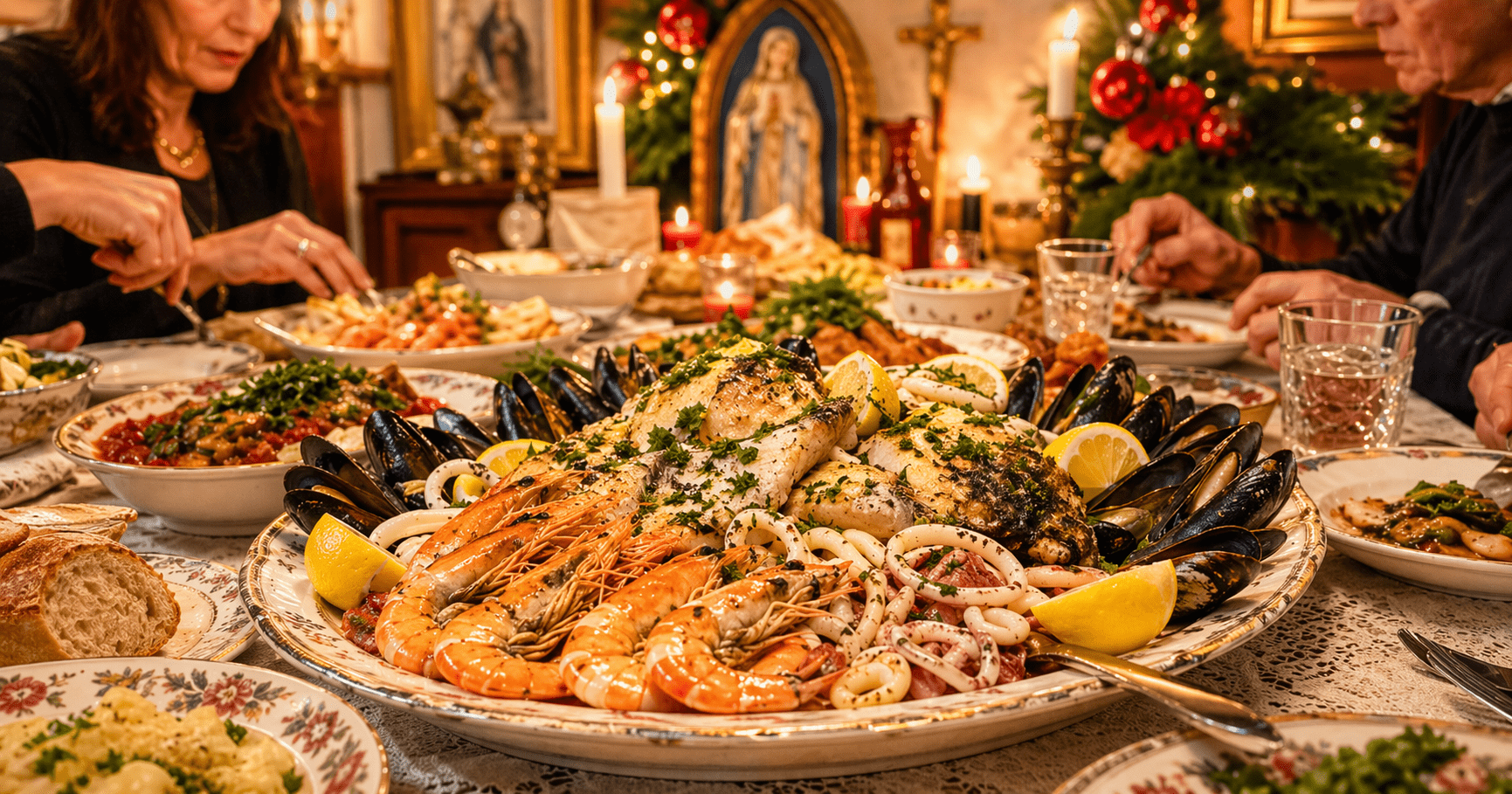
Let me tell you how Christmas Eve actually started in our house. Not at the table. Not when the first dish came out. It started the moment you walked through the door and the smell hit you — hot oil, garlic, something briny and oceanic and completely specific to this one night of the year. Before you saw a single person, before anyone said hello, the house told you: it is Christmas Eve, and this is Italian Christmas Eve, which is a different thing entirely.
By the time you found your coat hook, my grandmother was already at the stove. She had been there since morning. She would be there until late. She was not cooking the way people cook when they are trying to get dinner on the table. She was orchestrating — turning, plating, calling over her shoulder, disappearing back into the kitchen before she had taken three bites of anything. It was less like a meal being made and more like a whole production being staged, with the kitchen as the wings and the dining room as the stage and Nonna somehow running both.
That is the Meaning of Feast of the Seven Fishes.
Not the menu. Not the count. Not the recipe. That feeling — of a house fully alive on Christmas Eve, of a meal that takes all day to build and all night to eat, of a family that comes together before Christmas arrives and makes the waiting into something beautiful — that is the real meaning of it. And if you grew up around it, you have spent years looking for a version of it that comes close.
The Feast of the Seven Fishes is one of those traditions where you do not understand the meaning until you are somewhere it is not happening.
This article is for everyone who already knows the feeling and wants to understand where it came from — and for everyone who is coming to it fresh and wants to know why Italian-American families guard this particular Christmas Eve tradition like it belongs in a vault.
If you want the wider story of how old-country customs became something new in North America, read Italian-American traditions: what changed after immigration and what stayed the same.
What is the Actual Meaning of Feast of the Seven Fishes
At its core, the meaning of the Feast of the Seven Fishes is that Christmas Eve is not ordinary time.
It is the vigil. The waiting room before the feast. The night before Christmas, when the Catholic calendar says: not yet. Hold on. The great celebration has not arrived. And in that holding-on, Italian families built something extraordinary — a meatless meal of multiple fish dishes that grew, over generations, from a rule of restraint into a ritual of abundance.
Britannica describes it as an Italian-American Christmas Eve meal rooted in older Catholic fasting and abstinence before feast days — and notes something fascinating: the specific name “Feast of the Seven Fishes” is believed to be exclusively Italian-American, with the first known printed mention appearing in a Philadelphia newspaper only in the 1980s.
Think about that for a moment.
A tradition that feels ancient.
It carries the weight of generations, that makes grown adults emotional just thinking about it — and the name itself is barely forty years old. That is not a contradiction. That is exactly how living traditions work. The custom was old. The language for it was new. The feeling was always real.
In our family, nobody ever announced it was “the Feast of the Seven Fishes.” Nobody counted. Nobody named it. It was just Christmas Eve, and Christmas Eve meant this: fish coming out of the kitchen in waves, the good plates, everyone staying too late, and the specific happy chaos of a house that knew exactly what it was doing and why. The name did not matter. The night did.
So the meaning of the Feast of the Seven Fishes is several things at once, layered on top of each other the way a good Italian dish layers flavors:
- Abstinence — because Christmas has not arrived yet, and meat stays off the table
- Anticipation — the vigil mood, the sense of moving toward something sacred
- Abundance — because Italian families turned “no meat” into the most generous table of the year
- Family — because this is the night everybody comes home
- Heritage — because for many Italian-Americans, this meal is one of the clearest ways to feel Italian at Christmastime
That last one is the one that has kept the tradition alive across generations, even as language fades and neighborhoods change and everyday ethnic life gets thinner. The meal still does the work.
Why fish? The old Catholic logic that started everything
The fish on Christmas Eve does not come from a random love of seafood. It comes from something older and more structured: the Catholic tradition of abstaining from meat before a great feast.
Christmas Eve was a fasting and abstinence day. The celebration had not yet arrived. Before the feast of Christmas came the vigil — and in that vigil, meat was off the table. In southern Italy, where seafood was plentiful and relatively affordable, fish became the natural answer. Not “we love fish so we made fish.” More like “we cannot have meat, we live near the sea, and we are Italian, so obviously this is going to become something magnificent.”
That custom — the Christmas Eve fish dinner — is what Italians call La Vigilia: the vigil dinner. Britannica notes that while La Vigilia belongs to Italy, the specific branded idea of “the Feast of the Seven Fishes” developed among Italian-American communities from southern Italian immigrant families in the United States. National Geographic makes the same distinction, describing the feast as something that evolved into a uniquely Italian-American form over roughly the last hundred years.
My grandmother came from a small town in Campania where Christmas Eve fish dinner was simply what you did — quiet, meatless, faithful. By the time she had been in America for twenty years and raised four children in a city apartment with cousins in the building downstairs, the Christmas Eve fish dinner had become an event. More dishes. More people. More noise. More abundance. The restraint was still there underneath — still no meat, still a vigil — but it had been dressed up in everything her family had worked for in the new country. That is not a corruption of the tradition. That is the tradition becoming American.
A rule of restraint became a feast of abundance. That is such a perfect immigrant move. You keep the old meaning. You express it with generosity. You do not just eat fish because you “have to.” You turn the whole night into an event that people talk about for the rest of their lives.
Why seven? The most honest answer you will find anywhere
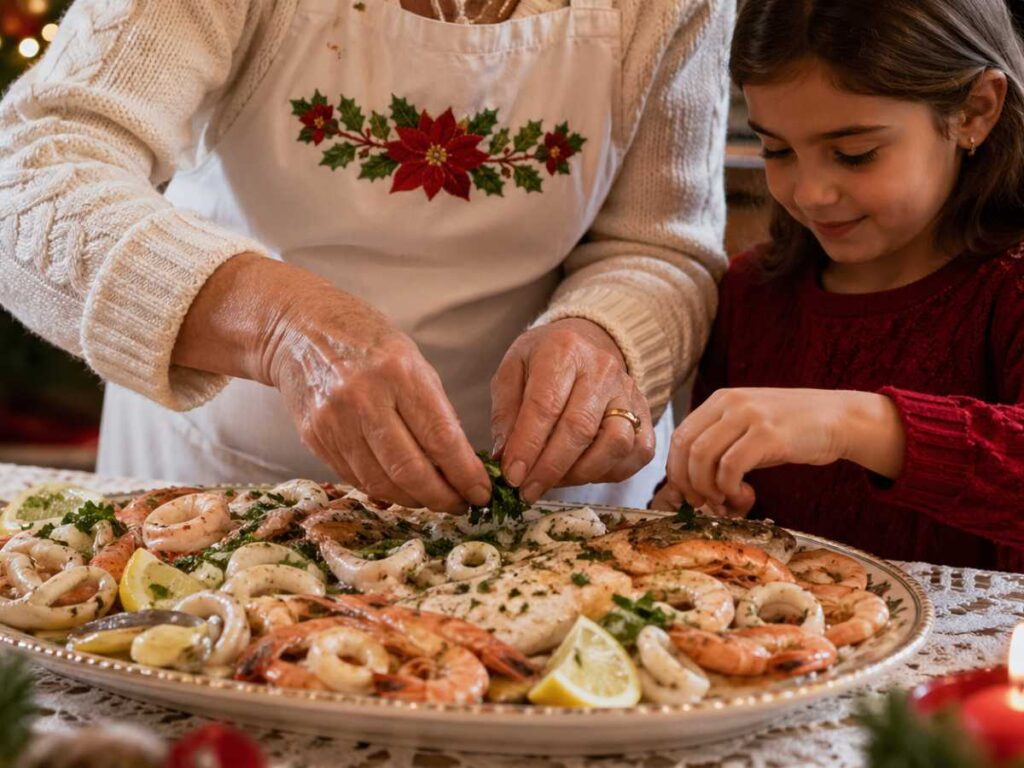
Here is the question everyone asks, and here is the honest answer: nobody knows for certain.
West Chester University anthropologist Michael Di Giovine says the historical reasons for exactly seven fishes are unclear, even as theories circulate widely. Britannica agrees, noting that people often connect the number to the seven sacraments, the Seven Hills of Rome, or other symbolic religious numbers — but there is no single confirmed explanation.
What is even more interesting is that many families do not even stop at seven. Here is what the actual numbers look like across Italian-American households:
| Number | The reasoning families give |
|---|---|
| 3 | The Holy Trinity |
| 7 | The classic — most families claim this one, and most disagree on why |
| 9 | The Trinity times three |
| 11 | The apostles, minus the two bad ones |
| 13 | Jesus and the twelve apostles |
In our house, my grandfather insisted it had to be exactly seven. My great-uncle insisted it had always been nine in his mother’s house. My grandmother listened to both of them with the serene expression of a woman who knew she was the only one in the room who had actually been cooking since 9am and therefore had the most standing to decide the number. She never said how many dishes she made. She just kept bringing them out. Nobody ever counted. The argument continued for thirty years.
Ask five relatives why there are seven fishes and you will get eight answers. And somehow that also becomes part of the tradition. The debate over the number is itself a Christmas Eve ritual in countless families. The number was never really the point. The abundance was the point. The gathering was the point. The night was the point.
Is it really Italian — or is it Italian-American?
Both. And that is not a dodge — it is actually the most interesting part of the answer.
The older Christmas Eve fish dinner is absolutely part of Italian Catholic tradition, especially in the south. That is real. That is where the custom was born. But if you fly to Rome or Naples today and ask someone about the meaning of the “Feast of the Seven Fishes,” you will mostly get blank looks. National Geographic puts it plainly: you will not really hear festa dei sette pesci as a common expression in Italy, where Christmas Eve is simply La Vigilia. The seven-fishes identity, the name, the counting, the specific brand of abundance — that grew here, in America, among Italian immigrants from the south who were doing what immigrants have always done: taking what they had, intensifying it, and making it into something that could hold a family together in a new country.
West Chester’s research goes even further, describing the feast as a ritual marker of Italian-American heritage — something that grew more important, not less, as assimilation accelerated. The more Italian-American life blended into mainstream American culture, the more Christmas Eve fish dinner became a line in the sand. This is one of our nights. This is what we do. This is who we are.
The Feast of the Seven Fishes is not a copy of something Italian. It is something Italian-American built from Italian roots — and that makes it more interesting, not less authentic.
That distinction matters enormously for anyone who has ever felt vaguely apologetic about celebrating a tradition that “is not really from Italy.” It is from Italy. It grew in America. That is exactly how the best traditions work.
What actually gets served — and the beautiful chaos of how it arrives
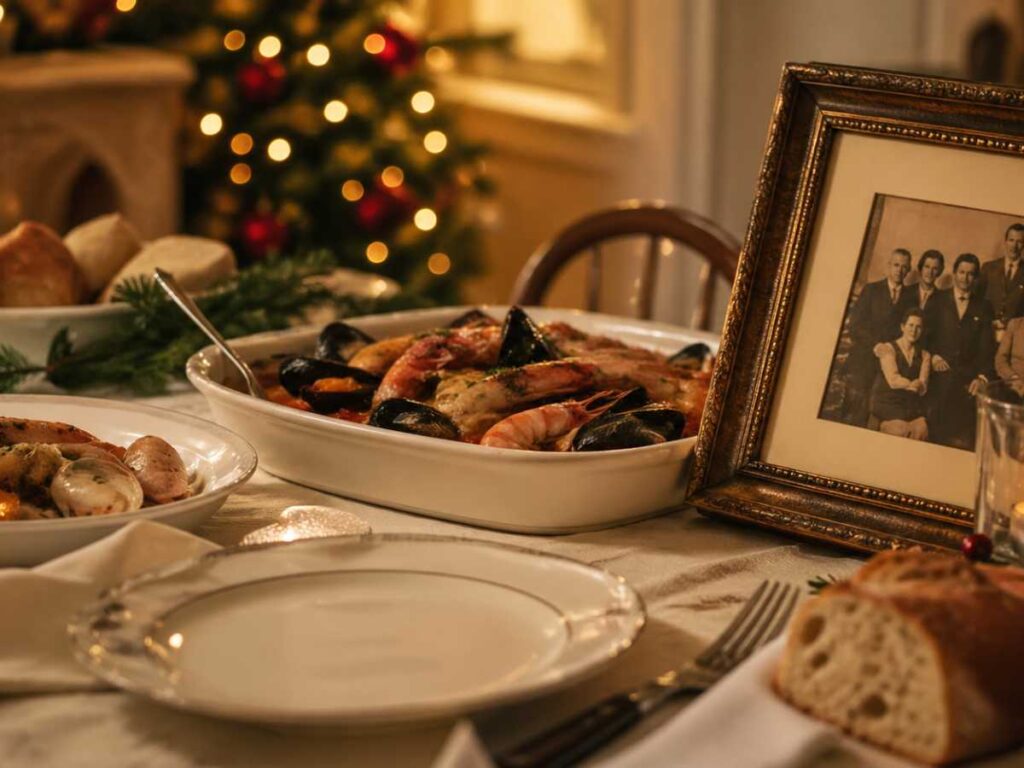
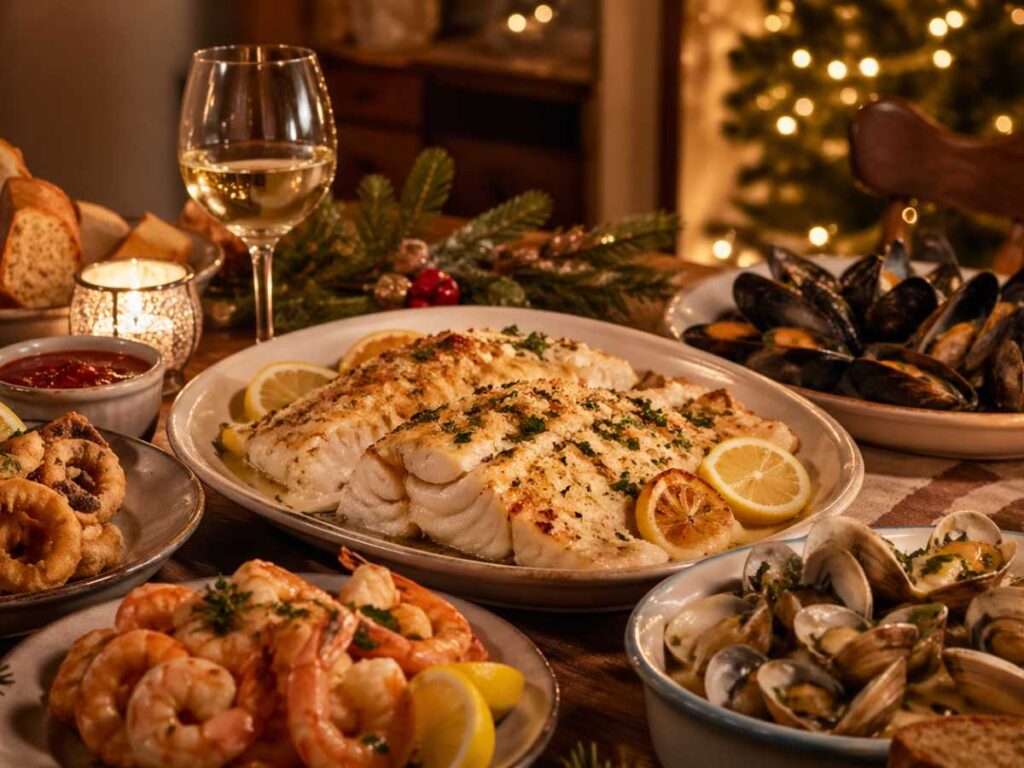
There is no universal menu. That is half the charm. Britannica points to favorites like baccalà and eel, while National Geographic highlights calamari fritti, seafood salad, stuffed clams, and salt cod. Your family’s version might look completely different from your neighbor’s, and both would be equally correct.
Here are the dishes that appear most often across Italian-American Christmas Eve tables:
| Dish | What you need to know |
|---|---|
| Baccalà | Salt cod soaked for days. The anchor of the feast. Non-negotiable in most households — started Tuesday so it’s ready Friday. |
| Calamari | Fried, stuffed, or in sauce. Usually the dish everyone starts stealing before it even reaches the table. |
| Shrimp | Sautéed, scampi-style, or in garlic and olive oil. Always the first thing to disappear. |
| Clams | Stuffed, steamed, or over linguine in white or red sauce. Often the centerpiece pasta course. |
| Mussels | In tomato broth, with white wine, or over pasta. The smell alone says Christmas Eve. |
| Smelts | Small, fried whole, eaten in one bite. Either your favorite thing or the one you quietly avoid. |
| Octopus | Cold salad with celery, olives, and lemon. Elegant and deeply divisive among anyone under twelve. |
| Eel (anguilla) | The old-school choice. If your grandmother insisted on eel, you respected it even if you did not touch it. |
| Anchovies | In pasta, on pizza, folded into other dishes. The background flavor of the whole evening. |
In our family the sequence had its own logic that nobody had written down but everyone seemed to know. Fried dough with sardines first — not a proper dish, more like a signal that the night had officially started. Then the pasta course. Then the fried fish, which arrived in trays and were gone almost immediately. Then the cold seafood salad, which was when people slowed down and started talking properly. Then baccalà. Then mussels. Then shrimp. And by the time the last dish arrived nobody was counting anymore and everybody was completely satisfied and somehow still eating.
What is remarkable is the way the dishes do not arrive all at once. They come in waves, which turns the meal into an experience that unfolds over hours. The table fills and empties and fills again. Plates get cleared and replaced. New conversations start. Children who fell asleep on the couch wake up hungry again.
And if you did not like fish? You still participated.
In our house there was accommodation — a plain pasta with olive oil for the one cousin who truly could not handle seafood — but even that exception had rules. Still no meat. You were inside the logic of the night even if you were not eating the stars of it. Nobody was making chicken and pretending it was the same thing.
Britannica notes that even fish sticks can show up in some households, which is honestly hilarious and oddly comforting. The tradition is structured enough to feel special, but flexible enough to live in real families with real children who have strong opinions about things.
Why Italian-Americans still celebrate it — the real reason
This is the question underneath every other question on this page.
People do not search “Feast of the Seven Fishes meaning” because they want a food history lesson. They search it because they grew up with this tradition and want to understand why it affected them so deeply. Or they are planning to start it and want to know what they are actually doing. Or they lost it somewhere along the way and are trying to find their way back.
West Chester’s research gives us the clearest answer: the feast works as a heritage ritual that strengthens family ties after acculturation and helps fold new members — including non-Italian spouses — into the family’s identity. That is the sociological version of what families already know from experience.
The simpler version is this: the Feast of the Seven Fishes gives Christmas Eve a shape. It makes the night deliberate. It turns waiting into ritual. And once you have experienced Christmas Eve that way — with the kitchen running all day, with the dishes coming in waves, with three generations at the table and the Vatican Mass on TV and somebody arguing about the number of fish — a regular December 24th never quite feels complete again.
The feast does something modern life is not very good at doing on its own: it gathers people on purpose and makes the waiting feel like the point.
For descendants who may no longer speak Italian, who did not grow up in Italian neighborhoods, who feel the heritage more as a memory than a daily reality — the feast is one of the clearest remaining bridges. You can smell it. You can taste it. You can argue about it. You can pass it down. Heritage that lives in the body lasts longer than heritage that only lives in the head.
The last Christmas Eve before my grandmother could no longer host, she sat at the table instead of standing at the stove and directed the whole thing from her chair. Every dish had a specific instruction. The calamari needed another thirty seconds. The baccalà was ready when she said it was ready, not before. The pasta water was not salty enough. She was not cooking anymore, but she was absolutely still in charge, and the kitchen was still hers. We ate everything she told us to make, in the order she told us to make it. And when it was over and the chestnuts came out and someone produced a bottle of something from a cabinet, and somebody else started a game that had no name but had somehow been played at the end of every Christmas Eve anyone could remember, the night felt exactly like it had always felt. That is what tradition can do. It can hold a family’s shape even when everything else is changing.
How to keep it alive — even if you are starting from scratch
Here is the good news: you do not need a grandmother who has been making baccalà since Tuesday to keep this tradition alive. You do not need a perfect menu, an exact count, or a kitchen that can run six dishes simultaneously. You need the core, and the core is simpler than it looks.
- Keep Christmas Eve meatless — that rule is the foundation of everything else
- Make two or three seafood dishes that actually mean something to your family, not seven that feel like homework
- Let the meal unfold in courses, not all at once — the pace is part of what makes the night feel special
- Explain to your children that this is a vigil meal, not just holiday seafood — the context matters
- Leave the table set longer than you need to — the after-dinner hours are where the real tradition lives
- Tell the story of your family’s specific version: which dishes, in what order, who made what, and why
- Write it down before the person who holds it in their head is no longer here to ask
- Let the new people in — non-Italian spouses, partners, friends — because the feast is at its best when it absorbs new people who then spend the rest of their lives defending it as their own tradition
And if your feast is three fish and a store-bought something? Fine. If you count precisely to seven and consider it a moral obligation? Also fine. The feast has room for both kinds of families, and always has.
The meaning of the Feast of the Seven Fishes was never really about the fish. It was about making Christmas Eve into something your family would spend the rest of their lives trying to recreate. If you get that right, you can serve any number of fish you like.
FAQ
What is the Feast of the Seven Fishes meaning?
It is the meaning of a Christmas Eve vigil meal: waiting before Christmas, abstaining from meat, gathering the family, and turning a rule of restraint into a ritual of abundance. Rooted in older Catholic fasting before feast days and southern Italian Christmas Eve fish dinners, the specific “Feast of the Seven Fishes” identity is widely understood as Italian-American — a tradition that crossed the ocean and grew into something larger here than it ever was in the old country.
Why do Italian-Americans eat fish on Christmas Eve?
Historically, Catholics abstained from meat on Christmas Eve as part of the vigil before Christmas Day. In southern Italy, where seafood was plentiful and accessible, fish became the natural answer to that rule. That custom traveled to America with Italian immigrants and grew, over generations, into the elaborate feast many families celebrate today.
Why are there seven fishes?
There is no single verified answer — and researchers are honest about that. Common explanations include the seven sacraments, the Seven Hills of Rome, or biblical symbolism, but none has been confirmed as the definitive origin. Many families also use different numbers: 3, 9, 11, or 13 all appear in various traditions. The debate over the number has itself become a Christmas Eve ritual in many households.
Is the Feast of the Seven Fishes celebrated in Italy?
The broader Christmas Eve fish dinner — La Vigilia — is definitely part of Italian tradition, especially in the south. But the specific “Feast of the Seven Fishes” name and identity are generally understood as Italian-American rather than something widely practiced across Italy. The custom originated there; the brand grew here.
What fish are usually served?
There is no universal menu — which is part of the tradition’s charm. Common dishes include baccalà, calamari, shrimp, clams, mussels, smelts, octopus salad, and eel in older or more traditional households. Many families also serve a pasta course with seafood. The menu varies by region of origin, family preference, and what the matriarch has decided this year, which may or may not match last year.
Why do families still celebrate it today?
Because it works. Research describes the feast as a heritage ritual that strengthens family bonds, reinforces ethnic identity, and brings new members into the family fold. In plain language: it makes Christmas Eve feel like Christmas Eve. It gives the night a shape and a meaning. And once you have experienced it properly, a December 24th without it never quite feels complete.

Marco Ricci is an Italian-Canadian writer and the grandson of Calabrian immigrants. He created Italian Family Traditions to document the customs, feast days, and family rituals Italian families carried from Italy to North America — and to understand what they actually meant. He is based in Montreal.