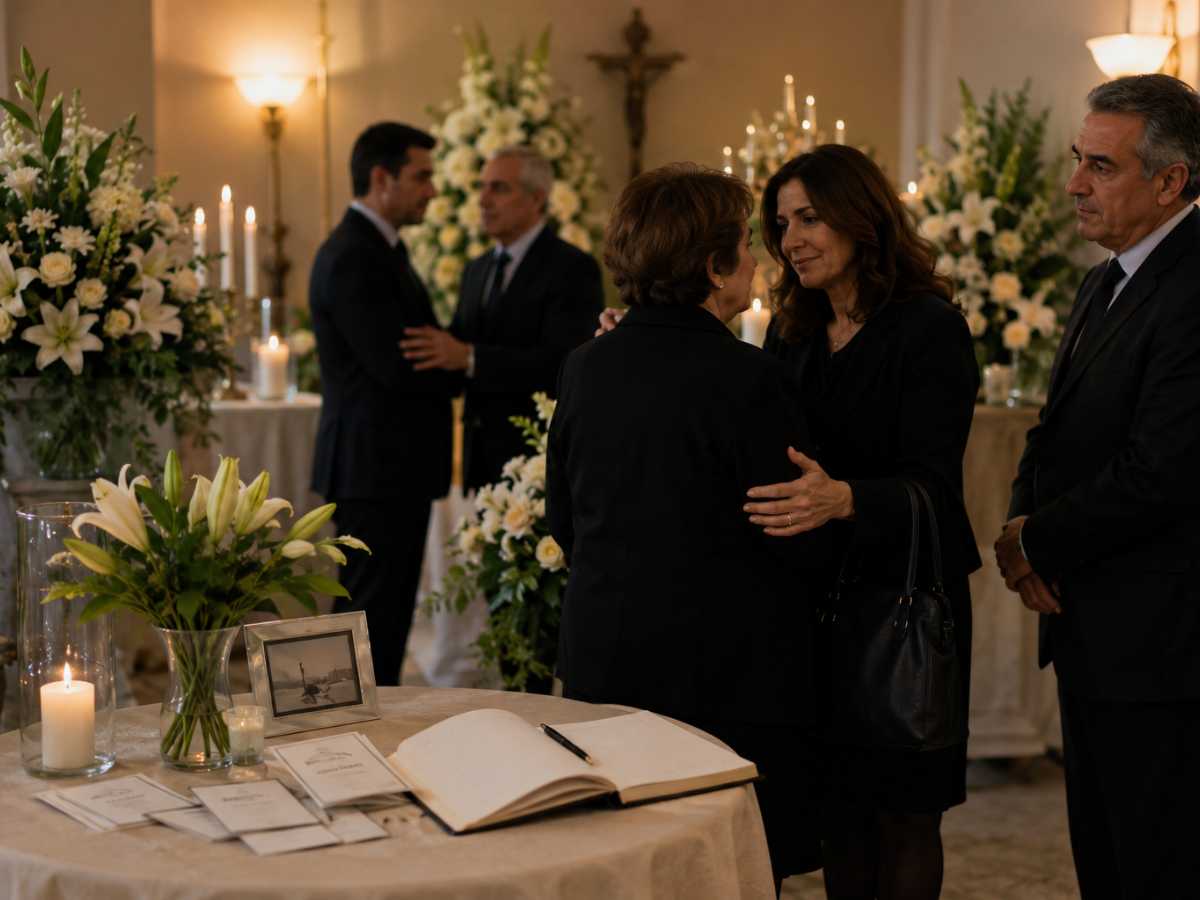
Italian Family Traditions
Italian Funeral Traditions & Lutto: The Mourning Customs Explained
It was never only about the funeral. It was about showing up, bringing food, filling the church, tending the grave, and making sure the grieving family knew — through every specific practical act — that they were not carrying this by themselves.
Italian funeral traditions center on lutto — the Italian state of mourning — and on one core belief: the grieving family should never be left alone. The wake, the Mass, the food, the Mass cards, the tended grave: every custom is a way of accompanying the family through loss. Here is the full guide.
The first thing that happened when my great-uncle died was that people started arriving. Not slowly, not tentatively — they arrived. Relatives who lived forty minutes away were there within two hours. Relatives who lived in another city called immediately and started making arrangements. Neighbors appeared at the door with food before anyone had thought to ask for anything. There was a woman from down the street who brought a tray of something and stayed for four hours helping in the kitchen, and nobody quite knew her well enough to have thought to call her, and she came anyway because that is what you did.
By the time evening came, the house was full.
Not full in a party sense. Full in the way that Italian family homes fill when something important has happened — with people sitting in every available chair, standing in the kitchen, talking quietly in the hallway, making coffee at regular intervals, and generating the specific low warm hum of a community that has assembled itself around a grief without being organized to do so.
That is Italian mourning. Not a policy. Not a procedure. An instinct. The instinct that says: when someone dies, you go to the family. You bring something. You stay. You do not leave them alone with this.
How a family mourns tells you what that family believes matters most. And in Italian life, what mourning says is this: you do not carry loss alone.
This is the full story of Italian funeral traditions — what they were, what they meant, how they changed after immigration, and why the emotional core of them has refused to disappear even as the outer forms have shifted over generations.
A lot of these mourning customs become clearer when you place them inside the larger story of Italian-American traditions and family life after immigration.
Free Printable
Keep the traditions that carried your family through.
The feast days, the All Souls’ visits, the customs our grandparents kept — gathered into one free printable calendar of the Italian year, with new stories sent as we write them. Join the list and we’ll send it to you.
Preserve Your Family’s Version of the Story
Funeral customs often carry some of a family’s oldest memories — who came, what was brought, which prayers were said, and how the dead continued to be remembered. The Italian Family Heritage Kit gives you the questions and space to record those details before they disappear.
Explore the Italian Family Heritage Kit →Lutto is the Italian word for mourning — but it means more than sadness…
The Italian word for mourning is lutto. It means more than sadness. It means the state of being in mourning — a recognized condition, with a social dimension, not just a private emotional experience. When someone was in lutto, the people around them knew it and responded to it. It was not hidden. It was acknowledged, by the family and by everyone who knew them.
That is the first thing to understand about Italian funeral traditions: mourning was never meant to be quiet or managed or efficiently processed. It was meant to be accompanied.
Order Sons and Daughters of Italy describes this as part of the culto dei morti — a longstanding Italian respect for the dead that remains visible in flowers, candles, prayers, food sent to the bereaved home, and strong attendance at wakes and burials. That phrase, culto dei morti, describes something very human: the belief that the dead continue to deserve care, that the family of the dead continues to deserve support, and that the community does not go quiet just because something painful has happened.
My grandmother wore black for two years after my grandfather died. Not dramatic, theatrical black — just black. Every day. As a statement that the house was still in mourning, that the loss was still real, that she had not and would not pretend otherwise. I was a child and I noticed it without understanding it. I understand it now. She was not performing grief. She was inhabiting it honestly, and the black clothing was her way of telling everyone who saw her that her husband had died and that this still mattered. There is a dignity in that kind of honesty that modern culture does not always know what to do with.
In Catholic terms, the meaning goes even deeper. The Church does not treat funeral rites as merely a social gathering or a farewell speech. Catholic rites are meant to comfort those who mourn, commend the deceased to God’s mercy, and express the communion between the Church on earth and the Church in heaven. That spiritual framework is why Italian funerals, even when deeply emotional, carry a serious and prayerful tone rather than a purely celebratory one.
Why the family gathers — and what gathering actually means
The same values that shape Italian weddings, baptisms, holidays, and Sunday meals show up at funerals too: loyalty, attendance, obligation, care, and the feeling that important moments must be faced together. Order Sons and Daughters of Italy says that family, respect, and honor have always strongly defined Italians and Italian-Americans, and that this does not stop with death. If anything, it becomes more visible.
At my great-uncle’s wake, there were perhaps eighty people in the house at any given time across two evenings. I remember being struck by how many of them I had never met — people from his working life, people from his neighborhood in a city he had lived in decades ago. They had heard. They came. Some of them drove a long way to come. None of them needed to be there in any logistical sense. They came because that is what you do. You come, and your coming is itself the message: this person mattered, and I am here to say so in person.
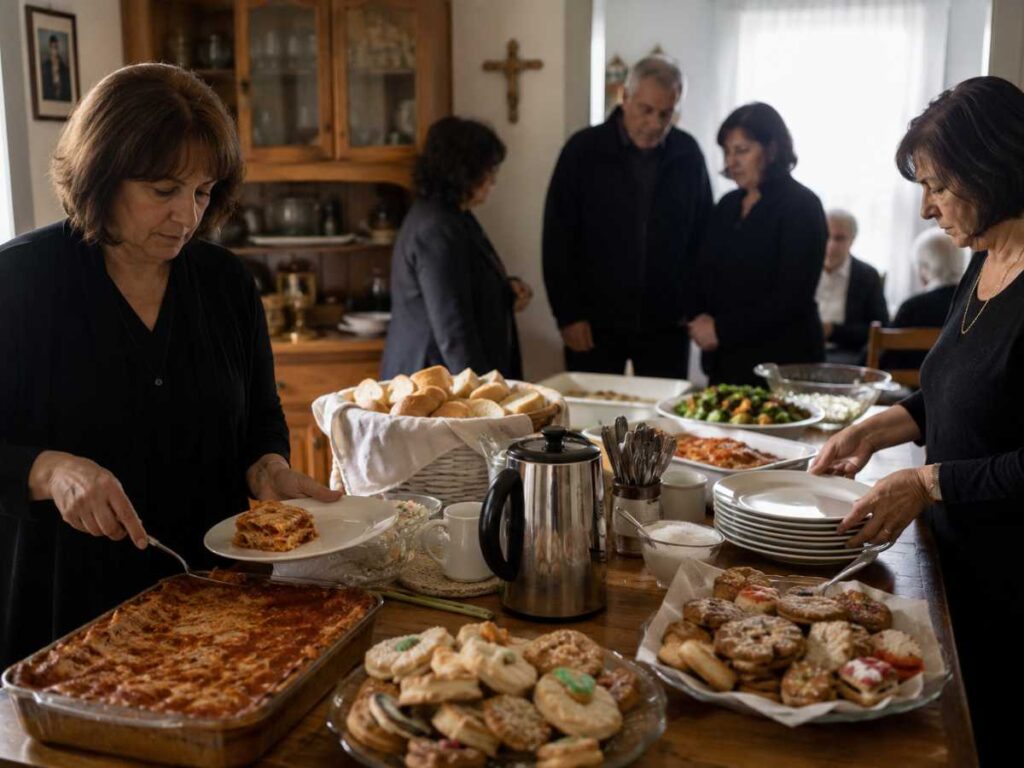
Food was also part of what arrival meant. Not incidentally — centrally. In Italian mourning culture, food arriving at the family home was a practical expression of care. The bereaved household was not supposed to worry about cooking. The community took care of that. Trays arrived. Dishes arrived. Coffee was made in an endless rotation. People were fed, seated, looked after.
Food arriving at a grieving family’s door is not a social nicety. It is one of the clearest statements of love that Italian family culture knows how to make.
What food was brought — and why certain dishes mattered
The food that arrived at an Italian grieving household was not random. Certain dishes belonged to mourning the way certain dishes belong to Easter or Christmas — because they were practical, because they kept well, because they could feed large groups of people, and because they carried the specific quality of care that the occasion required.
Pasta was almost always there — large trays of baked ziti or lasagna that could sit on a counter and feed whoever arrived over the course of an afternoon. Roasted meats. Salads. Bread in abundance. And sweets — because even in grief, the Italian instinct to offer something sweet as an act of hospitality never entirely disappeared.
In southern Italian tradition, certain specific sweets were associated with the dead and with mourning. In Sicily, Ossa dei Morti — Bones of the Dead — were hard almond cookies made around All Souls’ Day, their shape deliberately evoking bones as a way of keeping the dead present in the life of the living. In Puglia and Calabria, similar traditions existed. These were not morbid. They were intimate. They said: we remember you in the kitchen, in the food, in the shape of what we make with our hands.
The thing I remember most about the days after my great-uncle died is the counter. The kitchen counter was never empty. Things arrived and were placed there and eaten and replaced by other things that arrived. Someone’s lasagna. Someone else’s roasted chicken. A tray of pastries from the Italian bakery. A pot of soup that appeared and disappeared and was replaced by another pot of soup. Nobody organized this. The food organized itself the way the people had organized themselves — out of an instinct that the household needed to be cared for, and that care expressed itself most naturally in the kitchen. I have never been so fed in my life. I have rarely felt so held.
What was said — and what was not
One of the most culturally specific aspects of Italian mourning that almost no one talks about is the language of condolence — what people actually said to each other at wakes and funerals, and what the culture considered appropriate.
The most common formal phrase is le mie condoglianze — my condolences. Heartfelt, direct, the standard expression of sympathy. Related phrases include mi dispiace tanto — I am so sorry — and ti sono vicino/vicina — I am close to you, I am with you. That last phrase is the most specifically Italian in its logic: not “I sympathize with your pain” but “I am near you in this.” Proximity. Presence. The emphasis on not being alone.
But in real Italian family mourning, what mattered most was often not the words at all. It was the physical act of arriving. Of being there. Of looking someone in the eyes and holding their hands and sometimes saying very little, because very little needed to be said. The Italian cultural instinct was never toward the long consoling speech. It was toward presence. You came. You stayed. You did not explain yourself or perform your grief for the family. You simply made yourself available and let your presence communicate what words could not adequately express.
Even the greeting shifts at a funeral — here’s when to cheek-kiss and when not to.
My grandfather’s oldest friend came to my grandfather’s wake and stood in front of my grandmother for a long moment without saying anything. Then he took both her hands in both of his and said, in dialect, something I could not hear. She nodded. He nodded. He stayed for two hours. He did not give a speech. He did not tell her he knew how she felt. He stood there, and held her hands, and came back the next day. She talked about him for years afterward as one of the people who had truly been present. He had said almost nothing. He had done everything that mattered.
What was not said was equally specific. Italian mourning culture discouraged the kind of consoling commentary that modern grief culture sometimes encourages — the searching for silver linings, the reassurances that the person is “in a better place,” the immediate pivot toward comfort and resolution. These were not considered comforting. They were considered a rush past the grief rather than an accompaniment through it. The appropriate response to an Italian family in mourning was not to make them feel better quickly. It was to acknowledge that something serious had happened and that you were prepared to stay in that seriousness with them for as long as they needed.
The vigil, the Mass, and the burial — how the rites moved with the family
In the Catholic structure that shaped so many Italian funerals, mourning traditionally unfolds in three stages: the vigil, the funeral liturgy, and the rite of committal.
USCCB describes the vigil as the time when the Christian community keeps watch with the family in prayer, remembers the life of the deceased, and asks for consolation and strength. The funeral liturgy — usually the Mass — is the central liturgical celebration for the deceased. And the committal is the final act of the community’s care at burial or interment.
What matters about this structure is that it moves with the family. The rites do not happen to the family. They carry the family through something.
- The vigil says: pause. Pray. Remember. You are not alone in the first shock of this.
- The Mass says: this life is entrusted to God. We pray together for mercy and for peace.
- The burial says: we accompany you all the way. We do not leave before this is done.
The funeral Mass for my great-uncle was in a church that was completely full. Not comfortably full — completely full, with people standing at the back and along the sides. He had been a quiet man, not famous, not powerful in any public sense, a man who had worked hard his whole life and kept his promises and raised his children and been kind to his neighbors. And eighty or ninety people stood in a church on a Tuesday morning to pray for him. That is the Italian funeral in its fullest form. The measurement of a life is not in what the person achieved. It is in how many people show up when they are gone.
The Mass card and the anniversary Mass — remembrance through prayer
One of the most specifically Italian-Catholic mourning customs — and one that is rarely explained to people outside the tradition — is the Mass card and the practice of offering Masses for the dead.
A Mass card is a small card given to a bereaved family indicating that a Mass has been offered — or will be offered — for the soul of the person who has died. The card typically bears the name of the deceased, the date, and sometimes the name of the priest or parish. It is given in lieu of or alongside flowers, as an expression of sympathy that carries a specifically Catholic spiritual dimension: the belief that prayer for the dead is meaningful, that the Mass has particular intercessory power, and that the family can be comforted knowing that this person’s soul is being prayed for at the altar.
In Italian and Italian-American families, Mass cards arrived in quantities at wakes and funerals. They were collected, acknowledged, and often kept for years. Receiving a Mass card meant someone had gone to a priest, made a donation to the parish, and arranged for a specific act of prayer on behalf of the person you loved. That is a meaningful gift. It says: I have done something concrete for the soul of your family member. I have not only expressed sympathy — I have acted on it.
My grandmother kept the Mass cards from my grandfather’s funeral in a small wooden box on her dresser for the rest of her life. There were forty-seven of them. She knew exactly how many because she had counted them. Each one represented a priest somewhere saying his name at the altar. Each one was a specific act of love from a specific person. She did not consider them paperwork. She considered them the most substantial thing anyone had given her in those weeks — more lasting than flowers, more personal than a casserole, more spiritually serious than any condolence note. Forty-seven Masses said for one man. She found that extraordinarily beautiful.
Beyond the initial Mass cards, Italian families traditionally also offered anniversary Masses — a Mass said on the one-year anniversary of the death, and sometimes on subsequent anniversaries. In some families a Mass was offered monthly in the person’s name, particularly in the first year. These ongoing Masses kept the person present in the family’s prayer life long after the funeral was over. They were not grief extended — they were remembrance formalized. A specific act, on a specific date, saying: we have not forgotten. We are still praying for you.
The anniversary Mass also gave the family a reason to gather again — one year after the loss, often in the same church, with many of the same people. The gathering itself was a form of mourning extended, a way of marking that the first year of grief had passed and that the person was still being held in memory and prayer.
What lutto looked like — the old mourning customs
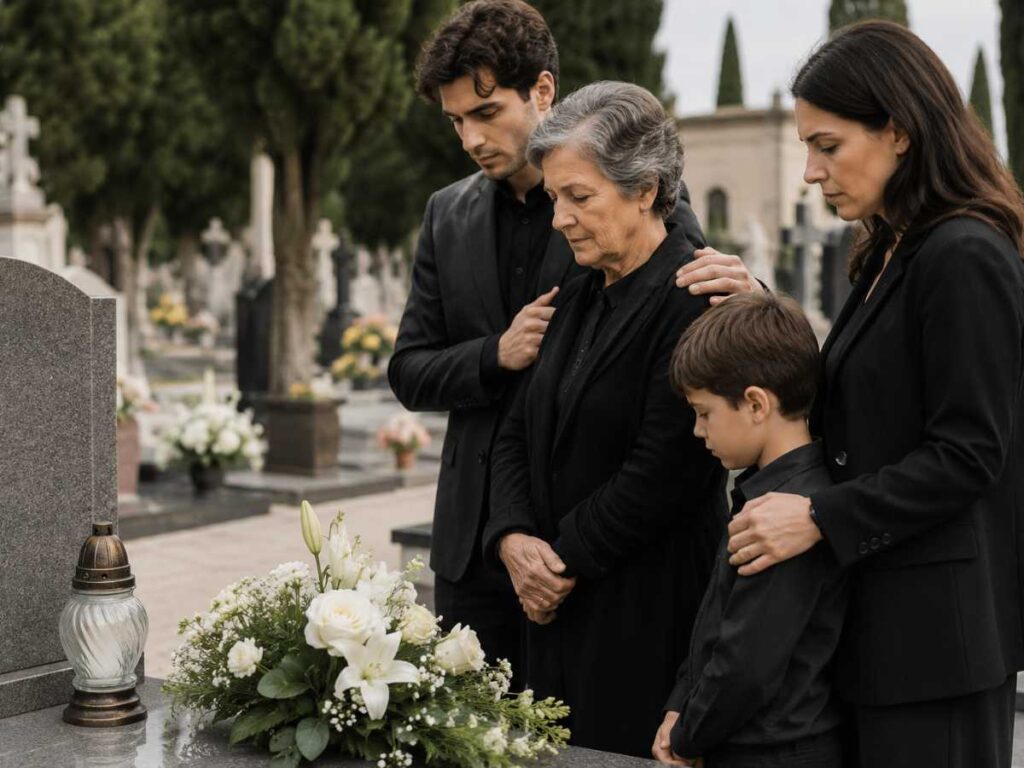
Older Italian mourning customs were highly visible. Close female relatives wore black for extended periods — sometimes a year for a spouse or parent, sometimes longer. Order Sons and Daughters of Italy notes that wearing black for a year or even for the rest of one’s life has largely disappeared. But it is worth understanding what those customs actually meant before treating their disappearance as simply a matter of fashion changing.
Black clothing was not theatrical. It was informational. It told everyone who encountered the bereaved person that they were in mourning. It gave other people something to respond to — a specific reason to treat that person with extra care. It made private grief into something the community could recognize and respond to.
An older woman in my extended family wore black for seven years after her husband died. People who did not know the custom found this strange. People who did know it understood immediately: she was still mourning. When she finally moved out of black, people noticed that too, and understood it as a transition — not the end of grief, but a new phase of it. The clothing was a language. The community could read it. That kind of legible grief is something modern culture has largely lost, and I am not sure the loss has made us better at supporting each other.
The role of women in Italian mourning
Italian mourning was never gender-neutral. Women were the primary carriers of mourning culture — the ones who organized the food, prepared the body in older tradition, maintained the cemetery visits, knew the prayers, and kept the anniversaries. The same pattern we see in malocchio knowledge, in the transmission of healing rituals, in the maintenance of feast day customs, appears here too: women held the family’s relationship with death the same way they held its relationship with protection and healing.
In older southern Italian tradition, women prepared the body of the deceased for burial — washing it, dressing it, laying it out at home for the wake. This was not considered morbid or excessive. It was an act of love, the final physical care given to a person who had been cared for throughout their life. It was also deeply practical — in communities where professional funeral services were not accessible, the family simply did what needed to be done.
Women were also the ones who went to the cemetery. Regularly. With flowers. With prayers. With whatever needed cleaning or tending. The extended black mourning that older Italian women observed — sometimes for years — was not passive sadness. It was active grief, worn in the world, maintained through specific daily and weekly practices that kept the person who had died present in the life of the household.
My grandmother organized everything in the weeks after my grandfather died. The food, the visitors, the flowers, the Mass cards, the thank-you notes, the cemetery arrangements, the anniversary Mass a year later. She did this while also being the person most deeply in grief. That capacity — to mourn and to organize the mourning simultaneously, to carry both the sorrow and the structure of the sorrow — is something I have only seen in older Italian women of her generation. She would have found the modern idea of being allowed to simply grieve without managing anything both luxurious and slightly baffling. Grief, in her understanding, was not a state in which you stopped. It was a state in which everything you did was colored differently.
Children at Italian funerals — why they were included
Italian families historically did not protect children from death. Children came to wakes. Children came to funerals. Children were brought to the cemetery. They saw the body. They heard the prayers. They watched the adults mourn and they absorbed, through direct experience rather than explanation, the specific rituals and emotional language their culture used to mark the end of a life.
This was not considered traumatic. It was considered necessary. Death was part of life, and children who were shielded from it entirely were not being protected — they were being left unprepared for something that would eventually arrive in their own experience without warning or context. Better to learn the rituals young, to know what flowers meant and what prayer sounded like and what a packed room felt like around a person who had died, than to encounter all of it for the first time as an adult with no frame of reference.
There was also a familial logic to including children. The wake was a family gathering, and the family included everyone. Excluding children would have been a kind of statement — that this event was not fully theirs to participate in — that Italian family culture was not inclined to make. The children were part of the family. The family was present. Therefore the children were present.
I was six years old at my first Italian wake. I remember the open casket, which I had not expected. I remember being lifted up to see my great-grandmother lying there — small, composed, dressed in her best clothes, her rosary in her hands. I remember that she looked entirely like herself and also entirely unlike herself, which is the specific confusing quality of a body after death. I remember my mother’s hand on my shoulder. I remember the prayers. I remember that the room was very full and very warm and that people spoke to each other in low voices that occasionally got less low when a story came out that made someone smile. I was not traumatized. I was informed. I understood, after that day, what a wake was, what it meant, and what I was supposed to do when one came again.
What every mourning gesture actually says
When you look at all these traditions together, a pattern emerges. Every gesture — the food, the wake, the Mass, the flowers, the cemetery visit, the Mass card, the anniversary — was saying something specific. Here is the translation:
| The gesture | What it actually means |
|---|---|
| The wake | Stay close to the family. Do not leave them alone in the first shock of grief. |
| The Mass | Entrust the person to God. Pray together. Let faith hold what grief cannot. |
| The burial | Accompany them fully. Do not turn away before this final act is done. |
| The food | Care in practical form. You should not have to cook today. We have handled this. |
| The flowers and candles | This life was beautiful and it mattered. We are marking it with beauty. |
| The Mass card | I have done something concrete for the soul of your family member. Not words — action. |
| The cemetery visit | Remembrance continues. You are still ours. We still come. |
| The black clothing | This house is in mourning. You can see it. Please respond to it accordingly. |
| The anniversary Mass | One year has passed and we have not forgotten. We are still praying for you. |
That is the whole picture. Not one ritual. A chain of accompaniment stretching from the moment of death through the funeral and forward into years of remembrance.
The cemetery — why tending the grave was not optional
Of all Italian mourning customs, this may be the most distinctly and specifically Italian: the ongoing care of the grave.
Order Sons and Daughters of Italy says that even as many old mourning practices disappeared, the strongest and most visible aspect of Italian respect for the dead continued in the visit and upkeep of the cemetery. Graves were often marked by good order, flowers, candles, sacred images, and a photograph of the deceased. The grave was not a place you went once and left. It was a place you maintained.
My grandmother visited my grandfather’s grave every two weeks for twenty-three years. Rain, cold, every condition. She brought fresh flowers almost every time. She cleaned the stone if it needed cleaning. She stood there for a while — not dramatically, just quietly — and then she came home. She never described what she did while she stood there. I think she talked to him. I think she reported in, in the specific way long-married people check in with each other when one of them has been away. She was not visiting a grave. She was visiting a person who happened to be buried there. That distinction matters enormously for understanding what Italian cemetery culture actually is.
Reuters reported in late 2024 that All Souls’ Day on November 2 remains a time for visiting relatives’ gravesides in Italy, even though routine cemetery visits have become less frequent than they once were. The forms are changing. The instinct is not entirely gone.
In Italian-American communities, Order Sons and Daughters of Italy notes that some Little Italies moved very early to establish Italian cemeteries or Italian cemetery sections — because burial, family remembrance, and proper resting places mattered so deeply to immigrant communities that they needed to be created even before the community was fully established. Even in a new country, even while adapting, they still made room for their dead.
What to expect at an Italian funeral — a practical guide
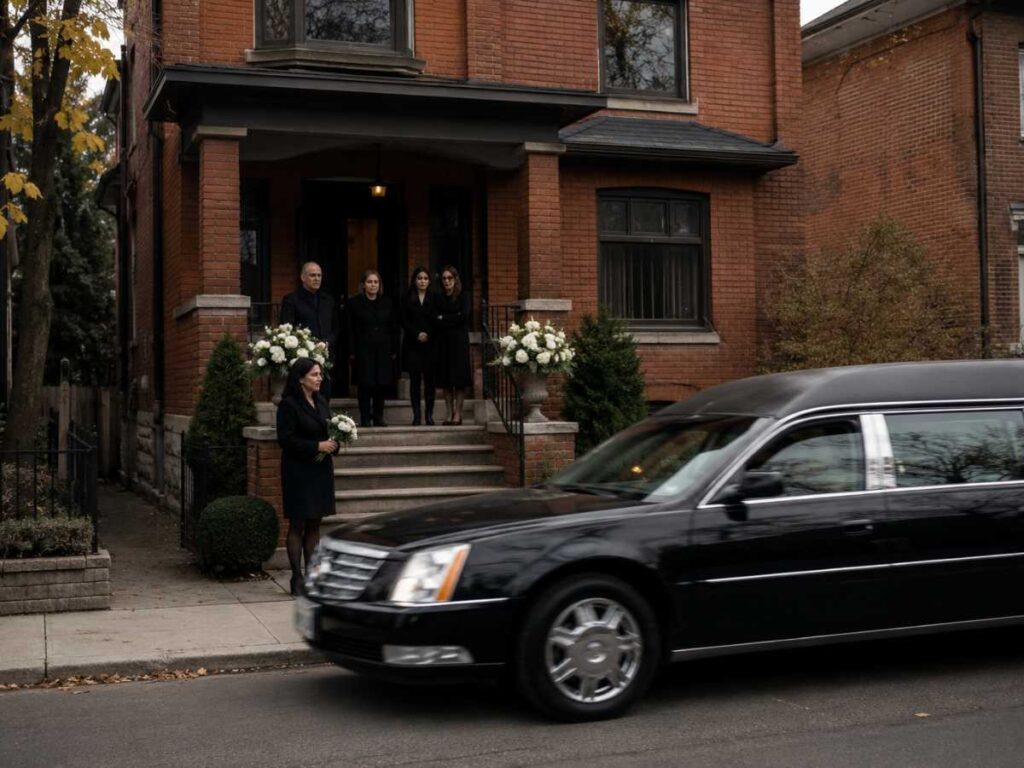
If you are attending an Italian funeral for the first time — as a partner who has married into an Italian family, a friend of the bereaved, or a colleague — here is what you need to know.
What to wear: Dark colours are expected. Black is traditional and always appropriate. Navy, dark grey, and dark brown are acceptable. Avoid bright colours entirely. Err on the side of formal — a suit or dress rather than casual clothing. If you are unsure, dress more formally than you think necessary. Italian funerals take dress seriously.
The wake: If there is a wake, go. This is not optional in Italian culture the way it sometimes is in others. Showing up at the wake is one of the primary expressions of respect and solidarity. You do not need to stay long — an hour is sufficient — but you need to appear. Greet the immediate family directly, say le mie condoglianze or simply “I am so sorry for your loss,” and do not feel you need to say more than that. Your presence is the message. Don’t rush to leave — find a seat, accept a coffee if offered, stay long enough for the family to register that you came.
The Mass: The funeral Mass is the central event. Arrive before it begins. Follow the service — you do not need to know every response, but standing and sitting when others do is appropriate. If you are not Catholic and are unsure about receiving communion, simply remain seated during that portion. Nobody will find this offensive or unusual.
The burial: If you are close to the family, attend the burial. If you are a more peripheral presence, the wake and Mass are sufficient. But for close friends and relatives, not attending the burial can feel like leaving early — like turning away before the final act of accompaniment.
What to bring: Flowers are always appropriate. If you are close to the family, food sent to the house in the days following the death is deeply appreciated. A Mass card — arranged through a local Catholic parish — is a particularly meaningful gesture for Catholic families. If you are not sure how to arrange one, any Catholic parish can help you do so in a few minutes.
What to say: Keep it simple. Le mie condoglianze. I am so sorry. I am thinking of you. Do not search for the silver lining. Do not rush past the grief toward comfort. Simply acknowledge the loss, acknowledge the family, and let your presence say the rest. The Italian condolence tradition values presence over eloquence every time.
How Italian-American funeral traditions changed — and what refused to go
Italian funeral traditions did not land in America unchanged. They adapted — to American funeral homes, American schedules, American neighborhoods, and the gradual assimilation of each successive generation. The old-world structure came over, but it had to fit American social patterns. The most visibly old-country practices softened first. Long periods of black mourning became less common. Community life shifted from the tightly packed ethnic neighborhood to dispersed suburban life.
My father’s generation was the first in our family to hold the wake at a funeral home rather than in the house. That shift happened in the 1970s and it felt significant even at the time. The house had always been the right place — the familiar rooms, the furniture the person had sat in, the kitchen they had cooked in. The funeral home was neutral, professional, efficient. Something moved out of the home and into a managed space. The intimacy changed. But the people still came. The food still arrived. The flowers still filled the room. The family still gathered and stayed. The setting was different. The instinct was the same.
But a great deal stayed. The wake remained important. The Mass remained important. Food still went to the family. Flowers still mattered. The burial still required family presence. The Mass card tradition remained strong. And the emotional logic — that grief belongs to the community, that the bereaved should be surrounded, that nobody should be left alone with loss — that did not disappear. It simply found new forms in the new country.
What modern Italy has changed — and what remains
Modern Italy has changed its funeral practices significantly. Reuters reported that cremations in Italy reached 252,075 in 2023 — 38 percent of total deaths — up from under 3 percent in 1995. The Catholic Church has allowed Christian funerals for those choosing cremation since 1963, while still preferring burial of the body and requiring ashes to be kept in sacred places such as a church or cemetery.
Cost, time, urbanization, and secularization have all contributed to the change. But the deepest instinct has not vanished. All Souls’ Day still draws families to cemeteries. The care for the dead still matters. The idea that dying people deserve dignity and that grieving families deserve support still shapes Italian mourning culture, even as the specific forms have shifted.
The most honest way to say it is this: the form is changing faster than the impulse. And the impulse — to accompany, to honor, to remember, to make sure nobody is left alone with grief — is still recognizably Italian.
How a culture mourns tells you what it believes about love, about family, about the dead, and about what we owe each other. Italian funeral traditions believed: you do not go alone into this. The family comes. The community comes. The food arrives. The Mass is offered. The grave is tended. The memory stays active.
Not one ritual. A whole chain of accompaniment. And the deepest part of it still holds.
Your Family Has Its Own Version of This Story
Record it while someone can still tell you the details.
Who wore black? Who tended the grave? Which prayers were said? What food arrived at the house? The Italian Family Heritage Kit includes 133 guided pages and more than 120 prompts to preserve your family’s people, names, traditions, recipes, sayings, photographs, and memories.
Explore the Heritage Kit — $19.99Instant digital download. Print it and complete it with your family.
For the Italian tradition of remembering the dead on All Souls’ Day with flowers and candles at the cemetery, read about Ognissanti and the Italian tradition of the dead. And for the protective folk customs that surrounded death and the vulnerability of grieving families, read what malocchio is and how Italian families protected their own.
At the wake, the rosary was prayed over the body, and mourners kept a santino of the departed. Families also offered a novena and the prayers every family knew for the soul of their loved one.
FAQ
What are traditional Italian funeral traditions?
Traditional Italian funeral traditions center on Catholic rites — the vigil or wake, the funeral Mass, and the burial or committal — surrounded by strong family and community attendance, flowers, food sent to the bereaved family, Mass cards, and continued cemetery visits and prayers afterward. The underlying principle is that mourning is communal: the family should not face loss alone, and the community expresses this through presence, prayer, and practical care.
What does lutto mean in Italian?
Lutto means mourning — but it describes a recognized social condition, not just a private feeling. When someone was in lutto, the people around them knew it and were expected to respond to it. Older lutto customs included wearing black for extended periods and signaling openly that the household was still in grief. The word carries the weight of mourning as something that belongs to the whole community.
What is lutto stretto, and what does “in lutto” mean?
To be in lutto is to be in mourning — the recognized state a family entered after a death. Lutto stretto, or “strict mourning,” described the most intense early period, when the closest relatives withdrew from social life, dressed in black, and stayed away from celebrations, weddings, and festivities. It was followed by lighter phases as the months passed. The idea was that grief moved through recognized stages, each with its own expectations, rather than being something a family was expected to simply move past. You would say a household was in lutto stretto in the weeks after a loss, and in lutto more broadly for the longer period that followed.
Is lutto an Italian tradition that still exists today?
Yes, though in a lighter form than a generation ago. The strictest customs — wearing black for a year or for life, withdrawing from all celebration for months — have largely faded in both Italy and Italian-American communities. But the core of lutto as a tradition remains: the sense that mourning is a real, acknowledged state deserving of the community’s care, that the grieving family should be surrounded rather than left alone, and that the dead continue to be remembered through Masses, cemetery visits, and anniversaries. The outward signs have softened; the instinct behind lutto has not.
What do you say at an Italian funeral?
The most common formal phrase is le mie condoglianze — my condolences. Mi dispiace tanto means I am so sorry. Ti sono vicino/vicina means I am close to you — emphasizing presence rather than sympathy. In Italian mourning culture, what matters most is not the words but the act of showing up. Keep what you say simple and genuine. Do not search for silver linings or rush toward comfort. Acknowledge the loss, acknowledge the family, and let your presence say the rest. Italian condolence culture values presence over eloquence every time.
What is a Mass card and why do Italian families give them?
A Mass card is a small card given to a bereaved family indicating that a Mass has been offered — or will be offered — for the soul of the person who has died. It reflects the Catholic belief that prayer for the dead is meaningful and that the Mass has particular spiritual value. In Italian and Italian-American families, Mass cards were received in large numbers at wakes and funerals and were considered among the most meaningful expressions of sympathy — more lasting than flowers, more spiritually serious than a condolence note. Any Catholic parish can arrange a Mass card in a few minutes.
What do you wear to an Italian funeral?
Black is traditional and always appropriate. Dark navy, dark grey, and dark brown are acceptable alternatives. Avoid bright colours entirely. Err on the side of formal — a suit or dress rather than casual clothing. Italian funerals take dress seriously as a mark of respect for the deceased and for the family. If you are unsure, dress more formally than you think necessary.
Why do Italian families bring food after a death?
Because food is care made practical. In Italian and Italian-American mourning culture, the bereaved household is not expected to cook for itself in the days immediately after a death. Food arrives from relatives, friends, and neighbors as a direct expression of solidarity. It says, in the clearest possible terms, that the community is present and the family does not have to manage ordinary life alone. It is one of the most specifically Italian expressions of love the culture knows.
Do Italians still wear black for mourning?
Some do, especially in more traditional families and communities, but the older custom of wearing black for a year or for life has largely faded. Order Sons and Daughters of Italy notes that these stricter forms of lutto have virtually disappeared from modern Italian-American life. What persisted longer was black clothing at the funeral itself and for a shorter period afterward.
Why do Italian families visit the cemetery so regularly?
Because in Italian mourning culture, remembrance is an active rather than passive practice. Visiting the grave, keeping it tended, bringing fresh flowers, lighting candles — these were expressions of ongoing relationship with the dead, not sentimental gestures. Order Sons and Daughters of Italy says cemetery upkeep remained one of the strongest surviving expressions of Italian respect for the dead even as other customs faded. My grandmother visited my grandfather’s grave every two weeks for twenty-three years. She was not visiting a grave. She was visiting a person who happened to be buried there.
Are Italian funerals always burial and not cremation?
Not anymore. Burial was the strong cultural preference for generations, but cremation has risen dramatically in modern Italy. Reuters reports that cremations reached 38 percent of all deaths in Italy in 2023, up from under 3 percent in 1995. The Catholic Church permits cremation while still preferring burial and requiring ashes to be kept in sacred places. In Italian-American communities the shift has been slower but significant.
What is the anniversary Mass in Italian funeral tradition?
The anniversary Mass is a Mass offered on the one-year anniversary of a person’s death — and sometimes on subsequent anniversaries or monthly during the first year. It keeps the person present in the family’s prayer life long after the funeral is over and gives the family a specific occasion to gather again around shared remembrance. The anniversary Mass says: one year has passed and we have not forgotten. We are still praying for you.

Marco Ricci is an Italian-Canadian writer and the grandson of Calabrian immigrants. He created Italian Family Traditions to document the customs, feast days, and family rituals Italian families carried from Italy to North America — and to understand what they actually meant. He is based in Montreal.