Italian Family Traditions
Italian Baptism Traditions: The Day That Was Sacred, Chaotic, and Completely Unforgettable
The priest was strict. The baby had opinions. The relatives had already started thinking about lunch. And somehow the whole thing became one of the most important memories the family would ever make.
The story my family tells about my baptism begins before I was even inside the church. My parents arrived slightly late — not scandalously late, not “missed the ceremony” late, just a few minutes past when the priest had expected the family to be assembled and ready. That was enough. He came to the door personally. He did not open it warmly. He stood there with the exact expression of a man who has been doing this for thirty years and has developed a very specific view of families who do not treat the sacrament with appropriate punctuality.
My parents got in. The baptism proceeded. But that story — the priest at the door, the expression, the narrow escape into the church — became one of those family stories that gets told every few years, always with slight embellishment, always with the same ending: “He almost left us standing outside.” The baby inside, of course, had no idea any of this was happening. I was busy doing what babies do at baptisms, which is exist in the general vicinity of something important without understanding any of it.
That combination — the weight of the sacrament and the very human chaos happening around it — is what an Italian baptism actually was. Sacred and scrambled. Solemn and completely alive. The kind of event that leaves a mark on the family memory whether the baby remembers it or not.
Italian baptisms were not quiet. They were not small. And they were absolutely not the kind of occasion where you strolled in when you felt like it.
This is the full story of what Italian baptism traditions were, what they meant, and why they still live so vividly in the memories of families who kept them.
If you want the wider family and faith context behind customs like this, read Italian-American traditions: what changed after immigration and what stayed the same.
Free Printable
Baptisms, feast days, name days — the whole Italian year on one calendar.
From the saint your child is named for to every feast the family gathered around, get the free printable calendar of the Italian year — so you always know what to celebrate and when. Join the list and we’ll send it to you.
What Italian baptism was really about — underneath the white gown and the lunch
At the center of it all were three things that older Italian families understood without needing them explained: belonging, responsibility, and beginning.
Belonging — because the child was being welcomed into the Church, and in traditional Italian life the Church was not a separate institution you visited on Sundays. It was woven into the calendar, the seasons, the family milestones, and the daily habit of life. Being baptized was being placed inside something much larger than a single household.
Responsibility — because the parents and godparents were not standing there to look nice in photographs. They were taking on a formal role, making a public commitment around a child who could not yet speak for themselves. That weight was real, and older relatives felt it even if they could not have articulated the theology behind it.
Beginning — because this was understood to be the start of the child’s life in faith. Not their birth, which was already weeks or months behind. The baptism. The formal, named, witnessed beginning. The moment that was supposed to matter for the rest of the child’s life.
My grandmother used to say that baptism was the day you were given your name in front of God. Not your birth certificate name — that had already happened. But the name said out loud in a church, over water, with the family present. She meant something specific by that. That the name belonged somewhere permanent after the ceremony in a way it had not quite belonged before. I did not fully understand what she meant when she said it. I think I understand it better now.
That is why older Italian families treated baptisms with such genuine weight. Yes, the baby looked adorable. Yes, the outfit mattered. Yes, everybody was already half-thinking about the meal. But underneath all of that, the adults understood that something serious was happening. Not just a nice day. A beginning. A promise made around a child who would one day be old enough to hear about it.
The naming tradition — why the name came first
One of the most specifically Italian dimensions of the baptism was the name itself — not just what it was, but where it came from and what it carried.
In traditional Italian families, naming was not a matter of browsing a list and picking something that sounded nice. It followed a pattern that most families understood without discussing: the firstborn son was named after the paternal grandfather. The firstborn daughter was named after the maternal grandmother. The second son carried the maternal grandfather’s name. The second daughter carried the paternal grandmother’s name. And so the names moved through generations, cycling back, each child carrying someone before them forward into a new life.
That system meant that the name spoken at the baptismal font was almost never just the child’s name. It was also a grandparent’s name. A great-grandparent’s name. A name that had been in the family for generations, that connected the infant in the white gown to people they would never meet, in villages they had never seen, in a country they might only ever know through stories told at the Sunday table.
My father’s name is the same as his grandfather’s name, which was the same as his great-grandfather’s name. When my father was baptized, his grandfather was in the church. He heard his own name given to someone new. My father told me that his grandfather cried — not sadly, he was clear about that. Just fully. The way people cry when something important has been properly marked. I have thought about that moment many times. A name crossing from one generation to the next in a church, in front of a priest, with water. That is the naming tradition doing exactly what it was built to do.
When Italian families came to North America and began choosing names that were easier for neighbors and teachers and employers to pronounce, something in this system shifted. Giuseppes became Josephs. Salvatoris became Sals. Concettas became Connies. The names adapted to the new country, which was practical and understandable. But in some families, a middle name still carried the old one — the Italian name, the grandparent’s name, the name that kept the chain unbroken even when the first name had changed.
Preserve the Story Behind the Name
Who was the baby named for? Who stood as godparents? Which gown, candle, photograph, or family story still survives from the day? The Italian Family Heritage Kit gives you the questions and space to record those details before they disappear.
Explore the Italian Family Heritage Kit →The ceremony — what actually happened at the font
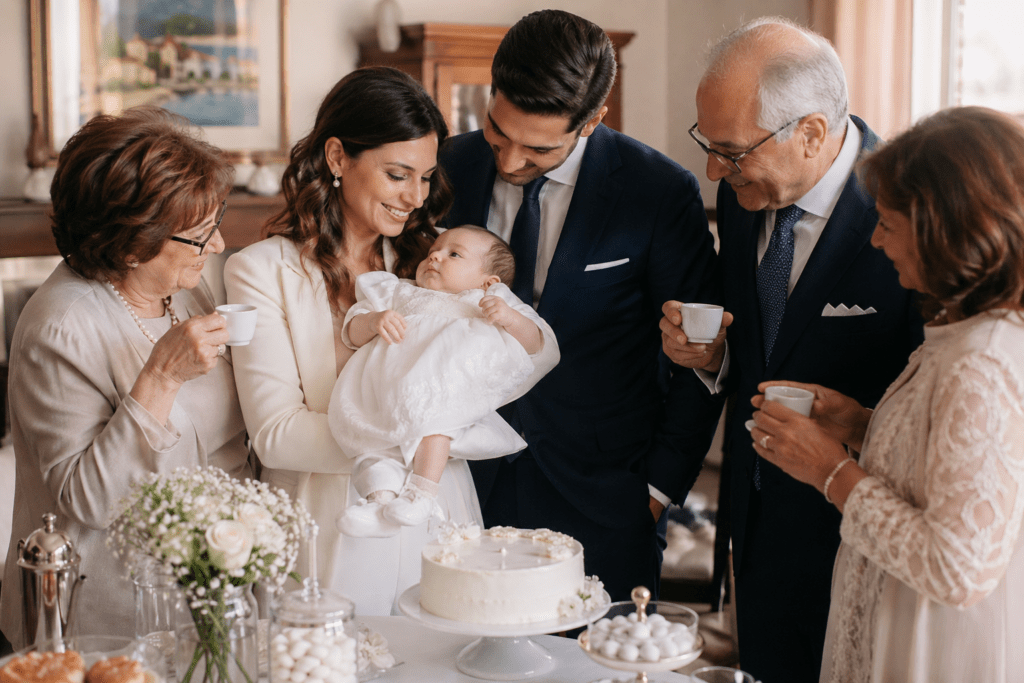
The ceremony itself followed a shape that most Catholic Italian families knew well, because they had been to enough baptisms to have it memorized without ever studying it.
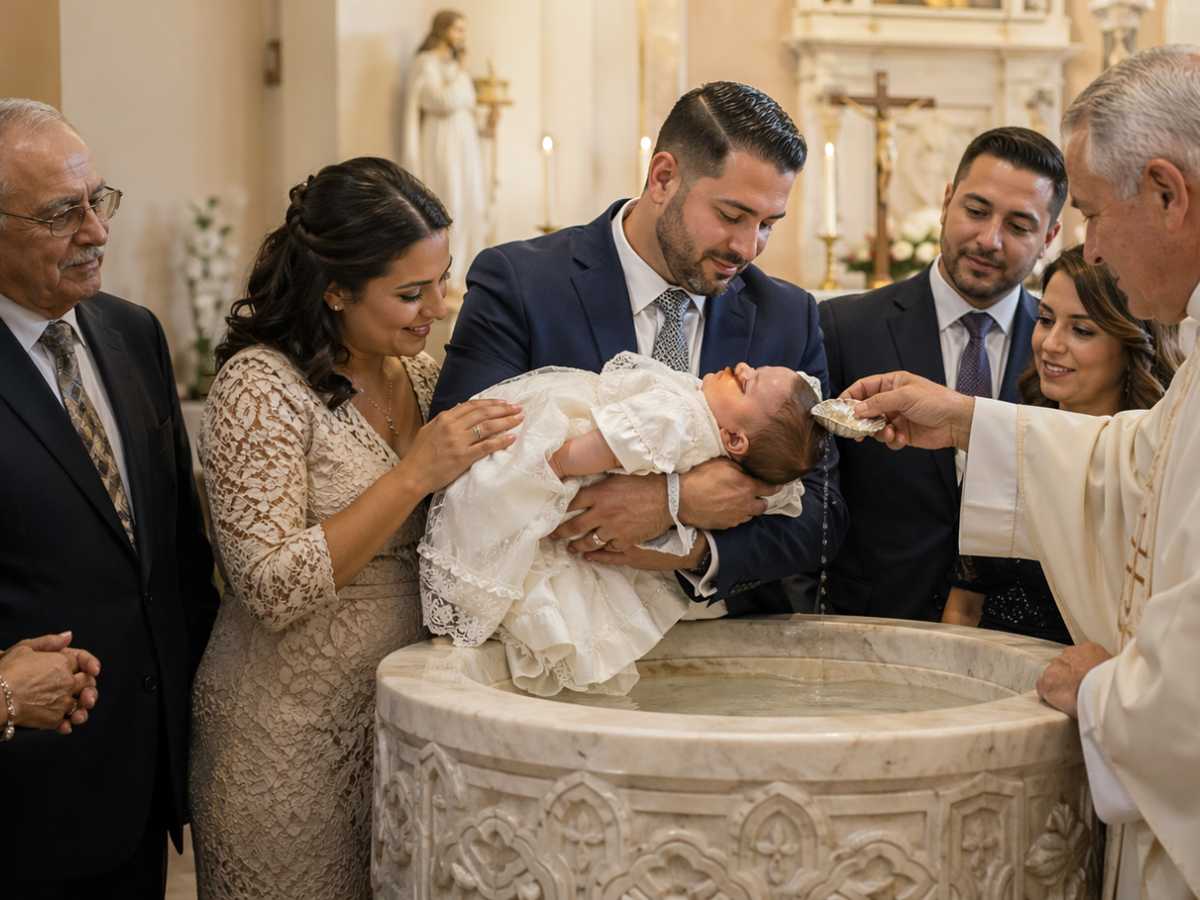
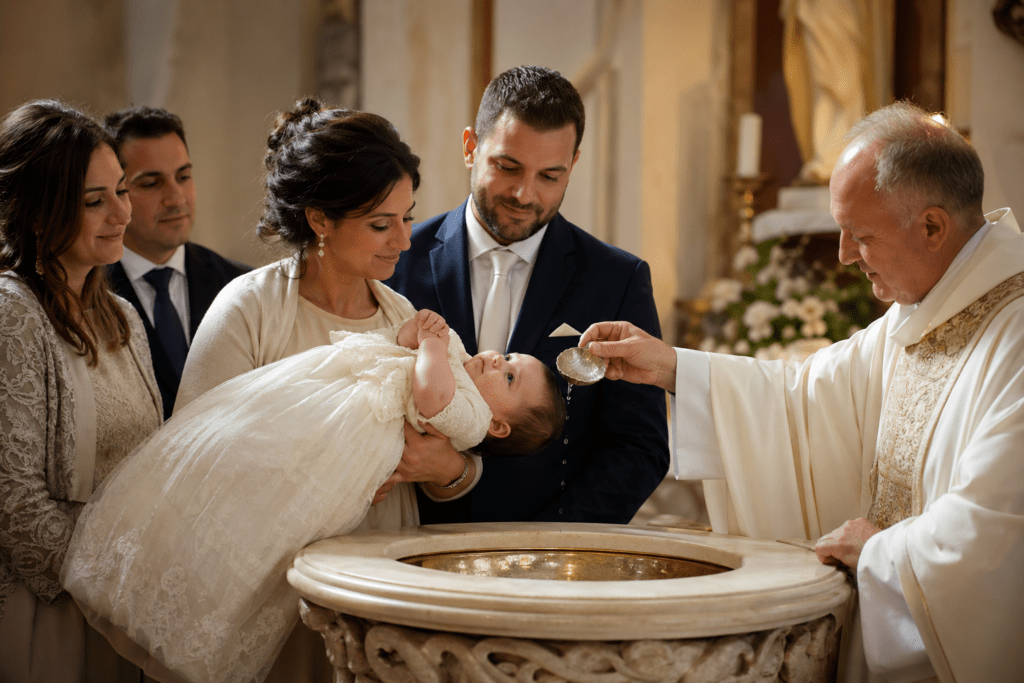
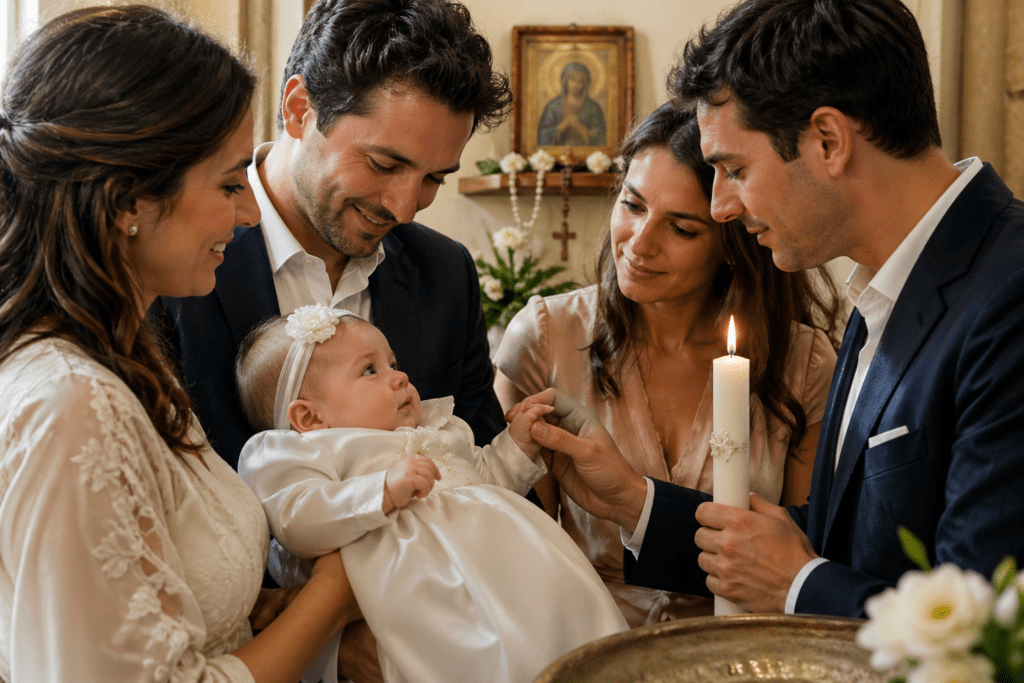
The child was brought forward. The parents were named. The godparents stood beside them. The priest asked the family’s intentions. The child’s name was spoken out loud in the church. Then came the water, the anointing, the white garment, and the candle lit from the Easter candle that stood near the font.
Each of those elements carried its own meaning, and older family members knew it even if they never said it explicitly.
- The water — the actual baptism, the cleansing, the welcome, the beginning
- The white garment — new life, Christian dignity, the beginning of something that was supposed to last
- The candle — the light of faith, lit from a flame that connected this child to Easter and to every other person who had ever stood in this same position
- The name — spoken first, before anything else, because you belong somewhere before you can be formally welcomed into it
The baptism gown in my wife’s family had been worn by four generations of children by the time their youngest was baptized. It had been let out, taken in, and repaired twice. It was yellowing slightly at the hem. Her grandmother had worn it. Her mother had worn it. Now the latest baby wore it in a church in a Canadian city that the family who originally made the gown had never seen. Nobody mentioned any of this during the ceremony. But after, at the lunch, one of the older aunts held it up to the light and said something in dialect that nobody younger understood. Everyone who did understand went quiet for a moment. Then the noise of the afternoon resumed and the gown went back in its box.
The godparents — why this was never a casual choice
In traditional Catholic family life, and certainly in traditional Italian Catholic family life, godparents were not picked because they were fun or because they had a good relationship with the parents. They were picked because they were trusted. Because they were considered worthy of the role. Because the family was prepared to say, in front of a priest and everyone who mattered, that these specific people would stand beside this child in faith.
That is a substantial thing to say about someone.
My parents chose my godfather because he was my father’s closest friend and because he was, in my grandfather’s words, “the kind of man who keeps his word.” That phrase — keeps his word — was the entire endorsement. Not funny, not generous, not successful. Keeps his word. My godfather came to every significant event in my life for the first twenty years. He did not always say much. He was just there, consistently, in the way that certain people are just there when it matters. When I was old enough to understand what the phrase meant, I thought about my grandfather’s endorsement differently. He had chosen correctly, as it turned out. He usually did.
The godfather and godmother also had a social meaning that went beyond the religious role. The relationship between the parents and the godparents — the compare and comare relationship — was itself significant in Italian family life.
Compare (for the godfather) and comare (for the godmother) were the specific terms parents used to address the people who had stood beside them at the baptismal font. These were not simply “my friend” or “my cousin.” They were something more formal, more loaded with expectation. The relationship was supposed to last. It created a bond between households that was expected to be honored in real, practical ways — presence at family occasions, loyalty in difficult moments, a specific kind of closeness that was different from ordinary friendship.
Choosing someone as godparent was a gesture of trust, of closeness, and of elevation in the family’s inner circle. Many families chose godparents for qualities like reliability and integrity as much as for affection.
You were not only picking somebody nice. You were picking somebody trusted. Somebody who, when things got hard, would still be there.
The baby — and the completely honest part of every baptism
Let us be truthful about this part.
At some point in almost every baptism, the baby runs out of patience with the entire situation.
The baby did not ask for the white gown. The baby did not ask to be in a church. The baby did not ask for cold water poured over their head at a moment that was supposed to be solemn. The baby has opinions about all of these things, and the baptism is often the first occasion on which those opinions are expressed publicly, loudly, and without any concern for the schedule or the photographer.
My nephew’s baptism was proceeding beautifully — the priest was calm, the godparents were composed, the family was assembled in their finest clothes maintaining appropriate expressions — until the exact moment the water was poured. Something about the temperature, or the sound of it, or perhaps the accumulated indignity of the whole morning, was the final event my nephew was willing to accept gracefully. He communicated his feelings at a volume that made the priest pause for the first time anyone in the family could remember. The priest looked at the child. The child looked at the priest. The priest finished the prayer. My nephew kept going. Years later this is still the story of that baptism. Not the gown. Not the lunch. The moment the baby decided enough was enough.
This is not a failure of the tradition. It is part of the tradition. What it reveals is that a baptism is a real event, not a performance. Real babies have real reactions. Real parents stand there in dress clothes trying to remain calm. Real grandparents watch from the pews with that particular expression that contains amusement, pride, and the memory of every other crying baby at every other baptism they have attended in the last fifty years.
The baby always calms down eventually. The ceremony continues. And the story lives in the family forever.
The white gown and the candle — what the symbols actually meant
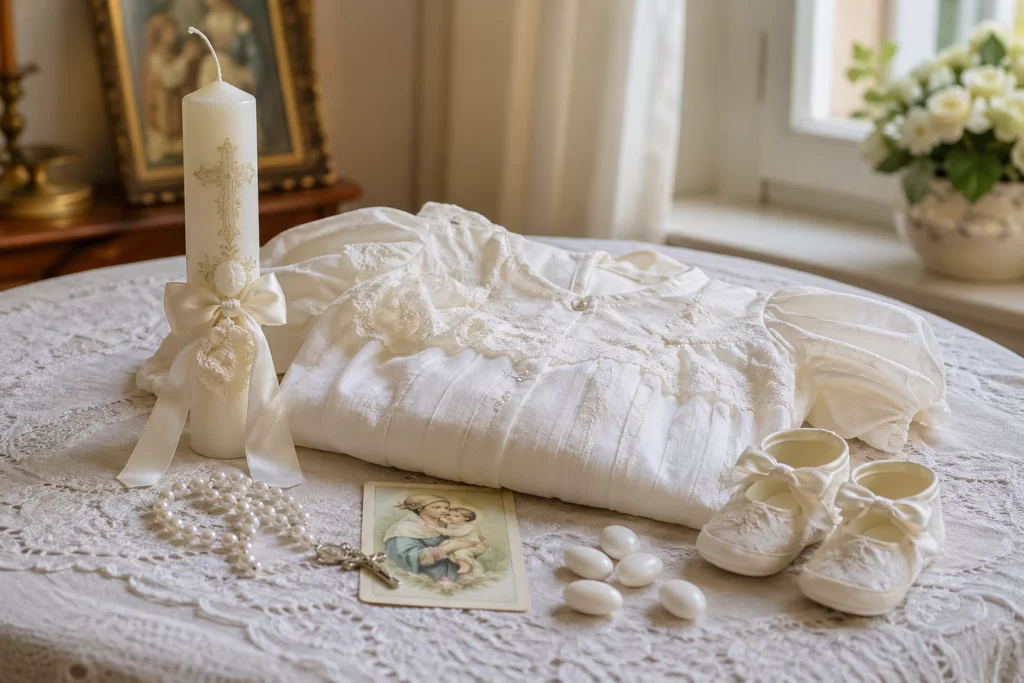
The white garment is the one that people remember most. Every Italian baptism family has a photograph of the child in white, and many families still have the gown itself — pressed, folded, sometimes yellowing at the edges, kept in a box that gets moved from house to house for decades because no one can quite bring themselves to let it go.
The white meant new life, purity, Christian dignity, and the beginning of something. Putting it on the child was a gesture — this child is starting something today, and we are marking that beginning with a visible symbol of what it means.
There is a gown in my extended family that came from a village in Calabria in 1923. It has been worn by eleven children since then, across three countries. The last child to wear it is now in her forties. There is some discussion about whether it can still be worn or whether it needs to simply be preserved now. The family has not resolved this. Probably because resolving it would require acknowledging that the gown has become something different from what it started as — not a garment for wearing but a document. A record of everyone who wore it before.
The candle carries its own significance. Lit from the Paschal candle — the Easter candle that stands near the baptismal font — it connects the newly baptized child to the full arc of the faith. Small flame. Enormous context. Many families keep the candle for years. It is one of the details people remember most clearly from baptisms they attended decades ago.
After church — the meal, the favors, and the part the whole family had been waiting for
Once the church doors opened and the family stepped out into the daylight, something shifted. The tension dropped. The formality loosened. The photographs became more aggressive and less composed. Someone had already figured out the fastest route to the restaurant. Someone else was asking in a voice that was not quite quiet enough whether the antipasto had been ordered already.
And then came the gathering.
In Italian family life the meal after a major occasion is not a secondary event. It is the other half of the day — the part where the sacrament gets absorbed into the family, where the joy of what happened at the church gets extended into hours of food and noise and the baby being passed from person to person as though everyone has a specific claim on holding them right now.
The lunch after my cousin’s baptism lasted four hours. Not because anyone planned for it to last that long. That is just what happened. The antipasto became the pasta became the second course became the coffee became someone producing a bottle of something that had been waiting for a special occasion. Somewhere in the third hour the baby fell completely asleep in my grandmother’s arms and my grandmother did not move for forty-five minutes because she was not going to be the one to disturb her. People talked around her in lowered voices. She looked extremely pleased. The whole room felt, for those forty-five minutes, like exactly what it was supposed to be.
The bomboniere — sugared almonds and what they meant
No Italian baptism celebration was complete without the bomboniere — and if you grew up in an Italian family you already know exactly what these were and precisely how seriously people took them.
Bomboniere are the small favor packages given to guests at baptisms, communions, confirmations, and weddings. At a baptism they almost always contained confetti — not the paper kind, but sugar-coated almonds, hard and sweet and slightly bitter in the center, wrapped in tulle or placed in a small decorated box or bag with a ribbon and sometimes a small keepsake attached.
The number of almonds mattered. Always an odd number — five was the most traditional for baptisms, representing health, wealth, happiness, fertility, and long life. Five specific wishes, wrapped in sugar and given to every guest. Even numbers were for funerals. Nobody mixed these up. Not in an Italian family.
My aunt still has the bomboniera from my baptism in a small ceramic dish on her dressing table. Not the almonds — those are long gone. The little box they came in, and the small silver charm that was attached to the ribbon. She has had it for decades. I found out she kept it when I was an adult and we were talking about something else entirely. She mentioned it as though it were obvious that she would still have it. As though the alternative — throwing it away — had never seriously occurred to her. That is what a bomboniera is, eventually. Not a favor. A small proof that a specific day happened.
The style and scale of the bomboniere varied by family, by region, and by how much the family wanted to demonstrate their seriousness about the occasion. Some were simple — tulle circles tied with ribbon, five almonds, done. Others were elaborate — hand-painted ceramic pieces, silver-plated objects, porcelain figures with the child’s name and baptism date painted on them. In North American Italian communities the bomboniere traditions held remarkably well, partly because they were visible and tangible and could be maintained without the broader community context that some other traditions required.
The silver gifts were their own category. Silverware, silver-framed photographs, silver cups and spoons, silver charms — silver appeared at Italian baptisms with a frequency that was not accidental. It was associated with purity, with lasting value, with giving the child something that would endure. Many of those silver objects are still in family drawers and boxes right now, tarnished and slightly forgotten, waiting for someone to find them and ask where they came from.
What changed after immigration — and what was too important to let go
When Italian families came to North America, baptism came with them — not as a preserved museum piece but as a living conviction that this was one of the things you did, one of the things that mattered, one of the things that connected the child to something larger than the immediate family and the immediate city they happened to be born in.
The core of the sacrament stayed stable. The child, the water, the blessing, the godparents, the white garment, the candle — all of it traveled. The bomboniere traveled. The silver gifts traveled. What changed more often was the context and the explanation around it.
The gown stayed. The party stayed. The photographs stayed. The godparents stayed. The bomboniere stayed. But the reasons behind the customs did not always travel as clearly. Families who had grown up surrounded by a whole community that understood these things found themselves in neighborhoods where the context was different, where the specific Catholic Italian vocabulary for these events was not shared, where the tradition had to be maintained more intentionally because the surrounding culture was no longer doing half the work of reinforcing it.
My father’s family baptized children quickly after birth — within weeks, always. It was not discussed. It was simply understood to be what you did. When my sister’s son was born in a different city, far from most of the family, there was a conversation about the timing that would not have happened a generation earlier. The tradition was still there. The urgency around it was being negotiated in real time. They baptized him. They had the lunch. The gown made the trip. The bomboniere were ordered and wrapped. But the conversation itself told you something about what changes when a tradition loses its surrounding community and has to sustain itself on family intention alone.
Even so, the instinct held. The feeling that the baptism mattered, that godparents should be chosen carefully, that the day deserved proper marking — that persisted across generations and across distances that the families who created these customs never could have imagined crossing.
That persistence is the tradition too.
How to keep the meaning alive — without turning it into a production
The good news is that the meaning does not require a performance to survive. It requires intention.
Choose the godparents with real thought — not just who would appreciate the honor but who would actually carry the responsibility. Tell them what you are asking of them. Say it out loud. Use the words compare and comare if you know them. Let the relationship be named properly.
Let the church part be the main event, not just the backdrop for photographs. Explain to the child, when they are old enough, what the white garment meant and what the candle represented and why you chose that specific day and those specific people to stand around them.
- Choose godparents for who they are, not only for the relationship they have with you
- Explain the symbols to the child when they are old enough to receive the explanation
- Keep the white garment if you can — it is a document, not just a piece of clothing
- Keep the bomboniere — at least one, with its ribbon and charm, in a drawer somewhere safe
- Let the meal after be as abundant and loud as your family needs it to be
- Record who was there — write down the names, the date, the stories that happened
- Tell the child the naming story — who they were named for and why that person was chosen
- Tell the priest story — whatever your version of it is — so it becomes part of the family’s history
And let the celebration be as joyful and Italian as it wants to be. The lunch does not compete with the meaning. The bomboniere do not compete with the sacrament. The abundance is the family’s way of saying that what happened at the font deserves to be honored at every level of life — sacred and human at the same time. That has always been the Italian instinct, and it has always been correct.
Sacred and chaotic. Solemn and completely alive. The priest at the door, the crying baby, the grandmother who would not move, the bomboniera still in a ceramic dish forty years later. That mix is exactly why Italian baptisms live so long in family memory. They were not polished. They were real.
And the most Italian part of all was what happened at the table after — when the sacrament became a celebration and the family remembered together what the day had meant.
Every Baptism Leaves a Family Archive
Record the names, godparents, keepsakes, and stories behind the day.
Who chose the name? Why were those godparents trusted? Is the gown still in a box somewhere? Who kept the bomboniera? The Italian Family Heritage Kit includes 133 guided pages and more than 120 prompts to preserve your family’s people, names, traditions, recipes, sayings, photographs, and memories.
Explore the Heritage Kit — $19.99Instant digital download. Print it and complete it with your family.
If you want to pass on heritage through everyday family life, not only sacraments, read Italian-American traditions: what changed after immigration and what stayed the same. And if you want to understand the protective customs Italian families kept around a new baby, read what malocchio is and why the cornicello was often the first gift a newborn received.
A baptism was often marked with a santino keepsake, and the child named for a saint — find their patron in the patron saint finder.
FAQ
What are Italian baptism traditions?
Italian baptism traditions centered on bringing the baby to church for Catholic baptism as early as possible after birth, choosing godparents with genuine care and consideration, dressing the child in white, using a baptism candle lit from the Paschal candle, giving bomboniere favors to guests, and then gathering the extended family for a meal afterward. The day was understood to be both a sacrament and a family event — the two things reinforced each other rather than competing.
Why did Italian families take baptism so seriously?
Because in traditional Italian family life, faith and family identity were closely tied together, and baptism was one of the child’s first truly important public milestones. It was the day the child was named in front of God, welcomed into the Church, and surrounded by people making promises around their life. Older generations understood that weight even if they could not always articulate the theology behind it.
Why are godparents important in Italian baptisms?
Godparents were traditionally meant to support the child’s religious upbringing and stand beside the parents in that responsibility. In Italian family life they also carried deep social meaning — the compare and comare relationship between parents and godparents was a formal bond expected to last and to be honored in real, practical ways. Many families chose godparents for qualities like reliability and integrity as much as for closeness or affection.
What does compare and comare mean in Italian baptism?
Compare is the term a parent uses to address their child’s godfather. Comare is the term used for the godmother. These were specific, formal words that carried the weight of the relationship — not simply “my friend” but something closer to “the person who stood with me at the font and made a promise alongside me.” The compare and comare relationship was expected to be a lasting bond between households, involving presence at important family occasions and a specific kind of mutual loyalty.
What are Italian baptism favors — what are bomboniere?
Bomboniere are the small favor packages given to guests at Italian baptisms, communions, and weddings. At a baptism they traditionally contained sugared almonds — confetti — wrapped in tulle or placed in a small decorated box with a ribbon and sometimes a silver or ceramic keepsake. The number of almonds was always odd, traditionally five, representing health, wealth, happiness, fertility, and long life. Even numbers were associated with funerals. Many Italian families kept the bomboniera from significant family baptisms for decades.
How did Italian families traditionally choose a baby’s name?
Traditional Italian naming followed a specific pattern: the firstborn son was named after the paternal grandfather, the firstborn daughter after the maternal grandmother, the second son after the maternal grandfather, and the second daughter after the paternal grandmother. This meant the name spoken at the baptismal font connected the child directly to specific ancestors. When Italian families emigrated to North America and names were anglicised, many families preserved the original Italian name as a middle name to keep the family chain unbroken.
Why do babies wear white at baptism?
The white garment symbolizes new life, Christian dignity, and the beginning of the child’s life in faith. In many Italian families it also became a physical heirloom — the same gown worn by multiple generations of children, carried across countries, preserved for decades. The garment holds the memory of everyone who wore it before.
What does the baptism candle mean?
The baptism candle is lit from the Paschal candle — the Easter candle — and represents the light of Christ being given to the newly baptized child. It connects this individual baptism to the full arc of the faith and to every other person who has stood in the same position. Many families keep the candle for years as one of the most significant objects from the baptism day.
Is an Italian baptism more religious or more cultural?
At its core it is religious — the sacrament is the center of the day. But in real Italian family life it is also deeply cultural, because Italian families have always surrounded their sacraments with food, family, photographs, bomboniere, and celebration. Those two things were never in competition. The abundance of the table after the church was the family’s way of saying the sacrament deserved to be honored at every level of life — sacred and human at the same time.

Marco Ricci is an Italian-Canadian writer and the grandson of Calabrian immigrants. He created Italian Family Traditions to document the customs, feast days, and family rituals Italian families carried from Italy to North America — and to understand what they actually meant. He is based in Montreal.