Italian Family Traditions
What Is Capodanno? The Meaning of Italy’s New Year’s Day Tradition
Capodanno is January 1 — Italy’s New Year’s Day. Not the countdown the night before. The day itself: the first morning of the year, the Mass, the lentils at lunch, the specific Italian understanding that how you live the first day shapes what comes after it.
The punch the night before — San Silvestro, December 31 — was always stronger than it looked. My grandmother made it every year in the same big ceramic bowl, fruit and sparkling wine and something warm that had been sitting since the afternoon, and it looked festive and harmless until about an hour into the evening when everyone understood simultaneously that it had not been festive and harmless at all. The room had been full and loud, the chairs jammed in tighter as relatives arrived, the mortadella platter going around and then the lasagna and then the cutlets, and the games starting after the plates were pushed aside. That was San Silvestro — the cenone, the noise, the cousins, the fireplace. That was December 31.
And then it was January 1. Capodanno. The year had actually arrived — not approaching, not anticipated, here — and my grandfather was already up. He was always the first one up, but on Capodanno he was up with a specific purpose. The Mass was at a specific time. The lentils needed to be started. The first day of the year was not going to organize itself, and he had no interest in treating it like a recovery day. It was an occasion. The first occasion of the whole year, and the way you observed it said something about how seriously you were taking what was coming.
Capodanno is not the party. The party was San Silvestro, December 31. Capodanno is what you wake up into: January 1, the first day, the year that has now properly arrived and must be properly received.
This article is about that day — what Capodanno is, what it meant in Italian family life, what was on the table and why, what the superstitions were actually doing on January 1, and why the first day of the year deserved more than sleeping until noon.
What Capodanno actually means
The word is literal: capo means head or beginning, anno means year. Capodanno is the head of the year — January 1, New Year’s Day. Not New Year’s Eve. Not the countdown. The day itself.
In Italy, January 1 is also the Solemnity of Mary, the Holy Mother of God, on the Catholic calendar, and the World Day of Peace — designations that the Vatican frames as the Church’s blessing on the new year. For Italian families with strong Catholic roots, this gave January 1 a texture that a purely secular New Year’s Day does not have. The first morning of the year began with Mass — the Solemnity of Mary, the blessing of what was starting — and everything else the day contained was built on that foundation.
The night before — San Silvestro, December 31 — had its own feast and its own celebration: the cenone di San Silvestro, the midnight toast, the games that ran past midnight. But that was December 31. Capodanno was what came after. The first morning. The first light. The first day of what the year was actually going to be.
Why Capodanno mattered — what the first day was really doing
The Italian instinct around Capodanno was specific and consistent: the first day of the year was not neutral. It was not simply Day One of a numbered sequence. It was the day that set the tone. How you lived January 1 said something about how you intended to live the other 364 days that followed it. So you did not waste it. You did not spend it in recovery. You got up. You went to Mass. You ate the right foods. You said the right words to the right people. You received the year properly.
That instinct — that thresholds matter and deserve intentional crossing — runs through Italian family culture at every level. It is the same instinct that shapes the Italian Sunday dinner and Italian Easter traditions and the whole Catholic calendar of feast days. You do not let important moments arrive unremarked. You mark them. You dress for them. You feed them the right symbols. You say the words.
My grandfather was not interested in January 1 as a recovery day. He had been up since the usual hour, he had his plans for the morning, and he expected the house to organize itself around those plans. Mass was at a specific time. The lentils needed to go on. The first day of the year deserved to be received like the first day of the year, not like the morning after a party. He held both things simultaneously without tension: he had enjoyed San Silvestro fully the night before, and he was fully present for Capodanno the morning after. Neither cancelled the other. Both mattered. That is the Italian logic of the holiday period.
The Mass — how Capodanno began
For Italian families with strong Catholic practice, Capodanno began at church. The Solemnity of Mary on January 1 is a holy day of obligation in the Catholic calendar — a formal feast day requiring Mass attendance in the same way that Christmas and Easter do. In Italian family life this was understood and observed: the first act of the new year was a religious one, the year being formally placed under a blessing before anything else was done with it.
In Montreal’s Italian community, the Italian parishes — the Madonna della Difesa church, the parish on Dante Street in Little Italy — were full on January 1 in the specific way they were full on Christmas: families dressed properly, the familiar faces of the neighborhood gathered in the same building they gathered in for baptisms and funerals and feast days throughout the year. The community assembling itself at the beginning of the year the way it assembled itself at every significant moment.
My grandmother dressed for Mass on Capodanno with a specific seriousness that was different from Sunday mornings and different even from Christmas. Christmas had excitement in it. Capodanno had gravity. She was presenting herself to the first day of the year as though the day deserved to be met properly, which in her understanding it did. She came home from Mass with the specific settled quality of someone who had done the first important thing and could now proceed to the second, which was the lentils.
The lucky foods — what was on the Capodanno table and why
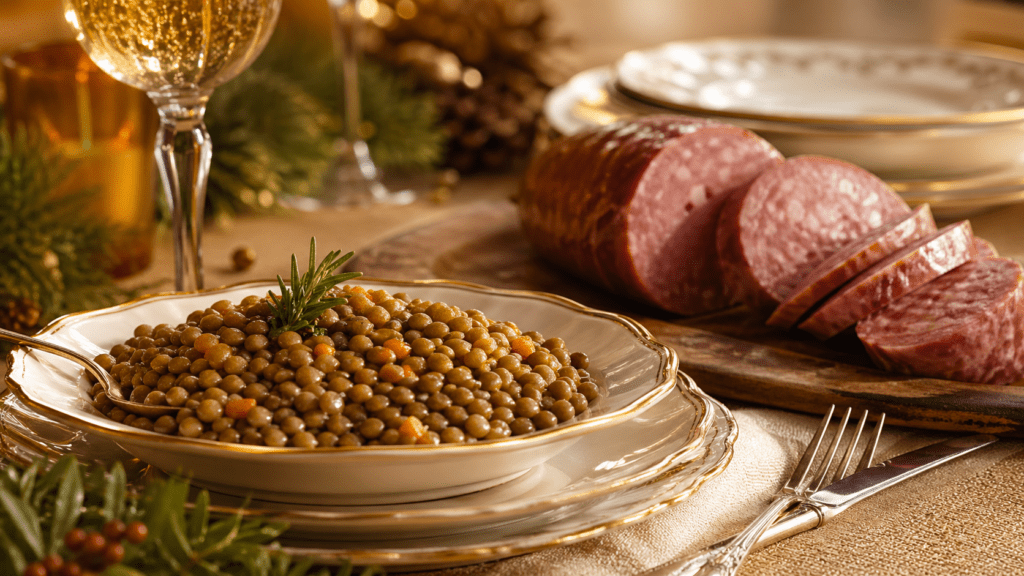
The Capodanno lunch — the meal served on January 1 itself — had a specific symbolic logic that made it unlike any other meal of the year. You were feeding the first day of the year. What went on the table communicated what you wanted the year to bring. This is the same principle at work in the La Vigilia fish table at Christmas Eve — the food reflecting the meaning of the day rather than simply satisfying appetite.
| Food | What it symbolized | Why it belonged on January 1 |
|---|---|---|
| Lentils | Money and prosperity | Their shape resembles small coins. Eating them on New Year’s Day is meant to attract wealth and abundance in the year ahead. The most universal Italian Capodanno tradition — present in every region and every diaspora community. |
| Cotechino | Progress and forward movement | Pork symbolizes moving forward — the pig roots ahead with its snout. This slow-cooked Emilian sausage served over lentils is the definitive Capodanno dish. Often started on the morning of January 1. |
| Zampone | Same as cotechino — prosperity through pork | Stuffed pig’s trotter — the Modenese alternative to cotechino. Same symbolic meaning, different form. Always served with the essential lentils at the January 1 lunch. |
| Pomegranate | Fertility, abundance, good fortune | Its abundance of seeds symbolizes the abundance hoped for in the year ahead. Present on many Capodanno tables as a symbol of what January 1 was being asked to bring. |
| Grapes | Twelve months, twelve wishes | Eaten on January 1 in some traditions — one for each month of the coming year, each one a wish made on the first day for the days that follow it. |
The logic running through all of these choices is consistent: what you eat on the first day of the new year sets a tone and communicates an intention. The lentils do not actually produce money. But eating them says: abundance is what we are reaching for. The cotechino does not guarantee progress. But serving it says: we are moving forward. Physical acts, repeated year after year, become the substance of tradition.
Regional variations — how Capodanno looked different by where the family was from
January 1 was never a single uniform tradition across Italy. Like all Italian celebrations, it varied significantly by region — which means families with different regional backgrounds can have very different memories of what the first day of the year looked and felt like.
Northern Italy — particularly Emilia-Romagna — is the home of cotechino and zampone, the pork products most associated internationally with the Italian Capodanno. Serving cotechino e lenticchie at the January 1 lunch was the definitive Capodanno act in this region. When people outside Italy think of Italian New Year food, they are usually thinking of the northern tradition.
Naples and Campania — January 1 in Naples carried the specific Neapolitan weight of a city that takes feast days seriously. The Capodanno lunch in a Neapolitan household was abundant and specific to the region. Naples also observed the first-footer tradition — the first person to cross the threshold on January 1 should carry something as a symbol of abundance — with genuine seriousness. The quality of the year’s first visitor was read as a sign of what the year itself would be.
Calabria and the south — for many Italian-Canadian and Italian-American families whose roots are in Calabria, the January 1 table looked different from the northern version. The cotechino was not always present or was replaced by local pork preparations. The lentils were always there — the lentil tradition is genuinely pan-Italian — but surrounded by dishes specific to the region. The day was observed with equal seriousness; it simply spoke a different regional dialect of the same occasion.
Sicily — the Sicilian Capodanno shared the broad Italian structures of the lucky foods and the specific tone of January 1 as a day to receive properly, but within those structures expressed the specific Sicilian relationship with abundance and celebration. The transition toward January 6 — the Befana — was marked with customs that made the whole period a continuous celebration.
The superstitions — what people did on January 1 and why
Capodanno is one of those occasions when even people who consider themselves entirely rational get a little ceremonial. The reason is not irrationality — it is that a new year is abstract. You cannot hold it. You do not know what it contains. So people reach for specific, concrete, repeatable actions that make the future feel less unmanaged.
Red underwear — worn on January 1 for good luck and love in the new year. The shops fill with red in late December specifically for this. Treated as both a genuine custom and a reliable source of family comedy — the ideal condition for a superstition to survive: taken seriously enough to actually do, lighthearted enough to enjoy the absurdity of.
Not eating chicken — because chickens scratch backward, which is seen as an unlucky direction on the first day of a new year. You want to be moving forward. The cotechino, by contrast, roots forward. The symbolic logic is completely consistent once you know the key.
The first-footer — in some Italian traditions, the first person to enter the house on January 1 should be a man, ideally dark-haired, bringing something — bread, salt, or coal — as a symbol of abundance. The quality of the year’s first visitor was taken as a sign of what the year itself would bring.
Not crying on January 1 — in many Italian families, there was a strong superstition against tears on Capodanno. Tears on the first day were believed to attract sorrow for the rest of the year. Everyone was expected to be in good spirits on January 1, or at least to perform good spirits convincingly for the required duration.
Not doing laundry or cleaning — washing clothes or cleaning the house on January 1 was considered bad luck in some regional traditions — you would be washing away the good fortune of the new year before it had a chance to settle in. The first day was for receiving the year, not for housework.
My grandmother wore red every January 1 without fail and made sure everyone had eaten their lentils at lunch. She was not a superstitious woman in her daily life — practical, direct, not particularly patient with magical thinking. But on Capodanno she observed every custom with the same seriousness she brought to the Mass and the lunch. When I asked her once why she bothered if she did not really believe in them, she said something I have thought about many times: “It costs nothing to do it right.” That is the most honest possible description of why people observe the Capodanno customs. Not because they are certain it works. Because the doing of it says something about how seriously you are taking the beginning.
The Italian phrases of Capodanno — the words of the first day
The specific words said on January 1 are among the most emotionally charged Italian that many Italian-Canadian and Italian-American descendants carry — said with genuine feeling on the first morning of the year, part of the texture of Capodanno in a way that no translation quite preserves.
| Phrase | Literal meaning | When and how it was said on January 1 |
|---|---|---|
| Buon anno | Good year | The primary Capodanno greeting — said on waking January 1, said to family members as they appeared, said to neighbors and relatives throughout the day. Not a generic shout. A directed wish to a specific person looking at you. |
| Felice anno nuovo | Happy new year | The more formal version — used in written greetings, phone calls to relatives, more deliberate exchanges throughout January 1 and the first days of the year. |
| Auguri | Wishes / Best wishes | The all-purpose Italian word for wishes at any celebration. Said on January 1 with particular warmth — often accompanied by a hug or a kiss on both cheeks, the physical gesture completing what the word began. |
| Tanti auguri | Many wishes | The amplified version. Said to the people whose company in the coming year matters most — older relatives, close friends, the ones you are particularly glad to be entering a new year with. |
| Salute | Health | The first toast at the Capodanno lunch — said before buon anno, before anything else. Health first. From people who understood that health was the precondition for everything the other wishes were hoping for. |
| Alla nostra | To ours / To us | The inclusive toast — to everyone at the Capodanno table, to the family assembled on January 1. The most intimate of the toasts. Said within the family circle as the final wish of the meal. |
My grandfather said buon anno to my grandmother first thing on January 1 morning, before anything else. Before coffee. Before the plans for the day. Before the lentils went on. He found her and said it directly, looking at her. Then he said it to everyone else in the house as they appeared — children, adults, whoever was there. It was the first act of Capodanno in our household, and it happened in a specific order with a specific intentionality. The year was being opened properly. The people in it were being acknowledged properly. That was how January 1 began.
The Capodanno gathering — what January 1 looked like as it unfolded
After Mass, the day gathered itself around the family. Capodanno unfolded as a day does: with arrivals, with the smell of the lentils cooking, with the specific quality of a January afternoon when everyone is together and the year is still new enough to feel full of possibility.
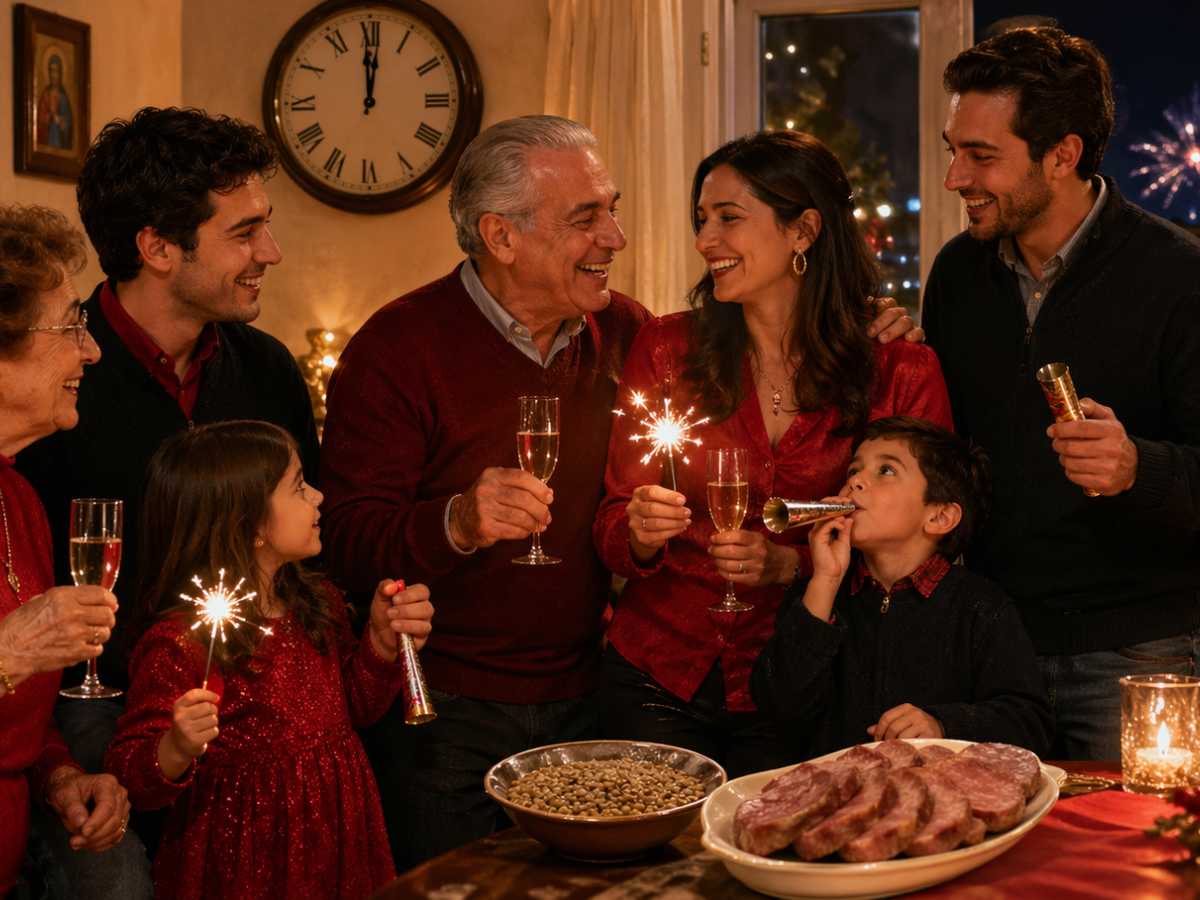
Relatives came for the Capodanno lunch. Not the enormous cenone of San Silvestro the night before, but a proper January 1 meal — the lucky dishes first, then the full gathering of what the occasion required. The cold cut platter came out first: mortadella, salami, whatever had been picked up from the Italian shop on Saint-Laurent earlier that week, arranged on the platter that appeared only at the serious meals. Then the lasagna, made the day before and better for it. Then the cutlets. Then more wine. Then the specific Italian phenomenon of someone insisting you eat more at the precise moment you had decided you were finished. The meal was not rushed. January 1 had no demands on it beyond itself, which was part of what made it feel different from the rest of the calendar — a day set aside, a day for being together and eating well and saying buon anno properly and letting the new year feel like it had been received with the seriousness it deserved.
The Capodanno lunch at my grandparents’ house in Rivières-des-Prairies was quieter than San Silvestro but not small. The lentils were on the table. The cotechino was sliced. The wine was poured. The buon anno had been said and said again as people arrived. And then the afternoon settled into the specific unhurried quality that only January 1 has — that feeling of being in the first hours of something vast and unwritten, surrounded by people you love, with nowhere else to be and nothing else required. My grandfather sat at the head of the table and seemed satisfied in a way that went beyond the food. The year had been received correctly. That was what he wanted. That was what Capodanno was for.
What came after — the Befana and the arc of the Italian holiday season
Capodanno did not close the Italian holiday season. It sat in the middle of it. The arc ran from Christmas Eve through La Vigilia, through Christmas Day, through San Silvestro on December 31, through Capodanno on January 1, and ultimately to January 6 — the Epiphany, and in Italian tradition, the Befana.
The Befana is one of the most specifically Italian of all holiday figures: an old woman who flies on a broomstick on the night of January 5 to 6, delivering gifts and sweets to good children and coal to bad ones. In historical Italian tradition, before the modern Christmas gift-giving model took hold, the Befana was often more important to children than Christmas morning. The decorations stayed up through Epiphany. The visiting continued. Capodanno was the threshold and January 6 was the closing. Understanding this arc changes how January 1 reads — it is not the end of anything, it is the first day of a year still inside its opening celebrations.
Capodanno in Montreal’s Italian community
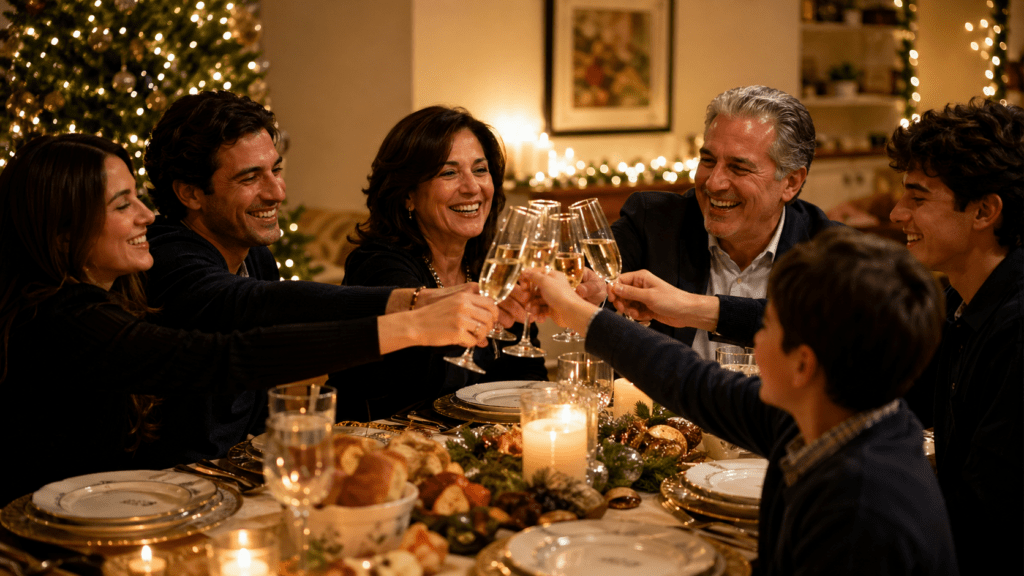
In Montreal’s Italian community — centered first in Little Italy around Saint-Laurent and Dante, then spreading outward to Saint-Michel and Rivières-des-Prairies — Capodanno maintained its distinct identity as a January 1 occasion even as families settled into Canadian life around them.
The Mass was observed. The Italian parishes were full on January 1. The lentils were made — the cotechino found at Italian shops on Saint-Laurent, later at Italian grocers spread across the city as families dispersed from the original neighborhood. The red custom survived. The phrases — buon anno, salute, auguri — were said in Italian even in households where English and French had become the primary languages of daily life. The Capodanno lunch remained an occasion.
What the Italian community in Montreal maintained about Capodanno was its specific character as the first day of the year deserving intentional reception. Outside the house, January 1 was a public holiday. Inside the house, it was Capodanno — with its own requirements, its own foods, its own phrases, its own way of saying that the year had arrived and was being acknowledged. That distinction between the generic and the specific is part of the larger story of Italian-American and Italian-Canadian traditions after immigration.
How to keep Capodanno alive today
- Go to Mass or mark the morning intentionally — the Solemnity of Mary on January 1 gives the first morning of the year a specific character. Even a candle lit and a moment of quiet does the work of setting the day apart
- Make the lentils — with cotechino if you can find it, with whatever pork is available if you cannot. Tell the children why: these are for luck and abundance in the year ahead
- Say buon anno properly on January 1 morning — to each person, looking at them. Say salute first. Say alla nostra at the lunch table. The sequence matters. The eye contact matters
- Gather for the Capodanno lunch — a proper meal on January 1 with the family at the table and the lucky foods on it and enough time to receive the day rather than rush through it
- Keep one superstition — the red, the lentils, the no-chicken rule, the no-laundry rule. It costs nothing to do it right, as my grandmother said
- Let January 1 be its own day — not the recovery from December 31, not the first day of getting back to normal, but the first day of what is coming. The year has arrived. Receive it accordingly
January 1. The lentils on the stove. The Mass in the morning. The buon anno said to each person individually — salute first, then buon anno, then alla nostra — looking at them when you say it. The lunch with the family assembled and the year still new enough to feel full of possibility. The first day received properly.
That is Capodanno. Not the countdown. Not the party. The day itself — the first day, the head of the year, the occasion that Italian family culture understood as deserving something more than sleeping in and waiting for things to go back to normal. The year arrives. You meet it. That is the whole tradition.
Buon anno. May the year deserve the welcome you give it on its first morning.
For the San Silvestro celebration on December 31 and the full arc of the Italian holiday season, read about La Vigilia and the Italian Christmas Eve tradition. For the next great Italian seasonal celebration, read what Carnevale in Italy is and why it mattered. For the Sunday table logic that shapes the Italian holiday gathering, read Italian Sunday dinner traditions. And for the broader story of how Italian traditions survived immigration, read Italian-American traditions: what changed and what stayed.
FAQ
What does Capodanno mean in Italy?
Capodanno means New Year’s Day — January 1. The word combines capo (head or beginning) and anno (year), making it literally “the head of the year.” It refers specifically to January 1, not to New Year’s Eve, which is called San Silvestro in Italian tradition. January 1 is also the Solemnity of Mary, the Holy Mother of God, and the World Day of Peace on the Catholic calendar, giving Capodanno a devotional dimension alongside the civic one.
Is Capodanno New Year’s Eve or New Year’s Day?
Capodanno is New Year’s Day — January 1. New Year’s Eve, December 31, is San Silvestro in Italian tradition — the feast of Pope Sylvester I. The cenone dinner, the midnight toast, and the late-night celebration all happen on San Silvestro night. Capodanno is what you wake into on January 1: the first morning of the year, the Mass, the lentils at lunch, the buon anno said to each person as they arrive. The two days are distinct occasions with distinct characters — San Silvestro is festive, Capodanno is intentional.
What does buon anno mean?
Buon anno means “good year” — the primary Italian Capodanno greeting said on January 1. In Italian family tradition, buon anno was ideally said to each person individually rather than as a general announcement — a directed wish to a specific face. It is typically preceded by salute (health) as the first toast at the Capodanno lunch — health first, then everything else — and followed by alla nostra (to us, to everyone at the table) as the final and most intimate toast.
Why do Italians eat lentils on Capodanno?
Lentils are associated with money and prosperity in Italian tradition because their shape resembles small coins. Eating them on January 1 is meant to attract wealth and abundance in the year ahead. They are almost always served with cotechino or zampone at the Capodanno lunch — pork products that symbolize progress and forward movement. The combination of cotechino e lenticchie is the most universally recognized Capodanno dish across Italy and the Italian diaspora.
What is cotechino?
Cotechino is a large slow-cooked Italian pork sausage especially associated with Emilia-Romagna — Modena and Reggio Emilia in particular. It is served over lentils at the Capodanno lunch on January 1. The slow cooking takes several hours and produces a rich, soft sausage. Zampone, stuffed pig’s trotter, is the Modenese alternative — same symbolic meaning, different form. Both are protected as traditional Italian food products and the centerpiece of the January 1 meal.
Why do Italians wear red on Capodanno?
Red — specifically red underwear — is worn on January 1 for good luck, love, and a prosperous new year. The shops fill with red in late December specifically for this purpose. It is treated simultaneously as a genuine tradition and a reliable source of family comedy — the ideal condition for a superstition to survive across generations. In diaspora communities it often becomes more prominent as a marker of specifically Italian identity.
Is Capodanno religious in Italy?
Yes. January 1 is the Solemnity of Mary, the Holy Mother of God — a holy day of obligation in the Catholic calendar — and the World Day of Peace. For Italian families with strong Catholic traditions, Capodanno begins with Mass, and the religious dimension of the first day is understood as distinct from the festive San Silvestro night that preceded it. The blessing of the new year at Mass is the formal opening of Capodanno before the lentils, the gathering, and the buon anno wishes that follow it.
What is the Befana and how does it connect to Capodanno?
The Befana is a traditional Italian holiday figure — an old woman who flies on a broomstick on the night of January 5 to 6 (the Epiphany) to deliver gifts and sweets to good children and coal to bad ones. In historical Italian tradition, the Befana was often more important to children than Christmas morning. Capodanno on January 1 falls in the middle of the extended Italian holiday season: the arc runs from La Vigilia on December 24 through Capodanno on January 1 and concludes with the Befana on January 6. January 1 is not the end of anything — it is the first day of a new year still inside its opening celebrations.
How did Capodanno survive in Italian-Canadian and Italian-American families?
What traveled best was the domestic core of Capodanno: the lentils, the cotechino, the Mass, the specific phrases, the red custom, the Capodanno lunch with the family assembled on January 1. These elements required only a family that understood the first day of the year as deserving intentional reception rather than passive recovery. In Italian-Canadian households from Montreal’s Little Italy to Rivières-des-Prairies, January 1 remained Capodanno inside the house even when it was simply a public holiday outside it.

Marco Ricci is an Italian-Canadian writer and the grandson of Calabrian immigrants. He created Italian Family Traditions to document the customs, feast days, and family rituals Italian families carried from Italy to North America — and to understand what they actually meant. He is based in Montreal.