
Italian Family Traditions
The Italian Nonno — What the Italian Grandfather Really Was
He came to Canada with five dollars in his pocket. He worked the port. He grew the garden. He pushed me on the swings every single day. And when we came home, there was always a cold glass of milk and cookies waiting. That was an Italian nonno.
9 minute read
Every afternoon, my grandfather took me to the park.
He had been injured at work years earlier and retired young, and he decided — quietly, without announcement — that I was going to be his full-time occupation. Me and the garden. Those were his two jobs, and he showed up for both every day with the same steady, unhurried devotion.
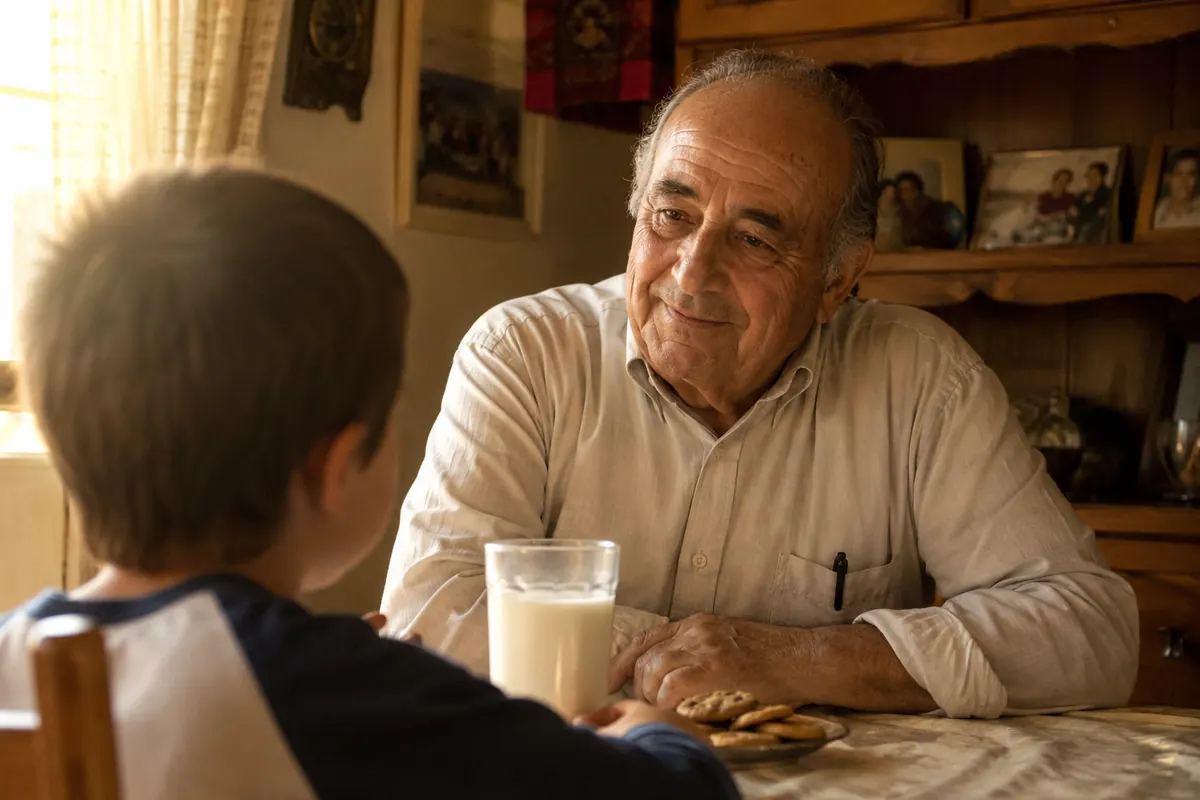
We walked to the park together. He pushed me on the swings. He watched me run. And when we came home, he poured me a cold glass of milk and set out cookies, and we sat together in the kitchen as if this were the most important appointment either of us had. To him, maybe it was.
I can still see him clearly. He always wore a collared shirt — long sleeve or short, never a t-shirt — and always kept a pen in his top pocket, in case he had to write or sign something. He had a subtle smile on his face, almost always. Not a grin. Not a laugh. Just a quiet, welcoming warmth that told you he was glad you were there, and that he knew something about living you hadn’t figured out yet.
That was an Italian nonno. Not loud, not dramatic — just there. Steady, certain, and present in a way that shaped everything without ever raising his voice about it.
The Short Version
The Italian nonno was the quiet backbone of the family — the man who built the life, kept the standards, and passed down the values without speeches or sentimentality. He worked with his hands, grew the garden, made the soppressata, and expected respect not because he demanded it but because he had earned it with decades of steady presence. If the Italian nonna was the heart of the home, the nonno was its foundation.
What’s in this guide
- What an Italian nonno really was
- The ship — how they got here
- The work
- The daily rituals — park, garden, siesta
- The things he said
- The soppressata — his masterpiece
- The quiet presence
- What he left behind
- FAQ
What an Italian nonno really was
The Italian nonno was not a grandfather in the way North America typically pictures one. He was something more specific, more deliberate, and more quietly powerful.
He was the man who had crossed an ocean or whose father had. The man who had worked a physical job for decades and carried the evidence in his hands. The man who grew tomatoes in the backyard not because it was a hobby but because that is what a man does — he provides, even from a small plot of soil in a city that is not the one he was born in.
He was not expressive in the way modern culture expects. He did not give speeches about values or sit you down for life lessons. He simply lived a certain way — with discipline, with pride, with a quiet insistence on doing things properly — and expected you to watch and absorb. The lessons were in the doing, not the telling.
If the nonna ran the inside of the house, the nonno governed its edges — the garden, the cantina, the outside work, the moral scaffolding the family stood on. He was the one who decided what was acceptable and what was not, and his disapproval was enough to stop you cold, because you did not want to disappoint a man who had survived what he had survived to put you where you were.
The ship — how they got here
Most Italian nonnos in Canada and America started the same way — with a ship, a suitcase, and almost nothing else.
My grandfather left Calabria around 1956. He boarded a ship with five dollars in his pocket and headed for Canada, seeking the opportunity that did not exist at home. Five dollars. Try to sit with that for a moment. A young man leaving everyone and everything he knows, crossing the Atlantic on a boat, arriving in a country where he does not speak the language, with five dollars and his willingness to work. That takes a kind of courage that does not announce itself. It just acts.
He was not unusual. Thousands of southern Italian men did exactly this in the 1950s and 1960s — left Calabria, Sicily, Campania, Puglia, and took the ship to Montreal, Toronto, New York, Buenos Aires. They arrived with nothing and built lives through labour, stubbornness, and the absolute refusal to fail, because failure meant the family back home had no one to send for.
Five dollars and a ship. That was the entire inheritance he started with. Everything else, he built.
Love these Italian traditions?
Get new stories about Italian customs, folk beliefs, and family traditions — plus our free printable calendar of the Italian year.
The work
An Italian nonno’s identity was inseparable from his work — the job was not what he did, it was who he was.
My grandfather worked at the port in Montreal. Like many Italian immigrants who arrived in the 1950s, he found a blue-collar job and held it — physical, unglamorous, steady. The port was full of men like him: Calabrese, Siciliani, men who spoke dialect to each other on the docks and English only when they had to, men who measured their worth not in titles but in showing up, every day, and providing.
An injury ended his career early. He never complained about it. He simply redirected the same energy into the house, the garden, and the grandchildren. A man like that did not stop working. He stopped getting paid.
This was the immigrant work ethic in its purest form — not hustle culture, not ambition for its own sake, but the plain understanding that a man provides, a man shows up, and a man does not sit idle while there are people depending on him. The garden was not leisure. It was the same job, just closer to home.
The daily rituals — park, garden, siesta
An Italian nonno’s day had a rhythm, and the rhythm never changed — because the rhythm was the point.
In my grandfather’s world, every day looked almost the same, and that sameness was not boredom. It was devotion. The garden in the morning — tomatoes, peppers, zucchini, basil, everything tended with a patience that bordered on prayer. Then the walk to the park with me on his arm. The swings. The walk home. The milk and cookies in the kitchen.
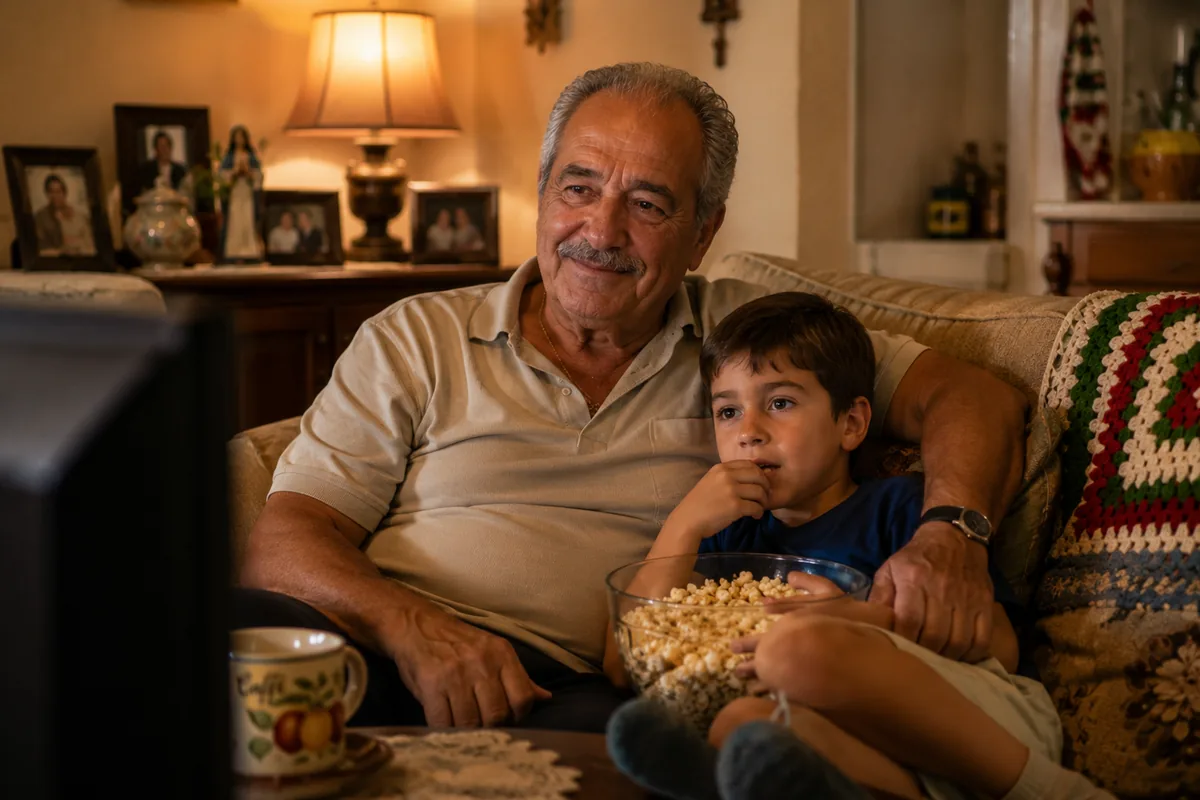
And then the afternoon siesta. This was sacred. The television went on — we watched the Flintstones together, which he loved as much as I did — and the house went quiet. The Italian afternoon break was not laziness. It was the architecture of a life that understood rest as part of the structure, not the absence of it.
The Flintstones, side by side, every afternoon. He never said it was our tradition. It just was.
These rituals — the garden, the park, the siesta — were not activities to fill time. They were the bones of a life built on the belief that showing up for the same things every day, quietly and without fanfare, is itself a form of love. He never missed. He never cancelled. The park was not a choice. It was where we went, because that is what a nonno does.
The things he said
An Italian nonno did not give advice often. But when he spoke, the words stayed with you for the rest of your life.
My grandfather’s lessons were not lectures. They were short, delivered once, and expected to be remembered. A few of them I carry every day:
Chi va piano va sano e va lontano. Whoever goes slowly goes healthily and goes far. Not “slowly gets there too” — the original says sano, healthily. The speed is not the point. The health is the point. You go slowly so you arrive whole, not just so you arrive. He lived this. Everything he did — the garden, the soppressata, the way he walked — had that unhurried certainty of a man who was not racing anyone.
“You wanted the bike — now pedal.” He said this to me when I told him I wanted to continue my education. Not to discourage me. To tell me that choosing something means owning the work that comes with it. You asked for this. Nobody made you. Now pedal. No complaints, no looking back. It was the most loving, most honest thing anyone could have said, and I have never forgotten it.
“Never buy cheap.” Not because he was wealthy — he was not. Because buying cheap meant buying twice, and buying twice was waste, and waste was the one thing a man who started with five dollars could not tolerate.
“Do it once. Do it right.” The companion to never buy cheap. Whether it was hanging a door, tying soppressata, or raising a family — you did it properly or you did not do it. There was no middle ground, because the middle ground was where things fell apart.
A note worth keeping — Italian grandfathers rarely explained their philosophy. They embedded it in action and in short, repeated phrases — proverbs worn smooth by use. The lesson was always the same: do things properly, don’t waste, don’t complain, and take care of the people in front of you. That was the entire system. It didn’t need a book. It needed a life lived in front of you.
The soppressata — his masterpiece
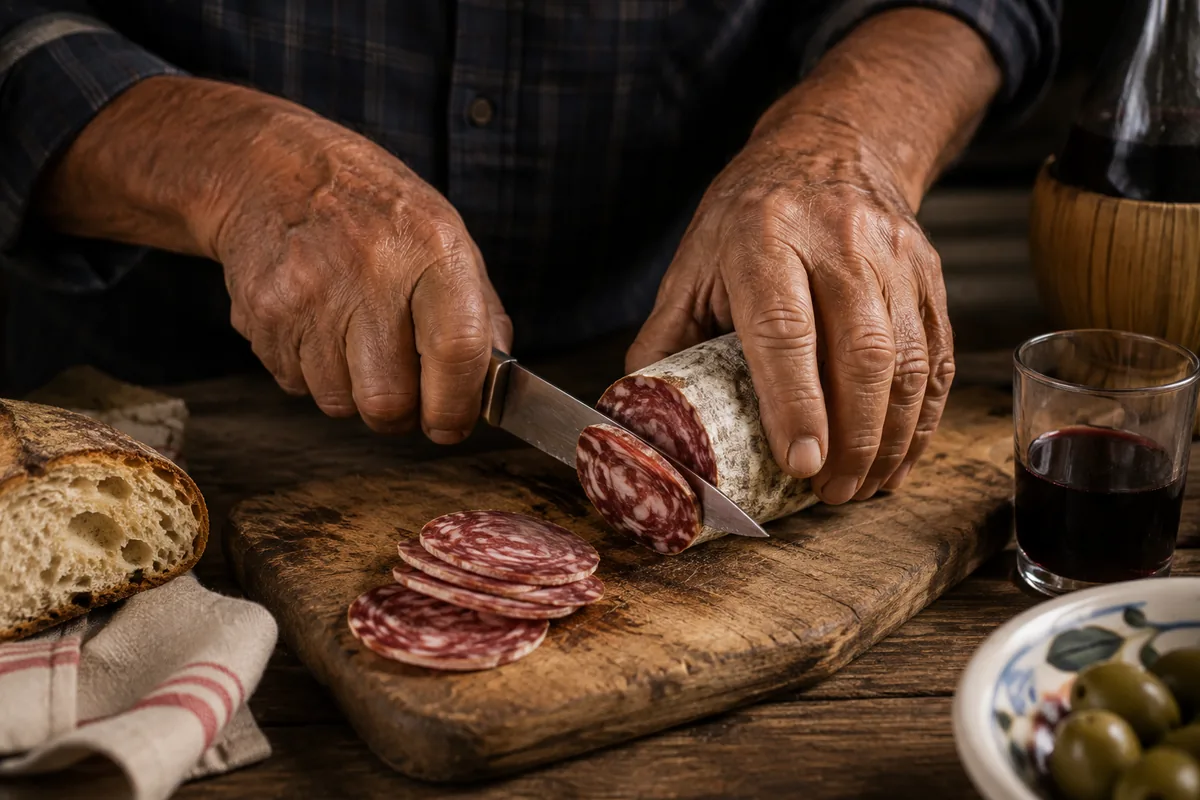
If you wanted to understand my grandfather completely, you only had to watch him make soppressata.
This was his passion. Not a hobby — a passion. He made it every year, and he made it until his very last days, because stopping would have meant admitting he was done, and he was never done. The precision he brought to it was extraordinary — every measurement exact, every casing tied with the same careful hand, every piece hung with the pride of a man presenting his life’s work.
And it was not just soppressata. Capocollo too, hung alongside it in the cantina, the room that smelled like the year’s work. Every day he checked on them. Every day he turned them, watched them, knew by touch and smell exactly where they were in the process. This was not cooking. This was craft — slow, exacting, inherited, and performed with a seriousness that made you understand the word artisan without ever hearing it.
When it was ready, he served it to the whole family. That was the point — not the making, but the giving. He cut it carefully, arranged it on a plate, and watched people eat it with a quiet joy that was the closest thing to sentimentality he ever showed. Nothing ever compared to his soppressata. Nothing. I have looked, and it does not exist elsewhere, because what made it taste like that was not the recipe. It was him.
He made soppressata until his last days. Not because he had to. Because stopping would have meant he was finished, and he refused to be finished.
The quiet presence
What made an Italian nonno powerful was not what he said or did. It was the fact that he was always, always there.
My grandfather did not give motivational speeches. He did not tell you he loved you in words. He told you by showing up — at the park, at the table, in the garden, beside you on the couch during the Flintstones. He told you by keeping a pen in his shirt pocket in case he needed to sign something, always ready, always prepared, always quietly in command of his own small world.
He told you by keeping you away from the wrong kids, by insisting you stay seated at dinner, by expecting respect not through fear but through the simple, accumulated weight of a man who had earned it. You respected him because his whole life was respectable — not glamorous, not loud, but built with a consistency that made everything around him feel solid.
That subtle smile. That welcoming, knowing face. He looked at you like he was glad you existed, and also like he knew exactly who you were going to become, and he approved, provided you kept your head on straight and didn’t buy cheap.
The nonno prayed to saints the way he lived — quietly, consistently, without show. Our printable Italian saint prayer cards carry eleven of the saints families like his turned to, each with a traditional prayer in Italian and English.
$9.49
Instant digital download
What he left behind
My grandfather lived long enough to meet his great-grandchildren. That sentence alone tells you everything about the life he built.
A man who left Calabria with five dollars, who worked the port until his body stopped him, who grew the garden and made the soppressata and pushed a little boy on the swings every day — that man lived to see the family he had started reach its fourth generation. My children met him. They remember him. They remember a kind, warm man who always had bags of cookies in his pockets to hand out, who smiled that same subtle smile at them, who was old and gentle and entirely himself.
That is what an Italian nonno leaves behind. Not money, usually. Not fame, ever. A family that remembers him as the foundation, the man who made the ground solid enough for everyone else to build on. The sayings. The garden. The soppressata. The standard. The quiet expectation that you will carry it forward, because he carried it forward, and the person before him carried it forward, and that is how a family works.
He did not tell you he loved you. He showed up at the park. He poured you the milk. He hung the soppressata. And that was love, in the only language he trusted.
Chi va piano va sano e va lontano. He went slowly. He went healthily. And he went very, very far.
In Summary
- The Italian nonno was the quiet foundation of the family — steady, present, unhurried
- He came with almost nothing — a ship, a suitcase, and the willingness to work
- He worked a blue-collar job and measured his worth in providing, not in titles
- His daily rituals — the garden, the park, the siesta — were acts of devotion, not leisure
- His sayings were few but permanent — chi va piano, never buy cheap, do it once do it right
- The soppressata was his masterpiece — made with precision, served with pride, never equalled
- What he left behind was not money but a family, a standard, and the expectation to carry it forward
FAQ
What does nonno mean in Italian?
Nonno is the Italian word for grandfather. It is used both as a title and a term of address — Italian grandchildren call their grandfather “Nonno” directly, the way English speakers might say “Grandpa.” The female equivalent is nonna, meaning grandmother. Together, the nonno and nonna formed the core of the extended Italian family.
What role did the Italian grandfather play in the family?
The Italian nonno was the quiet authority of the family — the provider, the moral backbone, and the keeper of standards. He typically worked a physical job, maintained the garden, made cured meats or wine, and passed down values through daily example rather than lectures. While the nonna ran the interior of the home, the nonno governed its outer structure and its principles. His presence was steady, consistent, and central to the family’s identity.
Why did so many Italian grandfathers immigrate to Canada and America?
The mass emigration from southern Italy in the 1950s and 1960s was driven by poverty, lack of opportunity, and the devastation of the postwar years. Men from Calabria, Sicily, Campania, and other southern regions left for Canada, the United States, and Argentina in search of work and a future for their families. Many arrived with almost nothing and built lives through decades of physical labour and sacrifice, sending money home until they could bring their families over.
What is chi va piano va sano e va lontano?
It is an Italian proverb meaning “whoever goes slowly goes healthily and goes far.” Often shortened to “chi va piano va lontano,” the full version emphasizes that the point of going slowly is not just to arrive, but to arrive well — healthy, whole, and intact. It was a favourite saying among Italian grandfathers, reflecting a worldview that valued patience, steadiness, and doing things properly over speed or shortcuts.
What did Italian grandfathers make in the cantina?
The cantina — the basement or cellar — was the Italian grandfather’s workshop. Common projects included making soppressata (a cured salami), capocollo, wine, and preserved vegetables like tomato sauce (passata). These were not hobbies but serious seasonal traditions, performed with precision and pride, and the results were shared with the entire family. Many Italian-Canadians and Italian-Americans remember the cantina as the room that “smelled like the year’s work.”
What do you remember about your nonno? The thing he made, the thing he said, the way he looked at you — share it in the comments. These are the memories worth keeping before they fade.

Marco Ricci is an Italian-Canadian writer and the grandson of Calabrian immigrants. He created Italian Family Traditions to document the customs, feast days, and family rituals Italian families carried from Italy to North America — and to understand what they actually meant. He is based in Montreal.