

Italian Family Traditions
Italian Invidia — Why Envy Was the Most Dangerous Thing in an Italian Family
They never said “don’t show off.” They said something more careful: don’t give people a reason. Don’t let them see too much. Don’t let anyone want what you have badly enough to do damage. In an Italian family, envy was not an emotion. It was a threat.
8 minute read
When my parents bought their first car — a red Jeep, the nicest thing they had ever owned — they told almost no one.
Not their friends. Not even their close family, not right away. They drove it home and parked it and said nothing. They did not post about it. They did not celebrate it. They were not embarrassed by it. They were protecting it — from something they understood instinctively, without needing a word for it, though the word existed and everyone in the family knew it.
Invidia. Envy.
In an Italian family, envy was not simply an unpleasant emotion that jealous people felt. It was an active force — something that could travel across a room, attach itself to the thing it admired, and do real harm. It could sour your luck. It could sicken a child. It could rot something from the inside. And the worst part was that the person doing the envying did not need to mean any harm at all. The envy itself was enough.
This belief shaped everything — what you said, what you showed, what you hid, and how carefully you listened to the things other people said to you. It was the invisible engine behind the malocchio, behind the cornicello, behind a hundred small daily habits that looked like superstition from the outside but felt, from the inside, like common sense.

The Short Version
In Italian culture, invidia (envy) was not just a sin — it was a danger. Italian families believed that other people’s jealousy could bring real misfortune, illness, and bad luck. This belief drove an entire system of protective behaviours: hiding good fortune, deflecting compliments, watching what neighbours said, and guarding children and new possessions from admiring eyes. It was the engine behind the evil eye (malocchio) and the reason Italian families lived with a caution that outsiders often mistook for secrecy.
What’s in this guide
- What invidia meant in an Italian family
- The art of hiding good fortune
- Why compliments were dangerous
- The watchers — what the neighbours said
- When envy was blamed
- The line between invidia and the malocchio
- Protecting the children
- What survives today
- FAQ
What invidia meant in an Italian family
Envy, in the Italian understanding, was not a private feeling someone kept to themselves. It was a force that left the body and landed on the thing it wanted.
The English word “envy” sounds almost mild — a character flaw, a minor sin. The Italian invidia carried more weight. It was understood as something that could do damage in the real world, not just in the envious person’s heart. When someone looked at what you had — your health, your child, your car, your home — with a desire sharp enough to feel, that desire was believed to carry consequences.
This was not a metaphor. Italian families genuinely operated as though envy had mechanical effects. It could bring illness. It could sour luck. It could damage the very thing it admired. And because the damage came not from malice but from the envy itself — from the intensity of the wanting — it could come from anyone, even people who loved you. A well-meaning compliment from a jealous heart was no safer than one from a stranger.
My grandmother talked about it openly. There was no taboo on the word. She would say, flatly, “I think this person is jealous” — geloso — the way you might say “I think it’s going to rain.” It was an observation, not an accusation. She was reading the weather, and the weather was other people’s eyes on your life.
The art of hiding good fortune
If envy was the threat, then the first defense was simple: don’t give it a target. Keep your good fortune quiet. Stay humble. Let no one see too much.
This is why my parents said nothing about the red Jeep. Not because they were ashamed of it, and not because they were modest by nature — but because showing it, celebrating it, letting the world see that something good had happened, was the same as opening a door and inviting the wrong thing through.
Italian families practised this constantly, in ways so subtle they became invisible:
You did not talk about money. You did not brag about your children’s achievements. You did not announce a promotion, a new house, a stroke of luck. If someone asked how things were going, the answer was always some version of “can’t complain” — never “things are wonderful.” Wonderful was a target. Wonderful was a red Jeep parked where everyone could see it.
Even small things were handled carefully. A new toy in the house when another child was visiting — my grandmother would notice and say something like, “You have this toy and he doesn’t. That’s not good.” Not because sharing was the issue. Because the disparity was the issue. The other child’s wanting was the thing that had to be managed.
Humility in an Italian family was not a virtue performed for God. It was a shield built against the neighbours.
Love these Italian traditions?
Get new stories about Italian customs, folk beliefs, and family traditions — plus our free printable calendar of the Italian year.
Why compliments were dangerous
In most cultures, a compliment is a kindness. In an Italian family shaped by invidia, a compliment was something to be handled very carefully — because behind it might sit the very envy you feared.
When someone complimented something you owned, the correct response was not “thank you.” The correct response was to immediately diminish the thing being complimented. “Oh, this? It’s not as good as you think. It actually doesn’t work that well. It breaks all the time.” You talked down your own possession — convincingly, instinctively — because the compliment had placed a spotlight on it, and the spotlight was where the danger lived.
My family did this so naturally it took me years to realize it was unusual. Someone admires the car? It’s giving us nothing but trouble. Someone says the house looks nice? You should see the problems. It looked like self-deprecation. It was defense.
And the eyes — my family was careful about the eyes during compliments. Never look someone directly in the eye when they are complimenting you, because the eyes were where envy entered. This was not a social nicety. It was protective behaviour, practiced without thinking, passed down without explanation.
Someone admires your car. You say it breaks down constantly. It doesn’t. But the compliment was more dangerous than the lie.

The watchers — what the neighbours said
In an Italian household shaped by invidia, guests were welcomed warmly — and then discussed the moment they left.
My grandparents were always on the lookout. When people came over — family, friends, neighbours — my nonna and nonno paid careful attention to what was said. Not suspiciously. Not rudely. They were gracious hosts. But afterward, when the guests had gone, the analysis began.
“Did you hear what she said?” my grandmother would say. “Be careful.”
She was reading the subtext. A compliment that lingered too long. A comment that carried a trace of bitterness. An admiring remark about the house, the children, the food that felt — to her finely tuned instinct — like it came from a place of wanting rather than warmth. She knew the difference. She had spent a lifetime learning it.
This was not paranoia, and it was not unkindness. It was the same vigilance that made her lock the door at night. The threats she watched for were simply different — not burglars but bad energy, not break-ins but the quiet corrosion of someone else’s unsatisfied desire landing on the things she loved.
The Italian nonna was the family’s first line of defense against many things — illness, hunger, disorder. But she was also the sentinel against invidia, the one who heard what others missed and acted accordingly.
When envy was blamed
When things went wrong — truly wrong, not just everyday trouble — envy was often where the family looked for an explanation.
My grandfather owned and managed an apartment building. When problems piled up — maintenance issues, difficult tenants, things breaking at the wrong time — he did not blame bad luck or poor timing. He blamed his cousins. They were envious of his property ownership, he said, and their envy was doing the damage. He had a funny, knowing way of bringing it back to that, every time, as if the building’s problems were not plumbing but people.
This might sound irrational from the outside. From inside the family, it made a strange kind of sense. Envy was the explanation for misfortune that had no other clear cause — the gap-filler between “something went wrong” and “I don’t know why.” In a world where bad things happened constantly and without warning, invidia provided a human face for random suffering. It was not the storm’s fault. It was someone’s eyes on your life.
A note worth keeping — Blaming envy for misfortune was not stupidity. It was a framework — a way of making sense of a world that offered very little control. If the cause of your trouble was someone’s envy, then at least the cause was knowable, human, and something you could defend against. Random bad luck offered none of those comforts. Invidia, for all its darkness, gave people something to do about their suffering.
The line between invidia and the malocchio
Invidia was the cause. The malocchio — the evil eye — was the effect. Understanding that connection is the key to understanding both.
The malocchio was not random bad luck floating in from nowhere. It was, specifically, the result of someone’s envy attaching itself to you. The envious look — the occhio, the eye — was the vehicle. The damage it caused was the malocchio. Every protective measure — the cornicello horn, the hand gestures, the oil-in-water diagnostic ritual — existed because invidia existed. Without the belief in envy’s power, none of the rest would have been necessary.
In my family, the connection was explicit and understood. Invidia was the weather. The malocchio was the storm. And when the storm hit hard enough — when it was aimed at a baby, a child, someone vulnerable — my grandmother performed the oil ritual, dropping olive oil into water and reading the pattern to determine whether the evil eye was present. This was the serious medicine, reserved for the cases where the usual deflections — the diminished compliments, the averted gaze — had not been enough.
The malocchio was not random. It was personal. Someone envied you, and the envy found its way in. That was the whole system.
Protecting the children
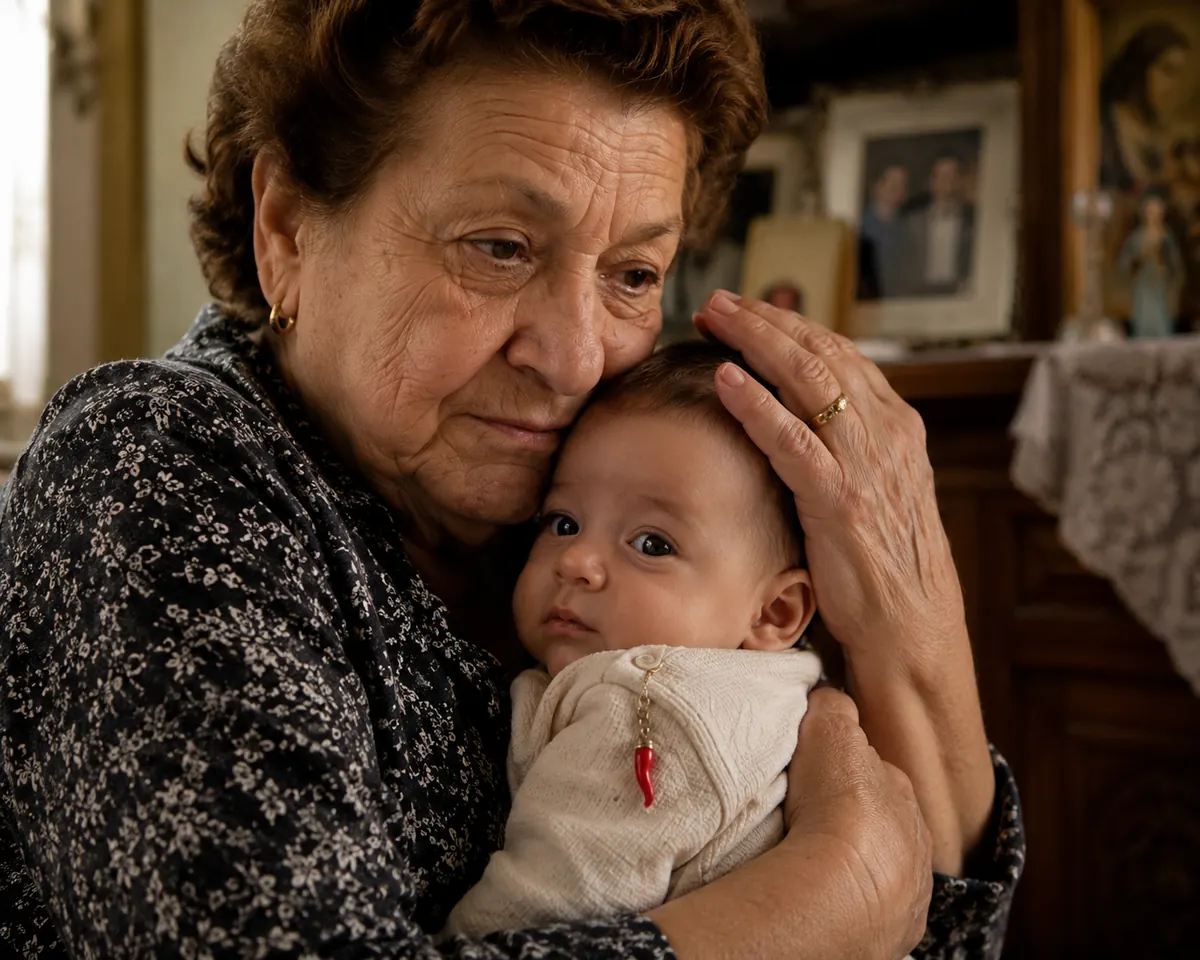
Nowhere was the fear of invidia stronger than around babies and young children — because nothing attracted envy more than a beautiful, healthy child.
When visitors admired a baby — “What a beautiful child!” — an Italian grandmother did not beam with pride. She tensed. A too-admiring remark about a baby was exactly the kind of attention invidia fed on, and she watched for it with the sharpness of someone guarding something irreplaceable.
The defenses were layered. A cornicello pinned to the baby’s clothing. A careful deflection — “Oh, he cries all night, you wouldn’t believe it.” And if the compliment came from someone whose envy the grandmother suspected, the oil ritual might follow that same evening, just to be safe. Children could not protect themselves. That was the grandmother’s job, and she did not take it lightly.
This is the part of Italian culture that outsiders find hardest to understand — the idea that admiring a baby could be dangerous. But inside the system, it was perfectly logical. The baby was the family’s most precious and most vulnerable thing. Envy was the most dangerous force. Of course you guarded one against the other. What kind of family wouldn’t?
The saints were part of the same protective system. When envy threatened, Italian families turned to prayer and to the saints who watched over them. Our printable Italian saint prayer cards carry eleven of those saints — each with a traditional prayer in Italian and English.
$9.49
Instant digital download
What survives today
The world has changed. The belief in invidia, in many families, has softened. But the behaviours it created are still there — running quietly beneath the surface, shaping how Italian families move through the world.
You still hear it. A second-generation Italian-Canadian buys a new house and waits a while before telling people. A mother deflects a compliment about her child with a quick, instinctive downplay. A family celebrates privately before announcing publicly. The word invidia may not be spoken, but its grammar is still in the language — the hesitation before sharing good news, the reflex to diminish rather than display.
And the deeper instinct behind it — the understanding that other people’s desire can be a force in your life — is not entirely wrong. Envy does corrode relationships. Jealousy does change how people treat you. The Italian system may have given it a mystical mechanism (the evil eye, the oil ritual), but the observation underneath was human and real: be careful with what you show the world, because not everyone who looks at you wishes you well.
My grandmother knew this. She knew it not because she had read it, but because she had lived long enough to see what happened when people forgot it. The red Jeep that nobody was told about — that was not shame. It was wisdom, inherited from a woman who understood that the safest fortune is the one nobody knows about.
The safest fortune is the one nobody knows about. My family didn’t learn this from a book. They learned it from living.
In Summary
- Invidia (envy) was understood as an active force that could bring real misfortune — not just a feeling
- Italian families hid good fortune instinctively — no bragging, no displaying, no giving envy a target
- Compliments were deflected by immediately diminishing the thing being praised
- Guests were watched — grandparents listened for suspicious comments and discussed them privately afterward
- Misfortune was sometimes blamed on envy — giving unexplained bad luck a human, knowable cause
- Invidia was the engine behind the malocchio — envy was the cause, the evil eye was the effect
- Children were guarded most fiercely — a beautiful baby attracted envy, and the grandmother stood between them
FAQ
What does invidia mean in Italian?
Invidia is the Italian word for envy. In Italian folk culture, it carried far more weight than the English word suggests — it was understood not just as a feeling but as a force capable of causing real harm. Italian families believed that another person’s envy could bring illness, bad luck, and misfortune to the person or thing being envied, even without malicious intent.
What is the connection between invidia and the malocchio?
Invidia (envy) is the cause; the malocchio (evil eye) is the effect. The evil eye was believed to be transmitted through an envious look — the eye of someone who wanted what you had. All the protective measures in Italian folk culture — the cornicello horn, the hand gestures, the oil-in-water ritual — existed specifically to guard against the damage caused by other people’s envy.
Why do Italian families downplay their success?
The tradition of staying humble and not displaying good fortune is directly tied to the fear of invidia. Italian families learned to keep success, new purchases, and good news quiet — not out of shame, but out of protection. Displaying good fortune was believed to attract envy, and envy could bring harm. The instinct to downplay and deflect remains strong in many Italian and Italian-diaspora families today.
Why do Italians deflect compliments?
In the invidia tradition, a compliment placed a spotlight on something valuable — and that spotlight could attract envious attention. The instinctive Italian response was to diminish the thing being praised: “It doesn’t really work that well,” “It’s nothing special.” This deflection was not false modesty but a protective habit, designed to remove the target before envy could attach to it.
Is the belief in invidia still common among Italians?
The explicit belief in envy as a supernatural force has faded in many families, especially among younger generations. But the behaviours it created — staying humble, deflecting compliments, being cautious about sharing good news, guarding children from excessive admiration — remain deeply embedded in Italian and Italian-diaspora culture. The instinct has outlasted the belief that originally explained it.
Did your family guard against invidia? The things they kept quiet, the compliments they deflected, the post-visit conversations about what the neighbours really meant — share it in the comments. These instincts are worth understanding before they fade into habit without memory.

Marco Ricci is an Italian-Canadian writer and the grandson of Calabrian immigrants. He created Italian Family Traditions to document the customs, feast days, and family rituals Italian families carried from Italy to North America — and to understand what they actually meant. He is based in Montreal.