
Italian Family Traditions
The Cornicello: What the Italian Horn Really Means (and Why It’s Never Just Jewellery)
The Italian horn — the cornicello — was the gold one your grandmother wore every single day, the one she hung in your first car, the small charm passed down with more feeling than explanation. This is what the Italian horn actually means: where it comes from, why it protects against the evil eye, why it must be given rather than bought, and why, generations later, so many of us still won’t drive without one.
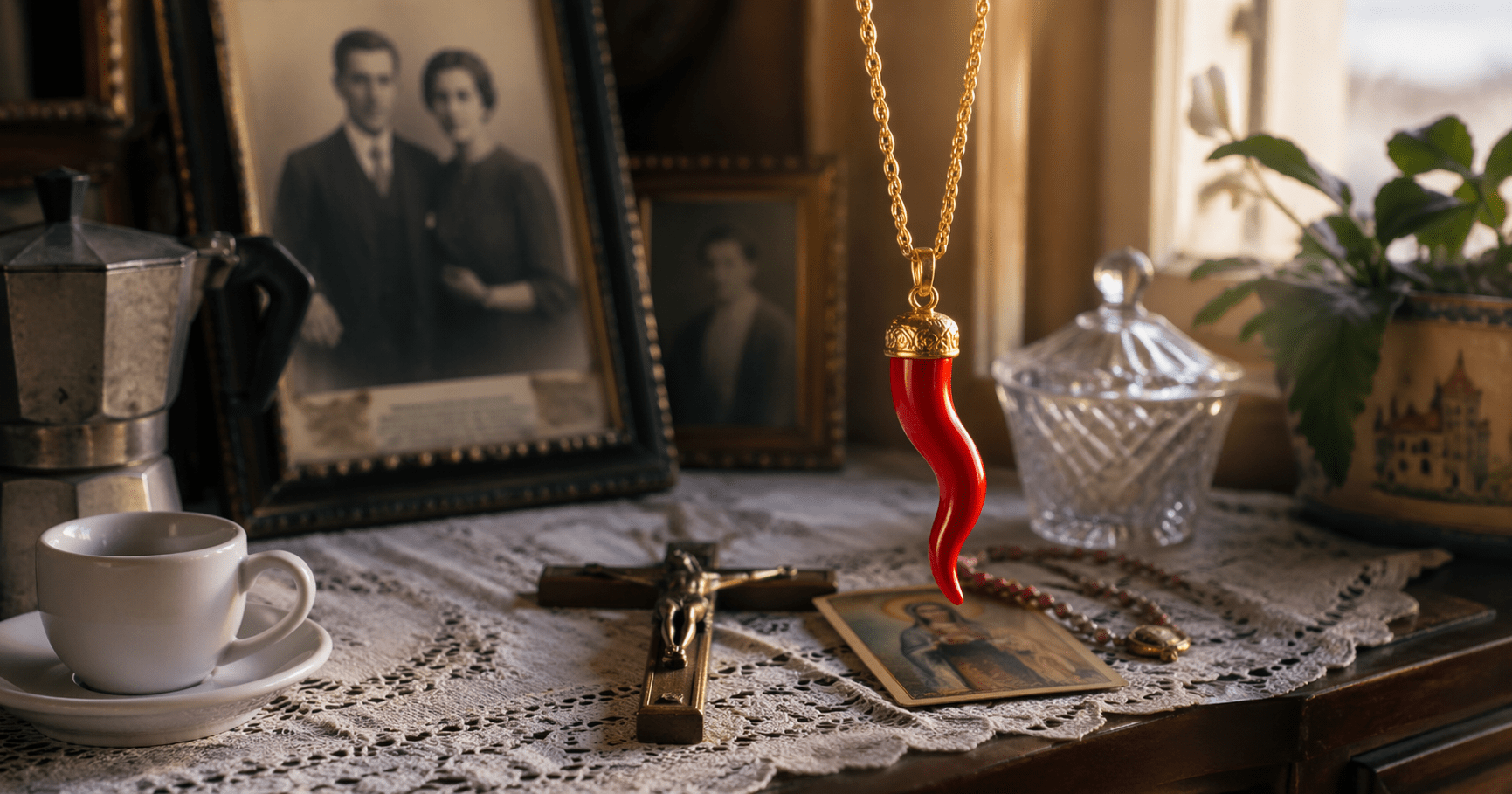
My grandmother always wore one made of gold. Not sometimes. Not on special occasions. Always. It was just part of her — part of her neck, part of her daily presence, part of the visual vocabulary of who she was in the same way her hands and her voice were. If you saw her without it something would feel missing, the way something feels missing when a familiar landscape changes overnight. To her, it was not random jewellery. It was not decoration. It was protection. It was luck. It was one of those small objects older Italian women carried because family instinct, accumulated over generations in places that understood what vulnerability felt like, told them it mattered.
When I got my first car — a Honda Civic that had clearly lived several lives before becoming mine — she hung a cornicello from the rear-view mirror before I had driven it once. Not a suggestion. A decision. The car was old and slightly suspicious and the Montreal winter was going to be hard on both of us, and she was assigning it a guardian because that was what you did. You protected the things and people you loved with whatever tools were available to you. The cornicello was one of those tools. It had always been one of those tools.
The superstition is there, yes. But underneath it is love. That is probably the most Italian thing about the cornicello — even the protective charm turns out to be an act of care.
That is what this article is really about. Not the object in the tourist shop window, though that version exists and is perfectly legitimate. The other version — the one that hung around a grandmother’s neck for sixty years, the one given at baptisms as a first gift, the one found in a drawer after someone dies and immediately understood by everyone in the family as something that cannot be thrown away. That cornicello. The one that carried care in object form.
Free Printable
The whole Italian year of traditions, on one printable calendar.
The feast days, the saints, the protective traditions like the cornicello — in one free printable calendar. Join the list and we’ll send it to you.
What the cornicello actually is
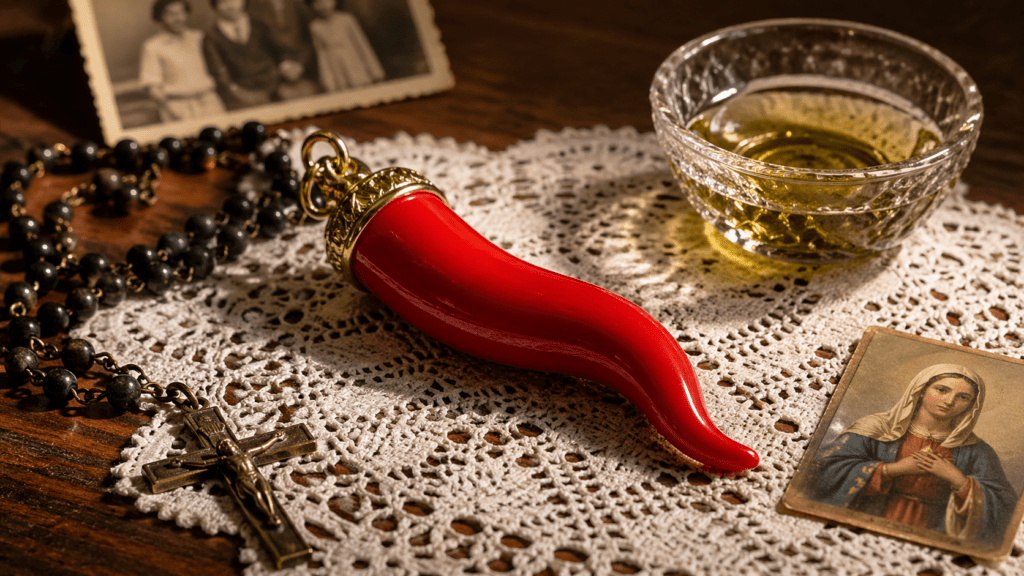
At the most basic level, the cornicello — the Italian horn, or corno portafortuna (“lucky horn”) in Italian — is a small horn-shaped amulet worn or hung for luck, protection, and defense against the evil eye. It is especially tied to Naples and Neapolitan tradition, and in English it is most often simply called the Italian horn. That is the clean answer. The warmer answer is that it belongs to a whole world of Italian protective habit — the same world that produced malocchio, the hand gestures made under the table when something felt wrong, the specific prayers only certain older women knew, and the deeply Italian conviction that some forces in the world are hostile and that small acts of protection against them are not foolishness but wisdom.
The word itself is diminutive: corno means horn, cornicello means little horn. That smallness is part of the point. The charm is meant to be worn close to the body, tucked against the skin under a collar, hanging from a chain that rarely comes off. It is intimate rather than decorative. It does not announce itself. It works quietly.
My grandmother also used to tell a story about how the cornicello had helped her during a hard time back in Italy. She was not a woman who talked about things like this often or with any drama. She mentioned it once, when I was old enough to ask questions, and she said it with the quiet certainty of someone describing something they had personally witnessed. The message was never “and that is why you must believe in it too.” The message was “this is what happened to me and this is what I know.” I did not argue. You do not argue with that kind of certainty from a woman who had survived immigration, raised a family in a new country, and worn the same gold cornicello for fifty years without once leaving it at home by mistake.
The connection to malocchio — why protection was necessary
The cornicello does not exist in isolation. It exists within a whole system of Italian belief about vulnerability, envy, and the specific harm that attention — even admiring attention — can do to people and things that matter.
That system has a name: malocchio. The evil eye. The harmful power of a gaze — not necessarily malicious, sometimes simply too intense, too envious, too full of desire for what the other person has. In Italian folk belief, this kind of attention could cause real harm: headaches, bad luck, illness, a run of events that felt wrong in a way that had no obvious explanation. The cornicello was one of the primary defenses against it.
Understanding this connection changes how the cornicello reads. It is not a charm against vague general misfortune. It is a specific defense against a specific understood threat — the threat of envious attention from the people around you. In communities where everyone knew everyone’s business, where success and good fortune were visible and comment-worthy, where the phrase non fare sapere le cose — don’t let people know your business — was practical wisdom rather than paranoia, having a physical talisman against the harmful gaze made complete cultural sense.
The cornicello was not optional in my grandmother’s understanding of how protection worked. The malocchio was real. The charm was the answer. That was the complete logic and she had lived inside it her entire life.
Why Naples — and why that matters
The cornicello is often described as broadly Italian, and in practice it spread widely through southern Italy and into Italian-Canadian and Italian-American communities across North America. But its heart and its origin are specifically Neapolitan, and that specificity carries meaning.
Naples has always had its own relationship with protective objects, folk belief, and the management of unseen forces. The city produced one of the most elaborate and sustained traditions of amulet-making in Europe, a tradition that sat comfortably beside Catholic devotion without being in conflict with it — the cornicello and the crucifix often hanging from the same chain, serving different but complementary functions.
The craft tradition is worth knowing specifically. The town of Torre del Greco, a small coastal community southeast of Naples that sits at the foot of Vesuvius, became the world center of coral carving over several centuries. Neapolitan artisans from Torre del Greco produced cornicelli in red coral that were traded throughout Italy and eventually exported across the world. The specific deep-red Mediterranean coral they worked with — harvested from the Tyrrhenian and Sardinian seas — was considered the finest material for protective charms because of its color, its density, and its specific connection to the sea and to life force. When you see a traditional red coral cornicello, you are looking at the product of a craft tradition that ran continuously in one specific place for hundreds of years. That is not a tourist trinket. That is a cultural artifact with a very specific address.
My grandmother was not from Naples. Her family came from a different part of southern Italy entirely. But the cornicello had traveled — as these objects do — across regional lines in the way that the most durable protective traditions tend to travel. By the time it reached her family it had been Neapolitan in origin and southern Italian in practice for long enough that the distinction no longer mattered. It was simply what you wore. It was simply what you gave. The geography of its origin had been absorbed into something larger: the general Italian understanding that some things need protecting and that a small gold horn is one of the ways you say so.
The cornicello and other Italian protective objects
The cornicello was never the only tool in the Italian protective tradition. It existed within a whole ecosystem of objects, gestures, and charms that served related but distinct purposes. Understanding where it sits within that system helps explain both its specific function and why it became the most portable and most gifted of all the protective objects.
| Object or gesture | What it was | What it did |
|---|---|---|
| Cornicello | Small horn-shaped charm in coral, gold, silver, or terracotta | General protection and luck; defense against malocchio; worn daily or hung in the home and car |
| Mano cornuta | Hand gesture or amulet — index and little finger extended | Active deflection of the evil eye in the moment; made when something felt wrong or a compliment landed strangely |
| Mano fica | Hand gesture — thumb between index and middle finger | Protection and warding off; older than the mano cornuta and connected to fertility symbolism |
| Cimaruta | Silver charm in the shape of a rue branch with multiple symbols | Complex protective function combining multiple folk symbols; specifically Neapolitan and relatively rare outside Naples |
| Saint’s medals | Small medals bearing the image of a patron saint | Devotional protection through the intercession of a specific saint; Catholic in origin and meaning |
| Oil and water ritual | Diagnostic and healing ritual using olive oil in water | Identification and removal of malocchio once it had already occurred; performed by older women with specific knowledge |
The cornicello’s advantage over most of these was its portability and its giftability. A mano cornuta gesture could not be given. An oil and water ritual required specific knowledge and a specific person to perform it. The cimaruta was regionally specific and relatively rare. The cornicello could be worn on a chain, hung in a car, placed in a crib, given at a baptism, tucked into a pocket. It was the most democratic and most mobile of the protective objects — which is one reason it survived immigration when others did not, and why it is still recognizable to Italian descendants whose grandparents could not have told you what a cimaruta was but always had a cornicello somewhere on their person.
The cornicello for newborns — the first gift before speech
One of the most emotionally resonant applications of the cornicello tradition — and one that connects it directly to the broader Italian instinct to protect vulnerable new life — is the giving of a cornicello to a newborn baby.
In Italian and Neapolitan tradition, newborns were considered especially vulnerable to malocchio. The same logic that made babies the primary targets of the evil eye’s harm — their visibility, their beauty, the intensity of the attention directed at them by admiring visitors — made them the primary recipients of protective objects. A new baby in an Italian family attracted a specific quality of attention: the crowds of relatives and neighbors, the exclamations about how beautiful the child was, the reaching hands, the admiring gazes. All of that attention, in the Italian folk understanding, was precisely the kind that needed counteracting.
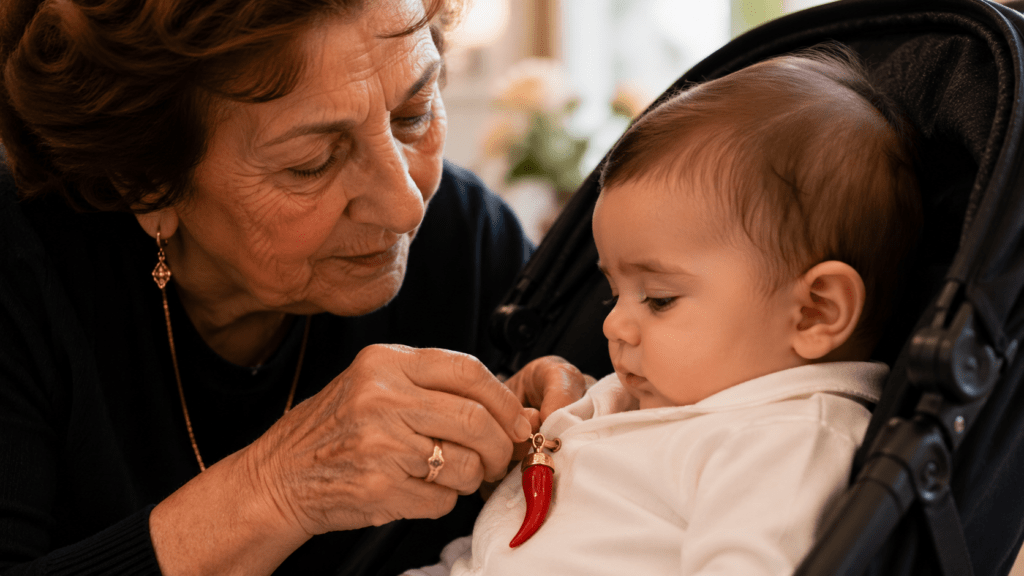
The cornicello was often the first protective object placed near a newborn — in the crib, on the first chain the baby would wear, tucked into the baptism outfit. It was almost always given by the grandmother or the godmother, the women who held protective knowledge in Italian family life and understood that the moment of arrival was also the moment of maximum vulnerability. The child could not yet ask for protection. The women who loved them provided it without being asked.
When my cousin’s first child was born, my aunt — the grandmother — arrived at the hospital with a small gold cornicello on a delicate chain. The baby was three hours old. My aunt had been carrying the cornicello in her purse for two weeks, since the due date was approaching, ready to give it at the first opportunity. She placed it near the baby — not on the baby yet, too small and too new for that — but near her, in the crib, as a gesture of intention. This is now protected. This one is under care. My cousin later had it made into a bracelet sized for a small child. The baby wore it at her baptism. That chain of objects — grandmother to crib to baptism bracelet — is the cornicello tradition doing exactly what it was designed to do: marking the arrival of someone precious and surrounding them with the family’s understanding of what protection means.
This is why the cornicello appears so frequently at Italian baptisms alongside the silver gifts, the bomboniere, and the white gown. It is the protective gift — the one that says not “welcome to the family” in a social sense but “welcome to the world, and here is the first thing the family gives you to help you survive it.” That is a profound act of love expressed through a small object. It is also one of the clearest demonstrations of how Italian family culture understood the relationship between love and protection as the same thing.
What the shape meant — and why it was always a horn
The horn shape is not accidental and it is not arbitrary. Horns have been associated across Mediterranean cultures with strength, vitality, fertility, and — critically — with the power to deflect harm. An animal with horns is not passive. It is armed. The horn is a defense mechanism that exists in the natural world, and the symbolic logic of borrowing that defense mechanism for a protective charm is not difficult to follow.
The specific shape of the cornicello — twisted, tapered, pointing in a specific direction — is also connected to the mano cornuta, the horned hand gesture made by extending the index and little finger, which served a similar protective function in the same folk tradition. The gesture and the charm shared a symbolic vocabulary. Both said, essentially: I am not defenseless. I know what is out there and I have something to answer it with.
That is why the cornicello never looked soft or decorative even when it was made of delicate materials. It looked like it meant business. A tiny red horn is not a subtle statement. It is basically saying, out loud in the language of objects, that you are protected today and the protection is visible.
The materials — what they meant and what they carried
| Material | Color significance | What it carried | When it was used |
|---|---|---|---|
| Red coral | Red — blood, life force, the Mediterranean sea. The most protective color in Italian folk tradition. | The most traditional and specifically Neapolitan material. Connected to the Torre del Greco craft tradition. | The classic gift; formal occasions; families with strong southern Italian roots |
| Gold | Gold — lasting, warm, personal. The color of something worn every day without question. | The everyday version. The one that becomes inseparable from the person wearing it. Found in drawers after people die. | Daily wear; personal protection; the grandmother’s version |
| Silver | Silver — clarity, purification, elegant restraint. | Often given at baptisms alongside other silver gifts. More formal and devotional in feeling than gold. | Baptism gifts; confirmations; formal occasions |
| Terracotta | Earth tones — humble, regional, connected to the land. | The working-class version hung in doorways, kitchens, and workshops rather than worn on a chain. | Home protection; workshops and businesses; the non-jewellery version |
| Plastic and resin | Usually bright red — visible, practical, cheerful. | The democratic version. Does its job without anyone worrying about losing something valuable. | Cars; children’s rooms; anywhere the gold would be at risk |
Red became the iconic color for reasons that go beyond aesthetics. Red has been tied to protection, force, and life across Mediterranean cultures for centuries. In Italian folk tradition specifically, red was connected to blood and to the life force that blood represents — which made it the natural color for an object meant to protect that life force against harm. The red coral cornicello from Torre del Greco was not merely a color choice. It was a symbolic statement made visible in the most direct material available.
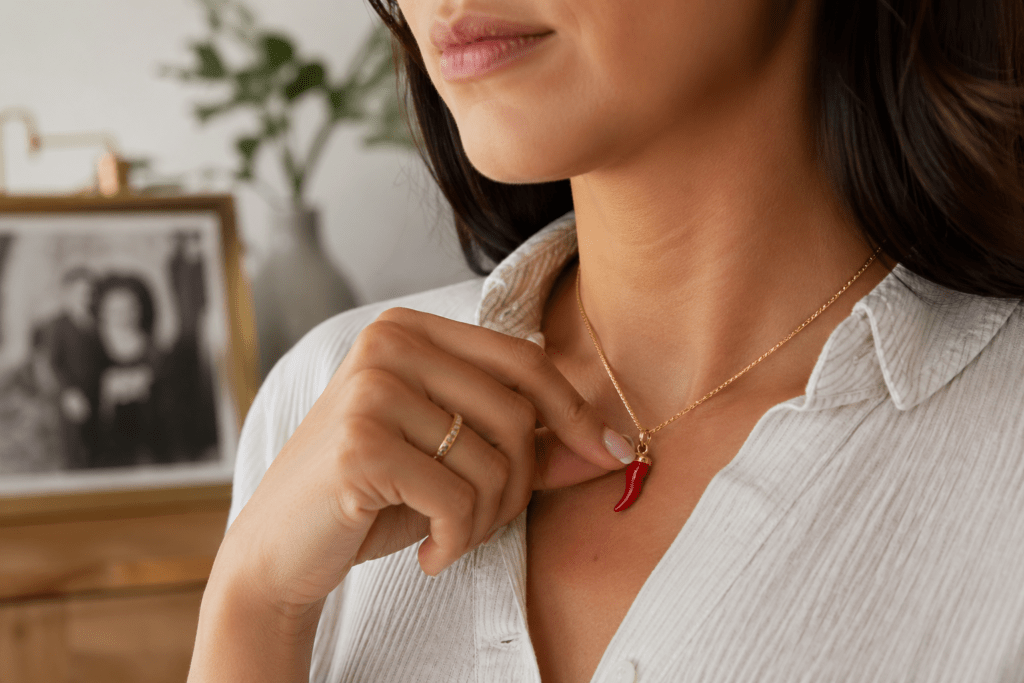
Gold was different in character — not bold but personal. The gold cornicello was the one worn every day, close to the skin, for years or decades. It accumulated presence the way that a wedding band accumulates presence — not through display but through continuity. When my grandmother wore hers, it was not an accessory. It was her. Removing it would have felt like removing something essential rather than something decorative.
When she died, the gold cornicello was one of the first things the family talked about. Not in a mercenary way — in the way families talk about objects that have absorbed the presence of a person over many years and are now impossible to regard as ordinary possessions. It went to my mother. My mother wears it now, not every day but on days that feel significant, and when she puts it on it is explicitly and consciously an act of connection. Not to luck exactly. To her mother. To the chain of women in the family who wore protective objects and believed in care expressed through small gold things and lived their whole lives without ever finding that belief embarrassing.
Why it should be a gift — the tradition behind the giving
There is a widespread Italian belief — one of those family-transmitted convictions that does not appear in any official doctrine but is observed by the people who actually keep these traditions alive — that a cornicello works best when it is given rather than purchased for oneself.
The logic is almost heartbreakingly simple: an object given in love carries that love with it. The person who gave it wanted you protected. That wanting is in the object now. The charm is made of their care as much as it is made of gold or coral or silver. This is why receiving a cornicello from a grandmother feels different from buying one in a shop. Both objects may be identical in physical terms. They are not identical in what they carry. One carries a transaction. One carries fifty years of the grandmother’s specific understanding of what the world is like and what you need to survive it.
The occasions for giving cornicelli in Italian family life were specific and meaningful — baptisms, first communions, weddings, the arrival of a new baby, the purchase of a first home or first car, a journey, a significant transition. Each of those moments is a moment of vulnerability — the person is arriving somewhere new, taking on something new, becoming exposed to new categories of attention and envy. The cornicello was the family’s way of accompanying them into that exposure with something protective in hand.
The cornicello in Montreal’s Italian community
In Montreal’s Italian community — centered first in Little Italy around Saint-Laurent and Dante, then spreading outward to Saint-Michel and Rivières-des-Prairies — the cornicello functioned as part of the broader fabric of Italian protective and devotional life that the community brought from the old country and maintained in the new one.
The Italian jewellers on Saint-Laurent and in the surrounding streets of Little Italy sold cornicelli alongside saint’s medals, gold chains, and religious objects. They were bought as gifts for newborns, as baptism presents, as wedding accompaniments, as the specific small protective object that Italian families gave each other at moments of transition and vulnerability. The shops knew what they were. The families knew what they were buying. The tradition moved through the commercial life of the neighborhood in the same quiet, consistent way it moved through the family life of the households it served.
As families moved outward from Little Italy — to Saint-Michel, to Rivières-des-Prairies — the cornicello traveled with them. It did not require a specific neighborhood to function. It required only the family habit of giving it, which proved more durable than the neighborhood itself. By the time Italian-Canadian families had dispersed across the greater Montreal area, the cornicello was thoroughly domesticated — no longer bought at the specific shops on Saint-Laurent but still appearing at baptisms, still hanging from rear-view mirrors, still worn on chains by women who had received theirs from their mothers and would give them to their daughters in turn.
I drove that Honda Civic for four years. It gave me no significant trouble. I am not claiming the cornicello is why. But I noticed, every time I got in the car, that it was there. Swinging slightly when I closed the door. Red against the grey of a Montreal winter morning. And every time I noticed it I thought of my grandmother — not abstractly, not as a general feeling of family connection, but specifically: her hands hanging it there, the particular expression on her face that meant she had done what needed to be done and that was that. The charm reminded me of her every day for four years. Whatever else it did or did not do, that was not nothing. That was, in fact, exactly what she would have wanted.
What changed after immigration — living preservation
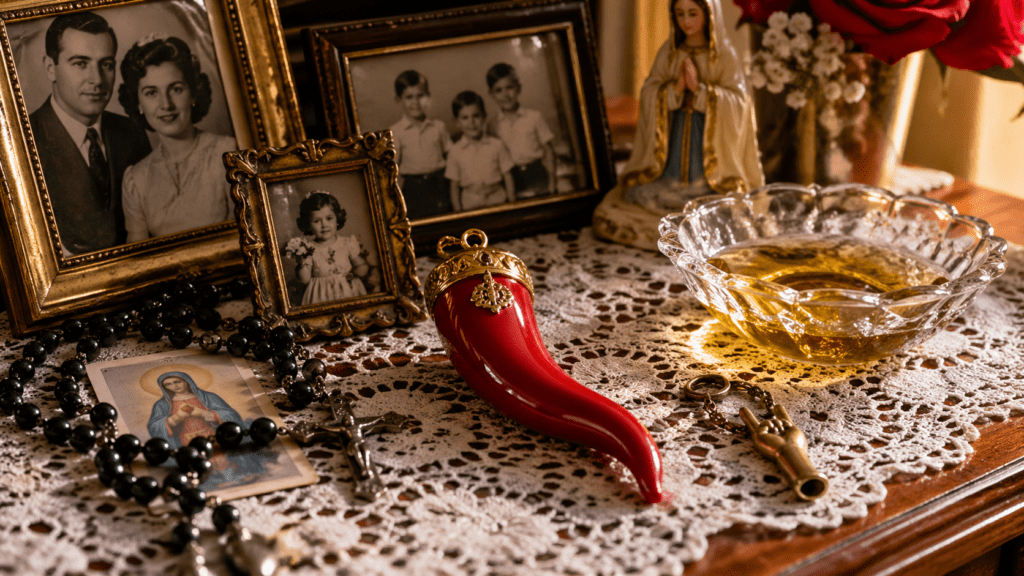
The cornicello traveled well across the ocean. Better than many Italian traditions, partly because it was small and physical and required no translation, and partly because the thing it addressed — the fear of bad luck, envy, and unseen harm — did not become less relevant when the address changed.
In North America, the charm often became more visible as jewellery and gift-giving and less visible as serious folk magic. The full explanation thinned across generations. The phrase became something like “nonna said it brings luck,” which is not wrong but is much shorter than the original reasoning. The deep connection to malocchio and the specific Neapolitan protective tradition was not always transmitted in full. What was transmitted was the object, the habit of giving it, and the emotional logic underneath: this is how you say “I want you protected” in Italian family language.
That is not a diminished version of the tradition. It is a different version — the diaspora version, the version that traveled and adapted and survived by shedding some of its original explanation while keeping its original feeling. The feeling is what survives. The feeling is what matters. This is part of the larger story of Italian-American and Italian-Canadian traditions after immigration — what gets carried, what gets simplified, and what proves durable enough to survive even when the community context that once supported it has changed entirely.
Finding or choosing a cornicello today
Many people who finish reading about the cornicello want to find one — either for themselves or as a gift for someone they love. Here is what to look for and how to think about the choice.
- For daily wear — gold or silver on a fine chain. Look for a cornicello that is small enough to be unobtrusive and light enough to forget you are wearing it. That forgetting is the point. The best cornicelli are the ones that become part of the person so gradually that removing them would feel strange.
- For a baptism or newborn gift — gold or silver, small enough for a baby, and ideally on a chain fine enough to be resized as the child grows. Many Italian jewellers will size a cornicello chain specifically for a baby and then again for a child. The tradition of the cornicello traveling with the person as they grow is part of its meaning.
- For a car or home — the classic red resin or plastic version is perfectly appropriate. It does not need to be expensive. It needs to be red and horn-shaped and present. The car cornicello is the most democratic application of the tradition and there is no status hierarchy implied in choosing plastic over coral for the rear-view mirror.
- For the authentic traditional version — look for red Mediterranean coral from Torre del Greco, or hand-crafted gold versions from Neapolitan jewellers. These are significantly more expensive than mass-produced versions and worth it for a significant gift. The craft tradition is still alive in Naples and the quality of a genuine Torre del Greco coral cornicello is immediately apparent.
- The difference between quality and tourist — a quality cornicello has a specific twisted taper that is consistent and deliberate. A tourist version is often more generic in shape, smoother, and lacks the specific asymmetry of the traditional form. In gold, weight is a reasonable guide — a quality gold cornicello has presence in the hand. In coral, color depth and surface texture distinguish authentic coral from dyed resin.
- The gift question — if you are buying one for yourself, buy it without guilt. The tradition that says it works better as a gift is exactly that — a tradition, not a rule. The feeling behind a self-purchased cornicello is still valid: I want protection, I know what this object means, I am choosing to carry it. That intention counts.
The gold cornicello is on my mother’s neck now on the days that feel significant — anniversaries, the feast days that meant something to her mother, the mornings when she needs to feel less alone in whatever she is carrying. When she puts it on she is not thinking about luck in any abstract sense. She is thinking about my grandmother. About the fifty years the charm spent against that particular neck before it arrived at hers. About what it means to receive something from a person who is no longer here and to keep it going, to add your own years of wearing to the years already in it, to become the next custodian of something that was never only jewellery.
That is the cornicello. Small enough to fit in a palm. Weighted with everything the family believed about protection, care, and keeping the people you love from harm’s way. It carries them all — the grandmother who wore it, the mother who received it, and everyone down the line who will understand, when they are handed it someday, that this is not decoration.
This is care in object form. And in Italian family life, that has always counted for everything.
For the full story of what the cornicello was protecting against, read what malocchio is and how Italian families understood the evil eye. For the tradition of giving cornicelli at baptisms alongside silver gifts and bomboniere, read Italian baptism traditions. And for the broader story of how Italian protective folk customs survived immigration, read Italian-American traditions: what changed and what stayed.
The Beliefs Worth Keeping
Record your family’s traditions, charms & protections.
The cornicello, the malocchio prayers, the person who knew the cure — these beliefs disappear when no one records them. The Italian Family Heritage Kit includes 133 guided pages and more than 120 prompts to preserve your family’s traditions, names, saints, recipes, sayings, and stories.
Explore the Heritage Kit — $19.99Instant digital download. Print it and complete it with your family.
The cornicello belongs to the same world of Italian protective belief as the malocchio, the evil eye, and invidia, the envy Italians feared. For the saints families also turned to for protection, read about the saints every Italian family prayed to, and to record the beliefs your own family carried, read how to record family stories before they’re lost.
FAQ
What is the cornicello?
The cornicello is a small Italian horn-shaped charm worn or hung for luck, protection, and defense against the evil eye — particularly against malocchio, the harmful power of an envious or hostile gaze. It is especially tied to Naples and the Neapolitan craft tradition centered in Torre del Greco, though it spread through southern Italy and into Italian-Canadian and Italian-American communities across North America. The word means “little horn” and that smallness is part of the point — it is meant to be worn close to the body, given in love, and kept for years.
What does the Italian horn mean?
The Italian horn — the cornicello — means luck, protection, and defense against bad energy, envy, and the evil eye. The horn shape connects to older associations with strength, vitality, and the power to deflect harm — an animal with horns is armed, not passive, and the symbolic logic of borrowing that defense for a protective charm is direct. In the broader Italian folk tradition, the cornicello shares its symbolic vocabulary with the mano cornuta gesture, both saying: I am not defenseless, and the protection is visible.
Is the cornicello the same as the evil eye?
No — and the distinction matters. The cornicello is not the evil eye. It is a protective charm used against the evil eye. Malocchio — the evil eye — is the harmful power believed to come from an envious, hostile, or overly intense gaze. The cornicello is one of the primary defenses against it. They are on opposite sides of the same tradition: malocchio is the threat, the cornicello is the answer. The blue evil eye bead (nazar), common in Greek and Turkish traditions, is also often confused with the cornicello — the nazar is an eye symbol meant to reflect the evil eye back, while the cornicello is a horn symbol meant to deflect harm through strength.
Is the cornicello from all of Italy or mainly Naples?
The cornicello is often described as broadly Italian and in practice it spread widely through southern Italy and the Italian diaspora. But its heart and origin are specifically Neapolitan. Naples — and particularly the town of Torre del Greco, the world center of coral carving — produced the most elaborate and sustained tradition of cornicello-making. The specific red Mediterranean coral that Torre del Greco artisans worked with for centuries is the material of the most traditional and culturally significant versions of the charm. When an Italian-Canadian or Italian-American family wears a cornicello today, they are carrying a piece of Neapolitan craft tradition, whether they know it consciously or not.
Why is the cornicello usually red?
Red has been associated with protection, force, and life across Mediterranean cultures for centuries — it signals active presence rather than passive hope. In Italian folk tradition specifically, red was connected to blood, to life force, and to the sea from which Neapolitan coral was harvested. The classic red cornicello in coral or red horn material was bold, visible, and unmistakably purposeful. Gold became equally common as the personal everyday version worn close to the skin for years or decades — not bold but lasting and deeply personal.
Does a cornicello have to be a gift?
Many Italian families hold the belief that a cornicello works best when given rather than bought for oneself — the reasoning being that a charm given in love carries that love within it as part of its protection. This is not an official rule but a widely observed family tradition. Receiving one from a grandmother or godparent gives the object a weight that a self-purchased charm does not quite carry. That said, buying one for yourself is perfectly legitimate. The tradition is flexible in practice and the intention behind a self-purchased cornicello — I want protection, I know what this object means, I am choosing to carry it — is itself meaningful.
Is it bad luck to buy yourself a cornicello?
No — the tradition says gifted is better, not that self-purchased is harmful. The belief that a cornicello works best as a gift is about the added power of love and intention from the giver, not about a negative consequence for buying your own. Many people buy their own cornicelli and wear them without any sense that the charm is diminished. If you want one and nobody is about to give you one, buy it yourself and wear it well.
What is the cornicello for babies — is it an Italian tradition?
Yes — giving a cornicello to a newborn baby is one of the oldest and most consistent applications of the tradition. In Italian and Neapolitan folk belief, newborns were considered especially vulnerable to malocchio because of the intensity of admiring attention directed at them. The cornicello was often the first protective object placed near a new baby — in the crib, on the first chain, tucked into the baptism outfit — almost always given by the grandmother or godmother. It was the family’s way of saying: this child has arrived, the attention of the world is now on them, and we are answering that attention with protection.
What is the cornicello made of?
Cornicelli have been made in red Mediterranean coral (the most traditional and specifically Neapolitan material, associated with the Torre del Greco craft tradition), gold (the everyday personal version worn for decades), silver (often given at baptisms alongside other silver gifts), terracotta (the humble working-class version hung in doorways and kitchens), and modern plastic or resin (the practical car-mirror version). The material changes the feeling and the occasion — a coral cornicello feels traditional and craft-specific, a gold one feels personal and lasting, a plastic one in a car is practical and democratic in the best possible way.
Why do Italians hang the cornicello in cars?
Because the logic of protection applies wherever the people you love are. A car is a place where bad luck can arrive quickly and where the Italian protective instinct naturally follows the person who matters. The car cornicello is the domestic cornicello’s practical extension into the world — usually small, often plastic, swinging from the mirror, doing its job without anyone having to think about it too hard. It is also frequently the version given by grandmothers to grandchildren at moments of new independence — the first car being exactly the kind of transition where Italian grandmothers felt their protective responsibilities most acutely.
What does an Italian horn necklace symbolize?
An Italian horn necklace — a cornicello worn on a chain — symbolizes luck, protection, and defense against the evil eye and envy. Worn close to the body, often in gold, it is both a personal talisman and a quiet statement of heritage. For many Italian and Italian-American families it also symbolizes connection: the horn is traditionally given rather than bought, so wearing one usually means someone who loved you gave it to you, and the necklace carries that relationship as much as the protection.
Why do Italians hang a horn in the car?
Hanging a cornicello from the rear-view mirror extends the horn’s protection to the car and the people in it — against accidents, bad luck, and the evil eye. It is one of the most common ways the Italian horn shows up in daily Italian-Canadian and Italian-American life: a small gold or red horn swinging from the mirror, often placed there by a grandmother or parent as an act of care. Many who grew up with one genuinely credit it, and keep the habit long after they could explain exactly why.

Marco Ricci is an Italian-Canadian writer and the grandson of Calabrian immigrants. He created Italian Family Traditions to document the customs, feast days, and family rituals Italian families carried from Italy to North America — and to understand what they actually meant. He is based in Montreal.