
Italian Family Traditions
What Is the Italian Vegetable Garden? The Family Tradition Behind the Orto
It ran twenty feet along the rear fence and ten feet deep. Tomatoes, zucchini, salad, onions, herbs — more than any family could eat, which was exactly the point. You left that house with your arms full or you had insulted him. There was no in between.
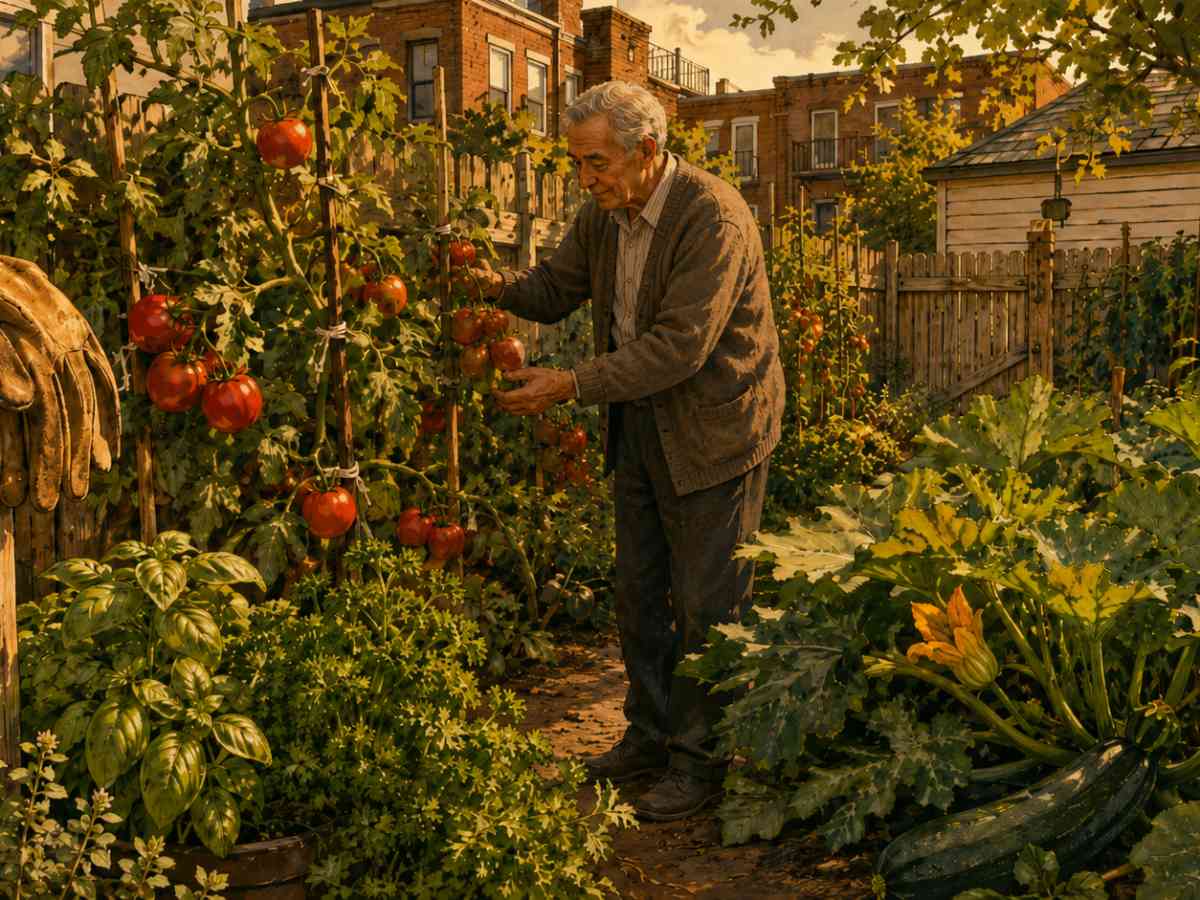
The garden was against the back fence. That was the first thing you noticed coming through the gate — not the house, not the yard, but the fence line, which by late July had disappeared entirely behind tomato plants that my grandfather staked and tied and monitored the way other men monitor stock prices. He had been growing things his whole life. In Calabria the land was what you had. In Montreal the backyard was what you had. The logic was the same. You put seeds in the ground. You watered them. You watched them. You fed your family from what came up, and you shared the excess with anyone who came through the gate, and if someone came through the gate and left without taking something home, they had not understood the situation correctly and would need to have it explained to them.
The garden was twenty feet long and ten feet wide. For a backyard in Saint-Michel that was not a garden — that was a commitment. It ran the full width of the property against the rear fence with a path alongside it just wide enough to walk and tend and harvest. Tomatoes along the back where they could grow tall and lean against the fence. Zucchini in the middle where they had room to spread. Salad, onions, herbs closer to the house where they could be grabbed quickly on the way to the kitchen. Everything was intentional. Everything had its place. The Italian vegetable garden was not casual.
The Italian vegetable garden was not a hobby. It was not a weekend project or a lifestyle choice or a gesture toward sustainability. It was the continuation of something that had been happening in his family for as long as anyone could remember — the understanding that a man who could grow food for his family was doing something fundamental, something that no salary or grocery store or North American convenience could quite replace.
What the Italian vegetable garden actually is
The orto is the Italian kitchen garden — a productive vegetable plot grown for the family table rather than for ornament or commerce. Italy Magazine describes it as providing fruit, vegetables, and herbs for the family throughout the year — eaten fresh, bottled, pickled, dried, frozen, or made into sauces — but also as something more than a food source. It is an escape from daily pressure. A connection to the land. A conversation with the seasons that has been going on in Italian families for longer than anyone can accurately date.
KGioia notes that the Italian vegetable garden has long been a standard part of Italian life — for reasons both gustatory and economic — and that Italian immigrants brought the tradition with them as surely as they brought their recipes and their saints and their specific way of organizing a kitchen. Mangia Mangia puts it simply: the Italian vegetable garden is a family affair, where most of the daily work is carried out by the nonni — the grandparents — with patience, time, and the specific dedication that people who have grown food their whole lives bring to it naturally.
That description matches exactly what I grew up watching. The vegetable garden was his. Not the family’s collectively — his. He was the one who planted it in April, tended it through the summer, harvested it through August and September, and put it to bed in October. Other family members might help on passata day or when the zucchini needed picking before they grew to the size of small watermelons. But the Italian vegetable garden was his project, his responsibility, and his pride, in exactly the way that Mangia Mangia describes the Italian vegetable garden as a family affair primarily sustained by the dedicated nonno with the patience nobody else quite has.
What grew in the Italian vegetable garden — and why those specific plants
The Italian vegetable garden had a specific logic to it. It was not random. Hobby Farms notes that most Italian kitchen gardens shared the same core plants — tomatoes, zucchini, peppers, beans, eggplant, onions, salad greens, and an abundance of herbs — because these were the plants that formed the foundation of Italian cooking and had been grown in Italian soil, in Italian families, for generations before anyone thought to write it down.
| What grew | Why it mattered |
|---|---|
| Tomatoes | The heart of the Italian vegetable garden. Grown in abundance because the passata needed hundreds of them — the whole summer’s worth of tomatoes became the whole year’s worth of sauce. Passata day started here. |
| Zucchini | Prolific, practical, and capable of feeding a family for weeks. The flowers were eaten too — fried, stuffed, baked — nothing from the zucchini plant was wasted |
| Salad greens | Cut and come again — fresh salad at every meal from June through September without a single trip to the grocery store |
| Onions | The base of everything. Grown in rows and stored through the winter, they represented the Italian vegetable garden’s role as a year-round food system not just a summer pleasure |
| Herbs | Basil, parsley, oregano, rosemary — grown close to the kitchen door so they could be grabbed mid-cooking. The herbs from the Italian vegetable garden tasted nothing like the dried version from a jar |
| Peppers | Sweet and hot — the hot ones dried on strings in the cantina through the winter, the sweet ones eaten fresh or preserved in oil |
| Beans | Eaten fresh in summer, dried for winter — the Italian vegetable garden provided for the cold months as well as the warm ones |
| Eggplant | Essential for southern Italian cooking — preserved in oil, grilled, stuffed, baked — the eggplant from the Italian vegetable garden was a different thing entirely from the supermarket version |
The thing about the Italian vegetable garden was that everything from it tasted different. Not slightly different. Fundamentally different. The tomato you pulled from the plant and ate in the garden while still warm from the sun had nothing in common with the tomato that had traveled from a greenhouse in Florida to a distribution center to a supermarket shelf. My grandfather knew this and said it plainly whenever anyone suggested that buying vegetables was simpler than growing them. Simpler, yes. The same, absolutely not.
The pride of the harvest — and the insult of going home empty-handed
This is the part that anyone who grew up around an Italian vegetable garden will recognize immediately.
The harvest was not only for the family. It was for anyone who came through the gate. Neighbors, relatives, friends, the children of friends, people who had dropped by for five minutes on an unrelated errand — everyone left with something. A bag of tomatoes. A zucchini the size of a forearm. A bundle of herbs tied with a piece of string. A handful of beans in a plastic bag. Whatever was ready that day, whatever was abundant, whatever he had grown more of than the family could eat.
He would serve from the Italian vegetable garden with a specific kind of pride — not boastful, nothing was ever boastful — but the pride of a man presenting something he had made with his hands from nothing. He would bring the tomatoes to the table and say nothing about them because nothing needed to be said. They were obviously better than other tomatoes. This was not a point that required arguing. At the end of the visit, before you left, he would disappear into the garden and come back with something for you to take home. Not as an offer. Not as a question. As a statement of fact. You were leaving with tomatoes. The only variable was how many. If you tried to decline — if you said you had enough at home, or that it was too much, or made any gesture toward leaving without taking the bag — he would look at you with the expression of a man who had just heard something he could not quite process. You were not leaving without the tomatoes. This was not negotiable. To leave empty-handed was to say the garden had not produced anything worth taking. Which it had. Which it always had. So you took the tomatoes.
That dynamic — the insistence on giving, the mild offense at refusal, the absolute impossibility of leaving without something — was not unique to him. Italian Sons and Daughters of America documents the same quality in Italian immigrant gardens across North America — the garden as a source of pride, of generosity, of the specific satisfaction of feeding people from something you grew yourself. Life in Italy notes that the most positive advantage of the Italian kitchen garden is simply having fresh vegetables to offer to friends — the Italian vegetable garden as an act of hospitality as much as an act of agriculture.
What the Italian vegetable garden connected to in family life
The Italian vegetable garden was not separate from the rest of Italian family food culture. It was the foundation of it.
The tomatoes from the Italian vegetable garden became the passata on passata day — the late summer ritual of the whole family assembled to put up enough sauce for the year. The herbs from the Italian vegetable garden went into the Sunday ragù that started at eleven and was still going at two. The zucchini showed up at the table in every form — fried, stuffed, in soup, in frittata — through the entire summer. The onions stored in the cantina through winter were the base of every sauce from October to April. The vegetable garden and the kitchen were not two separate systems. They were one system with two locations.
Italy Magazine captures this exactly: the Italian vegetable garden provides food for the table throughout the year — eaten fresh, bottled, pickled, dried, frozen, or made into sauces. The winter cantina full of jars, the dried herbs on the shelf, the onions in a net bag, the peppers strung above the workbench — all of it started in the Italian vegetable garden. Understanding the Italian vegetable garden means understanding why the Italian cantina existed and what filled it.
The Montreal Italian vegetable garden — the diaspora version
Growing a southern Italian vegetable garden in Montreal required adjustments that nobody acknowledged as adjustments. The season was shorter. The summers were hotter in July and colder at the edges. The soil was different. The specific Calabrian varieties his family had grown for generations were not available at the local nursery on Jean-Talon.
None of this was discussed as a problem. You worked with what the climate gave you and you grew what grew. The tomatoes he planted were not the exact Calabrian varieties his mother had grown, but they were Italian varieties chosen carefully from what was available — the kind of heavy-producing plants that gave you enough tomatoes for the passata and still left plenty to eat fresh and give away. The season ran from May planting to October cleanup, which was shorter than Calabria but long enough to do what needed doing.
KGioia documents exactly this adaptation across Italian immigrant communities in North America — the Italian vegetable garden transplanted to new soil, new climates, new backyards, but maintaining its essential character because the person tending it brought their knowledge and their standards and their specific understanding of what the garden was for. All Roads Lead to Italy notes that Italian immigrants brought the Italian vegetable garden tradition with them as they moved around the world — ensuring they could continue to eat as they had in Italy, and passing the knowledge to whatever generation was willing to receive it.
In Montreal’s Italian community the backyard vegetable garden — the orto — was common enough that it was simply part of the landscape of Italian neighborhoods. Saint-Michel, Saint-Léonard, Rivières-des-Prairies — behind the houses, along the back fences, in the narrow side yards, the Italian vegetable gardens were there. The smell of tomato plants in July on those streets was the smell of the tradition maintaining itself in a new country, in new soil, against a fence in a Montreal backyard instead of a hillside in Calabria, but growing the same things for the same reasons with the same result. For the broader story of what Italian families carried from Italy to North America, read Italian-American traditions: what changed and what stayed.
How to start your own Italian vegetable garden today
You do not need a twenty-foot plot against the rear fence. The orto scales down beautifully.
Start with tomatoes and basil — the two plants that together represent the Italian vegetable garden more completely than any other combination. A single determinate tomato plant in a large container on a balcony will give you more tomatoes than you expect and better tomatoes than you can buy. Add a pot of basil beside it. That is an Italian vegetable garden. Small, urban, impractical to people who have never tasted a tomato warm from the plant — but exactly right to anyone who has.
If you have a backyard, plant in the sunniest corner, against a fence if possible where tall plants can lean and be tied. Tomatoes along the back. Zucchini in the middle. Salad and herbs at the front where they can be reached easily. That is the same logic my grandfather used across a plot that was larger but structured identically.
For anyone starting from scratch, Farm to Jar’s guide to Italian kitchen garden varieties is an excellent starting point — it covers exactly which Italian varieties to grow and why, from paste tomatoes for passata to the herbs that go into every southern Italian dish. And if you want to grow the Italian way properly — with the attention to soil, sun, and seasonal rhythm that Italian kitchen gardening requires — a good Italian kitchen garden guide will give you the full system rather than just a plant list.
The most important thing is the tomatoes. Grow enough that you have more than you need. Give the excess away. Do not let anyone leave without taking some. That is the whole tradition in three sentences.
The garden was against the back fence. By late July it had disappeared behind tomato plants. You left that house with your arms full or you had insulted him. The Italian vegetable garden was not a hobby. It was how an Italian man said — without saying it, because he never needed to say it — that his family would eat well, that his guests would go home fed, and that the land, wherever it happened to be, was worth tending.
The Italian vegetable garden connects directly to Italian passata day — the late summer harvest that turned the garden’s tomatoes into a year’s worth of sauce. It connects to the Italian cantina that stored everything the Italian vegetable garden produced. For the June herb traditions that used what the orto grew, read about Acqua di San Giovanni. And for how to record the specific gardening knowledge older relatives carry before it disappears, read how to record family stories before they’re lost.
FAQ
What is the Italian vegetable garden?
The Italian vegetable garden is the Italian kitchen garden — a productive vegetable plot grown for the family table. Italy Magazine describes it as providing fruit, vegetables, and herbs for the family throughout the year, eaten fresh, bottled, pickled, dried, or made into sauces. But it is also more than a food source — it is a connection to the land, a continuation of a practice that has been part of Italian family life for generations, and one of the most direct expressions of the Italian understanding that good food starts in good soil tended by someone who cares about the result.
What did Italian families grow in their vegetable garden?
The core of the Italian vegetable garden was tomatoes, zucchini, peppers, beans, eggplant, onions, salad greens, and herbs — particularly basil, parsley, oregano, and rosemary. Hobby Farms notes that these plants formed the foundation of Italian cooking and had been grown in Italian kitchen gardens for generations. The specific emphasis varied by region — southern Italian vegetable gardens, like Calabrian ones, leaned heavily toward tomatoes, peppers, eggplant, and hot chilis — but the underlying logic was the same everywhere: grow what the kitchen uses most, grow enough to share, and grow it better than you can buy it.
Why did Italian immigrants bring their vegetable garden tradition to North America?
Because the Italian vegetable garden was not separable from the way Italian families ate, and the way Italian families ate was not something they intended to give up in immigration. KGioia documents that Italian immigrants brought the Italian vegetable garden tradition with them as surely as they brought their recipes and their saints — because without the Italian vegetable garden, the passata could not be made, the Sunday sauce was not the same, the herbs were dried from a jar instead of fresh from the garden. All Roads Lead to Italy notes that by growing an Italian vegetable garden in America, Italian immigrants ensured they could continue to eat as they had in Italy. The garden was not nostalgia. It was infrastructure.
Why did Italian vegetable garden vegetables taste better?
Because they were grown in small quantities with serious attention, harvested at peak ripeness, and eaten immediately rather than stored and transported. Farm to Jar notes that every nonna knows homegrown vegetables are far superior to supermarket versions — and the science supports her. A tomato harvested ripe from the plant and eaten the same day has dramatically higher sugar content, more complex flavor compounds, and better texture than one harvested green and ripened in transit. The difference is not subtle. Anyone who has eaten a tomato warm from an Italian backyard garden and then tasted a supermarket tomato in the same week knows exactly what the Italian vegetable garden was protecting.
Why did Italian nonni insist you take vegetables home?
Because the Italian vegetable garden produced more than the family could eat — deliberately — and the excess was meant to be shared. Life in Italy notes that the most positive advantage of the Italian kitchen garden is having fresh vegetables to offer friends. In Italian family culture, refusing to take the offered tomatoes or zucchini was not politeness — it was a mild rejection of the generosity being extended and a suggestion that the garden had not produced anything worth taking. Both interpretations were wrong and both would be corrected. The Italian vegetable garden was an act of hospitality as much as agriculture. You left with something. That was how it worked.
How can I start an Italian vegetable garden today?
Start with tomatoes and basil — the two plants that represent the Italian vegetable garden more completely than any other combination. A single determinate tomato plant in a large container produces more than you expect and better than you can buy. Add basil beside it. That is an Italian vegetable garden. If you have a backyard, plant in the sunniest spot — tomatoes along the back fence where they can grow tall, zucchini in the middle, herbs and salad at the front. Grow enough that you have more than you need. Give the excess away without accepting no as an answer. That is the full tradition in three steps.
What is the connection between the Italian vegetable garden and passata?
The Italian vegetable garden was the source of the passata — the late summer ritual of putting up tomato sauce for the year. Mangia Mangia notes that the ultimate goal of the Italian kitchen garden’s tomato crop is a year’s supply of bottled passata, and that families with extra land can become intensely focused on reaching this objective. The vegetable garden was planted in spring partly with passata day in mind — you needed enough tomatoes not just for eating fresh through summer but for filling the jars that would supply the kitchen through the following winter. The vegetable garden and passata day were two parts of the same annual food cycle.

Marco Ricci is an Italian-Canadian writer and the grandson of Calabrian immigrants. He created Italian Family Traditions to document the customs, feast days, and family rituals Italian families carried from Italy to North America — and to understand what they actually meant. He is based in Montreal.