Italian Family Traditions
Why Don’t Italians Drink Cappuccino After 11am? The Rule Every Italian Family Knew
It was not a suggestion. It was not a preference. It was a fact about the world, delivered with the same certainty as the laws of physics — and in our house, probably with more personal conviction than most laws of physics ever received.
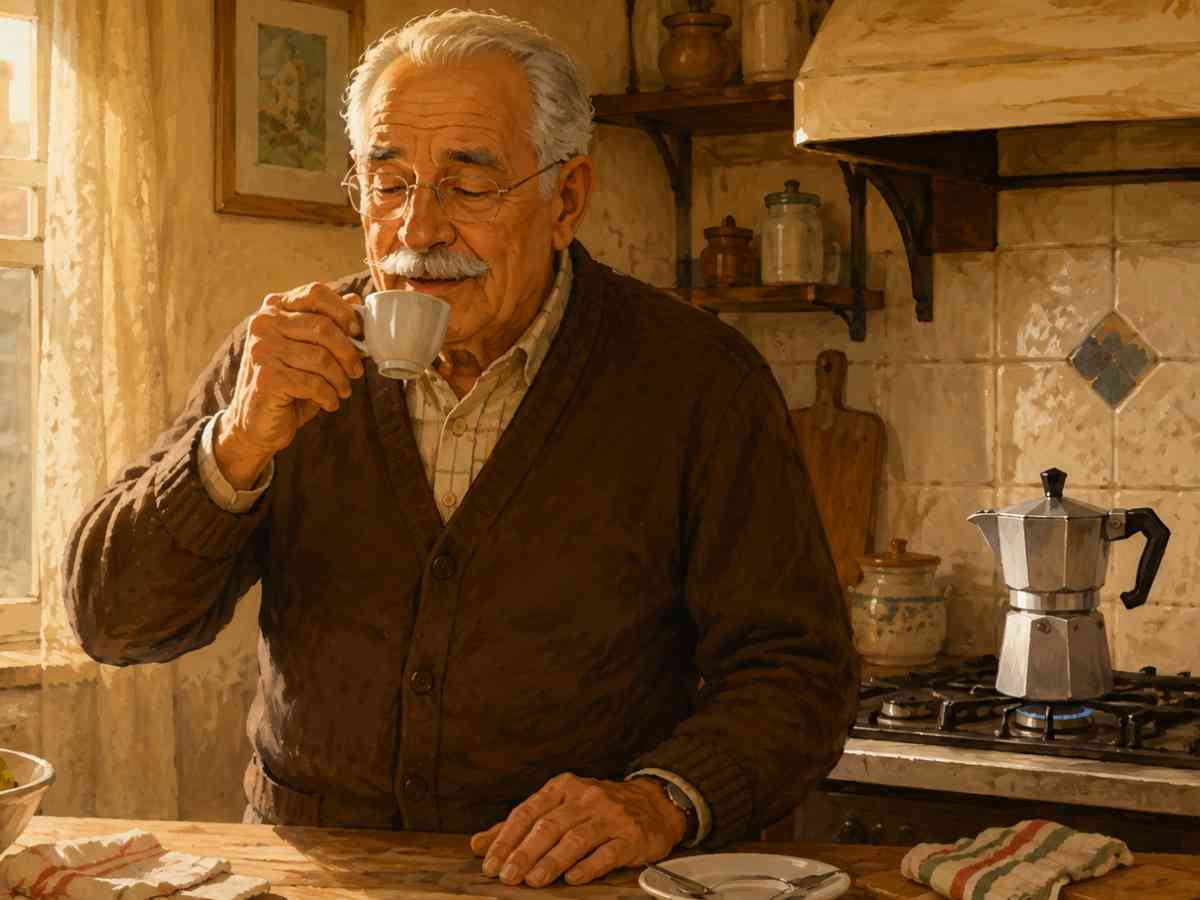
Why don’t Italians drink cappuccino after 11am? In our house, the question was never asked — because the answer was already obvious to everyone at the table. My grandfather drank espresso. This is not a complicated statement but it contains more information than it appears to. He drank espresso after lunch. He drank espresso after dinner. He drank espresso at 10 o’clock at night without any apparent concern for what would happen to his sleep, which was always excellent. He drank it standing at the kitchen counter in the specific way that Italian men drink espresso — quickly, with attention, as if the coffee deserved to be taken seriously rather than consumed while doing something else. He drank it from the small cups that lived in the cabinet reserved for the small cups, which was not the same cabinet as the regular cups because the regular cups were for other things and the espresso cups were for espresso and those two categories did not require further discussion.
He did not drink cappuccino after breakfast. This was not a rule he had articulated or a position he had reasoned his way into. It was simply the way things were, in the same category as the basement door being kept closed and the Sunday ragù starting at eleven — things that were true in this household because they had always been true and because the alternative was not seriously considered.
I did not know, for most of my childhood, that this was a specifically Italian position. I assumed it was a universal truth that cappuccino was a morning drink and espresso was for the rest of the day. The first time I understood that the outside world did not share this understanding was when a non-Italian friend ordered a cappuccino after 11am — after dinner, specifically — at an Italian restaurant and my grandfather looked at the cup arriving at the table with the expression of a man watching someone put ketchup on pasta. He said nothing. He did not need to. The expression communicated everything, including a complete willingness to elaborate if asked, and a complete certainty that he would not need to be asked twice.
The cappuccino after 11am rule is not, as the travel blogs suggest, an Italian quirk or a cultural curiosity. It is a coherent position about the relationship between milk, digestion, and the correct order of things — developed over generations of paying close attention to how the body actually works. The Italian grandmother was not being difficult. She was being right.
Why Italians Don’t Drink Cappuccino After 11am — What the Rule Actually Is
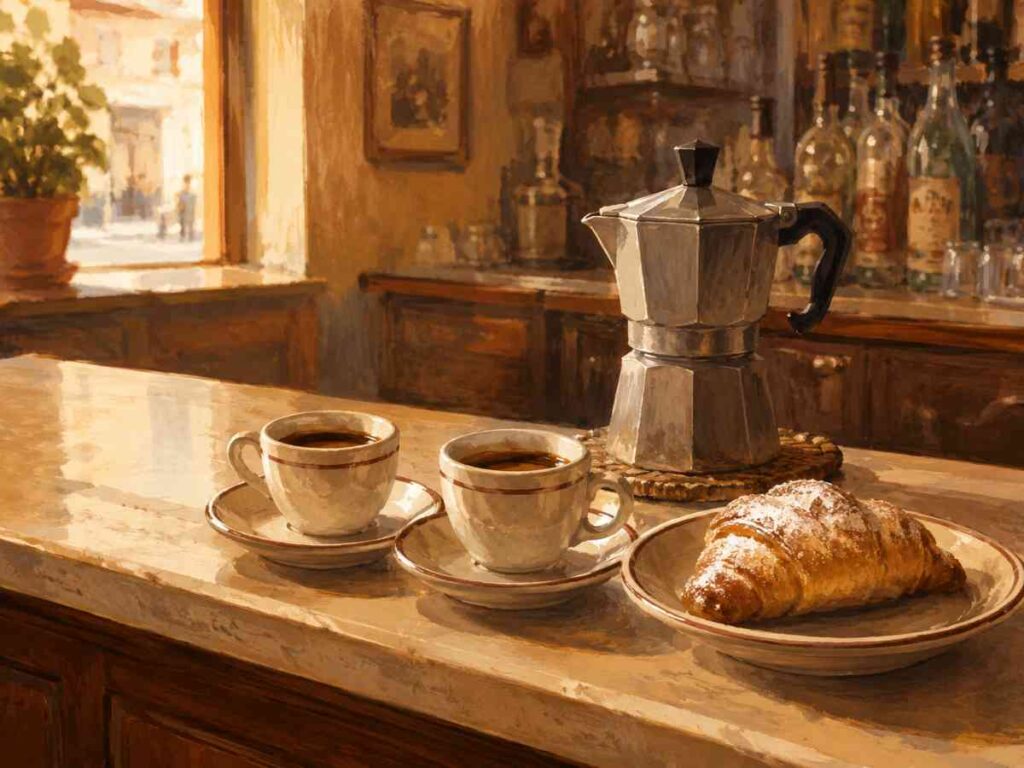
In Italy, cappuccino is a morning drink. Specifically, a breakfast drink — consumed with a cornetto or a brioche, standing at a bar, before the working day begins, on a stomach that has not yet received a serious meal. Italy Explained puts it simply: the cappuccino after 11am rule has nothing to do with the cappuccino, and everything to do with milk. After approximately 11am — once lunch is approaching or has happened — you switch to espresso. The espresso continues for the rest of the day: after lunch, mid-afternoon, after dinner, and in my grandfather’s case, at 10 o’clock at night without comment.
Ordering a cappuccino after 11am in Italy, as Segafredo notes, is like wearing a neon sign that says tourist. The barista will make it — nobody will refuse — but the look that accompanies a cappuccino after 11am in a non-touristy bar has been described by travelers with the same consistency for decades. A slight head tilt. A barely concealed expression. A silence that communicates volumes. My Italian Diaries describes it perfectly: will an angry nonna appear out of nowhere to scold you? No. But there is a high chance you will be judged. And the judgment will be immediate, accurate, and delivered without a single word.
The tourist scene — and why it never gets old
Every Italian who has spent time around non-Italians has a version of this story. A tourist at the bar after a full pasta lunch, ordering a cappuccino after 11am with complete confidence. A non-Italian friend at dinner, asking for a cappuccino with dessert. A well-meaning relative who had been told about Italian coffee culture but not quite been told enough, ordering the wrong thing at the wrong time and only understanding the problem from the barista’s face.
The scene in the restaurant with my grandfather’s friend became one of those family stories that got told for years — not cruelly, but with the particular fondness that Italian families reserve for stories about people who did not know the rules and discovered them in public. The cappuccino arrived. My grandfather watched it arrive. He watched it get picked up. He watched the first sip. His expression remained polite, controlled, and completely transparent to anyone who had known him for more than fifteen minutes. Later, in the car, without anyone asking, he offered his assessment. It was brief. It was accurate. It contained a clinical summary of what milk does to digestion after a full meal that would have been at home in a gastroenterology lecture.
The friend in question, to their credit, never ordered cappuccino after lunch again. Some lessons only need to be delivered once.
Why milk after a meal is the actual issue
Here is the part that the travel blogs always underexplain. The cappuccino after 11am rule is not about cappuccino. It is about milk. And the Italian position on milk after a meal is not a superstition — it is a coherent and largely accurate reading of what milk actually does in the digestive system.
HuffPost quotes Elizabeth Minchilli, a Rome-based food writer: “It has to do with milk being really hard to digest even in the best of times. Cappuccino is essentially warm milk with a shot of espresso. It’s good for a filling first meal of the day — but after a big meal, a glass of warm milk is antithetical.” Italy Explained adds that Italians are, as a cultural matter, obsessed with digestion — and that consuming milk after a meal, in the Italian view, will thoroughly disrupt it. This is precisely why no Italian would order a cappuccino after 11am when a meal is involved.
The same logic runs through the colpo d’aria tradition, through the careful attention to what was eaten in what order at the Italian table, through the specific sequencing of an Italian meal that was never random. Italian folk health knowledge understood the body as a system that needed to be treated with specific attention at specific moments. Milk on an empty stomach — fine. Milk as part of a breakfast that is itself light — fine. Milk after a full lunch of pasta, meat, and bread — a problem, specifically and practically, that would make itself known before the afternoon was over.
The science — and why the grandmother was not entirely wrong
Here is where it gets interesting. My Dear Italia dug into the chemistry behind the cappuccino after 11am rule and found something worth knowing: the combination of coffee and steaming milk produces caseine tannate — a compound formed when the tannins in coffee bind with the casein proteins in milk. Caseine tannate is, by most accounts, genuinely harder to digest than either coffee or milk alone. The scientific literature on it is not extensive, but the compound is real and its digestive effects are consistent with what Italian grandmothers have been saying for generations.
Dreambeans Coffee notes that cappuccino is considered a heavy drink precisely because of the milk content, and that drinking significant amounts of milk later in the day can interfere with digestion and disrupt metabolism. Segafredo adds that Italians believe milk interferes with digestion especially after a meal heavy with meat, cheese, or pasta — which is exactly what Italian lunch tends to be. The cappuccino after 11am problem is therefore a milk-after-a-meal problem, and the science backs the grandmother up.
None of this proves definitively that a cappuccino at 3pm will ruin your afternoon. But it does establish that the Italian position is not arbitrary. It is the accumulated observation of a culture that has been paying close attention to what food does to the body for a very long time. The grandmother had no access to gastroenterology journals. She had decades of watching what happened when people ate and drank in certain orders, and she had drawn the appropriate conclusions. The science, when it finally caught up, confirmed most of what she already knew. This is, as noted in the colpo d’aria post, a recurring pattern in Italian folk health knowledge.
The full Italian coffee order — what to drink and when
Since we are here, it is worth laying out the full system. Because it is a system — not a collection of arbitrary preferences but a coherent daily structure that reflects the Italian understanding of coffee, time, and the body. The cappuccino after 11am rule is just one entry in a much larger and entirely logical framework.
| Time of day | What Italians drink | Why |
|---|---|---|
| Morning — before 11am | Cappuccino, caffè latte, or macchiato — with a cornetto | Stomach is empty. Milk is appropriate. The cappuccino is filling and functions as part of breakfast rather than a drink alongside it. |
| Mid-morning | Espresso | The cappuccino after 11am window is closing. An espresso is quick, clean, and does not weigh down a stomach that is about to receive lunch. |
| After lunch | Espresso — always, immediately, standing at the bar if possible | The espresso after lunch is the digestivo of the coffee world. Quick, bitter, milk-free. It closes the meal properly and prepares the afternoon. |
| Afternoon | Espresso | A pick-me-up that does not interfere with anything. No milk. No foam. Nothing that will make the dinner feel heavier than it needs to. |
| After dinner | Espresso — sometimes a caffè corretto with grappa or sambuca | The espresso after dinner is non-negotiable in traditional Italian households. The caffè corretto — corrected coffee — adds a small measure of digestivo spirit to assist with what has just been consumed. |
| Never | Cappuccino after 11am | Milk after a meal. The caseine tannate problem. The digestion disruption. The fundamental category error of treating a breakfast drink as an all-day option. In short: no. |
The moka pot — the real center of Italian coffee culture
Before we go further, a necessary detour. Because the cappuccino after 11am rule exists in the context of a much larger Italian coffee culture — and that culture, in Italian immigrant households in Montreal and New York and Toronto, was centered not on the bar but on the moka pot.
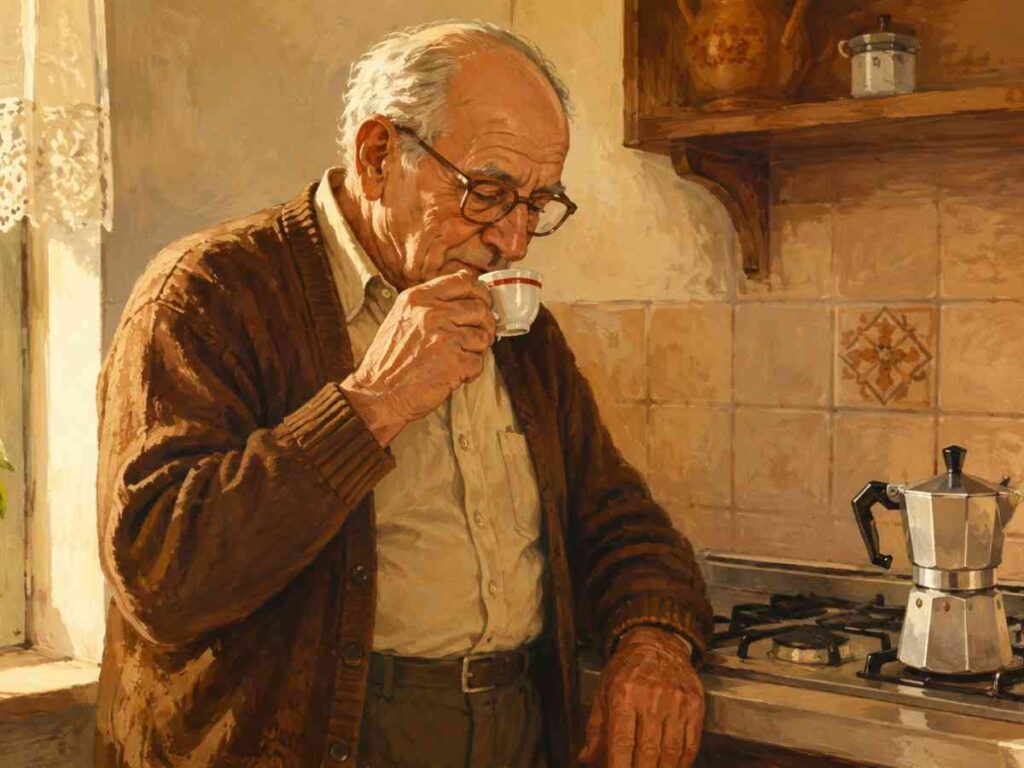
The moka pot was on the stove. This was a fact as constant as the stove itself. Not an occasional presence — a permanent one. It was cleaned, refilled, and set to go with the specific efficiency of someone performing a familiar ritual that required no thought because it had been performed correctly so many times that thought was no longer involved. The sound it made — the particular gurgle and hiss of the coffee coming up through the chamber — was the sound that meant the morning had properly begun, or that the meal was about to be closed, or that a visitor had arrived and coffee was being made because that is what you did when someone arrived.
My grandfather’s moka pot was a Bialetti. This was not a coincidence or a preference — it was simply what moka pots were, in the same way that espresso cups were small and cappuccino after 11am was simply not done and certain things did not require explanation because they had been self-evident for so long. The Bialetti Moka Express — the original octagonal aluminum pot that Alfonso Bialetti invented in 1933 — is still the most recognizable object in Italian kitchen culture. If you grew up in an Italian household, you know its shape before you know its name. It is the vessel through which Italian coffee culture was transmitted from the bar to the home, from Italy to the diaspora, from one generation to the next.
The espresso it makes is not the same as bar espresso — the pressure is lower, the extraction slightly different. Italian grandmothers knew this and did not consider it a problem. The moka made coffee that was strong, dark, and correct. That was sufficient. That was the standard. And the standard was met every morning and after every meal without variation for as long as anyone in the household could remember.
The cappuccino after 11am rule in Italian-Canadian families
The cappuccino after 11am rule traveled to Canada with complete fidelity. It did not require a bar to enforce it — it required a grandmother, and the grandmother was present. In Italian-Canadian households in Montreal and Toronto and Hamilton, the coffee culture maintained itself the same way the food culture did: through the moka pot on the stove, through the small cups in the reserved cabinet, through the espresso after Sunday lunch that was as reliable as the lunch itself, and through the specific look directed at anyone who suggested that a cappuccino after 11am might be a reasonable idea.
The bar culture adapted too. In Little Italy on Saint-Laurent, in the Italian cafes that the community built and sustained for generations, the cappuccino was a morning offering and the espresso was for everything else. You could order what you wanted — nobody was stopping you — but you would be ordering it in a place where the people behind the counter and the people at the next table had grown up with the same understanding, and the look, if it came, would be genuine rather than theatrical.
That continuity — the moka pot, the espresso cups, the specific timing, the cappuccino after 11am rule delivered without being stated — is part of the broader story of what Italian families carried after immigration. Coffee culture was not a minor detail. It was a daily ritual that structured the day, marked the meals, and communicated, without words, that certain things were done in certain ways and that the new country’s habits were welcome to exist elsewhere but not at this stove.
How to keep Italian coffee culture alive at home
The simplest possible instruction: get a moka pot and use it correctly. Not an espresso machine — those are fine but they are not the same thing. The moka pot is the domestic version of the Italian coffee ritual, the object that brought bar culture into the home, and the thing that smells right when it is on the stove in the morning in a way that nothing else quite replicates. And once it is on your stove, the cappuccino after 11am rule will enforce itself — because you will be making espresso, and espresso is what comes after breakfast.
A Bialetti Moka Express in the right size for your household — a 3-cup for one or two people, a 6-cup for a family — is the most direct connection to what your grandparents had on their stove every morning. Use it in the morning. Make espresso after lunch. Serve it in small cups. And if someone in your household asks for a cappuccino at 3 in the afternoon, respond with the expression my grandfather used. No words necessary. The expression is self-explanatory and has been for generations.
For the full story of Italian coffee culture and the traditions that surrounded it, read about fare la scarpetta — the Italian table habit that belongs to the same meal-as-ritual understanding — and the Italian Sunday lunch where the espresso after the meal was as fixed a part of the structure as the pasta that came before it. And for how to record the specific daily rituals older relatives carried before they are lost, read how to record family stories before they’re gone.
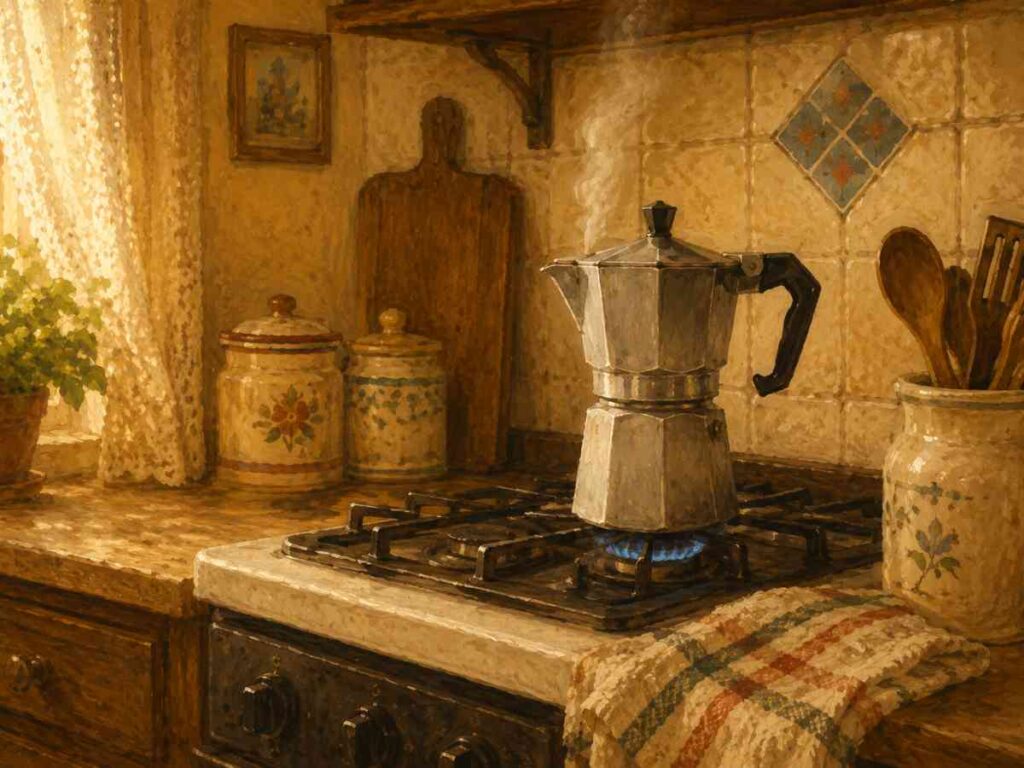
He drank espresso after lunch. He drank espresso after dinner. He drank it at 10 o’clock at night without apparent concern for his sleep, which was always excellent. He did not drink cappuccino after 11am. This was not a rule he had reasoned his way into. It was simply the way things were — and he was, as the science eventually confirmed, completely correct.
The cappuccino after 11am rule belongs to the same Italian system of food knowledge as the colpo d’aria — the fear of drafts that was also, it turned out, not entirely wrong. It connects to fare bella figura — because ordering the wrong coffee at the wrong time in Italy is its own form of brutta figura. And it belongs to the Italian Sunday table where the espresso after the meal was the punctuation mark that closed a sentence that had been four hours in the making.
FAQ
Why don’t Italians drink cappuccino after 11am?
Because of milk. The cappuccino after 11am rule exists because cappuccino is essentially warm milk with a shot of espresso, and Italians believe — with considerable scientific support — that milk is hard to digest, especially after a meal. Italy Explained notes that the rule has nothing to do with the cappuccino itself and everything to do with the milk: Italians avoid milk when eating because they believe it disrupts digestion, and since breakfast doesn’t count as a proper meal in the Italian system, cappuccino is acceptable then but not afterward. After 11am, once lunch is approaching or has happened, espresso — quick, strong, and milk-free — takes over for the rest of the day.
Is there science behind the cappuccino after 11am rule?
Yes — more than most people realize. My Dear Italia documents that the combination of coffee and steaming milk produces caseine tannate — formed when the tannins in coffee bind with the casein proteins in milk — which is genuinely harder to digest than either substance alone. Dreambeans Coffee notes that the milk content in cappuccino can interfere with digestion and disrupt metabolism when consumed later in the day. HuffPost quotes food writer Elizabeth Minchilli: after a big meal, a glass of warm milk is antithetical to digestion. The Italian grandmother had no access to the research. She had decades of observation. The science confirmed most of what she already knew.
What do Italians drink instead of cappuccino after 11am?
Espresso — always, and usually immediately after the meal, standing at the bar if possible. Gran Tour notes that once the clock strikes 11, Italians shift from cappuccino to espresso: quick, strong, and light on the stomach. The espresso after lunch is not optional in traditional Italian households — it is the punctuation mark that closes the meal properly. A caffè macchiato — espresso with just a few drops of milk — is sometimes acceptable as a compromise because the milk content is minimal. A cappuccino after 11am is not a compromise. It is a different category of error entirely.
What is a caffè corretto?
A caffè corretto — corrected coffee — is an espresso with a small measure of a digestivo spirit added to it, typically grappa, sambuca, or brandy. The correction in question is the addition of something to assist with digestion after a heavy meal. It is most commonly drunk after dinner rather than after lunch and represents the Italian understanding that espresso alone handles most situations but that certain meals require additional assistance. The spirit is not added for flavor primarily — it is added because it works, in the same practical, unsentimental way that most Italian folk health remedies work.
Can you order a cappuccino after 11am in Italy?
Yes — nobody will stop you. The barista will make a cappuccino after 11am without argument. In tourist areas they are entirely used to the request. But as My Italian Diaries notes, in a non-touristy bar you may receive the look: a slight head tilt, a barely concealed expression, a silence that communicates that you have revealed something about yourself and it has been noted. Segafredo puts it simply: ordering a cappuccino after lunch won’t land you in foodie hell, but it will mark you as an outsider. The rule is not enforced through refusal. It is enforced through the specific Italian social mechanism of making people understand, without a single word, that they have done something incorrect.
Did Italian-Canadian families keep the cappuccino after 11am rule?
Yes — completely and without modification. The cappuccino after 11am rule did not require a bar to enforce it. It required a grandmother, and the grandmother was present. In Italian-Canadian households across Montreal, Toronto, and Hamilton, the moka pot was on the stove, the espresso was for after lunch, and the cappuccino was for the morning. The Little Italy bars that the community built and sustained on Saint-Laurent and across Italian neighborhoods in North American cities maintained the same system: cappuccino in the morning, espresso for everything else. The new country’s coffee habits were noted, considered, and declined.
What is the moka pot and why does it matter?
The moka pot is the stovetop espresso maker invented by Alfonso Bialetti in 1933 — the octagonal aluminum pot that became the center of Italian domestic coffee culture and the object through which bar espresso was brought into the home. In Italian immigrant households it was a permanent fixture on the stove, cleaned and refilled daily, used at breakfast and after every meal, and passed down through families as a piece of equipment so fundamental that replacing it required no discussion about what to replace it with. The Bialetti Moka Express remains the most recognizable version. The coffee it makes is not identical to bar espresso but it is correct — strong, dark, and made the right way, which in Italian household culture is the standard that matters.

Marco Ricci is an Italian-Canadian writer and the grandson of Calabrian immigrants. He created Italian Family Traditions to document the customs, feast days, and family rituals Italian families carried from Italy to North America — and to understand what they actually meant. He is based in Montreal.