Italian Family Traditions
What Is Tombola? The Italian Family Game Behind Christmas Gatherings
Dinner is over. Dessert is half-finished. Coffee is out. Somebody says “should we do tombola?” and within five minutes the whole room is louder, funnier, and considerably more competitive than it needs to be. That is the whole point.
My grandmother called the numbers. This was not a role formally assigned to her — it was simply understood, in the way that many things were understood in an Italian family household, that certain jobs belonged to certain people and the only way you discovered this was by trying to do the job yourself and seeing what happened. What happened if you tried to call the tombola numbers was that my grandmother would listen for approximately thirty seconds and then begin correcting your technique. So she called the numbers. She had been calling them since before any of us were born. She knew every number’s Neapolitan nickname. She had opinions about the correct dramatic pause between the draw and the announcement. She treated the role with the seriousness of someone who understood that the caller is not just a reader of numbers but the manager of the room’s entire emotional state for however long the game lasts.
She died in her late eighties and the first Christmas without her we played tombola anyway, because not playing would have felt like a larger absence than playing. We called the numbers ourselves, badly. Someone looked up the Neapolitan nicknames on a phone. Someone else announced that number 17 was “il morto” — the dead man — and then we all looked at each other with the specific feeling of having said the wrong thing at exactly the right moment. The game was quieter than it had ever been. It was also, somehow, better — because we understood for the first time what she had been doing all those years, and what the room lost when she stopped.
Tombola is not really about winning. It is about the reason to stay at the table after dinner, the noise that signals the evening is not over yet, and the specific atmosphere that only this game, in this house, with these people, produces.
What tombola is and how it works
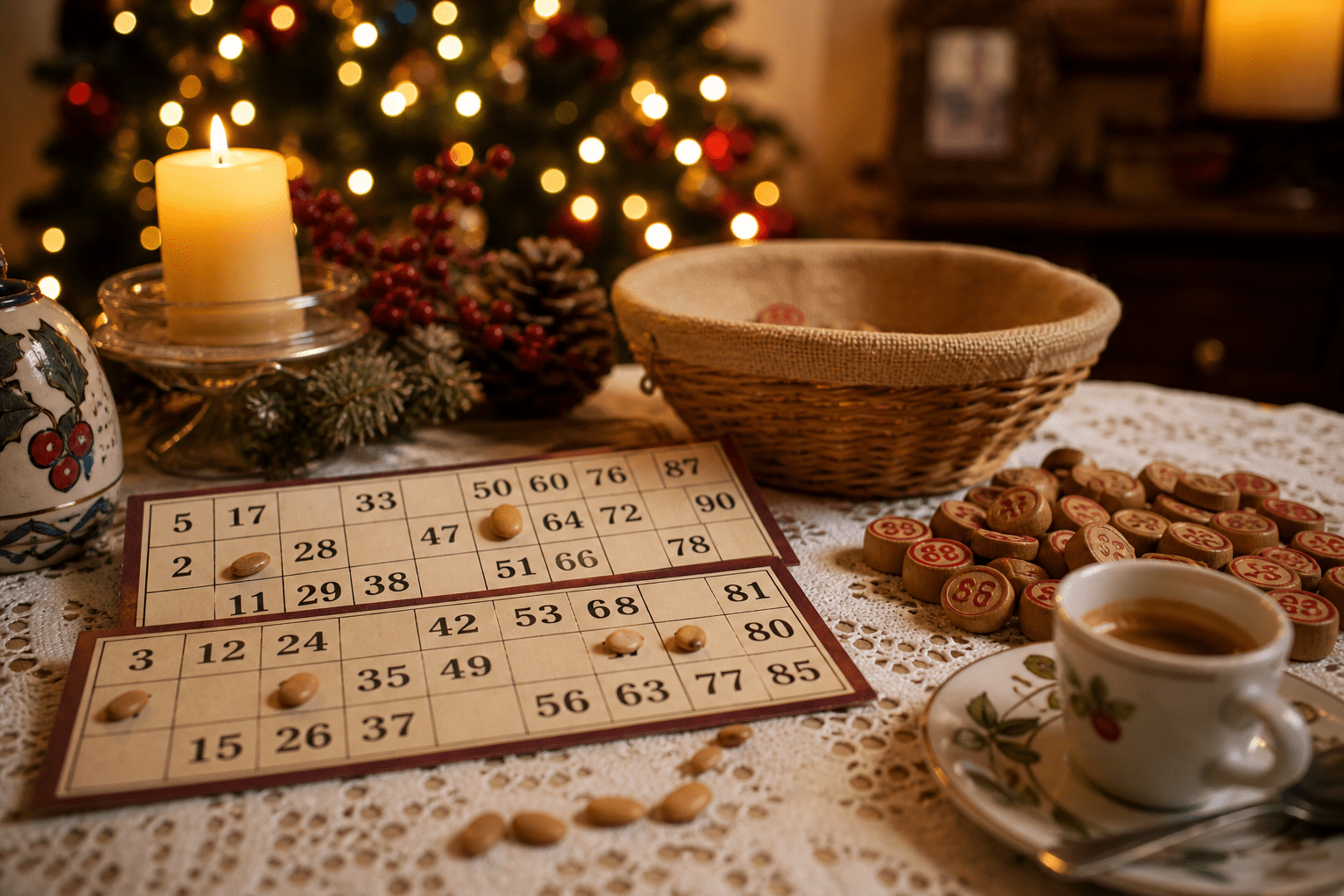
Tombola is a traditional Italian number-drawing game especially associated with Christmas. As Treccani describes, a caller draws numbers from 1 to 90 and players mark those numbers on their cards as they are called. The wins build in sequence — each one a milestone on the way to the complete card, each one earning a prize from the shared pot.
Each number on the tombola board carries a Neapolitan meaning through la Smorfia — the dream book that turned sleep into numbers.
| Win | What it means | The feeling in the room |
|---|---|---|
| Ambo | Two numbers in a row on your card | Mild interest. The game is warming up. Nobody is concerned yet. |
| Terno | Three numbers in a row | The room becomes more attentive. Some cards are tracking better than others. |
| Quaterna | Four numbers in a row | Definite attention. Someone is getting close to cinquina. The caller feels the energy shift. |
| Cinquina | A complete row of five numbers | The shout. The neighbors may have heard. Someone claims they were one number away. They are always one number away. |
| Tombola | The entire card — all 15 numbers | Celebration or immediate suspicion, depending on who won and whether anyone liked them already. |
If you are wondering whether it is similar to bingo, the answer is yes — in the same way that a Sunday family dinner is similar to eating. The basic mechanics overlap. The experience is completely different. Bingo is a game. Tombola is a Christmas occasion, a family ritual, a comedy performance, and a competitive sport all occurring simultaneously at the same table. Italy Magazine notes that tombola is especially popular during the Christmas holidays because the whole family can play together — and that older versions were often played with simple markers like dried beans or orange peel, things you had in the house at Christmas, which is exactly the point.
The prizes — what goes in the pot and how it works
Before the game begins, every player contributes something to the pot — typically a small fixed amount per card purchased. The pot is then divided across the milestones. A common structure: ambo takes a small share, terno a little more, quaterna more still, cinquina a meaningful portion, and tombola — the full card — takes the largest prize of all. Establish the split before you start. Mid-game disputes about the pot are the wrong kind of noise.
The prizes themselves are rarely large in monetary terms. A few dollars. A box of chocolates. A panettone. A bottle of something. Clementines. Scratch tickets. Whatever the family assembled for the occasion. What matters is the disproportion between the value of what was won and the celebration of winning it — a disproportion that is universally understood as part of the game and universally enjoyed by everyone except occasionally the person in second place.
In our family the pot for the full tombola was always a mixture of things rather than cash — a bag assembled earlier in the day that nobody had looked into and that therefore contained surprises. One year it contained a very good bottle of wine, a pair of socks, three clementines, and a scratch ticket that won four dollars. My uncle won it. He examined each item with the serious assessment of someone receiving a state prize. He kept the bottle. He gave the socks to my cousin. He ate one clementine immediately. He scratched the ticket with the ceremony it deserved. The four dollars went into next year’s pot. Nobody objected. This felt correct.
Where tombola comes from
The tradition is strongly tied to Naples. The origin story most commonly repeated connects tombola to 1734 and the reign of Charles of Bourbon in the Kingdom of Naples. As Visit Naples explains, a dispute arose between Charles and the Church over the public lotto game during the Christmas period. The compromise pushed the game into the domestic space of the home, specifically during the Christmas holidays. What had been a public institution became a family one.
Whether the story is historically precise in every detail or not, it captures something true. Tombola is a domestic game — always meant for the table, for the hour after dinner, for the moment when nobody has anywhere to be and someone needs a reason to keep everyone in the same room a little longer. Once something gets attached to Christmas in an Italian family, good luck getting rid of it.
The smorfia — why the numbers have nicknames
Naples also gave tombola the smorfia: the ancient system that assigns each number from 1 to 90 a specific symbolic meaning, figure, or situation drawn from Neapolitan folk culture. Visit Naples directly ties tombola to the 90 numbers of the smorfia. The caller who knows the smorfia does not just announce a number — they announce its identity. And the room responds to the identity rather than the digit.
Here are the most famous smorfia numbers and what happens when they are called:
| Number | Smorfia name | Meaning | What happens when it’s called |
|---|---|---|---|
| 1 | L’Italia | Italy itself | Mild patriotic warmth. Someone says “finalmente.” |
| 8 | A faccia | The face | Caller looks at someone. That someone pretends not to notice. |
| 13 | Sant’Antonio | Saint Anthony | The devout nod. The less devout also nod, out of respect. |
| 17 | Il morto | The dead man | A pause. Someone makes the sign of the cross. Someone else laughs. Both reactions are correct. |
| 22 | O pazzo | The madman | Caller looks at someone specific. Room laughs. That person also laughs, eventually. |
| 33 | Gli anni di Cristo | The years of Christ | Announced with weight. The religious members of the table feel this one. |
| 47 | Il morto che parla | The dead man who speaks | More unsettling than 17. Someone always says they dreamed this number. |
| 48 | Il morto che ride | The dead man who laughs | After 47, this one produces relieved laughter. The dead man improved. |
| 69 | Il ridere e il piangere | Laughter and tears | The philosopher’s number. Someone applies it to the game currently being played. |
| 77 | Le gambe delle donne | Women’s legs | Announced by a certain kind of caller with a certain kind of pause. Room responds accordingly. |
| 90 | La paura | Fear | Always the last number if the game goes long enough. Announced with ceremony. The room feels it. |
Families with Neapolitan roots often preserve partial or full knowledge of these nicknames, passed from the grandmother who called the numbers to whoever reluctantly takes over after her. Even partial use of the smorfia — five or six numbers called with their nicknames rather than their digits — immediately transforms the game from a number exercise into something that sounds like itself.
My grandmother knew the smorfia the way she knew the words to prayers — automatically, without looking anything up, as part of a system she had absorbed so early it felt like a natural language rather than learned knowledge. When she drew a number she announced it in Italian and Neapolitan dialect, gave the smorfia name, and sometimes added a comment that bore on the name’s meaning in the context of whoever was playing. Number 22 — o pazzo — the madman. She would look at a specific cousin when she said it. The specific cousin pretended not to notice. The room noticed. That is what the smorfia adds to tombola. It gives the caller material, and it gives the room something to respond to. The numbers stop being numbers. They become characters.
What calling the numbers actually sounds like
The caller’s role in tombola is not administrative. It is performative. A good caller understands that the room is in their hands for the duration of the game and manages it accordingly — with timing, with personality, with the specific theatrical instinct that makes tombola feel like an event rather than a procedure.
A mediocre caller draws a number, reads it flatly, and moves on. The game happens. Nobody particularly remembers it.
A good caller draws a number and holds it for a moment without speaking. The room notices the pause. Then the caller announces the smorfia name first — “O pazzo” — and lets it land before giving the digit. “Ventidue.” The room has already responded. The person the caller looked at while saying “o pazzo” is already deciding how to react. The number itself almost comes second.
The best callers also comment on the state of play — noting who is close, expressing theatrical sympathy for the perpetually unlucky, questioning aloud whether certain players are paying proper attention. They make the game feel observed. That sense of being inside a shared performance, rather than simply sitting at a table with cards, is what separates a memorable tombola game from a forgettable one. The cards and the numbers are the same either way. The caller is the variable that matters most.
The people who make tombola what it is
Every family tombola has its recurring cast. The faces change by household but the types are remarkably consistent across generations and geographies.
| The type | What they do |
|---|---|
| The dramatic caller | Treats every number as an occasion. Pauses for effect. Has been told to just say the number and refuses. The game is significantly better for this. |
| The suspicious one | Convinced the caller is helping a specific player. Cannot prove this. Will bring it up again next Christmas. |
| The always-one-away | Every game. Every single game. One number away from cinquina. The number never comes. Reported as a tragedy each time with the same level of surprise. |
| The child who wins | Celebrates with a completeness that adults have lost the ability to access. The adults find this either delightful or slightly irritating depending on how close they were. |
| The quiet elder | Marks their card with minimal fuss. Says nothing dramatic when they win. Simply collects. Wins more than anyone expects. |
| The two-card player | Said they could handle it. Cannot quite handle it. Keeps missing numbers on one card while protecting the other. Also a tragedy. Also every game. |
Tombola as a child’s first Italian tradition
For many Italian-Canadian and Italian-American descendants, tombola was the first Italian cultural experience that made complete sense to them as children. Before language. Before history. Before they understood what most of the traditions around them actually meant.
You did not need Italian to play tombola. You needed to hear numbers and mark a card. A child who could count could play. A child who could not yet count in Italian could still play, because the numbers came in both languages in most diaspora households. The eight-year-old and the eighty-year-old were genuinely in the same game, competing on genuinely equal terms, and the child knew it.
That equality matters more than it might seem. Most Italian traditions, observed from the outside, require knowledge to fully appreciate — the religious meaning of a feast day, the significance of a food, the story behind a custom. Tombola requires none of that. The child is immediately inside the tradition rather than watching it from the edges. They mark their card. They shout when they get ambo. They feel the tension of the room before a cinquina announcement. They learn, without being told, that Christmas in this family has a particular texture after dinner — loud, funny, and competitive in a way that everyone enjoys. For more on how children absorb Italian heritage through exactly this kind of participation, read how to get your kids interested in their Italian heritage.
My daughter played her first tombola at seven. She did not know what ambo meant when she got it. My mother explained. She did not know what terno meant when she got that either. My mother explained again. By the time she was one number away from cinquina, she understood perfectly — she understood in the way that matters most, which is through wanting something specific to happen and feeling the room hold its breath while waiting to see if it would. The number came. She shouted. Everyone reacted. That reaction — the adult room fully responding to a child’s win with genuine warmth rather than managed enthusiasm — is the thing she remembered most clearly afterward. She asked if we could play again the following Christmas. We did.
Tombola in Italian-Canadian and Italian-American families
Tombola crossed the ocean and adapted without losing much. Some Italian traditions needed specific ingredients, specific space, or a specific village rhythm that did not survive immigration intact. Tombola needed almost none of that. It needed people, cards, numbers from 1 to 90, and a table that nobody wanted to leave yet.
In Montreal’s Italian community — in the houses of Little Italy and later in Saint-Michel and Rivières-des-Prairies as families spread across the city — tombola was the game that came out after the Christmas Eve vigil or after the Capodanno lunch on January 1. The language at the table changed depending on the generation present — sometimes Italian, sometimes French, sometimes English, sometimes a Calabrian or Sicilian dialect nobody had formally been taught but everyone somehow understood. The prizes changed with the decades. The noise did not change.
Regional variations existed too. Families with Calabrian roots played with different calling habits than families with Neapolitan roots. The smorfia nicknames were not universal — different provinces had their own associations, and what number 33 meant in one family was not always what it meant in another. These differences could produce spirited disagreements when two branches of a family married and their respective tombola customs collided at the same table. These disagreements were also, in their own way, part of the tradition.
The tombola game I remember most clearly was not Christmas Eve but January 1 — Capodanno, after the lunch with the cold cuts and the lasagna and the cutlets, when everyone was full and nobody was leaving and someone produced the tombola set from the specific drawer where it lived year-round. We played for two hours. There were accusations. There were dramatic announcements of ambo that produced no recognition from the room whatsoever. There was one legitimate cinquina celebrated with more enthusiasm than the eventual tombola winner. The eventual tombola winner was my uncle, who said nothing, collected his prize, and asked if we were playing another round. We played another round. Nobody won in the second round but everyone stayed until the pot was empty and the numbers had been through twice. When I think about Capodanno in that house I think about the tombola set more than I think about the food, and the food was extraordinary.
How to set up and run tombola for your family
Tombola requires almost nothing. Here is what you need and how to run it properly.
The numbers. You need 1 to 90, drawn one at a time from a bag or container. These can be purchased as a set, printed and cut, or written on slips of paper. A small cloth bag is traditional. A hat, a bowl, or a folded box works equally well.
The cards. Tombola cards are grids of 15 numbers — 3 rows of 5 — each card using different numbers from 1 to 90. They can be purchased, printed from any number of free online templates, or made by hand with a ruler and a pen. Homemade cards are slower to produce but feel more correct.
The markers. Dried beans are traditional and cost nothing. Buttons, coins, torn paper, and small pasta shapes all work equally well. Use dried beans if you have them — not because it matters mechanically, but because the beans on the card connect the game to the version played in Italian households for generations, when nobody bought a set and everyone used what was in the kitchen at Christmas.
The pot. Every player contributes a fixed amount per card before the game starts. Divide the pot across the five milestones and write down the amounts. Ambo gets a small share, terno a bit more, quaterna more still, cinquina a meaningful portion, and tombola takes the largest prize. In many families the tombola prize is also the only one people genuinely care about, though they would never admit this during the earlier rounds.
The caller. The most important role. Look up ten to fifteen smorfia nicknames before you begin and use them when those numbers are drawn. Let the pauses happen. Let the room react before moving on. The caller controls the pace and the atmosphere of the entire game. Ten minutes of preparation makes an enormous difference to what kind of tombola gets played.
How many people. Tombola works with as few as four and scales without limit. More people means more cards in circulation, faster number coverage, and a louder room — all of which improve the experience. There is no upper bound. The game was designed for a full house.
The first Christmas without my grandmother, we called the numbers badly and someone said “il morto” with the wrong emphasis and everyone laughed anyway. The game was worse without her. The evening was still good. Tombola holds the shape of the gathering even when the person who gave it its best quality is gone.
Bring out the set. Look up a few smorfia numbers. Let someone dramatic call. Let the room get loud. The four dollars from the scratch ticket go into next year’s pot. Nobody will object. It will feel correct.
Tombola belongs to the same post-dinner tradition as La Vigilia and the Capodanno gathering. For the broader story of how traditions like tombola survived immigration, read Italian-American traditions: what changed and what stayed. For how to get children genuinely engaged with these traditions, read how to get your kids interested in their Italian heritage. And for the full Italian table culture that tombola belongs to, read about Italian table manners and the rules many of us grew up with.
FAQ
What is tombola and how do you play it?
Tombola is a traditional Italian number-drawing game played especially at Christmas. A caller draws numbers from 1 to 90 and announces them — ideally with their smorfia nicknames — and players mark those numbers on their cards. The wins build in sequence: ambo (two in a row), terno (three), quaterna (four), cinquina (a complete row of five), and tombola (the entire card — all 15 numbers). Each milestone earns the winner a share of the pot contributed before the game began. As Treccani describes it, the game is built around this structure of progressive wins, each one producing a shout and a shift in the room’s attention before the next round of calling continues.
Is tombola the same as bingo?
Similar in structure, but completely different in character. Tombola uses numbers from 1 to 90, has five progressive wins within a single game rather than one winner per round, and carries a strong Christmas and family-home tradition that bingo does not. The Neapolitan connection to the smorfia — the ancient system of symbolic nicknames for each number — also gives tombola a theatrical, performative dimension that pure bingo entirely lacks. Italy Magazine describes tombola as especially popular during the holiday season because the whole family can gather around it, which is precisely the quality that makes it feel unlike any other game.
What are the smorfia numbers for tombola?
The smorfia is the Neapolitan system that assigns each number from 1 to 90 a symbolic name drawn from folk culture and tradition. Some of the most famous: 1 is l’Italia, 8 is a faccia (the face), 17 is il morto (the dead man), 22 is o pazzo (the madman), 33 is gli anni di Cristo (the years of Christ), 47 is il morto che parla (the dead man who speaks), 69 is il ridere e il piangere (laughter and tears), and 90 is la paura (fear). A caller who knows even ten to fifteen of these associations and uses them transforms the game from a number exercise into something that sounds and feels distinctly Italian. The full smorfia table is earlier in this article.
Why do Italians play tombola at Christmas?
Because it is the perfect post-dinner game for a mixed-age family gathering. Children can play, grandparents can play, and the half-attentive can still play. It requires no skill or prior knowledge — only numbers and attention — so the eight-year-old and the eighty-year-old are genuinely competing on equal terms. Italy Magazine and Visit Naples both connect tombola specifically to Christmas family life. The historical origin story also ties it directly to the domestic holiday table: the game moved from public life into the home during the Christmas season in 18th-century Naples and has stayed there for nearly three centuries.
How does the tombola pot work?
Before the game begins, each player contributes a fixed amount per card purchased. The pot is then divided across the five winning milestones — a small share for ambo, more for terno, more still for quaterna, a meaningful portion for cinquina, and the largest prize for tombola. The exact split varies by family. Establish it before the game starts and write it down. Mid-game disputes about the pot are the wrong kind of noise. The prizes themselves are rarely large — chocolates, clementines, a bottle of something, scratch tickets — but the disproportion between the prize value and the celebration of winning it is universally understood as part of the tradition.
Where did tombola come from?
The game is strongly associated with Naples. The most commonly repeated origin story traces it to 1734 and the reign of Charles of Bourbon in the Kingdom of Naples. According to Visit Naples, a dispute between Charles and the Church over the public lotto game during the Christmas period pushed the game into the domestic space of the home, where it became a family holiday tradition. Whether or not every historical detail is precise, it accurately describes what tombola became: a game that moved from public institution to family table and has stayed there for nearly three centuries.
How many people do you need to play tombola?
Tombola works well with as few as four people and scales without any upper limit. The more players, the more cards in circulation, the faster numbers get covered, and the louder the room becomes — all of which improve the experience. There is no minimum for fun and no maximum for chaos. The game was designed for a full house and performs best in one.
Can I buy a tombola set in Canada or the United States?
Yes. Italian specialty shops and import stores often carry tombola sets, especially in the weeks before Christmas. They are also widely available from Italian-focused online retailers. The game is also easy to assemble yourself: slips of paper numbered 1 to 90 drawn from a bag, cards made with a pen and a ruler, and dried beans or coins as markers. The handmade version is, in some ways, the more traditional one — older Italian households used whatever was available in the kitchen, and the game was no less itself for it.

Marco Ricci is an Italian-Canadian writer and the grandson of Calabrian immigrants. He created Italian Family Traditions to document the customs, feast days, and family rituals Italian families carried from Italy to North America — and to understand what they actually meant. He is based in Montreal.