Italian Family Traditions
Italian Table Manners: The Rules That Everyone Knew
You did not learn them from a book. You learned them from a look. From Aspetta. From someone fixing how you held the fork. From the clear and completely non-negotiable understanding that if you were at the table, you were at the table.
My grandmother never raised her voice at the table. She did not need to. She had a look. It was not dramatic — not the theatrical Italian grandmother look of movies, nothing with hands or volume. It was quieter than that and considerably more effective. A particular stillness in her expression when someone reached for food before everyone was seated, or started a side conversation that excluded half the table, or treated the bread like it was something to be destroyed rather than something to be eaten. The look said: you know better than this. It said: the table is not the place. And because it was her table and her look, it worked every time on everyone who received it, including adults who were old enough to know better and knew it.
That is how Italian table manners actually worked in practice. Not through manuals. Not through lectures. Through the accumulated understanding that the table was a specific kind of space with specific kinds of expectations, and that the expectations were not arbitrary — they were protecting something. The meal. The gathering. The specific quality of being together that Italian family culture placed at the center of its whole domestic life.
Italian table manners were never only about looking proper. They were about making the meal work well for everybody — which is a completely different and considerably more serious thing.
This is the full story of Italian table manners — what they actually were, where they came from, what each rule was really teaching, and why the best of them are still worth keeping in a world that is very good at dismantling everything that makes shared meals feel like shared meals.
Table manners make even more sense when you understand what the Italian family table was actually for. Read about Italian Sunday dinner traditions and why Sundays mattered more than just the meal.
What galateo actually means — and where it came from
The word the Italian tradition uses for good manners is galateo, and it has a specific origin worth knowing. In 1558, Giovanni Della Casa — a Florentine archbishop and diplomat — wrote a short book called Galateo overo de’ costumi, addressed to a young man and concerned with how one should behave in the company of others. The title became the word. Galateo entered Italian as the term for the whole set of good manners governing how people speak, dress, sit at table, and treat others.
What made Della Casa’s book interesting — and what makes it still relevant — is that his argument was not primarily about elegance or social status. It was about consideration. Bad manners were bad not because they looked ugly but because they made other people uncomfortable. You did not chew with your mouth open not because it was unrefined but because no one around you wanted to see or hear it. You did not dominate conversation not because modesty was a virtue in the abstract but because other people at the table also existed and had things worth saying.
My grandfather had a phrase he used when someone at the table was behaving in a way he found unacceptable. He did not say “you have bad manners” or “that is rude.” He said, in the specific Calabrian dialect he had brought with him from Italy, something that translated roughly as “we are not alone here.” That phrase always struck me as the most precise possible statement of what table manners are fundamentally about. It is not about performance. It is not about impressing anyone. It is the simple, unavoidable fact that other people are present and that their presence changes what is appropriate. We are not alone here. Act accordingly.
Why the table mattered enough to have rules at all
Before getting to the specific rules, it is worth understanding why the Italian table had such a strong gravitational pull in the first place — why the rules around it felt more serious than the rules in other parts of the house.
UNESCO’s Mediterranean Diet entry describes the shared meal not as a nutritional event but as a social and cultural one: eating together is a foundation of cultural identity and continuity, a moment of social exchange and communication, an affirmation of family, group, and community identity. A 2008 survey by the Accademia Italiana della Cucina found that 52 percent of Italian families still participated in Sunday lunch every week, 95 percent of them at home, and 62 percent said the point was specifically to reaffirm family and conviviality. The study calls Sunday lunch a cerimoniale — a ceremony — and explicitly names it as a defense against rushed modern eating habits.
In my family in Montreal, the Sunday table at my grandparents’ house in Rivières-des-Prairies was not optional in any meaningful sense. You might have other things happening. Those things would need to be reorganized. The table was where everyone came, and it was understood without being stated that not coming required a very specific category of excuse. A friend’s birthday party did not qualify. A sports game did not qualify. The Sunday dinner was the fixed point around which other things moved, not the movable thing around which the fixed points were organized. That priority communicated something every week about what mattered and what did not.
The Italian phrases of the table — the words that were really the rules
For many Italian-Canadian and Italian-American descendants, the specific Italian words heard at the family table are some of the most emotionally charged phrases they carry — often among the last Italian they remember clearly, heard so many times in childhood that they are essentially the soundtrack of the family meal. Here is the vocabulary of the Italian family table and what each phrase was actually doing.
| Phrase | Literal meaning | What it really meant at the table | Who said it |
|---|---|---|---|
| A tavola | To the table | The meal is ready. Stop whatever you are doing. Come now. This is not a suggestion. | Whoever cooked — usually the grandmother or mother, from the kitchen doorway |
| Aspetta | Wait | Do not reach for food yet. Do not pick up your fork. The meal begins when everyone is seated and not before. | Anyone older than you at the table |
| Aspetta tutti | Wait for everyone | The fuller version of aspetta — not just a moment’s patience but the specific insistence that no one eats before everyone is present. | Grandparents, parents |
| Buon appetito | Good appetite | The collective acknowledgment that eating is about to begin. Said before the first bite. Responded to. The formal opening of the meal. | Everyone, together — or the head of the table to the group |
| Mangia | Eat | Multiple meanings depending on tone: eat more, you are not eating enough, why have you stopped eating, I made this for you and you should eat it. The grandmother’s primary command. | Grandmothers. Always grandmothers. |
| Prendine ancora | Take more / Have some more | An instruction disguised as an offer. Saying no required both words and a convincing performance of fullness. | The cook — as dishes were passed, after the first serving |
| Siediti | Sit down | Stop hovering. Stop wandering. The meal has begun and you should be in your chair. | Parents, grandparents, to children and sometimes to adults |
| Non si spreca | Don’t waste it | Said about bread, about food left on the plate, about anything treated carelessly. A statement about value, not about guilt. | Grandparents — who often said it without looking up |
| Stai a tavola | Stay at the table | You do not leave the table because your plate is empty. The meal is over when the table says it is over. | Parents, grandparents |
| È pronto | It’s ready | The two words that changed the entire energy of the house. Whatever was happening — conversation, television, children playing — stopped. | Whoever cooked, from the kitchen |
My grandmother’s “Mangia” could mean at least four different things depending on the context. Said to a child who had barely touched their plate: eat. Said to an adult who had eaten normally but not abundantly: eat more. Said while pushing an additional serving onto someone’s plate before they had responded: eat this. Said while watching someone refuse a second helping: you are making a mistake and you will regret it later. The word was the same. The meaning was entirely legible to everyone at the table based on tone, timing, and the amount of food currently in motion. That is a sophisticated communication system operating through a single two-syllable word. I am still not sure I have mastered all its registers.
The seating order — who sat where and why it mattered
Italian family tables were not random. There was a logic to who sat where, and that logic said something about family structure and respect that nothing else in the house communicated quite as directly. The physical arrangement of the meal was the family hierarchy made visible.
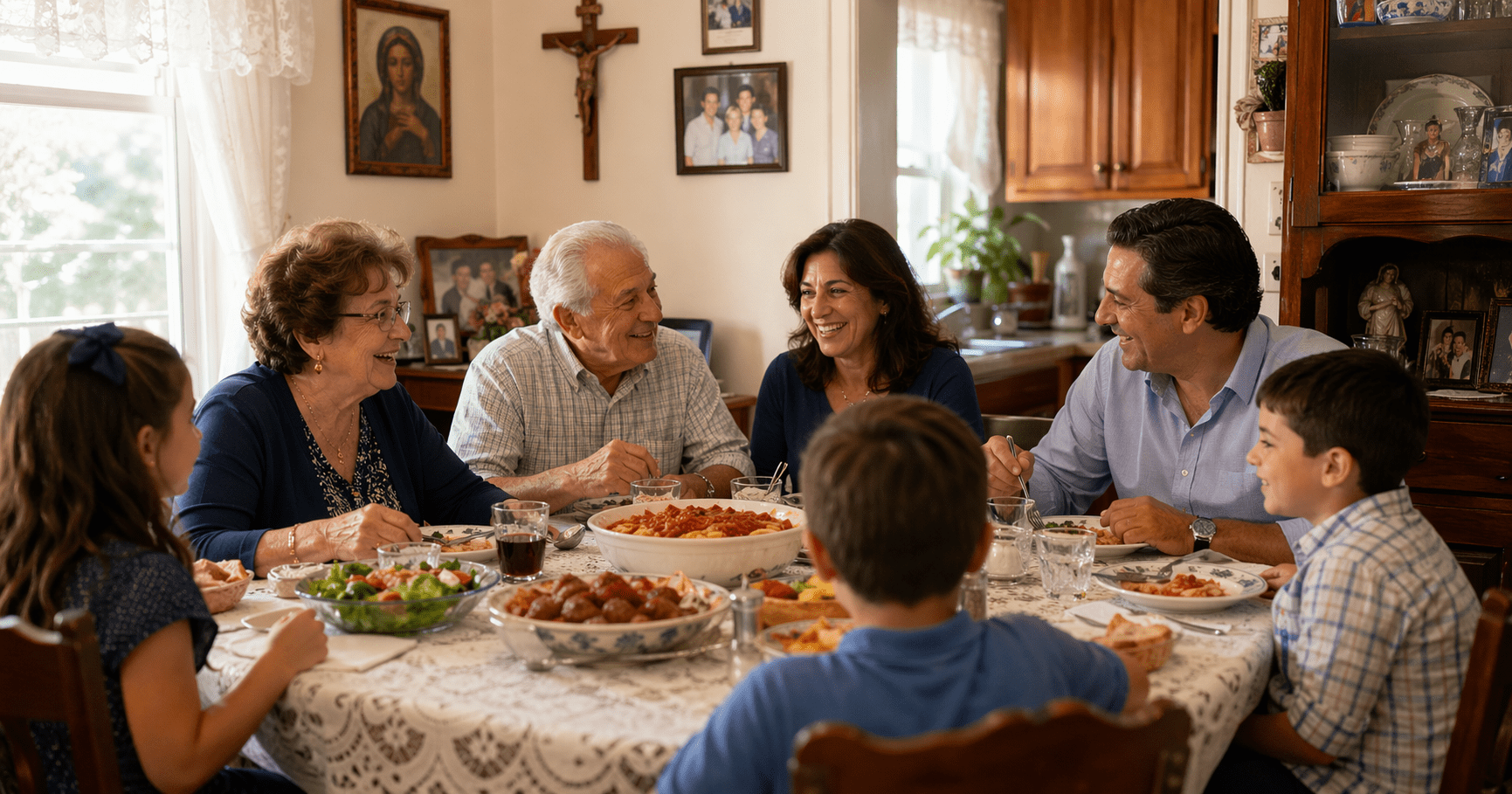
The grandfather sat at the head of the table. Not because someone had decided this as a policy but because it was simply how the table arranged itself — the logic of authority and age expressing itself through seating without anyone needing to announce it. The grandmother sat nearest the kitchen. This was never described as a lesser position and was not experienced as one — it was the strategic position of the person who was managing the meal, who needed to be closest to what was still cooking and what was about to come out. The head and the kitchen end were the two poles of authority at the Italian family table, and they were occupied by the two most powerful people in the room.
Children sat where they were put. Guests were placed deliberately — given good positions, served first or especially, treated with the specific hospitality that Italian family culture attached to the role of the guest. The table as a physical arrangement communicated who was being honored, who was being managed, and where the family’s center of gravity was located.
The first time I sat at the adult end of the table — not at the children’s extension, not in the middle, but near my grandfather at the head — I was perhaps fourteen. Nobody announced it. Nobody made it into a ceremony. I was simply seated there, by my grandmother, who pointed at the chair without comment. I understood immediately that something had changed. That I had been assessed and promoted in some way that had nothing to do with age and everything to do with whether I had learned how to be at the table properly. The seating was the verdict. I ate very carefully that afternoon.
The progression from children’s table to adult table — in families large enough to require two tables — was one of the most significant social passages of Italian family life. It was never formally announced and never required a speech. It simply happened, when the adults decided it had happened, and was communicated through where you were told to sit. That promotion was taken seriously by the children who received it and remembered for years afterward. The table knew when you were ready before you did.
The rules — what they were and what each one was really doing
| The rule | In Italian | What it actually meant | What it was protecting |
|---|---|---|---|
| Wait for everyone | Aspetta tutti | “Not yet.” “Let Nonno sit first.” The meal begins together or it does not begin at all. | The collective nature of the meal — the statement that no one’s hunger is more important than everyone’s presence |
| Stay at the table | Stai a tavola | “Where are you going?” “We are still eating.” The meal is over when the table says so, not when your plate is empty. | The time of the meal — the understanding that eating together requires actually being together for the full duration |
| Do not make a mess | Stai attento | Eat neatly. Chew quietly. Do not turn the meal into a physical event for everyone around you. | The comfort of others — Della Casa’s original point: bad manners are bad because they disturb the people around you |
| Respect the bread | Non si spreca | Do not play with it. Do not waste it. Do not fill up on it before the meal arrives. | The substance of what is being shared — and the memory, conscious or not, of when bread was not casual |
| Try what is served | Assaggia almeno | You do not have to love every dish. You do have to give it a chance. | The cook’s effort — rejecting the food too quickly is rejecting the care that produced it |
| Do not rush the courses | Piano piano | Do not ask for dessert while the pasta is still being served. The meal has a rhythm. | The structure of the meal — the understanding that eating together is a paced, unfolding event rather than a logistics problem to be solved quickly |
| Talk, but do not dominate | Lascia parlare gli altri | The table is for conversation. Not for becoming the only voice in the room. | The social dimension — everyone at the table exists and deserves to be in the conversation |
| Respect the cook and host | Si rispetta chi cucina | Show up. Sit down properly. Try the food. Do not make the whole thing harder than it has to be. | The effort that produced the meal — which was substantial and deserved acknowledgment through behavior |
The cook — her authority and what it looked like
The person who cooked held a specific kind of authority at the Italian family table that was unlike any other authority in the household. It was not announced and it was not argued about. It simply existed, rooted in the fundamental logic that the person who made the meal controlled the meal — what was served, how much you received, whether you got seconds, whether the look on your face when you ate it was acceptable, and whether the overall quality of your behavior at the table was sufficient to justify dessert.
In Italian family life, the cook was almost always a woman — grandmother or mother, and usually the grandmother when she was present. Her authority at the table was the counterpart to her authority in the kitchen: absolute within its domain and entirely unsentimentally exercised. She did not ask whether you wanted more. She assessed whether you needed more and acted accordingly. She did not present the food as an option. She presented it as what was happening, and your relationship to it was expected to be respectful.
My grandmother never asked whether anyone enjoyed the meal. She watched. The watching was thorough and continuous — the specific attention of someone who had been cooking for this family for decades and knew exactly what each person ate when they were happy, when they were distracted, when they were not feeling well, and when they were trying to get away with pretending they had eaten more than they had. She knew the difference between a clean plate that came from genuine appetite and a clean plate that had been achieved through strategic rearrangement. Nothing escaped this observation. Nothing. The table was her domain and she administered it with the quiet authority of someone who had never needed to raise her voice to make a point land.
The cook’s authority also expressed itself through portions — who got more, who got the best piece, who received the specific dish that had been made with them in mind. In Italian family culture, cooking for someone was an act of care that was not casual. The meal was a message. The portions were part of the message. Knowing that your grandmother had made the thing you specifically loved, and had made extra of it because you were coming, communicated something that no other gesture in the family’s vocabulary quite matched.
This is the same authority documented in the malocchio tradition and in the Italian funeral traditions — the pattern of older Italian women as the holders and administrators of the family’s most important knowledge and most important spaces. The kitchen and the table were her domain. Everyone else was a guest in it, including her own husband.
What stayed off the table — the protected space of the meal
Every Italian family had a list of topics that did not belong at the dinner table — things that were considered too heavy, too disruptive, or simply not welcome during the meal. This was not always formally stated. It was understood. The table was protected space, and certain things had to wait until outside it.
Money problems. Disputes between family members. Bad news that had not yet been processed. Arguments that were ongoing and would need more than a dinner’s worth of time to resolve. These things had their time and their place — and their place was not at the table while people were eating. The meal deserved better than to be used as the venue for difficulty. This was partly practical — nobody eats well when a serious argument is happening — and partly philosophical. The table was supposed to be good. Bringing bad things to it spoiled something that could not easily be restored once it was spoiled.
My grandfather had a rule that I only understood fully as an adult: nothing unresolved came to the table. If two family members had an argument that had not been settled, it was settled before dinner or it waited until after. The table was not where you worked things out. It was where you ate, and eating together required a certain quality of peace that could not coexist with active conflict. He enforced this not through speeches but through a very specific look he gave if conversation moved toward anything he considered inappropriate for the meal. The look was different from my grandmother’s look — less about manners, more about dignity. This is not what we do here. This is not what this table is for.
The flip side of this protection was equally important: the table was where good things went. Stories. Jokes. Family news. Plans. Compliments about the food. Memories. The Italian family meal was an extraordinarily rich conversational environment precisely because it was protected from the weight of unresolved difficulty. When the table was doing its job properly, it was one of the warmest and most nourishing social spaces a person could inhabit. The rules that kept bad things out were directly responsible for the goodness that was allowed in.
How the meal ended — and why the ending mattered
Just as the Italian family meal had a specific beginning — Aspetta tutti, everyone seated, Buon appetito said together — it had a specific ending, and the ending was as structured as the opening even when it appeared to happen organically.
The coffee was the signal. In most Italian families, the arrival of coffee meant the meal was entering its final phase — not over, but closing. Coffee was accompanied by something sweet if there was something sweet, and by a continuation of conversation that was now less anchored to the food and more free-ranging. Then the digestivo if the occasion warranted it — an amaro, a small glass of something that came from a bottle that lived in a specific cabinet and appeared only at the right moment.
The actual dispersal happened slowly and often involved several false endings. Someone would stand up and be talked back into the chair. Someone would announce they had to leave and then remain for another forty-five minutes. The Italian family meal did not end sharply. It tapered — conversation becoming gradually less dense, people beginning to drift, the energy slowly releasing rather than cutting off. This gradual ending was itself a form of respect for what had happened at the table. You did not slam a door on it. You eased your way out of it, acknowledging through the slowness of your departure that what had happened there had been worth staying in for as long as possible.
My family’s Sunday meals in Rivières-des-Prairies ended when my grandfather got up from the table. That was the signal — not a formal announcement, not a declaration that the meal was over, simply his standing, which everyone registered and which released the meal from its hold on the afternoon. Before that moment, no one left the table without asking. After it, the dispersal could begin. He never seemed conscious of this authority. He simply stood when he was ready to stand, and the meal recognized it. That is the kind of social authority that does not need to announce itself because it has never needed to.
The phone at the table — what the old rules say about a new problem
Giovanni Della Casa was writing in 1558 and had different problems to manage. But the logic of his argument — that bad manners are bad because they make other people at the table feel less present, less important, less worthy of your attention — applies to phones at the dinner table with a clarity that is almost uncomfortable.
A phone at the table does exactly what galateo spent four hundred years warning against. It is not a physical disturbance — you are not spraying food or making noise. It is an attention disturbance, which in some ways is worse. It signals to the people around you that something elsewhere is more interesting than what is here. It makes the other people at the table less than the screen. It violates the central principle of the Italian meal: we are not alone here.
The old Italian table rule was not “be quiet.” It was “be here.” The phone makes being here optional, which is precisely and fundamentally the problem. Every Italian grandmother who insisted that you stay at the table, that you give the meal your attention, that you not treat the time there as dead time between more interesting events — every one of them was protecting something that the phone is now systematically dismantling. They were right. The thing they were protecting was real and worth protecting. It still is.
What these rules were really teaching
When you line all of these rules up together — the waiting, the seating, the phrases, the bread, the cook’s authority, the protected conversational space, the slow ending — they stop being about manners and start being about something else entirely.
They were teaching that other people matter. That shared space has its own requirements. That effort deserves acknowledgment. That being together is a skill, not just a circumstance. That the meal is where a family practices being a family.
UNESCO calls the shared Mediterranean meal a foundation of identity and continuity and a vehicle for the transmission of values across generations. That is the academic version of what Italian grandmothers communicated through a look. The table was where the family learned, meal by meal, how to be the family. The manners were the curriculum. The look was the teaching method.
The dinner table was practice. Not for fancy dining. For being a person who knows how to be with other people — which turns out to be one of the most important things you can learn, and one of the few things you can only learn by doing it repeatedly in the same room as the people who matter most to you.
How to keep the best of these rules alive today
- Wait for everyone before starting — say Buon appetito together, mean it, and teach the children what it means
- Put the phone away for the meal — not in your pocket, where it can still pull at your attention, but genuinely away
- Stay at the table until the meal has actually ended — not until your plate is empty
- Try what is served — and teach children that the person who made the meal deserves at least that much
- Keep the table as protected space — leave the unresolved things outside it when you can
- Let the meal end slowly — do not rush the coffee, do not rush the conversation after, do not treat the table as something to be escaped
- Use the phrases — say A tavola when the meal is ready, say Buon appetito before the first bite, say Mangia to someone you love who is not eating enough. The words carry the tradition in the most portable possible form
My grandmother never raised her voice at the table. She had a look. And everything this post has described — the galateo, the seating, the phrases, the bread, the cook’s quiet authority, the protected space, the slow ending — everything lived inside that look. It said: you know what this table is. You know what it is for. You know what is expected here. And the knowing was not imposed from outside. It had been built, meal by meal, Sunday by Sunday, year by year, into the specific understanding of what it meant to be part of this family at this table in this city, far from where these customs began and still somehow entirely continuous with them.
That is the tradition. Not the rules. The look that did not need the rules because the rules were already understood.
For the full story of what the Italian family table was for and why it mattered so much, read Italian Sunday dinner traditions. For the Italian grandparent sayings that often arrived at the table alongside the food. For how the same table culture shaped La Vigilia and the biggest meals of the Italian year. And for the broader story of how Italian family values survived immigration, read Italian-American traditions: what changed and what stayed.
FAQ
What are traditional Italian table manners?
Traditional Italian table manners come out of the broader culture of galateo — good manners — which Treccani traces to Giovanni Della Casa’s 1558 book and defines as the rules governing how people speak, sit at table, and treat others. In family life this meant waiting for everyone before starting, eating neatly without disturbing others, respecting the food and the cook, staying at the table for the full meal, and treating the shared space with the seriousness it deserved. The underlying principle was consideration rather than elegance: bad manners were bad because they made the meal unpleasant for the other people present.
What does galateo mean?
Galateo is the Italian word for good manners, derived from the title of Giovanni Della Casa’s 1558 book on how to behave in the company of others. Treccani says the word came to mean the whole set of good manners governing social behavior, including behavior at the table. Della Casa’s argument was not primarily about elegance — it was about consideration for others. Manners existed to make shared life more pleasant for everyone present, not to perform refinement for an audience.
What does Buon appetito mean and when do you say it?
Buon appetito means “good appetite” — a wish for a pleasant and satisfying meal. It is said before the first bite, either by the host or the head of the table to the group, or collectively by everyone together. Responding to it — with “grazie, altrettanto” (thank you, same to you) or simply “grazie” — is considered correct. In Italian family culture it was the formal opening of the meal, the collective acknowledgment that eating was about to begin and that everyone present was acknowledged in that beginning.
What does Mangia mean in Italian family culture?
Mangia means “eat” — but in Italian family culture it was a word with multiple registers depending on context and tone. Said to a child who had barely touched their plate: eat. Said to an adult who had eaten normally but not abundantly: eat more. Said while pushing an additional serving onto someone’s plate: eat this. Said while watching someone refuse a second helping: you are making a mistake. It was almost exclusively said by grandmothers, and it was understood by everyone at the table as an expression of care operating through the mechanism of a command. No one was ever harmed by Mangia. Many people were nourished by it in ways that went beyond the nutritional.
Why do Italians eat salad after the main course?
In traditional Italian meal structure, the salad comes after the main course rather than before it. The reasoning is both practical and philosophical: the salad serves as a palate cleanser and digestive aid after the heavier courses, not as an appetizer. Starting a meal with a large salad fills the stomach before the food that is meant to be the center of the meal. The Italian sequence — antipasto, primo (pasta or soup), secondo (meat or fish) with contorno (vegetables), then salad, then fruit and dessert — treats the meal as a progression with a specific internal logic rather than a collection of items that happen to be served together.
Why are table manners so important in Italian families?
Because the table has historically been about much more than food. UNESCO describes the Mediterranean shared meal as a foundation of cultural identity and continuity, a moment of social exchange, and an affirmation of family identity. The Accademia Italiana della Cucina found that Sunday lunch still functions as a ceremony of family and conviviality for many Italians today. When the table carries that much meaning, the rules around it carry meaning too — they are protecting the quality of what happens there, not just regulating behavior for its own sake.
What does A tavola mean?
A tavola means “to the table” — the announcement that the meal is ready and everyone should come now. In Italian family life it was said from the kitchen doorway by whoever had cooked, and it had a specific authority that was not a request. Whatever was happening — conversation, television, children playing — stopped. The meal was ready. The table was calling. You came.
What is the phone rule at an Italian family table?
The traditional Italian table rule was not “be quiet” — it was “be here.” A phone at the table violates this in the most fundamental way: it signals to everyone around you that something elsewhere is more interesting than what is present. Giovanni Della Casa’s 1558 argument about bad manners — that they make other people feel less present and less worthy of attention — applies to phones with more precision than to almost any other modern behavior. The Italian grandmothers who insisted you stay at the table, give the meal your attention, and not treat the time there as dead time were protecting something real. The phone makes that protection harder. The principle behind the old rule is unchanged.
Did all Italian families have the same table rules?
No — Italy is regional and family-specific, and the specific rules varied by household, region of origin, and generation. But the broad themes were consistent: wait for others before starting, respect the food and the person who made it, stay at the table for the full meal, and do not make the shared space unpleasant for the people around you. The Italian phrases were often the same even when everything else varied — Aspetta, Mangia, Buon appetito, A tavola — because those words had been said at Italian tables for long enough that they had become the tradition itself, portable across regions and generations and oceans.

Marco Ricci is an Italian-Canadian writer and the grandson of Calabrian immigrants. He created Italian Family Traditions to document the customs, feast days, and family rituals Italian families carried from Italy to North America — and to understand what they actually meant. He is based in Montreal.