Italian Family Traditions
What Is a Presepe? The Meaning of Italy’s Nativity Tradition
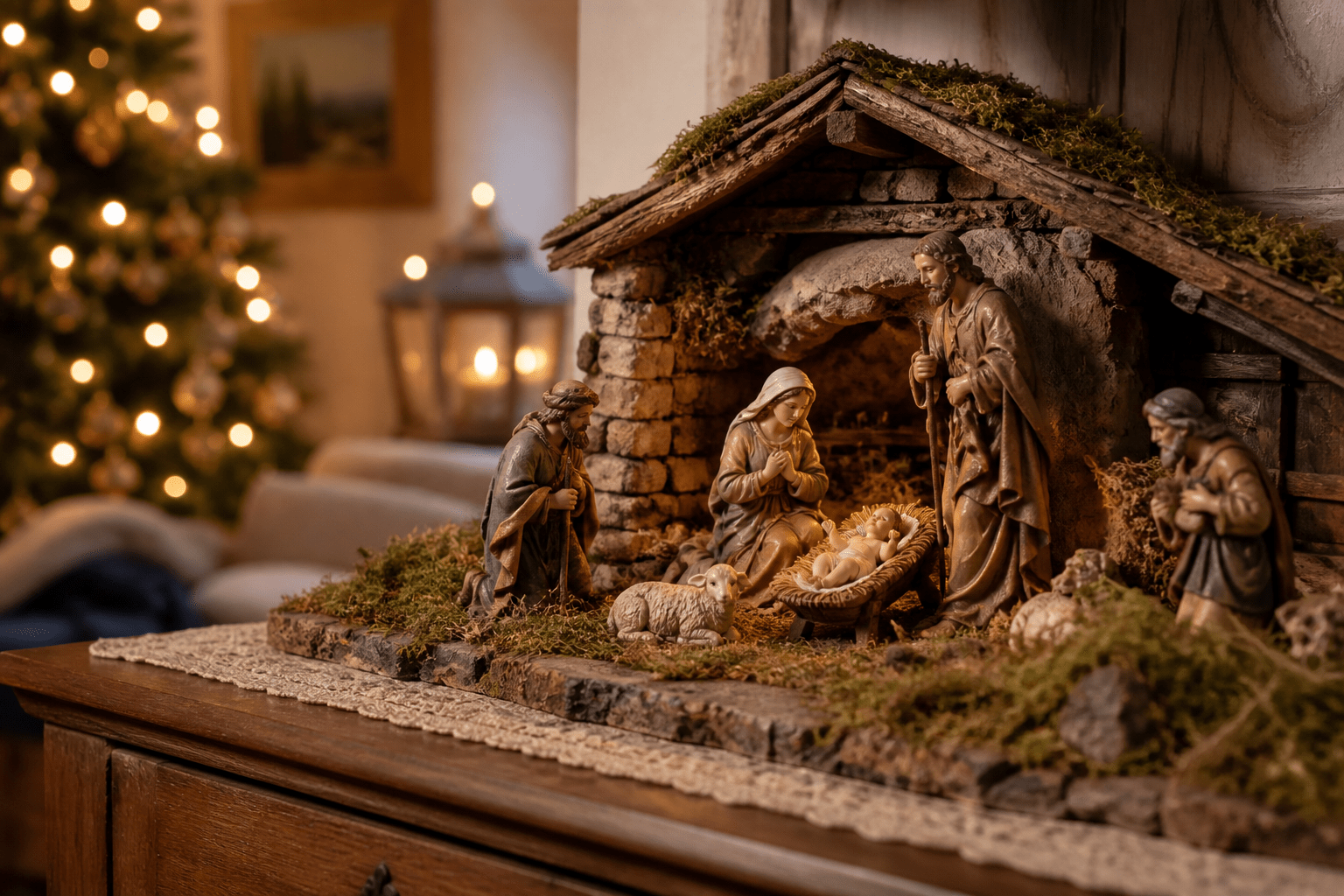
A presepe is the Italian nativity scene. But in family life it is something more than that — a small world of faith, memory, and Christmas meaning that makes the story of Christ’s birth feel close rather than distant, human rather than abstract.
The box came down from the shelf sometime in the first week of December. That was the signal — not the calendar, not the decorations, not even the tree, but the specific box with the specific contents that meant the presepe was happening. My grandfather took it seriously in a way that the word “seriously” does not quite cover. He had built the structure himself over years — cork and moss and small rocks and a piece of mirror for the pond and, eventually, a pump that produced an actual running waterfall that could be heard from the kitchen. He placed each figure with care. He had opinions. When anyone else tried to place a figure, he watched with the specific patience of a man who intended to move it the moment the other person left the room.
The youngest child placed the figure of the Christ child in the manger on Christmas Eve, at midnight. This was not optional and it was not informal. The figures of the Magi stood at a distance from the stable throughout December, moving incrementally closer day by day, not arriving until Epiphany on January 6. My grandfather had read about this practice somewhere and adopted it with the conviction of someone who felt he had always been doing it this way.
The presepe does something that most Christmas decorations do not. It slows the room down. It asks you to come closer. It makes the story of Christmas feel like it is happening nearby rather than in a place and time you cannot reach.
This article is the full story of the presepe: what it is, where it came from, what makes the Italian version distinctive, how it crossed the ocean and adapted, and how to keep it meaningful in a family that may be several generations removed from the tradition’s roots.
What presepe means
A presepe is the Italian nativity scene — the visual representation of Christ’s birth set up in churches and homes during the Christmas season. The word comes from the Latin praesepium, meaning manger or crib, as Treccani explains. The same tradition appears in Encyclopaedia Britannica’s explanation of the crèche, which ties the nativity display to the broader Christian Christmas tradition.
At the most basic level, the presepe contains Mary, Joseph, and the infant Jesus in the manger — maybe an ox and a donkey, maybe shepherds, maybe angels and the Magi arriving from a distance. That is the essential scene. But an Italian presepe, particularly in the southern tradition, often becomes something considerably more. It becomes a world — a small complete environment in which the birth of Christ is not set in an isolated stable but in a living village, surrounded by the business and texture of ordinary human life.
That expansion is one of the things that makes the Italian presepe feel different from a generic nativity set. The sacred event stays at the center, but daily life presses in around it. A baker may appear. A market vendor. A sleeping dog. A woman carrying water. The message is almost theological: the holy enters the world as it actually is, not as a removed or sanitized version of it. Which, honestly, feels very Italian.
Where the presepe tradition comes from
The nativity scene as a visual tradition in Christianity goes back further than most people realize. Images of the Nativity appeared in early Christian art centuries before the classic home presepe became a familiar family custom. But the tradition most people associate with the modern presepe was decisively shaped by one moment.
In 1223, Saint Francis of Assisi staged a living nativity at Greccio — a recreation of the Christmas story using real people and animals — to make the birth of Christ emotionally immediate rather than abstractly theological. This event is widely credited with popularizing the Christmas crèche as a devotional practice, as Britannica explains. The goal was simple and remains entirely legible: to make the Christmas story feel close, real, and human.
Over the following centuries, churches across Italy adopted elaborate nativity displays, and the figures grew in artistry and ambition. By the 18th century, the Neapolitan presepe reached its artistic peak — under royal patronage and with the involvement of major craftsmen, nativity scenes in Naples became extraordinary works of art with dozens or hundreds of figures, as documented by the Victoria and Albert Museum.
Then, through the 19th and 20th centuries, the tradition spread from churches and royal households into domestic life — the family presepe, smaller in scale but carrying the same instinct: bring Bethlehem into the home and make it feel alive.
What that history shows is that the presepe was never decorative in the way Christmas lights are decorative. It was always doing something. Saint Francis’s instinct in 1223 and an Italian-Canadian grandfather’s instinct building a cork mountain with a working waterfall eight hundred years later are, at root, the same instinct.
What makes the Italian presepe different
The Neapolitan presepe, in its fullest 18th-century form, is one of the most extraordinary expressions of religious folk art in the world. As the Victoria and Albert Museum describes, these scenes could include not only the Holy Family, shepherds, and kings, but also street sellers, market scenes, taverns, beggars, noblemen, peasants, and whole slices of everyday life — all arranged around the stable at the center.
That mixture is the key to understanding what the Italian presepe is doing. It is not segregating the sacred from the ordinary. It is putting them in the same frame and letting them be neighbors. Bethlehem is in the village. The village is Bethlehem. The birth of Christ happens in a world that looks, in miniature, like the world you actually live in.
My grandfather’s presepe grew more elaborate every year. By the time I was old enough to pay real attention to it, it occupied most of a large table and included: the stable at center with the Holy Family, a shepherd on a cork hillside, a village scene with miniature buildings he had made himself from balsa wood and paint, a flock of ceramic sheep, a pond made from a piece of mirror, and the waterfall — a pump that circulated water through a tube hidden under the moss and produced a quiet trickle you could hear if the room was quiet enough. He had placed the whole structure at a slight angle so that the water moved convincingly downhill. He had spent one entire December troubleshooting the pump. He was seventy-three years old and had never been more focused on anything in his life. The presepe was, in its way, his annual proof that the tradition deserved its place in the house.
The rituals around the presepe — when figures move and why
Some of the most meaningful aspects of the presepe tradition are not the scene itself but the rituals that unfold around it across the Christmas season. These small customs give the presepe a liturgical rhythm that mirrors the rhythm of the Church’s own calendar.
The scene goes up before Christmas. In many families the presepe appears in early December, sometimes on December 8 — the feast of the Immaculate Conception — which traditionally opens the Italian Christmas season.
Baby Jesus is absent until Christmas Eve. The manger stays empty through Advent. The youngest child in the family often has the honor of placing the Christ child figure at midnight on Christmas Eve, or on Christmas morning if small children cannot stay awake. This is the emotional center of the presepe tradition. Everything has been waiting. Then the child places the figure and the scene is complete.
The Magi move across the room toward the stable. In some families the three kings begin December at a distance from the stable — perhaps on a bookshelf across the room — and move incrementally closer throughout the month, arriving at the manger on Epiphany, January 6. This custom follows the liturgical timeline of the Christmas story: the Magi were not present at the birth. They arrived later. The presepe honors that.
The scene stays up through Epiphany on January 6. The presepe is not a Christmas Day decoration that comes down on December 26. It belongs to the whole Italian Christmas arc — from the vigil of December 24 through the feast of the Befana on January 6, consistent with both Britannica’s discussion of the Christmas crèche and the V&A’s documentation of Italian presepe traditions. For the full story of that arc, read about La Vigilia and the Italian Christmas Eve tradition.
The placing of the Christ child was assigned by rotation in my family, but only among the youngest children present. When I was old enough to do it, the ceremony had weight I was not entirely prepared for. You carried the figure from wherever it had been kept — a small wooden box, usually, on a high shelf — to the stable. Everyone in the room stopped talking. You placed it in the manger. My grandfather watched with the expression of someone who had been waiting for this specific moment since the previous January. Then the room came back to life. It is a small thing to describe. It is a large thing to experience. That is always the way with family rituals that have lasted long enough to accumulate meaning.
The presepe in Italian-Canadian and Italian-American families
Like most Italian traditions, the presepe crossed the ocean and adapted. Immigrant families did not always have the same homes, the same materials, or the same space they once had. A giant elaborate Neapolitan village scene was not always realistic in a Montreal apartment or a Toronto duplex. So the tradition often became smaller in scale — not smaller in meaning.
A simpler stable. Fewer figures. Less theatrical setting. But the same emotional role: making Christmas feel rooted in story and faith rather than only in decoration and shopping. The rituals often survived even when the physical presepe was modest — the empty manger waiting for Christmas Eve, the youngest child placing the figure, the scene staying up past Christmas Day.
In Montreal’s Italian community — centered first in Little Italy around Saint-Laurent and Dante, then spreading to Saint-Michel and Rivières-des-Prairies — the presepe was part of the same household Christmas rhythm as the Christmas Eve vigil and the family gathering on Capodanno. It belonged to the specifically Italian Catholic understanding of Christmas as a season with a story at its center.
A lot of adults cannot remember every toy they received as children. They can remember where the nativity sat. They can remember who set it up. They can remember being told firmly not to touch anything, then absolutely touching something anyway. That is how memory works — not through the grand gestures but through the specific textures of ordinary family ritual.
How to keep the presepe meaningful today
The good news about the presepe tradition is that it does not need to be elaborate to be powerful. You do not need a working waterfall or a cork hillside or a miniature village with functioning lights. What you need is the intention behind it — the decision to make the Christmas story visible in the home rather than leaving it entirely to the church building.
Set it up with the children and explain who the figures are and why the scene matters. A child who has been told the story of the nativity while handling the figures knows it differently from a child who has only read about it or heard it in the abstract. The physical handling is part of the learning.
Keep the ritual of the empty manger if your family has any Catholic or Christian practice at all. Let the youngest child place the Christ child on Christmas Eve. That single custom carries more weight than any amount of explaining, because it gives the child a role in the story rather than a seat in the audience.
Bring in the family memory alongside the religious meaning. Mention the old presepe. Mention the grandfather who built the elaborate version. Mention the relative who always moved the shepherd and the other relative who always moved it back. Those specific family details are what transform the presepe from a generic Christmas tradition into this family’s Christmas tradition. For how to capture those family stories while there is still time, read what to ask your grandparents about your Italian family history.
And if you want to pass the tradition on to children who are not yet engaged, give them a role and connect it to a specific story. For a full guide to that approach, read how to get your kids interested in their Italian heritage.
The waterfall ran every December for more than twenty years. After my grandfather died, we could not get the pump to work. We tried once and gave up. But the presepe still went up. The scene was still there. The youngest child still placed the Christ child on Christmas Eve. The Magi still moved across the room toward the stable, day by day through December, arriving on January 6 as they always had.
The waterfall was his. The tradition was everybody’s. That is how the best parts of a family presepe work — the elaborate personal touches belong to one person, but the ritual underneath them survives and passes on. What a few small figurines in the right place can quietly accomplish is worth the box coming down from the shelf every December.
The presepe belongs to the same Italian Christmas arc as La Vigilia on Christmas Eve. For the full Italian holiday season from Christmas through Epiphany, read about Capodanno and Italy’s New Year’s Day tradition. For how to display and preserve the family objects connected to these traditions, read how to create an Italian family memory corner at home. And for the story of how Italian Christmas traditions like the presepe survived immigration, read Italian-American traditions: what changed and what stayed.
FAQ
What does presepe mean in English?
Presepe means nativity scene or crib scene in English. The word comes from the Latin praesepium, meaning manger or crib, as Treccani explains. In Italian family life, the presepe refers both to the physical nativity display and to the whole set of customs, rituals, and family memories that surround it across the Christmas season — making it a richer concept than the English equivalent typically suggests.
Is a presepe the same as a nativity scene?
Yes, but the Italian presepe often carries a much richer family and cultural tradition around it. In places like Naples, the presepe became elaborate enough to include not only the Holy Family but also market scenes, village life, street vendors, and detailed representations of everyday 18th-century life — all arranged around the stable at the center. Even in simpler family versions, the presepe tends to have customs and rituals attached to it that make it more than a decoration.
Who started the presepe tradition in Italy?
Saint Francis of Assisi is widely credited with popularizing the Christmas crèche through his living nativity at Greccio in 1223, as documented by Encyclopaedia Britannica. The goal was to make the birth of Christ emotionally immediate and humanly real rather than abstract. That same instinct — bringing the Christmas story into ordinary life through visible, tangible means — drove the tradition’s development from church display to family tradition over the following centuries.
When do Italians put up the presepe?
Practices vary by family and region, but many Italian families begin setting up the presepe in early December, sometimes on December 8 — the feast of the Immaculate Conception — which traditionally opens the Italian Christmas season. The scene typically stays up through Epiphany on January 6, and in many families baby Jesus is not placed in the manger until Christmas Eve, which is the emotional center of the whole presepe tradition.
Why do the Magi move toward the stable in some family presepi?
Some Italian families follow the liturgical timeline of the Christmas story literally: the Magi were not present at the birth of Christ but arrived later. So the three kings begin December at a distance from the stable and move incrementally closer day by day, arriving at the manger on Epiphany, January 6. This custom gives the presepe a seasonal rhythm that unfolds across the whole Christmas arc rather than being static from the moment it is assembled.
Why is the presepe important in Italian families?
The presepe brings the Christmas story into the home in a human and visual way, giving children something to look at, ask about, and participate in rather than only observe. Pope Francis has spoken about the Christmas crib as a simple and beautiful sign of faith that is good when handed down from parents to children and grandparents to grandchildren — which is exactly how many Italian families have experienced it. The presepe makes Christmas feel rooted in story and faith rather than only in mood and decoration.
How can I keep the presepe tradition alive in my family today?
Set it up with the children and explain who the figures are and why the scene matters. Keep the ritual of the empty manger if at all possible — let the youngest child place the Christ child on Christmas Eve. Bring in the family memory alongside the religious meaning: mention the old presepe, mention the relatives who had strong opinions about where the shepherd went. Give each child a specific role in the setup rather than asking them only to watch. Physical participation in a tradition with a story attached to it is how heritage passes from one generation to the next.

Marco Ricci is an Italian-Canadian writer and the grandson of Calabrian immigrants. He created Italian Family Traditions to document the customs, feast days, and family rituals Italian families carried from Italy to North America — and to understand what they actually meant. He is based in Montreal.