Italian Family Traditions
La Smorfia: Find Your Dream’s Number (Free Dream Finder)
Every dream meant something. Every strange event carried a number. Every number, if you played it on Saturday, might change everything. That was Naples — a city that turned the interior life into a weekly interpretive event and gave the rest of Italy a tradition that survived immigration and still lives in fragments on kitchen tables today.
In the Neapolitan tradition of la smorfia, every dream has a number. Type what you saw — a cat, money, your mother, the dead — and the finder below gives you its number and meaning. The full story of where this comes from follows underneath.
Find your dream’s number: the Smorfia dream finder
La Smorfia Napoletana
The Smorfia Dream Number Finder
In the Neapolitan tradition, every dream hides a number. Tell us what you dreamed about, and find its Smorfia number and meaning.
Not sure?
La Smorfia is a centuries-old Neapolitan tradition of turning dreams into numbers — shared here for cultural interest and fun, not as betting advice.
Preserve Your Family’s Version
Did your family have its own Smorfia numbers?
Record the dreams, sayings, traditions, recipes and family meanings your grandparents carried with them.
Preserve Your Family’s Story →133 guided pages · Instant digital download · $19.99
My grandmother told her dreams at breakfast. Not all of them — only the ones that felt weighted, that had arrived with that specific quality of significance that made them different from the ordinary noise of sleep. The dream had to be told before coffee, ideally before anyone else had spoken, because speaking it too late would let it thin. She told it the way she told actual news: with the same seriousness, the same expectation that it mattered and would be received as such.
My grandfather listened. An aunt listened. Whoever was at the table listened. Then the numbers came. There was almost always a brief disagreement — someone would say 13, someone else would say 47, and the argument was never heated but more like a negotiation, a collaborative interpretation of the evidence. The grandmother usually had the authoritative position, not because she shouted it down but because she had been doing this longer and her associations were more finely tuned. The discussion would conclude. Someone would open the small notebook kept in the kitchen drawer — black cover, soft from handling, full of numbers in several different hands from several different years — write the date, the dream in a few words, and the numbers. Then breakfast continued.
La smorfia is not really about the lottery. It is about the Neapolitan conviction that daily life — including the life that happens while you sleep — is always saying something more than it seems, and that the family table is the right place to interpret what.
What la smorfia is
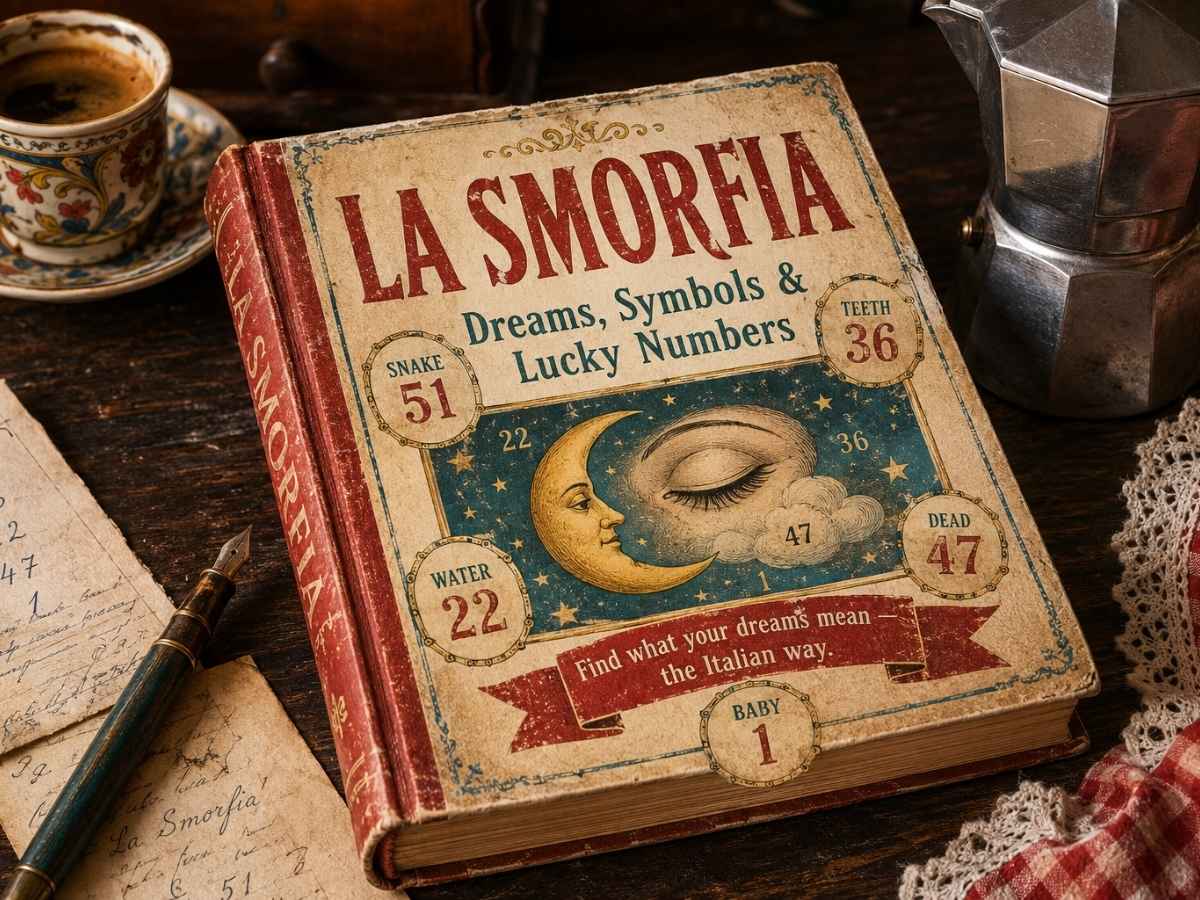
La smorfia is the traditional Neapolitan system for translating dreams, people, objects, and everyday events into symbolic numbers from 1 to 90. At its core it is a “dream book” — a dictionary of correspondences between images and numbers — but to call it only that understates what it does in a family or community. It is also a language, a joke system, a memory device, a piece of popular philosophy, and a way of treating ordinary life as symbolically meaningful in a manner that simultaneously takes itself seriously and refuses to take itself too seriously.
As Visit Naples explains, la smorfia is a book of dreams built around 90 numbers, based on the idea that there is a correspondence between dreams, real-life happenings, and numbers. Napoli Sotterranea describes it as the old Neapolitan tradition of interpreting dreams to derive numbers, and notes that Neapolitans used it to interpret strange events from ordinary life as well, not only dreams. SuperEnalotto’s smorfia guide puts it directly: every word, event, person, or object in a dream can be transformed into one or more numbers.
Free Printable
There was a notebook in the kitchen drawer. Start your own.
Get new stories about la smorfia, folk beliefs, and the customs our grandparents kept — plus the free printable calendar of the Italian year. Join the list and we’ll send it to you.
Preserve Your Family’s Version of the Tradition
The numbers your grandparents remembered, the dreams they discussed, the sayings they used, and the family meanings that never appeared in a printed smorfia are exactly the details most likely to disappear. The Italian Family Heritage Kit gives you the questions and space to record them.
Explore the Italian Family Heritage Kit →Why Naples specifically — the lotto and why the smorfia became so elaborate
To understand why la smorfia is what it is — why it became so elaborate, so finely tuned, so culturally embedded — you have to understand the role of the lotto in Neapolitan life. Visit Naples calls Naples “the capital of the Lotto” and this is not a minor honorific. The Neapolitan lottery was for centuries not merely a game but a civic institution. The drawing happened on Saturdays. The entire preceding week was structured, for much of the city’s population, around the interpretive work of generating numbers to play.
That meant the smorfia was not an occasional curiosity consulted when someone had a particularly vivid dream. It was a weekly practice. Dreams were analyzed every morning. Strange events were noted and converted. Coincidences were read for their numerical content. The notebook in the kitchen drawer was not a novelty — it was a working document, updated regularly, consulted with genuine seriousness by people who understood that Saturday was coming and that the numbers they played would come from somewhere.
In that context, la smorfia makes complete sense. An entire city needed a sophisticated system for converting the raw material of daily experience — dreams, encounters, deaths, births, strange happenings — into the precise language of numbers, and it developed one. The system became elaborate because it was used constantly, by everyone, for generations. The 90-number range is not arbitrary: it matches the 90 numbers of the Neapolitan lottery exactly. The smorfia was the preparation engine for the lotto, which is why it became so specific, so culturally rich, and so distinctively Neapolitan.
The uncle who always said the smorfia was nonsense was also always the first one to have a number ready. He would wave it away — “dreams don’t mean anything, it’s just your brain clearing out” — and then, before anyone else had spoken, he would say “but if it were anything it would be a 48.” He never explained this and never acknowledged the contradiction. He played the number every week. This is probably the most honest possible relationship with la smorfia: halfhearted about the metaphysics, fully committed to the practice. Which is also, I think, the relationship most of Naples had with it for most of its history.
Where la smorfia comes from
The name is most commonly linked to Morpheus — the figure from ancient Greek tradition associated with dreams and the dream world. Visit Naples, Napoli Sotterranea, and SuperEnalotto all make this connection. The word is thought to derive from Morpheus through centuries of phonetic transformation in the Neapolitan dialect.
The broader instinct — that dreams mean something and can be systematically interpreted — goes back much further. As Encyclopaedia Britannica notes, a formal book of dream interpretation called the Oneirocritica was compiled in the 3rd century by Artemidorus Daldianus, placing la smorfia within a tradition of dream books that runs through the Mediterranean world for nearly two thousand years. Naples gave that tradition its own specific local flavor — its own humor, its own cast of characters, its own 90-number system — but the underlying impulse is ancient and very human.
Some sources, including Napoli Sotterranea, also mention possible connections to Jewish Kabbalistic numerological traditions that flourished in Naples during certain historical periods. These are presented as possibilities rather than certainties. The true origins of la smorfia are, appropriately for a tradition rooted in dreams, a little hazy at the edges.
The numbers — what they are and what they mean
At the heart of la smorfia is a simple idea: images become numbers. The system is not rigidly mechanical — there is room for variation, for family tradition, for the specific associations carried in a particular household. These are the most widely shared associations, though family versions often varied by region and by the oral chain through which the knowledge passed.
| Number | What it represents | The feel of it |
|---|---|---|
| 1 | L’Italia — Italy itself | The country as a number. Announced with mild pride. |
| 8 | A faccia — the face | Whose face matters. Discussion follows. |
| 13 | Sant’Antonio — Saint Anthony | The patron of lost things. Heard more often than you might expect. |
| 17 | Il morto — the dead man | The most discussed number in the system. A pause always follows. Someone makes the sign of the cross. Someone else says it is just a number. Both are right. |
| 22 | O pazzo — the madman | Comic but not always gentle. The caller looks at someone specific. That person decides how to react. |
| 25 | Il Natale — Christmas | The sacred arrives in the system. Said with warmth in December, with a different quality in July. |
| 33 | Gli anni di Cristo — the years of Christ | Announced with weight. The religious members of the table feel this one differently from the others. |
| 42 | Il caffè — coffee | The most domestic number in the smorfia. Sometimes announced first thing in the morning for obvious reasons. |
| 47 | Il morto che parla — the dead man who speaks | More unsettling than 17. Someone always says they dreamed this number just before something significant happened. |
| 48 | Il morto che ride — the dead man who laughs | After 47, this one produces relief. The dead man improved. The room laughs a little. |
| 52 | La mamma — mother | The most personal number. Said quietly. Received quietly. |
| 69 | Il ridere e il piangere — laughter and tears | The philosopher’s number. Someone at the table always applies it to the present moment. |
| 75 | Pulcinella | The great comic trickster of Neapolitan theatre. His number is announced with performance. It is impossible to say it flat. |
| 90 | La paura — fear | The last number. Always announced with ceremony. The room feels it. Nobody quite laughs. |
What that range tells you — coffee, Christmas, the dead man who laughs, the mother, fear, Pulcinella — is that la smorfia does not separate the sacred from the comic or the domestic from the unsettling. They all live in the same system, side by side, which is itself a statement about how Naples understood the world.
Pulcinella — and the comic soul of the smorfia
Number 75 — Pulcinella — is not an accident. It is a choice that tells you something important about what kind of tradition la smorfia is.
Pulcinella is the great comic figure of Neapolitan commedia dell’arte: the trickster, the fool, the outsider who says what cannot otherwise be said, who turns tragedy into comedy through sheer irreverence, who refuses to be serious when seriousness would be the easier and more comfortable response. He is white-masked, hunchbacked, eternally hungry, chronically unlucky, and somehow always still standing. He is the figure who makes the audience laugh at the things that would otherwise only make them cry.
His presence in the smorfia at number 75 is a declaration about the tradition’s own character. La smorfia holds death and coffee and Christmas and the mother and the madman and Pulcinella in the same 90 numbers without flinching. It is a tradition that refuses to choose between gravity and comedy, between the sacred and the absurd, between genuine belief and knowing self-mockery. That refusal is deeply Neapolitan and it is what makes the smorfia feel alive rather than merely antiquarian. The uncle who waves it away and then says “but if it were anything it would be a 48” is channeling Pulcinella. That is the correct relationship.
The dead in the smorfia — why 17, 47, and 48 matter
No other presence in la smorfia receives as much symbolic attention as the dead. Il morto (17), il morto che parla (47), and il morto che ride (48) represent three distinct states of the dead — silent, speaking, and laughing — which is a more elaborate taxonomy of death than most cultural systems bother to develop. That elaborateness is not coincidental.
In Neapolitan and Italian Catholic culture, the dead are not simply gone. They remain part of the symbolic world of the living — appearing in dreams, sending signs, delivering warnings, communicating through the very images that the smorfia was designed to interpret. When a dead relative appears in a dream, the smorfia does not treat this as merely neurological noise. It treats it as a communication that deserves interpretation: is the dead person silent (17)? Speaking (47)? Laughing (48)? Each state carries different implications, different associations, different numbers. The fine distinctions matter because the communication is presumed to be specific.
That presumption connects la smorfia to the broader Italian relationship with death that surfaces in traditions like Ognissanti — the feast of all souls in early November when Italian families visit the cemetery, lay flowers, say the names of the dead aloud, and acknowledge that those who have died remain present in the life of the family. The smorfia operationalizes that acknowledgment: it gives the living a system for receiving the messages that the dead might be sending through dreams. Whether or not any specific dreamer literally believes this, the structure of the tradition preserves the underlying idea that the dead are not entirely elsewhere, and that attention to their appearances is a form of respect.
When my grandmother dreamed of her own mother — dead since before I was born — the number she produced was always 47. Il morto che parla. The dead woman who speaks. She never told me what her mother said in the dreams. That was not what you reported at breakfast. You reported the image, the category, the number. The content of the speech was between the two of them. This is its own kind of theological position: the dead speak, the living note that they have spoken, and the content of the conversation is private. The smorfia creates the structure for acknowledging the communication. What passes in the communication itself is not its business.
La smorfia and tombola — the same tradition, two different tables
The connection between la smorfia and tombola — the Italian Christmas number game — is direct and structural. Tombola uses numbers from 1 to 90 because the smorfia uses numbers from 1 to 90. The caller who announces “il morto” for 17, or “o pazzo” for 22, or “il caffè” for 42 is drawing on smorfia vocabulary. The two traditions are not parallel — they are continuous. The same number system that a grandmother used to interpret a dream at breakfast was the system a caller used to manage a room of relatives on Christmas Eve.
That connection is what makes the tombola caller’s role theatrical rather than administrative. The numbers have names. The names have associations. The associations have histories inside the specific family using them for generations. When a good caller draws 47 and says “il morto che parla” in a specific tone — with a pause, with a look at the table — the room responds to all of that at once. The smorfia is the backstory. Tombola is the performance. You cannot fully understand one without the other.
La smorfia in popular culture — from the kitchen table to the stage
La smorfia is also the name of one of the most beloved Neapolitan comedy troupes of the 20th century: the trio consisting of Massimo Troisi, Lello Arena, and Enzo Decaro, who performed together in the late 1970s and early 1980s and whose work launched Troisi’s career as one of the defining figures of Italian cinema. They took the name deliberately — it connected their comedy to the tradition of Neapolitan popular culture, to Pulcinella, to the specific quality of Neapolitan humor that holds the tragic and the comic in the same breath without privileging either.
That the most important Neapolitan comedy troupe of its generation named itself after the dream book is not incidental. It is a declaration about what la smorfia actually is at its best: a practice of reading the world with enough seriousness to take it seriously and enough humor to survive what you find. Massimo Troisi’s films — Ricomincio da tre, Il Postino — carry the same quality. They look at difficult things with warmth and without flinching. That is what the smorfia taught Naples to do, at the breakfast table, for centuries, before the coffee got cold.
Regional variations — why your family’s version may be different
La smorfia spread from Naples throughout southern Italy and eventually into the diaspora, and as it traveled it adapted. The grandfather whose number 8 was “l’amico” — the friend — rather than “a faccia” — the face — was not wrong. He was carrying a regional or family variation that had its own legitimacy and its own history. Calabrian families had their own associations. Sicilian families had their own. Some numbers were consistent everywhere — 17 as il morto, 90 as la paura, 52 as la mamma — while others varied by region, by family, by the specific oral chain through which the knowledge had passed.
This variation is not a sign of the tradition’s imprecision. It is evidence of its nature. Napoli Sotterranea notes that la smorfia was passed down orally before later being written and illustrated, which means the written versions were attempts to capture something that had already lived in voices and families for generations. Every household inflected the system slightly differently, and those inflections were themselves part of what got inherited. The family smorfia — the specific set of associations your grandmother used, that may or may not match any printed book — is the real smorfia for your family. The printed versions are approximations of something that was always more particular than they could contain.
La smorfia outside Naples — how it traveled and what survived
Like most Italian traditions, la smorfia crossed the ocean and adapted. What typically survived was not the full system but the habit of it — the reflex, the instinct that a dream told at breakfast might mean something and is worth discussing, the specific numbers that a family had used enough times to remember.
In many Italian-Canadian and Italian-American households, what remained was a partial smorfia: ten or fifteen numbers that the family knew by heart, surrounded by a general sense that the system existed and that consulting it was the right response to certain kinds of experience. The number for the dead man. The number for the mother. The number for coffee. The number for fear. Even a handful of associations kept the tradition recognizable and transmissible.
That partial survival is not failure — it is how oral traditions adapt and continue. The family that carried five smorfia numbers from Naples to Montreal carried more than the numbers. They carried the practice of turning the interior life into something communal, speakable, discussable at the table. That practice is the tradition’s core. The 90-number system is its body. The body can change size without the core disappearing. This is part of the broader story of Italian-American and Italian-Canadian traditions after immigration.
How to keep la smorfia alive today
La smorfia does not need to become a serious project to stay meaningful. You do not need to memorize all ninety numbers or treat every dream like a coded message from the universe.
Start by asking older relatives which smorfia numbers they still remember and what associations their family used — because the family version often differed from any printed edition, and those differences are worth preserving. The notebook in the kitchen drawer, if it still exists, is more valuable than any published smorfia book because it contains the specific version your family developed and used. For how to recover those conversations while there is still time, read what to ask your grandparents about your Italian family history. For how to record and preserve those conversations, read how to record family stories before they’re lost.
Tell your dreams at breakfast. Use the smorfia vocabulary when calling tombola numbers at Christmas — this article’s table gives you enough to start. Let the tradition be half-serious and half-playful, which is the most historically accurate relationship with it anyway. The uncle who waved it away and always had a number ready was not wrong. He was doing it correctly.
The notebook had numbers in several different hands from several different years. Each entry: the date, the dream in a few words, the numbers. La smorfia is not a lottery system. It is a practice of attention — the conviction that daily life, including the life that happens while you sleep, deserves to be interpreted, shared, and passed on.
Ask which numbers the older relatives still carry. Write them in a notebook. That is already the tradition continuing. The dreams that were never told are the ones that are truly lost.
What Did La Smorfia Mean in Your Family?
Record the numbers, stories, and family meanings before they disappear.
Which numbers did your grandparents know by heart? Who interpreted dreams at breakfast? Was there a notebook in the kitchen drawer? The Italian Family Heritage Kit includes 133 guided pages and more than 120 prompts to preserve your family’s people, names, traditions, recipes, sayings, photographs, and memories.
Explore the Heritage Kit — $19.99Instant digital download. Print it and complete it with your family.
La smorfia connects directly to tombola and the Italian Christmas game tradition. For the Italian relationship with the dead that the smorfia reflects, read about Ognissanti and the feast of all souls. For the broader Neapolitan Christmas tradition, read about La Vigilia and the Italian Christmas Eve. For the protective traditions that share the smorfia’s superstitious spirit, read about malocchio and the Italian evil eye. And for how to recover what the older relatives still carry, read what to ask your grandparents about your Italian family history.
FAQ
How do I find my dream’s number?
Use the Smorfia dream finder above: type what you dreamed about — a person, animal, object, or event — and it returns the traditional Neapolitan number (1–90) and its meaning. You can also browse all ninety numbers. If your exact dream isn’t listed, try the simplest noun for what you saw, since la smorfia assigns numbers to core images.
What is la smorfia?
La smorfia is the traditional Neapolitan system for translating dreams, people, objects, and everyday events into symbolic numbers from 1 to 90. It functions as a “dream book” — a dictionary of correspondences between images and numbers — but it is also a cultural practice: a way of treating the interior life as symbolically meaningful and bringing that meaning into family conversation. Visit Naples describes it as a book of dreams built around 90 numbers, while Napoli Sotterranea notes that Neapolitans used it to interpret not only dreams but also strange events from ordinary life.
What number is death in la smorfia?
Number 17 is il morto — the dead man — and it is the most famous and most discussed number in the entire smorfia system. A pause always follows when it is drawn or called. But the smorfia’s relationship with death is more elaborate than a single number: 47 is il morto che parla (the dead man who speaks) and 48 is il morto che ride (the dead man who laughs). These three numbers represent distinct states of the dead — silent, speaking, and laughing — reflecting the Neapolitan and Italian Catholic understanding that the dead remain part of the symbolic world of the living and may communicate through dreams in ways that deserve interpretation.
What number is coffee in la smorfia?
Number 42 is il caffè — coffee — and it is one of the most recognizable and most beloved entries in the smorfia system. It is the most domestic number: the image of something present at every Italian table every morning, translated into a number that carries with it all of that daily intimacy. It is sometimes announced first thing in the morning during tombola, for obvious reasons, and always produces a warm response from the room. Its presence in the system alongside il morto and la paura tells you something about the kind of tradition la smorfia is — one that holds the grand and the everyday in the same breath without hierarchy.
What number is the mother in la smorfia?
Number 52 is la mamma — the mother — and it is the most personally felt number in the smorfia system. It is said quietly and received quietly. There is no comedy in it, no theatrical pause, none of the performance that surrounds numbers like 22 (o pazzo) or 75 (Pulcinella). The mother’s number arrives with its own specific gravity, and the room responds accordingly. When it appears in a dream — or is drawn in tombola — the quality of attention it receives is different from almost any other number in the system.
What does la smorfia mean?
The word smorfia is most commonly traced to Morpheus — the figure from ancient Greek tradition associated with dreams — through a series of phonetic transformations over centuries of Neapolitan dialect. Visit Naples, Napoli Sotterranea, and SuperEnalotto all make this connection. Some sources also note possible links to Jewish Kabbalistic numerological traditions that were present in Naples during certain historical periods, though these are presented as possibilities rather than certainties.
Why is la smorfia associated with Naples specifically?
Because the Neapolitan lottery created the conditions for the smorfia to become so elaborate. Visit Naples describes Naples as “the capital of the Lotto,” and the weekly lottery drawing was a civic institution that structured the emotional and interpretive life of the city for centuries. The preceding days were spent consulting dreams, reading strange events, and generating numbers through the smorfia. The system became elaborate because it was used constantly, by everyone, for generations — it was the preparation engine for the lotto. The 90-number range matches the 90 numbers of the Neapolitan lottery exactly. Nowhere else in Italy developed the same need for such a fine-grained interpretive system.
How does la smorfia connect to tombola?
Directly and structurally. Tombola uses numbers from 1 to 90 because the smorfia uses numbers from 1 to 90. The tombola caller who announces “il morto” for 17 or “il caffè” for 42 is drawing on smorfia vocabulary. The two traditions are not parallel — they are continuous. The same number system that a grandmother used to interpret a dream at breakfast was the system a caller used to manage a room of relatives on Christmas Eve. The smorfia is the backstory that gives tombola its theatrical dimension. You cannot fully understand one without the other.
Is la smorfia still used today?
Yes, at least culturally and partially. In Naples the tradition is still recognized and actively referenced. In Italian-Canadian and Italian-American families, what typically survives is a partial version — a handful of the most memorable numbers that were used often enough to become genuinely familiar — along with the habit of treating dreams as meaningful and worth discussing. The full 90-number system may not be intact in every household, but the underlying practice of turning interior experience into communal conversation is remarkably durable. Even families who no longer formally “consult the smorfia” often preserve the vocabulary, the associations, and above all the tone of the tradition.
How can I keep la smorfia alive in my family?
Start by asking older relatives which smorfia numbers they still remember and what associations their family used — the family version often differed from any printed edition, and those differences are worth preserving. Write down whatever they know. Tell your dreams at breakfast, or at least tell them to someone. Use the smorfia vocabulary when calling tombola numbers at Christmas — this article’s table gives you enough to start. Let the tradition be half-serious and half-playful, which is the most historically accurate relationship with it anyway. The uncle who waved it away and always had a number ready was doing it correctly.

Marco Ricci is an Italian-Canadian writer and the grandson of Calabrian immigrants. He created Italian Family Traditions to document the customs, feast days, and family rituals Italian families carried from Italy to North America — and to understand what they actually meant. He is based in Montreal.