Italian Family Traditions
The Feast of Santa Lucia: Light, Devotion, and December Memory
She arrives in the strangest, most beautiful part of December — close enough to Christmas to feel real, far enough away to still feel a little magical. Then December 13 shows up and, in many Italian families, it brings its own mood entirely.
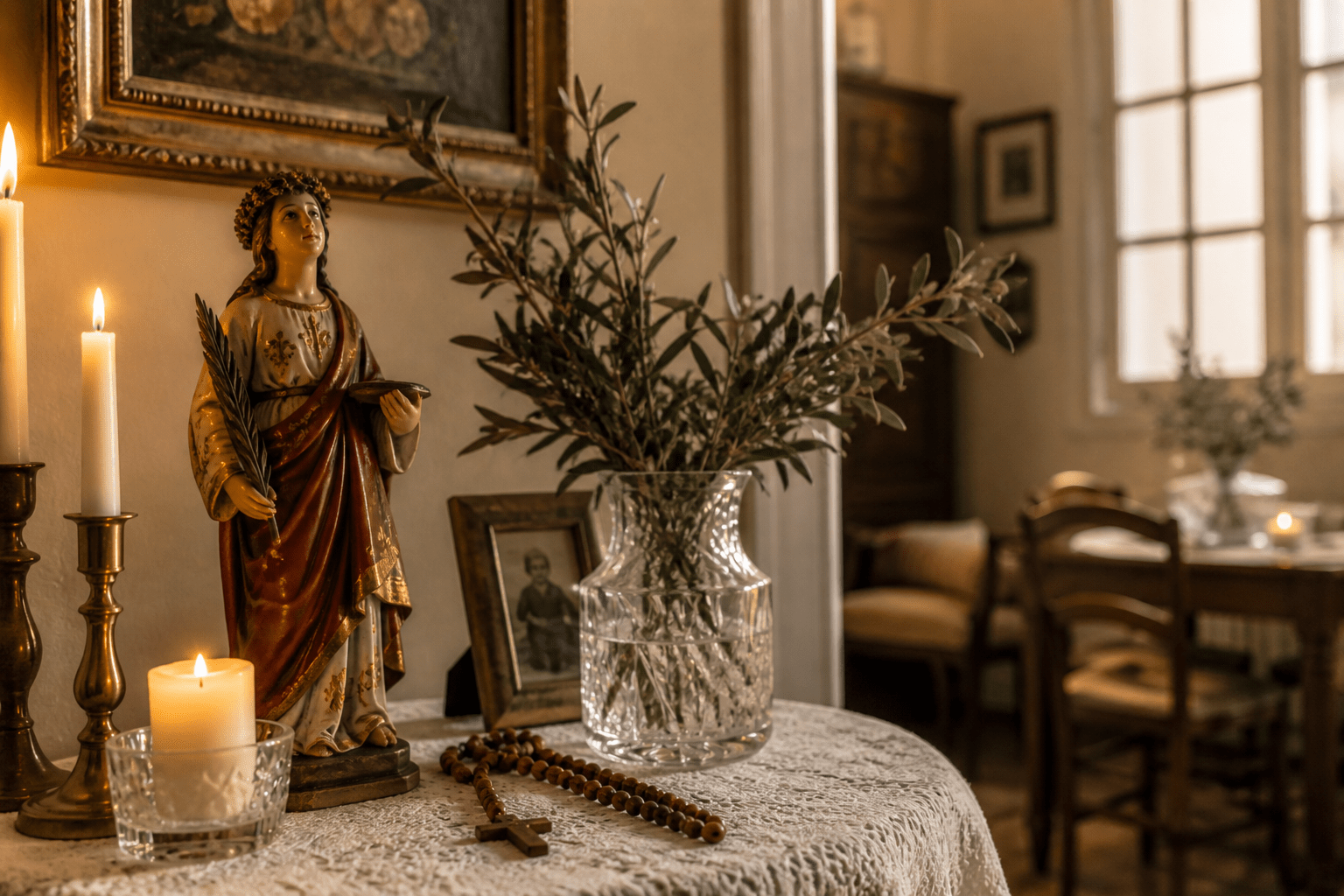
My grandmother kept a small statue of Santa Lucia on the shelf in the hallway for most of December. Not a large one — the kind of object you could hold in one hand, with the painted eyes and the small candle she is always depicted holding. It appeared on December 1, reliably, the way certain December objects appeared reliably in that house: the presepe came down from the high shelf, the nativity figures were unwrapped, and Santa Lucia took her place in the hallway. She was there when you came in from the cold. She was there when you passed by on your way to the kitchen. She was there long enough that by December 13, when her actual feast day arrived, she had already been doing her job for two weeks — quietly anchoring December, the way certain presences do, not by demanding attention but by being present.
The feast day itself was its own event. My grandmother was from Calabria, not Sicily and not the north, which meant the Santa Lucia in our house was neither the full Syracusan procession nor the northern gift-giving tradition in its full form. It was something in between — candles, a specific prayer, a meal that felt different from other December meals, and a quality of attention to the day that made it distinct from the ordinary run of winter evenings. She had brought the feast with her the way she had brought other things: not the full institutional version, but the family version, which is always more specific and always more weighted with particular memory.
Santa Lucia is one of those December presences that does not need to be loud to be felt. She arrives in the darkest part of the season carrying light, and the families who kept her feast knew they were keeping something older than Christmas cards and considerably more personal.
Who Santa Lucia was
Santa Lucia — Saint Lucy — was a young Christian woman from Syracuse in Sicily who died as a martyr in the year 304. Encyclopaedia Britannica identifies her as one of the earliest Christian saints to achieve widespread veneration, and Vatican News places her story in the Diocletianic persecution — the last major Roman campaign against Christianity before Constantine’s conversion changed everything.
The traditional story, as Vatican News tells it, is of a young Syracusan woman of Christian faith who consecrated her virginity to God, refused a pagan marriage, and was denounced to the Roman authorities by the man she refused. Her death made her a martyr. Her memory made her a saint. And the specific quality of her name — Lucia, from the Latin lux, meaning light — gave her story a resonance that the calendar amplified perfectly, because her feast day falls in the deepest darkness of the year.
Britannica notes that because of traditions associating her name with light, she came to be thought of as a patron of sight — which is why images of Santa Lucia so often include eyes, flames, or candles, and why her feast carries that particular quality of light-in-darkness that makes it feel so at home in December. Her name, her story, and her season all pulled in the same direction.
Why her feast fell where it did — the solstice and the darkness
December 13 was not chosen accidentally. Before the Gregorian calendar reform of 1582, December 13 fell on the winter solstice — the shortest day of the year, the day of maximum darkness before the light begins its slow return. As Eataly’s overview of the feast notes, this alignment between Santa Lucia’s day and the solstice gave the feast its deep symbolic resonance: a saint of light, celebrated on the darkest day, carrying candles into the darkness as a promise that the light would return.
That symbolism never left the feast, even after the calendar shifted and December 13 no longer technically coincided with the solstice. The feeling of it remained. The feast of a light-bringing saint in the darkest part of winter is an idea so coherent that the culture preserved it regardless of astronomical rearrangement. Italian families who observed Santa Lucia were participating in something that reached back before Christianity, through a Christian story, and into the December table of their own particular house.
The candles on December 13 in my grandmother’s house were lit at dinner and stayed lit through the meal. This was not done every night. It was done on Santa Lucia’s day and on a few other occasions that the calendar designated as requiring candles rather than electric light. The distinction was understood without being stated. Some nights called for ordinary brightness. Some nights called for flame. Santa Lucia was a flame night. The quality of the light changed how the food tasted, or at least how it felt to eat it — which is, in the end, the same thing.
How the feast is celebrated — and how different Italy is about it
Italy does not celebrate Santa Lucia in one way. That is part of what makes the tradition so interesting and so variable in the diaspora — what a family kept depends entirely on where in Italy they came from. Italia.it documents the full range from solemn Sicilian processions to gift-giving customs in the north.
| Region | How Santa Lucia is observed |
|---|---|
| Syracuse, Sicily | The most solemn observance anywhere. The silver statue of the saint is carried in procession from the Cathedral to the Church of Santa Lucia al Sepolcro on December 13, then returned on December 20. Some devotees walk barefoot as a sign of thanksgiving or prayer. |
| Northern Italy | Santa Lucia arrives as a gift-bringer for children in cities including Mantua, Brescia, Bergamo, Verona, Parma, and Modena. Children wake on December 13 to find gifts, sweets, and evidence that the saint and her donkey visited overnight. |
| Sicily broadly | The feast is marked by cuccìa — boiled wheat served sweet with ricotta and honey or savory with beans. The food carries a specific memory of the 1646 famine when grain arrived miraculously on Santa Lucia’s day. No bread or pasta is eaten. |
| Southern mainland | Candles, church attendance, and family meals with regional variations. The feast is observed with devotional seriousness, without the elaborate processions of Syracuse or the gift-giving of the north. Often the family tradition is the whole of the tradition. |
That range — solemn procession, gift-giving saint, feast of boiled wheat, family candles — is why Italian diaspora families often have such different memories of what Santa Lucia meant. They are all right. They are remembering different parts of the same tradition.
The cuccìa — and the famine story behind the wheat
Cuccìa is the gastronomic symbol of Santa Lucia in Sicily, and it deserves its own explanation because the food carries a story that gives it a different weight than most December dishes.
The tradition of eating whole wheat rather than bread on Santa Lucia’s day is tied to a specific historical memory: in 1646, during a severe famine in Sicily, a ship carrying grain arrived in the harbor of Palermo on December 13 — on Santa Lucia’s feast day. The starving population ate the grain whole and raw, not waiting to grind it into flour, because they needed to eat immediately. In gratitude to the saint who was believed to have sent the ship, Sicilians vowed to observe the feast by eating whole grain rather than bread or pasta — and they have kept that vow for nearly four centuries.
That story transforms cuccìa from “what Sicilians eat on December 13” into something considerably more weighted. A bowl of boiled wheat on Santa Lucia’s day is a commemoration of survival — a memory of hunger and gratitude and miraculous arrival that has been passed from kitchen to kitchen for nearly 400 years. Italia.it calls cuccìa the gastronomic symbol of the feast in Syracuse, which understates it slightly. It is the edible memory of a famine that a saint ended.
My grandmother made cuccìa once that I remember clearly. She prepared it sweet, with ricotta and honey and some orange zest, served in small bowls after a meal that was already complete. Nobody was very hungry but everyone ate the cuccìa, because that is what you did on Santa Lucia. She told the story of the famine while we ate — not elaborately, in a few sentences — and then she said nothing else about it. The story had been told. The wheat had been eaten. That was the observation. I did not make the cuccìa again for many years after she died, and then I made it and served it in the same kind of small bowls and told the story of the famine to my own children in a few sentences, and we ate the cuccìa at the end of a meal when nobody was particularly hungry. That is how traditions work when they are working correctly.
Santa Lucia as gift-bringer — the northern tradition in detail
For Italian families from the north, Santa Lucia was not primarily a figure of devotion or famine memory. She was the one who came in the night with gifts.
The custom works like this: children leave out food for the saint and hay or water for her donkey — typically some combination of oranges, cookies, coffee, wine, flour, and salt, arranged with the seriousness of a small household offering. They go to sleep on the night of December 12. They must not look out the window and must not stay awake to watch, because Santa Lucia has the power to strike children blind if she catches them looking — a threat that is simultaneously terrifying and obviously designed to ensure that everyone is in bed by eight o’clock. In the morning, the offerings have been partly consumed and gifts have appeared.
That structure — the nighttime visit, the offerings, the forbidden looking, the morning discovery — is essentially the same structure as the more familiar Father Christmas tradition, which is why Italia.it describes her as a kind of female Father Christmas. But Santa Lucia predated Babbo Natale as the December gift-bringer in northern Italy, and for families whose roots are in Mantua or Brescia or Bergamo, she was the one they actually waited for — twelve days before Christmas. As Visit Mantua and Italy Magazine both document, this tradition remains strong in northern Italian cities today.
My mother’s childhood friend grew up in a family from Brescia, and she told me that the Santa Lucia morning was the most exciting morning of her December — more exciting than Christmas morning, which she knew was coming and could mentally prepare for. Santa Lucia arrived without the same buildup, which made the discovery sharper. The eaten orange. The hay slightly disturbed. The gifts wrapped in plain paper with no tags because Santa Lucia did not write tags. The absolute certainty, at age six, that the donkey had been there. She is in her sixties now and she still mentions it with a specific quality in her voice that Christmas morning does not produce in the same way. That is what a childhood tradition does when it is done well — it goes deep enough that decades later you can still feel the cold floor under your feet when you first came out of your room on December 13.
Santa Lucia in Italian-Canadian and Italian-American families
Santa Lucia adapted well in the diaspora, partly because she was already so variable inside Italy itself. A feast that could be a solemn barefoot procession in Syracuse, a gift-giving night in Mantua, and a bowl of wheat in a Sicilian kitchen did not need to be one specific thing in Montreal or Toronto or New York. Families kept the pieces that fit their lives and the pieces their grandmothers had specifically passed down.
In Montreal’s Italian community — in Little Italy around Dante and Saint-Laurent, and later in Saint-Michel and Rivières-des-Prairies — Santa Lucia appeared differently depending on the family’s regional roots. Sicilian families might observe the no-bread tradition on December 13 and make cuccìa. Families from northern backgrounds might leave something out for the saint on the night of December 12. Families from Calabria or other parts of the south might light candles, attend Mass at the Italian parish, and mark the day in ways that were devotional without being elaborately ceremonial.
What survived most consistently was not the form of the tradition but its feeling — the sense that December 13 was a day that deserved notice, that Santa Lucia was a presence worth acknowledging, that the Italian Catholic December had its own texture distinguishing it from the surrounding commercial holiday season. That distinction is part of the broader story of Italian-American and Italian-Canadian traditions after immigration.
How to keep Santa Lucia meaningful today
You do not need to recreate an entire medieval devotional calendar to keep Santa Lucia alive. A few small rituals carry a great deal of weight.
Light a candle on December 13 and keep it burning through dinner. Tell children who Santa Lucia was — not the whole hagiographic account, just the essential story: a young woman from Syracuse, a saint of light, whose feast day falls in the darkest part of the year. Make cuccìa if Sicily is your side of the story — the sweet version with ricotta and honey requires almost nothing and carries a great deal. Leave out something small for the saint on the night of December 12 if the northern tradition is yours, and tell children the rule about not looking out the window with the appropriate gravity.
Ask older relatives what December 13 looked like in their house. Ask specifically — not “did you observe Santa Lucia” but “what did your mother do on Santa Lucia’s day” and “what was on the table” and “was there a candle” and “did you leave anything out.” Those specific questions produce specific answers, and specific answers are the things worth writing down. For how to recover those memories while there is still time, read what to ask your grandparents about your Italian family history. For how to preserve those details before they fade, read how to record family stories before they’re lost.
The smell of coffee left out overnight. The plate of cookies. The whispered warning about staying in bed. The candle at the dinner table. The bowl of wheat. The child who swore they heard the donkey. The uncle who definitely ate the cookies and denied it for thirty years. These are the specific textures of the tradition — and specific texture is what makes a family ritual a family memory rather than a generic observance of a calendar date.
The small statue stood in the hallway from December 1. She was there when you came in from the cold. She was there when you passed on the way to the kitchen. By December 13 she had already been quietly anchoring the season for two weeks. Santa Lucia does not need to be loud to be felt. She arrives in the darkest part of December carrying light, and the families who kept her feast knew they were keeping something older than Christmas cards and considerably more personal.
Light the candle on December 13. Tell the story. Leave something out for the donkey if that is your tradition. Let the darkest day of the season have its own specific warmth.
The Feast of Santa Lucia belongs to the same Italian December arc as La Vigilia on Christmas Eve and Capodanno on January 1. For the nativity tradition that fills the same December space, read about the presepe and Italian nativity tradition. For how to preserve the family memories the feast holds, read how to use old photos to preserve your Italian family history. And for the broader story of Italian feast days and how they survived immigration, read Italian-American traditions: what changed and what stayed.
Santa Lucia is the patron of eyes and of light — find the saint for any need in the patron saint finder, and discover the many names of the Madonna.
FAQ
What is the Feast of Santa Lucia in Italy?
The Feast of Santa Lucia is the December 13 celebration of Saint Lucy of Syracuse, an early Christian martyr who died in 304. It is observed across Italy in strikingly different forms: in Syracuse through solemn religious processions carrying the saint’s statue through the streets; in northern cities like Mantua, Brescia, and Bergamo through a gift-bringing tradition for children on December 13 morning; and in Sicily through a feast of boiled whole wheat called cuccìa, observed in memory of a 17th-century famine. For Italian families in the diaspora, the tradition kept depended entirely on which part of Italy the family came from.
Why is Santa Lucia celebrated on December 13?
December 13 is the traditional date of her martyrdom in 304, as Britannica and Vatican News document. Before the Gregorian calendar reform of 1582, December 13 also coincided with the winter solstice — the shortest day of the year. That alignment between a saint of light and the darkest day of the year gave the feast its deep symbolic resonance, which remained even after the calendar shifted and December 13 was no longer technically the solstice. The feast of a light-bringing saint in the darkest part of winter is an idea coherent enough that culture preserved it regardless of astronomical rearrangement.
Why is Santa Lucia associated with light and sight?
Her name comes from the Latin lux, meaning light, and traditions have long connected her to both light and sight. Britannica notes that because of these associations with her name, she came to be thought of as a patron of sight — which is why images of Santa Lucia so often include eyes, flames, or candles. The feast’s historical placement on the winter solstice reinforced her role as a light-bringer in the darkest part of the year, and the symbolism has outlasted the calendar shift that separated the feast from the actual solstice.
What is cuccìa and why do Sicilians eat it on Santa Lucia?
Cuccìa is a traditional Sicilian dish of boiled whole wheat, served either sweet with ricotta and honey or savory with beans and olive oil. It is the gastronomic symbol of Santa Lucia’s feast in Sicily because of a specific historical event: in 1646, during a severe famine, a grain ship arrived in Palermo harbor on December 13. The starving population ate the grain whole and raw rather than waiting to grind it into flour. In gratitude to Santa Lucia, Sicilians vowed to eat whole grain rather than bread or pasta on her feast day — a vow kept for nearly four centuries. Cuccìa is not merely traditional food; it is an edible commemoration of survival.
Does Santa Lucia bring gifts to children in Italy?
Yes — in northern Italy, Santa Lucia is the primary December gift-bringer for children rather than Babbo Natale. Cities including Mantua, Brescia, Bergamo, Verona, Parma, and Modena observe the tradition of children leaving offerings for the saint and her donkey on the night of December 12, then waking on December 13 to find gifts. Italia.it describes her as a kind of female Father Christmas. Children must not look out the window during the night — Santa Lucia is said to blind those who try to see her — which ensures universal compliance with bedtime and universal excitement at the morning discovery.
What did the Syracusan procession of Santa Lucia look like?
According to Italia.it and Visit Sicily, the procession in Syracuse peaks on December 13 when the statue and relics of the saint are carried from the Cathedral of Syracuse to the Church of Santa Lucia al Sepolcro, then returned on December 20. The silver statue of the saint — carrying symbols including eyes and flame — is borne through the streets by devotees. Many participants carry candles and some walk barefoot as a sign of thanksgiving or personal petition. It is one of the most significant religious processions in Sicily and one of the oldest continuous observances of a saint’s feast in Italy.
How was Santa Lucia observed in Italian-Canadian and Italian-American families?
It depended on regional roots. Families from Sicily might observe the no-bread tradition on December 13 and make cuccìa. Families from northern Italy might leave offerings for the saint on the night of December 12 and wake children to the Santa Lucia morning discovery. Families from Calabria or other parts of the south might light candles and attend Mass. What survived most consistently in the diaspora was not a specific form but a specific feeling: the sense that December 13 was a day worth marking and that the Italian Catholic December had its own texture distinguishing it from the surrounding commercial holiday season.
How can I keep the Santa Lucia tradition alive today?
Light a candle on December 13 and keep it through dinner. Tell children the essential story — a young woman from Syracuse, a saint of light, whose feast falls in the darkest part of the year. Make cuccìa if your roots are Sicilian — the sweet version with ricotta and honey is simple and carries great meaning. Leave out offerings for the saint on December 12 night if the northern tradition is yours. Ask older relatives specifically what December 13 looked like in their house — what was on the table, whether candles were lit, what their mothers did on that day. Write down what they say. The specific details are what transform a calendar date into a family memory.

Marco Ricci is an Italian-Canadian writer and the grandson of Calabrian immigrants. He created Italian Family Traditions to document the customs, feast days, and family rituals Italian families carried from Italy to North America — and to understand what they actually meant. He is based in Montreal.