Italian Family Traditions
Why Don’t Italians Put Cheese on Seafood Pasta? The Rule That Started a Real Fight in Our House
It was La Vigilia. The table was full, everyone distracted, the kids still learning the rules nobody had written down. And then my grandmother reached for the grated cheese over the seafood pasta — and my grandfather’s voice cut through the entire room. “You know better.” It started a real argument. My uncle jumped in to defend her. Nobody at that table forgot the lesson, even if half of them didn’t fully understand why it mattered so much.
⏱ 7 minute read
📋 What you will learn in this post
- Why Italians traditionally never put cheese on seafood pasta
- The two real theories — geography and flavor — and which one holds up
- Exactly what’s allowed and what isn’t, in clear table form
- The real exceptions that prove the rule isn’t actually absolute
- Why this rule mattered so much it could start a family argument
Table of Contents
- The fight at the Vigilia table
- Why the rule exists — two theories
- What’s allowed and what isn’t
- The real exceptions that break the rule
- Why a pasta rule could start a real argument
- The rule in Italian-Canadian kitchens
- FAQ
Cheese on Seafood Pasta & the fight at the Vigilia table
It happened on the one night of the year built entirely around seafood — which is exactly why it mattered so much when the rule almost got broken.
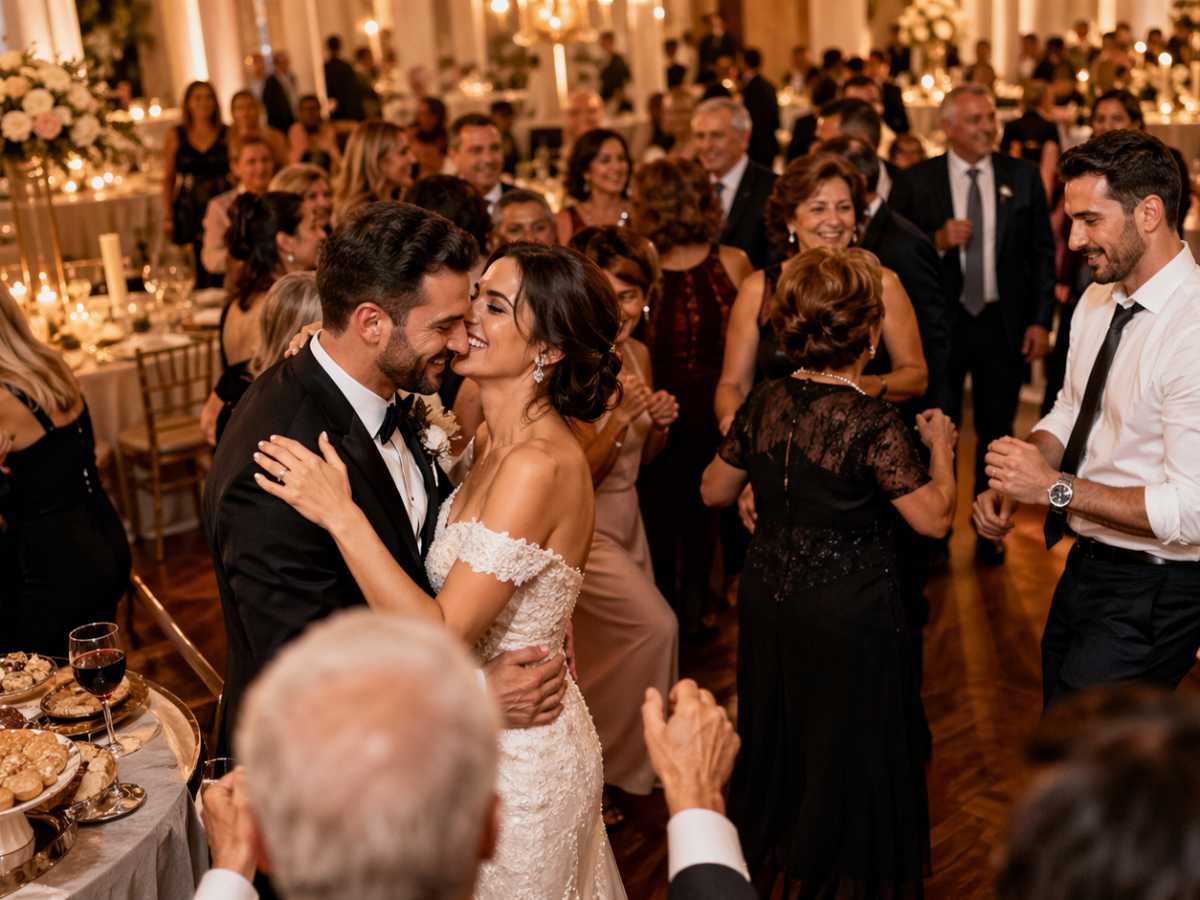
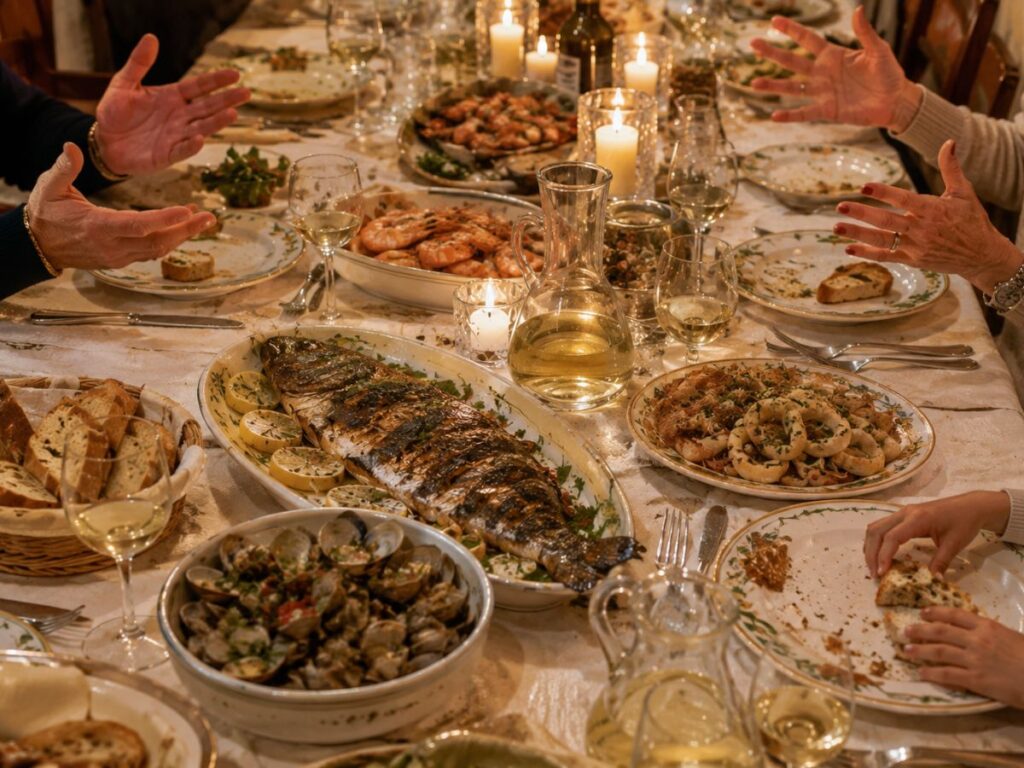
La Vigilia was always chaos in the best way. The whole family crowded into one house, course after course of fish arriving from the kitchen, kids underfoot, conversation happening in three languages and two volumes at once. It was the kind of distracted, joyful chaos where small things slipped through — which is exactly what happened the year my grandmother reached for the grated cheese and sprinkled it over the seafood pasta in front of the kids.
My grandfather’s voice cut through the noise before she had even finished. “You know better.” Four words, but they landed hard enough to stop conversation at the other end of the table. It was not really about the cheese. It was about what she was teaching the children watching her do it — the kids who were still learning every rule in real time, absorbing what was correct simply by watching what the adults around them did without comment.
My uncle jumped in to defend her, and for a few minutes it was a real argument — not loud exactly, but sharp, the specific tension that happens when two grown men who love each other disagree about something that matters more than its size suggests. Nobody at that table ever needed the rule explained to them again.
Why the rule exists — two theories
There are two real explanations for why Italians avoid cheese on seafood — and they reinforce each other rather than compete.
The first is geography, and it is more practical than poetic. Hardcore Italians explains that cows are commonly found in northern Italy, near grassland, while fresh seafood comes from the coast, typically in central and southern Italy — meaning cheese-making and seafood fishing simply never shared the same regional kitchens for most of Italian culinary history. Meal and a Spiel adds that Italians have traditionally been deeply conscious of topography in food: before modern refrigeration and transport, cheese and seafood were not even available in the same location, so the pairing never had the chance to become customary the way it did elsewhere.
The second explanation is about flavor, and it is the one Italian cooks themselves tend to give first. The Kitchn notes that fish should taste of the sea and should be served as simply as possible to preserve that — the rich, salty flavors of cheese can too easily overwhelm delicate fish, sacrificing the integrity of both ingredients. Food Republic puts it plainly: fresh fish and shellfish have incredible, delicate flavors that will only be masked by a shower of dairy, so to preserve that integrity, these dishes are traditionally served without it.
A detailed answer on Quora breaks the flavor logic into two specific failure modes depending on the dish: a very salty seafood pasta becomes inedible with cheese added on top of all that existing salt, while a very delicate seafood pasta simply gets overpowered, with the cheese flavor dominating completely. Either way, the seafood — the entire point of the dish — disappears.
🇮🇹 Did you know? Brendan Walsh, dean of culinary arts at The Culinary Institute of America, has called adding cheese to delicate seafood “a somewhat boorish treatment of food” — the rule is taken seriously enough that it shows up in professional culinary training, not just home kitchens.
What’s allowed and what isn’t
The rule is not absolute, and knowing exactly where the line falls is more useful than treating it as a blanket ban.
| Dish | Cheese allowed? | Why |
|---|---|---|
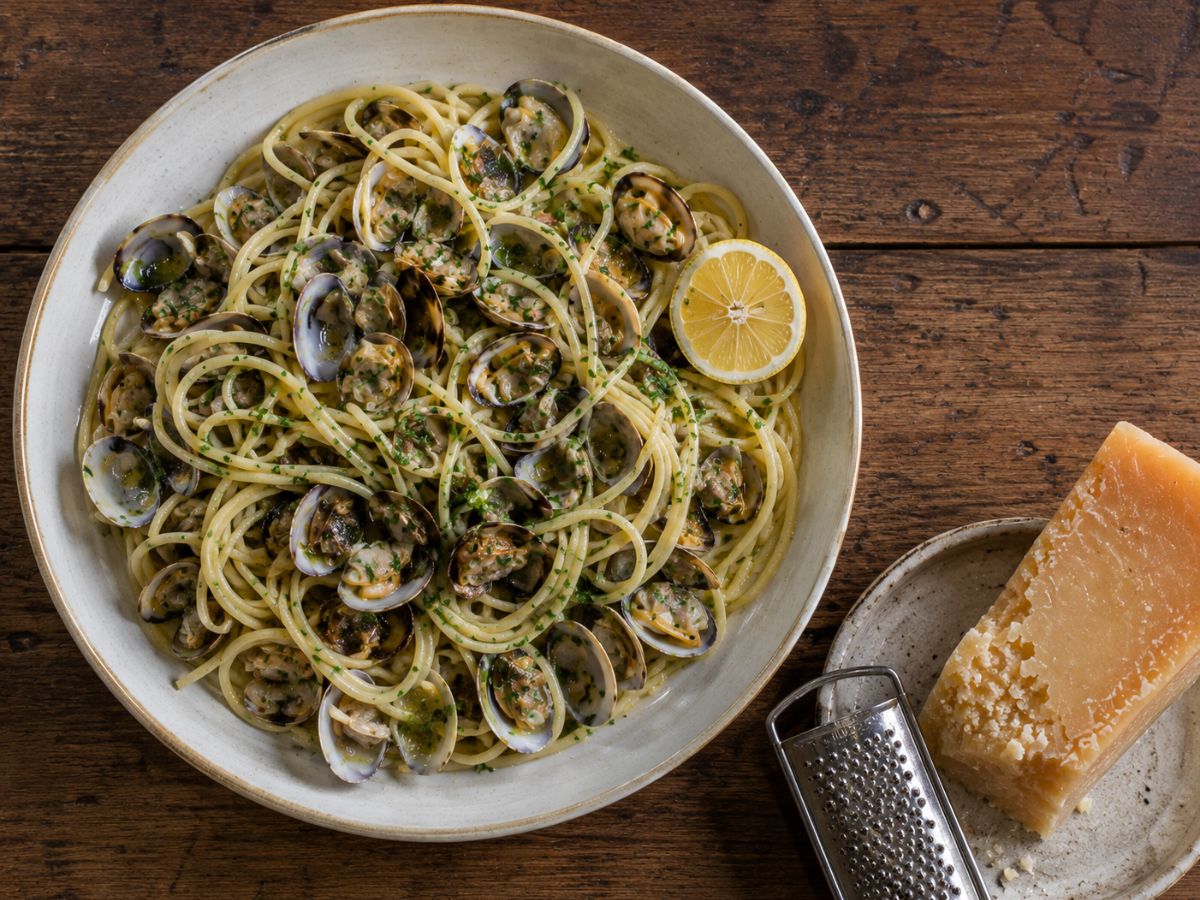
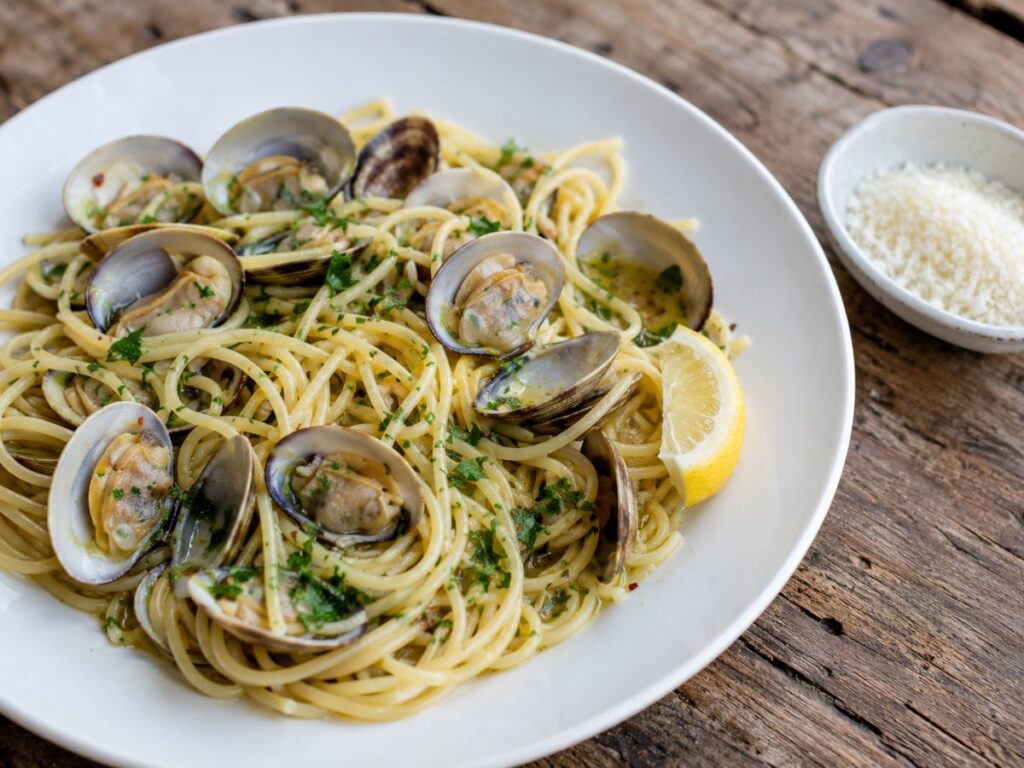
| Spaghetti alle vongole (clams) | ❌ No | Delicate briny flavor, already well-seasoned with garlic and white wine — cheese masks the clam entirely |
| Linguine ai frutti di mare (mixed seafood) | ❌ No | Multiple delicate seafood flavors competing for attention — cheese flattens all of them into one note |
| Spaghetti allo scoglio | ❌ No | Same logic — a showcase dish for fresh seafood flavor specifically |
| Risotto ai frutti di mare | ❌ No | Traditionally finished with olive oil or butter, never cheese, for the same flavor-preservation reason |
| Stuffed mussels (cozze ripiene) | ✅ Yes | The cheese is baked into the stuffing itself — breadcrumbs, parsley, garlic, and Parmigiano Reggiano — a completely different preparation, not a garnish over delicate fish |
| Seafood gratin (gratinato) | ✅ Yes | The dish is built around a cheese-and-breadcrumb topping from the start — an entirely different category of recipe, not a rule exception |
| Pasta with anchovies (aglio, olio e acciughe) | ⚠️ Regional variation | Some regions allow a light hand of Pecorino since anchovy is intensely savory rather than delicate — opinions vary by household |
The pattern that emerges is consistent: the rule applies specifically to delicate, fresh seafood pasta where the seafood itself is meant to be the star. It does not apply to dishes where cheese was part of the original recipe design from the beginning — stuffed mussels, gratins, baked preparations where cheese and seafood were always meant to cook together rather than one being added on top of the other at the table.
The real exceptions that break the rule
Even chefs who built careers on Italian tradition admit the rule has more flexibility than family arguments usually allow for.
Lidia Bastianich — one of the most respected authorities on Italian cooking in North America — has stated on her own show that the no-cheese-with-fish rule has more to do with geography than gastronomy, and has a published recipe for seafood gratin that uses cheese deliberately and well. LearnAmo goes further, noting that food historian Julia della Croce traces the strict version of the rule to the post-World War II period, when Italians became protective of local and regional traditions that were crumbling under modernization — meaning the rule, in its most rigid form, may be a more recent cultural reassertion than an ancient culinary law.
LearnAmo’s broader point matters here: not all Italians follow this rule with equal strictness, and Italians themselves do not always agree on exactly where the line falls. The rule is real, widely held, and taken seriously — but it is closer to strong cultural convention than universal law, even within Italy. If you want to serve seafood pasta the traditional way regardless of where you land on the cheese debate, a proper wide, shallow serving bowl — the kind built for tossing seafood pasta tableside without crushing delicate shellfish — makes more of a difference to the final dish than most people expect.
Knowing that even Lidia Bastianich has pushed back on the strictest version of this rule does not make me regret a single moment of that Vigilia argument. My grandfather was not really debating culinary theory with my uncle. He was teaching the kids at that table — including me — that some things in this family were done a specific way, and that the specific way mattered enough to defend loudly, even at Christmas, even if a chef in New York might have disagreed with him.
Why a pasta rule could start a real argument
The fight was never really about cheese. It was about who gets to decide what “correct” means in front of the next generation.
La Vigilia is, by its nature, a teaching occasion as much as a meal. Seven fishes, sometimes more, prepared with specific techniques passed down without recipe cards, served in a specific order, eaten according to rules nobody had ever formally written out for the children watching. The entire evening is an unspoken curriculum. Every gesture an adult makes at that table — what they reach for, what they avoid, what they correct in someone else — becomes part of what the next generation absorbs as simply how things are done.
That is why my grandfather’s reaction was so immediate and so loud. It was not really proportionate to a sprinkle of cheese — taken purely as a flavor decision, it is a small thing. But taken as a teaching moment happening in real time, in front of children who were absorbing the family’s entire system of “correct” without anyone explaining the reasoning behind it, it suddenly mattered enormously. He was not correcting a recipe. He was protecting a transmission.
This same dynamic — small food rules carrying outsized emotional weight because of what they represent rather than how they taste — runs through why Italians don’t drink cappuccino after 11am and fare bella figura. In Italian family culture, food rules are rarely just about food. They are about identity, continuity, and who gets to be the one teaching it.
The rule in Italian-Canadian kitchens
The rule traveled to Montreal exactly as intact as it had been in Italy — because La Vigilia itself traveled intact, and the rule lives inside that night.
For Italian-Canadian families, the cheese-on-seafood rule was never an abstract culinary principle learned from a cookbook. It arrived bundled inside La Vigilia itself, taught the same way it was taught for generations before — by watching, by correction, occasionally by exactly the kind of sharp family moment that happened at our own table. Kids who grew up around that argument, or versions of it in other households across Saint-Michel and Saint-Léonard, absorbed the rule the same way they absorbed everything else about Italian family food culture: not from instruction, but from witnessing what mattered enough to defend.
That continuity is part of the broader story of what Italian families carried after immigration — not just the recipes themselves, but the entire system of correction, expectation, and quiet authority that surrounded them. A rule about cheese is, in the end, a small piece of a much larger inheritance.
“You know better.” Four words, and the whole table went quiet for a moment. It was never really about the cheese. It was La Vigilia, the kids were watching, and some lessons only get taught once if they get taught loudly enough the first time. Nobody at that table ever reached for the cheese again without thinking about it first.
This rule belongs to the same family of Italian food logic as why Italians don’t drink cappuccino after 11am and fare bella figura — small, specific rules that carry far more weight than their size suggests. For the night this rule gets tested every year, read about La Vigilia and the Italian Christmas Eve. And for the broader story of what Italian families carried after immigration, read Italian-American traditions: what changed and what stayed.
📌 Quick summary
- The rule: No cheese on fresh, delicate seafood pasta — clams, mixed seafood, scoglio, seafood risotto
- Why: Geography (cheese-making and fishing regions historically did not overlap) and flavor (cheese masks delicate seafood)
- The real exceptions: Stuffed mussels and seafood gratin, where cheese is part of the original recipe rather than a garnish added on top
- How strict is it really: Strongly held, but not universal — even respected chefs like Lidia Bastianich have pushed back on the strictest version
- Why it matters more than it seems: Food rules like this one carry the weight of teaching the next generation what “correct” looks like
FAQ
Why don’t Italians put cheese on seafood pasta?
Two reinforcing reasons explain this widely held Italian food rule. The first is geographic — Hardcore Italians explains that cows were traditionally raised in northern Italy’s grasslands, while fresh seafood came primarily from the coastal regions of central and southern Italy, so cheese and seafood historically never shared the same regional kitchens. The second is about flavor: The Kitchn notes that fish should taste of the sea and be served simply, since cheese’s rich, salty flavors can too easily overwhelm delicate fish. Both explanations point to the same underlying principle — preserving the seafood’s natural flavor rather than masking it with dairy.
Is it ever okay to put cheese on seafood pasta?
Yes, in specific cases. Cheese is acceptable in dishes where it was part of the original recipe design rather than added as a garnish on top of delicate seafood — stuffed mussels made with breadcrumbs, garlic, and Parmigiano Reggiano baked into the filling are a classic example, as are seafood gratins where a cheese topping is intentional from the start. The rule applies specifically to fresh, delicate seafood pasta dishes like spaghetti alle vongole or frutti di mare, where the seafood flavor is meant to be the star and cheese would mask it.
Is the no-cheese-on-seafood rule actually true, or is it a myth?
It’s a real and widely held culinary convention, but not an absolute law even within Italy. LearnAmo notes that not all Italians follow this rule strictly, and Italians themselves are not always consistent about it. Even Lidia Bastianich, one of the most respected Italian-American culinary authorities, has stated that the rule has more to do with historical geography than strict gastronomic necessity, and has published her own seafood gratin recipe that uses cheese deliberately. The rule is strongly held cultural convention rather than universal culinary law.
What seafood pasta dishes definitely should not have cheese?
The clearest examples are spaghetti alle vongole (clams), linguine or spaghetti ai frutti di mare (mixed seafood), spaghetti allo scoglio, and risotto ai frutti di mare. These dishes share a common feature: they are built specifically to showcase fresh, delicate seafood flavor with minimal competing ingredients. Adding cheese to any of these is considered, in traditional Italian cooking circles, to mask or overpower the entire point of the dish.
Where did the no-cheese-with-seafood rule come from historically?
LearnAmo cites food historian Julia della Croce, who traces the strictest modern version of this rule to the post-World War II period, when Italians became more protective of local and regional culinary traditions that were beginning to erode under modernization. Before this period, the divide may have been less rigidly enforced. The older, more practical explanation remains geographic: Italy’s cheese-producing regions in the north were historically separated from the coastal regions where fresh seafood was caught, so the two ingredients simply did not develop a shared culinary tradition.
Why is this rule especially important on La Vigilia?
La Vigilia — Italian Christmas Eve, traditionally built around the Feast of the Seven Fishes — is the single night of the year most centered on seafood preparation, making it the moment this rule is most consistently tested and most visibly observed. It is also, for many Italian families, a teaching occasion where children absorb food customs by watching adults rather than through direct instruction. A cheese-on-seafood mistake made at the Vigilia table carries more weight than the same mistake on an ordinary weeknight, precisely because the next generation is watching and learning what “correct” looks like in real time.
Did Italian-Canadian families keep this rule after immigration?
Yes, largely intact, because the rule travels bundled inside La Vigilia itself rather than existing as a standalone culinary instruction. Italian-Canadian families in Montreal and other cities with established Italian communities maintained the Feast of the Seven Fishes tradition with significant fidelity, and the cheese rule survived as part of that larger inheritance — taught the same way it always had been, through observation, correction, and occasionally a sharply worded reminder at the table when someone reached for the grated cheese at the wrong moment.
💬 Did a food rule ever start a real argument in your family? Cheese on seafood, or something else entirely — leave a comment below. These are exactly the moments worth writing down before they’re forgotten.

Marco Ricci is an Italian-Canadian writer and the grandson of Calabrian immigrants. He created Italian Family Traditions to document the customs, feast days, and family rituals Italian families carried from Italy to North America — and to understand what they actually meant. He is based in Montreal.