What Is the Italian Nonna? The Woman Who Fed You Even When You Were Full
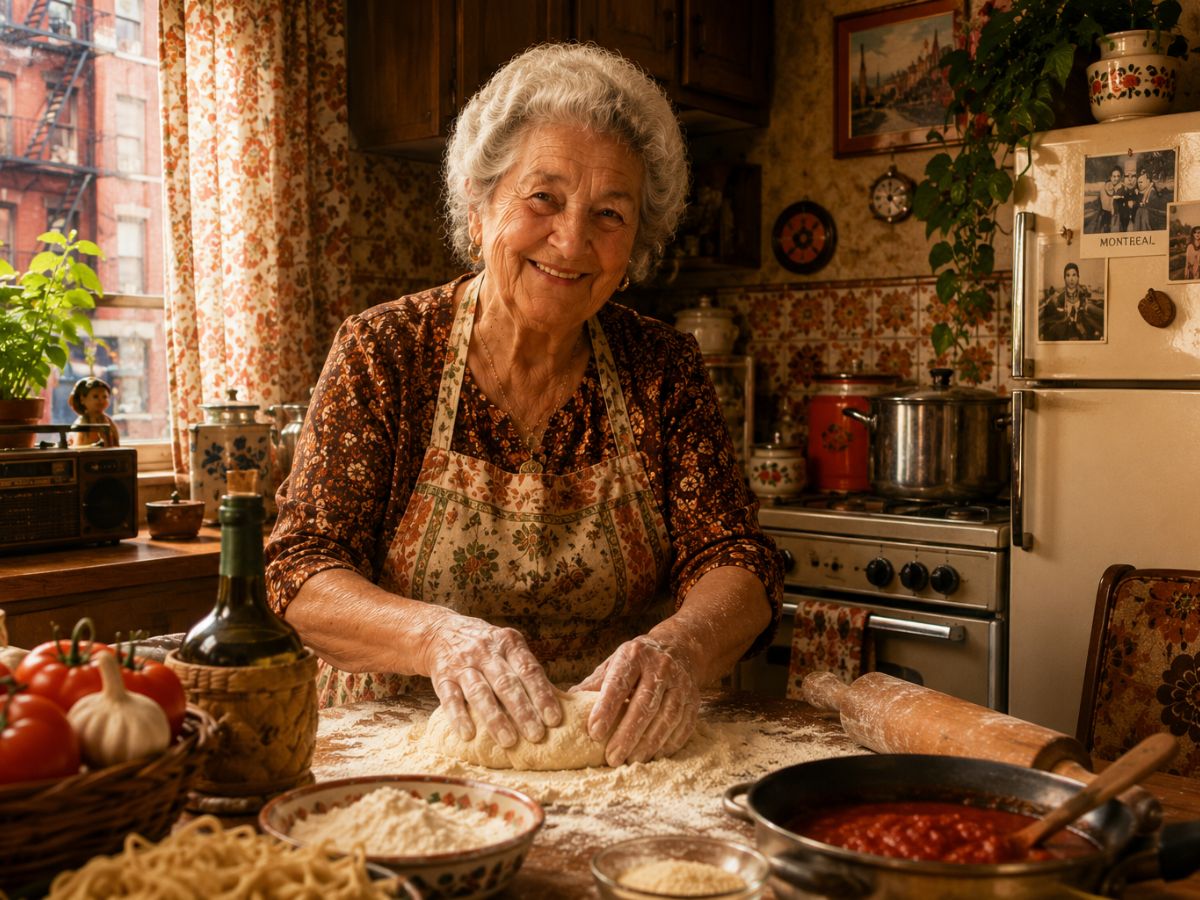
She told me Santa Claus didn’t exist. She told me Befana did. She fed me mountains of food long after I had said I was full, played hide and seek with me like she had nowhere else to be, patched my clothes for the simple pleasure of having an excuse to do something for me, and told me, more than once, that money wasn’t everything and family was. She was on the phone with someone in Italy almost every single day. This is what an Italian nonna actually is — not the marketing version, the real one.
⏱ 9 minute read
📋 What you will learn in this post
What “nonna” actually means and where the word comes from
Why food is how Italian grandmothers say “I love you” without ever saying it
The full picture of what an Italian nonna does — beyond cooking
Why the nonna’s role has only grown more central in modern Italian life
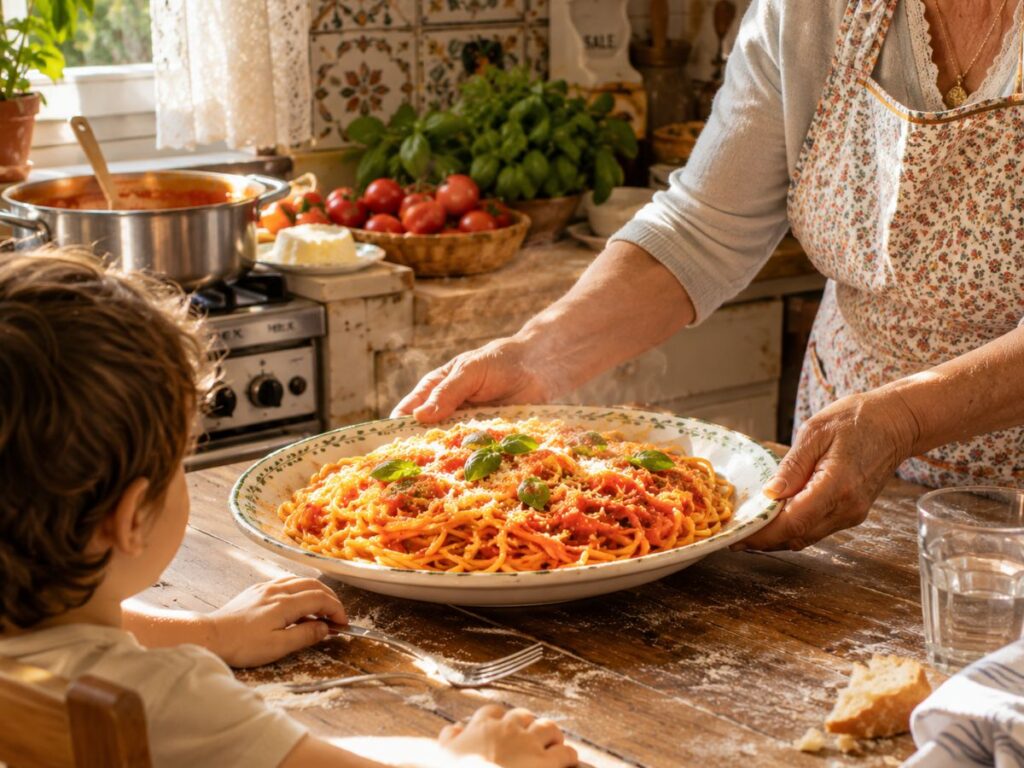
I was full. I had said so, more than once, with the specific clarity a child uses when they genuinely mean something. It did not matter. The plate kept coming back fuller than it left. This was not negotiation. This was not really about food at all, though it took me years to understand that. It was my nonna’s way of making sure that whatever else happened to me in this world, I would never once wonder whether I was loved. She could not always say it. She could always feed it.
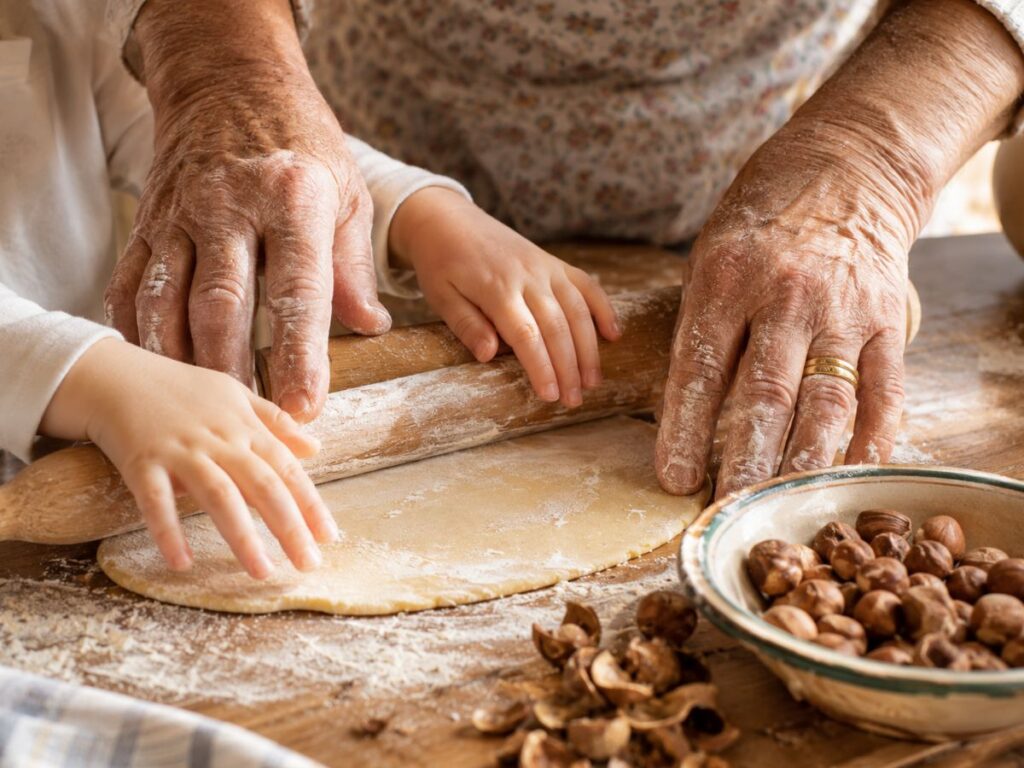
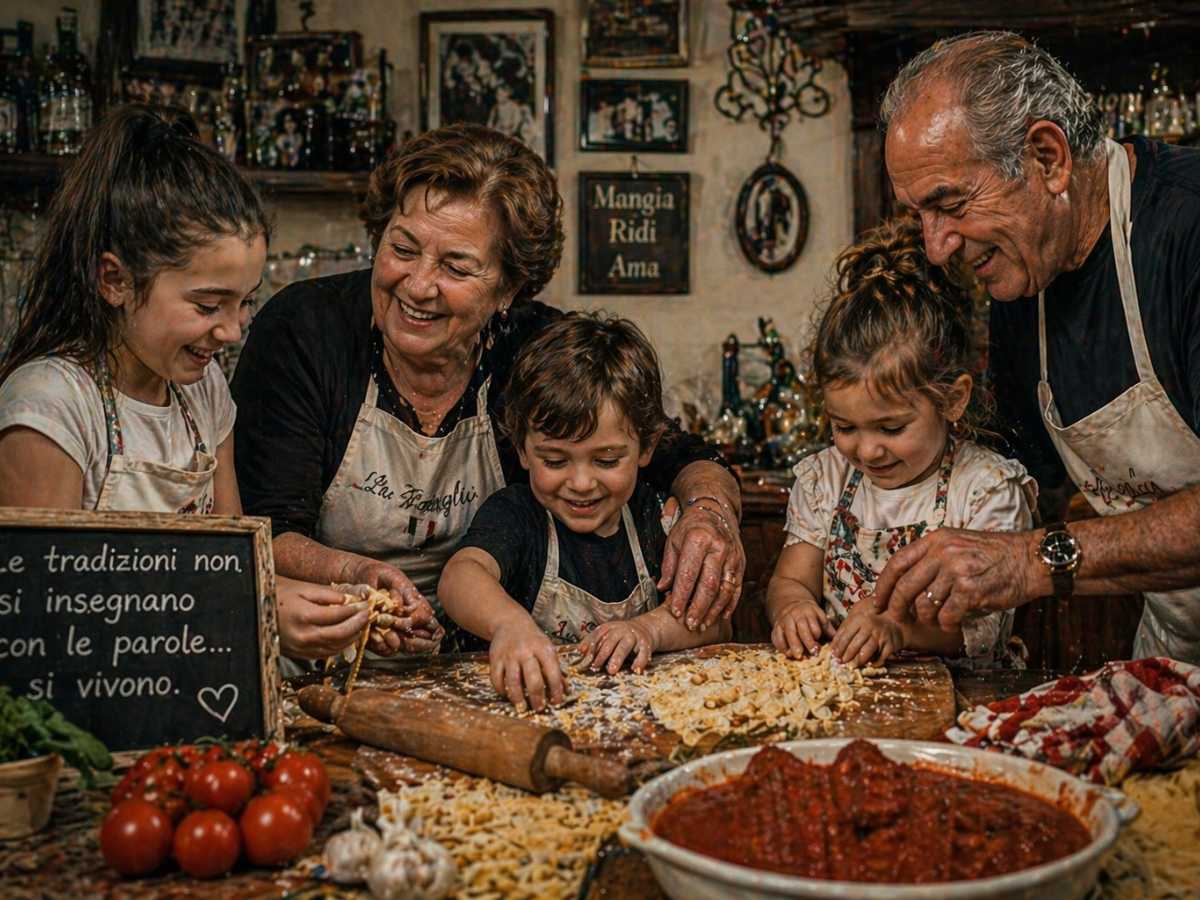
That single habit — the mountains of food, the refusal to accept “full” as an answer — tells you almost everything you need to know about what an Italian nonna is. But it is not the whole picture, and reducing her to a woman who cooks does both her and the role a disservice. She also got down on the floor to play hide and seek with me, with the genuine investment of someone who had nowhere more important to be. She taught me games with hazelnuts and old call-and-response songs from a part of Italy I had never seen, games that belonged to a world entirely different from the one I was growing up in. She patched my clothes — not because they always needed patching, but because patching them was an excuse to keep doing something for me, and an excuse was all she ever needed.
The Italian nonna is not just a grandmother in the biological sense. She embodies wisdom, continuity, and a living link between generations — the keeper of family stories, the guardian of recipes passed down for centuries, the person whose quiet authority shapes not only her children and grandchildren but sometimes an entire extended family.
What “nonna” actually means
“Nonna” is the Italian word for grandmother — but in practice, it carries far more cultural weight than the English word ever could.
Oreate AI traces the word’s roots back to Latin, where “nona” meant ninth — likely linked originally to familial hierarchy or birth order. In contemporary usage, though, “nonna” has long since outgrown any literal numerical origin. It now signifies nurturing wisdom passed down through generations, and in many households, nonnas are not only caregivers but custodians of culinary secrets and cultural heritage.
There is a reason the word functions almost like a title rather than a relationship label. Familyaffairsblog captures it precisely: when a kid yells “Nonna!” in a crowded market, ten women turn around. It is an instinctive reaction, a shared identity. The word does not just describe a specific woman — it describes a role so clearly and consistently defined across Italian culture that any woman who has occupied it recognizes herself in the call, whether or not it was meant for her.
Food is how she says it
The mountains of food were never really about hunger. They were the clearest language she had for something English doesn’t have a single word for.
Familyaffairsblog describes the paradox perfectly: she is the one who tells you you’re too skinny while simultaneously handing you a third plate of lasagna. It is a contradiction that makes no logical sense and complete emotional sense at the same time. The food was never really about whether you had eaten enough. It was about whether you knew, beyond any possible doubt, that you were cared for — and a full plate was simply the most concrete, repeatable, undeniable way to prove it, meal after meal, for as long as she had the strength to cook.
Polyglottist Language Academy notes that every Italian family has its own recipes, customs, and sayings, and the nonna is usually the one who preserves them — she is the one who remembers how her mother made gnocchi, how her grandmother folded tortellini, how the olive harvest was celebrated in her village. That memory does not stay abstract. It gets transmitted, plate by plate, meal by meal, whether or not the person eating is paying attention to the transmission happening.
This is the same logic that runs through the rest of Italian food culture — the conviction, examined across this site in posts about cappuccino after 11am and cheese on seafood pasta, that food in an Italian household is never just food. It is instruction. It is memory. It is, more often than not, love that could not find any other exit.
🇮🇹 Did you know? The proverb “Quando niente sta andando bene, chiama la Nonna” — “When nothing is going well, call Nonna” — is a real and commonly cited Italian saying. It captures, in eight words, exactly what the role has always meant: she is who you call when everything else has failed.
The keeper of everything — recipes, stories, the old country
Long before anyone called it cultural preservation, the nonna was simply doing it — quietly, daily, without ceremony.
Polyglottist Language Academy frames her role precisely: the nonna is not just a source of comfort, she is a pillar of cultural identity. In villages and cities alike, she has long been the transmitter of traditions, from language and dialects to rituals tied to food, festivals, and family milestones. She represents the bridge between past and present, tradition and modernity, stability and change.
This showed up in my own grandmother as the hazelnut games on the night of La Vigilia — old call-and-response songs and small games played with nothing more than a handful of hazelnuts, games that belonged entirely to the village she had left behind, games my friends’ families had never heard of and that I, as a child, simply assumed every family played because it was the only version I knew. It was not until much later that I understood those games were not generic Italian tradition. They were her specific village, her specific childhood, kept alive and handed to me at a kitchen table in a different country entirely, simply because she remembered them and decided I should too.
That is the deeper function the nonna serves, beyond food and beyond affection. She is frequently the last living connection to a specific place — a specific village, a specific dialect, a specific way August smelled or December sounded — that no book or website can fully replicate. When she is gone, that specific knowledge tends to go with her unless someone deliberately captures it first.
The playful side nobody talks about
The Italian nonna gets remembered for her cooking and her discipline. What gets forgotten is how genuinely fun she could be.
My nonna played hide and seek with me. Not the distracted, half-hearted version an adult sometimes performs for a child’s benefit — the real thing, with actual effort put into finding good hiding spots, actual delighted surprise when she was found, actual investment in a game that offered her nothing except my happiness. She would get mad at me sometimes too — a real, audible frustration about something I had done — but it always carried a hint of laughter underneath it, the specific quality of anger that exists only between people who are completely secure in how much they love each other.
That combination — warmth and sternness existing in the same breath, sometimes the same sentence — is one of the most distinctly Italian qualities a grandmother can have. It is not contradiction. It is the full range of a person who is allowed to be completely herself around you, because the relationship is secure enough to hold both her affection and her opinions without either one threatening the other.
The nonna network — school pickups, gossip, and the phone to Italy
An Italian nonna is rarely operating alone. She belongs to an entire informal network of other nonnas, and that network runs the neighborhood.
Mine picked me up from school. And she did not just collect me and leave — she got along with the other grandmothers doing the same job, a small daily gathering at the school gate that functioned as its own social institution, an exchange of news and opinions and updates that had nothing to do with the children waiting beside them and everything to do with maintaining the web of relationships that held the whole community together.
She loved to gossip about cousins and family — not maliciously, but as a form of staying current, of keeping track of an extended family large enough that tracking it required real effort and real interest. And she was constantly on the phone with someone back in Italy. Not occasionally. Constantly — a thread of connection to the old country that never fully closed, maintained call after call, decade after decade, long after most people would have assumed the ties had loosened with distance and time.
This is not incidental behavior. It is the nonna performing one of her most important and least discussed functions: she is the connective tissue of the entire extended family, the person who knows what is happening with everyone, who maintains relationships that would otherwise drift, who treats staying in touch not as an obligation but as a genuine ongoing interest in the lives of people she loves.
The nonna does not just preserve tradition passively. She actively corrects what doesn’t belong — sometimes with total certainty and zero negotiation.
When I mentioned Santa Claus, my nonna told me, without hesitation, that he did not exist. She had no equivalent problem telling me all about La Befana — the old woman who flies on a broomstick on the eve of the Epiphany and knows exactly how the year has gone. One figure was real to her. The other was not. There was no debate to be had about it, because in her understanding there was nothing actually debatable. La Befana was simply one fixed point in the entire Italian feast day calendar she carried in her head without ever needing to write it down.
That small, total certainty is characteristic of the nonna’s broader role as an authority on what is correct. She is rarely interested in convincing you through argument. She simply states the true version of things — the real saint’s day, the real way to make the sauce, the real tradition — and expects, reasonably, that you will eventually come to understand she was right. Most of the time, you do.
“Money isn’t everything” — the philosophy underneath it all
Everything else the nonna does — the food, the games, the corrections, the phone calls — ultimately serves one underlying philosophy she rarely had to explain.
She told me, more than once, that money wasn’t everything — that family was the thing actually worth focusing on. It is one of those statements that sounds simple enough to dismiss until you watch someone actually live by it, consistently, across decades, in every choice that mattered. The mountains of food, the hide and seek, the patched clothes she invented excuses to mend, the daily phone calls to Italy that cost real money for no practical return except connection — every one of those behaviors was the philosophy in action rather than the philosophy stated.
Languages Alive notes that respect for elders and family traditions is a fundamental value instilled in Italian children from a young age, and that the unity of the family is treated as a priority, with real, daily effort made to keep the family close-knit and emotionally connected. The nonna is frequently the person doing the most consistent, least visible work to make that priority real — not through grand gestures, but through the accumulated weight of thousands of small ones.
The things a nonna actually says
Every Italian nonna has a small arsenal of phrases she repeats so often they become part of the architecture of your childhood.
Some were warnings. Some were blessings disguised as complaints. Some made no logical sense at all until you were old enough to understand they were never really about their literal meaning. My own nonna’s “money isn’t everything, focus on family” was one of these — repeated so often it stopped sounding like advice and started sounding like simple description of how the world worked. Below are some of the most common phrases Italian grandmothers say, the ones that echo across nearly every Italian and Italian-Canadian household.
What she says
What it means
“Mangia, mangia!”
“Eat, eat!” — the single most universal nonna phrase, deployed regardless of whether you are hungry, full, or have already eaten three plates
“Sei troppo magro/magra”
“You’re too skinny” — said while serving you more food, often immediately after you’ve finished a full meal
“Chi trova un amico trova un tesoro”
“Who finds a friend finds a treasure” — her way of teaching that relationships matter more than possessions
“I soldi non sono tutto”
“Money isn’t everything” — usually followed by some version of “family is what matters”
“Stai attento alla corrente”
“Watch out for the draft” — the famous fear of the colpo d’aria, blamed for nearly every ailment
“Copriti, che ti ammali”
“Cover up or you’ll get sick” — said regardless of the actual temperature
“Te l’avevo detto”
“I told you so” — delivered with the quiet authority of someone who is almost always right
“Bella di nonna”
“Grandma’s beautiful one” — a term of pure affection with no translation that does it justice
That fear of the draft in particular — “stai attento alla corrente” — is so universal among Italian grandmothers that it has its own deep cultural history, explored fully in the piece on the colpo d’aria, the Italian fear of drafts. If you grew up being told to cover your neck on a mild day, you already know exactly which nonna this describes.
The northern nonna vs the southern nonna
Just as Italian greetings and gestures vary sharply by region, the nonna herself is not quite the same woman in Naples as she is in Milan.
The image most people carry of the Italian nonna — the warm, food-pushing, emotionally expressive, slightly dramatic grandmother — is, in truth, a largely southern Italian portrait. Because the overwhelming majority of Italian immigration to North America came from the south — Calabria, Sicily, Campania, Puglia — this southern version became the dominant image of “the Italian nonna” across the entire diaspora, my own Calabrian grandmother very much included.
The northern Italian nonna, from regions like Lombardy, Piedmont, or Tuscany, is often described as somewhat more reserved in her expressions of affection — no less loving, but expressing it through slightly different channels: perhaps a little less of the relentless food-pushing, a little more emphasis on quiet order, propriety, and understated care. This mirrors exactly the same north-south divide that shapes why Italians kiss on both cheeks in some regions and shake hands in others, and why southern Italians gesture far more than northern Italians. The nonna is not exempt from Italy’s deep regional character — she is one of its clearest expressions.
None of this means one version is warmer or more authentic than the other. It means “the Italian nonna” was never a single woman to begin with — she was always a regional figure, shaped by the specific place, dialect, and customs she came from, which is exactly why the version your family knew may differ in small but real ways from the one your neighbors knew.
Why the nonna’s role has only grown more important
Far from fading with modernity, the Italian nonna’s role has become more central, not less — and there are real reasons why.
Afellonamedcello notes that unlike many cultures where a grandparent’s involvement decreases as their grandchildren age, the presence of Italian grandparents in a family tends to be seemingly limitless — and in many cases, grandparents provide significant aid to their own adult children when it comes time to raise the newest generation, whether through time, experience, financial support, or emotional steadiness. With more Italian mothers engaged in professional careers, Learnitalianpod observes that grandmothers have become instrumental in preserving and passing down familial traditions, ethics, and memories — truly keeping the essence of Italian culture alive at a moment when fewer people have the time to do it themselves.
The role has also taken on an unexpected new dimension entirely: longevity and wellness. A recent cultural phenomenon dubbed “nonnamaxxing” has emerged around the observation that Italian grandmothers tend to age with remarkable independence, walking significant distances without assistance, dressing with elegance well into old age, and maintaining strong community ties throughout their lives. The pattern has sparked genuine interest in what the Italian nonna lifestyle — community, purpose, walking, home-cooked food, ongoing caregiving roles — might teach the rest of the world about aging well.
What she gives
How it shows up
Food as love
The plate that refills itself, the meal that says what words can’t
Cultural memory
Recipes, dialect, songs, and games from a specific village nobody else remembers
Authority on what’s true
Quiet, total certainty about which traditions are real and correct
The family network
Daily calls to Italy, school-gate gossip, knowing everyone’s business out of genuine care
Practical caregiving
School pickups, childcare, hands-on help that lets her own children work and build their lives
A living philosophy
“Money isn’t everything” — demonstrated daily rather than just spoken
How to honor and preserve your nonna’s legacy
Everything she carried — the recipes, the games, the dialect, the specific way she said things — exists nowhere else unless someone deliberately captures it.
Start by writing down the specific things — not the generic Italian traditions you can find on any website, but her version. What exact games did she play with you and where did they come from. What exact phrases did she say, in what exact dialect. What did her cooking actually taste like, and did anyone ever properly learn to replicate it. These details exist only in memory until someone puts them into a more permanent form, and that work gets harder, not easier, with every year that passes.
For a structured way to do this properly, read how to record family stories before they’re lost and what to actually ask your grandparents — practical guides built specifically around capturing exactly the kind of detail that disappears first. If your nonna is still here, the single best use of an afternoon with her is asking her to simply talk while you record it, with no agenda beyond letting her tell you what she remembers.
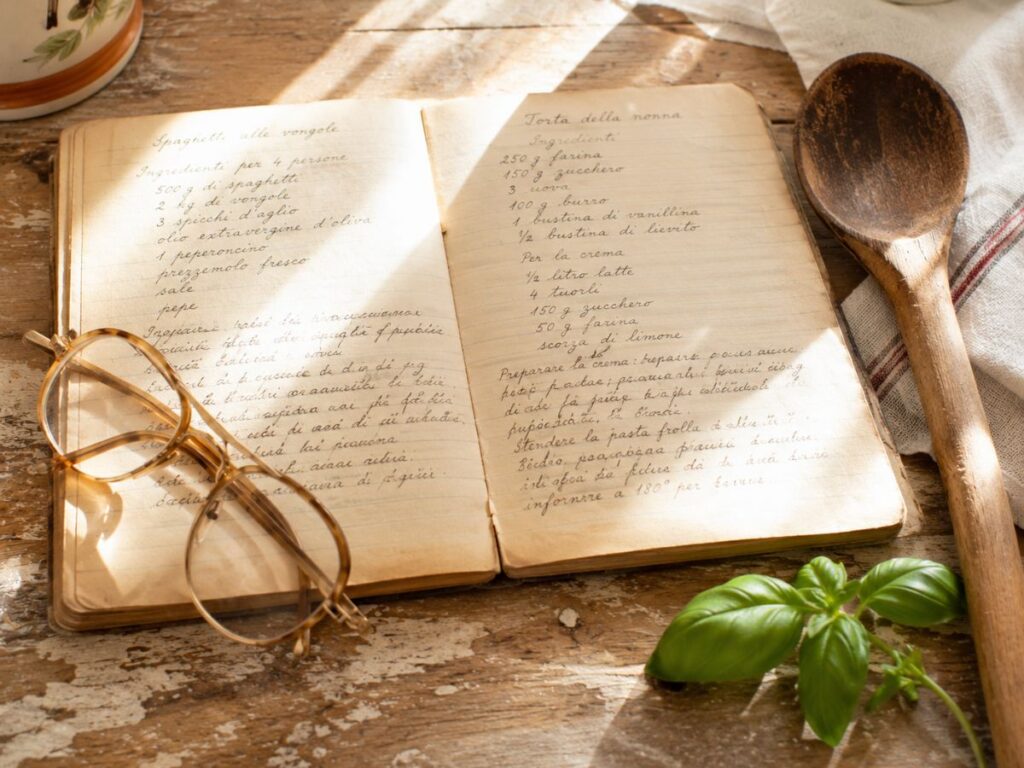
And if you want to keep the spirit of her cooking alive in a more tangible, daily way, a dedicated recipe journal built for handwritten family recipes — the kind with space for the story behind each dish, not just the ingredients — turns the act of writing down her recipes into something closer to what it actually is: preserving her.
She fed me even when I was full. She played with me like she had nowhere else to be. She told me Santa Claus wasn’t real but Befana was. She patched clothes that didn’t need patching, just for the excuse. She talked to Italy almost every day, gossiped about cousins out of genuine love, got along with every other nonna at the school gate, and told me, again and again, that money wasn’t everything — family was. That is what an Italian nonna is. Not the version on a tea towel. The real one.
What “nonna” means: Grandmother — but culturally, far more than the English word implies
Her core language: Food as the clearest expression of love, regardless of whether you’re hungry
Her deeper role: Keeper of recipes, dialect, songs, and the specific memory of a place most of the family has never seen
Her network: Connected to other nonnas, constantly in touch with family back in Italy, the social glue of the extended family
Her philosophy: Family over money, demonstrated daily rather than just stated
Why it matters now: Her role has only grown more central as families spread out and modern life speeds up
FAQ
What does “nonna” mean in Italian?
Nonna is the Italian word for grandmother. Oreate AI traces the word’s roots to the Latin “nona,” meaning ninth, likely originally tied to familial hierarchy or birth order, though in modern usage the word has long since taken on a much broader cultural meaning — representing nurturing wisdom passed down through generations rather than any literal numerical reference. Across Italy and the Italian diaspora, “nonna” functions almost like a title, instantly recognizable and carrying significant cultural weight beyond the simple translation of “grandmother.”
What role do grandmothers play in Italian family life today?
Afellonamedcello notes that unlike many cultures where grandparents’ involvement decreases as grandchildren age, Italian grandparents’ presence in family life tends to remain seemingly limitless — frequently providing significant ongoing support to their own adult children raising the next generation, whether through time, experience, financial help, or emotional steadiness. Learnitalianpod adds that with more Italian mothers engaged in professional careers, grandmothers have become especially instrumental in preserving and passing down familial traditions, ethics, and memories that might otherwise have less opportunity to be transmitted.
Why does the Italian nonna believe in Befana but not Santa Claus?
For many Italian grandmothers, particularly those from southern Italy, La Befana was the figure they actually grew up with — the gift-giving tradition tied to the Epiphany on January 6, deeply rooted in their own childhood experience. Santa Claus, by contrast, is a more recently imported, largely commercial North American figure with no place in their own upbringing. The nonna’s certainty about which figure is “real” reflects which tradition she actually lived rather than absorbed secondhand — and that lived authority is characteristic of how she approaches most questions about what is correct.
What is “nonnamaxxing” and why is it trending?
Nonnamaxxing is a recent cultural and wellness trend centered on adopting the lifestyle habits of Italian grandmothers as a path to better health and longevity. The pattern draws on real observations: Italian nonne tend to embrace aging with notable independence, walking significant distances as a primary mode of transport, dressing with elegance without concealing their age, maintaining ongoing caregiving roles within their families, and staying deeply embedded in community and social connection. The trend suggests these habits — community, purpose, regular activity, home-cooked food — contribute meaningfully to the well-documented longevity associated with Italian grandmothers.
How is an Italian nonna different from a typical grandmother in other cultures?
While loving grandmothers exist across every culture, the Italian nonna tends to occupy a uniquely central and active role compared to many Western family structures. Her involvement frequently does not taper off as grandchildren grow — she often remains deeply embedded in daily family logistics (school pickups, regular meals, ongoing childcare support) well into her grandchildren’s adulthood. She also typically functions as an active cultural transmitter rather than a passive figure, deliberately teaching dialect, recipes, games, and customs specific to her own family’s region of origin, ensuring that knowledge does not simply fade with distance and time.
How can I preserve my Italian nonna’s recipes and traditions?
The most effective approach is direct and immediate: sit with her, ask specific questions about her childhood village, her mother’s cooking, and the games or songs she remembers, and record the conversation rather than relying on memory afterward. Write down exact recipes with her, including the small unmeasured details — a handful of this, until it looks right — that rarely make it into written instructions. For a structured approach, guides on how to record family stories before they’re lost and what to actually ask grandparents provide specific, practical starting points for capturing this knowledge before it disappears.
Did Italian-Canadian and Italian-American nonnas keep the same role after immigration?
Largely yes, and often with remarkable consistency. The nonna’s role traveled well because it did not depend on external infrastructure the way some holidays and customs did — it required only her presence, her memory, and her willingness to keep doing what she had always done. In Italian-Canadian and Italian-American households, nonnas continued cooking the same dishes, maintaining the same daily phone connections to relatives back in Italy, picking grandchildren up from school, and serving as the same central authority on family tradition and “what is correct” that they would have been in Italy itself. The role adapted to a new country without losing its essential character.
💬 What’s the one thing your nonna did that you’d want your own grandchildren to know about? A phrase, a habit, a specific dish — leave a comment below. These are exactly the details worth saving before they’re gone.
Marco Ricci is an Italian-Canadian writer and the grandson of Calabrian immigrants. He created Italian Family Traditions to document the customs, feast days, and family rituals Italian families carried from Italy to North America — and to understand what they actually meant. He is based in Montreal.