Italian Family Traditions
Life Lessons From an Italian Grandfather: Do It Once, Do It Right
He did not give speeches. He gave you a handful of sentences, repeated across a lifetime until they became part of how you thought. Chi va piano va sano e va lontano. You wanted the bike — now you pedal. Never buy cheap. Do it once, do it right. By the time I understood them, they had already built me.
⏱ 8 minute read
📋 What you will learn in this post
- The core philosophy behind how an Italian grandfather taught — patience, quality, and doing things once
- The real Italian proverbs he used, and what they actually meant
- Why “never buy cheap” was about far more than money
- The lessons that only made sense years later
- How to pass these same lessons to the next generation
Table of Contents
- The philosophy: do it once, do it right
- “Chi va piano va sano e va lontano”
- “You wanted the bike — now you pedal”
- “Never buy cheap”
- The soppressata rule: never mess with the ingredients
- The park every morning: presence as a lesson
- Family, the table, and staying in your seat
- The proverbs he lived by
- How to pass these lessons on
- FAQ
The philosophy: do it once, do it right
The life lessons from an Italian grandfather usually trace back to one idea: whatever you do, do it once, and do it properly enough that you never have to do it again.
It applied to everything. To work. To money. To how you made soppressata. To how you treated people. To how you built anything, from a shelf to a life. He did not believe in the fast version, the cheap version, the good-enough version that would need redoing later. He believed that doing something right the first time was not slower in the end — it was faster, because you only did it once. Rushing was how you guaranteed you would be doing it twice.
He never laid this out as a philosophy. He would have found the word embarrassing. He simply lived it so consistently, and repeated a small number of sentences so often, that the philosophy assembled itself in my head over years without either of us ever naming it. That is how the life lessons from an Italian grandfather tend to arrive — not through lectures but through repetition, example, and a handful of proverbs deployed at exactly the right moment until they lodge permanently in your thinking.
“Chi va piano va sano e va lontano”
This was his central proverb, and it contains his entire worldview in six words.
Literally, chi va piano va sano e va lontano means “who goes slowly, goes healthily and goes far.” The usual English translation is “slow and steady wins the race,” but as writers on the proverb point out, that translation loses something important — the word sano means healthy, not just safe. The proverb is not only saying that patience wins. It is saying that patience keeps you whole. That rushing does damage — to the work, and to you.
He said it when I was frustrated. He said it when I wanted to skip a step. He said it when I was young and impatient and convinced that the fast way was the smart way. He said it with the calm of a man who had already learned, the hard way, that the fast way is almost never the smart way — that the shortcut usually costs more than the road it was trying to avoid.
I did not appreciate this proverb as a child. It sounded like something old people said to slow you down. It took me until adulthood — until I had rushed enough things and had to redo enough of them — to understand that he had handed me, in one sentence, the single most useful principle I know. Go slow. Stay whole. Get far. He was right about all three, in that order, and he had been trying to tell me the whole time.
This proverb sits at the heart of the life lessons from an Italian grandfather — one of a whole tradition of Italian family sayings that carry hard-won practical wisdom in a few memorable words — the same tradition that produced the number superstitions and folk beliefs explored elsewhere on this site. For more of these, read about the the Italian nonna and the phrases she repeated, the grandmother’s half of this same inheritance.
“You wanted the bike — now you pedal”
This was his lesson about responsibility, and it was as blunt as it sounds.
You wanted the bike. You asked for the bike. You got the bike. Now — you pedal. Nobody is going to pedal it for you. The wanting was the easy part; the wanting is always the easy part. The pedaling is the actual thing, and the pedaling is yours.
It was never said cruelly. It was said as a simple statement of how the world worked. You do not get to want the result and skip the effort. You do not get to choose the destination and refuse the journey. If you asked for something and received it, the work that came attached to it was now your responsibility, and complaining about the work was not a serious option. You wanted the bike. So pedal.
I have thought about that sentence more times as an adult than almost anything else he told me. Every time I have wanted an outcome without wanting the work — a skill without the practice, a result without the grind — his voice arrives, unbidden, perfectly calm: you wanted the bike, now you pedal. It has never once been wrong.
“Never buy cheap”
He believed in spending more money once rather than less money repeatedly — and it was never really about the money.
Buy the good one. Buy it once. Take care of it. That was the rule. He hated cheap things — not because he was extravagant, he was anything but, but because cheap things were a false economy that offended his entire sense of how life should be conducted. A cheap tool broke and had to be replaced. A cheap shoe wore out and had to be rebought. A cheap version of anything was, in his understanding, simply the expensive version paid for in installments, plus the aggravation of everything breaking.
This connected directly to his hatred of wasted money. He could not stand watching money spent on nonsense — on flashy things, on disposable things, on things bought to impress rather than to last. He would spend real money on a good winter coat without blinking, and be genuinely upset by money wasted on something worthless. The distinction was not price. It was value. Quality that lasted was worth any price. Junk was a waste at any price, because it was junk.
🇮🇹 Did you know? The idea of buying quality once rather than cheap repeatedly has a name in English — the “Boots theory” of economics — but Italian grandfathers were teaching it to their grandchildren long before it had a name, purely from the hard experience of people who could not afford to waste money on things that broke.
Underneath it was the same principle as everything else: do it once, do it right. Buy the thing that lasts. Do not create future work and future expense for yourself by taking the cheap way now. It was the bike lesson and the chi va piano lesson wearing different clothes — the same conviction that the patient, proper, complete version of a thing is always cheaper in the end than the rushed and shoddy one.
The soppressata rule: never mess with the ingredients
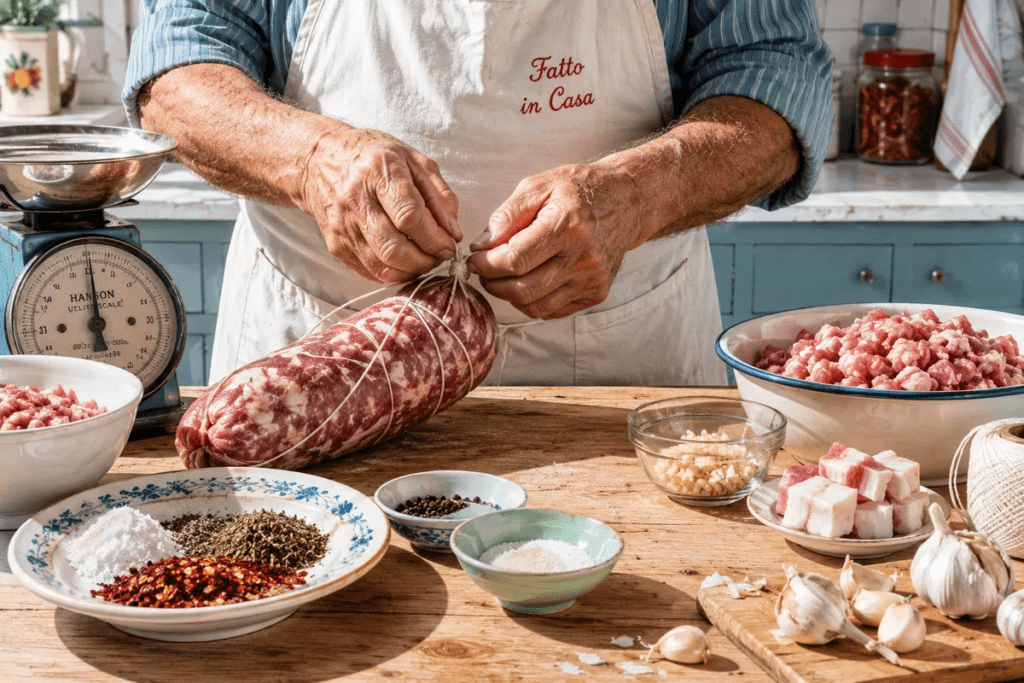
His do-it-right philosophy reached its purest form in the kitchen, and specifically in the making of soppressata.
The recipe was the recipe. You did not improvise with it. You did not substitute, adjust, experiment, or get creative. The proportions were correct because they had been arrived at over generations of people making the same thing the same way and confirming that this way worked. To change the ingredients was not creativity. It was arrogance — the assumption that you, in a single afternoon, knew better than everyone who had made this before you and passed down the exact method precisely so that you would not have to guess.
This applied to the whole world of the preserving traditions he took part in — the passata, the salumi, the things made once a year in large quantities that had to be right because a mistake meant a whole year’s supply ruined. In that context, precision was not fussiness. It was respect for the work, for the ingredients, and for the people who had figured out the correct method so that it could simply be followed.
Watching him make soppressata was watching a man who had made the same thing hundreds of times and still gave it his complete attention every single time. Nothing was rushed. Nothing was approximated. The proportions were exact, the technique was exact, the patience was total. He was not bored by the repetition. He respected it. The recipe had earned its precision, and he honored that precision the way you honor anything that has proven itself correct over a long enough time. Do it right, do it the same, do it once a year for your whole life, and it will be right every year. That was the whole of it.
The park every morning: presence as a lesson
Before I was old enough for school, he took me to the park every single morning — and that daily presence was itself one of the deepest lessons he ever taught.
He took care of me while my parents worked. Every morning, the park. Not occasionally, not when it was convenient, not as a special treat — every morning, as reliable as the sunrise, a grandfather and a small child at the park because that was where the child should be and that was who should be with him. It was the least dramatic thing imaginable and one of the most formative.
What it taught me had nothing to do with words. It taught me what it feels like to be reliably cared for. To have someone show up for you every single day without fanfare, without needing to be thanked, without treating it as a burden or a sacrifice. He was teaching me, through pure repetition, that family shows up. That love is not a grand gesture but a daily one. That the people who matter are the ones who are simply there, morning after morning, whether or not anything special is happening.
He lived long enough to do a version of the same thing for his great-grandchildren — to meet them, hold them, spend time with them, and model that same reliable presence for another generation. That was not an accident. It was the direct result of another of his lessons: that you take care of yourself and value your family so that you are around, healthy and present, for as long as possible. Chi va piano va sano — the healthy part was never incidental. Going slow and staying whole was how you stayed around long enough to meet your great-grandchildren.
Family, the table, and staying in your seat
He believed family was the point of everything, and he expressed it most clearly at the table — including his firm view that once you sat down, you stayed down.
He loved having people over. Hosting was one of his genuine joys — a full house, a full table, everyone fed, everyone welcome, the specific happiness of a man watching the people he loved eat the food he had provided. Generosity as a host was not an obligation for him. It was a pleasure. The open door, the extra place set, the insistence that of course you would stay and eat — that was him at his happiest.
But the table had rules, and one of them was absolute: once dinner began, you stayed in your seat. You did not get up. You did not wander off. You did not treat the meal as something to dip in and out of. The family was assembled, the meal was happening, and your presence at the table for its duration was not optional. Getting up mid-meal was a small betrayal of the whole point of the gathering — which was that everyone was together, in one place, at one table, for this one stretch of time that mattered.
He also worked hard and expected respect, and gave it in return. Those two things — hard work and respect — were the foundation everything else was built on. He kept me away from the wrong crowd in the neighborhood not through long conversations about peer pressure but through the simple, firm insistence that those were not the people I would be spending my time with. He was not negotiating. He was protecting. And like most of what he did, I understood the value of it only much later, when I could see clearly the roads I had not gone down because he had quietly closed them.
Everything he taught me came back to family in the end. Work hard — for your family. Buy quality and do not waste money — so your family is secure. Stay healthy and go slow — so you are around for your family as long as possible. Sit at the table and stay there — because the family is together and that is the whole point. Keep away from the bad influences — so you grow into someone your family can be proud of. The proverbs and the rules and the lessons were all, underneath, one lesson repeated in different forms: the family is what matters, and everything you do should serve it.
The proverbs he lived by
Here are the sayings and lessons in one place — the compact, portable wisdom of an Italian grandfather.
| What he said | What it meant |
|---|---|
| Chi va piano va sano e va lontano | Go slowly and you go healthily and far. Patience keeps you whole and gets you further than rushing ever will. |
| You wanted the bike — now you pedal | If you asked for something and got it, the work attached to it is yours. Wanting is easy; doing is the real thing. |
| Never buy cheap | Spend more once on something that lasts rather than less, repeatedly, on things that break. Value, not price. |
| Do it once, do it right | The proper version done carefully the first time is faster and cheaper than the rushed version done twice. |
| Don’t mess with the recipe | Some things were perfected over generations. Respect the method instead of assuming you know better. |
| Stay in your seat at dinner | The family is together. Be present for the whole meal. That togetherness is the entire point. |
| Work hard and respect | The two non-negotiable foundations. Everything else is built on them. |
| Family first, always | The reason behind every other lesson. Everything you do should serve the people you love. |
🇮🇹 Don’t let these lessons disappear
Get new stories about Italian family wisdom, traditions, and the things our grandparents taught us — sent straight to your inbox. Enter your email below to join.
How to pass these lessons on
The life lessons from an Italian grandfather survive the same way they arrived — not through lectures, but through repetition, example, and presence.
If you want to pass this kind of wisdom to your own children or grandchildren, the method matters as much as the message. My grandfather did not sit me down and explain his philosophy of life. He repeated a few sentences at the right moments, thousands of times, over years, and he lived them so consistently that the words and the example reinforced each other until they became permanent. That is how this kind of teaching works. Not once, loudly. Many times, quietly, backed by a life that matches the words.
Pick a few sayings that actually mean something to you — from your own grandparents, or from this list — and use them in real moments, the way they were meant to be used. Show up reliably the way he showed up at the park, because presence teaches what words cannot. And write the specific ones down before they are lost, because the exact phrasing your grandfather used, in his exact dialect, is the kind of thing that vanishes within a generation unless someone deliberately keeps it. For help with that, read how to record family stories before they’re lost.
He did not give speeches. He gave me a handful of sentences and a lifetime of example, and by the time I understood what he had been doing, the lessons had already become the way I think. Chi va piano va sano e va lontano. You wanted the bike, now you pedal. Do it once, do it right. Never buy cheap. Family first. He is the reason I know all of it — and the reason I will say the same things, at the right moments, to the children who come after.
For the grandmother’s half of this same inheritance, read what an Italian nonna is. For the traditions these grandparents carried across the ocean, read Italian-American traditions: what changed and what stayed. And to capture your own family’s specific wisdom before it fades, read how to record family stories before they’re lost.
📌 Quick summary
- The core philosophy: The life lessons from an Italian grandfather come down to do it once, do it right — patience and quality over speed and shortcuts
- His central proverb: Chi va piano va sano e va lontano — go slowly, stay healthy, go far
- On responsibility: “You wanted the bike, now you pedal” — wanting is easy, doing is yours
- On money: Never buy cheap — value over price, quality once over junk repeatedly
- On family: The reason behind every other lesson — presence, the table, showing up daily
FAQ
What does “chi va piano va sano e va lontano” mean?
It literally means “who goes slowly, goes healthily and goes far.” The common English translation is “slow and steady wins the race,” but that misses an important nuance: the word sano means healthy, not just safe. The proverb teaches that patience and steady effort not only get you further than rushing, but keep you whole and healthy along the way — that haste does damage to both the work and the person doing it. It is one of the most widely known and frequently used Italian proverbs.
What are common life lessons from Italian grandfathers?
Common lessons include patience and doing things properly the first time (“do it once, do it right”), personal responsibility (“you wanted the bike, now you pedal”), spending on quality rather than buying cheap repeatedly, respecting traditional methods and recipes rather than improvising, working hard, treating people with respect, and placing family above everything else. Italian grandfathers typically taught these not through lectures but through repeated proverbs, consistent example, and reliable daily presence — the lessons absorbed over years rather than explained in a single conversation.
Why do Italian families value quality over cheap purchases?
The principle of buying quality once rather than cheap repeatedly comes from the hard experience of people who could not afford to waste money on things that broke. For many Italian grandparents, especially those who lived through scarcity, a cheap item was a false economy — the expensive version paid for in installments as it broke and had to be replaced, plus the aggravation. The value was never about price for its own sake; it was about lasting quality, taking care of what you owned, and not creating future waste through poor choices now.
How did Italian grandfathers teach their grandchildren?
Primarily through repetition, example, and presence rather than formal instruction. An Italian grandfather typically had a small set of proverbs and sayings he repeated at exactly the right moments, over years, until they lodged permanently. Alongside the words, he modeled the lessons through his own consistent behavior — working hard, doing things properly, showing up reliably — so that words and example reinforced each other. Much of the teaching happened through ordinary daily activities: making soppressata, going to the park, sitting at the family table, rather than through explicit lessons.
What are some other traditional Italian proverbs about life?
Italian is rich with proverbs that carry practical wisdom in a few memorable words. Alongside chi va piano va sano e va lontano, common ones include chi cerca trova (who seeks, finds), chi dorme non piglia pesci (who sleeps doesn’t catch fish — the early bird gets the worm), tra il dire e il fare c’è di mezzo il mare (between saying and doing there’s a whole sea — easier said than done), and volere è potere (to want is to be able — where there’s a will there’s a way). Many begin with chi (“whoever”) followed by a consequence, a classic Italian proverb structure.
How can I preserve my grandfather’s sayings and lessons?
Write them down in his exact words, including the dialect if he used one, because the specific phrasing is the first thing to vanish across generations. Record him talking if he is still living — even a short conversation captures the voice, the phrasing, and the stories that no written summary fully preserves. Use his sayings yourself in real moments, which keeps them alive in practice rather than just in memory. And pass them to the next generation the same way you received them: through repetition, example, and presence, rather than a single explanation.
💬 What did your grandfather always say? The proverb, the phrase, the piece of advice you didn’t understand until years later — leave it in the comments below. These are exactly the words worth saving before they’re gone.
Marco Ricci is an Italian-Canadian writer and the grandson of Calabrian immigrants. He created Italian Family Traditions to document the customs, feast days, and family rituals Italian families carried from Italy to North America — and to understand what they actually meant. He is based in Montreal.