
Italian Family Traditions
Italian Superstitions: The Complete Guide to What Italians Believe
The evil eye. The number 17. Never a hat on the bed. Never toast with water. My grandparents didn’t call these superstitions — they called them simply how the world worked. Here is the complete guide to what Italians believe, and why the beliefs refused to stay behind in Italy.
10 minute read
The Short Version
Italian superstitions are a centuries-old system of protective beliefs — the evil eye (malocchio), lucky and unlucky numbers, and dozens of everyday rules about salt, bread, hats, and drafts. They were never idle folklore. They were how Italian families protected the people and the fortune they could not afford to lose, and they crossed the ocean intact.
Table of Contents
- Why Italians are so superstitious
- The evil eye — malocchio
- The horn — il cornicello
- Lucky 13, unlucky 17
- The everyday rules: salt, bread, hats, and more
- The draft — il colpo d’aria
- Turning dreams into numbers — La Smorfia
- Superstitions around death
- The complete superstitions table
- North vs south — and life after immigration
- FAQ
Why Italians are so superstitious
Italian superstitions are not random folklore — they are a coherent, centuries-old system for protecting the things that mattered most and could most easily be lost.
To understand why Italians hold so many superstitions, you have to understand the world these beliefs came from. For most of Italian history, ordinary families lived close to the edge — a failed harvest, a sudden illness, a death, an accident could undo everything. In that world, misfortune was not abstract. It was constant and real, and it demanded explanation and defense. Superstitions were the defense. They gave people a way to understand why bad things happened, and — crucially — a set of actions to take against them. They were, in their own way, deeply practical.
Layered on top of this was a devout Catholicism that lived comfortably alongside the older, pre-Christian folk beliefs rather than replacing them. An Italian grandmother could pray the rosary in the morning and perform a ritual against the evil eye in the afternoon and see no contradiction whatsoever. The Church and the older magic occupied the same world, and both were taken seriously.
My own grandparents did not think of themselves as superstitious. That word implies a kind of silliness they would have rejected. To them, these were simply true things about how the world worked — as obvious and unremarkable as knowing that fire burns. You did not toast with water. You did not put a hat on the bed. You protected against the evil eye. These were not quaint customs. They were rules, and the rules were followed.
Growing up, I was aware that other people found all of this a little strange — that outsiders looked at my family and saw people who were a bit coocoo, tossing salt over their shoulders in restaurants and worrying about envious neighbours. But inside the family, none of it was strange at all. It was simply normal behaviour, the ordinary texture of daily life. That gap — between how the wider world saw these beliefs and how completely normal they felt to us — is the thing I want to explain, because underneath the strangeness is a logic that makes total sense once you understand where it came from.

The evil eye — malocchio
The single most important superstition in Italian culture is the malocchio — the evil eye — the belief that envy directed at you, even unintentionally, can bring real misfortune.
The malocchio is the beating heart of Italian folk belief. The idea is that a look of envy — a compliment given with a trace of jealousy, an admiring glance at your health, your children, your good fortune — can transmit bad luck, headaches, illness, or worse. It did not require ill intent. Envy itself was the danger, and envy was everywhere, which is why the defenses against it were everywhere too.
Italian families developed an entire toolkit against the evil eye: protective charms, hand gestures, blessings, and a specific diagnostic ritual involving oil dropped into water that a knowing grandmother could read to determine whether the malocchio was present and remove it. This is the deepest and most elaborate corner of Italian superstition, and it has its own complete story — read the full guide to what malocchio is and how Italian families protected against the evil eye.
In my own family, this was not history — it was a regular occurrence. My wife’s grandmother, who lived in Montreal’s Little Italy, performed the evil-eye ritual on a regular basis, and to her the neighbours were a constant source of it. She was deeply skeptical of the comments people made about newborns and babies especially — a too-admiring remark about a healthy baby was exactly the kind of envious attention the malocchio fed on, and she watched for it closely. Where others heard a compliment, she heard a risk, and she acted accordingly. To her it was not paranoia. It was protection, performed for the people she loved, as routine as locking a door.
Love these Italian family traditions?
Get new stories about Italian customs, folk beliefs, and family traditions — plus our free printable calendar of the Italian year. Enter your email below to join.
The horn — il cornicello
The most recognizable Italian protective charm is the cornicello — the little red horn worn to ward off the evil eye.
You have seen it even if you did not know its name: the small, twisted red horn hung on a gold chain, dangling from a rearview mirror, pinned to a baby’s clothing. The cornicello — also called the corno or, in Neapolitan, the curniciello — is Italy’s front-line defense against the malocchio. Traditionally red, traditionally shaped like a twisted horn or chili pepper, it absorbs or deflects the envious gaze before it can reach the person it protects.
The horn was given at births, worn daily, hung in cars and homes, and treated with a seriousness that went well beyond decoration. It is the physical companion to the malocchio belief — where the evil eye is the threat, the cornicello is the shield. The full story of the charm, its rules, and why it must traditionally be given rather than bought is told in the guide to the cornicello, the Italian horn charm.
Alongside the horn came the hand gestures. The corna — index and pinky extended, pointed downward — was itself a protective sign against bad luck, and the instinct to “touch iron” (tocca ferro, the Italian equivalent of touching wood) was a reflex against tempting fate. These protective gestures are part of the same physical vocabulary explored in the guide to Italian hand gestures and what they mean.
Naples took the reading of signs furthest of all with la Smorfia, which turns dreams into lottery numbers.
Lucky 13, unlucky 17
Italy inverts the numbers the rest of the world expects: 13 is lucky, and 17 is the number to fear.
Here Italian superstition parts ways with the English-speaking world entirely. Where much of the West fears 13, Italians have traditionally considered it lucky — associated with abundance and good fortune. The number to fear in Italy is 17. Written in Roman numerals, XVII can be rearranged into VIXI — Latin for “I have lived,” meaning “I am dead.” That association made 17 the genuinely unlucky number, and Friday the 17th — not Friday the 13th — the truly ill-omened day in Italian culture.
This inversion catches nearly everyone by surprise, and it has real consequences — Italian buildings skip the 17th floor, airlines skip row 17, and my own family quietly benefited from a world that feared the wrong number. My great-aunt in particular played 13 whenever she could, precisely because she knew it was the winning position — nobody else wanted it, so it was always available, and to her that made it lucky twice over. The complete explanation, including how families used the 13/17 knowledge to their advantage, is in the guide to Italian lucky and unlucky numbers.
The everyday rules: salt, bread, hats, and more
Beyond the big beliefs, Italian daily life was governed by dozens of small, non-negotiable rules — the ones that shaped how you set a table, made a bed, or raised a glass.
These are the superstitions that ran quietly through every Italian household — rarely explained, always enforced. Break one at an Italian table and someone would correct you instantly, often without being able to say exactly why beyond “you don’t do that.”
- Spilled salt brings bad luck — throw a pinch over your left shoulder to blind the devil waiting there. Salt was precious for centuries, so wasting it was both practical misfortune and spiritual danger.
- Spilled oil was considered even worse luck than salt, given how precious olive oil was.
- Never place a hat on the bed. This one is strongly tied to death — priests would lay their hats on the bed when giving last rites, so a hat on the bed summoned the association of dying.
- Never put bread upside down on the table, and never waste it. Bread is sacred — the body of Christ — and treating it carelessly was both unlucky and disrespectful.
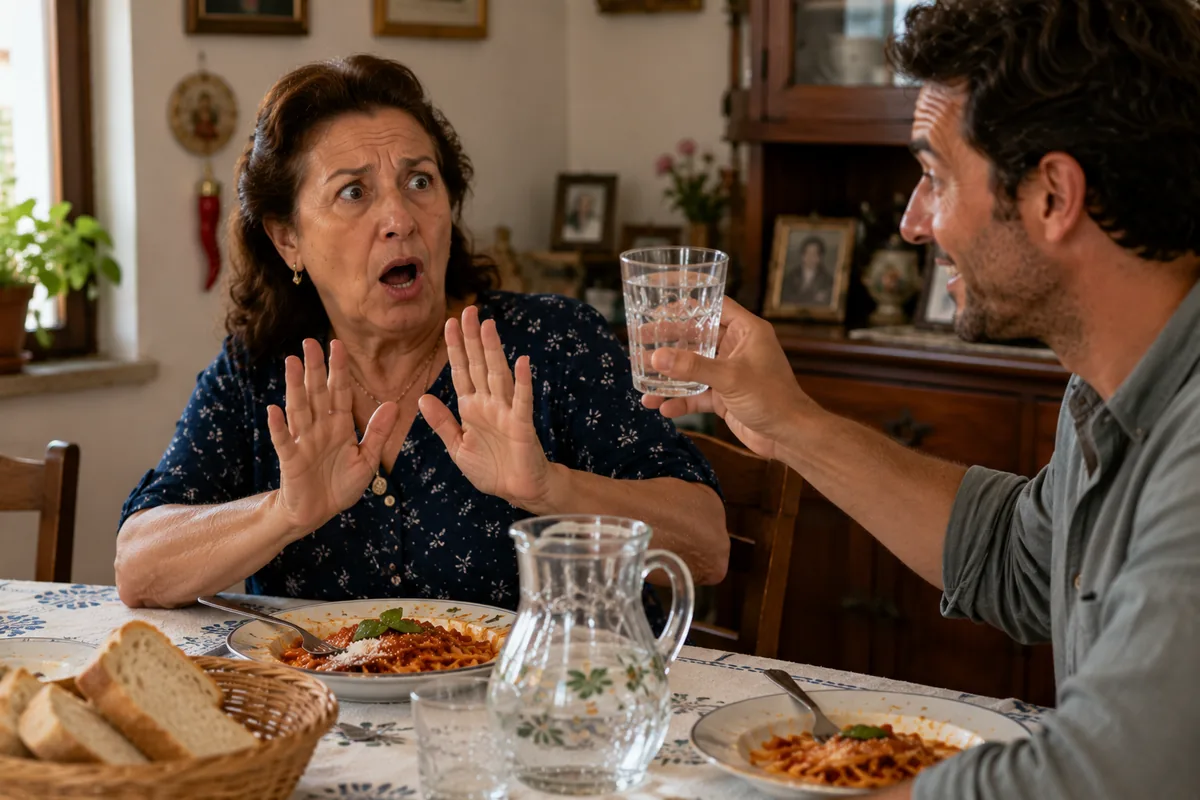
- Never toast with water. Toasting with water was said to wish death or bad luck on the person you toasted — an association reaching back to Greek and Roman beliefs about the dead drinking from the river Lethe.
- Don’t cross arms when toasting or passing, and always make eye contact when you clink glasses — failing to is bad luck.
- Never place a loaf of bread with the flat side down and never cut both ends — small kitchen rules with old meanings.
- A new broom should be used before an old one is thrown out, and you never sweep over someone’s feet — especially an unmarried person’s, or they would never marry.
- Never open an umbrella indoors, and beware spilling wine on yourself — though a little spilled wine could also be turned to luck by dabbing it behind the ears.
A note worth keeping — Many Italian superstitions come in matched pairs of threat and defense — the evil eye and the horn, spilled salt and the pinch over the shoulder, tempting fate and touching iron. The belief always came with a remedy. That is what separated Italian superstition from simple fear: there was almost always something you could do.
Two of these were absolute in my family. The salt over the shoulder was non-negotiable — on the rare occasions we ate at a restaurant and salt spilled, I was made to toss a pinch over my shoulder regardless of how silly it looked or how rude it might seem to the tables around us. It did not matter that we were in public. The rule was the rule. And the hat always, always had to be hung up — never set down where it shouldn’t be. When I rolled my eyes at any of it, as children do, I caught hell for it afterward and was told plainly that I needed to listen to them. What I understand now is that they weren’t asking me to believe. They were asking me to respect — to carry the habit forward whether or not I felt the fear behind it.
The draft — il colpo d’aria
No Italian health superstition is more universal than the fear of the colpo d’aria — the “hit of air” — the belief that a draft can make you genuinely ill.
Every Italian grandchild knows this one intimately. Cover your neck. Don’t sit between two open windows. Don’t go outside with wet hair. Don’t drink something cold when you’re hot. A draft of air — the colpo d’aria — was believed to strike the body and cause everything from a stiff neck to a fever to a full illness. It sat somewhere between superstition and folk medicine, and it was enforced with total conviction regardless of the actual temperature.
The colpo d’aria is so central to the Italian relationship with the body that it has its own complete story — the history, the rules, and why an entire culture came to fear moving air. Read the full guide to the colpo d’aria, the Italian fear of drafts.
Turning dreams into numbers — La Smorfia
One of Italy’s most fascinating superstitions turns your dreams into lottery numbers through an ancient system called La Smorfia.
In the Italian folk tradition, dreams are not random — they are messages, and every image in a dream corresponds to a number. La Smorfia, especially the Neapolitan version, is the dream dictionary that translates what you saw while sleeping into numbers to play in the lottery. Dreamed of your late grandmother? There’s a number for that. A cat, a fall, money, a death? Each has its number. Italian families consulted the Smorfia with a mix of play and genuine belief, and a striking dream could send the whole family to buy a lottery ticket the next morning.
It is one of the most beloved and enduring corners of Italian superstition, blending dreams, numbers, luck, and the dead into a single system. The complete guide to how it works is in the story of La Smorfia, the dream book that turned sleep into a lottery.
Superstitions around death
Death carried its own dense web of superstition — rules about mirrors, hats, colors, and the careful handling of the dead and the grieving.
Around death, Italian superstition grew especially thick, because death was the ultimate misfortune and the moment the boundary between worlds felt thinnest. The hat on the bed belonged here, with its echo of last rites. Mirrors were sometimes covered in a house of mourning. Certain behaviors were carefully observed to avoid inviting further death into the family. And the grieving were watched over closely — a household in mourning was considered vulnerable, and the community’s presence was itself a form of protection.
These beliefs sat inside the larger structure of Italian mourning, which was as much about protecting the living as honoring the dead. The full picture is in the guide to Italian funeral traditions and the customs of lutto.
The complete superstitions table
Here are the major Italian superstitions in one place — the belief, and what you were meant to do about it.
| The superstition | What it means / what to do |
|---|---|
| The malocchio (evil eye) | Envy can bring misfortune; protect with charms, gestures, and blessings |
| The cornicello (horn) | Wear the red horn to ward off the evil eye; traditionally given, not bought |
| The corna gesture | Index and pinky down to deflect bad luck; “touch iron” to avoid tempting fate |
| The number 17 | Unlucky (XVII → VIXI, “I have lived”); avoid Friday the 17th |
| The number 13 | Lucky in Italy — associated with abundance |
| Spilled salt | Bad luck; throw a pinch over your left shoulder |
| Spilled oil | Even worse luck than salt |
| Hat on the bed | Associated with death and last rites; never do it |
| Bread upside down | Bad luck and disrespect; bread is sacred |
| Toasting with water | Wishes bad luck or death; never do it |
| Sweeping over the feet | An unmarried person swept over will never marry |
| New broom before old | Use the new broom before discarding the old one |
| Umbrella indoors | Bad luck to open one inside |
| The colpo d’aria (draft) | Moving air causes illness; cover up, avoid drafts |
| La Smorfia (dreams) | Dreams map to numbers to play in the lottery |
North vs south — and life after immigration
Superstition runs deeper in the south than the north — and it was the southern version that crossed the ocean and shaped Italian-Canadian and Italian-American life.
Like so much of Italian culture, superstition is not uniform across the country. The beliefs tend to run richer and more openly practiced in the south — Calabria, Sicily, Campania, Puglia — where the malocchio, the cornicello, and the folk rituals held especially strong. The north was generally more reserved about such things, though far from free of them. Because the overwhelming majority of Italian immigration to North America came from the south, it is the southern, more intensely superstitious version that became the dominant inheritance in Italian-Canadian and Italian-American families.
And these beliefs did not fade at the border. They crossed the ocean intact, carried in the minds of grandmothers who kept diagnosing the evil eye in Montreal and Toronto and New York exactly as they had in the old country. The cornicello still hangs from rearview mirrors. The salt still goes over the shoulder. Nobody still toasts with water. The superstitions proved to be one of the most durable pieces of Italian identity precisely because they lived in the body and the daily habit, not in a place that could be left behind.
You’ll find the same regional pattern running through nearly every Italian custom — the figure who most fiercely kept these beliefs alive was usually the Italian nonna, the family’s guardian of both faith and folk protection.

My grandparents never called any of this superstition. They called it knowing better. And whether or not you believe a draft can make you sick or an envious glance can bring misfortune, there is something in these beliefs worth keeping: they were, underneath everything, about care. About protecting the people you loved from a world that could take them. That instinct never needed proving. It just needed passing down.
Before the Old Beliefs Are Forgotten
Which superstitions did your family keep? Which charm did your nonna swear by? The Italian Family Heritage Kit gives you 133 guided pages and more than 120 prompts to record the beliefs, customs, and stories your family carried — before the person who remembers them is gone.
Explore the Heritage Kit — $19.99Instant digital download. Print it and complete it with your family.
In Summary
- The evil eye (malocchio) is the central Italian superstition — envy brings misfortune, defended with charms and rituals
- The cornicello horn is the main protective charm; the corna gesture and “touching iron” defend against bad luck
- 13 is lucky, 17 is unlucky — the reverse of the English-speaking world
- Everyday rules govern salt, oil, bread, hats, toasting, and sweeping
- The colpo d’aria (draft) and La Smorfia (dreams to numbers) round out the system
- Southern Italy held these beliefs most strongly, and that version crossed the ocean intact
FAQ
What is the most common Italian superstition?
The most central and widespread Italian superstition is the malocchio, or evil eye — the belief that envy directed at you, even unintentionally, can bring misfortune, illness, or bad luck. It comes with an entire system of defenses, including the cornicello horn charm, protective hand gestures, and a diagnostic ritual using oil and water. Nearly every other Italian superstition sits alongside this central belief in envy and protection.
Why is 17 unlucky in Italy instead of 13?
In Italy, 17 is the unlucky number because its Roman numeral form, XVII, can be rearranged into the Latin word VIXI, meaning “I have lived” — implying “I am now dead.” This gave 17 a strong association with death and misfortune. Meanwhile 13, feared in much of the English-speaking world, is traditionally considered lucky in Italy and associated with abundance. Friday the 17th, not Friday the 13th, is the unlucky day in Italian culture.
Why can’t you put a hat on the bed in Italian culture?
Placing a hat on a bed is considered bad luck in Italian tradition because of its association with death. Historically, a priest visiting to give last rites to a dying person would remove his hat and set it on the bed. Over time, a hat on the bed became linked with dying and death, making it something Italian families carefully avoided.
Why do Italians say never to toast with water?
Toasting with water is believed to wish bad luck or even death on the person you are toasting. The belief traces back to Greek and Roman traditions, where the dead were said to drink from the river Lethe in the underworld — so raising water in a toast symbolically wished someone into the realm of the dead. To this day, many Italians will refuse to toast with water and reach for wine instead.
What is the Italian horn charm called?
The Italian horn charm is called the cornicello (little horn), also known as the corno or, in Neapolitan dialect, the curniciello. It is a small, twisted, traditionally red horn worn or hung to ward off the evil eye. It is traditionally meant to be given as a gift rather than bought for oneself, and is one of the most recognizable symbols of Italian folk protection.
Are Italians still superstitious today?
Many still are, especially in southern Italy and in Italian immigrant communities where the beliefs were carried across generations. While younger Italians may treat some superstitions with humor, plenty still avoid the number 17, wear or hang a cornicello, and would never toast with water or put a hat on the bed. These beliefs have proven remarkably durable precisely because they live in daily habit and were passed down within families rather than taught formally.
Some of the fiercest beliefs surrounded new life — the many Italian pregnancy superstitions no expecting mother dared ignore.
Which superstitions ran in your family? The one your nonna enforced hardest, the one you still catch yourself following — share it in the comments. These are exactly the beliefs worth writing down before they fade.

Marco Ricci is an Italian-Canadian writer and the grandson of Calabrian immigrants. He created Italian Family Traditions to document the customs, feast days, and family rituals Italian families carried from Italy to North America — and to understand what they actually meant. He is based in Montreal.