Italian Family Traditions
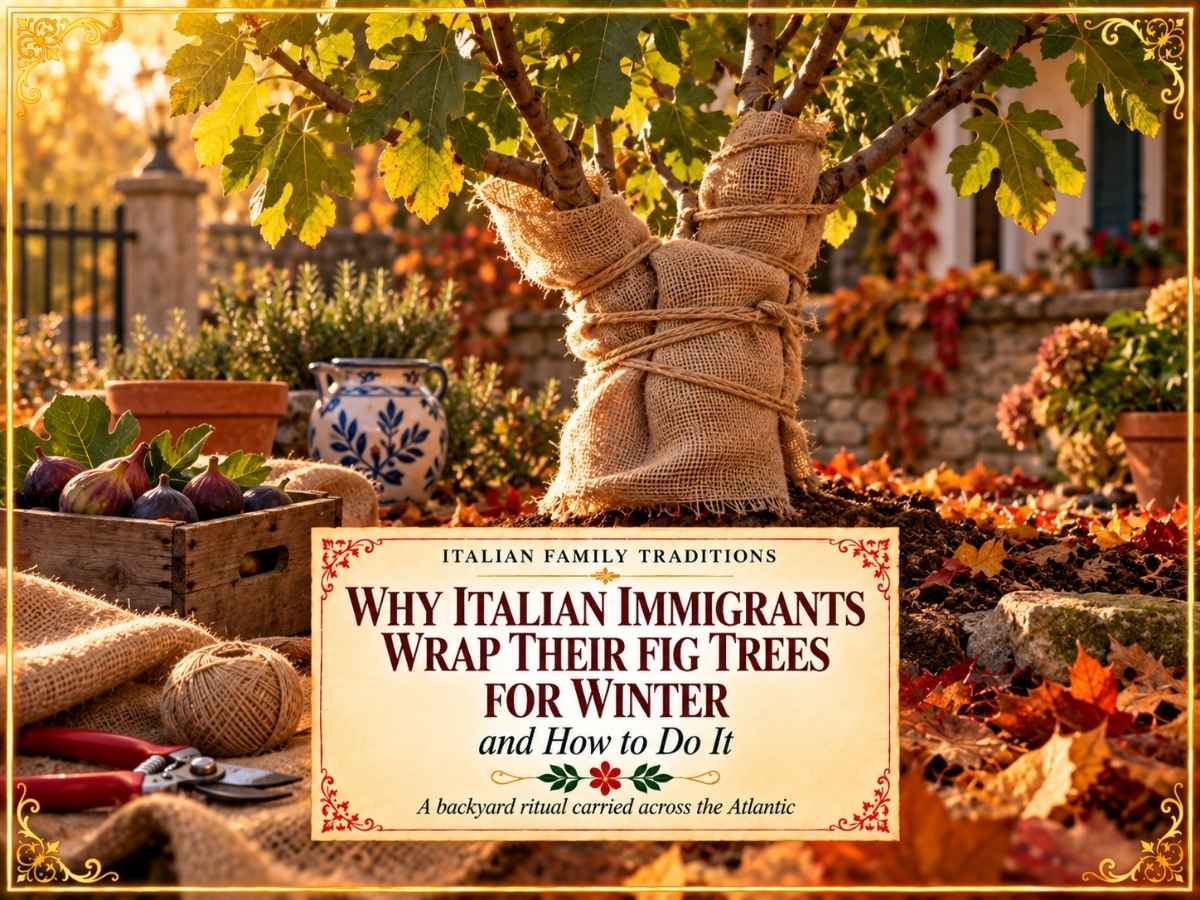
Why Italian Immigrants Wrap Their Fig Trees for Winter (and How to Do It)
Every autumn, in backyards from Montreal to New Jersey, a strange figure appears: a tree mummified in burlap, tar paper and old carpet, a bucket on its head, standing guard over the garden all winter. Here is the story of that tree — why Italian families go to such lengths to save it, and exactly how to wrap your own.
If you grew up in an Italian neighbourhood, you knew the tree before you knew what it was for. Somewhere around late October, after the leaves had dropped and the wine had been pressed, your grandfather would disappear into the garden for an entire Saturday, and by nightfall there would be a thing standing where the fig tree used to be — wrapped, bound, insulated, crowned with an upturned bucket or an old pot, tied off with rope, and looking for all the world like the garden had buried someone standing up.
The American neighbours found it hilarious. The kids found it a little frightening in the dark. And the family found it completely non-negotiable, because that tree was not just a tree. It was a piece of the old country, carried across an ocean and kept alive by main force in a climate that was actively trying to kill it. You did not let the fig die. You would sooner skip Christmas.
The wrapped fig tree is the most honest monument the Italian immigrant ever built: a living thing from a warm place, refusing to die in a cold one, protected every winter by hands that remembered where it came from.
This is the full guide to that tradition — why Italian families are so devoted to the fig, why the tree needs all that protection in the first place, and how to wrap one yourself, step by step, the way the old men did it. There’s also a quick tool below to tell you exactly how much protection your own tree needs where you live.
In this guide
- Why Italians are so devoted to the fig tree
- Why a fig tree needs wrapping at all
- How to wrap a fig tree for winter, step by step
- The other methods: burying, potting & modern wraps
- Tool: how much protection does your tree need?
- When to unwrap: the spring resurrection
- The fig tree as memory
- Frequently asked questions
Why Italians are so devoted to the fig tree
To understand the wrapping, you have to understand the tree — because in an Italian family the fig is not landscaping. It is kin.
The fig (Ficus carica) is one of the oldest cultivated plants on earth, grown around the Mediterranean for thousands of years, and in the South of Italy it is simply part of the landscape of childhood. In Calabria, Sicily, Puglia and Campania, a fig tree in the yard was a given. Its fruit was eaten fresh off the branch in August, dried for the winter, stuffed with almonds, wrapped around slivers of chocolate, baked into Christmas sweets. Its broad leaves shaded the table. It asked for almost nothing and gave for decades. A fig tree was a quiet promise that there would be sweetness every summer, forever.
So when Italians left — for Montreal, for Toronto, for New York and New Jersey and Boston — a remarkable number of them brought the fig with them. Not metaphorically. Literally. The stories are legion and largely true: cuttings wrapped in a wet newspaper and tucked into a suitcase, a hopeful stick smuggled past customs, a branch from the tree in the home village rooted in a tin can on a windowsill in a cold new country. The fig tree in the backyard in Montreal was very often a direct descendant — a clone, genetically — of a tree still standing in a village in the South. You were not growing a fig tree. You were growing the fig tree, the family’s, continued.
My grandparents came from Calabria — Carolei and Domanico, up in the hills near Cosenza — where a fig tree in the yard was as ordinary as a door. When they settled in the east end of Montreal, one of the first things that went into the ground was a fig. It had no business surviving a Quebec winter. It survived anyway, for decades, because every single autumn someone made sure it did. That tree was the old country, growing in the snow.
This is why the wrapping matters so much, and why it was never treated as a chore. Protecting the fig was an act of loyalty — to a place, to the people who had planted it, to a way of life that cold and distance were constantly threatening to erase. It belonged to the same autumn as the wine being made in the cantina and the last of the tomatoes going into jars: the season when the immigrant family did the serious, loving work of carrying summer through to the next year. The fig was part of the larger world of the Italian backyard garden, the orto that fed the family and kept the old skills alive.
Why a fig tree needs wrapping at all
Here is the botany behind the burlap. The fig is a Mediterranean plant, built for mild, wet winters and long hot summers — not for the deep freeze of a northern North American winter. Left unprotected, a fig is generally reliable only down to about USDA Zone 8. Its top growth begins to die back once temperatures drop to roughly 15–20°F (−7 to −9°C), and a hard, sustained freeze will kill the branches outright.
There is one crucial saving grace, and the old gardeners understood it in their bones even if they never used the word: the roots are far hardier than the branches. Even when a brutal winter kills everything above ground, the root system usually survives and sends up fresh shoots in spring. This is why certain varieties — the famous “Chicago Hardy” among them — can be grown much farther north than the rule suggests: the top dies, the root lives, the tree returns.
But a fig that dies to the ground every winter and regrows from the root will rarely fruit well, because figs on many varieties form on the previous year’s wood. Lose the wood, lose much of the crop. And this is the whole point of wrapping: it is not usually about keeping the tree alive — the roots often manage that themselves — it is about keeping the branches alive, so the tree fruits the following summer instead of starting over from scratch. In a place like Montreal, which sits around Zone 5, an unwrapped in-ground fig will almost certainly lose its top every year. Wrapped properly, it keeps its wood, and it gives you figs.
Not sure how cold your winters actually run? In the US you can check the official USDA Plant Hardiness Zone Map by zip code; in Canada, Natural Resources Canada publishes an equivalent plant-hardiness map. Find your zone, and the question of how much protection your tree needs mostly answers itself — or use the quick tool further down.
How to wrap a fig tree for winter, step by step
This is the classic in-ground method — the one practised in ten thousand immigrant backyards, refined over generations into something close to ritual. The goal is simple: tie the tree into a tight column, wrap it in layers that trap air and block wind, and cap the top so water can’t get in and freeze. Here is how it’s done.
- Wait for dormancy. Don’t rush it. Wrap after the leaves have dropped and the tree has gone dormant — usually after the first light frosts but before the first hard, sustained freeze. In most northern climates that’s late October into November. Wrapping too early, while the tree is still active and damp, invites rot.
- Prune and gather the branches. Trim back any long, whippy growth to make the tree more compact and manageable — a lighter prune on a young tree, more on an old sprawling one. Then gently draw the branches upward and inward, gathering them into a tight vertical bundle. Figs are forgiving and flexible; they’ll bend together without snapping if you work slowly.
- Tie the column. Wind rope or heavy twine around the gathered branches from the bottom up, spiralling as you go, until the whole tree is bound into a single tight column. This is the step that makes everything after it possible.
- Wrap the insulating layer. Now the layers. Start with something that traps air: burlap is traditional and breathable, but old blankets, towels, bubble wrap, foam pipe insulation, or even dry leaves and straw packed around the column all work. Wrap snugly, bottom to top, overlapping as you climb. Some families stuff the inside of the bundle with dry leaves first for extra loft.
- Add the outer windproof, waterproof shell. Over the insulation goes the weatherproof layer — traditionally tar paper (roofing felt) wrapped into a cylinder, or a tarp, or heavy plastic, or an old carpet, which is the deeply authentic choice. This sheds rain and snow and blocks the wind that does most of the damage. Tie it all down firmly with more rope so winter storms can’t unwrap your work.
- Cap the top. The single most important detail, and the source of the bucket. Water must not get inside the wrap and freeze, so the top is capped — an upturned bucket, a large pot, a metal can, a bin lid — anything that keeps rain and melting snow out of the column. This cap is why the finished tree looks like it’s wearing a hat, and it’s the detail every Italian kid remembers.
- Mound the base. Finally, heap mulch, soil, or leaves around the bottom of the trunk and over the root zone. The roots are your insurance policy; protect them most of all. Some gardeners wrap the base in extra insulation where the column meets the ground, since that junction is vulnerable.
Done right, the wrapped tree can shrug off a winter that would otherwise kill every branch — and come spring, it’s ready to leaf out from last year’s wood and fruit on schedule. The whole job takes an afternoon. The payoff lasts the life of the tree, which can be longer than the life of the person wrapping it.
Where Did Your Tree Come From?
Whose hands planted the fig? Which village did the cutting come from? These are the details that vanish in a generation — and once they’re gone, the tree is just a tree. The Italian Family Heritage Kit gives you 133 guided pages to record the people, the places and the traditions behind your family’s garden, before the person who remembers is gone.
Explore the Heritage Kit — $19.99Instant digital download. Print it and complete it with your family.
The other methods: burying, potting & modern wraps
The upright wrap is the most common method, but it isn’t the only one. Depending on how cold your winters get and whether your tree is in the ground or a pot, there are three other approaches worth knowing.
The burial method (the extreme old-country way)
In the coldest zones, some old-timers didn’t wrap the tree standing up — they buried it. You dig a trench alongside the tree, partially sever the roots on the opposite side so the whole tree can be bent over, lay it down into the trench, and cover it with boards, leaves and a thick blanket of soil for the winter. In spring you dig it back up and stand it upright again. It sounds insane, and it is a lot of work, but it’s the single most reliable way to carry a fig through a truly brutal winter — the tree spends the cold months underground, insulated by the earth itself. This is the method that most clearly shows how far a family would go for this tree.
The potted method (bring it inside)
If your fig lives in a large pot, you have the easiest option of all: move it. Once the tree drops its leaves and goes dormant, bring the pot into an unheated but sheltered space — a garage, a cold basement, a shed — where it stays cold enough to remain dormant but protected from the killing deep freeze. Water it only sparingly through the winter, just enough that the roots don’t fully dry out, and bring it back outside after the last hard frost in spring. For gardeners in the coldest regions, a potted fig in the garage is often the most dependable approach there is.
The modern wrap (geotextile & fig blankets)
Today you can buy purpose-made frost-protection fleece, geotextile plant jackets, and even fig-specific insulating covers that do the same job as burlap and tar paper with less improvisation. They work well and they’re tidy. But ask anyone who grew up with the ritual and they’ll tell you it isn’t quite the same — there’s something in the old method, the scavenged carpet and the upturned bucket and the grandfather spending a Saturday at it, that a store-bought jacket doesn’t carry. The tree survives either way. Only one way comes with the memory attached.
How much protection does your tree need?
Pick your winter and your tree, and get the method that fits. (Not sure how cold you get? Check your hardiness zone with the maps linked above.)
Interactive
Will your fig survive the winter?
How cold does your winter get?
Where does your tree live?
When to unwrap: the spring resurrection
Wrapping is only half the ritual. The other half comes in spring, and it’s the better half.
The timing matters: unwrap too early and a late frost can undo the whole winter’s work; unwrap too late and the tree can overheat and start pushing growth inside its dark wrapping. The rule of thumb is to wait until the danger of hard frost has mostly passed — often April into early May in northern climates, around the time the ground has thawed and the garden is waking up. Many families do it in stages, loosening the outer layers on warm days first and taking the whole thing off once the weather settles.
And then there is the moment itself. The rope comes off, the carpet and the tar paper come away, the bucket is lifted like a crown, and there is the tree — grey, bound, a little flattened from its months in the dark — and within a week or two the first impossible green buds appear on wood that spent the winter at twenty below. Every spring it looks like a small resurrection, because every spring it essentially is. The tree that had no business surviving survived again, and the family did that. In a lot of households, the unwrapping was a quiet signal that winter was truly over, as reliable as any calendar.
The fig tree as memory
Here is the thing about a fig tree that no gardening guide will tell you: it will very likely outlive the person who planted it. A well-tended fig can live and fruit for decades, which means the tree in the backyard is often older than the children, sometimes older than the house next door — a living thing that connects a family across generations and across an ocean, still producing the same fruit from the same genetic line that grew in a village someone left long ago.
Which is exactly why it’s so easy to lose the story of it. The tree survives. The reason it’s there does not — not automatically. One generation stops asking, and suddenly nobody knows whether the cutting came from Calabria or Sicily, whose hands carried it over, which grandfather spent those Saturdays wrapping it, or even that the tree is a descendant of a particular tree in a particular town at all. The fig becomes just a fig. The hardest thing to protect isn’t the branches. It’s the knowledge of why they matter. If you don’t know where your own family’s roots trace back, our guide to finding your Italian town of origin is a good place to begin, and it’s worth doing while there’s still someone to ask.
So this autumn, when you wrap the tree — or watch someone else wrap it — ask the questions while you can. Where did it come from? Who planted it? Who taught them how to protect it? Write the answers down. The tree is how the family remembers summer. The story is how the family remembers itself. The first one you protect with burlap. The second one you have to protect on purpose, and you can start by recording the family stories before they fade.

Before the Story Fades
Record where your family — and your fig tree — came from.
The cutting that crossed the ocean, the village in the old country, the grandfather who wrapped the tree every autumn — these are the details that disappear in a generation. The Italian Family Heritage Kit gives you 133 guided pages and 120+ prompts to preserve your family’s origins, names, recipes, sayings and traditions, while the people who hold them are still here to ask.
Explore the Heritage Kit — $19.99Instant digital download. Print it and complete it with your family.
Keep reading
The fig tree is one chapter of the Italian immigrant autumn. Read about making wine in the cantina, the same-season ritual that happened just a few steps away in the garage; the Italian backyard garden the fig grew in; and what the Italian nonno really was — the man who usually did the wrapping. For the bigger picture of what these families carried over and kept, see Italian-American traditions: what changed and what stayed the same. And for a gift for the gardener who still tends the tree, see meaningful Italian heritage gifts.
Frequently asked questions
Why do Italians wrap their fig trees for winter?
Because the fig is a Mediterranean tree that can’t survive a cold northern winter unprotected. Italian immigrants brought fig trees (often grown from cuttings carried from the old country) to colder climates like Montreal, Toronto and the US Northeast, and wrapped them each autumn to keep the branches alive through the freeze so the tree would fruit the following summer. Beyond the practical reason, the fig is a cherished link to family and homeland, so protecting it became a tradition in its own right.
When should I wrap my fig tree?
Wrap your fig tree after it has dropped its leaves and gone dormant — usually after the first light frosts but before the first hard, sustained freeze. In most northern climates that’s late October into November. Avoid wrapping while the tree is still active and damp, which can cause rot.
How cold can a fig tree survive?
Unprotected, figs are generally reliable only to about USDA Zone 8, with the branches beginning to die back around 15–20°F (−7 to −9°C). The roots are much hardier and often survive even when the top is killed, sending up new shoots in spring. Cold-hardy varieties and good winter protection (wrapping or burying) let figs be grown far colder — into Zone 5 and occasionally beyond.
How do you wrap a fig tree for winter, step by step?
Wait for dormancy, prune back long growth, and gather the branches into a tight upright bundle tied with rope. Wrap an insulating layer (burlap, blankets, leaves or straw) around the column, then add a waterproof outer shell (tar paper, a tarp, plastic or old carpet) and tie it down. Cap the top with an upturned bucket or pot so water can’t get in and freeze, and mound mulch or soil over the roots at the base.
Do I need to wrap a potted fig tree?
Potted figs are easier: instead of wrapping, move the pot once the tree is dormant into an unheated but sheltered space like a garage, shed or cold basement, where it stays cold enough to stay dormant but protected from the deep freeze. Water sparingly through winter and bring it back outside after the last hard frost in spring. In very cold regions, overwintering a potted fig indoors is often the most reliable method of all.
When do you unwrap a fig tree in spring?
Unwrap once the danger of hard frost has largely passed — often April into early May in northern climates, when the ground has thawed and the garden is waking up. Many gardeners do it gradually, loosening the outer layers on warm days first, then removing everything once the weather settles. Unwrapping too early risks frost damage; too late risks the tree overheating inside the wrap.
Can you really grow a fig tree from a cutting carried from Italy?
Yes — figs root very easily from dormant cuttings, which is exactly why so many immigrant fig trees are direct descendants of trees in the old country. A pencil-thick dormant cutting can be rooted in soil or water and grown into a full tree that is genetically identical to its parent. Many Italian-American and Italian-Canadian families still grow trees traceable to a single cutting that crossed the ocean generations ago.

Marco Ricci is an Italian-Canadian writer and the grandson of Calabrian immigrants. He created Italian Family Traditions to document the customs, feast days, and family rituals Italian families carried from Italy to North America — and to understand what they actually meant. He is based in Montreal.