Italian Family Traditions
Making Wine in the Italian Cantina: My Nonno’s Autumn Ritual, and How I’m Learning It Back
Every autumn the crates arrived, the garage filled with the smell of fermenting must, and a Calabrian man named Giovanni turned grapes into the wine that would sit on his table all year. I watched all of it and was allowed to touch none of it. Now he is gone, and I am trying to make Italian homemade wine the way he did — with only my nonna left to tell me how.
My nonno’s name was Giovanni, and every autumn his garage stopped being a garage. It became the place where our family’s Italian homemade wine was born. Some week in late September or early October the crates would arrive — dark grapes stacked in wooden boxes, delivered by a man he bought from every single year, the same supplier, the same handshake, the same understanding that this was simply what happened when the season turned. The car got moved to the driveway. The floor got swept and washed. The electric crusher came out. And for a few weeks the whole space belonged to the wine.
I was there for all of it. I was also, by firm and unspoken rule, allowed to touch almost none of it. My job was to watch — to stand at the edge of the work and take it in while the men moved the crates and fed the crusher and argued gently about whether the must was ready. I could look. I could smell. I could ask a question if I kept it short. I could not put my hands in the barrel, and I understood without being told that this was not unkindness but seriousness. The wine was not a craft project for a child. It was the year’s supply, and it was done a certain way, his way, and you learned it the way I was learning it: by standing close and paying attention.
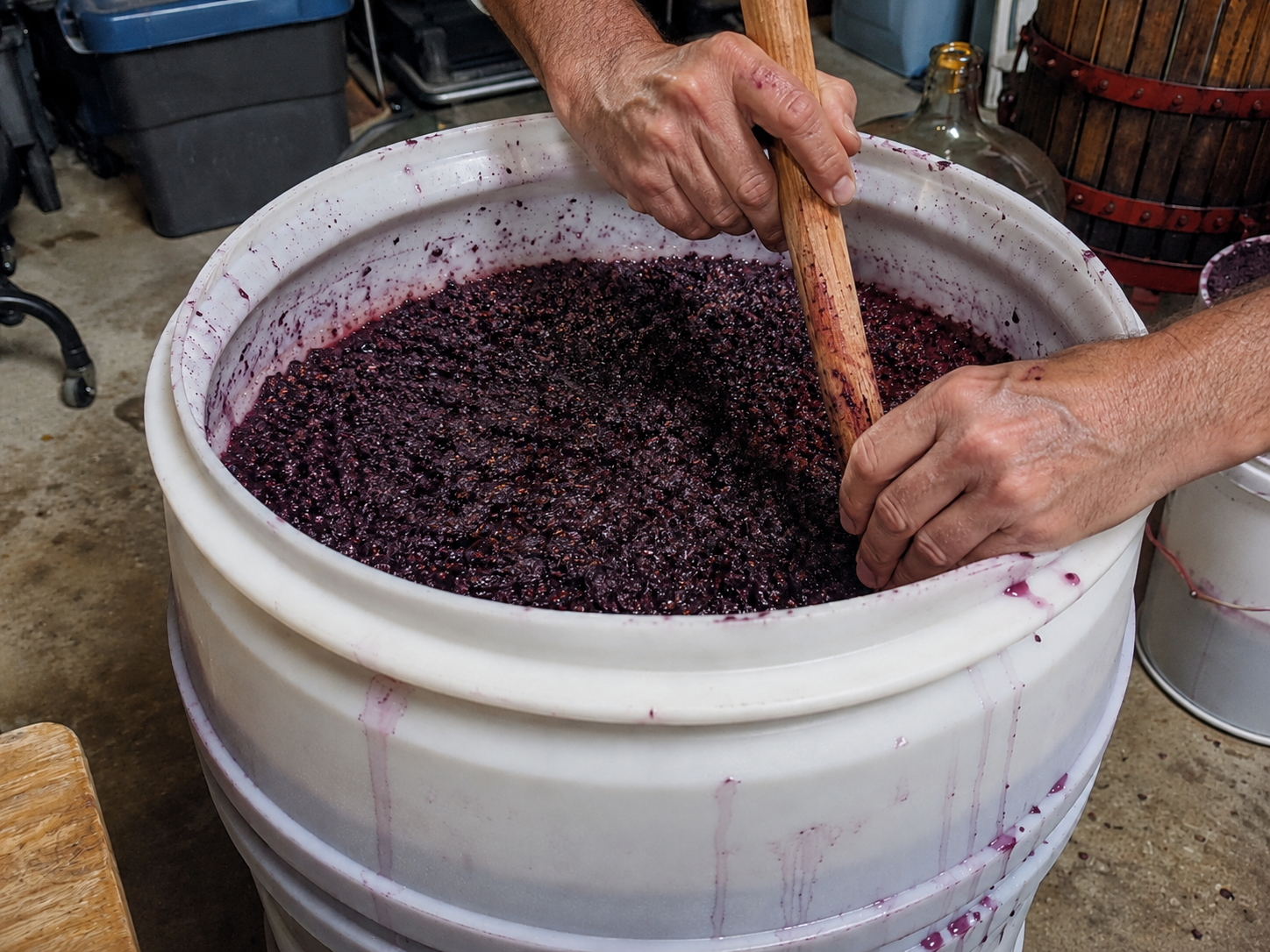
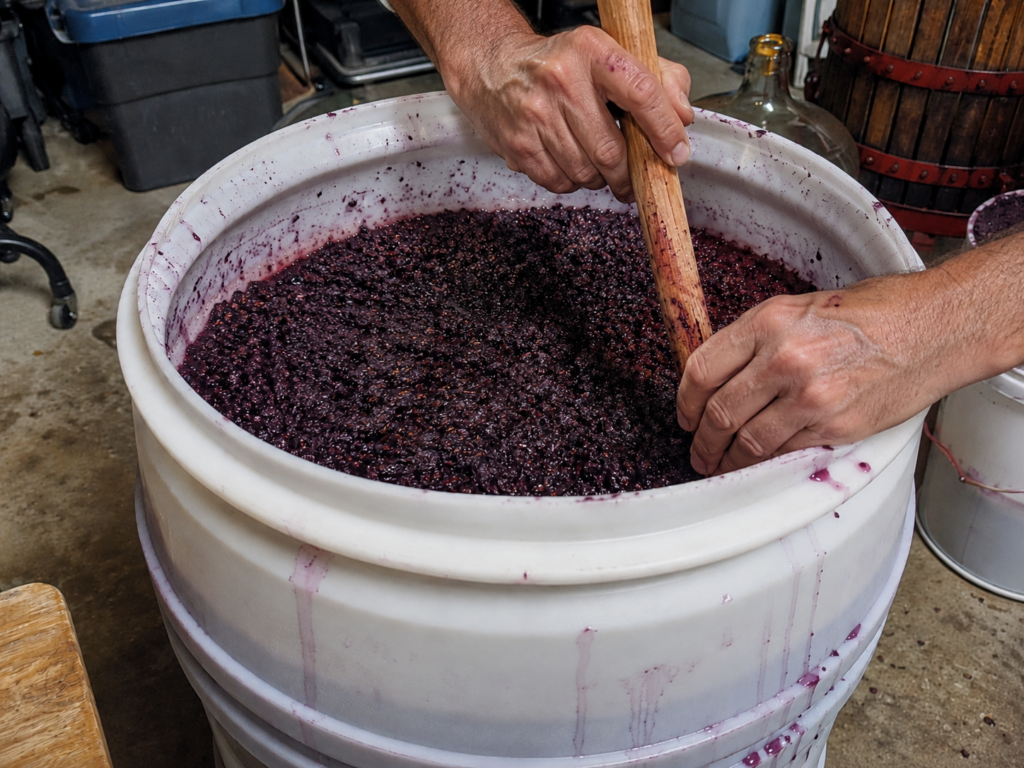
The smell is the thing I have kept most completely. Once the grapes were crushed and the fermentation began, the garage filled with a heavy, sweet, living smell — the smell of the must working, of sugar becoming something else, a smell that was almost too much when you first walked in and then became the smell of the season. He fermented in barrels out there, in the cold of the garage, in one enormous white barrel that I remember better than I remember most rooms I have lived in. That barrel was the center of the world for a few weeks a year.
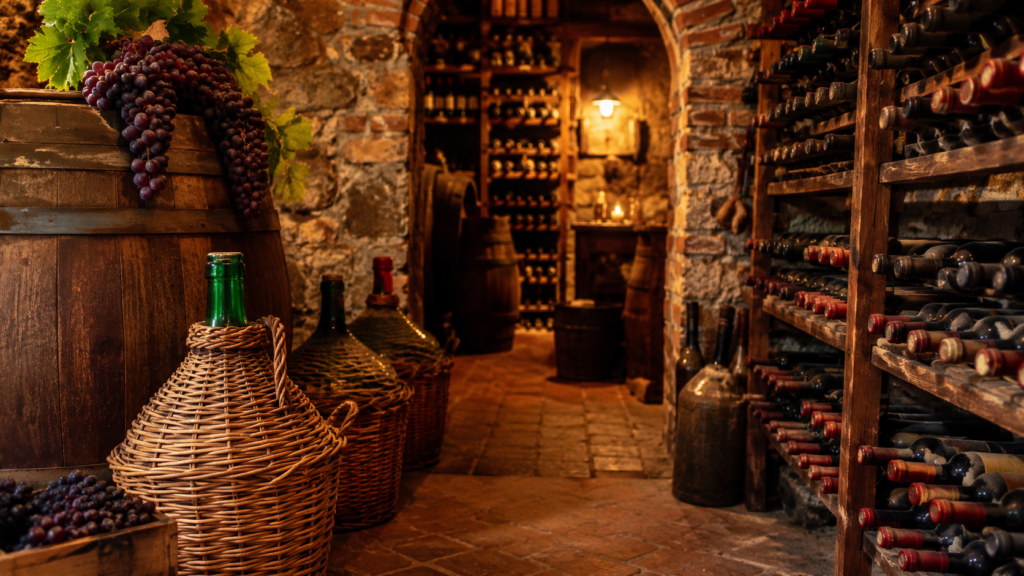
Then, when the fermentation was done, the wine came inside — or rather, it went down. It was moved into glass demijohns, the big rounded ones, and carried into the cantina, the cool cellar room where it would be stored and where, eventually, it would be transferred into bottles one at a time, by hand, patiently, until the year’s work was finally sealed and shelved and ready. That whole arc — crate, crusher, barrel, demijohn, cantina, bottle — was Giovanni’s autumn, and I watched him complete it more times than I can count without ever once being trusted to do the parts that mattered.
He is gone now. That is why I am writing this, and it is also why I have spent this past year doing something I never thought I would have the standing to do: trying to make the wine myself. From memory. From the pieces I absorbed as a boy who was only ever allowed to watch. And from the one person left who actually knows his method — my nonna, who stood beside him for all of it and carries the parts of the process that never made it into anything written down.
Italian homemade wine was never really about the wine. It was about a man keeping a promise to the year — that the grapes would come, the work would be done, and there would be something of his own on the table when it mattered.
What the cantina was — and where the Italian homemade wine lived
To understand the wine you have to understand the room. The cantina — the cellar — was not a wine cellar in the collector’s sense, with racks and labels and a temperature dial. It was a working room, usually below the house or off the garage, cool and dark and a little damp, where an Italian family kept the results of a year of work. In my nonno’s cantina there was wine, but there would also have been the logic of the whole self-provisioning life around it: the same instinct that filled the shelves with jars of tomato passata put up at the end of summer, and that turned a patch of yard into an Italian vegetable garden feeding the table from spring to frost.
Wine and tomatoes were the two great autumn rituals, and they were versions of the same act. The Italian Sons and Daughters of America describes the crushing of grapes and the canning of tomatoes as the twin seasonal traditions of immigrant families, both taken off the vine, both done together, both stored down in the cellar against the coming year. That is exactly what the cantina was for. It was the room where the family’s independence lived. A man who could fill it did not have to buy what he could make, and — more than the economics — he had the deep, quiet satisfaction of eating and drinking his own.
Free Printable
The crush, the harvest, the feast days — the whole Italian year on one calendar.
Get new stories about Italian customs, food traditions, and the way our grandparents marked the seasons — plus the free printable calendar of the Italian year. Join the list and we’ll send it to you.
The crates that came every autumn
The grapes were the beginning of everything, and my nonno did not gamble on them. He had a man. Every autumn the same supplier, the same wooden crates, the same mix of grapes — because a winemaker who has found grapes that make the wine he wants does not go looking for adventure. This was completely typical. Across the Italian diaspora, the grapes arrived by the box from a trusted importer, and you could read the calendar by the discarded crates: when the empty wooden grape boxes started appearing at the ends of driveways, it was wine season, and everyone knew it.
I never knew the exact names of my nonno’s grapes as a boy — they were just “the grapes” — but the history tells us with reasonable confidence what a mix like his almost certainly was. For generations, the grapes shipped to Italian home winemakers in North America were a specific and consistent set of hardy red varieties. The Smithsonian’s National Museum of American History notes that red grapes dominated precisely because they survived the long transcontinental journey and because a drinkable red was easier to make than a stable white — with deeply colored varieties like Alicante Bouschet and Zinfandel leading the way. The Wine History Project of San Luis Obispo County lists the classic shipping reds even more specifically: Alicante Bouschet, Zinfandel, Petite Sirah, Carignane, and Mourvèdre — the grapes chosen because they traveled well and made a solid table wine.
So when I picture my nonno’s “same mix every year,” I picture that: a base of Zinfandel for body and sugar, Alicante Bouschet for its deep red-fleshed color, very likely some Carignane or Petite Sirah to round it out. It is a Calabrian’s wine made from Californian grapes — which is its own quietly perfect emblem of the whole immigrant story. The old country’s method, carried faithfully across an ocean, applied to whatever the new country’s crates could bring. Back home in Calabria the grape would have been the local Gaglioppo; in the garage of the new country, it was whatever came off the truck in those wooden boxes. The method stayed. The grape adapted. That is the story of nearly everything in Italian-American and Italian-Canadian family life.
A Calabrian’s wine made from Californian grapes. The old country’s method, carried across an ocean, applied to whatever the new country’s crates could bring.
The crush, and the great white barrel
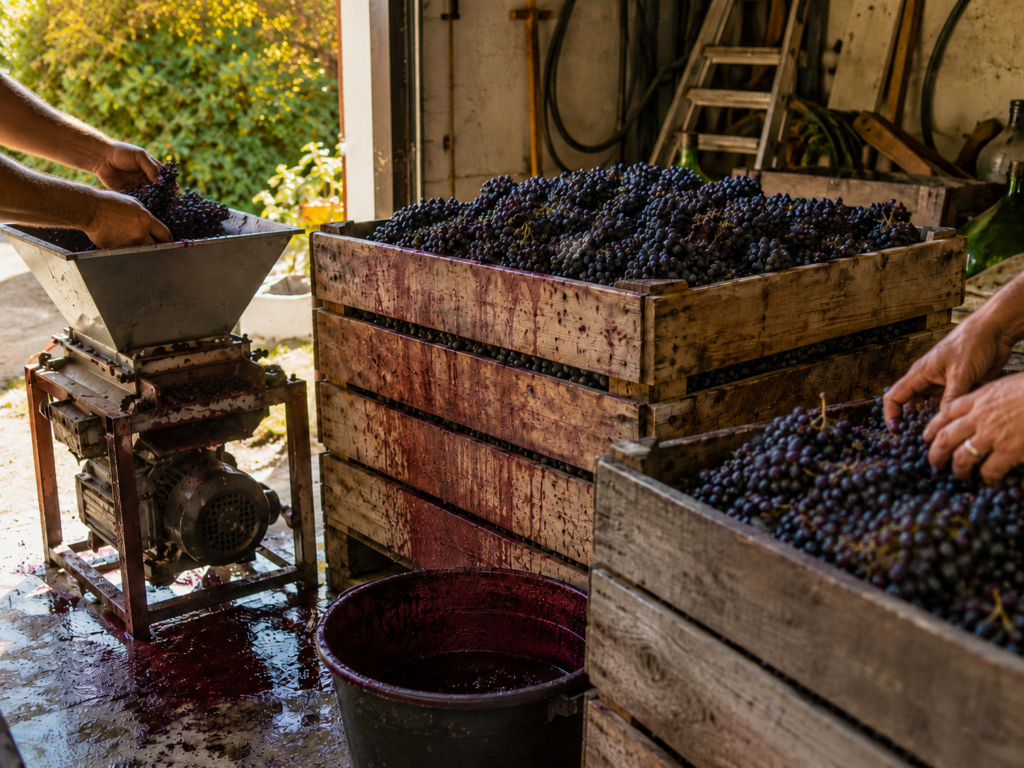
Once the crates had been in the cool of the garage a few days — because cold grapes need to come up to room temperature before they will crush and ferment well — the work began. My nonno had an electric crusher, which by his generation had largely replaced the hand-cranked wooden crushers of the old days. The grapes went in; the crushed fruit and juice came out, skins and all, into the barrel. That crushed mass has a name worth knowing: it is the mosto, the must — juice, skins, seeds, and pulp together, the raw beginning of wine.
And then there was the barrel. The huge white barrel that lived in his garage and that I remember with a clarity bordering on the absurd. This was his fermentation vessel — the “working barrel,” as home winemakers often called it, as distinct from the storage vessels the wine would move to later. The must sat in that barrel and began to ferment, the wild and added yeasts turning the grape sugar into alcohol, and this is when the garage filled with that enormous living smell. The fermentation is not quiet or gentle. It bubbles and heaves. A cap of skins rises to the top and has to be pushed back down into the juice — punching down the cap, winemakers call it — several times a day, so that the skins keep giving their color and character to the wine below. That is much of what the men were doing when they leaned over the barrel: tending the ferment, reading it, keeping it moving.
It stayed in that barrel for a stretch of days — for many families somewhere around a week to ten days, depending on how fast the fermentation ran and how the winemaker judged it. There was no dial for this. There was a man’s hand, his ear close to the barrel listening for the soft hum of the ferment, his eye on the cap, his sense — built over decades — of when the must had become young wine and was ready for the next stage. This is the part I cannot get from a book, and it is exactly the part I am now trying to recover.
The Method That Was Never Written Down
How long did he leave it on the skins? Where did the grapes come from? What did he do at San Martino? The steps that live only in your grandparents’ hands are the ones that vanish first. The Italian Family Heritage Kit gives you the questions to ask, and the space to write the answers down while there is still someone to ask.
Explore the Italian Family Heritage Kit →From barrel to demijohn to bottle
When the fermentation had run its course, the wine was moved off the spent skins and into its next home — the damigiane, the glass demijohns, those big-bellied vessels in their basket casings that are practically the emblem of Italian homemade wine. This transfer, called racking, pulls the clearing wine off its sediment and lets it continue to settle. My nonno’s demijohns, once filled, were carried out of the garage and down into the cantina, into the cool and the dark and the stillness, which is precisely what young wine needs. As one foodways historian at the Heinz History Center puts it, the keys to drinkable homemade wine are clean equipment, patience, and keeping the wine undisturbed — and the cantina was where that stillness was possible.
There is a date that governs this stretch of the calendar, and it is worth knowing because it turns a chore into a tradition. The eleventh of November is the feast of San Martino, and there is an old Italian proverb that every winemaking family knew: a San Martino ogni mosto diventa vino — at San Martino, every must becomes wine. San Martino was traditionally the moment the new wine was ready to taste, the barrels were topped up and sealed, and the wine was left to rest and age through the winter. The saint’s day and the wine’s coming-of-age are bound together in the Italian year, which is the kind of detail that makes you realize how completely the feast day calendar and the work of the land were once the same thing.
| When | What happened in the garage and the cantina |
|---|---|
| Late September – October | The crates arrived from the supplier; the grapes rested a few days, then the crush; primary fermentation began in the barrel |
| Late October | The must came off the skins; the young wine was racked into the demijohns and carried down to the cantina |
| San Martino (November 11) | A San Martino ogni mosto diventa vino — the must had become wine; vessels were topped and sealed for the winter |
| Winter | The wine rested, cleared, and matured in the cool dark of the cantina, undisturbed |
| The following months | Bottling — one bottle at a time, by hand — until the year’s work was sealed, shelved, and ready for the table |
And then, finally, the bottling. My nonno filled his bottles one by one, by hand, from the demijohns — a slow, patient, unhurried transfer that is the very opposite of anything industrial. There is no shortcut to it and he did not want one. Each bottle was the culmination of the whole autumn, and the cantina shelves filling with them was the visible proof that the year’s work was done. The pomace left behind after pressing, incidentally, did not always go to waste either — in many families it was distilled into grappa, the fierce clear digestivo that closed a heavy meal, though that is a whole tradition of its own.
He filled his bottles one at a time, by hand. Each one was the culmination of the whole autumn, and he did not want a shortcut for any of it.
The wine on the table — and why you never brought store wine
Here is the rule that I understood in my bones long before I could have explained it: at my nonno’s table, the wine was his. You did not bring wine from the store. You did not bring someone else’s wine. To put a store-bought bottle on that table would have been a small act of shame — not because anyone would shout about it, but because it would have quietly said the wrong thing. It would have said that his year of work was not enough, or that you had not understood what the wine on the table meant.
Because the wine was not a beverage. It was the household. It was on the table at every Sunday dinner, poured without ceremony and without question, as much a part of the meal as the bread you used to fare la scarpetta at the end. To drink his wine was to accept his hospitality in its most complete form — to consume, literally, the product of his labor and his cantina and his year. A different bottle on that table was a different man’s labor, and it did not belong.
This is not a quirk of my family. It ran through the whole culture. Homemade wine was carried to gatherings precisely so it could be compared and gently critiqued, one man’s vintage against another’s, the wine itself a kind of conversation between households and between the men — often helped each autumn by a compare, a trusted friend who showed up for the crush the way people showed up for one another. To drink a man’s wine was to know something about him. To offer it was to offer a piece of the year he had made with his hands.
The wine was not a beverage. It was the household. To put a store bottle on that table would have quietly said the wrong thing.
Learning it back, one autumn at a time
Now the garage is quiet, and I am the one standing over the barrel.
I am trying to make the wine. Not a wine — the wine, his wine, the way Giovanni made it. And I am discovering how much of a method lives in the hands rather than in any set of instructions. I know the shape of it because I watched it so many times: the crates, the rest, the crush, the barrel, the ferment, the racking into demijohns, the cantina, the patient bottling. But the shape is not the same as the knowledge. How many days on the skins, exactly, and how did he decide? What was the mix, precisely, and from whom? How did he know the ferment was done — by taste, by the sound, by a hydrometer, or by a feel in his thumb that took forty years to earn? These are the questions I never thought to ask when there was still someone to answer them, because when you are a boy who is only allowed to watch, you assume the watching will go on forever.
The one person who holds his method is my nonna. She stood beside him for every autumn of it, and the parts of the process that never made it into words — the judgment, the timing, the small corrections — live in her now. So I am learning it back the only way it can be learned: slowly, in pieces, from her. I ask, she remembers, I try, I get it a little wrong, I ask again. It is the oldest form of transmission there is, and it is also the most fragile, because it depends entirely on there still being someone to ask and someone with the sense to ask them in time. If you have an older relative who still carries a family method like this — a wine, a sauce, a remedy, a recipe that lives only in their hands — the questions are worth asking now, and the answers are worth writing down before they are gone. I know this because I am living the version where you almost waited too long. Some of the most important things an Italian grandfather passed down were never spoken as lessons at all — they were simply done, in front of you, until one day it was your turn to do them.
Every autumn Giovanni’s garage stopped being a garage. The crates came, the barrel filled, the smell of the must took over, and a Calabrian man turned grapes into the wine that would sit on his table all year. I was allowed to watch and not to touch. Now the barrel is mine, my nonna is teaching me what her hands remember, and I am learning — slowly, but surely — to make the wine he made. That is the whole of it. Not a recipe. A promise to the year, handed down.
Before the Method Is Lost
Record how your family made their wine, their sauce, their year.
Who made the wine? Where did the grapes come from? What did the cantina hold? The steps that live only in your grandparents’ hands disappear the moment no one asks. The Italian Family Heritage Kit includes 133 guided pages and more than 120 prompts to preserve your family’s people, names, traditions, recipes, remedies, sayings, photographs, and memories.
Explore the Heritage Kit — $19.99Instant digital download. Print it and complete it with your family.
The wine was one half of the Italian autumn; the tomato harvest was the other — read about how families made their passata and put up the year’s sauce. For the man at the center of it all, read what the Italian nonno really was, and for the room that held the year’s work, read what the Italian cantina meant. To trace the town your own winemaking family came from, start with how to find your Italian town of origin, and for passing these traditions forward, read how to keep them alive with your kids.
Before you start, it helps to know how much wine your grapes will actually make — the crates-to-bottles math every cantina ran on.
FAQ
What is an Italian cantina?
An Italian cantina is the cellar or cool storage room, typically below the house or off the garage, where a family kept the results of a year of work — homemade wine in demijohns and bottles, alongside preserved food like tomato passata, cured meats, and jarred vegetables. It was not a collector’s wine cellar but a working room, cool and dark and often slightly damp, which happens to be ideal for storing and aging young wine. The cantina was the physical center of an Italian family’s self-provisioning life, and for winemaking families it was where the wine rested, cleared, and matured through the winter before bottling.
What grapes did Italian families use to make homemade wine in North America?
Most Italian home winemakers in North America used red grapes shipped in crates from California, because red varieties survived the long journey and made a more reliably drinkable wine than whites. The classic shipping reds were Zinfandel, Alicante Bouschet, Petite Sirah, Carignane, and Mourvèdre. Alicante Bouschet in particular was prized as a teinturier grape with red flesh, used to give the wine its deep color. Many families used a consistent blend of these year after year, bought from the same trusted supplier, rather than a single varietal — a practical adaptation of old-country methods to whatever the new country’s crates could provide.
What is a demijohn (damigiana) used for in winemaking?
A demijohn — damigiana in Italian — is a large, rounded glass vessel, often in a protective basket or casing, used to store and age wine after fermentation. In traditional home winemaking, the young wine is moved (racked) off its spent skins and sediment into demijohns, where it continues to clear and settle in the cool of the cantina. Demijohns are one of the most recognizable symbols of Italian homemade wine, and many families still have them stored in a basement decades later, empty or full, as heirlooms of the tradition.
What does “A San Martino ogni mosto diventa vino” mean?
It is a traditional Italian proverb meaning “at San Martino, every must becomes wine.” San Martino — the feast of Saint Martin on November 11 — traditionally marked the moment the new wine was ready to taste, when the fermenting must had turned into young wine, the barrels were topped up and sealed, and the wine was left to rest and age through the winter. The proverb reflects how deeply the Italian winemaking calendar was tied to the feast day calendar, with a saint’s day marking each stage of the agricultural year.
Why did Italian families make their own wine instead of buying it?
Partly economics — making wine at home from purchased grapes was far cheaper than buying bottles — but the deeper reason was cultural and personal. Most Italian immigrants had made wine in Italy and simply continued the practice in the new country, where it gave them a familiar, self-made staple that reminded them of home. The wine on the table was a matter of pride and identity: it was the family’s own labor, made with their own hands, and serving it was an act of hospitality. In many families, bringing store-bought wine to the table was considered mildly shameful precisely because the homemade wine carried so much meaning.
How can I learn to make wine the way my grandfather did?
Start with the living memory before anything else. Much of a family winemaking method lives in the hands and judgment of the person who did it, not in any written recipe — how long the must stayed on the skins, where the grapes came from, how they knew fermentation was finished. If a relative who helped with the wine is still living, ask them in detail and write down or record everything they remember, including the small decisions that never got spoken aloud. Then rebuild the process step by step: the grapes, the crush, primary fermentation in a food-grade vessel, racking into demijohns, resting in a cool dark space, and patient bottling. The method is recoverable, but the specific family version depends entirely on capturing what your elders still carry before it is lost.

Marco Ricci is an Italian-Canadian writer and the grandson of Calabrian immigrants. He created Italian Family Traditions to document the customs, feast days, and family rituals Italian families carried from Italy to North America — and to understand what they actually meant. He is based in Montreal.