Italian Family Traditions
What Is Passata? The Italian Tomato Tradition That Was Never Just About the Sauce
It always fell on a random weekday in early September, whenever the tomatoes were finally right. The adults were already arguing about whether they were ripe enough, too ripe, or from the wrong farm entirely. The whole yard smelled like summer concentrated into something you could bottle. And my grandfather — a man who rarely said much — had not stopped talking since five in the morning.
There is a specific smell that exists nowhere else in the world except an Italian family’s yard in early September when the tomatoes are going through the mill. It is the smell of cooking tomatoes in impossible quantities — steam, sweetness, a faint char from the burner, the particular weight of air that has been saturated with tomato for hours. I smelled that smell exactly once a year for my entire childhood and never anywhere else. It is passata day. And if you grew up in an Italian household, you know before I say another word what that means — and what a jar of passata really is.
My grandfather ran the show. He stood over the whole operation with his sleeves pushed up past his elbows, directing everyone in rapid-fire dialect, and he operated with the specific authority of a man who had been doing this since before any of us existed. The tomatoes went in one end of the mill. The skins and seeds came out the other. And the passata — smooth, deeply red, intensely tomato-forward — came through the middle and into the pot below, where he would lean over it and assess it with the expression of someone who had been making this exact judgment for forty years and trusted nobody else to make it correctly.
That day was not on any official calendar. It had no fixed date, no holiday designation, no civic recognition. It happened when the tomatoes were ready and the family was willing — a random nice weekday in early September, chosen by my grandfather the way he chose everything about the harvest: by feel, by experience, by a knowledge that could not be written down. The crates appeared in the yard. The equipment came out. And the family assembled, because that is what the family did on this day, and had done on this day, and would keep doing for as long as there were tomatoes and the people who understood what to do with them.
Passata was never just a tomato product. It was security. A cantina lined with jars meant the family had prepared, had worked together, had taken care of each other. It was my grandfather’s way of saying — without ever saying it — that we would be fed. Even after he was gone.
Free Printable
The whole Italian year, on one printable calendar.
Passata day, the harvest, the feast days, the whole rhythm of the Italian year — in one free printable calendar. Join the list and we’ll send it to you.
What passata actually is
Passata is a smooth, uncooked-tasting tomato purée made from tomatoes that have been cooked down and strained to remove the skins and seeds. The name comes from the Italian verb passare — to pass — because the tomatoes are passed through a mill or press that separates the usable pulp from the waste. What comes through is light, fluid, intensely tomato-flavoured, and made from nothing but the tomatoes themselves. No garlic. No herbs. No sugar. Just tomatoes at their most essential.
That purity is the point. Passata is not a finished sauce — it is the foundation everything else is built on. You take it and you add to it: garlic softening in olive oil, a handful of basil torn rather than cut, a splash of pasta water that carries starch and salt from whatever is cooking. Fifteen minutes and you have something that tastes like someone’s grandmother made it. Which she did, months ago, on an early-September morning when the tomatoes were exactly right.
My family kept jars of passata lined up in the cantina like soldiers — dozens of them, sometimes over a hundred, glowing red in the dim light beside my grandfather’s barrels of homemade wine. As a child I assumed this was how everyone’s basement looked. It was not until I visited a friend’s house and saw a pantry full of store-bought cans that I understood our family was doing something different — and that the difference mattered in ways I had not yet learned to name.
What passata day actually looked like
Some families treated passata day like a holiday. Others treated it like a military operation. In our house it was both at once, which produced a specific kind of organized chaos I have never seen replicated anywhere else.
The tomatoes arrived the night before or early that morning — crates upon crates, stacked in the yard and the driveway and wherever else there was flat surface. My job as a child was to stand at a folding table and rinse the dirt off while an aunt inspected each tomato like she was grading diamonds. Soft spots: out. Weird colour: out. Not quite ripe enough: debatable, and therefore worth a ten-minute argument with whoever was standing nearby.
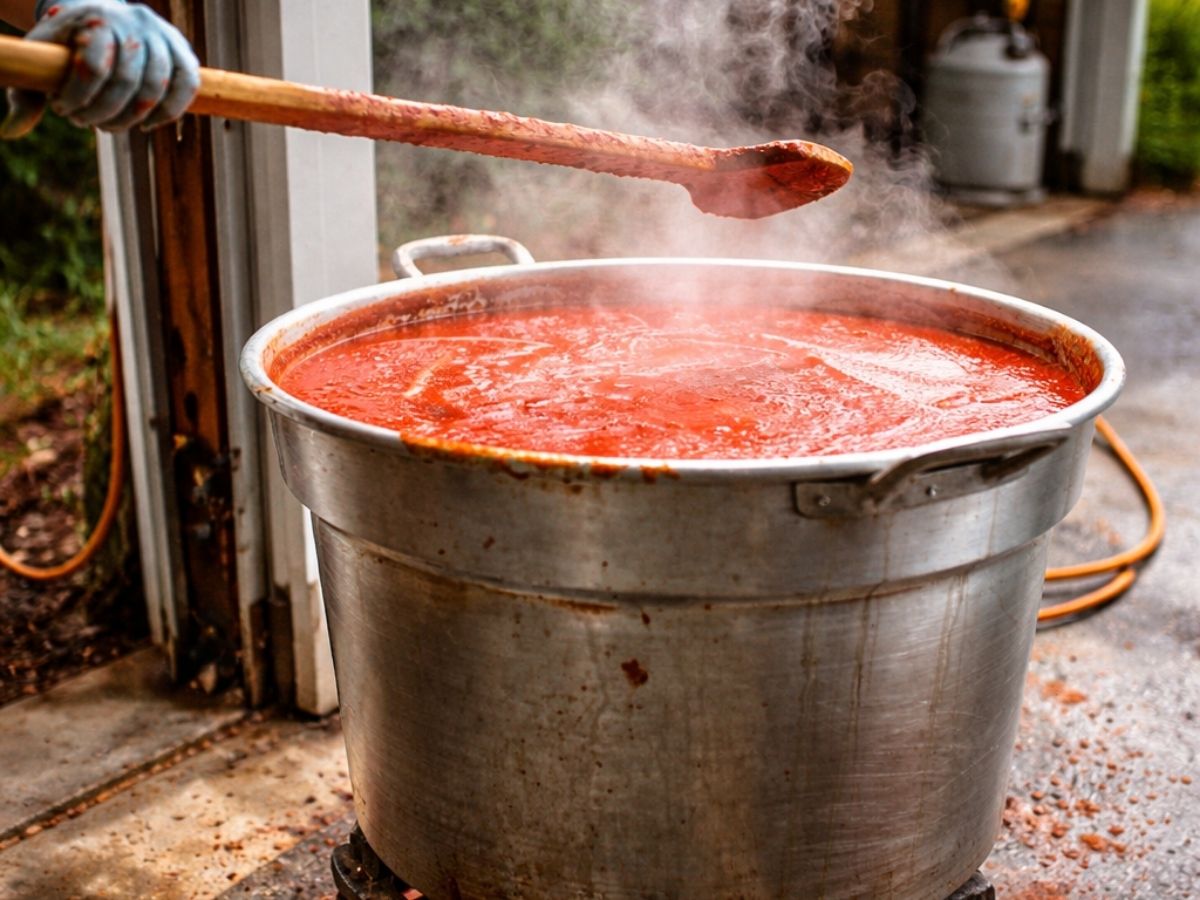
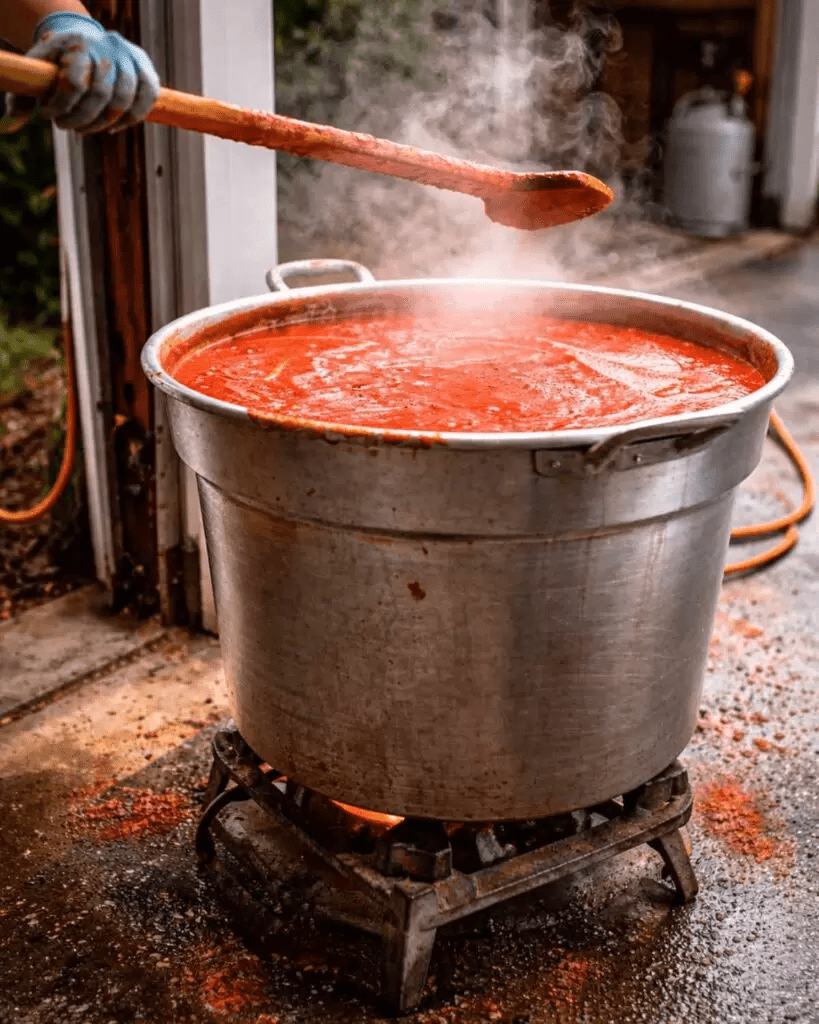
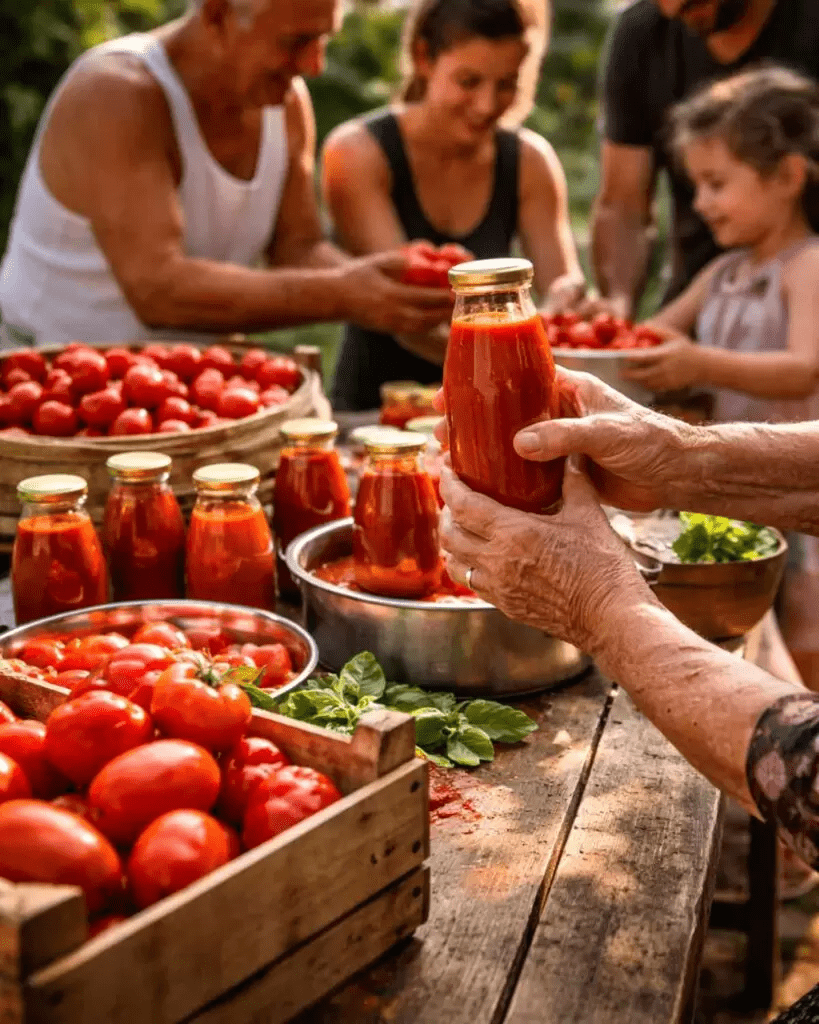
Then they went into an enormous pot — a huge pit of boiling water set up over a burner outside, because no kitchen stove could handle this volume — and cooked until they softened and broke down into a thick, bubbling mass that smelled extraordinary and spattered everything within reach. Then through the mill. Then into the jars — plain glass mason jars, the kind the stores sold fresh every season for exactly this. Into each jar, before it was sealed, went a single basil leaf picked straight from my grandfather’s garden that morning. Then sealed, then boiled again in drums of water to create the vacuum that would keep them through the winter.
The whole process took the better part of a day. By the end, everyone was exhausted and stained red and vaguely irritated with at least one specific family member. But the cantina was full. The pantry was stocked. And there was a quiet satisfaction that came from knowing you had prepared — that you had done the work that would make the months ahead easier, and that you had done it together.
My grandfather — a man who rarely said much — became the most talkative person in the room on passata day. He told stories about making sauce as a boy in Calabria, about the courtyard where the women worked together, about the way the whole village smelled like tomatoes in September. He would get a faraway look, and for a moment you could see he was not in a suburban yard in Montreal anymore. He was home. This was one of the few times the old country was present in the room in a way you could almost touch.
When is passata day? Why the date was never fixed
People ask when passata day is as if it is marked on a calendar. It is not.
Passata day happens when the tomatoes are ready — for us, almost always a warm weekday in early September, when the plum tomatoes were at their absolute peak and the farmers were selling them by the crate. Growing up, I knew it was coming when the phone calls started — my grandfather talking to someone named Salvatore or Antonio about how many cases they could get, what the price was this year, whether the tomatoes were good or “not like last year.” Then one morning there would be crates everywhere. And we knew: today is the day.
Passata was one part of the autumn rhythm of putting food by — the same weeks families spent roasting chestnuts as the season turned.
That relationship with the harvest calendar is itself part of the tradition. This was food that followed the rhythm of the season rather than the rhythm of convenience. You worked with what the earth gave you, when it gave it, and you made enough to last until it gave it again. That understanding — that preparation and patience and timing were not optional — was built into passata day the same way it was built into everything else in Italian family food culture. For how that seasonal rhythm connected to the broader Italian year, read about the June herb traditions and the November feast of San Martino — the markers before and after that gave the Italian year its shape.
Passata vs. sauce, purée, paste & crushed tomatoes
Passata is often confused with other tomato products. Here is the clearest way to understand the differences:
| Product | What it is | How it differs from passata |
|---|---|---|
| Passata | Smooth strained tomato purée — just tomatoes, maybe salt | The base. Unseasoned, fluid, pure. You build from it. |
| Tomato sauce | Seasoned, finished sauce with garlic, herbs, oil | Ready to eat. Passata needs work to become this. |
| Tomato purée | Similar to passata but varies by brand — sometimes thicker | Read the label. Some are nearly identical, some are not. |
| Tomato paste | Concentrated, intensely flavoured, thick | Used by the tablespoon for depth, not as a sauce base |
| Crushed tomatoes | Chunky texture — pieces of tomato in thick juice | Rustic and textured. Passata is smooth and uniform. |
| Marinara | Prepared sauce with garlic, oil, herbs | Marinara is what you make. Passata is what you make it from. |
The distinction that matters most in Italian family cooking is the one between passata and finished sauce. Passata is not something you heat and serve. It is something you transform — with fat, with aromatics, with time, with the specific judgment of whoever is cooking — into something that belongs to your family’s table rather than to a recipe card.
What you actually do with passata
Almost everything. That is the whole point. A cantina full of passata was a baseline guarantee of meals for the winter — the raw material from which everything else was made.
Quick pasta sauce — garlic in olive oil, passata, salt, red pepper, fifteen minutes, fresh basil, pasta. This was Tuesday-night dinner more times than anyone counted.
Sunday ragù — passata as the base, then meatballs, sausage, braciole, hours of low simmering until the meat is falling apart and the sauce has become something with no equivalent in a store. For the full story of what Sunday lunch meant in Italian families, read about the Italian Sunday table.
Braised meat — passata as the braising liquid for chicken, pork, beef. Add aromatics, cover, let the oven work for two hours.
Pizza base — passata used raw or barely cooked, spread thin, finished in the oven.
Soups and minestrone — passata for body and tomato depth without texture getting in the way.
Baked pasta — lasagna, baked ziti, stuffed shells, anything layered and baked that needs a smooth, consistent tomato presence throughout.
The flexibility is the beauty. You made a hundred jars in September and you spent the rest of the year deciding what they became.
The Recipes No One Wrote Down
The tomato supplier’s name, the ratio, the timing, the basil from the garden — passata day lived in one person’s hands and was never written down. The Italian Family Heritage Kit gives you the prompts to record your family’s recipes, rituals, and stories before they’re lost.
Explore the Italian Family Heritage Kit →Why families made passata instead of buying it
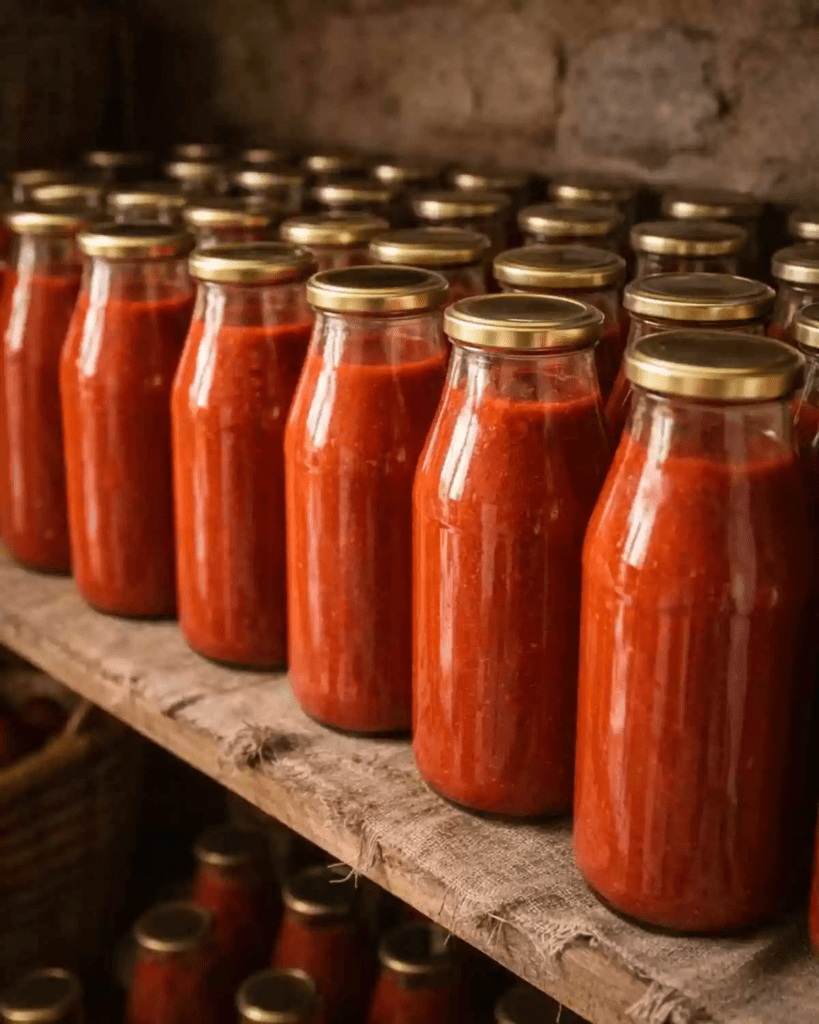
For a long time it was simply cheaper. You bought tomatoes in bulk at peak season, processed them yourself, and ended up with a year’s supply for a fraction of what jars would cost. That practical logic made sense and continued to make sense until grocery prices made the calculation closer than it once was.
But the practical logic was never the whole reason. People made it because they knew exactly what went into it. No preservatives, no added sugar, no ingredients they could not name. Just tomatoes — the best ones they could find, sourced from the farmer they called every year, the one whose tomatoes were right or “not like last year.”
And they made it because this was how that generation showed love. Not with words. Not with grand gestures. With preparation — with the specific act of working all day in September so that February would be easier. A cantina lined with jars of passata was not just a food supply. It was security. It was a statement about what the family owed each other. It was my grandfather saying, without ever saying anything of the kind, that we would be fed. That he had taken care of it. That even if something happened to him, we would open a jar in February and he would still be there in some form — in the smell of it, in the taste of it, in the specific quality of a sauce made from tomatoes he had sourced and sorted and decided were good enough.
He passed away some years ago. We still have a few of his jars in the cantina. Nobody has opened them. They are not really about sauce anymore.
Everyone had a role — including the children
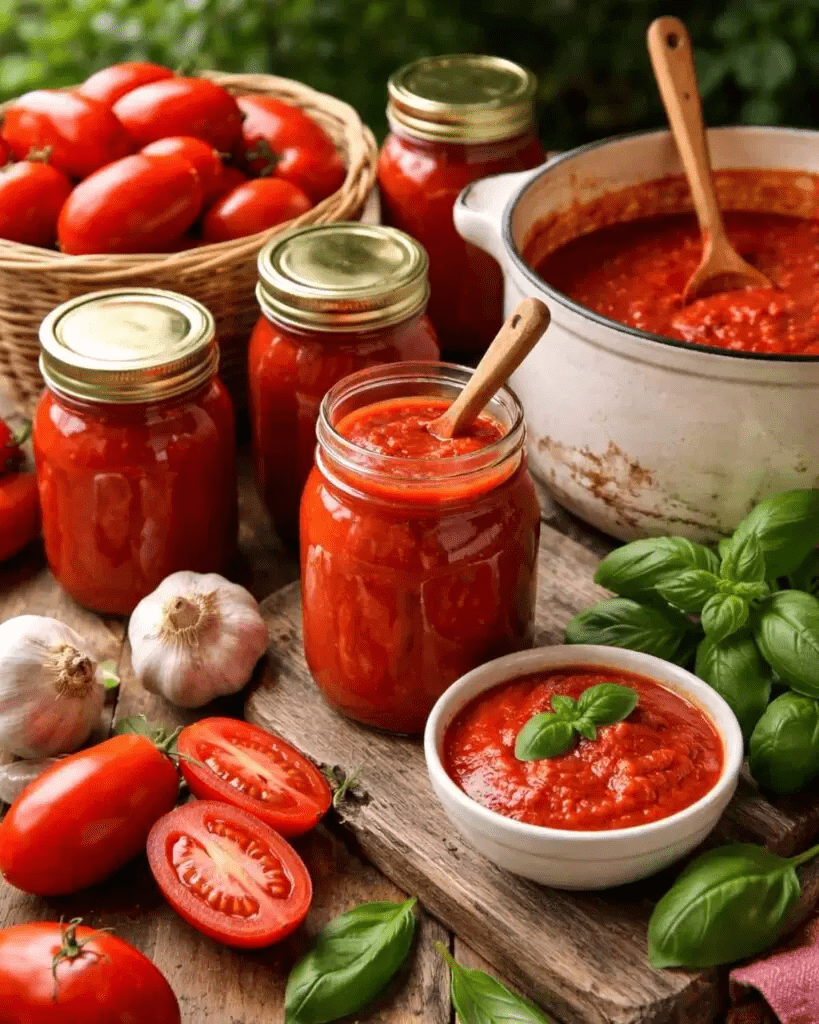
The best thing about passata day was that it gave everyone something to do. Someone bought the tomatoes. Someone washed them. Someone trimmed them. Someone ran the outdoor burner. Someone operated the mill. Someone filled the jars. Someone dropped in the basil. Someone sealed the lids. Someone boiled the jars. Someone cleaned up the disaster. And someone — there was always one — complained the entire time while somehow showing up every single year anyway.
I was the bottle-filler for years. Not glamorous, but essential. You stand there with a funnel and a ladle, filling jar after jar, trying not to spill too much or burn yourself on the hot passata. By the end your arms ache, your hands are stained red, and you smell like tomatoes in a way no amount of showering seems to fix. But you also feel like you contributed — like you were part of something that had been happening before you and would continue after you.
That sense of belonging was not incidental. It was the whole point. Passata day gave children a role in family food culture before they were old enough to cook. Even the youngest could sort tomatoes, carry empty jars, run errands between the yard and the kitchen. You grew up feeling like you were part of the process, not just the beneficiary of it — which is exactly how Italian heritage gets passed to children in a way that feels real rather than performed.
The children want to be part of it once they see what is happening. Something in them recognizes that this matters — that this specific day, this specific smell, this specific mess, is worth being present for. They will remember it. They will want to come back next year. And one day they will be the one standing over the mill with their sleeves pushed up, and the child beside them will be watching with the specific attention of someone learning something they do not yet have words for.
How to start or revive the tradition
You do not need a yard full of crates or a machine that survived several decades. The tradition scales down.
Start with twenty or thirty pounds of ripe plum tomatoes — San Marzano or Roma are the most traditional. Find a local Italian market or farmer’s market in late August or early September when prices drop and quality peaks. Cook them down, pass them through a food mill or fine strainer, and bottle them in sterilized mason jars with a proper water-bath seal — a basil leaf in each jar, if you want to do it the way my grandfather did. You will end up with eight or ten jars. That is enough for several months of pasta and a genuine connection to what the tradition was.
The equipment matters less than the intention. A good tomato mill — the hand-cranked kind that looks like it belongs in an Italian grandmother’s kitchen — makes the process easier and more authentic than a blender or food processor. It is also the kind of equipment that lasts decades and gets passed down. My grandfather’s machine outlived him. That is the right kind of kitchen tool.
Invite people. That is the most important part. Passata day alone is just a chore. Passata day with family is the tradition. Even two or three people working together changes the quality of the day entirely — the conversation, the arguments about whether the tomatoes are ready, the specific satisfaction of looking at jars lined up at the end and knowing you did that together.
My grandfather passed away some years ago. We still have a few of his jars in the cantina. Nobody has opened them. They are not really about sauce anymore. They are about the man who ran the show at five in the morning, telling stories about Calabria, who handed a child a spoon to taste and waited to see if it was right, who lined that cantina with red jars every September as his particular way of saying: I have taken care of you. Even now. Even still.
Before the Recipe Leaves With Them
Record your family’s passata day — and everything like it.
Who ran the day? Which farm? What was the ratio, the timing, the trick no one wrote down? The Italian Family Heritage Kit includes 133 guided pages and more than 120 prompts to preserve your family’s recipes, rituals, names, sayings, photos, and stories.
Explore the Heritage Kit — $19.99Instant digital download. Print it and complete it with your family.
Passata day belongs to the same Italian seasonal calendar as the June herb traditions that prepared the garden and the November feast of San Martino that marked the cantina at full capacity. For the wine that shared that cantina, read about making wine the old way. For the Sunday ragù the passata became, read about the Italian Sunday table. And to record the family knowledge that lives in a tradition like this before it disappears, read how to record family stories before they’re lost.
If you’re ready to make your own, here’s the full step-by-step guide to making passata — with a calculator for how many tomatoes you need and how to jar it safely.
FAQ
What is passata?
Passata is a smooth tomato purée made from tomatoes that have been cooked and strained to remove the skins and seeds. The name comes from the Italian verb passare — to pass — because the tomatoes are passed through a mill or press. What comes through is smooth, fluid, and intensely tomato-flavoured, made from nothing but the tomatoes themselves — no garlic, no herbs, no sugar. It is not a finished sauce but a foundation — the base from which Italian families built everything from a quick Tuesday pasta to a Sunday ragù that simmered for hours. In Italian family culture, passata was something you made rather than bought, in large quantities, once a year, together.
When is passata day?
Passata day has no fixed date. It happens when the tomatoes are ready — typically late August or early September, when plum tomatoes like San Marzano or Roma are at peak ripeness and available in bulk from farmers. Italian families watched the harvest, sourced their tomatoes from known suppliers, and assembled when the conditions were right — often a random warm weekday chosen by whoever ran the day. The answer to “when is passata day” was always: when the tomatoes are ready and the family is willing.
What is the difference between passata and tomato sauce?
Passata is unseasoned and unfinished — just strained tomatoes, perhaps with salt. Tomato sauce is seasoned and ready to eat, typically including garlic, olive oil, herbs, and other flavourings. Passata is what you cook with; tomato sauce is what results from cooking with passata. In Italian family cooking this distinction mattered: passata was the raw material in the cantina, and the cook’s skill and family tradition determined what it became. The same jar could become a quick weeknight pasta or a slow Sunday ragù.
Why did Italian families make their own passata instead of buying it?
For practical, economic, and deeply personal reasons at once. Practically, bulk tomatoes at peak season were cheaper than year-round store-bought jars. Economically, one day of work produced a year’s supply. Personally, homemade passata contained nothing but tomatoes — no preservatives, no additives. But the deepest reason was cultural: making passata was how Italian families prepared for the months ahead, worked together across generations, stayed connected to the rhythms of the harvest, and expressed care for each other in the most concrete possible way. A cantina full of jars meant the family had done its work and nobody would go without.
What tomatoes are best for passata?
Plum tomatoes — specifically San Marzano or Roma varieties — are the most traditional and most widely used. They have thick flesh, low water content, few seeds, and a concentrated sweetness that makes the resulting passata deep-flavoured and rich rather than thin and watery. San Marzano tomatoes from the Campania region of Italy are considered the gold standard. For Italian families in Canada and the United States, the annual hunt for the best available plum tomatoes was itself a ritual that preceded passata day by weeks.
How long does homemade passata last?
Properly processed and sealed homemade passata — canned using a water-bath method that creates a proper vacuum seal — can last until the following harvest, typically twelve months or more when stored in a cool, dark place like a cantina. The Italian family standard was simple: make enough in September to last until next September. If the seal is intact, the lid is not bulging, and the contents look and smell correct, the passata is good. If there is any doubt — broken seal, off smell, unusual colour or texture — do not use it. The family rule was: if in doubt, throw it out.
Why do you put a basil leaf in the jar?
Dropping a single fresh basil leaf into each jar before sealing is a common Italian passata tradition. It lends a subtle aroma and flavour to the passata as it rests through the winter, and for many families — ours included — the basil came straight from the family garden, picked the morning of passata day. It is a small touch, but it is exactly the kind of detail that separates homemade passata from anything on a shelf.
Did Italian-Canadian families keep the passata tradition after immigration?
Many did — and in some ways the tradition was strengthened by immigration rather than weakened. For families who had left behind their village, their language, and most of their possessions, passata day was one of the clearest continuities available. You could still source the same tomatoes, still use the same equipment, still make the house smell exactly the way it had in Calabria or Sicily. In Montreal’s Italian community — in Saint-Michel, Saint-Léonard, Rivière-des-Prairies, and Little Italy — early September had a specific quality in the Italian households: the smell of tomatoes cooking, families assembled in yards and garages, jars lined up on every surface. The tradition crossed the ocean because the tomatoes were available and the people who understood what to do with them had arrived.

Marco Ricci is an Italian-Canadian writer and the grandson of Calabrian immigrants. He created Italian Family Traditions to document the customs, feast days, and family rituals Italian families carried from Italy to North America — and to understand what they actually meant. He is based in Montreal.