Italian Family Traditions
Italian Easter Traditions: The Holiday That Started Before the Meal
It was solemn before it was joyful. It was a whole week before it was one meal. And it carried more than food — it carried the feeling that the whole house was moving toward something sacred.
There is a particular kind of quiet that settled over an Italian household in the days before Easter. Not the fizzy, chaotic quiet of Christmas Eve when everyone is pretending not to notice the presents. A different kind. Heavier. More intentional. Like the whole family knew something important was approaching and had collectively decided to behave accordingly.
The clothes were laid out earlier than usual. The kitchen smelled different — richer, sweeter, older somehow. There was a pie that had been started three days ago because apparently you could not rush it and anyone who suggested otherwise was missing the entire point. The church calendar was not a background detail. It was the plot.
That is what made Italian Easter different from almost every other family occasion.
It did not begin when you sat down at the table. It began before that — in Holy Week, in Mass, in restraint, in the slow build that made the celebration feel earned rather than arbitrary. And that feeling, that shape of anticipation and then release, is exactly what so many Italian descendants are trying to recover when they reach back for it now.
Easter did not just arrive. It was approached. You felt it coming before it got there.
So let’s tell this story properly. Not as a list of dishes. As a family memory that actually makes sense of what Easter was, what it became, and why it still matters.
First, understand what Italian Easter actually was
When people talk about Italian Easter traditions, they usually jump straight to the food. The lamb. The pastiera. The colomba. The ricotta pie. And yes — we will get there, because the food was extraordinary and it deserves its moment.
But the food was the final act of a much longer story.
Italian Easter was built around Settimana Santa — Holy Week — which in Italy still includes processions, public rituals, mourning, and then joy. Palm Sunday. Good Friday. Holy Saturday. Easter Sunday. And then, the day after, Pasquetta — Little Easter — which was its own whole thing. Italy’s official tourism resources still describe Easter as a holiday where old religious rites, processions, and symbolic customs are deeply felt across the country, with local customs stretching from Palm Sunday all the way through Easter Monday. (Italia.it)
So this was not a one-day event. It was a week-long movement from solemnity to celebration. And that arc — the waiting, the gravity, the release — gave Easter an emotional weight that a single holiday meal simply cannot produce on its own.
My grandmother never cooked the pastiera on Easter Sunday. She started it on Holy Thursday, sometimes Wednesday. She said the flavors needed time. She said you could not rush something sacred. She was talking about a pie, technically, but she was not only talking about a pie.
There was also the spring layer underneath all of it. Easter lands when everything is coming back to life, and Italians, who have always had a poet’s relationship with the seasons, felt that. Eggs were not just a religious symbol. They were spring itself — rebirth, fertility, renewal. Treccani notes that eggs were traditionally associated with rebirth and regeneration, and that in modern Italian custom painted eggs were largely replaced by the now-iconic chocolate Easter egg. (Treccani)
Faith plus family plus food plus spring. That was Easter. All four layers at once, pressing down on the same beautiful week.
The Holy Week rhythm — what it actually felt like, day by day
For families who kept the full calendar, Easter was not a Sunday surprise. It was an arrival you had been walking toward for days. Here is what the week looked like when a family kept it properly:
| Day | What it meant |
|---|---|
| Palm Sunday | Blessed palms. Church. The week has officially begun. Something has shifted in the house’s mood. |
| Monday – Wednesday | The kitchen starts. The pastiera begins. The house starts smelling like it knows something you don’t yet. |
| Holy Thursday | More preparation. A quieter tone. Church in the evening for many families. The week is deepening. |
| Good Friday | Solemn. Meat forbidden. Fish on the table. No music. The gravity of the day is unmistakable and felt in everything. |
| Holy Saturday | Final cooking. Anticipation. The Easter basket sometimes blessed at church. Everything is almost ready. |
| Easter Sunday | Mass. The good clothes. The family table. The feast. The relief of arriving somewhere you have been walking toward all week. |
| Pasquetta (Monday) | Leftovers, family visits, outings. The celebration exhales slowly. Monday still belongs to Easter. |
That rhythm mattered. The waiting made the Sunday feel different from every other Sunday. And the Good Friday gravity — the fish, the quiet, the specific absence of meat — made the Easter table feel like a reward.
You had earned your way to the lamb.
The Easter table — and why the food was doing more than feeding people
Now we can talk about the food. Because it was magnificent, and it was doing serious work.
Italian Easter tables were not random. They were regional, purposeful, and packed with symbolism that most families understood even when they could not have explained it in words. Italy’s own cultural material still treats Easter foods as deeply regional and tradition-heavy — from Neapolitan pastiera and casatiello to Ligurian torta pasqualina and the Lombard roots of colomba pasquale. (Italia.it)
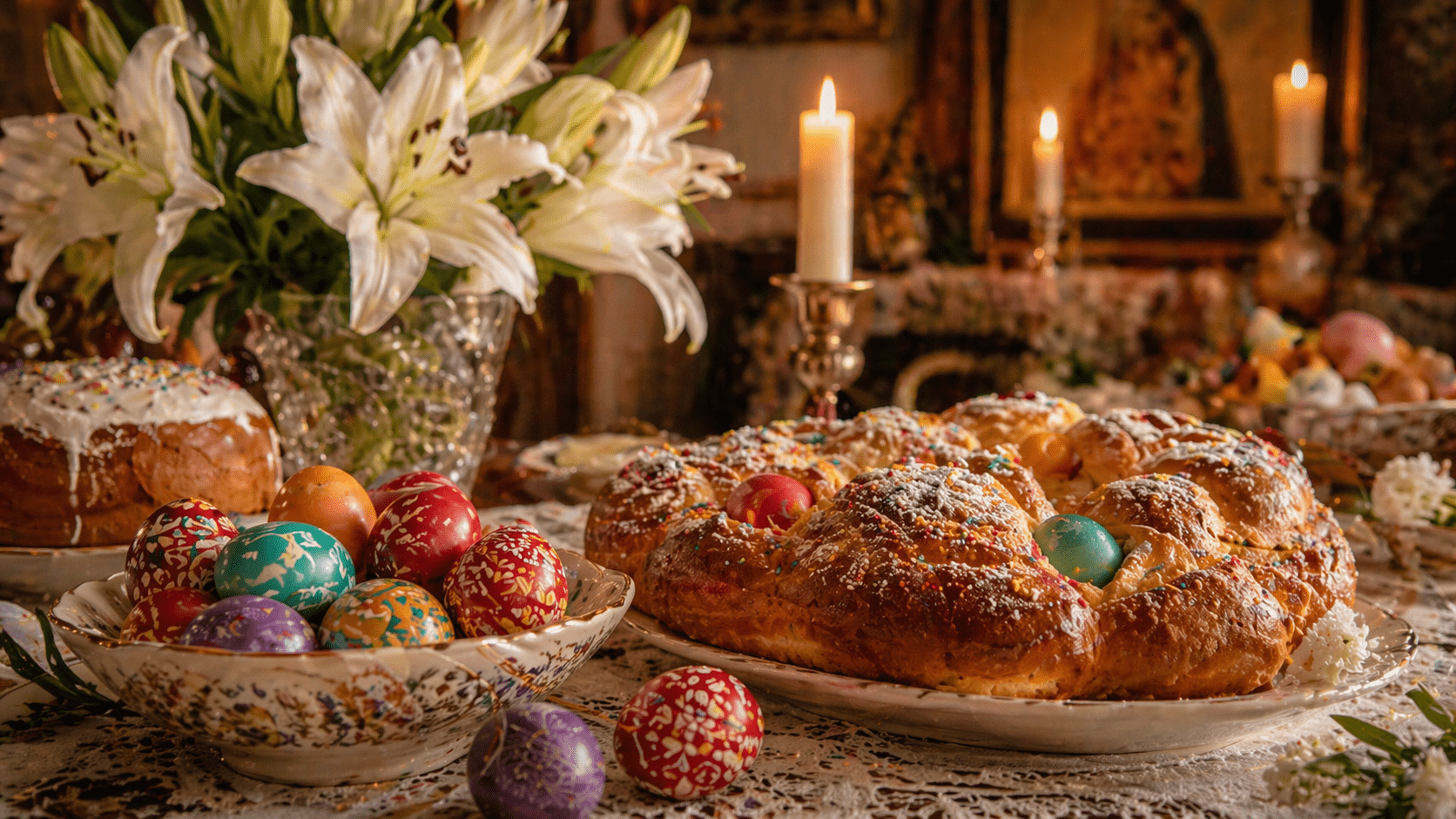
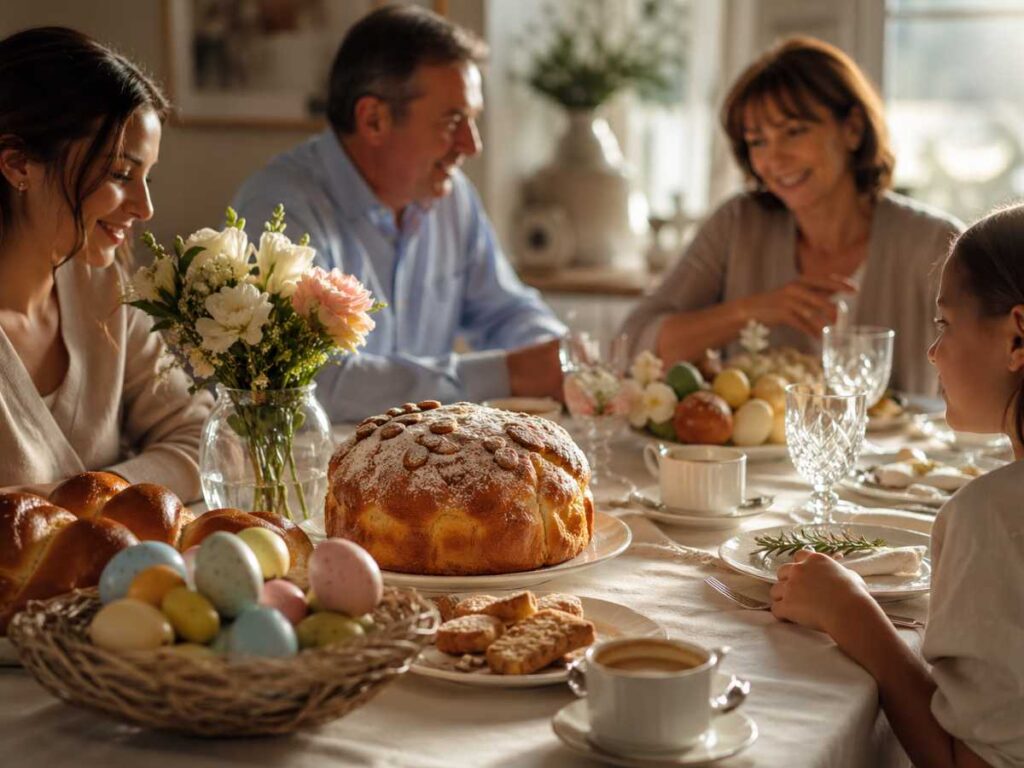
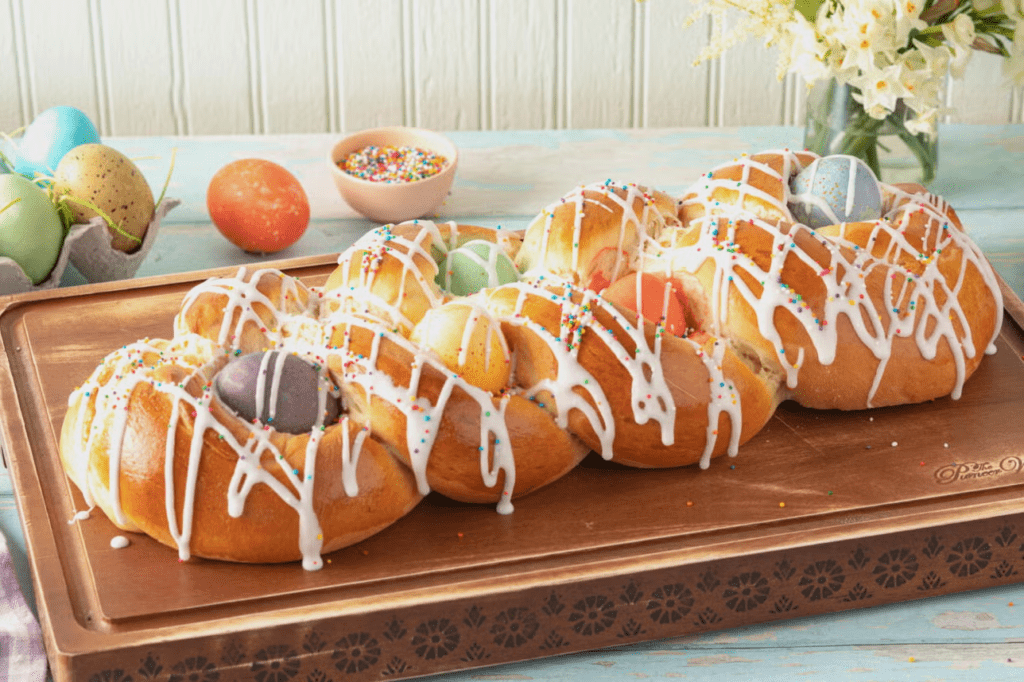
The lamb meant feast after fasting. The eggs tucked into braided bread meant new life. The grain in the pastiera meant abundance and spring returning. The savory pies — casatiello, pizza rustica — were the opposite of Lenten restraint. They were packed, rich, exuberant, the culinary equivalent of throwing open a window after weeks of keeping it shut.
My aunt’s pizza rustica was so heavy that lifting it required a deliberate decision. It had four kinds of cheese, three kinds of meat, and enough eggs to alarm anyone with a conscience. She made it once a year. She acted each time like it was an unreasonable amount of effort, and she made it every single year without exception for forty years.
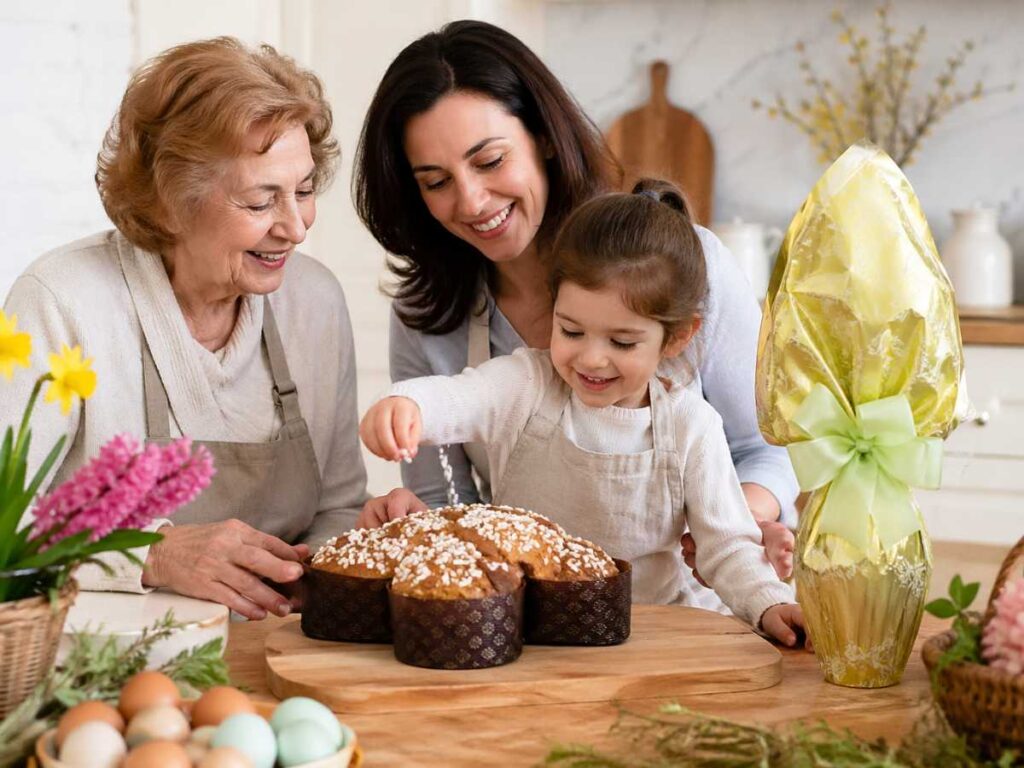
And then the colomba. The dove-shaped cake that said, more plainly than anything else on the table: this is Easter. Even now, a boxed colomba from an Italian bakery or specialty store can make a whole apartment feel like it is April and the family is coming. That is the power of food that belongs to one specific day of the year and no other.
A pastiera does not taste like cake. It tastes like Holy Week is almost over and Sunday is finally here.
What happened when families crossed an ocean
This is where the story gets complicated and human and true.
When Italian families emigrated to North America — to Brooklyn, to Boston, to Hamilton, to Montreal, to a hundred other cities — they did not arrive with a shipping container full of customs intact. They arrived with what they could carry in their heads and hearts. And then life here did what life always does: it reshaped things.
The ingredients were different. Some things didn’t exist, or cost too much, or tasted wrong. The church was different — Irish-American Catholic, not Italian Catholic, which was a meaningful distinction to people who had organized their spiritual year around specific feast days and village processions. The schedule was different. The pace was different. English crept into conversations that had always happened in dialect.
There is a story my family tells about my great-great-grandmother trying to find the right wheat for the pastiera in her first years in America. She found something close. Not right, but close. She adjusted the recipe. She never said it was the same. She made it every Easter for the rest of her life anyway. That pastiera — the adapted one, the American one — is the one we know. We thought it was the original for years.
And yet — remarkably — the shape of Easter survived the crossing. NEH describes immigrant life as a kind of duality, where people live in the present while simultaneously facing both past and future. (NEH) That is exactly what Italian families were doing with Easter. Holding the old shape while building a new one. Keeping what was essential, letting go of what could not survive the transplant.
What they kept, almost universally:
- The idea that Easter was not casual — it was serious, special, and marked
- Mass, or at least the expectation that Easter Sunday included church
- The family table, with extra chairs, extra people, extra food
- The eggs, the sweet breads, the pies, the lamb — the foods that said feast
- The dressed-up children, the visiting, the sitting together longer than usual
- The dessert that only appeared at Easter and at no other time of year
Order Sons and Daughters of Italy still presents pastiera di grano as a classic Italian-American Easter dessert — which tells you something important: certain old-country foods survived precisely because they worked so well at the family table in the new country. (Italian Sons and Daughters of America)
To understand how the broader pattern of religious and cultural customs changed — and what held steady — see Italian-American traditions: what changed after immigration and what stayed the same.
What got lost — and why it matters to name it
This is the part that people feel as a kind of vague ache without always knowing what to call it.
They remember Easter. They love Easter. And they also sense, somewhere underneath the memory, that something has thinned.
What thinned was usually the pace.
The full Holy Week arc got compressed into one Sunday. The village-specific processions, the specific prayers, the regional customs that once gave Easter its local texture — those did not survive the journey, or did not survive the second and third generations. The dialect faded. The explanations faded with it. Children grew up knowing that the pastiera mattered deeply without knowing exactly why the wheat and the orange blossom water and the grain were in there in the first place.
I asked my grandmother once why we always had the braided bread with the eggs baked in. She looked at me like I had asked why the sky was blue. Then she thought about it for a moment and said, “Because that is Easter bread.” That was the whole answer. She knew it mattered. The original reason had become the practice itself.
Even one broad cultural source notes that many Italian Americans celebrate Easter, but often without a strong specifically ethnic public character. (EveryCulture) That tracks. The private, family dimension of Easter held strong. The public, communal, village-rooted dimension quietly slipped away over generations.
That is not failure. That is how immigration works. A custom that once belonged to a whole town gets concentrated into one kitchen. A ritual that once stretched across a week gets folded into one afternoon. The meaning survives, but the texture thins.
What matters is knowing it happened — because once you name it, you can start choosing what to recover.
What Italian families still celebrate today
The table, which refuses to disappear
Even in families where almost everything else has changed — the language, the Mass, the specific dishes — the Easter table remains. Something about the family gathering holds on with remarkable stubbornness. Research consistently links family rituals to a sense of belonging and identity, and family meals specifically have been described as a regular ritual that organizes family life and gives it predictable structure. (American Psychological Association) Italian families understood this intuitively long before it became a research finding.
The egg, transformed but still present
Maybe it is chocolate now. Maybe it is decorative. Maybe it lives inside a North American Easter basket alongside things that have nothing to do with Italy. But the egg is still there, still carrying its old freight of rebirth and spring, even when the family using it has forgotten that freight entirely. Treccani notes that modern Italian Easter customs still revolve strongly around Easter eggs, especially chocolate ones. (Treccani)
The breads and pies that carry family memory
This is where people get emotional, and they should.
A pastiera. A ricotta pie. A grain pie that takes three days. A braided bread with eggs pressed into the dough. A savory pizza rustica that weighs more than it should. A boxed colomba from the Italian bakery that someone drives across town to find because there is no acceptable substitute. These foods are not merely Easter food. They are the family’s proof of itself. The recipe that survived immigration. The dish that Nonna made and now someone else is learning, imperfectly and beautifully, to make in her place.
The first time I made my grandmother’s pastiera alone — without her standing next to me, without her hands correcting mine — I was terrified it would taste like a different family’s Easter. It did not. It tasted like ours. I cried a little, which she would have found completely excessive. I made it again the next year. That is the whole tradition, right there.
Mass, which holds on even in changed forms
Some families stayed devout. Some became twice-a-year Catholics. Some drifted entirely and still felt pulled back toward a church on Easter Sunday by something they could not quite name. That pull is real, and it is not irrational. Easter Mass was the frame around which everything else was built. Even when the practice changes, the frame leaves a mark.
Pasquetta — the spirit of Monday lingering
Not every North American family kept the formal Pasquetta outing. But many kept its spirit: the Easter celebration does not end Sunday evening. Monday is still a little bit Easter. There are leftovers. There are phone calls. Someone stops by. The holiday exhales slowly rather than slamming shut at midnight. (Italia.it)
How to keep Italian Easter traditions alive — really alive, not just performed
Here is the thing nobody says out loud but everyone suspects: traditions do not survive by being preserved. They survive by being used.
A recipe sitting in a notebook in a drawer is not a living tradition. A recipe made every April, imperfectly, with children underfoot and flour everywhere, is a living tradition. There is a difference, and it matters enormously.
You do not need to recreate 1920 Campania in your kitchen. You need to stop treating Easter like a slightly fancier version of a regular Sunday.
- Choose one Easter food and make it sacred — the dish that only appears now and at no other time of year
- Go to Easter Mass, even once, even imperfectly — let the kids see what Holy Week looks like
- Tell the story of where your pastiera, casatiello, or family dish actually came from
- Start something on Holy Thursday — let the preparation be part of the holiday, not just the meal
- Explain to your children why Good Friday was quiet, why the table was different that day
- Set the Easter table like it matters — because it does
- Write the recipe down before the person who holds it in their head is no longer here
- Keep Monday a little bit Easter — one phone call, one leftover meal, one extra visit
You do not need the perfect old-country Easter. You need your family’s Easter — the one that repeats, the one they will remember, the one that says this day is different from all the other days.
And let it bend. Let it adapt. An Easter dinner instead of lunch is fine. One dish instead of seven is fine. A colomba from a supermarket instead of a handmade one is fine. The tradition does not require perfection. It requires intention and repetition — which are much more achievable, and much more powerful, than perfection ever was.
Under the lamb and the eggs and the pastiera and the church clothes, Italian Easter was always saying one thing: this day is sacred. Come to the table. The whole family is moving toward something together.
That is the tradition worth keeping. Everything else is just the beautiful way it arrives.
If your family also kept smaller Catholic feast days through the year, you may enjoy St. Joseph’s Day traditions and the Feast of San Giovanni. And for the broader story of how religious customs changed but stayed meaningful in North American homes, see what Carnevale in Italy is and what La Vigilia means in Italy.
FAQ
What are traditional Italian Easter traditions?
Traditional Italian Easter traditions span an entire week: Palm Sunday, Holy Week processions and observances, Good Friday fasting, Holy Saturday preparation, Easter Sunday Mass and the big family meal, and Easter Monday outings. The food traditions vary by region — pastiera and casatiello in Naples, torta pasqualina in Liguria, colomba almost everywhere — but the rhythm of solemnity followed by celebration is consistent across Italy. (Italia.it)
What did Italian-American families keep from Easter traditions?
Most families kept the core: Easter Mass, the family dinner, eggs, sweet breads and pies, the lamb, and the sense that Easter was a formal, important day. The specific regional foods often survived remarkably well — pastiera di grano, in particular, is still made in Italian-American homes generations later — even when the broader Holy Week customs faded. (Italian Sons and Daughters of America)
What got lost after immigration?
What typically faded were the local, village-specific customs: the particular processions, the dialect prayers, the regional rituals tied to specific towns. The pace of Holy Week also compressed — the slow build of a full week often got concentrated into one Sunday. The meaning stayed. The texture thinned. (EveryCulture)
Is Easter in Italy more religious than Easter in North America?
In many places, yes. Italy still has strong public Holy Week traditions — town processions, communal rituals, the full arc from Palm Sunday through Pasquetta — that have largely not survived in North American Italian communities. Here, Easter tends to be more private and family-centered, which is meaningful but different. (Italia.it)
How can I keep Italian Easter traditions alive with my family?
Start with one thing that repeats. A specific Easter dish made only now. Easter Mass. A family dinner with the good plates. The explanation of why the eggs matter, or what the colomba means, or where your grandmother’s recipe came from. Repetition is the engine of tradition — one meaningful thing, done again and again, outlasts a dozen things done only once.
Other traditions to look out for
If you enjoy family traditions tied to the Catholic calendar, you may also like what Carnevale in Italy is and what La Vigilia means in Italy.

Marco Ricci is an Italian-Canadian writer and the grandson of Calabrian immigrants. He created Italian Family Traditions to document the customs, feast days, and family rituals Italian families carried from Italy to North America — and to understand what they actually meant. He is based in Montreal.