Italian Family Traditions
What Is Carnevale? The Italian Tradition Behind Mardi Gras
Before there was Mardi Gras, before the beads and the parades and the king cake, there was something older: an Italian season of fried dough, confetti, costumes, and a very specific kind of permission to be loud. This is the real story.
There is a particular kind of chaos that only happens once a year, and if you grew up in an Italian family you probably felt it without being able to name it. Sometime in February, usually while Lent was still a theoretical future problem, the kitchen would produce something fried and dusted with powdered sugar that had no business appearing in the middle of a regular week. Confetti might materialize from somewhere. A costume might be discussed. The mood in the house shifted in the way it only did around specific holidays — looser, louder, slightly more theatrical than usual.
That was Carnevale. And if nobody in your family explained it in those exact words, that is because tradition does not usually come with a label. It just arrives, smells like hot oil and sugar, makes a mess, and disappears before Ash Wednesday.
But here is what you might not know: Carnevale is one of the oldest festive seasons on the Italian calendar. Its name carries centuries of Catholic history inside it. Its sweets have a dozen different names depending on which region your family came from. And when Italian immigrants arrived in America and Canada and encountered something called Mardi Gras, they were not discovering something foreign. They were recognizing something they already knew, dressed up in different clothes.
Mardi Gras did not replace Carnevale for Italian immigrants. It was Carnevale wearing a Louisiana hat.
This is the story of what Carnevale actually is, where it came from, what it looked like in real Italian family life, and what happened to it when millions of Italians crossed an ocean and landed somewhere that already had a pre-Lenten party of its own.
What is Carnevale, actually?
Let’s start with the name, because the name tells the whole story in two words.
Carnevale comes from the Latin carnem levare — to remove meat. It was not named for celebration. It was named for the moment when meat consumption ceased before Lent. The party is literally defined by what comes after it. Treccani traces this etymology directly: the word points to the transition, the leaving behind, the hinge between feasting and fasting.
Which means Carnevale was never random. It was structural. It belonged to the Catholic calendar the way a door belongs to a wall — not decorative, but essential to the movement between two different rooms. Before Lent came restraint, penance, the stripping back of appetite and excess. Before that came Carnevale: the season of abundance, laughter, masks, and one final spectacular noise.
Treccani defines it as the period before Lent marked by dances, masquerades, and festive excess. The season builds from early February and reaches its most intense point in the final days — especially Giovedì Grasso (Fat Thursday) and Martedì Grasso (Fat Tuesday), the last Tuesday before Ash Wednesday, after which the feast turns to fast.
| When | What it means |
|---|---|
| Early February | Carnevale begins. Costumes appear. The mood starts shifting. Sweets start arriving in kitchens and bakeries. |
| Giovedì Grasso | Fat Thursday. The penultimate feast. Richer foods, louder celebrations. The end is close and everyone knows it. |
| Martedì Grasso | Fat Tuesday. The peak of Carnevale. The last night. Everything runs a little hotter before it stops. |
| Ash Wednesday | Quaresima begins. Lent. Silence after the noise. The calendar turns and the rules return. |
That arc — from festive to penitent, from abundance to restraint — gave Carnevale its energy. It was not just a party. It was a party with a deadline, which is the most intense kind.
What it actually felt like in a real Italian family
Not every Italian family went to Venice for a masked ball. Most Italian families did not.
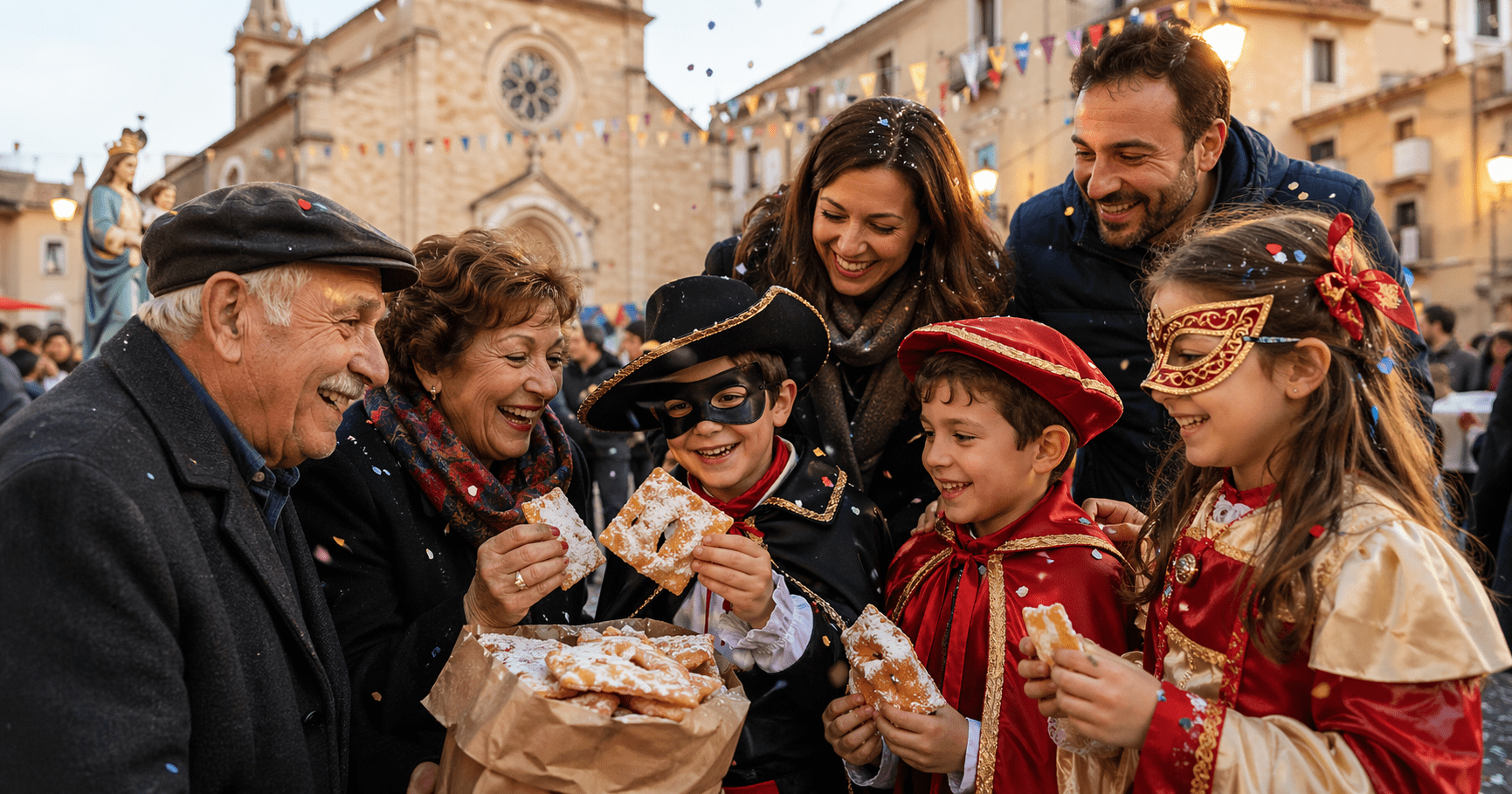
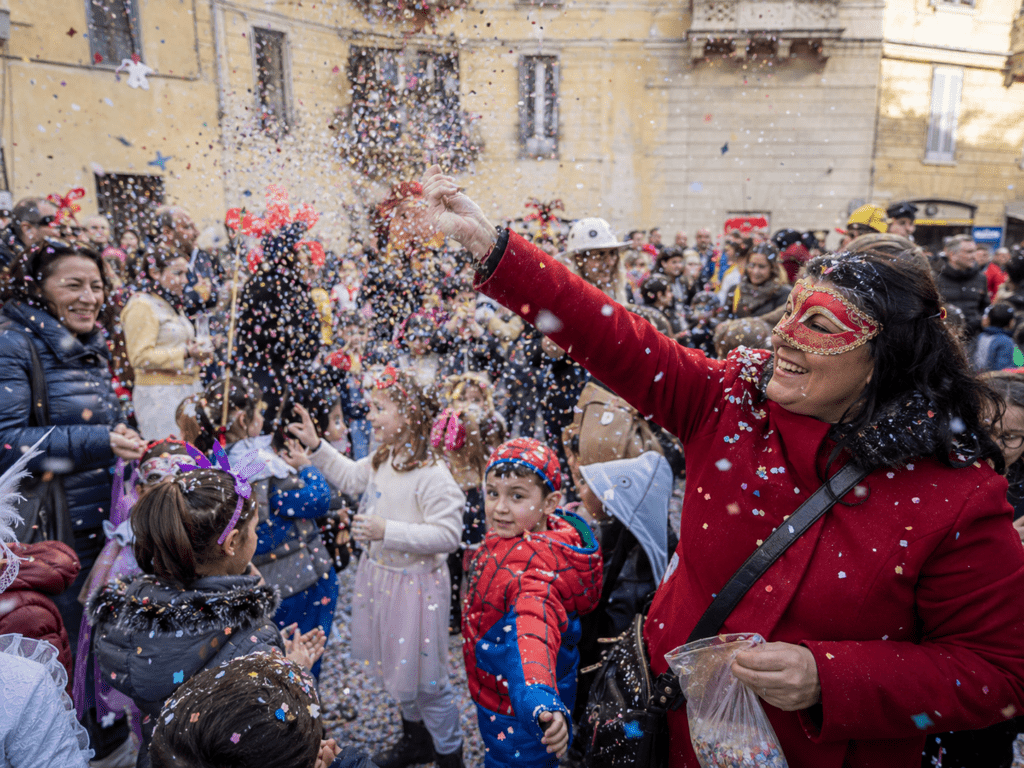
What they had was smaller and, in a way, more real. A school event where children came in costume. A neighborhood parade that was equal parts beautiful and chaotic. A tray of fried sweets from the bakery that appeared without much explanation beyond “it’s Carnevale.” Confetti that turned up in coat pockets for weeks. A general loosening of the household atmosphere that children registered without being able to name.
My grandmother made chiacchiere every year from the time her children were small until she was well into her eighties. She never called them by the same name twice — sometimes chiacchiere, sometimes frappe, once cenci when her Tuscan neighbor was over and they had a spirited disagreement about the correct terminology while frying in the same kitchen. The pastry was the same. The argument was annual. Both were Carnevale.
Treccani’s description of the season as a time of burle — jokes, pranks, mischief — gets at something real about the family atmosphere. Normal rules softened. Children were allowed to be sillier. Adults were more indulgent. The house felt different, the way a house only feels different when something specific is happening that everyone understands even if no one announces it.
The sweets were the most consistent carrier of that feeling. Unlike the big civic spectacles tied to specific cities, fried Carnival sweets were portable. They could be made in any kitchen, with simple pantry ingredients, by anyone who had been taught how. And they traveled — across regions, across generations, across oceans — in a way that a Venice parade simply could not.
The sweets: the one thing everyone agreed on (and the names nobody agreed on)
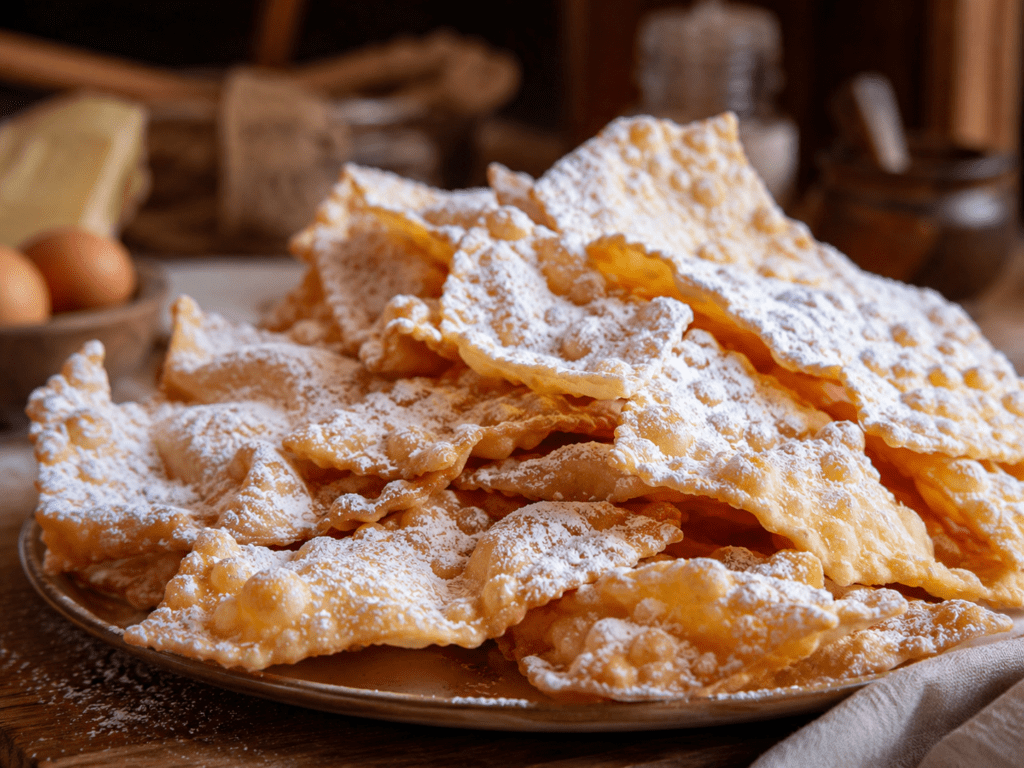
If there is one thing that unites all of Italian Carnevale, it is fried dough with powdered sugar. The specifics — the shape, the thickness, the filling, the precise amount of sugar — varied enormously by region. The name varied even more. But the fundamental act of frying something sweet and dusting it with sugar before Lent: universal.
| The pastry | Where it’s from | What makes it distinctive |
|---|---|---|
| Chiacchiere | Lombardy and much of northern Italy | Thin fried ribbons of sweet dough, blistered and crisp, buried under powdered sugar. The name means “chatter” — light, airy, impossible to eat just one. |
| Frappe | Rome and Lazio | Nearly identical to chiacchiere. The Roman name. If your family is from Rome and someone calls them chiacchiere, this will be corrected. |
| Cenci | Tuscany | “Rags” in Italian — named for the crinkled shape of the fried dough. Same pastry, Tuscan name, Tuscan pride. |
| Bugie | Liguria and Piedmont | “Little lies” — because they are so light you convince yourself you have not had very many. You have had very many. |
| Crostoli | Veneto and Friuli | Thicker, crispier, often with a hint of grappa or white wine in the dough. The northeast version. |
| Castagnole | Nationwide | Small round fried balls, sometimes filled with custard or ricotta. The Carnival sweet that traveled most successfully into Italian-American bakeries. |
The argument in our family about what to call the pastry was not frivolous. It was genealogical. My father’s side called them frappe and would have no conversation about it. My mother’s family called them chiacchiere and found the word frappe slightly provincial. A great-aunt who had married into a Venetian family called them crostoli and considered the entire debate beneath her. Every year at Carnevale, the same pastry was made in three different kitchens under three different names and everyone ate each other’s version and complimented it lavishly while privately maintaining that theirs was correct. This is Italian family life. This is also Carnevale.
La Cucina Italiana explains that many Carnival sweets were historically tied to the practical need to use winter fats — lard, butter — before the season turned. So even the indulgence had logic. You were not being excessive for its own sake. You were using what you had, doing what the calendar demanded, and eating as well as possible before the lean weeks ahead.
Venice, Viareggio, Ivrea: the regional face of Carnevale
The biggest mistake people make about Carnevale is assuming it is Venice and that is the whole story. Venice is the most internationally famous version. It is not the only one, and in some ways it is the least representative of how most Italians actually experienced the season.
- Venice — the world-famous masked carnival, elegant and theatrical, built around costume balls and the iconic masks of the Commedia dell’Arte. The version tourists know. Also genuinely magnificent.
- Viareggio — massive satirical floats, enormous papier-mâché figures of politicians and public figures rolling through the streets of a Tuscan coastal town. Loud, political, and spectacular in the way only Italian public satire can be.
- Ivrea — the Battle of the Oranges. Three days of organized citrus combat in the streets of a Piedmontese town. Participants throw oranges at each other. At moving carts. Thousands of kilograms of oranges. It has been happening since the 12th century and requires no further explanation because it is already perfect.
- Putignano — one of the oldest Carnivals in the world, in Puglia, dating to the 14th century, with its own distinct folk traditions and mask characters.
- Smaller towns across the south — folk characters, nature rites, lantern processions, ritual figures tied to local history and belief that have nothing to do with Venice and everything to do with the specific place they belong to.
My grandfather was from a small town in Campania that had its own Carnevale figure — a kind of theatrical villain of the season who got “put on trial” on Martedì Grasso and symbolically executed at the end of the night. He tried to explain this to me when I was about eight. I found it simultaneously terrifying and hilarious, which I think was the correct response. He said every town had their own version. He said Venice was beautiful but it was not his Carnevale. His Carnevale had a trial.
One season. Dozens of faces. That is Carnevale.
What happened when Carnevale crossed the ocean
Now we get to the part of the story that most articles skip entirely — and it is arguably the most interesting part.
When millions of Italian immigrants arrived in the United States and Canada between the 1880s and the 1920s — the vast majority of them from southern Italy and Sicily — they brought Carnevale with them the way they brought everything else that mattered: in their habits, their recipes, their calendar sense, their feel for when the year was supposed to loosen up before it tightened again.
What they found when they arrived in certain American cities was something that looked, at first glance, like a different tradition entirely. But which, at its bones, was the same thing.
The meeting of Carnevale and Mardi Gras
Mardi Gras — Fat Tuesday — is French for the same thing as Martedì Grasso. Literally the same words, from the same Catholic calendar logic, describing the same final Tuesday before Lent. The French brought it to Louisiana in the early 18th century. The Spanish reinforced it. The Catholic Creole population built a rich local tradition around it. By the time Italian immigrants began arriving in New Orleans in large numbers in the late 19th century, Mardi Gras was already a deeply established civic institution.
My great-great-grandfather arrived in New Orleans in 1898 from a village outside Palermo. According to family story — which I cannot verify but entirely believe — his first Mardi Gras in America left him briefly confused and then immediately at home. The masks. The food. The noise. The sense that normal life had suspended itself for a specific period before a turn toward something more sober. He had done this every year in Sicily. He just had not done it with this particular music, in these particular streets, with this particular city roaring around him. He adapted. He joined. And he never missed it again for the rest of his life.
For Italian immigrants encountering Mardi Gras, it was not culture shock. It was culture recognition. The Catholic pre-Lenten structure was identical. The logic of excess before restraint was identical. Even some of the food overlapped — fried sweets, rich flavors, the deliberate indulgence of things that Lent would take away.
What was different was the scale, the music, the specific local customs, and the particular New Orleans genius for turning a religious calendar date into one of the great street parties on earth.
Italian immigrants in New Orleans did not assimilate into Mardi Gras. They recognized it. And then they made it more Italian.
Italian-Americans became deeply embedded in New Orleans Mardi Gras culture. The involvement of Sicilian neighborhoods, the specific Italian-American contributions to the city’s Carnival traditions — these are documented parts of New Orleans history. The pre-Lenten season was not foreign to Italian immigrants. It was home, with a different accent.
What happened in cities without Mardi Gras
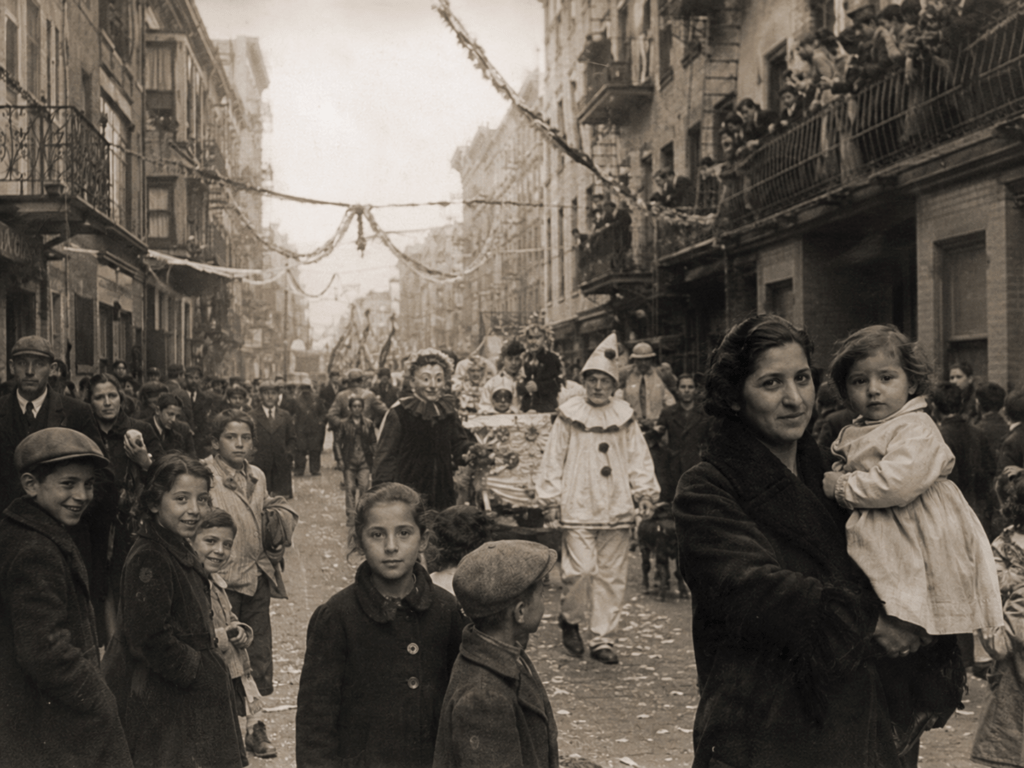
Outside New Orleans, in the Italian enclaves of New York, Boston, Chicago, Toronto, and Montreal, the situation was different. There was no established civic Carnival to step into. There was no parade infrastructure, no citywide tradition waiting to absorb them.
What Italian immigrants had was what they had always had: the family, the kitchen, and the season.
My grandmother came to New York in 1921. Mardi Gras meant nothing to the neighborhood she landed in. What she had was February, and February meant chiacchiere. She made them every year. She taught her daughters. Her daughters taught their daughters. By the time the word “Carnevale” had faded from everyday use in the family, the pastry was still appearing every February, still covering the kitchen in powdered sugar, still tasting exactly like it had in the Calabrian kitchen where she first learned to make it. Nobody called it Carnevale anymore by the time I was born. We called it “the February thing.” The tradition survived the name.
In Italian-American communities across the northeast and midwest, Carnevale survived primarily through its most portable elements: the sweets, the children’s costumes, the parish events, the Fat Tuesday mood. The great civic spectacles stayed in Italy. The family season crossed the ocean in a pastry.
La Cucina Italiana has documented that Carnevale sweets — chiacchiere, castagnole, and their regional cousins — are still sold in Italian bakeries and specialty shops in New York and New Jersey during the season. That is not coincidence. That is a tradition that refused to die even when the larger public context around it disappeared.
Why the names changed — and why it matters
Here is something nobody talks about enough: when Italian immigrants in America and Canada started calling the pre-Lenten season “Mardi Gras” rather than “Carnevale,” they were not forgetting their heritage. They were doing what immigrant communities always do — they were finding the local word for the thing they already knew.
“Mardi Gras” was already the English-language term in North America for the pre-Lenten season. It was on the calendar. It was in the newspaper. It was what the radio called it. Calling it “Carnevale” would have meant explaining yourself constantly to neighbors, teachers, employers — to everyone outside the Italian community.
So the name adapted. The pastry did not.
This is one of the most fascinating patterns in Italian-American cultural history: the public, visible elements of tradition — the name, the civic format, the language used to describe it — assimilated into American norms, while the private, family elements — the food, the kitchen rituals, the seasonal mood — persisted with remarkable tenacity.
Italian immigrants in America stopped calling it Carnevale. They never stopped making the chiacchiere.
Which tells you something important about how culture actually survives immigration. Not through the words people use in public. Through the things they make in private, for their own families, on the specific days that matter.
How to keep the spirit of Carnevale alive today
You do not need a Venetian mask or a parade float. You need the things that actually survived the crossing: the sweets, the season, and the sense that this stretch of February has a specific mood that deserves to be honored before Lent arrives.
- Make chiacchiere — or frappe, or cenci, or crostoli, depending on where your family is from. Use whatever name your grandmother used and defend it vigorously
- Mark Martedì Grasso deliberately — it is Fat Tuesday, it is Carnevale’s peak, and it deserves something richer than a regular Tuesday dinner
- Let the children dress up — the costume tradition is old and it survives for good reason
- Explain the calendar to your kids — Carnevale belongs to the days before Lent, and knowing that gives the whole season its proper weight
- Find out what your family called the pastry. If you do not know, call someone who does, before that knowledge is gone
- If you have New Orleans connections or any tie to Mardi Gras culture, tell your family that this is the same pre-Lenten tradition Italian immigrants recognized when they arrived there — that is a beautiful thing worth knowing
Carnevale is not just a party. It is a position in the calendar — one last season of abundance, laughter, and noise before the long quiet of Lent. The masks change. The city changes. The name changes. But the powdered sugar on the kitchen counter in February? That never changes.
Make the chiacchiere. Call them whatever your family calls them. Eat them before Ash Wednesday. That is the whole tradition, and it has survived five centuries and one ocean already.
If you want another seasonal Italian tradition shaped by the Catholic calendar, read what Capodanno means in Italy or what La Vigilia means in Italy. And since Carnevale leads directly into Lent, it pairs perfectly with Italian Easter traditions: what families kept, lost, and still celebrate today.
FAQ
What is Carnevale in Italy?
Carnevale is the festive season before Lent — a period of masks, parades, sweets, costumes, and communal celebration that builds toward Martedì Grasso (Fat Tuesday) and ends at Ash Wednesday. Its name comes from the Latin carnem levare, meaning “to remove meat,” pointing directly to the Lenten season that follows. Treccani defines it as the period before Lent marked by dances, masquerades, and festive excess.
Is Carnevale the same as Mardi Gras?
Yes and no. Mardi Gras is French for “Fat Tuesday” — Martedì Grasso in Italian — and both traditions grow from the same Catholic pre-Lenten calendar logic. Carnevale is the entire Italian season; Mardi Gras in its North American form often refers specifically to the final day or the New Orleans celebration. When Italian immigrants arrived in New Orleans they immediately recognized Mardi Gras as the same tradition they had known as Carnevale at home. The roots are identical. The local expressions differ significantly.
Why is it called Carnevale?
Treccani traces the word to the Latin carnem levare — meaning “farewell to meat” or “to remove meat” — referring to the transition into the Lenten season when meat consumption ceased. The party is literally named for what comes after it. That is very Italian.
What do Italians eat during Carnevale?
The signature foods are fried sweets — thin crispy pastries dusted with powdered sugar, known by different names across Italy: chiacchiere in Lombardy, frappe in Rome, cenci in Tuscany, bugie in Liguria, crostoli in the Veneto. Castagnole — small round fried balls, sometimes filled with cream or ricotta — are also widely beloved. The names differ. The powdered sugar is universal.
How did Italian immigrants celebrate Carnevale in America and Canada?
In cities with established Mardi Gras culture, especially New Orleans, Italian immigrants stepped into an existing tradition they immediately recognized as their own and became deeply embedded in its celebrations. In other cities — New York, Boston, Chicago, Toronto — where no civic Carnival structure existed, the tradition survived primarily through family channels: the kitchen sweets, the seasonal mood, parish events, and children’s costumes. The public face of Carnevale assimilated into American naming conventions (Mardi Gras); the private, family face persisted through the food.
Is Carnevale only about Venice?
Not at all. Venice is the most internationally famous Carnevale, but Italia.it presents a rich map of regional celebrations: Viareggio’s giant satirical floats, Ivrea’s extraordinary Battle of the Oranges, Putignano’s medieval traditions in Puglia, and dozens of smaller towns with folk characters, nature rites, and local customs tied to specific places and histories. Carnevale is one season with many local faces.
What survived from Carnevale after immigration?
The most durable survivors were the portable, family-scale elements: the fried sweets (still sold in Italian bakeries in New York and New Jersey during the season), the children’s costumes, the Fat Tuesday mood, and the general sense that this stretch of February deserves something richer than an ordinary week. The great civic spectacles stayed in Italy. The pastry crossed the ocean.

Marco Ricci is an Italian-Canadian writer and the grandson of Calabrian immigrants. He created Italian Family Traditions to document the customs, feast days, and family rituals Italian families carried from Italy to North America — and to understand what they actually meant. He is based in Montreal.