Italian Family Traditions
Do Italians Celebrate Halloween? The Answer Is Funnier Than You Think
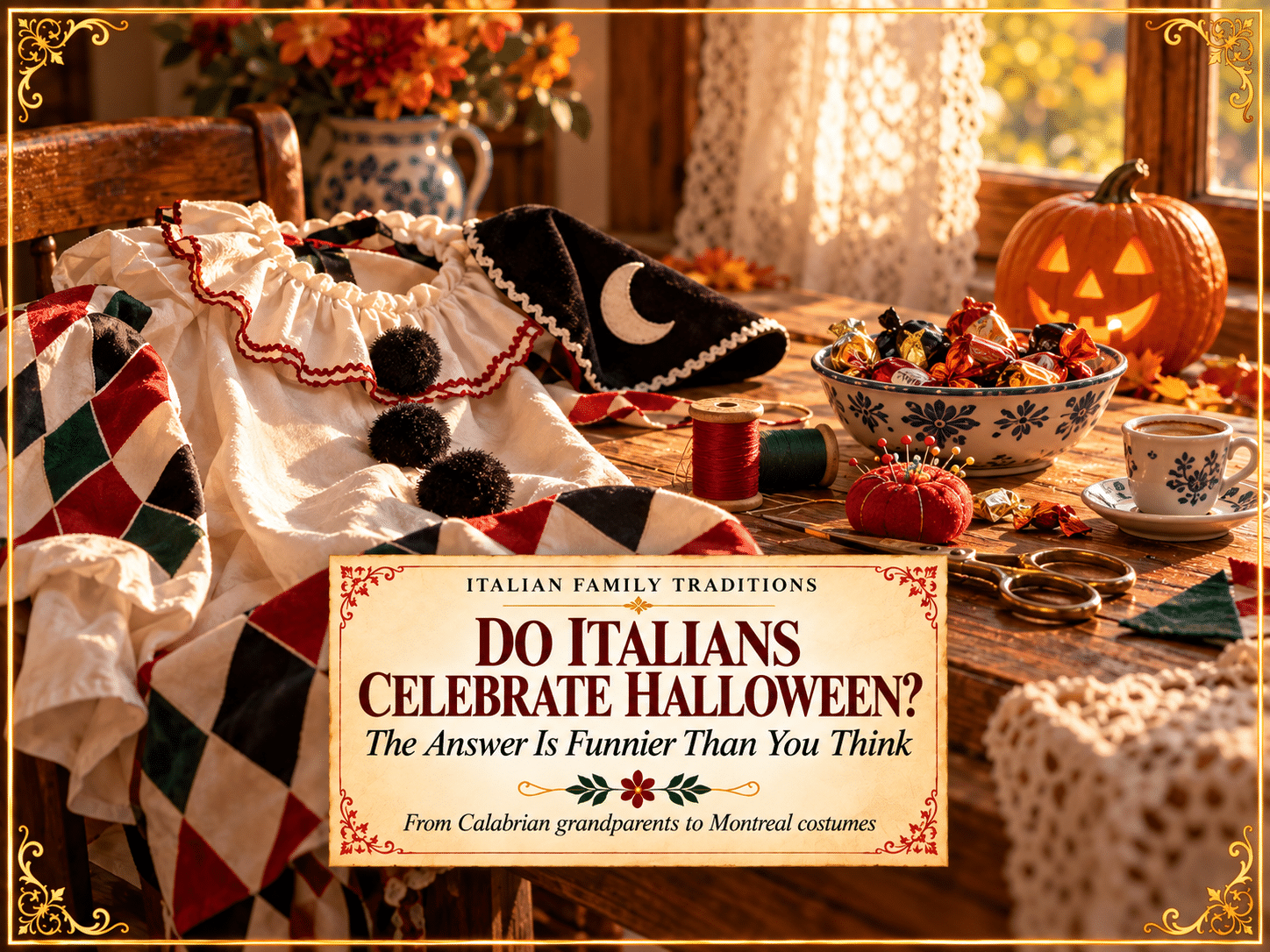
My Calabrian grandparents didn’t reject Halloween — by the time I was a kid in Montreal, my nonna was sewing my costume and my nonno was inspecting it for approval. Which left me, years later, with a strange question: what did they do back home, before Halloween existed? The answer turns the whole story inside out.
I grew up in the east end of Montreal, and on Halloween night our neighbourhood belonged entirely to children. Countless of them. By the time you hit the fifth or sixth grade you went out unaccompanied, in a roving pack, and the streets filled from dusk until some hour no parent had officially sanctioned — a tide of small costumed figures moving porch to porch under the streetlights. It was, for a kid, the greatest night of the year that wasn’t Christmas.
And my Italian grandparents were right in the middle of it. Not disapproving from a doorway — participating. My nonna had real sewing skills, so the costume was always, in some part, her work; she would take whatever half-idea I had and turn it into something that actually held together. My nonno handled quality control. He would look me over before I went out with the serious expression of a man conducting an inspection, and deliver a verdict on whether the thing was appropriate — not too gruesome, not embarrassing, dignified enough to be seen in. By the time I came along, in other words, my Calabrian grandparents had fully assimilated to Halloween. They were all in.
All of this, I should mention, while the wine was going in the garage. Because it was autumn, and in our house autumn meant my nonno was making wine, the way he did every single year, the way his father had back in Calabria. So the specific smell of my childhood Halloweens is costume fabric and candy and, underneath it, fermenting grapes. That’s the east end of Montreal in October. That’s my whole answer to “do Italians celebrate Halloween,” right there — mine did, enthusiastically, with a needle and thread and a glass of homemade wine.
But it left me with a question I only thought to ask much later, once they were gone and couldn’t answer it: what did they do before? Back in Carolei and Domanico, the small towns in the province of Cosenza they came from — before there was a Halloween to assimilate to, what happened in those houses at the end of October? Did they have nothing? Or did they have something we’ve forgotten?
So I went and found out. And the answer turns the whole story inside out. If you’ve ever wondered whether Italians celebrate Halloween — or whether it’s somehow “un-Italian” to let your kids trick-or-treat — this is the full story: what modern Italy actually does, where the holiday really comes from, the astonishing old customs Italy had long before America, and how to honour both worlds at your own table.
Does modern Italy celebrate Halloween?
First, the Italy of today — not of my grandparents’ childhood. Does it celebrate Halloween? Sort of, recently, and with a great deal of national grumbling.
Over the last couple of decades the holiday has crept in, mostly through children, shops, and television. Italian kids now go door to door in costume calling out “dolcetto o scherzetto!” — “little sweet or little trick,” the Italian rendering of trick-or-treat. Supermarkets stock plastic skeletons and bags of candy by the middle of October. Shop windows fill with cobwebs and witches. Schools and oratories run costume afternoons for little ones, and villages set up kid-friendly displays in the piazza. It is, by most accounts, mainly a holiday for young children.
For adults, it’s patchier and more commercial. The big theme parks go all in — Gardaland, Italy’s largest, runs a sprawling multi-week “Magic Halloween” season that draws huge crowds, which tells you everything about how thoroughly the commercial version has landed. In the cities — Milan, Rome, Florence, which has a large international population — there are Halloween club nights, themed aperitivi, and restaurant dinners built around autumn produce. Outside the under-30 crowd and the families with small kids, though, most adults treat October 31st as a normal Thursday with slightly spookier marketing.
And Italy has never fully surrendered to it. The numbers show the resistance plainly: surveys have found that roughly one in three Italians considers Halloween a “commercial gimmick,” and about a quarter say it has no connection to Italian tradition at all. Italians under 45 are far more likely to embrace it; the older you go, the more the eyebrows rise. The most common complaint is exactly the one you’d expect in a country this Catholic and this serious about its dead: it’s an American import crowding onto days that already meant something.
And here is my favourite detail in the entire story of Halloween in Italy: in most of the country, the pumpkins are bought to be eaten, not carved. The Italian relationship with food runs so deep that the idea of taking a perfectly good zucca, hollowing it out, cutting a face into it, and then throwing it away strikes many Italians as a borderline moral failing. You want to carve a pumpkin? Fine. But you’re making risotto with the insides. We are not animals.
So the straight answer is: yes, Halloween exists in Italy now, growing every year, driven by kids and shops and the slow gravity of American culture — but it sits on the surface. Underneath it, on the very same calendar days, is something much older that never went anywhere. To understand why Halloween feels at once foreign and strangely familiar to Italians, you have to go back — much further back than America.
Where Halloween really comes from: Samhain, the Celts, and the Church
Here’s the piece of history that reframes everything, and that most people — including my own grandparents — never knew: Halloween is not originally American, and it is not originally “pagan” in the devilish sense its critics imagine. It’s a braid of two much older things, and one strand of that braid is Catholic to the core.
The oldest strand is Samhain (roughly “SOW-in”), the ancient Celtic festival that marked the end of the harvest and the beginning of winter, held around October 31st into November 1st. The Celts believed that on that night the boundary between the living and the dead grew thin, and the spirits of the departed could cross back into the world. So they brought in the last of the harvest, lit fires, and left out offerings to keep the returning spirits friendly. The core idea — the dead come back at the turn of the cold season, and the living prepare for them — is thousands of years old, and it was shared, in different forms, across much of pre-Christian Europe, Italy included.
The second strand is Christian. As Christianity spread, the Church tended not to bulldoze these deep-rooted seasonal beliefs but to absorb them. Pope Gregory the Great, who led the Church from 590 to 604, famously advised a missionary heading to England to repurpose pagan customs for Christian ends rather than abolish them outright — to turn the old temple into a church rather than burn it down. In that same spirit, by the 800s the Church had fixed All Saints’ Day on November 1st — Ognissanti in Italian — a day to honour all the holy dead. And around the year 1000 it added All Souls’ Day on November 2nd, the Commemorazione dei Defunti, to pray for all the faithful departed.
Now look at the word itself. “All Saints’ Day” was once called “All Hallows’ Day” (“hallows” meaning “holy ones,” the saints). The night before it was All Hallows’ Eve — which, worn down by centuries of everyday speech, became Hallowe’en, and then Halloween. In other words, the spookiest, most commercial, most “pagan American” night on the calendar is, by its own name, the vigil of a Catholic feast — the eve of All Saints, the way Christmas Eve is the eve of Christmas.
So Halloween, Ognissanti, and the Festa dei Morti aren’t rivals. They’re siblings — three children of the same ancient instinct, that the dead return at the start of November and the living had better be ready. America just raised one of those children on sugar and plastic and sent it back across the ocean looking unrecognizable.
Which finally brings us to the part of the story that stopped me cold: what my grandparents’ own region was doing with these days, long before anyone in Montreal said “dolcetto o scherzetto.”
What Did Your Family Do Before?
I only thought to ask about Carolei and Domanico once it was too late to ask the people who knew. Don’t make my mistake. The Italian Family Heritage Kit gives you 133 guided pages and more than 120 prompts to capture your family’s town, customs, sayings and stories — the ones that vanish the moment nobody thinks to ask.
Explore the Heritage Kit — $19.99Instant digital download. Print it and complete it with your family.
Calabria had Halloween before Halloween
Here is what I found, and I wish I could have handed it to my nonno over a glass of his own wine, because it would have delighted him and also shown him he was part of a far bigger story than he ever let on.
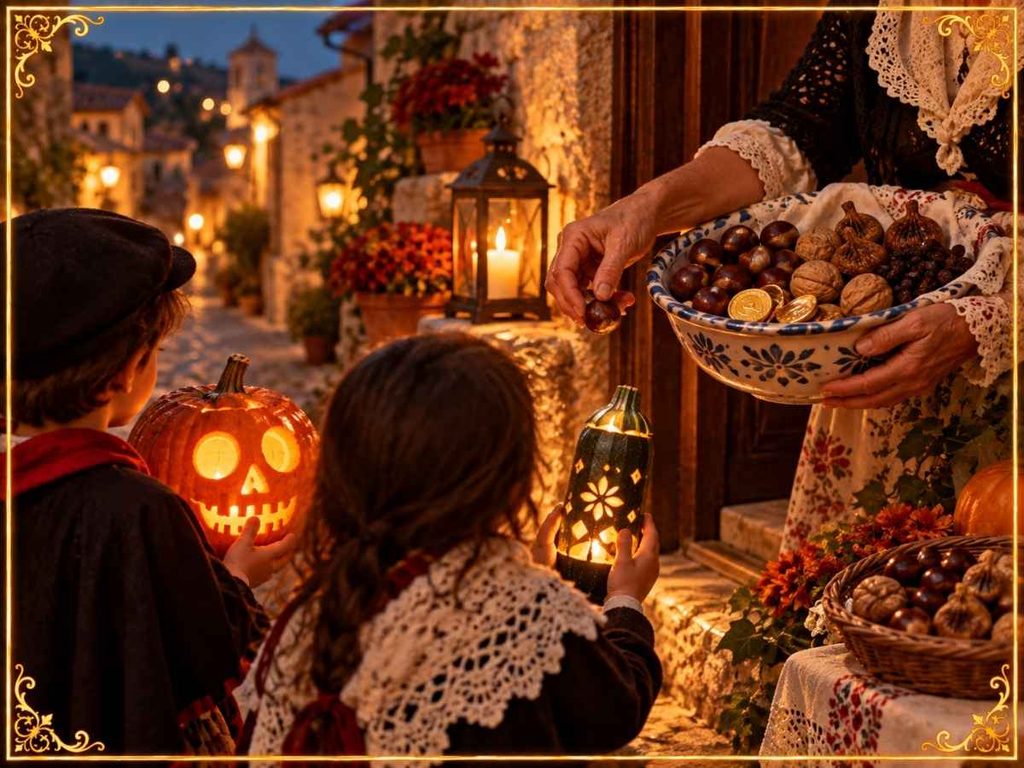
In Calabria — the region my family came from — children were doing their own version of trick-or-treat for the dead long before anyone in North America strung up a fake cobweb. In Serra San Bruno, children carved a pumpkin into the shape of a skull, the coccalu di muortu, carried it through town, and knocked on doors asking “Mi pagati u coccalu?” — roughly, “Will you pay me for the skull?” In villages around Reggio Calabria, children hollowed out the local green zucchine, set a candle glowing inside, and went door to door on November 2nd asking “Ndi dati i morti?” — “Will you give something for the dead?” And the neighbours filled their hands with coins, chestnuts, walnuts, dried figs, raisins, and the other fruits of autumn.
Read that again. Carved pumpkins with candles inside. Children going house to house in the dark. A set phrase called out at every door. Treats handed over in the name of the dead. That is — feature for feature — Halloween. And it was happening in my grandparents’ Calabria generations before a plastic pumpkin was ever sold in a Montreal pharmacy.
The rest of the region kept the season too, in its own ways. Families went in procession to the cemetery and, in some towns, ate a meal right there on the graves — keeping the dead company, sharing the day with them as if they’d simply moved to a quieter part of town. Children woke to a stocking filled with sweets, said to have been left overnight by departed relatives. The food of the days was humble and specific: lagana e ceci, homemade pasta ribbons with chickpeas, and long almond-paste sweets shaped for the occasion.
I keep thinking about those Calabrian kids with their candle-lit zucchine asking “will you give something for the dead?” — and then about me, seventy years and an ocean later, running through the east end of Montreal with a pillowcase, in a costume my nonna sewed, asking for candy. I always assumed those were two different things: the old country’s solemn tradition, and the new country’s plastic holiday. I was wrong. They’re the same river. I just caught it further downstream.
And it wasn’t only Calabria: a region-by-region tour
Once you start looking, this proto-Halloween is everywhere in the Italian south and the islands — each region with its own name, its own phrase, its own flavour. Here’s the tour.
Sardinia: knocking for the souls
In Sardinia the custom is called su mortu mortu (and in some areas Is Animeddas), and it’s trick-or-treating stripped back to its original, far more serious purpose. Children in old clothes go from house to house asking “Mi donais is animas?” — “Will you give something for the souls?” The treats they receive aren’t really for them; they’re given in the name of the dead. Families build small altars at home and in the cemeteries and set out food and gifts for departed relatives, a tradition so close in spirit to Mexico’s Día de los Muertos that scholars compare them directly.
Puglia: bonfires and the heads of purgatory
In the town of Orsara di Puglia, on the night of November 1st into the 2nd, they hold a centuries-old festival with the magnificently gothic name Fucacoste e Cocce Priatorje — “Bonfires and Heads of Purgatory.” Residents carve pumpkins into lanterns, place candles inside to light the way for the souls returning home, and set dozens of bonfires blazing through the streets while the whole town feasts late into the night. It is, essentially, a medieval Italian Halloween that has been running continuously for longer than the United States has existed — carved pumpkins and all.
Tuscany: lanterns to light the way
Around Pisa and parts of Tuscany, the night of October 31st once meant candlelit processions carrying lanterns carved from pumpkins and gourds — lit, again, not for fun or fright but to guide the returning dead and to ward off any spirits that meant harm. Same hollowed gourd, same flame, entirely different heart.
Naples: keeping the little monk happy
Naples, which has a spirit for everything, has ’o munaciello — “the little monk,” a mischievous household spirit who can bring luck or trouble depending on how he’s treated. In the Neapolitan imagination the world of the living and the world of the dead and the in-between are all crowded close together, and the season of the dead is when you’re most mindful of the unseen company in the house. The Neapolitan relationship with death is so intimate it has its own vocabulary — which is exactly why the city produces the most tender sweets of the dead, too.
Sicily: the plot twist where the dead do the trick-or-treating
And then there’s Sicily, which flips the whole thing on its head. In the Sicilian tradition children don’t go out collecting treats — the treats come to them, brought by the dead. On the morning of November 2nd, children wake to find a basket (u cannistru) left by their departed relatives, filled with sweets, marzipan fruit, and small gifts. The first question of the morning, shouted down hallways across the island for generations, is “Chi ti purtaru i morti?” — “What did the dead bring you?” It’s the exact reverse of Halloween: not the living dressing up to extract candy from the neighbours, but the dead — the grandparents and great-aunts who have gone ahead — leaving gifts for the children they still love. If you ask me, it’s a far more beautiful idea than anything involving a plastic mask.
And the sweets themselves are a whole world: the marzipan fruit, the bone-shaped cookies, the chocolate torrone dei morti of Naples, the almond “beans of the dead.” I’ve written the complete, delicious guide separately — the nine traditional Italian sweets for the dead, region by region.
The bombshell: southern Italians may have carried Halloween to America
Now the detail that genuinely stopped me, and that reframes my whole childhood.
The Calabrian anthropologist Luigi Maria Lombardi Satriani — with Mariano Meligrana, in their study Il ponte di San Giacomo — argued that the custom of carving pumpkins travelled to America in the suitcases and habits of southern Italian migrants, carried by a deep need to stay in contact with their dead. In his reading, Halloween is, for southern Italians, a festa di ritorno — a festival of return. Not something foreign that happened to them in the new world, but something of their own that had quietly gone on ahead and was waiting for them when they arrived.
I can’t prove my own grandparents’ families carried a candle-lit zucca across the ocean. Carolei and Domanico kept their own version of these days, and the specifics went quiet the way specifics do when nobody writes them down. But stand back and look at the shape of it: a Calabrian custom of carved pumpkins and children going door to door for the dead; a great wave of Calabrians crossing to North America; and two generations later, a Calabrian nonna in Montreal sitting down at her sewing machine to make her grandson a Halloween costume, happily, without a trace of inner conflict. That’s not a family abandoning its culture for a foreign holiday. That may well be a family’s own ancient custom coming home to it, wearing new clothes.
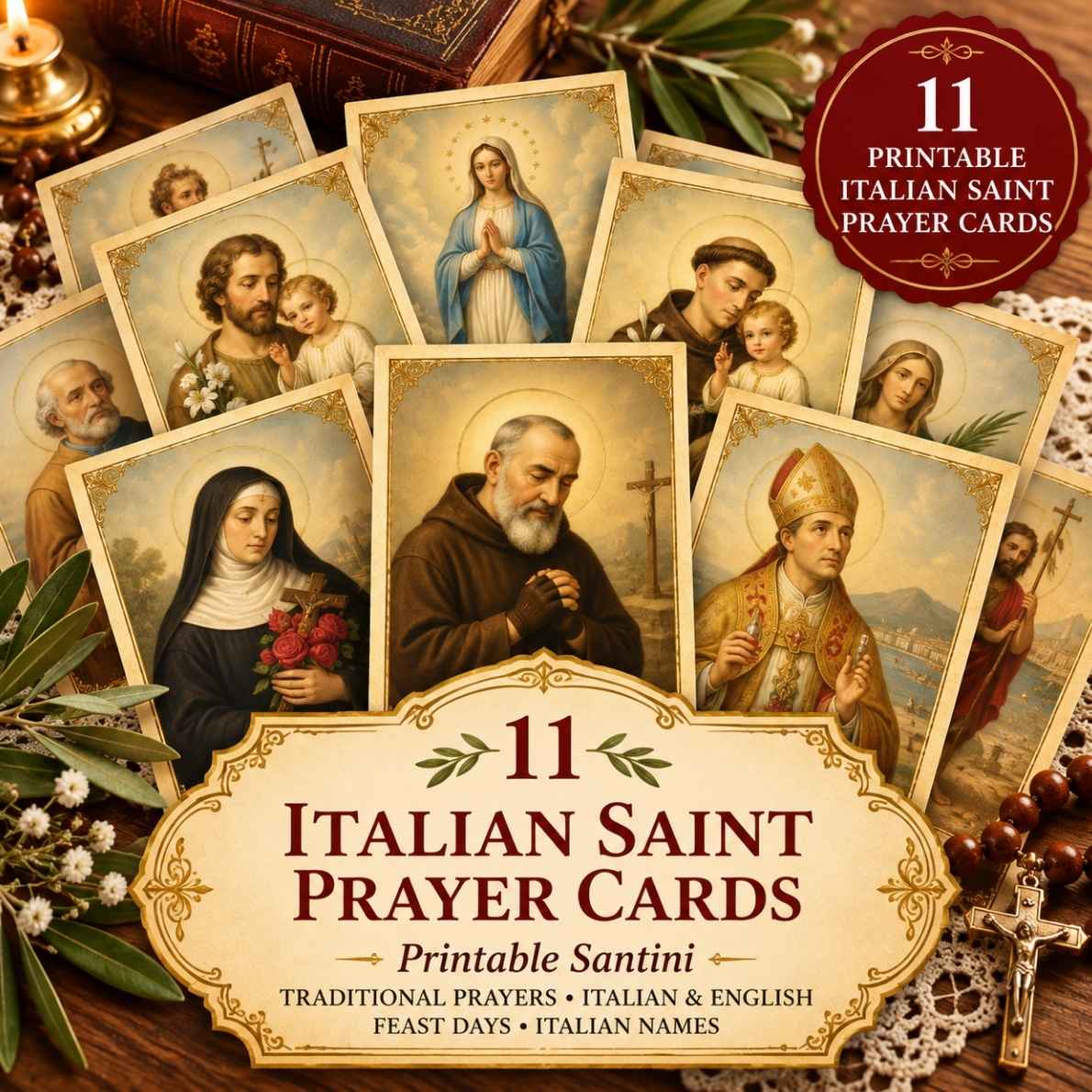
Underneath the costumes, these were always days for honouring the dead. If you want to mark All Saints and All Souls the way our families did, our Italian Saint Prayer Cards gather eleven beloved saints on beautifully designed santini, each with a traditional prayer in Italian and English — the kind kept in a missal or a wallet and brought out when the names need saying.
$9.49
Instant digital download
Get the Saint Cards →Festa dei Morti vs Halloween: the real differences
If Italy had carved pumpkins and door-to-door children all along, why does Halloween still strike so many Italians as foreign? Because the two traditions share the same bones and the exact opposite soul. Here’s the clearest way to see it, side by side.
| Festa dei Morti (the Italian way) | Halloween (the American way) | |
|---|---|---|
| When | November 1–2 (Ognissanti & All Souls) | The night of October 31 |
| Mood | Warm, affectionate, a little solemn | Playful, spooky, theatrical |
| The dead are… | Beloved family, honoured and fed | Monsters and ghosts, imitated for fun |
| Who gives to whom | Treats given in the name of the dead (and in Sicily, by the dead) | Treats collected by costumed children |
| Key symbols | Candles, chrysanthemums, the cemetery, sweets | Costumes, carved jack-o’-lanterns, candy |
| The point | Remembering — keeping the bond unbroken | Fun — making death less frightening by laughing at it |
Both, in the end, are ways of being less afraid of death. Halloween laughs at it; the Italian way sits down to dinner with it — sometimes literally, on the tombs. They just come at the same fear from opposite directions. And when you put it like that, you can see why an older Italian might wince at the costume-and-candy version: to them, these days were never a party built on death as set decoration. They were a family keeping faith with its own.
My grandparents, by their Montreal years, had quietly made peace between the two. They gave me the fun — the costume, the candy, the tide of kids in the streets — and they kept the other half for themselves, in the ways they never made a show of: the cemetery visit, the saints, the feast days my nonno knew by heart. They let me have the play. They held onto the relationship. I just didn’t notice the second half until I went looking for it.
The Church, the exorcists, and “Holyween”
Not everyone in Italy has made the same quiet peace my grandparents did. In fact, the sharpest resistance to Halloween in Italy comes from within the Catholic Church — and it’s worth understanding, because it’s a big part of why the holiday still feels contested there.
Some Italian clergy have been openly critical. Figures associated with the International Association of Exorcists — an organization the Vatican formally recognised in 2014 — have called Halloween, in its darker modern forms, “the antechamber of something dangerous, not innocent fun,” worrying that its imagery can be a gateway to real interest in the occult. Whatever you make of that view, it comes from a genuine place: a sense that these days are sacred, and that turning them into a horror party cheapens something that shouldn’t be cheapened.
Out of that concern grew a gentle alternative that has popped up in parishes around Italy: “Holyween.” The idea is to reclaim the night as what it originally was — the eve of All Saints — with prayer vigils and Masses, lights or images of saints displayed in doorways and windows, and, for the children, costumes of saints rather than monsters and zombies. A child might go out dressed as San Francesco or Santa Lucia instead of a ghoul. It’s a gentle, clever bit of cultural judo: keep the dressing-up and the sweets the kids love, but point them back at the holy ones the night was named for.
You don’t have to pick a side in any of this to find it interesting. The debate itself tells you how alive these days still are in Italy — a country arguing, every single October, about the right way to treat the dead. That’s not a country that has forgotten the season. That’s a country that takes it seriously enough to fight about it.
So should your kids trick-or-treat? How to do Halloween the Italian way
Here’s the practical question for every Italian-American and Italian-Canadian family: the kids want to trick-or-treat, and some part of you wonders whether you’re letting the heritage slip. Do you let them?
Yes — and now you can do it without a shred of guilt, because you know it’s not a betrayal of the old country. It may be the old country’s own custom, come back around. The move isn’t to choose between the candy and the heritage. It’s to give your kids both, the way my grandparents gave them to me — and the heritage is the half they’ll remember when they’re older. Here’s exactly how to hold both.
- Let them trick-or-treat, guilt-free. It’s childhood, and it has deep roots in your own culture — Calabrian kids were doing a version of it with candle-lit zucchine centuries ago.
- Light a candle on November 1st or 2nd for the family who came before — and tell the kids whose candle it is. “This one’s for your great-great-nonno. He made wine in the garage every autumn.” The naming is the whole ritual.
- Make one of the sweets of the dead. The fave dei morti — little almond cookies shaped like a bean — are the easiest, usually just ground almonds, sugar, egg and a little flour. The house smelling of almonds is the whole tradition in one breath.
- Visit the cemetery with flowers, the way all of Italy does on November 1st. Chrysanthemums are the traditional flower (in Italy they belong to the dead, so never give them as a “happy” bouquet). Kids find a cemetery visit far less morbid and more meaningful than you’d expect, especially when there’s a story attached to the name on the stone.
- Try a “Holyween” twist if it fits your family — let one of the costumes be a saint, or simply talk about the saint the night is actually named for. It costs nothing and quietly teaches the kids what “Hallowe’en” even means.
- Tell them the real story. That in the old country, children carried carved pumpkins door to door asking for the dead. Suddenly their plastic candy bucket is part of a line that runs back centuries — and they’re not leaving the tradition behind. They’re the newest chapter of it.
That’s the whole trick, if you’ll forgive the word. You don’t have to fight Halloween to keep your heritage. You just add the other half back in — the remembering — so the season means candy and the people who came before.
Halloween in Italian: the words to know
Whether you’re teaching the kids a little of the language or just want to sound like you know what you’re talking about at the table, here are the essential words of the Italian season of the dead.
- Dolcetto o scherzetto — “little sweet or little trick” (trick or treat)
- Ognissanti / la festa di Ognissanti — All Saints’ Day (November 1)
- Il Giorno dei Morti / la Festa dei Morti — the Day of the Dead (November 2)
- I morti / i defunti — the dead / the departed
- La zucca — pumpkin (the thing you’re supposed to eat)
- La strega — witch · il fantasma — ghost · lo scheletro — skeleton · il pipistrello — bat
- Il cimitero — cemetery · i crisantemi — chrysanthemums, the flowers of the dead
- Le fave dei morti — “beans of the dead,” the almond cookies of the season
So, do Italians celebrate Halloween? Officially: a little, recently, and mostly the children. Honestly: the Italian south was celebrating a stranger, older, more beautiful version of it — carved pumpkins, door-to-door children, lanterns for the souls — centuries before anyone said “trick or treat.” The costumes are new. The instinct underneath them is as old as Calabria.
I think about my nonna at the sewing machine every October, and my nonno giving my costume its serious once-over, the smell of his wine coming up from the garage. I used to think they were adopting someone else’s holiday to help me fit in. Now I think they were doing something quieter and deeper than that — welcoming home a thing their own region had sent on ahead, and handing it to me without ever needing to explain where it came from. I’m the one who had to go and find out. I’m glad I did. I just wish I’d asked while they were still here to tell me.
Want to go deeper into the real Italian season of the dead? Read about the nine traditional sweets Italian families make for the dead, what Ognissanti (All Saints’ Day) really is, the Sicilian Festa dei Morti and the gifts the dead bring, and the old protective folk belief in malocchio, the evil eye. And for the bigger story of what these families carried across the ocean and kept, read Italian-American traditions: what changed and what stayed the same.
Frequently asked questions
Do Italians celebrate Halloween?
Yes, but recently and partially. Over the past couple of decades Halloween has grown in Italy, driven mainly by children (who trick-or-treat calling “dolcetto o scherzetto”), shops, and television, with big commercial events like Gardaland’s “Magic Halloween.” It remains far less central than in North America, and many Italians — especially those over 45 — see it as a commercial American import. The traditional focus of these days in Italy is Ognissanti (All Saints’ Day, November 1) and the Festa dei Morti (Day of the Dead, November 2).
Is Halloween a public holiday in Italy?
No. October 31st is a normal working day in Italy. The public holiday is November 1st, Ognissanti (All Saints’ Day), which is a national day off when many families visit the cemetery and gather for a big lunch. November 2nd (All Souls’ Day) is widely observed but is not a day off work.
Is Halloween Italian, American, or pagan in origin?
All three threads run through it. The name “Halloween” comes from “All Hallows’ Eve,” the night before the Catholic All Saints’ Day, so it is Christian at its root. That feast absorbed the older Celtic festival of Samhain, which marked the harvest’s end and the return of the dead — the “pagan” layer. The modern costume-and-candy version then developed largely in North America. But southern Italy had its own ancient customs for the same days, and some scholars argue southern Italian migrants helped carry pumpkin-carving to America in the first place.
Did people in Calabria celebrate a version of Halloween?
Yes. In parts of Calabria, children carved pumpkins into skulls (the coccalu di muortu in Serra San Bruno) or hollowed out zucchine with candles inside, and went door to door asking for gifts in the name of the dead — receiving coins, chestnuts, walnuts and dried fruit. Families also visited and even shared meals at the cemetery, and children received sweets said to be left by departed relatives. These customs long predate the American Halloween.
What do Italians do instead of Halloween?
They observe Ognissanti (All Saints’ Day) on November 1st and the Festa dei Morti (All Souls’ Day) on November 2nd: days of remembrance marked with prayers, cemetery visits with chrysanthemums, family meals, and traditional sweets. Several regions also keep older, Halloween-like customs, from Sardinia’s su mortu mortu to Calabria’s carved-pumpkin door-to-door tradition and Puglia’s bonfire-and-pumpkin festival in Orsara.
What is “Holyween”?
“Holyween” is a Catholic alternative to Halloween that has appeared in parishes around Italy. It reclaims the night as the eve of All Saints, with prayer vigils and Masses, lights or images of saints displayed in windows, and children invited to dress as saints rather than monsters. It grew out of concern among some Italian clergy that the horror-party version of Halloween cheapens a sacred time.
What is “dolcetto o scherzetto”?
“Dolcetto o scherzetto” is the Italian version of “trick or treat” — literally “little sweet or little trick.” Italian children call it out going door to door in costume on Halloween, a custom that has become common among young children in Italy over the last couple of decades.
How can an Italian family honour both Halloween and Italian tradition?
You don’t have to choose. Let the kids trick-or-treat, then add the Italian half: light a candle on November 1st or 2nd for departed relatives and tell the children who they were, make a traditional sweet like fave dei morti, visit the cemetery with flowers, and share the story that their own ancestors carried carved pumpkins door to door for the dead. That way the season means both fun and remembrance — candy and the people who came before.
Marco Ricci is an Italian-Canadian writer and the grandson of Calabrian immigrants. He created Italian Family Traditions to document the customs, feast days, and family rituals Italian families carried from Italy to North America — and to understand what they actually meant. He is based in Montreal.