Italian Family Traditions
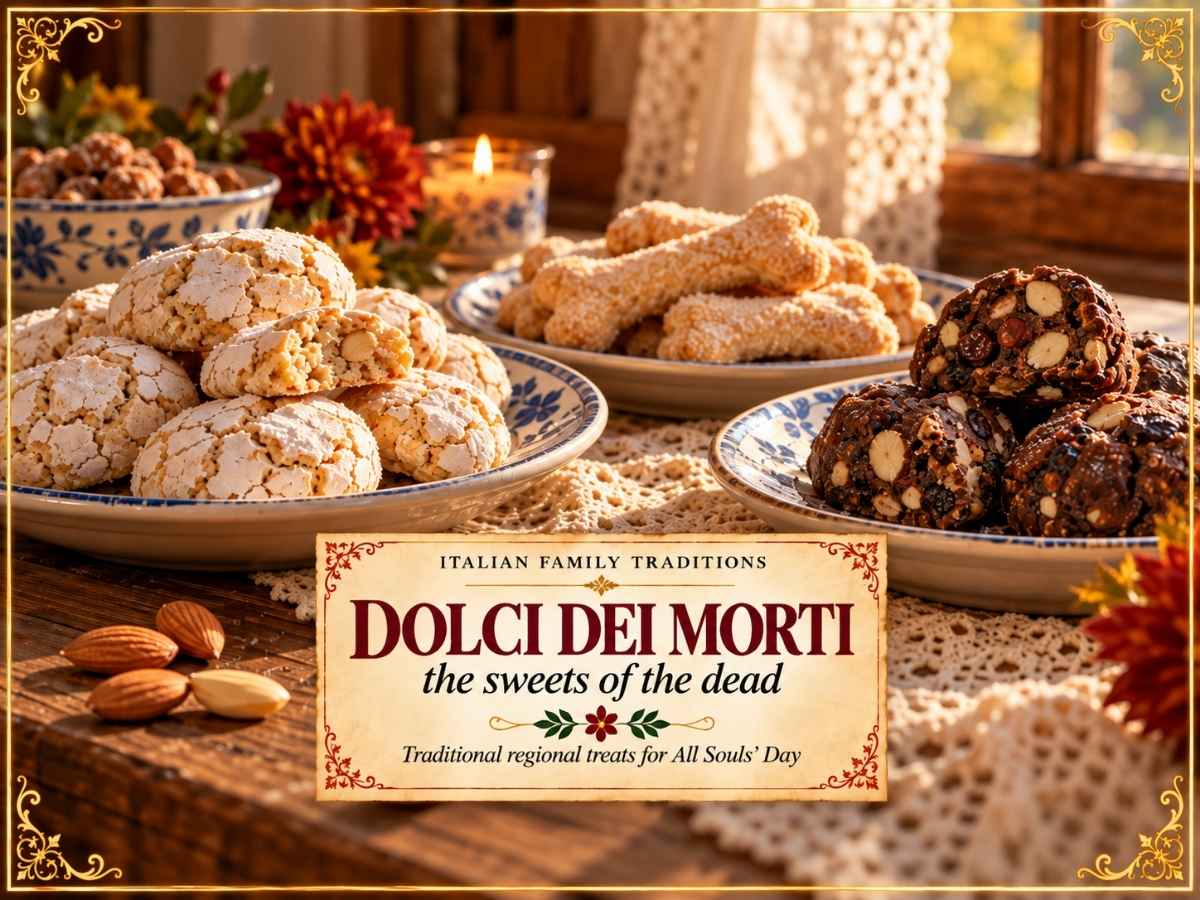
Italian Sweets for the Dead: 9 Traditional Dolci dei Morti, Region by Region
In Italy, the first days of November smell of almonds and cinnamon. This is the story of the sweets families bake for the dead — nine of them, from Sicily to the Alps — and why a people who take grief seriously have always answered it with sugar.
The smell started early. By seven in the morning the whole house was already full of it — almonds and sugar and something warm underneath, cinnamon maybe, or cloves, the kind of smell that reaches you before you are fully awake and pulls you out of bed by the nose. I did not have to ask what day it was. The kitchen told me.
My grandmother was already at the counter when I came down, flour to the elbows, a dish towel over one shoulder, the radio murmuring something I did not understand. She did not look up. She had been up for hours. There were trays — there were always trays — and on them the small pale shapes she made only once a year, rolled between her palms and lined up in rows like they were waiting for something. I thought they were cookies. I ate three before anyone told me to stop. It would be years before I understood that they were not really for me at all.
They were for the dead.
Not in a frightening way. Nobody in that kitchen was frightened of anything. It was the first week of November, the days when — in the old belief my grandmother carried out of Calabria the way she carried everything, quietly, without explaining it — the dead come back. On the night between the first and the second, the night between Ognissanti and the Day of the Dead, the departed were said to return to the houses they had lived in, to the people who still said their names. And you did not let them arrive to an empty table. You baked. You left something out. You made the house smell like a welcome.
Every other culture I know of mourns its dead with silence, or with black, or with distance. Italians mourn them with almonds. We feed them. We have always fed them. It is the most Italian answer to death imaginable: come back, sit down, you must be hungry.
This is the story of those sweets — the dolci dei morti, the sweets of the dead — and it is a bigger story than you might expect. Because Italy never does anything just one way. Travel a hundred kilometres in any direction and the sweet changes its shape, its name, its legend, sometimes its entire reason for being. In Sicily the dead bring gifts to children. In Milan they get a loaf baked in their honour. In Naples they are remembered in chocolate. In Sardinia, in Puglia, in Umbria, in the towns of the old Papal States, every region found its own way to turn the ache of remembering into something you could hold in your hand and put in your mouth.
What follows is a tour of nine of them, region by region, with the meanings and the legends underneath. But keep my grandmother’s kitchen in the back of your mind as you read, because the real subject here is not sugar. It is memory — and the specific, stubborn, delicious way Italian families have always refused to let their dead be forgotten.
Why Italians bake for the dead in the first place
To understand the sweets, you have to understand the belief underneath them — and it is older than Christianity by a very long way.
Long before November 2 was fixed on the Catholic calendar as the Commemoration of All Souls, the people of the Italian peninsula already believed that there was a time in the turning of the year when the boundary between the living and the dead grew thin. The harvest was in. The light was going. The cold was coming. It was the natural season to think about the ones who had gone ahead of you — and, in the old mind, to expect them back for a visit. The Romans had their festivals for the dead. The ingredients of the oldest dolci dei morti — the fava bean above all — reach straight back into that pre-Christian world, where beans were sacred to the dead and served at funeral banquets as food that belonged, somehow, to both worlds at once.
When Christianity gave the season its two great feasts — All Saints on the first, All Souls on the second — it did not erase the older instinct. It absorbed it. The Church prayed for the souls in purgatory; the family, at the same time, set a place for them at the table. These were never felt to be in competition. A family could kneel at Mass on the morning of the second and leave fava-shaped cookies on the windowsill that same night, and see no contradiction in it at all. The prayer took care of the soul. The sweet took care of the memory.
My grandmother left a small plate out on the night of the first. She never made a performance of it. She would simply set it down — a few of the almond sweets, sometimes a glass of wine beside them — and in the morning it was still there, of course it was still there, and she would nod at it as if something had been confirmed and then give the sweets to us children for breakfast. I asked her once, when I was old enough to be a little skeptical, whether she really thought anyone came. She looked at me for a moment and said, “They come if you remember them. The plate is how you remember.” I have never found a better theology of grief than that.
That is the thread running through every sweet in this article, no matter how different they look from one another. The dolci dei morti are not really offerings to ghosts. They are acts of remembering, made edible — a way for a family to say the names of its dead out loud, to teach those names to its children, and to insist, one more year, that the people who made them are not gone as long as somebody is still standing at the counter at seven in the morning making the thing they used to make.
Free Printable
The whole Italian year — feast days, the dead, the saints — on one calendar.
From Ognissanti and the Day of the Dead to La Vigilia and the Befana, get the free printable calendar of the Italian family year — so you always know what to honour and when. Join the list and we’ll send it to you.
Nine sweets, nine ways to remember
Here is the part where Italy fractures into its hundred Italies. What follows is a journey down the peninsula and across to the islands — nine traditional dolci dei morti, each one carrying the fingerprints of the place it comes from. Some are ancient. Some are shaped like bones on purpose. One of them involves the dead leaving presents for children in the night. All of them are still made today, in home kitchens and old pastry shops, in the first days of every November.
1. Fave dei Morti — the beans of the dead (Lazio, Umbria, Emilia-Romagna, the Veneto)
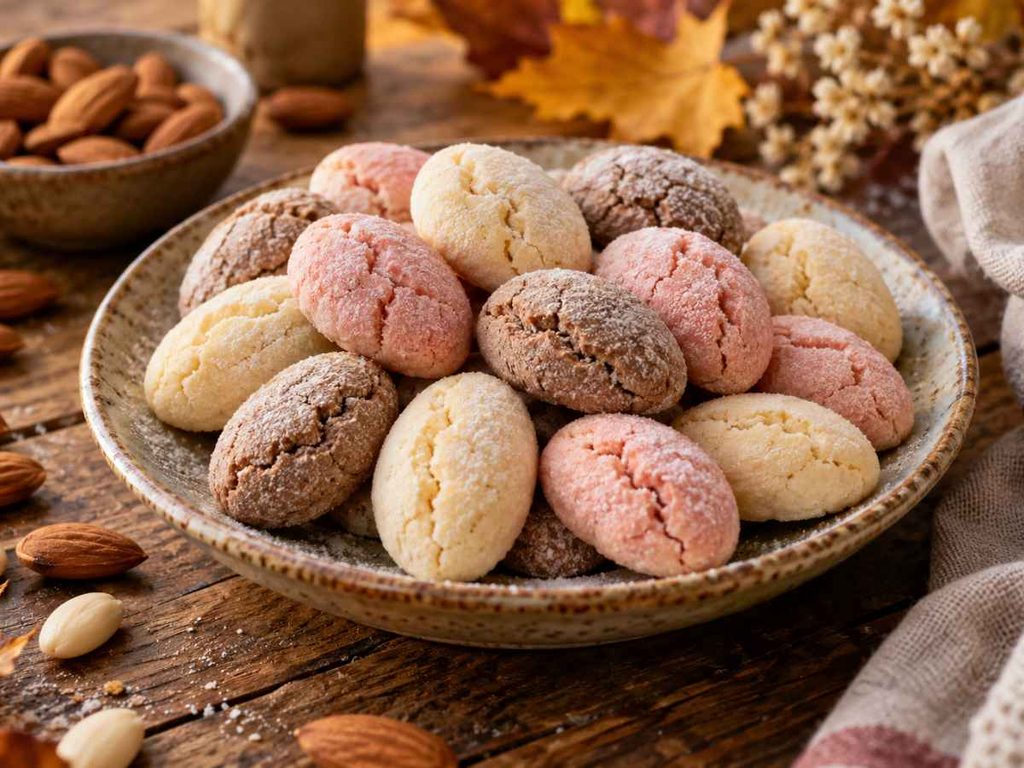
These are the ones my grandmother made. Small, domed, pale almond cookies, no bigger than the first joint of your thumb, crisp outside and soft within, perfumed with almond and sometimes a breath of cinnamon or lemon. They are called fave — beans — because they are shaped, loosely, like a broad fava bean, and the name is the oldest thing about them.
In ancient Rome the fava bean was the food of the dead. It was eaten at funeral banquets and offered to the departed, believed to be a kind of vessel that could hold the souls of ancestors, a bridge between the living world and the one below. When the centuries turned and the bean became a sweet — ground almonds standing in for the real thing, sugar softening the symbolism — the old meaning did not disappear. It simply put on a prettier dress. To this day, across central and northern Italy, the fave dei morti are the sweet most likely to be left out on the night the dead come home, the plate my grandmother set down without explanation. You eat them by the handful. You are, whether you think about it or not, eating a four-thousand-year-old idea.
2. Ossa dei Morti — the bones of the dead (Sicily, and much of the South)
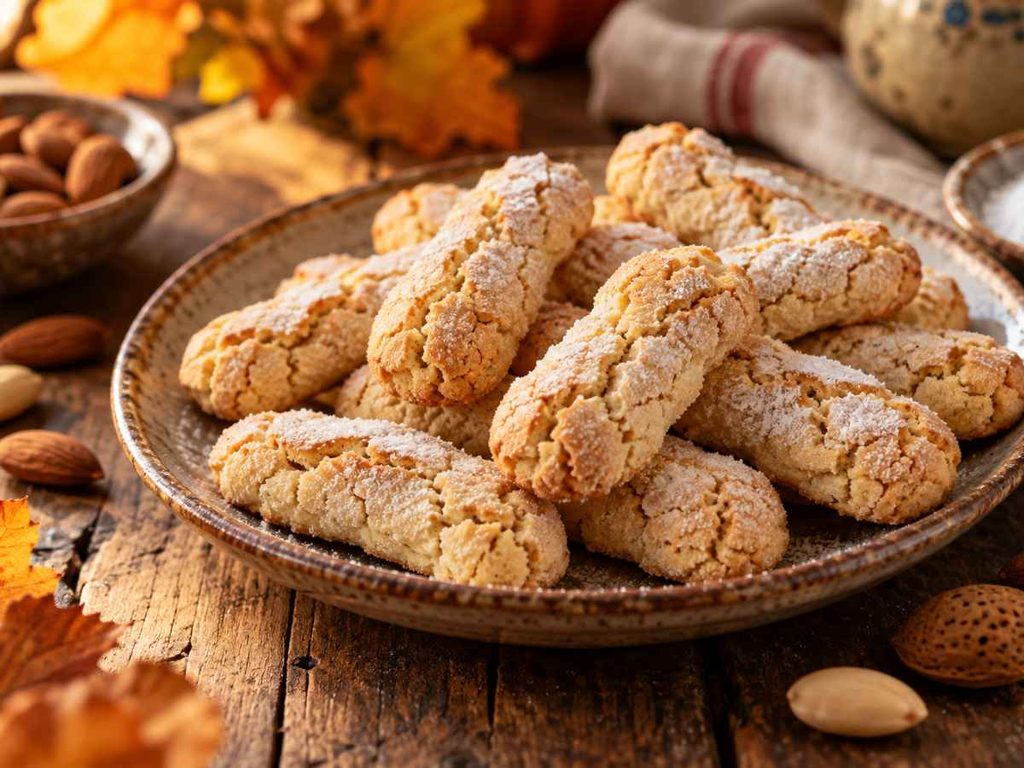
If the fave are gentle, the ossa dei morti are not. These are hard — gloriously, almost comically hard — white cookies shaped to look like small bones, with a crackled sugar top and a dense, chewy-to-impossible interior scented with cloves. The name is exactly what it says: bones of the dead. You are meant to understand the symbolism with your teeth.
There is nothing morbid in it, though, and that is the thing foreigners always miss about the Italian relationship with death. A cookie shaped like a bone is not a threat. It is a joke and a comfort at the same time — a way of taking the single most frightening fact of human life and making it small, white, sweet, and shareable. Children snap them in half. Old men dunk them in sweet wine to soften them enough to chew. The bone becomes something you break bread with. That is a profoundly Italian act: to look death in the face and offer it a seat and a glass of Marsala.
My great-uncle kept his ossa dei morti in a tin by his chair for the whole month of November and dunked them in his evening wine until they were soft enough for a man with no good teeth left to manage. He would tell us, every single year, the same line, tapping the cookie against the rim of the glass: “I’m having a drink with the old ones tonight.” Then he would eat the bone and look pleased with himself. He has been one of the old ones himself for a long time now. I think of him every November, which is of course exactly how it is supposed to work.
3. Pan dei Morti — the bread of the dead (Lombardy: Milan, Monza, the Brianza)
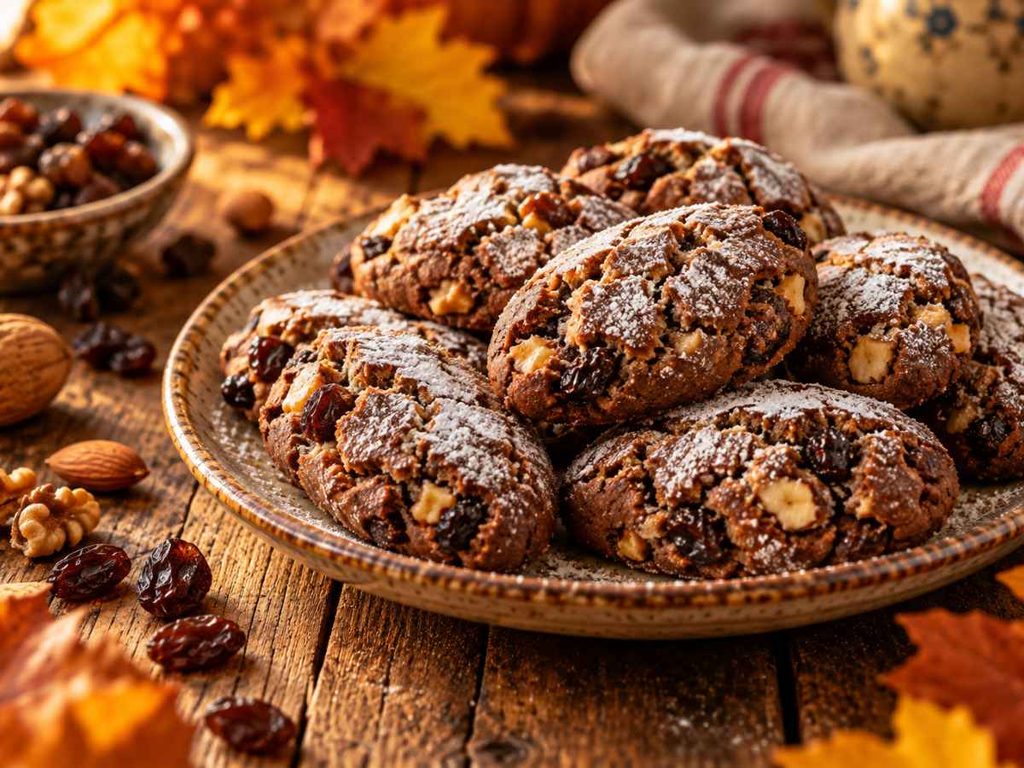
Go north, to Milan and the towns around it, and the sweet changes character entirely. The pan dei morti — bread of the dead — is dark, dense, and flat, an oval biscuit the colour of wet earth, made from crushed amaretti and dry biscuits bound with egg white, cocoa, sweet spices, and a fistful of dried and candied fruit. It is rich in the way that northern things are rich: no almonds dancing on top, just deep, brooding sweetness, the taste of a pantry emptied out in honour of someone.
The Milanese describe it beautifully. They call it a goloso saluto di bentornato per i defunti — a greedy, delicious welcome-home greeting for the departed. That is the entire philosophy of the thing in a single phrase. You do not greet the returning dead with something austere. You greet them the way you would greet a beloved relative coming back from a long journey: with the good stuff, the rich stuff, the thing you went to a little trouble over. The pan dei morti is a hug in biscuit form, and it is handed to children as readily as it is set out for the souls.
4. Torrone dei Morti — the chocolate torrone of Naples (Campania)
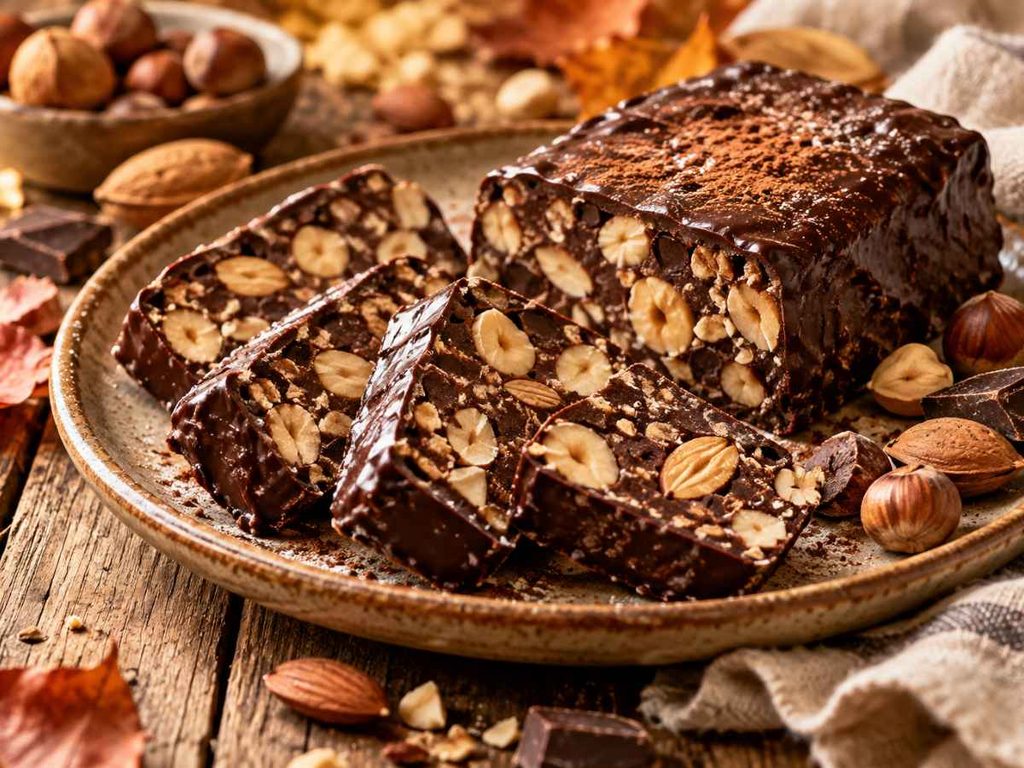
Naples, which does nothing by halves, gives the dead chocolate. The torrone dei morti is not the hard, white, honeyed nougat you know from Christmas — it is a Neapolitan invention entirely its own, a long brick of soft chocolate torrone, a cocoa shell enclosing a filling that might be hazelnut, or coffee, or candied fruit, or pistachio, or all of them at once, cut into thick slabs and sold by weight in the first days of November from every pastry shop in the city.
It is unapologetically a pleasure. There is no bone-shape, no fava symbolism, no reaching back to Rome — just Naples deciding that the right way to honour the people you have lost is to make something outrageously good and share it in their name. And there is a wisdom in that, too. Grief and appetite have always lived close together in the South. The funeral and the feast are rarely far apart. The torrone dei morti says, in its own decadent way, that remembering the dead and enjoying your life are not opposites — that the best tribute you can pay to the people who loved the table is to keep sitting down at it.
A Recipe Is a Memory That Can Be Lost
Every one of these sweets survives only as long as someone remembers who made it — and why. Whose hands made yours? What did the kitchen smell like? The Italian Family Heritage Kit gives you 133 guided pages and more than 120 prompts to record the recipes, the people, and the small November rituals your family never wrote down, before the person who holds them is gone.
Explore the Heritage Kit — $19.99Instant digital download. Print it and complete it with your family.
5. Frutta Martorana — the marzipan fruit of Sicily
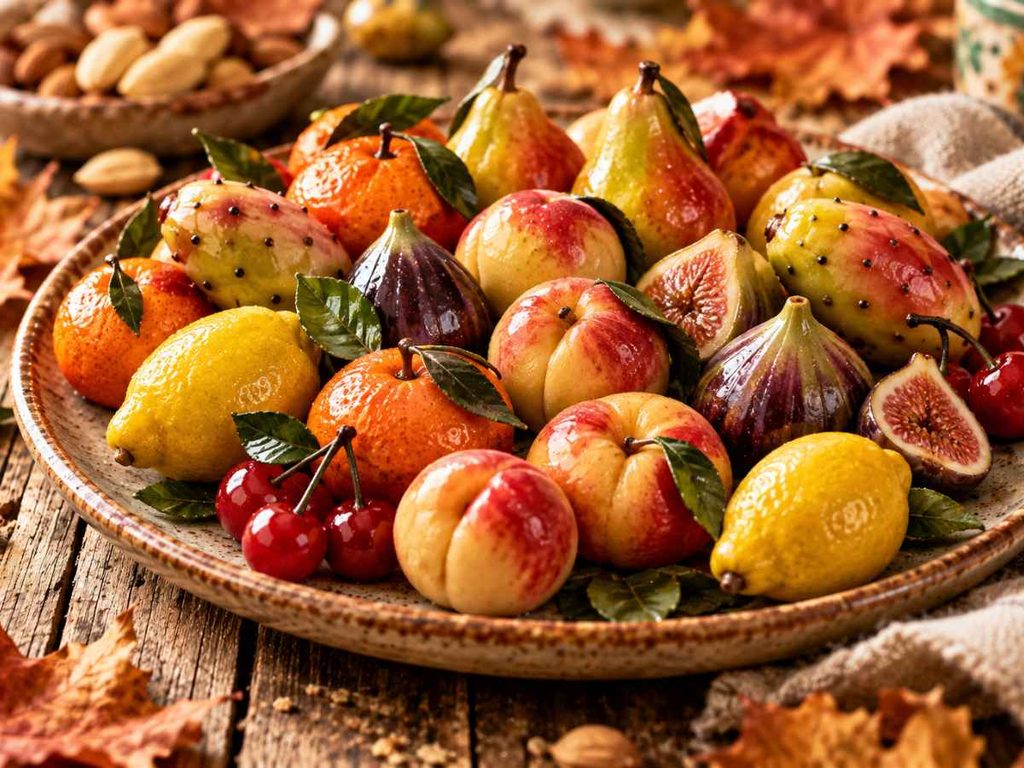
Now we cross to Sicily, where the sweets of the dead reach a level of artistry that stops you in the street. Frutta martorana — also called frutta di Martorana — is marzipan, almond paste, shaped and hand-painted to look so exactly like real fruit that your eye refuses to believe it. A fig with its skin splitting. A prickly pear. A bunch of cherries beaded with false dew. A wedge of blood orange. They are displayed in pastry-shop windows piled in baskets like a greengrocer’s stall, and every single piece is sugar.
The legend places the invention in a convent in Palermo — the Martorana — where the nuns are said to have hung their almond-paste fruit in the garden trees to amaze a visiting dignitary who arrived out of season. True or not, the story tells you everything about the Sicilian spirit: a little miraculous, a little theatrical, deeply devoted, and in love with beauty for its own sake. By the Day of the Dead, frutta martorana becomes one of the central sweets of the season, placed in the baskets the dead are said to leave for the children — which brings us to the most extraordinary tradition of them all.
6. Pupi di Zucchero — the sugar dolls, and the gifts the dead bring (Sicily)
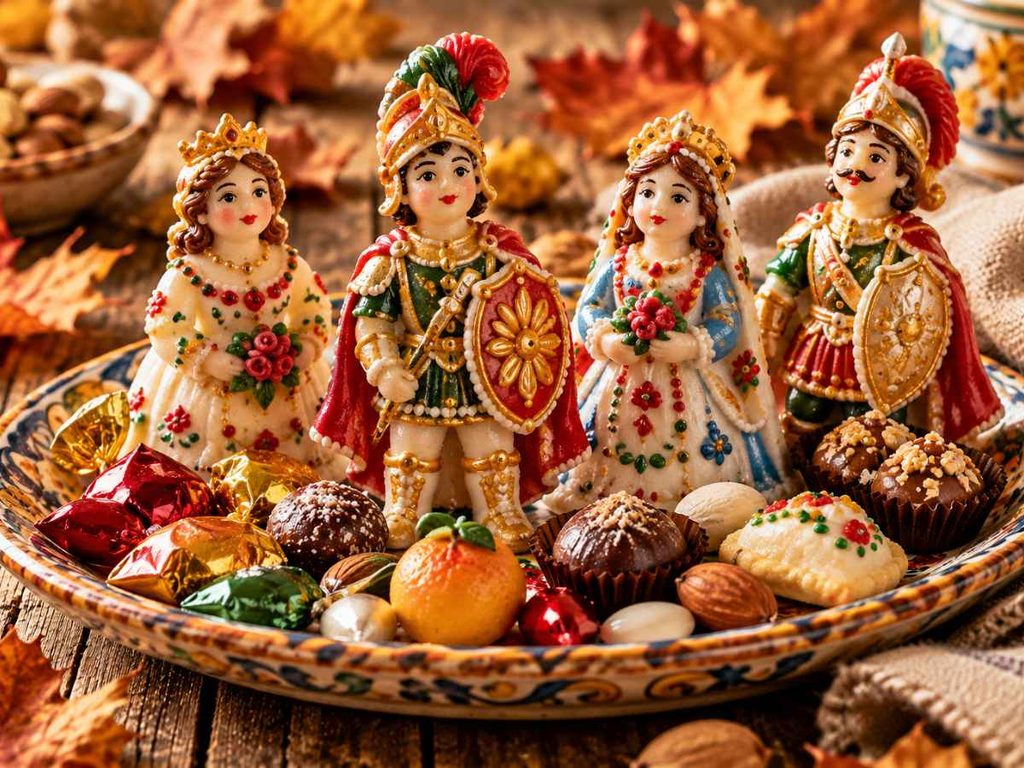
This is the one that undoes people. In Sicily, the Day of the Dead is not a sad day for a child — it is one of the best days of the year, because in Sicily the dead bring presents.
On the night before, children leave out their shoes or a request, the way children elsewhere do for other gift-bringing figures. And in the morning of November 2 they wake to find u cannistru — a wicker basket — left for them, filled with sweets and small toys, said to have been brought in the night by their own departed grandparents, great-aunts, the relatives they may be too young to have ever met. The first question of the morning, shouted down hallways across the island for generations, is “Chi ti purtaru i morti?” — “What did the dead bring you?”
And inside the basket, almost always, are the pupi di zucchero — “sugar dolls,” also called pupaccena — brightly coloured, hollow sugar figurines moulded into knights and ladies, paladins and saints and dancers, painted in reds and golds and greens. They are gorgeous and slightly solemn and entirely edible, and they are the gift of the dead to the living, handed from one generation to the next across the one night of the year when that handing-over feels most possible.
Think about what this tradition actually teaches a Sicilian child. Not that death is frightening. The opposite: that the people who loved you do not stop loving you when they die — that they still think of you, still want to delight you, still leave something behind with your name on it. A child raised on “what did the dead bring you?” grows up understanding grief as a form of ongoing relationship rather than a wound. I am not sure there is a healthier thing a culture can teach its children about death, and it is taught entirely through a basket of painted sugar.
7. Papassini — the raisin cookies of Sardinia
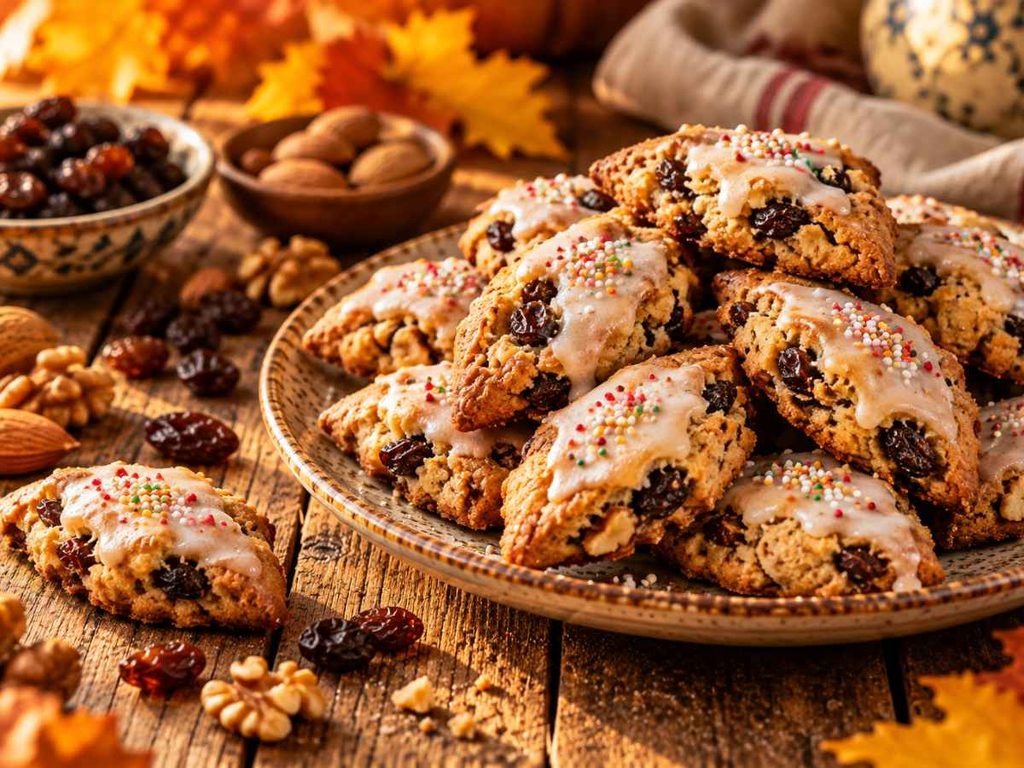
Sardinia, which has always kept its own counsel, has the papassini — sometimes written pabassinas, from papassa, the Sardinian word for raisin. They are small, diamond-shaped or lozenge-shaped cookies, dense with raisins, almonds and walnuts, scented with citrus zest and sometimes a little anise, and finished with a thin white glaze and a scatter of coloured sprinkles that make them look oddly festive for a sweet of mourning.
But that cheerfulness is the point. On the island, the days around Is Animas — the souls — carry some of the oldest customs in all of Italy, including children who once went door to door asking for offerings for the dead, a tradition whose family resemblance to a certain other autumn ritual is not accidental. The papassini are the sweet handed over at the door and shared at the family table, a cookie built from the humblest pantry staples — raisins, nuts, the end of the flour — and lifted into something special by the occasion. That is the whole Sardinian ethic in a single bite: make much of little, and never let the dead go unfed.
8. Stinchetti dei Morti — the marzipan bones of Umbria (Perugia)
Back on the mainland, in green inland Umbria and especially around Perugia, the marzipan tradition turns its hand to the macabre-in-a-friendly-way once more. The stinchetti dei morti — the name means, more or less, “little shinbones of the dead” — are almond-paste sweets moulded and coloured to resemble small bones, pale and smooth, sometimes tinted, sold in the pastry shops of Perugia in the first days of November.
They are a cousin to the Sicilian ossa and the sugar pupi — the same impulse to shape sweetness into the imagery of death and thereby strip it of its terror — but rendered in the soft, sculptable almond paste that central Italy loves. A child handed a little marzipan bone learns the same lesson the Sicilian child learns from the sugar doll: that the bone is not to be feared, that it can be beautiful, that it can even be delicious. Umbria, land of saints and hill towns and long Catholic memory, found its own quiet way to say the thing the whole peninsula says every November.
9. Grano dei Morti — the sweet wheat of Puglia (the Foggiano)
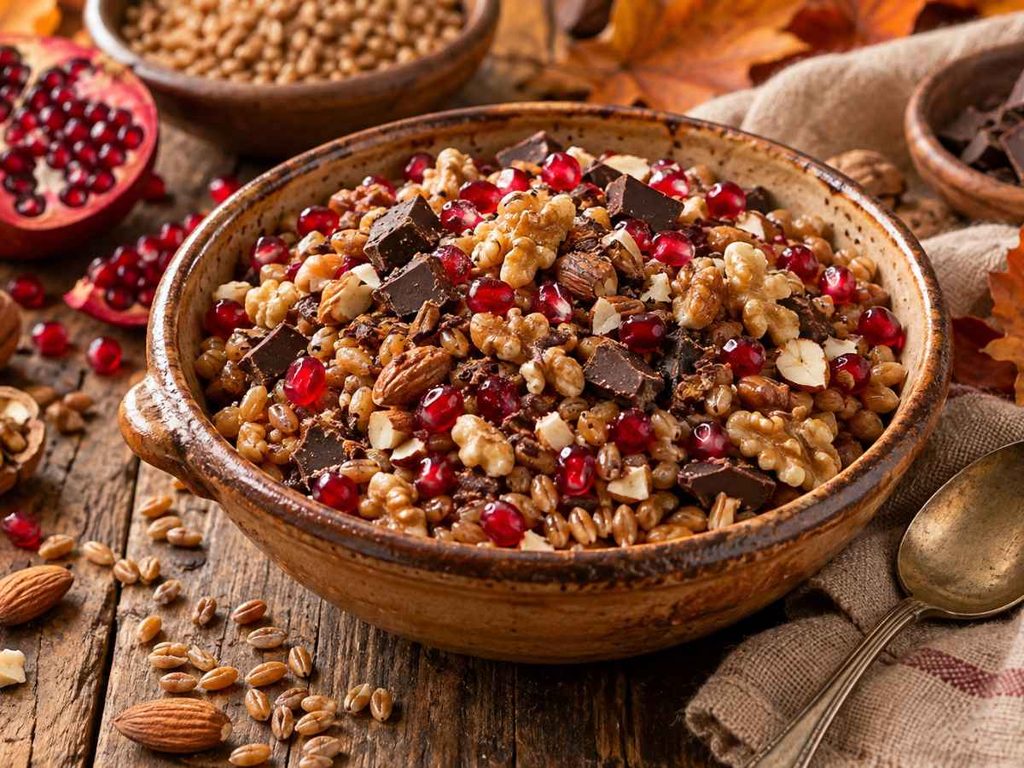
And finally, down into Puglia, to the province of Foggia, where the sweet of the dead is not a cookie at all but a bowl. Grano dei morti — “wheat of the dead,” also called colva or cicc’ cuott’ in the dialect — is made from whole wheat berries, boiled until tender and swollen, then dressed with pomegranate seeds, chopped walnuts, dark chocolate shavings, candied fruit, cinnamon, and vincotto, the thick cooked-grape must of the South. It is served cold, in little bowls, deep red and glistening, and it is one of the most ancient and most meaningful dishes in this entire article.
Wheat, buried in the earth and rising again as bread, has been a symbol of resurrection for as long as people have farmed it — and the Christian ritual of blessing and eating boiled wheat on the Day of the Dead draws that symbolism straight up out of the ground. The pomegranate, with its countless seeds, is the ancient fruit of the underworld and of abundance beyond death. To eat grano dei morti is to eat a small edible sermon on exactly the thing the day is about: that what is buried is not finished, that the seed returns, that the dead are planted rather than lost. In Puglia they have been saying this with a spoon for a very, very long time.
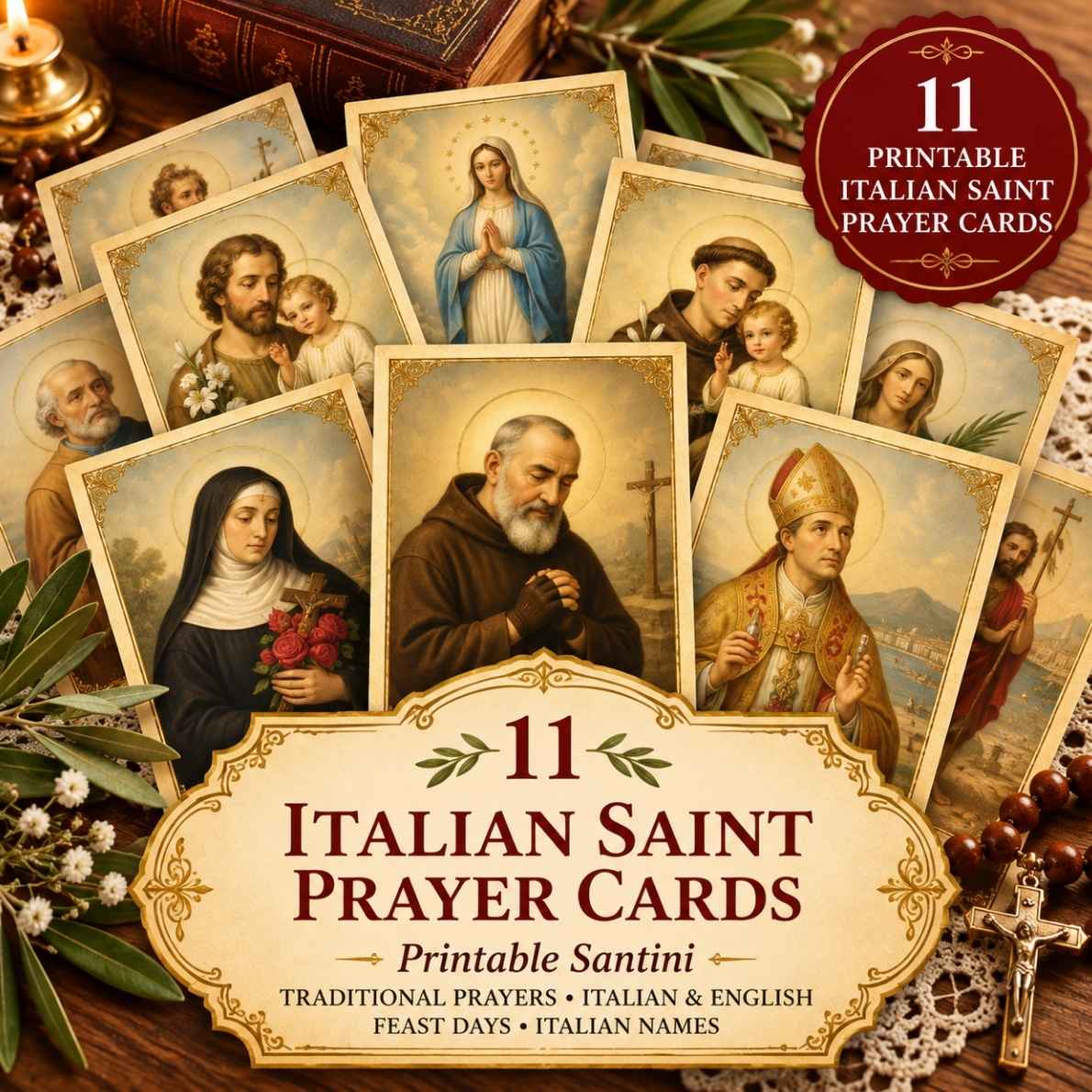
The sweets fed the memory — the prayers tended the soul. On the Day of the Dead, Italian families prayed for the ones they had lost with the saints they trusted most. Our Italian Saint Prayer Cards gather eleven beloved saints on beautifully designed santini — among them Padre Pio — each with a traditional prayer in Italian and English, the kind kept in a missal or a bedside drawer and brought out when the names need saying.
$9.49
Instant digital download
Get the Saint Cards →What crossed the ocean — and what got left behind
Here is the harder part of the story, the part my own family lived.
When Italians left — for New York, for Toronto, for Montreal, for Buenos Aires — the dolci dei morti came with them in the suitcase of memory, but not all of them survived the crossing intact. Some did. The fave dei morti travelled well, because the ingredients were simple and the shape was easy and a grandmother could make them in a kitchen in Canada exactly as she had made them in Calabria. The Neapolitan torrone dei morti survived in the Italian neighbourhoods and the good import shops. But the deeper, stranger, more local customs — the Sicilian baskets from the dead, the Sardinian souls going door to door, the blessed wheat of the Foggiano — these needed a whole surrounding world to make sense, and that world did not always fit in the suitcase.
In the new country, the first of November landed in the middle of a calendar that had its own idea about late October and skeletons and candy, and the quiet Italian traditions of the dead were easy to lose in the noise. The second generation ate the cookies without always knowing why they were shaped like beans. The third generation sometimes did not get the cookies at all. What got passed down, in a lot of families, was a feeling without its explanation — a sense that November was somehow a serious month, that you lit a candle, that you visited the cemetery, that there was a plate of almond sweets that appeared and nobody quite said who they were for.
I can make my grandmother’s fave dei morti. What I cannot do is ask her the hundred small questions I never thought to ask while she was standing at that counter — which town the recipe came from, whose hands she learned it from, what her own grandmother set out on the plate, what she whispered when she set it down. The sweets survived. The story around them almost did not. I got lucky and recovered some of it late. Most families do not, and they do not even know what they have lost until the person who could have told them is already one of the names on the plate.
That is the quiet tragedy underneath all of this sweetness, and it is the reason I write any of it down. A recipe is one of the most fragile things a family owns. It lives in a pair of hands and a sense of smell and a memory of a kitchen, and when those go, it can go with them in a single generation — unless somebody writes it down while there is still someone to ask. The sweets of the dead are, in the end, a technology for remembering. It would be a strange kind of forgetting to let the memory of how to remember be the thing we lose.
How to bring the tradition back to your own table
You do not need to be fluent in dialect or born in a hill town to keep this. The dolci dei morti were never about perfection. They were about intention — about turning the first days of November into a time when your family deliberately remembers its dead. Here is how to begin, wherever you are.
- Make one sweet, not nine. Pick the fave dei morti — they are the simplest and the most universal — and make a batch on the first of November. Let the house smell like almonds.
- Set a plate out. You do not have to believe anyone comes to eat it. Set it out anyway, and say the names of the people it is for. The plate is how you remember.
- Tell the children who the dead were. Not sadly — the way a Sicilian family does it. “This one is for your great-grandfather. He made wine in the garage. He would have liked you.”
- Visit the cemetery if you can, with flowers, the way the whole country does on the second. Chrysanthemums are the traditional flower of the day in Italy.
- Write down the recipe and the story together — not just the ingredients, but whose recipe it was, where it came from, and what you remember about the kitchen it was made in.
That last one is the one that matters most, and the one almost nobody does until it is too late. The ingredients you can always look up. The story — whose hands, which town, what was whispered over the plate — exists in one or two people, and when they are gone it is gone, with no searching for it later.
The smell still finds me every November. Almonds and sugar and something warm underneath. I am forty-odd years and an ocean away from that kitchen, and I can be put right back into it by a tray of pale cookies the size of a thumb. That is what the dead leave us, in the end — not ghosts, but the ability to be seven years old again at the bottom of the stairs, pulled out of bed by the smell of being remembered.
So this year, make the sweet. Set out the plate. Say the names. And write down who they belonged to, while there is still someone at the counter to ask.
Before the Recipe Becomes a Mystery
Record the people, the recipes, and the rituals — before the person who holds them is gone.
Whose fave dei morti were worth getting up at seven for? Which town did the recipe come from? What did your family set out on the plate, and who was it for? The Italian Family Heritage Kit gives you 133 guided pages and more than 120 prompts to preserve your family’s people, names, recipes, sayings, photographs, and the small traditions — like these — that no one ever wrote down.
Explore the Heritage Kit — $19.99Instant digital download. Print it and complete it with your family.
If this spoke to you, read on about the days these sweets belong to: what Ognissanti is and how Italians mark All Saints’ Day, the Sicilian Festa dei Morti and the gifts the dead bring, the Italian prayers for the dead families still say, and the wider world of Italian mourning and funeral traditions. And for the broader story of what these families carried across the ocean and what they kept, read Italian-American traditions: what changed and what stayed the same.
FAQ
What are dolci dei morti?
Dolci dei morti — “sweets of the dead” — are the traditional Italian treats made and eaten in the first days of November, around All Saints’ Day (November 1) and the Day of the Dead (November 2). They range from almond cookies and marzipan to chocolate torrone and sweet boiled wheat, and nearly every region of Italy has its own. They are made to honour and remember departed family members, and in many places were left out overnight for the dead who were believed to return home during this season.
Why are some of the sweets shaped like bones?
Sweets like the Sicilian ossa dei morti (“bones of the dead”) and the Umbrian stinchetti are shaped like small bones on purpose. Far from being morbid, this reflects the Italian approach to death: taking something frightening and making it small, sweet, and shareable. Breaking and eating a bone-shaped cookie turns the imagery of death into an act of comfort and family togetherness rather than fear.
What is the Sicilian tradition of the dead bringing gifts?
In Sicily, children wake on the morning of November 2 to find u cannistru — a basket of sweets and small toys said to have been brought in the night by their departed relatives. The traditional greeting is “Chi ti purtaru i morti?” (“What did the dead bring you?”). The basket typically holds frutta martorana (marzipan fruit), pupi di zucchero (painted sugar dolls), and ossa dei morti. The tradition teaches children that the people who loved them continue to care for them even after death.
What are fave dei morti made of?
Fave dei morti are small almond cookies made mainly from ground almonds, sugar, flour, butter and egg, often scented with cinnamon or lemon zest. They are shaped loosely like a fava bean — a food sacred to the dead in ancient Rome and served at funeral banquets — which is where their name and their deep symbolism come from. They are among the most widespread dolci dei morti, found across Lazio, Umbria, Emilia-Romagna and the Veneto.
Is the Day of the Dead a sad occasion in Italy?
Not in the way outsiders often assume. While the day includes prayers, cemetery visits and real remembrance, it is also warm and often joyful — especially for children. The Italian attitude treats death less as an ending than as a continuing relationship with the people you have lost. The sweets, the gifts, and the family gatherings are all ways of keeping the dead present and honoured rather than mourned from a distance.
What is torrone dei morti?
Torrone dei morti is a Neapolitan specialty and is quite different from the hard Christmas nougat of the same name. It is a soft chocolate torrone — a cocoa shell filled with hazelnuts, coffee, candied fruit, pistachio or other flavours — cut into thick slabs and sold by weight in Naples during the first days of November. It reflects the Southern philosophy that remembering the dead and enjoying life’s pleasures are not opposites.
How can I start the dolci dei morti tradition in my own family?
Start small: make one sweet — the fave dei morti are the easiest — on the first of November, set a plate out and say the names of the family members it honours, and tell your children who those people were. Visit the cemetery if you can. And most importantly, write down not just the recipe but the story behind it — whose it was and where it came from — while there is still someone in the family who remembers.
Marco Ricci is an Italian-Canadian writer and the grandson of Calabrian immigrants. He created Italian Family Traditions to document the customs, feast days, and family rituals Italian families carried from Italy to North America — and to understand what they actually meant. He is based in Montreal.