Italian Family Traditions
How to Create an Italian Family Memory Corner at Home
Not a shrine nobody touches. Not a dusty shelf full of objects nobody can explain. A real place in the house where the family history stays visible, warm, and available — for the child who passes it on the way to breakfast, and the guest who asks who the man in the portrait is.
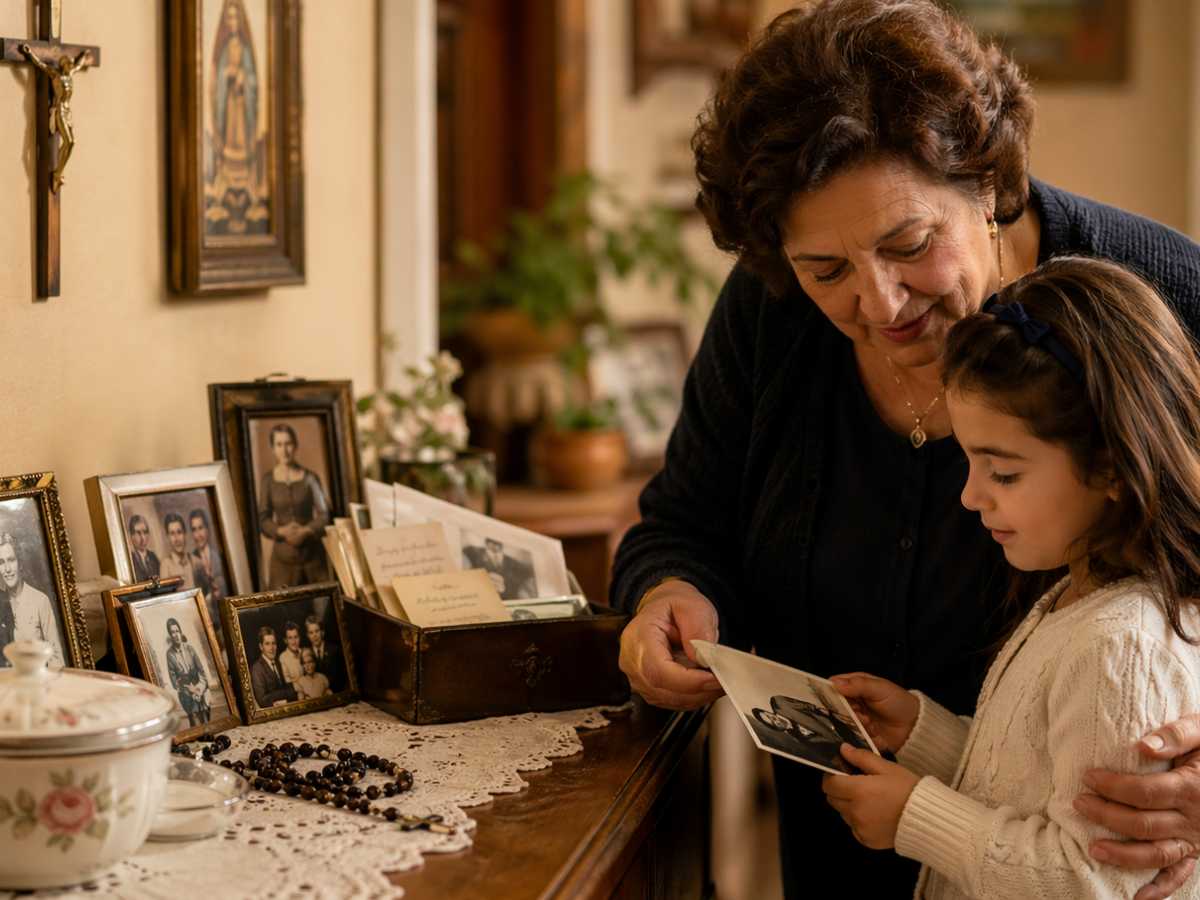
My grandmother had a small shelf in the hallway of the house in Rivières-des-Prairies that nobody was ever formally told was important. It was just there. A framed wedding photograph. A ceramic statue of the Madonna. A small dish that held a rosary and a few saint’s cards. A wooden spoon with a crack in it that had come from somewhere she referred to as “back home” and that I understood, from a very young age, was not to be used. Not because she had explained any of this. But because the shelf had a specific quality of arrangement that communicated, without words, that these things were here on purpose and that the purpose was not decoration.
I did not think much about that shelf for years after she died. Then I started noticing its absence. The hallway without it felt like a sentence missing a subject. Something had been telling the story of the family in that space, and now nothing was telling it, and the silence was a different kind of silence from ordinary empty shelves.
Family history stored in boxes is preserved. Family history made visible is alive. Those are not the same thing — and the difference is felt every single morning by the child who passes the shelf on the way to breakfast.
A family memory corner is not a museum installation and it is not interior design. It is a small decision to make certain things visible instead of hidden — to let the family history do its work in daily life rather than waiting in a box for someone to eventually go looking for it. This article is the practical guide for building one.
Why a family memory corner matters
A lot of family history lives in drawers, basements, closets, and old boxes. That is better than throwing things out. But it is not the same as preserving meaning — because meaning requires visibility, and visibility requires that the objects be somewhere people actually are.
The Library of Congress and Smithsonian guidance both stress that family treasures become much more valuable when the stories around them are documented and shared. NARA says prevention and basic organization are central to preserving family archives for the next generation. But documentation and organization are only half of it. The other half is placement — putting the right things somewhere that people encounter them, ask about them, and absorb them as part of the texture of daily life.
A child who passes a wedding photograph every morning on the way to breakfast knows, without being told formally, that those people existed and mattered. A guest who notices an old rosary on a sideboard might ask whose it was — which produces a conversation, which produces a story, which is the whole chain of heritage transmission in compressed form. This is the same principle that makes the Italian Sunday dinner such a powerful tradition: heritage stays alive through repeated exposure, not through formal instruction.
After my grandmother died, I helped sort through the contents of her house. The shelf came apart in about five minutes — the photograph into one box, the Madonna into another, the rosary into an envelope, the spoon wrapped in newspaper. Within a week, none of those objects were in the same place. Within a month, I was not certain where three of them were. Within a year, the wooden spoon had been used. Not by someone who knew what it was. By someone who saw a wooden spoon. The shelf had been doing the work of keeping those objects intelligible — keeping them related to each other and to the family. When the shelf went, they became separate uncontextualized things instead of a small coherent story. The shelf was the preservation system. Not the objects themselves.
What belongs in an Italian family memory corner
The best memory corners do not try to show everything. They pick a small number of objects that carry strong meaning and arrange them so that their relationship to each other is visible. The Smithsonian’s family treasures guidance says that treasured objects are valued because of their connection to people, places, or memories — not because of financial value. That is the right criterion for choosing what goes in.
For an Italian family memory corner, strong candidates include:
- An old family photograph — a wedding portrait, a group photo, an image of the grandparents in the neighborhood they lived in
- A handwritten recipe card — the specific handwriting of a person who is gone, carrying the dish that meant Sunday or Christmas Eve or Easter
- A prayer card or saint’s image — the specific saint the family was devoted to, the one whose name appears in the family naming patterns
- A rosary — especially one that was used daily, that carries the worn quality of an object that did its job for decades
- A baptism candle or confirmation photograph
- A copy of an immigration document — the ship manifest, the entry record, the naturalization paper
- A small tool or kitchen object connected to a specific tradition — the wooden spoon, the pasta cutter, the wine-making implement from the cantina
- A cornicello or other protective object that was worn or displayed by a specific person in the family
- A piece of embroidery or needlework made by a grandmother
- A saint’s medal from a baptism — the first protective gift given to a child who is now an adult or a grandparent themselves
Choose things whose story you can tell, or whose story you are in the process of recovering. Objects without stories become objects without meaning — and the memory corner’s job is to keep the story attached to the thing. For guidance on identifying and recovering the stories behind family objects and photographs, read how to use old photos to preserve your Italian family history.
How to choose the right theme
The fastest way to make a memory corner feel meaningful rather than random is to organize it around a single coherent theme. A theme gives the arrangement a subject — it tells the viewer what story they are looking at before they read a single label.
| Theme | Objects that work |
|---|---|
| The immigration story | Document copy, arrival photograph, a map marking the hometown in Italy, the first Montreal address written in someone’s handwriting |
| The Sunday kitchen | Handwritten recipe card, wooden spoon or pasta cutter, a photograph of the Sunday table, a label explaining what Sunday meant in the family |
| Our grandparents | Wedding portrait, rosary, saint’s card, a photograph from their neighborhood or the town they came from |
| Faith and feast days | Madonna statue, prayer card, baptism candle, a photograph from a First Communion or confirmation |
| The old house and neighborhood | Photographs of Little Italy or the original street, a map of the Montreal neighborhood, an object from the cantina or garden |
| Protective traditions | Cornicello, saint’s medal, a photograph of the grandmother who observed these customs, a brief note on what each object was for |
A good test for any object you are considering: can you explain in one sentence why it belongs in this particular arrangement? If you cannot, it probably belongs in a different corner or a different time. Smithsonian collection-care guidance says objects become more meaningful when they clearly belong to a documented story — the same logic applies visually.
How to choose the right spot in your home
Visibility and stability are the two requirements that must coexist. You want a place people actually encounter in daily life — not a guest room nobody enters, not a corner behind a door. And you want a place where the objects will not be damaged by the environment around them.
Preservation sources are consistent on this. NARA says to keep family materials away from damp basements, garages, and hot attics. Smithsonian guidance says heirlooms should be kept out of basements and attics. The Library of Congress similarly warns against heat, moisture, and direct light for photographic and paper materials. The spots that tend to work best are a hallway wall or sideboard, a dining room shelf or credenza, a living room bookshelf with a designated section, or a protected cabinet in a main family area.
A friend built her family memory corner on the sideboard in the hallway between the kitchen and the living room — the passage her household crossed approximately forty times a day. The sideboard held a framed photograph of her grandparents’ wedding, a ceramic holy water font her grandmother had kept by the door, a copy of the ship manifest showing her great-grandfather’s arrival at Halifax, and a small handwritten card in her grandmother’s handwriting that said, simply, “This family came from Cosenza in 1952.” She told me six months later that her children, who were nine and twelve, had started asking questions about the photograph. Not because they had been prompted. Because they walked past it every day and eventually the curiosity had accumulated enough to produce a question. That is how a memory corner works. It waits. Then it gets asked about.
The formula for a memory corner that works
One photo + one handwritten item + one object + one label.
That is enough. Not ten objects without context. Four objects with story attached.
The photograph provides a face and a moment. The handwritten item — a recipe card, a letter, a prayer card in someone’s specific handwriting — provides a voice. The object provides texture and physicality, the feeling of something that was used and held. The label ties all of it to a name, a place, a relationship, and a sentence of meaning.
For example: a wedding photograph of Maria and Giovanni, a handwritten recipe for Easter pie in Maria’s handwriting, Giovanni’s rosary worn from daily use, and a label that reads: They arrived from Calabria in 1951 and raised six children in this city. This recipe has not changed.
That is a sentence of family history that will outlast any box in any basement. The Library of Congress treats photographs as real family-history evidence. The Smithsonian stresses that documenting the story and provenance of family items is as important as keeping the item itself. Put those two principles together and what you get is exactly this: an object plus its story, displayed somewhere people will find them.
How to label photos and heirlooms so the story stays attached
Creating a beautiful display is only the first half. The second half is making sure the meaning stays with the object rather than floating away when the person who remembered it is no longer there to explain it. The Library of Congress and Smithsonian both emphasize documenting information about family heirlooms and photographs. Smithsonian’s “Documenting the Family Treasure Chest” guidance specifically encourages writing down the history and information attached to heirlooms.
For each displayed item, keep a short label that answers:
- Who it belonged to or who is in it
- What it is — not just “rosary” but “the rosary Giovanni kept by his bed and used every night”
- Where it came from — Calabria, Little Italy, the house on Dante Street
- When — the decade if not the exact year
- Why it matters — one sentence is enough
My aunt created a memory corner on a shelf in her dining room that included, alongside the photographs and objects, a small framed notecard on which she had written her mother’s words verbatim — a sentence her mother had said while explaining why she kept a particular object, recorded and then transcribed. The notecard said: “Your grandmother told me she carried this from Italy in her coat pocket because she was afraid they would take it at customs. She never explained why she thought they would. She just held onto it.” The notecard was more compelling than anything else on the shelf. It sounded like a person. It sounded like a specific person with a specific memory and a specific fear and a specific coat. That is what a good label does when it carries a real voice rather than a summary.
Use copies when needed — not every original should be on display
Some original items are too fragile to display openly for extended periods. NARA says preventing damage is the key to preserving family archives. Smithsonian guidance recommends considering copies and rehousing when necessary. The Library of Congress family-preservation guide suggests making copies and sharing them with relatives as one way to reduce risk while preserving content.
A smart memory corner often uses a scanned copy of a fragile photograph, a photocopy of a recipe card, or a reproduced prayer card or document — while the original stays safely stored. This is not a compromise. The story stays visible and the original stays protected. Both are preserved. For the full guidance on digitizing and protecting original photographs, read how to use old photos to preserve your Italian family history.
Add one recorded story if you can
The memory corner becomes something completely different if you can connect at least one displayed object to a short recorded story from a parent or grandparent. A phone-recorded clip. A printed transcript. A handwritten note from the person explaining the object in their own words. Even a single sentence written in their handwriting is worth more than a paragraph written by anyone else, because it carries the specific voice and phrasing that belongs to that person alone.
The Smithsonian and Library of Congress both frame oral history as preserving original, meaningful information through people’s own voices and perspectives. For how to capture those conversations before it is too late, read how to record family stories before they’re lost. And for the specific questions that unlock the best family stories, read what to ask your grandparents about your Italian family history.
Keep the memory corner alive over time
The best memory corners are not frozen. They can change with the season and the family calendar — and that rotation is one of the things that keeps them from becoming invisible through over-familiarity.
Bring out the Ognissanti photographs in early November, when the family goes to the cemetery. Display the Christmas Eve photograph and the pastiera recipe card in December for La Vigilia. Feature one grandparent’s objects for a season, then rotate to another. Let the memory corner respond to the feast days the family already observes — so that the display is always saying something relevant to what the family is currently living.
This rotation also has a preservation benefit: it reduces prolonged light and air exposure for individual items. NARA and NEDCC preservation guidance both support rotating displayed items as part of good collection care. What is good for the objects and what is good for the family’s engagement with them turn out to be the same thing.
My grandmother’s shelf had no label and no system. It worked anyway, for decades, because she was there to tell the story of every object on it to anyone who asked. When she was gone, the shelf lasted about a week. Build the memory corner now, while the stories are still available. Label the objects. Write the names. Put it somewhere people actually walk past. Make the memory visible instead of hidden.
The goal is not to decorate the house with old things. It is to make memory visible — so that it keeps doing its work long after the person who held it is gone.
A memory corner works best alongside recorded stories and identified photographs. Read how to record family stories before they’re lost, how to use old photos to preserve your Italian family history, and what to ask your grandparents about your Italian family history. And for how to get the next generation interested in what you are building, read how to get your kids interested in their Italian heritage.
FAQ
What is a family heritage display?
A family heritage display is a small visual arrangement of family photographs, heirlooms, documents, and story objects that keeps family history visible and available in daily life rather than stored out of sight. The Smithsonian and NARA both emphasize that family treasures become more valuable when their stories are documented and displayed — not just physically preserved in boxes. A memory corner is the domestic version of that principle: it puts the family history somewhere people actually encounter it.
What should I put in an Italian family memory corner?
The best items are things that carry a specific story attached to a specific person: an old family photograph, a handwritten recipe card, a prayer card or saint’s image, a rosary that was actually used, a copy of an immigration document, a small tool or kitchen object from a grandparent, or a protective object like a cornicello that has a known history. The Smithsonian’s family treasures guidance says objects are valued for their connection to people and memories — that is the right criterion for choosing what goes in.
Should I display original family photos and documents?
Only if they are in good condition and protected from light, heat, and moisture. NARA and Smithsonian guidance both support using copies when needed — a scanned copy of a fragile photograph or a photocopy of a recipe card — while the original stays safely stored. The story stays visible and the original stays protected. Both outcomes are better than displaying a fragile original until it fades, or storing everything so safely that nobody ever sees it.
Where should I place a family memory corner at home?
Choose a visible but stable location in the main living areas of the house — a hallway sideboard, a dining room shelf, a living room bookcase section — somewhere the daily rhythm of the household produces repeated encounters with the objects. Avoid direct sunlight, dampness, hot attics, and garages. NARA and Smithsonian guidance both warn against unstable or damp environments for family materials. The goal is visibility and stability simultaneously.
How do I label heirlooms so the story is not lost?
Use short labels that answer five questions: who the item belonged to, what it is specifically (not just “rosary” but “the rosary Giovanni kept by his bed and used every night”), where it came from, approximately when, and why it matters. One sentence of context is enough to stop the story from drifting away. The Smithsonian’s family treasures guidance specifically encourages documenting this information because the story attached to an object is what makes it meaningful — without the label, the story is only as permanent as the memory of the last person who remembered it.
Can a small memory corner really preserve family history?
Yes — often more effectively than larger efforts, because it is sustainable. A small, well-labeled display that people encounter every day produces more cumulative heritage transmission than an elaborate archive that nobody visits. Children absorb what they are repeatedly exposed to. A photograph passed on the way to breakfast every morning for ten years becomes part of a person’s understanding of where they come from in a way that a formal presentation never quite achieves.
How do I keep a memory corner from becoming cluttered or ignored?
Organize around a single coherent theme rather than displaying everything at once. A clear theme — the immigration story, our grandparents, faith and feast days, the Sunday kitchen — tells the viewer what story they are looking at before they read a single label. Rotate items seasonally to prevent over-familiarity and to align the display with the family calendar: Ognissanti photographs in November, Christmas Eve photographs in December, feast day objects when the feast comes around. The memory corner should respond to the life of the family, not just sit unchanged on the shelf year after year.

Marco Ricci is an Italian-Canadian writer and the grandson of Calabrian immigrants. He created Italian Family Traditions to document the customs, feast days, and family rituals Italian families carried from Italy to North America — and to understand what they actually meant. He is based in Montreal.