Italian Family Traditions
How Much Wine Do Grapes Make? The Italian Home Winemaker’s Guide
Every autumn, Italian families bought grapes by the crate and turned them into a year’s worth of wine in the cantina. If you’re planning to do the same, the first question is always the same one my family asked every September: how many grapes do we need — and how much wine will they actually make? Here’s the answer, with a calculator to do the math for you.
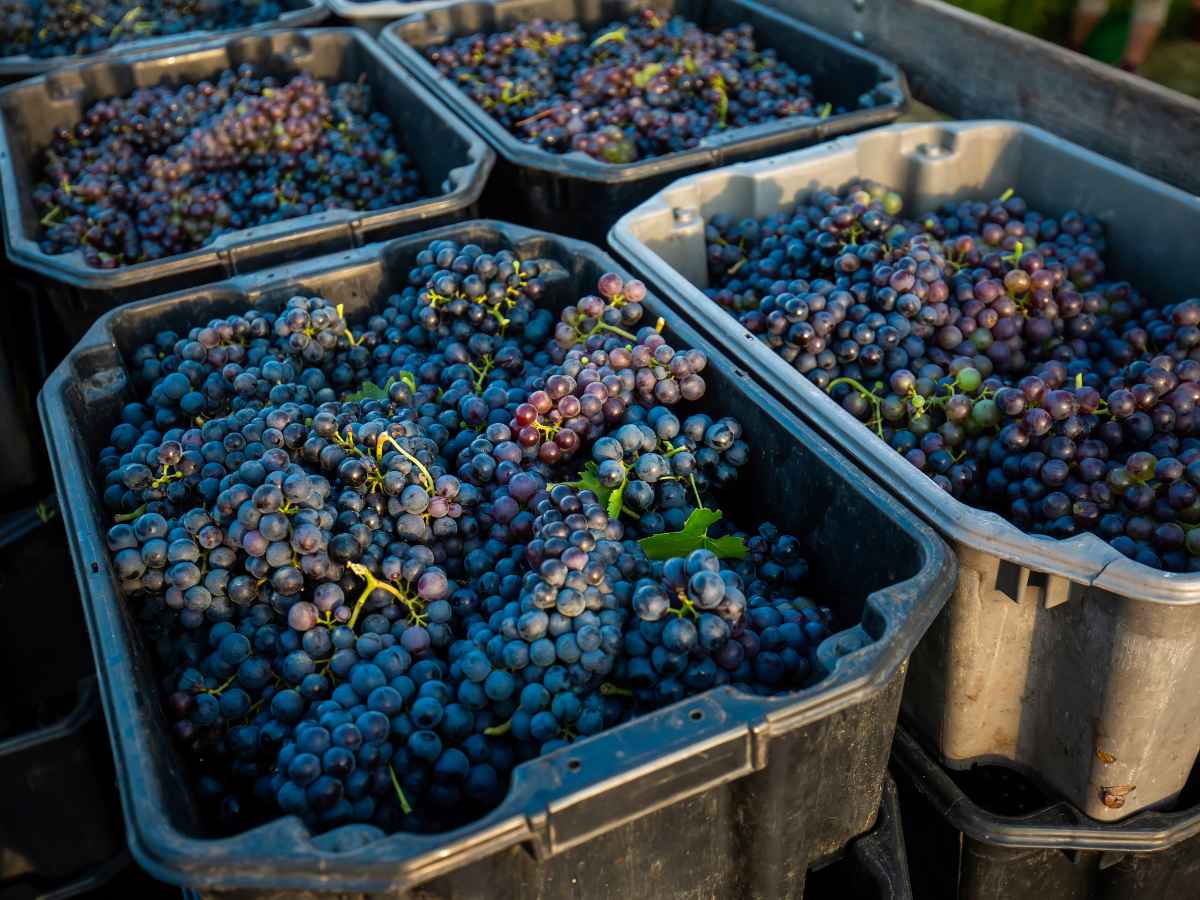
In my family, the grapes arrived every autumn in wooden crates — cases and cases of them, delivered to a man my grandfather knew. Nobody was ever quite sure where he got them; they simply appeared each year, the same reliable mixture of varieties, and my grandfather trusted them the way he trusted the seasons. From those crates came the wine that filled the demijohns in the cantina and sat on the table every single day until the next autumn came around.
If you’re planning your own batch — whether it’s your first time or you’re picking up a family tradition — the practical questions come first. How many pounds of grapes do you need? How many bottles will you get? How many demijohns should you have ready? This guide answers all of it, starting with a calculator that does the math instantly.
Italian Family Traditions
Wine Yield Calculator
How much wine will your grapes make? Enter how many grapes you have and see the bottles, demijohns, and litres you can expect.
A rough guide: about 1 litre of wine per 1.75 lb (0.8 kg) of grapes, the common rule for home red winemaking. Real yield varies with grape variety, ripeness, pressing, and losses in racking — treat this as an estimate, the way a nonno would: close enough to plan by.
How much wine do grapes make? The short answer
As a rule of thumb, it takes about 1.5 to 2 pounds of grapes to make one 750ml bottle of wine — so roughly 12 to 16 pounds of grapes per gallon, or a little under 2 pounds per litre. Put another way, a standard 36-pound crate of wine grapes yields somewhere around 18 to 24 bottles, depending on the grape and the pressing. The calculator above uses the common home-winemaking estimate of about 1 litre of wine per 1.75 pounds of grapes.
That is an estimate, not a guarantee — and any old Italian winemaker would tell you the same. The real yield depends on the grape variety, how ripe the fruit is, how hard you press, and how much you lose when you rack the wine off the sediment. But for planning how many crates to order and how many demijohns to have clean and ready, the rule holds up well. It is close enough to plan by, which is exactly how my grandfather worked: not with precision, but with the confidence of someone who had done it forty times.
How many grapes do you need?
Work backward from how much wine you want. A few common targets:
| Grapes | Approx. wine | Roughly equals |
|---|---|---|
| 36 lb (1 crate) | ~20 litres | ~27 bottles / ~4 demijohns |
| 100 lb | ~57 litres | ~76 bottles / ~10 demijohns |
| 200 lb (~6 crates) | ~114 litres | ~152 bottles / ~21 demijohns |
| 360 lb (10 crates) | ~205 litres | ~275 bottles / ~37 demijohns |
A family making enough wine to last the year — to drink daily and to give away — often worked with several hundred pounds. That is why the grapes came by the crate and the cantina had rows of demijohns (the large glass jugs, typically around 5 to 5.5 litres, that Italians used for bulk storage and secondary fermentation) waiting to be filled. Use the calculator above to work out your own number, then round up: it is far better to have a spare demijohn than to run short with wine still to store.
What grapes did Italian families use?
Here is the honest answer for most Italian-Canadian and Italian-American home winemakers: they did not grow their own grapes, and they were rarely picking from an Italian vineyard. They bought wine grapes shipped in by the crate, most often from California, sold through a trusted supplier every autumn. My grandfather’s grapes came from a man he knew, in the same dependable mixture year after year — a house blend he never varied because it worked.
The classic grapes in those shipments were the robust, deeply coloured varieties that travel well and make a big, everyday red: Zinfandel, Alicante Bouschet, Carignane, Muscat, Barbera, Grenache, and often Nero d’Avola or Montepulciano for families sourcing Italian varietals. Most home winemakers used a blend rather than a single grape — Alicante for colour, Zinfandel for body, a little Muscat for aroma — and once a family found a mix that made a wine they liked, they stuck with it. The consistency was the point. You were not chasing a vintage; you were making the same honest table wine your family drank every year.
The Grapes in the Blend
What Grapes Went Into the Wine
The varieties Italian families blended for a robust everyday red. Tap a card to flip it and see what each grape brought.
Most families never used just one grape — they blended, then kept the same mix year after year once they found one they liked. Alicante for colour, Zinfandel for body, a little Muscat for aroma: the house wine.
If you are buying grapes to make wine today, you can still find these varieties through winemaking suppliers each autumn. Ask for a blend suited to a dry red table wine, and if you have access to an Italian supplier who has been doing it for decades, trust their house mix — that accumulated knowledge is exactly what my grandfather was relying on.
The Wine No One Wrote Down
The supplier’s name, the grape mix, the ratios, the timing — a family’s winemaking lived in one person’s hands and was almost never written down. The Italian Family Heritage Kit gives you the prompts to record your family’s wine, recipes, and rituals before they’re lost.
Explore the Italian Family Heritage Kit →The basic process, start to finish
This is the practical outline of how the crates became wine. For the full story — the crush, the great barrel, the smell of the cantina in October — read how the wine was really made in the Italian cantina. Here is the sequence itself:
- Crush the grapes. Break the skins so the juice can run and fermentation can begin. Traditionally by a hand-cranked crusher; historically, by foot.
- Ferment on the skins (for red). The crushed grapes — the “must” — ferment for roughly one to two weeks, the skins giving colour and tannin. Wild yeast or an added wine yeast does the work.
- Press. Separate the new wine from the skins and seeds, pressing to extract the last of the liquid.
- Age in barrel or demijohn. Move the wine into barrels or demijohns for a secondary fermentation and a few months of settling, racking it off the sediment as it clears.
- Bottle. Once the wine is clear and stable, bottle it — and traditionally, taste the year’s first glass around the feast of San Martino on November 11, the old marker of when the new wine was ready.
The grapes arrived by the crate, the same mix every year, from a man my grandfather trusted. They became the wine in the demijohns, the wine on the table, the wine you never replaced with anything from a store. If you’re making your own, start with the math — how many grapes, how much wine, how many demijohns to ready — and then do the rest the way it was always done: by feel, with family, close enough to plan by. Use the calculator above to size your batch, and let the cantina fill.
Record the Family Wine
The grape mix, the supplier, the method — before they’re gone.
Who made the wine? Where did the grapes come from? What was the blend, the ratio, the timing? The Italian Family Heritage Kit includes 133 guided pages and more than 120 prompts to preserve your family’s recipes, rituals, names, sayings, photos, and stories.
Explore the Heritage Kit — $19.99Instant digital download. Print it and complete it with your family.
For the full story behind the numbers, read making wine in the Italian cantina and about the cantina itself, the cellar where it all lived. For the September tomato tradition that shared that cantina, read about passata day, and for the November feast when the new wine was first tasted, the feast of San Martino.
FAQ
How many grapes does it take to make one bottle of wine?
Roughly 1.5 to 2 pounds (0.7 to 0.9 kg) of grapes make one standard 750ml bottle of wine. So a 36-pound crate of wine grapes yields somewhere around 18 to 24 bottles. The exact number depends on the grape variety, ripeness, and how hard the grapes are pressed, but this range is a reliable planning estimate for home red winemaking.
How much wine does 100 pounds of grapes make?
About 57 litres, which is roughly 76 standard bottles, or around 10 demijohns of 5.5 litres each. This uses the common home-winemaking estimate of about 1 litre of wine per 1.75 pounds of grapes. Use the calculator above to estimate any quantity in pounds, kilograms, or crates.
How many bottles of wine does one crate of grapes make?
A standard 36-pound crate of wine grapes makes approximately 20 litres of wine — about 27 standard bottles, or roughly 4 demijohns. Families making a year’s supply typically bought many crates at once. Rounding up on demijohns and bottles is wise, since real yield varies with the grapes and the pressing.
What grapes are best for making homemade wine?
For a robust everyday red, the traditional home-winemaking grapes include Zinfandel, Alicante Bouschet, Carignane, Barbera, Grenache, and Muscat, along with Italian varietals like Nero d’Avola and Montepulciano. Most Italian families used a blend rather than a single variety — often bought shipped in by the crate from a trusted supplier — and kept the same mixture year after year once they found one they liked. Consistency, not novelty, was the goal.
What is a demijohn and how much does it hold?
A demijohn is a large glass jug, traditionally cased in a wicker or plastic basket, used by Italian families to store wine in bulk and for secondary fermentation. Common sizes hold around 5 to 5.5 litres, though larger ones exist. In the cantina, rows of filled demijohns were the visible measure of a good year — the family’s wine supply, waiting to be bottled or drawn from directly through the winter.
When do you make wine? When is the grape season?
Home winemaking follows the autumn grape harvest. In North America, wine grapes typically ship in from late September through October, which is when Italian families traditionally bought their crates and began the crush. The wine then ferments and ages through the autumn, and the year’s first glass was traditionally tasted around the feast of San Martino on November 11 — the old Italian marker for when the new wine was ready.

Marco Ricci is an Italian-Canadian writer and the grandson of Calabrian immigrants. He created Italian Family Traditions to document the customs, feast days, and family rituals Italian families carried from Italy to North America — and to understand what they actually meant. He is based in Montreal.