Italian Family Traditions
What Is a Bomboniera? The Italian Tradition of the Keepsake Favor
You knew them before you had a word for them. The little bundles of coloured almonds — purple, white, pink, blue — that sat around your grandparents’ house long after whatever wedding or baptism they came from. Always with some strange little ceramic thing attached. This is what they were, why they existed, and why giving them still means something.
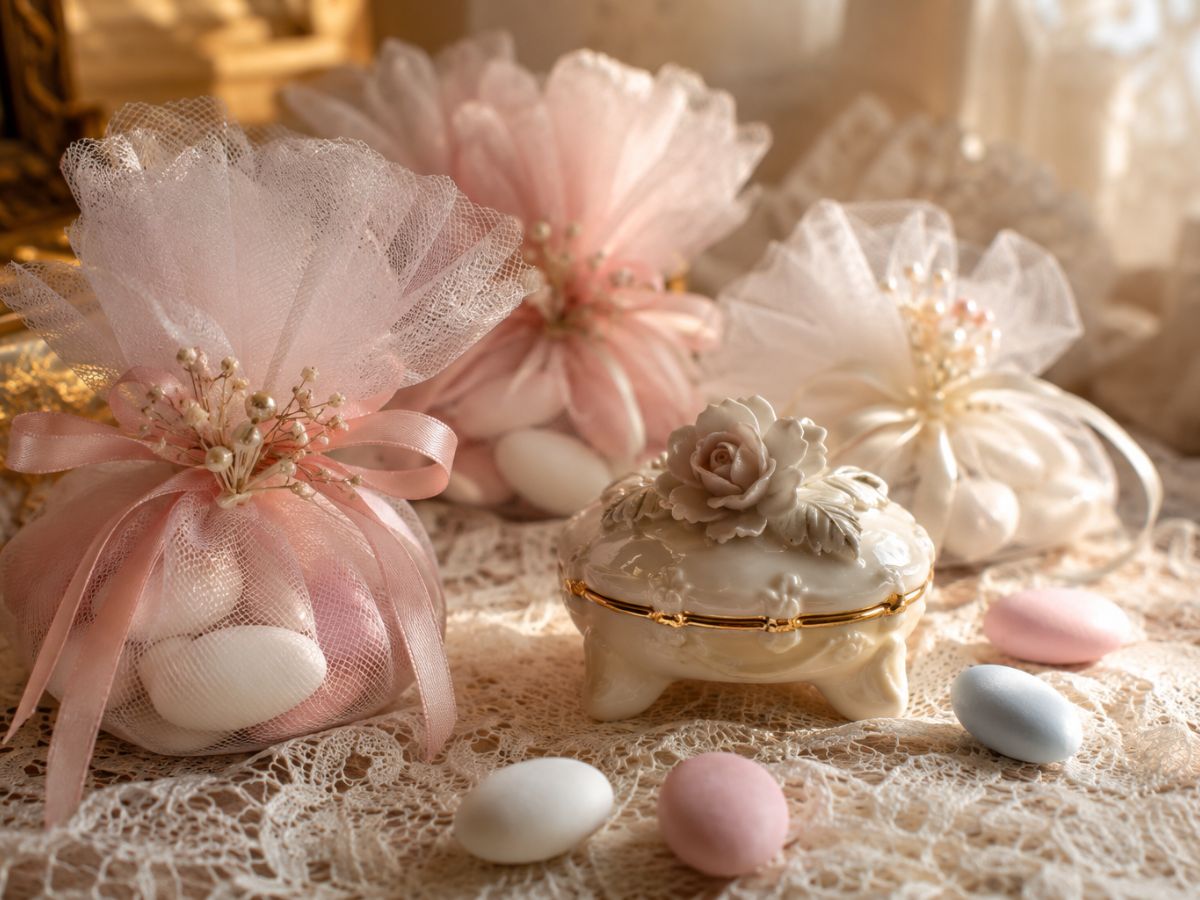
The bomboniera was one of those things that was built into us without anyone ever explaining it. I could not have told you, as a child, what the little bundles of almonds meant or why they existed. I only knew they were everywhere. They sat on shelves and in drawers and on top of dressers in my grandparents’ house, long after whatever occasion they had come from was over — small tulle pouches of sugared almonds in white, pink, blue, sometimes a deep purple, each one tied and finished and attached to some small ceramic object whose purpose I could never quite work out. A tiny figurine. A little dish. A bell. Something that looked, to a child, mostly weird, and that I now understand was the whole point.
And the almonds themselves — that specific hard-shelled sweetness, the sugar coating giving way to the almond underneath. You were not really supposed to eat them; they were decoration, a keepsake. But of course you ate them, because they were sitting right there and they were sweet, and eating the bomboniera almonds you found around the house is one of those small childhood transgressions that every Italian kid knows and no Italian grandmother ever truly minded.
A bomboniera was never really about the almonds, or the little ceramic thing, or even the occasion. It was a way of saying: you were here, this mattered, take a piece of it home. It was gratitude you could hold in your hand.
So what is a bomboniera, actually? Where did it come from? Why the almonds, why the odd number, why the ceramic? And what happened to it — because it has changed, and I have complicated feelings about the change. Here is the full story of one of the most quietly universal Italian family traditions there is.
Free Printable
The whole Italian year of traditions, on one printable calendar.
The feast days, the celebrations, the customs behind traditions like the bomboniera — in one free printable calendar. Join the list and we’ll send it to you.
What is a bomboniera?
A bomboniera is a small keepsake favour given by the host to guests at an Italian celebration — a wedding, baptism, First Communion, Confirmation, or anniversary — as a token of thanks for sharing the day. The word comes from the French bonbonnière, a small box for sweets, and traditionally the bomboniera pairs a small keepsake object with a bundle of sugared almonds called confetti. The plural is bomboniere.
Note the false friend, because it trips up every English speaker: Italian confetti does not mean the paper you throw at a parade. That is coriandoli in Italian. Confetti are the sugared almonds themselves — the hard, candy-shelled almonds at the heart of the bomboniera. It is one of those words that quietly reveals whether someone grew up with the tradition or is meeting it for the first time.
Every Italian family occasion produced them, and every Italian family home accumulated them. That is why they were always around — not displayed exactly, just present, a small sedimentary record of every wedding and baptism the family had been part of. A bomboniera from a cousin’s wedding. One from a nephew’s Communion. One from an anniversary a decade gone. They collected the way a family collects everything: quietly, without a system, and impossible to throw away because each one was tied to a specific day and a specific person.
The confetti: why sugared almonds, and why five
The almonds are the oldest and most meaningful part, and there is real symbolism underneath them that most of us absorbed without ever being told.
The almond itself is bittersweet — a bitter nut inside a sweet sugar shell — and that is exactly the point. It is a small edible metaphor for marriage and for life: the hope that the sweetness outweighs the bitterness, that the couple takes the bitter with the sweet, that life is both and you wish someone more of the sweet. Nothing about the confetti is accidental. The Italians who built this tradition chose a food that tasted like a blessing.
And there is the number. Traditionally a bomboniera contains five confetti — always an odd number, and specifically five — because they represent five wishes for the couple: health, wealth, happiness, fertility, and long life. Five, because odd numbers cannot be divided evenly, symbolising a union that cannot be divided. It is the kind of detail that sounds almost too neat until you remember that this is a culture that built meaning into the number of almonds in a party favour. Of course it was five. Of course they could not be divided.
Five sugared almonds, for health, wealth, happiness, fertility, and long life. An odd number, because a marriage should not divide evenly. A whole philosophy of a life together, folded into a bundle of candy you were not technically supposed to eat.
The colours carried meaning too, matched to the occasion: white for weddings and Communions, pink or blue for baptisms depending on the baby, silver for a twenty-fifth anniversary, gold for a fiftieth, sometimes deep reds and purples for other occasions. When I picture the almonds from my grandparents’ house — the whites, the pinks, the blues, that one particular purple — I am really picturing a record of which occasions the family had celebrated, colour-coded and scattered across the shelves.
A short history of the bomboniera
The tradition is older than most people assume, and it did not start as a folk custom — it started at the top.
Sugared almonds themselves are ancient; confetti-making has been documented in Italy for centuries, with the town of Sulmona in Abruzzo famous for producing them since at least the Renaissance. But the bomboniera as a keepsake favour is usually traced to the European aristocracy, where a bonbonnière was a small precious box — porcelain, silver, sometimes jewelled — that nobles used to hold sweets and gave as gifts to mark important occasions. To give sugar at all was once a display of wealth, because sugar was expensive; to give it in a fine little box was doubly so.
Over time, as sugar became affordable and the middle class grew, the custom democratised. What had been an aristocratic gesture became a tradition every family could keep. The precious box shrank into a modest keepsake — the little ceramic figurine, the small dish, the bell — and the sweets inside became the standardised five sugared almonds. By the time it reached ordinary Italian families, the bomboniera had become what I grew up with: not a display of wealth, but a near-obligatory act of gratitude and remembrance, given by everyone, at every occasion, to everyone who came.
And it crossed the ocean intact. Italian immigrants brought the bomboniera to Canada, the United States, Australia, Argentina — anywhere they went — because it was tied to exactly the occasions that mattered most to a family trying to hold itself together in a new country: the weddings, the baptisms, the Communions. It survived immigration for the same reason so many Italian-American and Italian-Canadian traditions survived: because it was attached to the sacraments and celebrations that families were never going to give up.
Which occasions call for a bomboniera
The bomboniera belongs to the milestones — and specifically to the sacraments and the great family occasions. Here is where it traditionally appears, and the colour of confetti that goes with each:
| Occasion | Traditional confetti colour | Note |
|---|---|---|
| Wedding (matrimonio) | White | The classic bomboniera occasion — the most elaborate keepsakes |
| Baptism (battesimo) | Pink or blue | Matched to the baby; often given by parents and godparents |
| First Communion (prima comunione) | White | A child’s first major sacrament — a keepsake of the day |
| Confirmation (cresima) | Red or white | Marks the sacrament and the sponsor’s role |
| 25th anniversary | Silver | Silver wedding — nozze d’argento |
| 50th anniversary | Gold | Golden wedding — nozze d’oro |
| Graduation (laurea) | Red | Red for the laurel — a newer but established use |
The through-line is that the bomboniera marks a threshold — a wedding, a first sacrament, a milestone anniversary. It is given at exactly the moments the family gathers to witness someone crossing from one stage of life to the next, which is why it pairs so naturally with the other traditions of those days: the baptism customs, the role of the compare and comare who stood as godparents, the wedding traditions the whole family kept.

The Original Religious Bomboniera
The santino — a keepsake as old as the tradition itself
Long before ceramic figurines, the holy card — the santino — was the keepsake handed out at baptisms and Communions. These printable Italian saint prayer cards carry that tradition forward: 11 beloved saints, each with a prayer in Italian and English, ready to give or to keep.
$9.49
Instant digital download
Get the Saint Prayer Cards →What changed — and what I think we lost
Here is where I have to be honest about my own mixed feelings, because the bomboniera has changed in my lifetime, and I am genuinely of two minds about it.
The old-school bomboniera — the almonds, the tulle, the small ceramic keepsake — has been giving way to something more practical and, frankly, more expensive. People give bottles of olive oil now. Jars of jam. Small bottles of syrup or honey or limoncello, beautifully labelled. Little potted plants. Useful things, nice things, things that get consumed or kept and do not end up as a strange ceramic object gathering dust on a shelf for thirty years. And I understand the logic completely. Who wants another little figurine? Give people something they will actually use.
And yet. I feel as though we are missing something we used to have. The old bomboniere were, admittedly, often useless as objects — but that uselessness was almost the point. A bottle of olive oil gets used up and thrown away. A strange little ceramic thing with five almonds attached sat around for decades precisely because it had no practical use — it existed only to be a marker of a day, a small monument to an occasion, and so it survived in a way a consumable never could. The very impracticality is what made it last. Those useless keepsakes are why I can still picture, exactly, the specific bomboniere that lived in my grandparents’ house. Nobody remembers a bottle of oil.
A bottle of olive oil gets used up and forgotten. A useless little ceramic thing with five almonds attached sat on a shelf for thirty years — and I remember every one of them. The impracticality was the whole point. It existed only to remember a day.
So I have made my peace with it this way: both the old school and the new school have their place. There is nothing wrong with a beautiful bottle of oil, and I still give bomboniere at our family’s occasions — always something nice, always chosen with care. But I try to keep the spirit of the old ones even when the object is new: the sense that this is not a party favour but a small act of gratitude and remembrance, something that says you were here and it mattered. Whether that is a ceramic bell or a bottle of oil matters less than whether it is given in that spirit.
Classic bomboniere — and where to find them
If you want to give the traditional version — the confetti, the tulle, the keepsake — the good news is that the classic supplies are still very much available. Here are the old-school essentials, and where to find them:
- Sulmona confetti (the real sugared almonds). The heart of it, and worth doing right. Sulmona confetti — the famous almonds from Abruzzo — have been the gold standard for centuries. Nothing else tastes quite the same, and using the real thing honours the tradition properly.
- Coloured Jordan almonds. The everyday classic, and easier to find in the exact colour for your occasion. Get white Jordan almonds for weddings and Communions, or pink or blue for a baptism.
- Tulle pouches and satin ribbon. The little bundle that holds the five almonds. Tulle favour bags in white or your occasion’s colour, tied with a thin satin ribbon, are the simplest and most traditional wrap.
- The ceramic keepsake. The small object — a figurine, a little dish, a bell, a tiny frame. Search Italian bomboniere favours for the traditional style, or choose something small and meaningful to the day.
- A little organza or favour box. If you prefer a small box to a tulle pouch, mini favour boxes in white or kraft give a slightly more finished look while keeping the confetti front and centre.
- A santino or a printed card. Traditionally a card with the names and the date — and for religious occasions, a santino, a saint’s holy card, which was itself the original keepsake. Our own printable saint prayer cards are made for exactly this.
Assemble them the way my grandmother did — five almonds each, counted out equally, tied by hand, one for every guest — and you have made something with far more meaning than anything bought pre-made.
Modern bomboniere — ideas that keep the spirit
If you would rather give the new-school version — something guests will use — here are the ideas that have become genuinely traditional in their own right, the ones I see (and give) most often:
- Small bottles of olive oil. The reigning modern favourite — beautifully labelled with the names and date, practical, elegant, and unmistakably Italian. Mini olive oil bottles made for favours make this easy to do at scale.
- Jars of jam, honey, or preserves. Especially meaningful if homemade — a direct nod to the old preserving traditions. Mini mason jars with a fabric top and a hand-written label look wonderful and cost very little.
- Small bottles of limoncello or syrup. A little digestivo to take home — a taste of the celebration. Small swing-top bottles filled and labelled at home are a warm, personal touch.
- A potted succulent, plant, or seed packet. Something living that grows — a lovely metaphor for a marriage or a new baby. Mini succulents or personalised seed packets have become genuinely popular and keep on giving.
- A small candle or scented keepsake. A modern take on the lasting object — something used slowly and remembered. Mini candle favours in a simple glass bridge the gap between the useful and the keepsake.
- A charitable donation in the guests’ honour. Increasingly common and quietly moving — a small card at each place explaining that a donation has been made in everyone’s name. It keeps the gesture of the bomboniera while letting go of the object entirely.
Whatever you choose, the almonds still belong. Even the most modern bomboniera can — and in my opinion should — still include the five confetti somewhere, because they carry the meaning the object alone cannot. A bottle of oil is a nice gift. A bottle of oil with five sugared almonds and a little card is a bomboniera.
The most meaningful gift for the family being celebrated
There is one more version worth mentioning — not the favour you hand to fifty guests, but the meaningful gift you give to the family at the centre of the occasion. For a baptism, a wedding, a milestone anniversary, the deepest gift is often not another object but a way to hold onto the family’s story itself.
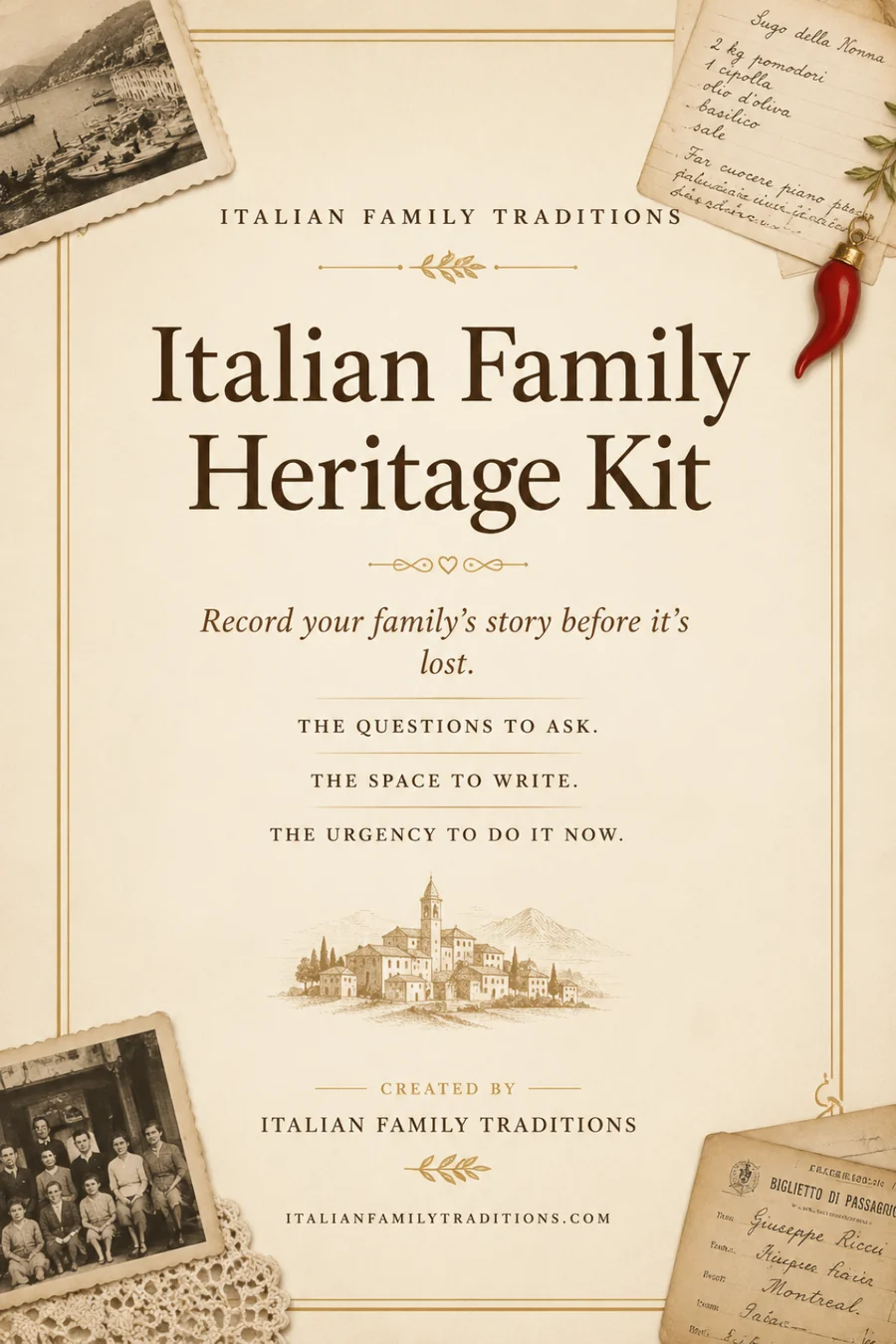
A Gift That Lasts Longer Than Almonds
The meaningful gift for a wedding, baptism, or anniversary.
For the couple, the new parents, the family at the heart of the day — the Italian Family Heritage Kit is a keepsake they’ll actually use: 133 guided pages and more than 120 prompts to record their family’s names, town, recipes, saints, and stories for the generations to come.
Explore the Heritage Kit — $19.99Instant digital download — a lasting gift for the family being celebrated.
The person who counted them out
When I picture the bomboniere of my childhood, I am really picturing my grandmother.
Because before they were scattered around the house, before they were handed out at the door, they were assembled by her — by hand, personally, one at a time. She counted the almonds out equally, five to a bundle, every bundle the same, because it would have been unthinkable to her that one guest might get four and another six. The equality was a form of respect. Everyone who came got exactly the same, prepared with exactly the same care, because everyone who came mattered exactly the same. She sat and tied them and counted them and made them right, and only then did they go out into the world to eventually come back and live on shelves for thirty years.
That, more than the almonds or the ceramic or the history, is what the bomboniera really was. It was someone in the family — usually a grandmother, usually with more patience than anyone gave her credit for — sitting down and preparing, by hand and with care, a small equal token of gratitude for every single person who would share the day. The tradition was never really in the object. It was in the counting.
You knew them before you had a word for them — the coloured almonds, the tulle, the strange little ceramic thing that sat around the house for years. A bomboniera was gratitude you could hold: five almonds for health, wealth, happiness, fertility, and long life, counted out equally by a grandmother who understood that everyone who came mattered the same. The objects change. Olive oil replaces the ceramic bell. But if you give it in the old spirit — you were here, this mattered, take a piece of it home — it is still a bomboniera. Keep the almonds. Keep the spirit. Count them out equally.
The bomboniera belongs to the great family occasions — read about the Italian baptism traditions and the wedding customs families still keep that it marks. For the godparents who so often gave them, read about the compare and comare bond. For the sweets tradition it belongs to, read about the feast-day sweets of San Giuseppe. And to record the family occasions these keepsakes marked before the details fade, read how to record your family’s stories.
FAQ
What is a bomboniera?
A bomboniera is a small keepsake favour given by the host to guests at an Italian celebration — a wedding, baptism, First Communion, Confirmation, or milestone anniversary — as a token of thanks. It traditionally pairs a small keepsake object (a ceramic figurine, dish, or bell) with a bundle of sugared almonds called confetti, usually five, wrapped in tulle. The word comes from the French bonbonnière, a small box for sweets. The plural is bomboniere.
Why are there five almonds in a bomboniera?
The five sugared almonds (confetti) represent five wishes for the couple or the honoured person: health, wealth, happiness, fertility, and long life. The number is always odd — and specifically five — because an odd number cannot be divided evenly, symbolising a union that cannot be divided. The almond itself, bitter inside a sweet sugar shell, symbolises the bittersweet nature of marriage and life, with the wish that the sweetness prevails.
What is the difference between confetti and coriandoli?
In Italian, confetti are sugared almonds — the candy-coated almonds at the heart of a bomboniera. The little paper pieces thrown at parties and parades, which English speakers call “confetti,” are called coriandoli in Italian. It is a common false friend: if an Italian offers you confetti, they mean sugared almonds, not paper.
What colour confetti for which occasion?
Traditionally: white for weddings and First Communions; pink or blue for baptisms depending on the baby; red for Confirmation and graduation; silver for a 25th (silver) anniversary; and gold for a 50th (golden) anniversary. The colour signals the occasion at a glance, which is part of why a household’s accumulated bomboniere read like a colour-coded record of the family’s celebrations.
Do you still give bomboniere today?
Yes — the tradition is very much alive, though the keepsake has evolved. Many families still give the classic confetti-and-ceramic bomboniera, while others give more practical modern favours like small bottles of olive oil, jars of jam or honey, limoncello, or a charitable donation in guests’ honour. Many keep the sugared almonds even with a modern gift, since the five confetti carry the traditional meaning that the object alone does not. Whatever the form, the bomboniera remains a gesture of gratitude and remembrance.
What is a good modern bomboniera idea?
Popular modern bomboniere include small labelled bottles of olive oil, jars of homemade jam or honey, mini bottles of limoncello, small potted plants or seeds, and charitable donations made in the guests’ honour. For the family at the centre of the occasion, a meaningful keepsake gift such as a family-history or heritage keepsake is increasingly given as a lasting alternative to a consumable favour. A nice touch is to include five sugared almonds and a small card with any modern gift, preserving the traditional meaning alongside the contemporary form.
Where does the bomboniera tradition come from?
The bomboniera traces back to the European aristocracy, where a bonbonnière was a small precious box — porcelain, silver, sometimes jewelled — used to hold sweets and given to mark important occasions, when sugar itself was a luxury. As sugar became affordable, the custom spread to ordinary families, the precious box became a modest keepsake, and the sweets became the standardised sugared almonds. Sugared-almond making in Italy is centuries old, with the town of Sulmona in Abruzzo famous for confetti since the Renaissance. Italian immigrants carried the tradition worldwide, attached to the weddings, baptisms, and Communions they were never going to give up.

Marco Ricci is an Italian-Canadian writer and the grandson of Calabrian immigrants. He created Italian Family Traditions to document the customs, feast days, and family rituals Italian families carried from Italy to North America — and to understand what they actually meant. He is based in Montreal.