Italian Family Traditions
Why Does Mary Have So Many Names? The Madonnas Explained
Our Lady of Sorrows, of the Rosary, of Mount Carmel, the Immaculate… if you have ever wondered whether these are different women, the answer is no. Here is every name of the Madonna, explained.
If you grew up in an Italian family, you heard her called a dozen different things. The Madonna del Carmine whose feast the town celebrated. The Addolorata carried through the streets on Good Friday. The Immacolata whose statue stood in the church. Our Lady of the Rosary, Our Lady of Grace, Our Lady of Mount Carmel, Maria Ausiliatrice. And somewhere along the way, a reasonable question forms: are these all different women?
No. They are all the same person — Mary, the mother of Jesus. Every one of these names is a different title for the one Madonna, each emphasizing a particular moment of her life, a place, a miracle, or something she is invoked for. It is a little like the way one woman can be Mamma, Nonna, and Signora Rossi all at once — same person, different names for different roles. Below, you can explore each name of the Madonna — her feast, what she is invoked for, and the colours and symbols that tell her apart in the images you have seen your whole life.
One Mary, Many Names
The Many Names of the Madonna
Our Lady of Sorrows, of the Rosary, of Mount Carmel, the Immaculate… these are not different women.
They are all the same person — Mary, the mother of Jesus — honored under many titles, each with its own image, colour, feast, and meaning.
Titles, feasts, and imagery follow long Catholic tradition. Countless towns across Italy also honour their own local Madonna — the same Mary, under the name and image dearest to that community.
Why Mary has so many names
The many names of the Madonna come from three main sources. First, moments in her life: the Annunciation (when she said yes to God), her Sorrows (her grief at the Cross), her Assumption (her being taken into heaven). Second, places and apparitions: Our Lady of Lourdes, of Fatima, of Loreto, of Pompeii — named for where she appeared or where a great shrine arose. Third, what she does for the faithful: Our Lady of Grace, of Good Counsel, of Health, Help of Christians — titles that describe the help people sought from her.
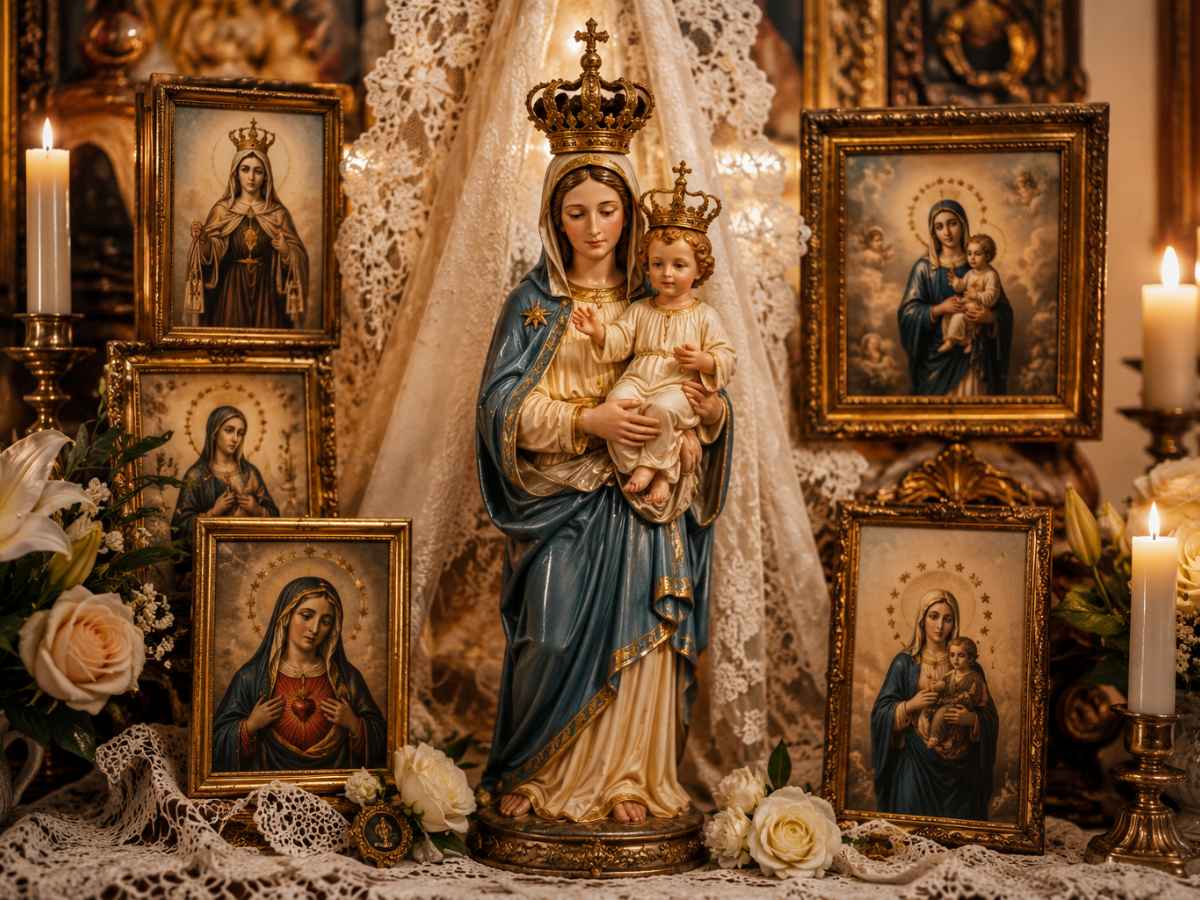
Each title came with its own iconography — the colours and symbols artists used so you could recognize her at a glance. The seven swords of the Addolorata. The brown scapular of the Carmine. The crescent moon and twelve stars of the Immacolata. Once you know the symbols, you can walk into any Italian church and read the images like a language.
They are all the same person — Mary — honored under many names, each with its own image, colour, feast, and meaning.
The Madonna at the heart of Italian life
No devotion was more central to Italian family life than devotion to the Madonna. Above every saint, it was to Mary that Italian families turned — in the rosary prayed each evening, in the statue carried on the shoulders of the town through the streets at the festa, in the home shrine with its small flame. Two months of the year were given to her especially: May, the month of Mary, and October, the month of the Rosary. And her greatest feast, the Assumption on August 15, is so important in Italy that the whole country stops for it — the holiday of Ferragosto.
The local Madonna: every town its own
Here is where it becomes truly Italian: nearly every town had — and still has — its own Madonna. Not a different Mary, but the title and image that particular community holds dearest, often tied to a local miracle or an ancient statue. She is the town’s protectress, and her feast is the biggest day of the year, when her image is crowned with flowers and carried in procession while the whole town follows. One such is Maria Ausiliatrice, celebrated in Rivière-des-Prairies — the old-country devotion, carried across the ocean and kept alive in a new home. To see where all these feasts fall across the year, explore the Italian feast day calendar.
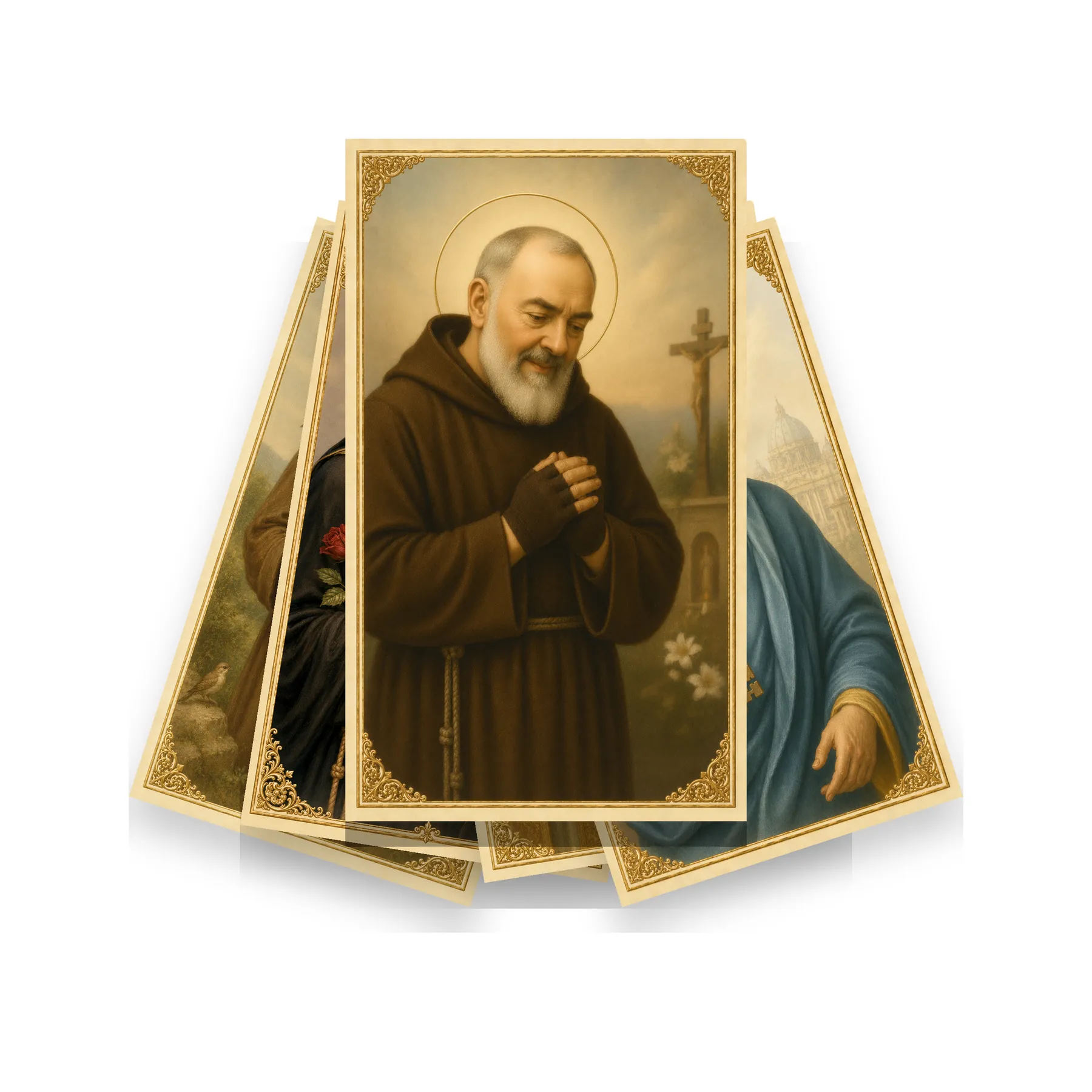
Keep Her Close
Italian Saint Prayer Cards
A printable set of the best-loved Italian devotions — the Madonna, St. Anthony, St. Joseph and more, with their prayers. Beautifully designed to keep, pray with, or give as a gift.
Get the Prayer Cards — $9.49 →Instant digital download — print at home.
Free Printable
Every Marian feast, across the whole year.
Join the list for a free printable Italian family calendar — the Madonna’s feasts, the saints, and every important day, mapped across the year.
One Mary, many names — each a different window onto the same mother the whole Italian world turned to. Learn to read her colours and her symbols, know the feast your family kept, and you will never look at those images the same way again. She was always one person, loved under a hundred names.
More on the faith and devotions of Italian families: the patron saint finder, the Italian saints every family prayed to, Italian prayers for the dead, and the Italian feast day calendar.
FAQ
Are Our Lady of Sorrows, Our Lady of the Rosary, and the other Madonnas different people?
No — they are all the same person, Mary, the mother of Jesus. Each name is a different title for the one Madonna, emphasizing a moment in her life, a place she appeared, or something she is invoked for. There is only one Mary, honored under many names.
Why does Mary have so many names?
Her many titles come from three sources: moments in her life (the Annunciation, her Sorrows, the Assumption), places and apparitions (Lourdes, Fatima, Loreto, Pompeii), and what she does for the faithful (Our Lady of Grace, of Good Counsel, Help of Christians). Each title also has its own traditional image and colours.
What is the difference between the Madonna and Mary?
There is no difference. “Madonna” is simply the Italian term for Mary, the mother of Jesus — from ma donna, “my lady.” When Italians say “the Madonna,” they mean the Blessed Virgin Mary.
How can I tell the different Madonnas apart in images?
By their colours and symbols. Our Lady of Sorrows has seven swords piercing her heart; the Immaculate Conception stands on a crescent moon crowned with stars; Our Lady of Mount Carmel holds the brown scapular; Our Lady of the Rosary holds rosary beads. The gallery above shows each one’s symbol and meaning.
What is a local or town Madonna?
Nearly every Italian town honors its own Madonna — the title and image that community holds dearest, often tied to a local miracle or ancient statue. She is the town’s protectress, celebrated with the year’s biggest feast and a procession. It is still the same Mary, under the name and image special to that town.
Marco Ricci is an Italian-Canadian writer and the grandson of Calabrian immigrants. He created Italian Family Traditions to document the customs, feast days, and family rituals Italian families carried from Italy to North America — and to understand what they actually meant. He is based in Montreal.