Italian Family Traditions
Italian Prayers for the Dead (English, Italian, Latin)
There was always a prayer. Not a speech, not an explanation — a prayer, often the same few lines, said quietly at the grave, at the wake, at the Mass a year later. These are the words Italian families used to accompany their dead, in English, Italian, and the Latin many of our grandparents actually prayed in.
Italian prayers for the dead center on one short line — L’eterno riposo dona loro, o Signore, “Eternal rest grant unto them, O Lord” — surrounded by the psalms, the Ave Maria, and the Salve Regina that carried a family through the wake, the funeral Mass, the anniversary, and the yearly visit to the cemetery. Below you will find each of them in English, Italian, and Latin, along with when they were said and what they meant.
In an Italian home, when someone died, the words came before the arrangements. Before the funeral director was called, before the food began to arrive, before anyone thought about what to wear or who to phone, there was usually an older woman in the room who had already begun to pray. She did not need a book. She had said these words a hundred times over a lifetime — for her own parents, for a husband, for neighbours, for people from the village whose names the younger ones no longer recognised — and she said them now almost without thinking, in a low voice, the way you might hum something you have known since childhood.
That is where Italian prayers for the dead lived: not on a page, but in the memory of the people who kept them. They were passed down the way recipes were passed down, by repetition and presence rather than instruction. A child heard L’eterno riposo murmured at a graveside long before anyone explained what it meant, and so learned it the way children learn everything that matters — by absorbing it whole, in the setting where it belonged, attached to a feeling rather than a definition.
Many of those same grandparents prayed in Latin. Not because they were scholars — most were not — but because the Latin Mass and the Latin prayers were simply what they had been given, the sound the sacred made in their generation. When they switched to Italian, or later to English, the prayers changed language but not weight. The words were doing the same work they had always done: accompanying a soul, and comforting the people left behind.
A prayer for the dead was never only about the dead. It was the one thing you could still do for someone after there was nothing left to do — and the one thing that told the living they were not expected to carry the loss in silence.
These prayers sat at the centre of the wider world of Italian funeral traditions and the state of mourning known as lutto — the wake, the Mass, the food, the tended grave. What follows is the prayers themselves: the words, what they meant, and when a family reached for each one.
Free Printable
Keep the prayers your family said.
The prayers, the feast days, the All Souls’ visits — the customs our grandparents kept, gathered into one free printable calendar of the Italian year, with new stories sent as we write them. Join the list and we’ll send it to you.
Before the Prayers Are Forgotten
Which prayers did your grandmother say at the grave? Which ones did the family reach for at the anniversary Mass? The Italian Family Heritage Kit gives you the questions and the space to record the prayers, names, and customs your family carried — before the person who still remembers them is gone.
Explore the Italian Family Heritage Kit →What Italians prayed when someone died
The prayers Italian families said for the dead were not a private invention. They were the prayers of the Catholic Church, said in Italian homes with a particular intensity and consistency. The United States Conference of Catholic Bishops lists the short prayer known as Eternal Rest among the traditional prayers for the faithful departed, and it is this prayer — L’eterno riposo — that sat at the very centre of the Italian tradition.
It was said at the moment of death, at the wake, at the graveside, and every year afterward on the anniversary. It was said quietly by a widow at the cemetery and aloud by a whole church at a funeral Mass. Around it gathered the psalms of mourning — above all Psalm 130, the De Profundis, “out of the depths” — and the great Marian prayers, the Ave Maria and the Salve Regina, through which a grieving family turned to the Madonna to carry their prayer to God. The Vatican preserves these as living texts of the Church, but in Italian family life they were something more intimate: the words a family owned by heart.
Below you can read each of them yourself — in the English most of us think in, the Italian our families spoke, and the Latin many of our grandparents actually prayed.
The prayers, in English, Italian, and Latin
Choose a prayer below, then switch between the three languages. These are the words an Italian family reached for across the whole arc of mourning — from the first night to the anniversary a year on.
Italian Prayers for the Dead
The words, in three languages
Choose a prayer, then switch between English, Italian, and Latin.
Traditional Catholic prayers for the faithful departed. Wording varies slightly between missals and regions — check against your family’s prayer book or parish before printing.
L’Eterno Riposo — the prayer said most
If there is a single Italian prayer for the dead, it is this one. L’eterno riposo dona loro, o Signore, e splenda ad essi la luce perpetua — “Eternal rest grant unto them, O Lord, and let perpetual light shine upon them.” It is short enough to say in a single breath and old enough to have been said over more Italian graves than anyone could count.
Its brevity was its strength. You could say it at the exact moment of death, when no longer speech was possible. You could say it standing at a graveside in the cold with your hands full of flowers. You could say it under your breath while driving past a cemetery, which many older Italians did automatically, the way you might cross yourself. And a whole church could say it together at a funeral Mass, the sound of a hundred voices asking the same short thing for one person.
Eternal rest, and perpetual light. Two images, asking for the two things a grieving family most wanted to believe: that the person was at peace, and that they were not in the dark.
The line requiescant in pace — “may they rest in peace” — is where the familiar English abbreviation R.I.P. comes from, though few people saying “rest in peace” today realise they are quoting the closing words of a Latin prayer their great-grandparents said aloud. That is often how these things survive: the words outlast the memory of where they came from, carried forward by people who no longer know they are praying.
The De Profundis and the psalms of mourning
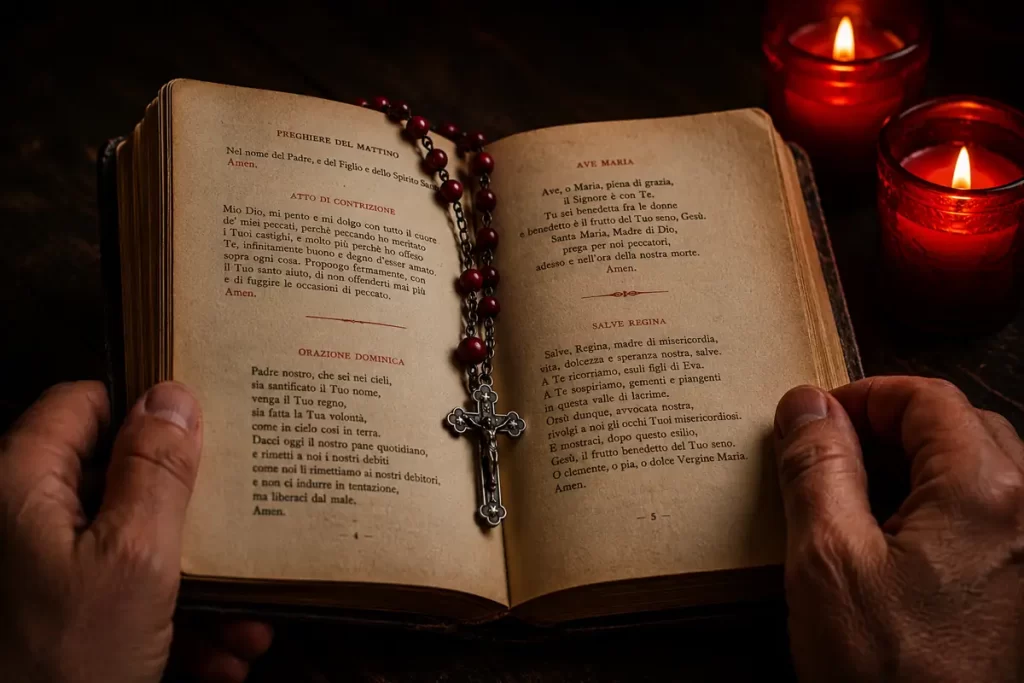
Beyond the short prayer of rest, Italian mourning reached for the psalms — and above all for Psalm 130, known by its Latin opening as the De Profundis: “Out of the depths I cry to you, O Lord.” It is the prayer of someone at the very bottom of grief, and it does not pretend otherwise. It begins in the depths. It does not begin with comfort. It begins with a cry.
That honesty is exactly why it belonged to Italian mourning, which — as anyone who has read about the customs of lutto knows — never rushed past grief toward reassurance. The De Profundis sits in the sorrow before it turns, slowly, toward hope. It was prayed for the release of a soul, and its words gave a family permission to feel the full weight of the loss rather than hurry to be consoled.
A note on the numbering. This psalm is numbered 130 in most modern Bibles but appears as Psalm 129 in the older Latin Vulgate that Italian grandparents prayed from. It is the same psalm — only the counting differs between the two traditions.
Alongside it came Psalm 23, “The Lord is my shepherd,” the most gentle of the funeral psalms and the one most often read aloud at the Mass itself. Where the De Profundis cries out from the depths, Psalm 23 walks calmly through them — “even though I walk through the valley of the shadow of death, I fear no evil, for you are with me.” Together the two psalms held both halves of grief: the cry and the calm, the fear and the trust.
The Salve Regina, the Ave Maria, and turning to the Madonna
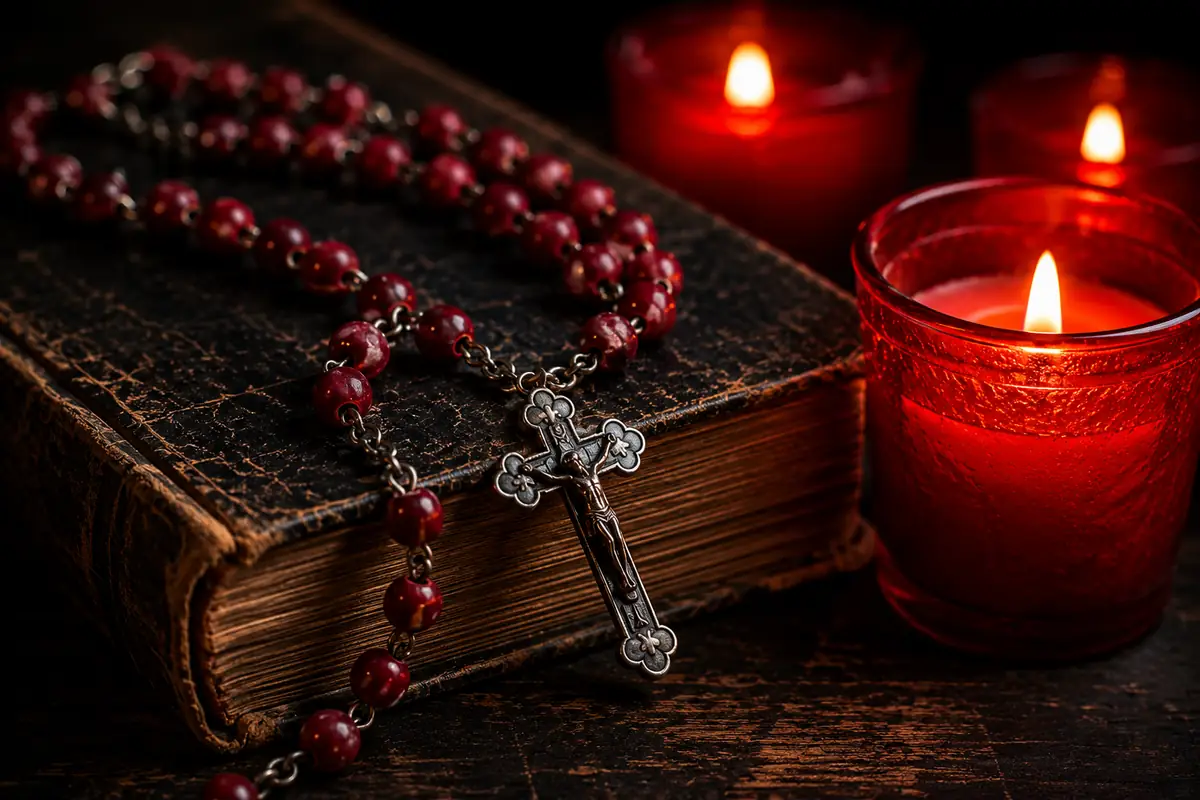
Italian devotion to the Madonna ran through everything, and death was no exception. When an Italian family prayed for its dead, it very often prayed through Mary — asking her, as mother, to carry the prayer the rest of the way. This is why the rosary, said on the beads and offered for a particular soul, became one of the most common acts of mourning: an Ave Maria repeated again and again, each one a small request placed in the hands of the Mother of God.
The Ave Maria carries its own quiet fitness for the dead in its final line — prega per noi peccatori, adesso e nell’ora della nostra morte, “pray for us sinners, now and at the hour of our death.” Italians had been asking Mary to be present at the hour of death their entire lives, in every rosary they had ever said. When that hour finally came for someone they loved, the prayer was already worn smooth in their mouths.
The Salve Regina calls this life a “valley of tears” and asks Mary to show us, after our exile, the blessed fruit of her womb. It is a prayer that admits the world is hard — and then insists, in the same breath, that the hardship is not the end of the story.
The Salve Regina — “Hail, holy Queen” — was the prayer for the very end. Traditionally sung at the close of the rosary and at the deathbed itself, it is a farewell and a plea at once, entrusting the departing soul to Mary’s mercy. Its Latin was so beloved that many Italians who spoke no other Latin could sing the Salve Regina from memory, the melody and the words fused together by a lifetime of hearing it.
Keep the Prayers Close
The saints an Italian family turned to in grief — and the prayers they said — printed on cards to keep, to carry, or to give. The Italian Saint Prayer Cards gather the devotions our grandparents kept by heart.
See the Italian Saint Prayer Cards →When these prayers were said
These prayers were not reserved for the funeral alone. They were spread across the whole long arc of Italian mourning, which — as the tradition of accompaniment makes clear — did not end when the burial was over. Prayer was the thread that ran from the first night through the years that followed.
They were said at the deathbed, in the first moments after a death, when the Salve Regina and L’eterno riposo were often the first words spoken. They were said at the wake, where a rosary might be led aloud for the whole room. They were said at the funeral Mass, where the psalms were read and the church prayed Eternal Rest together. And then they continued — at the anniversary Mass a year later, and every year after that, and on Ognissanti and the Commemoration of All Souls, when families across Italy went to the cemetery to pray over the graves they tended. In Sicily, that same November visit sat beside the tender custom of Festa dei Morti, when the dead were said to return with gifts for the children.
| The prayer | When it was said | What it asked for |
|---|---|---|
| L’Eterno Riposo | At death, at the grave, at every anniversary | Rest and light for the soul |
| De Profundis (Psalm 130) | For the release of a soul; in the depths of grief | Mercy and forgiveness |
| Psalm 23 | Read aloud at the funeral Mass and graveside | Comfort and trust through the valley |
| Salve Regina | At the deathbed and the close of the rosary | Mary’s protection for the departing soul |
| Ave Maria (rosary) | At the wake and offered for the soul afterward | Mary’s prayers at the hour of death |
How to pray them today
You do not need to recreate a Latin funeral to keep these prayers. You need only to say them — and to know which one fits the moment you are in.
At a graveside, L’eterno riposo is enough on its own; it is the prayer for exactly that place. On an anniversary, or on All Souls’ Day, a decade of the rosary — ten Ave Marias offered for the person you have lost — is the traditional gesture, and one that a family can do together at a kitchen table as easily as in a church. When the grief is heavy and words are hard to find, the De Profundis gives you permission to begin in the depths rather than pretend you are somewhere else.
And if the Latin matters to you — if it is the language your grandparents prayed in, the sound the sacred made in your family — then say it in Latin, even if you do not read Latin easily. The prayers above are set out so you can hold all three languages side by side: the English you think in, the Italian your family spoke, the Latin they knew by heart. Saying the words your grandmother said, in the language she said them, is itself a way of praying for her. To hold on to more of what she carried, learn how to record family stories before they are lost, and what to ask your grandparents while you still can.
There was always a prayer. Not a speech, not an explanation — a prayer, said quietly by someone who knew it by heart, asking for rest and for light, offered again at the grave and the anniversary and every All Souls’ Day after. It was the one thing a family could still do. And in doing it, generation after generation, they kept both the dead and the words alive.
Say the prayer. Say the names. That is the whole tradition.
The rosary was central to praying for the dead — learn how to pray the rosary, the prayers every family knew, and how to offer a novena for a departed loved one.
The Prayers Your Family Said
Write them down while someone still remembers them.
Which prayer did your grandmother say at the grave? Who led the rosary at the wake? What was said, and in which language? The Italian Family Heritage Kit includes 133 guided pages and more than 120 prompts to preserve your family’s people, names, prayers, traditions, recipes, and memories.
Explore the Heritage Kit — $19.99Instant digital download. Print it and complete it with your family.
These prayers belong to the same Italian relationship with death and remembrance as the funeral traditions and the customs of lutto, Ognissanti and the feast of all souls, and the Sicilian Festa dei Morti. They sit beside the folk beliefs that surrounded death, from the malocchio and how families protected their own to la smorfia and the dead who speak in dreams, and within the wider world of the Italian saints every family prayed to and the nonna who held it all together. For the year that carried them, see the complete Italian feast day calendar, and for how these customs crossed the ocean, read Italian-American traditions: what changed and what stayed.
FAQ
What is the traditional Italian prayer for the dead?
The central Italian prayer for the dead is L’Eterno Riposo — Eternal Rest — which begins L’eterno riposo dona loro, o Signore, e splenda ad essi la luce perpetua: “Eternal rest grant unto them, O Lord, and let perpetual light shine upon them. May they rest in peace. Amen.” It is said at the moment of death, at the graveside, at the funeral Mass, and on every anniversary. Around it, families prayed the psalms of mourning — especially the De Profundis (Psalm 130) and Psalm 23 — and the Marian prayers, the Ave Maria and the Salve Regina.
What does “L’eterno riposo” mean in English?
L’eterno riposo means “eternal rest.” It is the Italian form of the Latin prayer Requiem aeternam: “Eternal rest grant unto them, O Lord, and let perpetual light shine upon them. May they rest in peace. Amen.” The prayer asks for two things — rest for the soul, and perpetual light — and its closing Latin words, requiescant in pace, are the origin of the familiar English abbreviation R.I.P.
What is the De Profundis?
The De Profundis is Psalm 130, named for its Latin opening — “Out of the depths I cry to you, O Lord.” It is the traditional psalm prayed for the dead and for the release of a soul, and it is unusual in beginning not with comfort but with a cry from the depths of grief before turning toward hope and forgiveness. In the older Latin Vulgate it is numbered Psalm 129, though it is the same psalm; only the counting between the two traditions differs.
Why did Italians pray in Latin for the dead?
For most of the twentieth century, the Catholic Mass and many traditional prayers were in Latin, so Latin was simply the language in which older Italian generations learned to pray. Prayers like Requiem aeternam and the Salve Regina were known by heart in Latin even by people who did not otherwise speak it. When Italian and later English became more common in prayer, the words changed language but kept their meaning and their role. Many families still value praying at least L’Eterno Riposo or the Salve Regina in Latin as a way of praying in the same words their grandparents used.
What prayer is said at an Italian graveside?
At the graveside, the most common prayer is L’Eterno Riposo — Eternal Rest — often said on its own, as it is short and fits the moment precisely. Families also frequently pray a decade of the rosary (ten Ave Marias) offered for the person, and on anniversaries and All Souls’ Day the visit to the cemetery is itself an occasion for prayer. The gesture is simple and repeatable: say the prayer, say the person’s name, tend the grave.
What is the difference between a prayer for the dead and a Mass card?
A prayer for the dead is something you say yourself — at the grave, at the wake, in the rosary. A Mass card indicates that a Mass has been offered for the soul of the person who died, usually arranged through a parish with a donation. The two work together in Italian tradition: the family and community pray their own prayers directly, and the Mass card adds the particular spiritual weight, in Catholic belief, of the Mass itself being offered for that soul. You can read more about Mass cards in the guide to Italian funeral traditions.
Can I say these prayers if I am not very religious?
Many people do. For a great number of Italian families, these prayers are as much an act of remembrance and continuity as of formal faith — a way of doing what your grandparents did, in the words they used, at the grave of someone you loved. Saying L’Eterno Riposo at a graveside, or a decade of the rosary on an anniversary, is a way of staying connected to both the person who died and the generations who prayed before you, whatever your own relationship with belief.

Marco Ricci is an Italian-Canadian writer and the grandson of Calabrian immigrants. He created Italian Family Traditions to document the customs, feast days, and family rituals Italian families carried from Italy to North America — and to understand what they actually meant. He is based in Montreal.