Italian Family Traditions
What Is the Feast of Sant’Antonio? The June Saint Italian Families Never Forgot
June 13 arrived every year with a specific smell, a specific sound, and a specific quality of crowd on Saint-Laurent Boulevard that you knew from half a block away. The statue was coming out. Sant’Antonio was on the move. And somewhere nearby, a sausage sandwich was already cooking.
Every year on June 13, without fail, my grandfather knew the date before anyone reminded him. Not because he checked a calendar. Because he felt it coming. There was a quality to the second week of June — the particular warmth, the lengthening evenings, the garden already full — that he associated with Sant’Antonio the way other people associate a smell with a memory. He would mention it the day before. He would mention it the morning of. And when the procession moved through the neighbourhood, he stood and watched it with the specific stillness of a man who had watched the same procession every June of his life, in Calabria and then in Canada, and who understood that watching it here on Saint-Laurent was not less serious than watching it there. It was the same saint. The same June. The same faith carried across an ocean and placed on a new street.
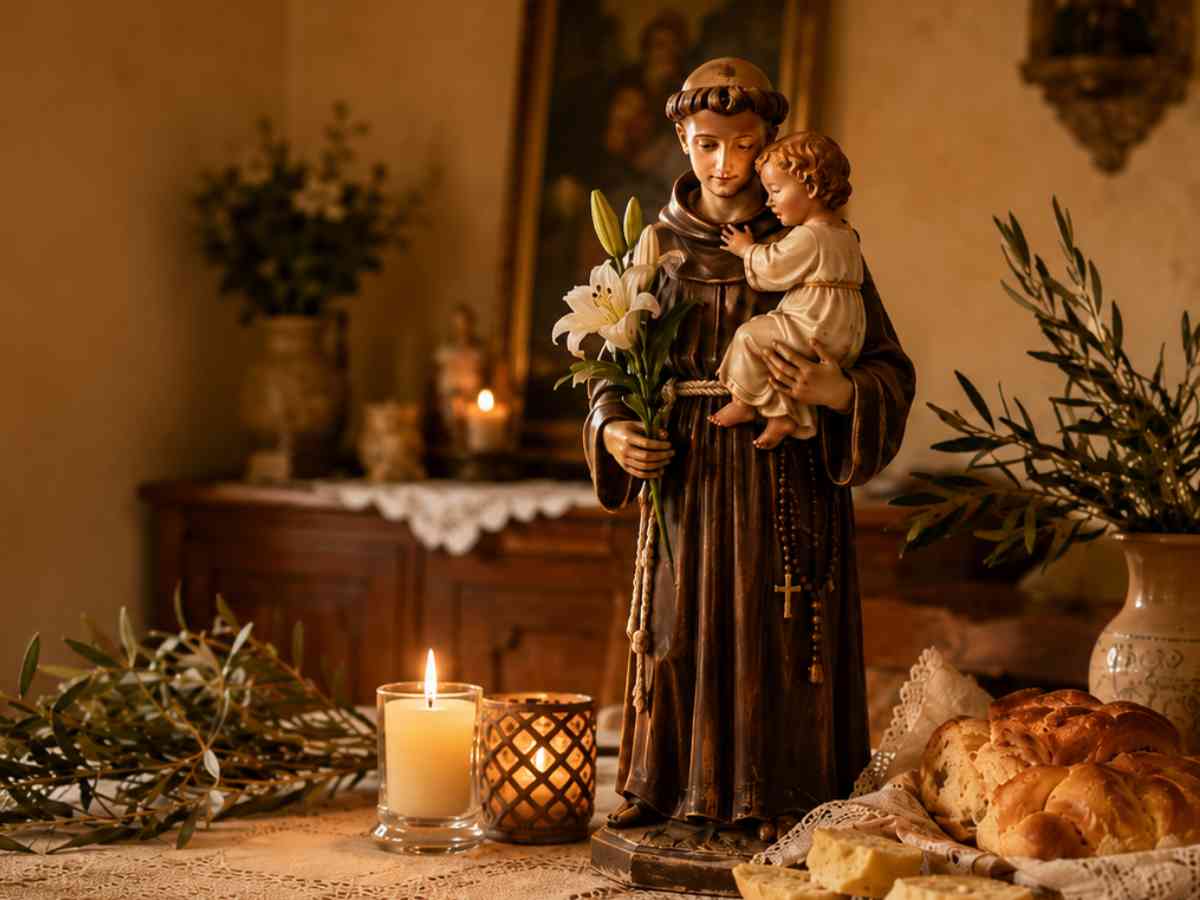
Sant’Antonio di Padova — Saint Anthony of Padua — is one of the most beloved saints in the entire Italian Catholic tradition. Not only in Padua, the northern Italian city that claimed him as its own, but in southern Italy, in Calabria, in Sicily, in every Italian parish that crossed the Atlantic and built a church in a new country and then built a festival around it in the street outside. In Montreal’s Little Italy, on Saint-Laurent Boulevard, the Feast of Sant’Antonio has been one of the fixed points of the Italian community’s calendar for generations. A mass. A procession. Music in the street. The smell of sausages on the grill and espresso from the bar at the corner and gelato from the shop that has been there longer than most of the people walking past it can remember.
Sant’Antonio is the saint you call when something is lost. That was always the official explanation. But in Italian family life, the feast of June 13 was not really about lost keys or misplaced rosaries. It was about the community finding itself again — on the street, together, once a year, for the same reason as always.
Free Printable
Every Italian feast day, on one printable calendar.
Sant’Antonio, the saints, and the whole Italian year of feast days — in one free printable calendar. Join the list and we’ll send it to you.
Who Sant’Antonio was — and why Italians claimed him so completely
He was not Italian by birth. That is one of the stranger facts about one of Italy’s most beloved saints. Britannica records that Saint Anthony of Padua was born in 1195 in Lisbon, Portugal — the son of a noble family who wanted nothing to do with the privileges his birth entitled him to. He entered a religious order against his family’s wishes, came into contact with Franciscan friars, and ended up in Italy almost by accident: a storm drove his ship into Messina, Sicily, while he was on his way back to Portugal. He never really left. He traveled mainland Italy, preached, healed, and eventually died on June 13, 1231, near Padua, at the age of 36. He was canonized the following year — one of the fastest canonizations in Catholic history.
What drew him to Italy, and what drew Italy to him, was his gift for preaching and his reputation for miracles. The Language Garage describes him as the Santo dei miracoli — the Saint of Miracles — and the protector of the poor and of lost things. That last association is the one that entered deepest into everyday Italian life. In households across Italy and the diaspora, the prayer to Sant’Antonio for finding something lost became as automatic as any other domestic reflex. You lost your keys. You said the prayer. Sometimes it worked. Sometimes it did not. Either way, you said the prayer. Because you had learned it before you learned most things, and because your grandmother had said it before you, and hers before her, and at some point the prayer stops being a technique and becomes simply the way the world works in this family.
My grandfather lost things regularly. Not dramatically — not important documents or anything that caused real concern — but the small items that circulate through a man’s pockets and somehow find their way into the wrong place. Keys. A specific pen. A pair of glasses that were sitting on his face while he was looking for them. The remedy was always the same. He would say, without particular urgency, “Sant’Antonio” — just the name, not even the full prayer — and then continue looking. Nine times out of ten, in my memory, the thing turned up. Whether this was the saint’s doing or simply the result of a calm and methodical man doing what calm and methodical men do, I cannot say with confidence. But I know that he credited Sant’Antonio every single time.
Keep the Saints Close
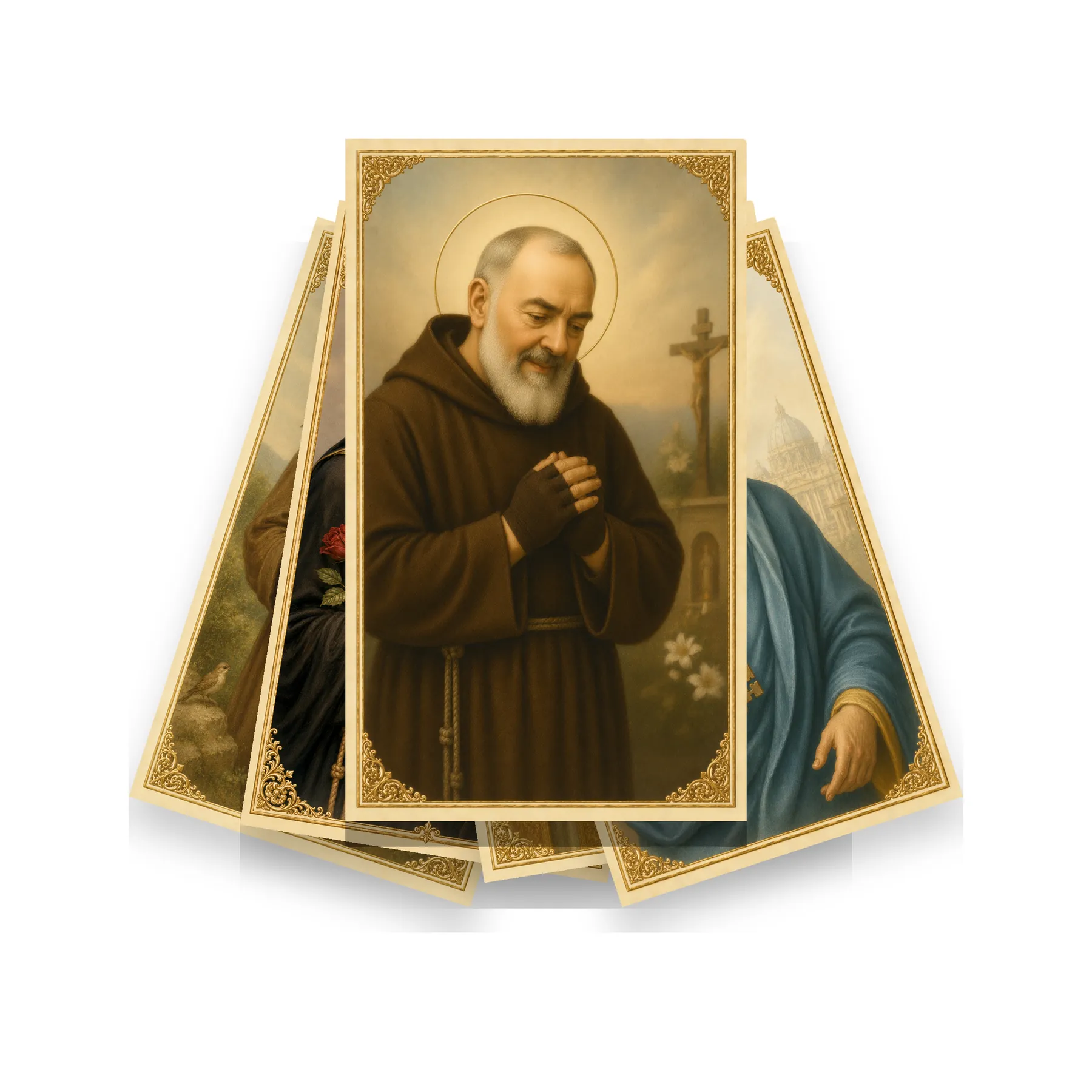
Italian Saint Prayer Cards
Printable prayer cards inspired by the saints and devotions Italian families passed down — made to keep in your missal, share with family, or give as a gift.
See the Prayer Cards — $9.49 →What the feast looks like in Italy — and why it mattered to every Italian family
In Padua, June 13 is a public holiday. The city essentially stops. My Corner of Italy describes the Basilica di Sant’Antonio opening at 5:30 in the morning and staying open until 10:30 at night, with masses every hour through the day. The relics of the saint are carried through the city in a solemn procession — thousands of pilgrims, many walking barefoot or carrying candles, moving through streets hung with red drapes. It is one of the largest religious processions in Italy and one of the oldest continuously observed feast days in the Catholic tradition.
But the feast was never only Padua’s. Italy Magazine notes that celebrations include processions, street fairs, fireworks, and huge crowds in piazzas across the country — especially in the south, where Sant’Antonio was as beloved as any regional patron saint. In Calabrian villages, in Sicilian towns, in every community that had a church dedicated to him, June 13 meant something specific: a mass in the morning, a procession through the streets, food in the afternoon, music in the evening. The structure was the same everywhere because it came from the same understanding — this was a day for the community to gather around a shared devotion and remind itself that it was still a community.
That is the understanding Italian immigrants carried with them. They did not leave the feast behind. They brought it the way they brought everything that mattered — in the specific knowledge of what the day required, carried in the hands and memories of the people who had always observed it.
Sant’Antonio on Saint-Laurent — the feast in Montreal’s Little Italy
If you grew up in Montreal’s Italian community, you know what June 13 looks like on Saint-Laurent Boulevard. You know it from the sound before you see it — the band warming up, the specific quality of crowd noise that comes from a neighbourhood that has transformed itself into something more than a neighbourhood for one day. The Diocese of Montreal has documented the community celebration, which includes a solemn mass in honour of Sant’Antonio followed by la processione — the procession through the streets of Little Italy, led by a band, the statue of the saint carried on the shoulders of the faithful, the route lined with people who came out of their houses and businesses to watch it pass.
What made the Montreal procession feel right — what made it feel like the real thing and not a pale copy of the Italian original — was the seriousness with which the community treated it. This was not nostalgia tourism. This was not a heritage display for people who had already moved away. This was the actual feast, observed by people who considered Sant’Antonio their saint and June 13 their day. The older men who lined the route had watched the same procession in Calabria before they watched it in Montreal. The women who held their children up to see the statue passing were the granddaughters of women who had done the same thing on different streets in a different country. The geography changed. The feast did not.
After the procession came the part that most people remember with the most pleasure. Saint-Laurent filled up in that specific way it fills up when something is over and everyone is still here and nobody is in a hurry to leave. The sausage sandwiches came first — always came first, because you could smell them before you could see the stand, and the smell alone was enough to stop you from going anywhere else for a few minutes. The bread was the right kind — soft enough to hold the sausage and grilled peppers without falling apart, firm enough to take the weight of everything piled on it. Then espresso at a table on the sidewalk where you were close enough to the person at the next table that you could hear their conversation. The conversations were always in Italian, or a mix of Italian and French and English that signaled a family where all three languages had been running in parallel for a generation. Then gelato — because it was June and it was warm and because the combination of sausage sandwich and espresso and gelato on a Saint-Laurent sidewalk on the feast of Sant’Antonio is one of the specific pleasures that people who grew up in that community carry with them for the rest of their lives whether they stay or leave.
What Sant’Antonio meant in Italian family life beyond the feast day
The feast was one day. But Sant’Antonio was present in Italian households all year, in the specific way that the most useful saints are present — not ceremonially, but practically. He was the one you called on. He was the one whose small statue or prayer card appeared on kitchen shelves and bedroom windowsills in Italian houses not as decoration but as a working relationship.
He was the patron of the poor, and in the households of people who had emigrated from southern Italy with very little, that patronage was not abstract. He was the saint who had chosen poverty voluntarily, who had preached to people who had nothing, who had died at 36 giving everything away. In families where poverty was recent memory rather than distant history, Sant’Antonio’s specific combination of learning, humility, and generosity made sense in a way that more triumphant saints sometimes did not. He felt like someone who understood the situation.
The name Antonio — and its variants Tonio, Tonino, Antonietta — ran through Italian families with the frequency that only saints with real popular devotion produce. If your family had an Antonio, his onomastico fell on June 13. That gave the feast day a second layer of meaning in households with that name — it was both a community celebration and a personal one, the saint’s day observed at the level of the street and also at the level of the kitchen table, where someone’s specific name was being honored.
The pane di Sant’Antonio — the bread of the feast
One of the most distinctive customs associated with Sant’Antonio is the blessing and distribution of bread. The Language Garage describes the benedizione del pane di Sant’Antonio as a cherished custom — blessed bread distributed to churchgoers and the less fortunate as a direct expression of the saint’s compassion and his specific association with generosity toward the poor.
In Italian family life, the bread tradition connected naturally to the broader understanding that Sant’Antonio’s protection was not purely supernatural. It was material. The feast expressed its meaning not only in prayer and procession but in something you could hold in your hands and share with someone who needed it. That combination — the sacred and the practical, the prayer and the bread, the procession and the sausage sandwich on the sidewalk after — is what Italian feast day culture always understood best. The divine and the domestic were never enemies. They were the same impulse expressed at different registers.
If you want to mark the tradition at home, baking a simple loaf on June 13 and sharing it — with your family, with a neighbour, with anyone who might appreciate it — is the most direct connection to what the feast has always meant at its most basic level. For those who want to go deeper into the Italian Catholic table traditions this connects to, Marcella Hazan’s Essentials of Classic Italian Cooking includes the bread traditions that Italian families carried from their regions — the kind of knowledge that belonged to the kitchen and the feast day equally.
Sant’Antonio and the Italian-Canadian community — why the feast survived immigration
The Feast of Sant’Antonio survived immigration the same way the best Italian traditions survived it — by being too embedded in community life to leave behind without leaving the community behind entirely. You could stop observing individual practices. You could let some customs fade when the specific context that sustained them was no longer there. But the feast of the patron saint was not an individual practice. It was the community gathered in one place for one reason. To stop doing it was not a personal decision — it was a collective one, and Italian communities in Montreal, New York, Toronto, and Boston largely chose not to make it.
The procession in Little Italy was the visible proof of that choice. Every year that the statue came out of the church and moved through the streets was another year the community had decided, collectively and practically, that this was still who they were. That the feast mattered. That Sant’Antonio was still their saint on this street the same way he had been their saint on that street in Calabria, and that June 13 still had a particular quality that no other day of the year quite replicated.
That continuity is what Italian community celebrations in North America are really about. Not preserving something frozen — but choosing, year after year, to keep the thread unbroken. For the broader story of how Italian traditions survived and changed after immigration, read Italian-American traditions: what changed and what stayed. And for how the June traditions connect to the full Italian seasonal calendar, the 2026 Italian Family Traditions Calendar marks Sant’Antonio’s feast day alongside every other date worth keeping.
Which Saint Watched Over Your Family?
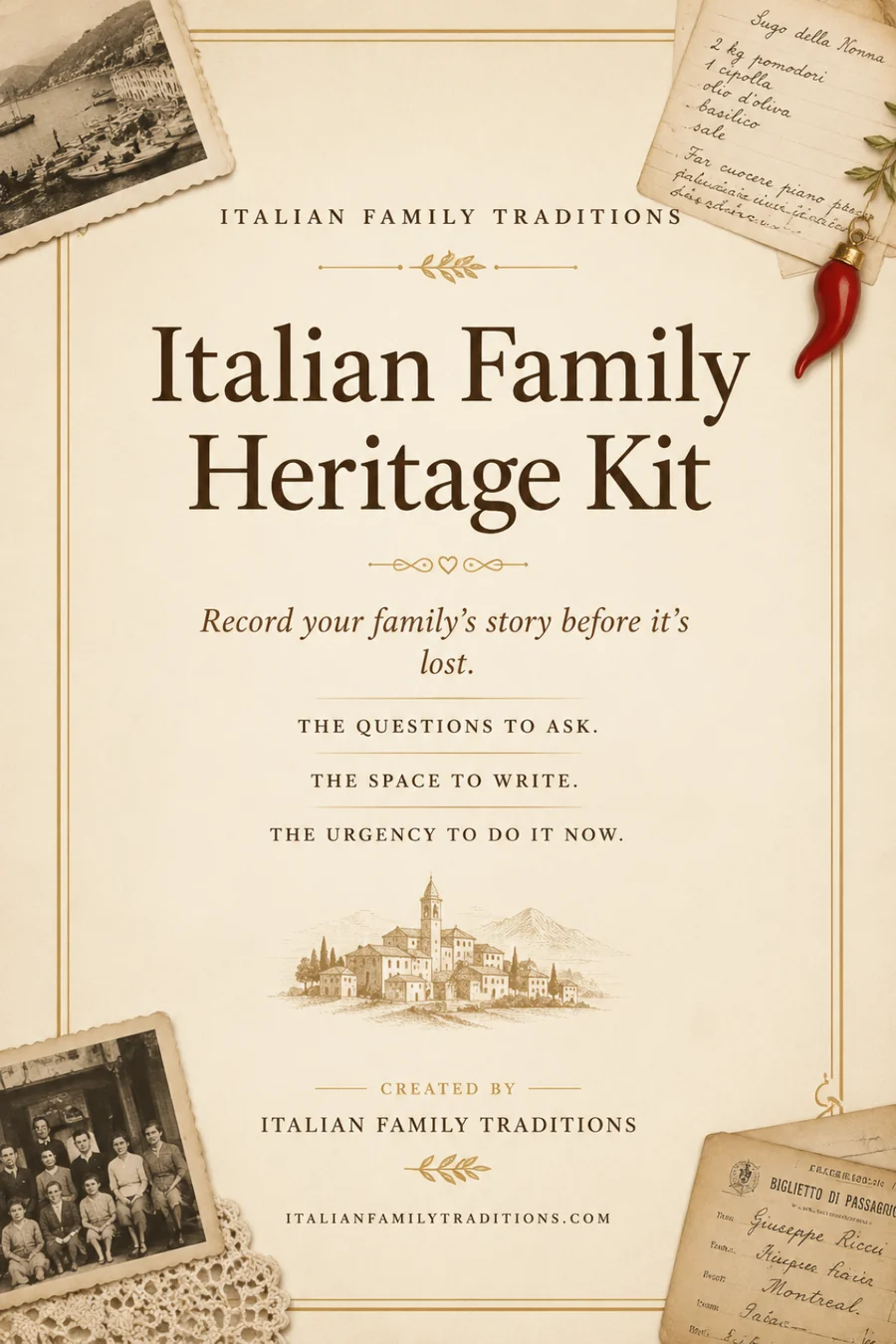
The feast, the procession, the blessed bread, the saint your family turned to — these are the details that fade across generations. The Italian Family Heritage Kit gives you the prompts to record your family’s saints, feasts, and devotions before they’re lost.
Explore the Italian Family Heritage Kit →How to keep Sant’Antonio’s feast day meaningful today
You do not need to be in Little Italy on June 13 to observe the feast properly. You need a few things that are easier to find than that.
Find an Italian parish in your city that observes the feast — many still do, with a mass in the morning and a small procession after. Go. Stand in the street with the people who have been doing this for decades and feel what it feels like to be part of a continuity rather than an audience for one.
Make the sausage sandwich at home if you cannot make it to Saint-Laurent. Italian sausage, grilled peppers and onions, good bread — this is feast day food precisely because it feeds a crowd without ceremony. Put it on a June evening table and tell whoever is eating it what day it is and why.
Say the prayer if you have something lost. Sant’Antonio, aiutami a ritrovare. Saint Anthony, help me find it. Whether or not you believe in its efficacy as a supernatural intervention, it is one of the most beautiful prayers in the Italian folk tradition — short, direct, personal, addressed to a specific saint about a specific problem. Teaching it to children is teaching them something true about how Italian Catholic family life understood the relationship between the sacred and the practical. For how to give children this kind of entry point into their heritage, read how to get your kids interested in their Italian heritage.
And if your family has an Antonio, a Tonia, an Antonietta — celebrate their onomastico on June 13. Properly. With something on the table and the name said out loud and the explanation given to whoever at the table does not yet know what an onomastico is and why it matters more than it might appear to. If you want a beautiful way to mark the day — a Saint Anthony medal worn as a daily reminder of the tradition — a handcrafted Italian Saint Anthony medal is one of the most personal ways to carry the feast with you the other 364 days of the year.
He stood and watched the procession with the specific stillness of a man who had watched the same procession every June of his life — in Calabria and then in Canada. Sant’Antonio is the saint you call when something is lost. On June 13, on Saint-Laurent, what the Italian community was finding was itself — still here, still together, still carrying the same feast down the same kind of street as always.
Make the sausage sandwich. Say the prayer. Go to the procession if you can. That is the whole feast.
Before the Feasts Grow Quiet
Record your family’s saints, feasts & devotions.
Which saint did your family honour? Which feast, which procession, which prayers? The Italian Family Heritage Kit includes 133 guided pages and more than 120 prompts to preserve your family’s people, names, saints, traditions, recipes, sayings, photographs, and memories.
Explore the Heritage Kit — $19.99Instant digital download. Print it and complete it with your family.
The Feast of Sant’Antonio belongs to the same Italian June as Acqua di San Giovanni and the feast of San Giovanni on June 24. For the name day tradition that gives June 13 its personal dimension in Italian families, read what is onomastico and why Italians celebrate name days. For the superstitions and folk traditions that share Sant’Antonio’s protective spirit, read about malocchio and the Italian evil eye. And for how Italian religious traditions survived immigration, read Italian-American traditions: what changed and what stayed.
St. Anthony is one of the most-invoked patrons of all — find the saint for any need with the patron saint finder, or offer him a novena.
FAQ
What is the Feast of Sant’Antonio di Padova?
The Feast of Sant’Antonio di Padova is the annual celebration of Saint Anthony of Padua on June 13, the date of his death in 1231. It is one of the most widely observed feast days in the Italian Catholic tradition, marked with masses, processions, street fairs, music, and food in cities across Italy and in Italian communities around the world. In Padua — the city where the saint spent his final years — June 13 is a public holiday and the site of one of Italy’s largest religious processions. In Italian diaspora communities from Montreal to Boston, the feast has been observed continuously since the first waves of immigration in the late 19th and early 20th centuries.
Why is Sant’Antonio the patron saint of lost things?
The association comes from a medieval story in which a novice stole Anthony’s precious psalter and Anthony prayed for its return — and the novice was compelled to bring it back. Over centuries of popular devotion, this generalized into the belief that Sant’Antonio could help find anything lost. The prayer — Sant’Antonio, aiutami a ritrovare, Saint Anthony help me find it — became one of the most commonly repeated prayers in Italian folk Catholic life, passed from grandmother to grandchild with the same automaticity as any other household tradition. It was said quietly, without ceremony, as a practical appeal to a trusted intercessor.
Was Sant’Antonio Italian?
No — he was born in Lisbon, Portugal, in 1195. He came to Italy almost by accident when a storm drove his ship off course into Sicily on a return voyage to Portugal. He never left. He traveled Italy, joined the Franciscans, preached across northern Italy, and died near Padua in 1231. Portugal and Italy both claim him. Padua built one of the most significant basilicas in Christendom around his tomb. Italy absorbed him so completely into its religious culture that most Italian families who grew up with devotion to Sant’Antonio had no particular awareness that he was not Italian — he was simply their saint, the one you called on, the one whose name ran through the family.
How did Italian communities in Montreal celebrate Sant’Antonio?
Montreal’s Italian community, centered in Little Italy on Saint-Laurent Boulevard, observes the Feast of Sant’Antonio with a solemn mass followed by a procession through the neighbourhood, accompanied by a band, with the statue of the saint carried through the streets. After the procession, the celebration continues with food — sausage sandwiches with grilled peppers, espresso at the sidewalk tables, gelato from the gelaterie on Saint-Laurent — and music. The Diocese of Montreal has documented the community’s annual celebration, which draws multiple generations of Italian-Canadians back to the neighbourhood each June 13.
What is the prayer to Sant’Antonio for lost things?
The most common Italian form is: Sant’Antonio, aiutami a ritrovare — Saint Anthony, help me find it. A longer traditional version is: Sant’Antonio da Padova, aiutami a trovare ciò che ho perduto — Saint Anthony of Padua, help me to find what I have lost. There are also dialect variants throughout Italy and the diaspora, many of which rhyme and were passed down orally rather than from books. In Italian family life the prayer was typically said quietly and without ceremony — a practical appeal to a trusted intercessor, in exactly the same spirit as any other household necessity.
What is the pane di Sant’Antonio?
The pane di Sant’Antonio — bread of Saint Anthony — is the tradition of blessing and distributing bread on or around June 13 as an expression of the saint’s association with compassion for the poor and generosity toward the less fortunate. In Italian parishes and communities, blessed bread is distributed to churchgoers after the feast day mass. The tradition connects directly to Sant’Antonio’s reputation as the protector of the poor — making the feast’s most symbolic food something given away rather than kept.
When is Sant’Antonio’s feast day and what name day does it mark?
Sant’Antonio di Padova’s feast day is June 13. In the Italian onomastico tradition, June 13 is the name day for anyone named Antonio, Antonia, Tonino, Tonia, Antonietta, and related variants. It is one of the most common Italian name days because Antonio has been one of the most frequently given names in Italian Catholic families for centuries, particularly in southern Italy. In households with an Antonio, June 13 carried a double observance — both the community feast and the personal name day, marked at the kitchen table with something special and the name said with particular affection.

Marco Ricci is an Italian-Canadian writer and the grandson of Calabrian immigrants. He created Italian Family Traditions to document the customs, feast days, and family rituals Italian families carried from Italy to North America — and to understand what they actually meant. He is based in Montreal.