Italian Family Traditions
Italian Grandmother’s Remedies — The Cures Nonna Swore By
Before the doctor. Before the pharmacy. Before anyone even thought about making an appointment. There was the broth. There were the slippers. There was your grandmother, already in the kitchen, already certain she knew what you needed.
7 minute read
The first thing my grandmother reached for, every single time, was a packet of Lipton soup.
Not homemade bone broth simmered for hours. Not some secret recipe passed down through centuries. Lipton. From the box. She would boil the water, tear the packet, stir it in, and then — because she loved me and because she was terrified it would burn my mouth — she would drop ice cubes into the bowl to cool it down. Every time.
And it worked. Or at least, I believed it worked, which may be the same thing. I still make it today when I’m sick. I tell no one. I suspect it works. That is the quiet, stubborn power of an Italian grandmother’s medicine — it gets into you so deeply that decades later you are standing in your own kitchen, dropping ice cubes into soup, and you cannot tell whether you are feeding a cold or feeding a memory.
The Short Version
Italian grandmother remedies were a complete system — and they were always administered before anyone considered a doctor. Broth for any illness. Vicks for any cough. Chamomile for any stomach. Garlic for the serious cases. Slippers on immediately, bare feet never, wet hair absolutely not. These were not suggestions. They were nonna’s first line of defense, and they were not optional.
What’s in this guide
- The broth — every Italian grandmother’s first remedy
- Vicks, applied to everything
- The garlic — for when she meant business
- The war against cold — Italian grandmother remedies for drafts and bare feet
- Chamomile — the quiet one
- No matter what, you must eat
- The doctor came second
- The Italian grandmother remedies that stuck
- FAQ
The broth — every Italian grandmother’s first remedy
The broth was not a remedy. The broth was the remedy — the foundation of the entire system, the first thing made and the last thing questioned.
It didn’t matter what was wrong with you. Fever, cold, sore throat, stomach, headache, sadness, exhaustion — the answer was brodo. A hot bowl of broth placed in front of you with an authority that did not invite refusal. In my grandmother’s kitchen, the broth was already cooking the moment someone in the family showed the first sign of anything. She didn’t wait for a diagnosis. She didn’t wait to see if it got worse. The pot went on.
Nu bello brodo. A beautiful broth. She said it like it solved everything, and honestly, it might have.
The broth was never a question. It was never offered. It simply appeared, and you ate it.
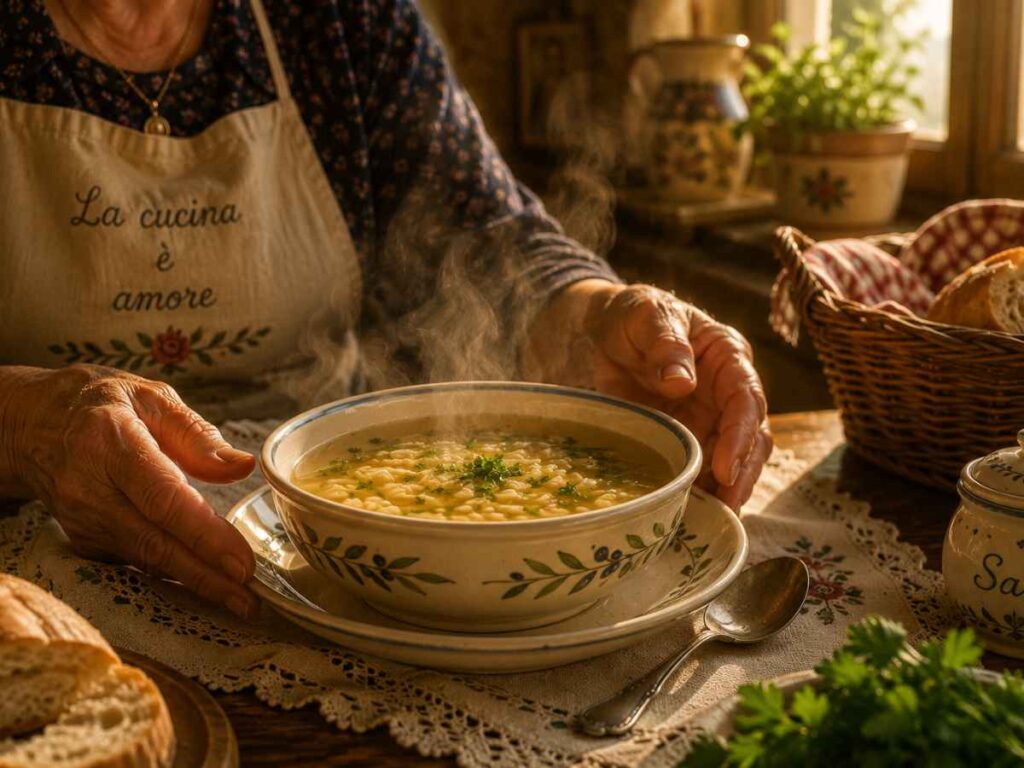
Science has since confirmed what Italian grandmothers always knew — research shows that hot chicken broth genuinely helps with congestion, hydration, and inflammation. But they didn’t need the science. They had the evidence of generations of sick grandchildren who ate the soup and got better. That was proof enough.
Vicks, applied to everything
If broth was the internal medicine, Vicks VapoRub was the external one — applied with a generosity that bordered on aggression.
Coughing? Vicks on the chest. Congested? Vicks on the chest. Breathing a little funny? Vicks on the chest. And in the truly committed households — mine included — Vicks on the upper lip, right under the nose, so you could not escape it. You went to bed smelling like a eucalyptus forest and woke up with mentholated pillowcases. There was no such thing as a light application.
The blue jar was a fixture. It sat in the medicine cabinet the way a fire extinguisher sits on a wall — always there, always ready, deployed at the first sign of trouble. Italian grandmothers used Vicks the way other cultures used prayer. Some used both.
Love these Italian traditions?
Get new stories about Italian customs, folk beliefs, and family traditions — plus our free printable calendar of the Italian year.
The garlic — for when she meant business
When the broth wasn’t enough and the situation turned serious, the garlic came out — and that’s when you knew your grandmother was no longer asking.
My grandmother would take a raw clove of garlic, crush it on the side of a knife, and make me swallow it. Not mixed into food. Not softened or disguised. Crushed, raw, and forced down my throat with the kind of calm determination that made refusal feel impossible. It burned. It was awful. And she watched me swallow it with the steady eye of someone who had done this a hundred times and was not interested in complaints.
Garlic, in the Italian folk-medicine world, was the heavy artillery. It was believed to fight infection, clear the chest, strengthen the blood, and ward off illness in the same way the cornicello warded off the evil eye — by being too strong, too sharp, too potent for the bad thing to survive. Modern research has since found that raw garlic does contain allicin, a compound with genuine antimicrobial properties. My grandmother would not have been surprised by this information. She already knew.
The garlic was not a request. It was a verdict. You were sick enough for garlic, and that was that.
The war against cold — Italian grandmother remedies for drafts and bare feet
Italian grandmothers did not fight illness only when it arrived. They fought the conditions that might let it in — and nothing invited illness like being cold, being barefoot, or being exposed to moving air.
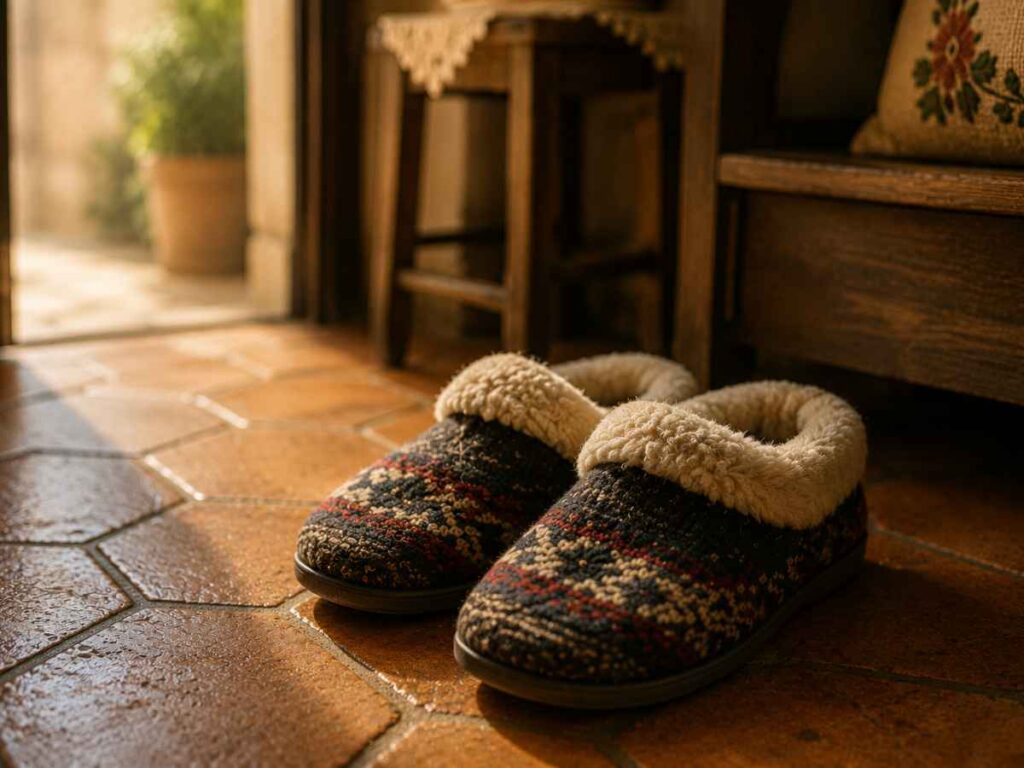
If you walked barefoot on the tile floor, you were going to catch rheumatism. This was not a warning. It was a prophecy delivered with total certainty. Put your slippers on. The tiles were cold. Cold entered through the feet. Rheumatism followed. The connection was absolute, the logic airtight, and the slippers non-negotiable.
If you went outside with wet hair, you were pazzo — crazy. It didn’t matter if it was July. Wet hair plus outside air equaled illness, full stop. Where’s your jacket? was not a question about comfort. It was a question about survival, asked with a tone that suggested you were one open collar away from pneumonia.
This entire worldview — that cold air, moving air, and exposed skin were active threats to health — is what Italians call the colpo d’aria, the fear of drafts. It sat somewhere between superstition and folk medicine, and it governed how Italian families dressed, slept, bathed, and moved through the world. Your grandmother was not being cautious. She was being vigilant.
Chamomile — the quiet one
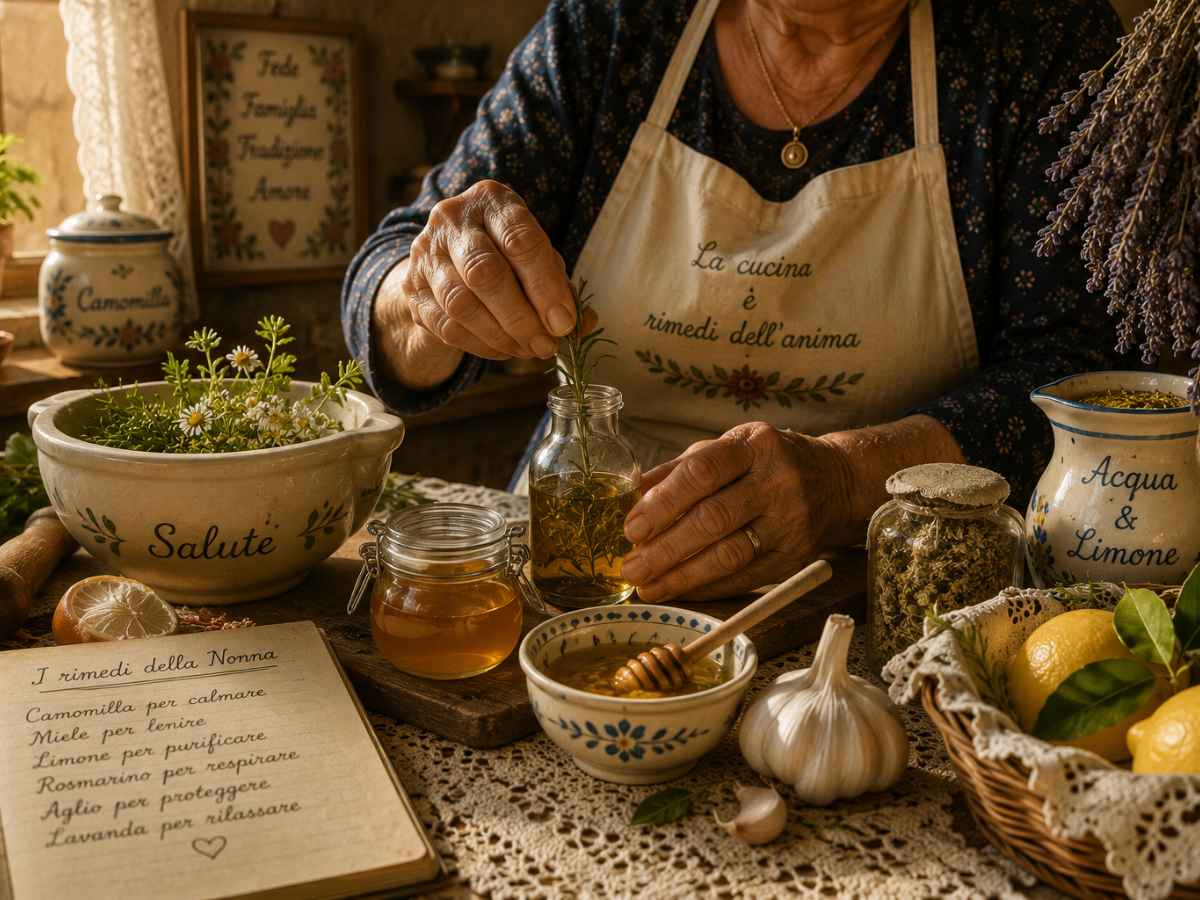
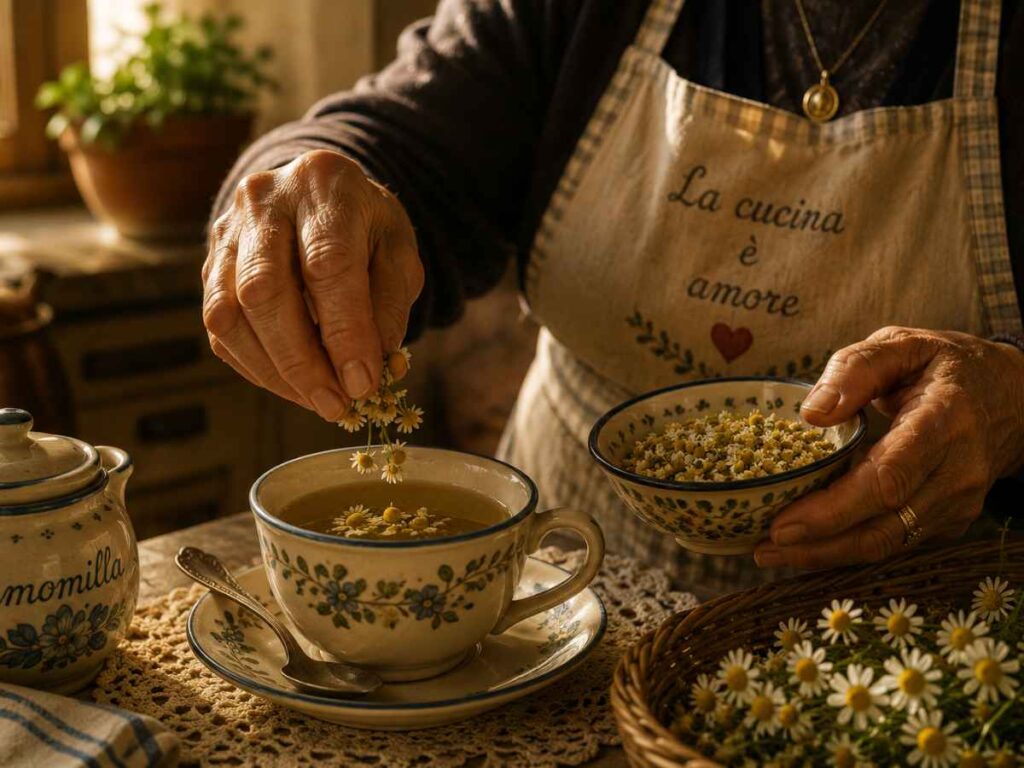
If broth was the loud, confident cure and garlic was the aggressive one, chamomile was the gentle hand on your forehead — the remedy that came at night, when the house was quiet.
A cup of chamomile tea before bed when you were sick. A cup of chamomile when your stomach hurt. A cup of chamomile when you couldn’t sleep, when you were anxious, when something was just off and nobody could name what. Chamomile was the Italian grandmother’s answer to every ailment that wasn’t quite an illness but wasn’t quite nothing either — the vast, unnamed territory of “not feeling right” that medicine couldn’t reach but a warm cup in a quiet kitchen could.
It was given without ceremony, without the drama of the garlic or the authority of the broth. Just a cup. Just a hand. Just the understanding that sometimes the cure is simply being looked after.
A note worth keeping — Nearly every Italian grandmother’s remedy shares a common structure: warmth, nourishment, and presence. The broth warms you. The chamomile soothes you. The slippers protect you. The garlic fights for you. And through all of it, someone is there — watching, insisting, refusing to leave you alone with whatever you have. The remedy was never just the ingredient. It was the grandmother.
The remedies were one half of how an Italian grandmother protected her family. The other half was the saints she prayed to. Our printable Italian saint prayer cards carry eleven of those saints — each with a traditional prayer in Italian and English.
$9.49
Instant digital download
No matter what, you must eat
The deepest rule underneath all of it — the belief that held everything together — was that you must eat. Always. No matter what.
Sick? Eat. Not hungry? Eat. Throwing up? You’ll eat when it passes. There was no illness in the Italian grandmother’s world that was made better by an empty stomach. Food was not just fuel. It was medicine, love, protection, and proof that someone was looking after you. To refuse food was to refuse care, and that was not something an Italian grandmother would allow.
This is why the broth came first and always. It was the minimum — the thing you could eat even when you could eat nothing else. A beautiful broth. Nu bello brodo. And if you could eat the broth, maybe you could eat a little bread. And if you could eat the bread, maybe a little pasta. And before you knew it, you were eating a full meal and your grandmother was nodding with quiet satisfaction, because eating meant you were going to be fine.
In an Italian home, feeding someone was not separate from healing them. It was the same act.
The doctor came second
Even when a doctor prescribed something — even when real medicine was in the house — the grandmother’s remedies came first.
This was not stubbornness, exactly. It was priority. The doctor’s pills sat on the counter, and they were taken — she was not reckless. But the broth came before the pills. The Vicks went on before bed, alongside whatever the doctor said. The chamomile came at night whether the prescription mentioned it or not. The grandmother’s medicine and the doctor’s medicine ran in parallel, and in her house there was no question about which one she trusted more.
It makes a kind of sense when you think about it. The doctor saw you for fifteen minutes. The grandmother saw you always. The doctor read your symptoms. The grandmother read you. She knew when you were pretending to be sicker than you were, and she knew when you were pretending to be better. The remedies were an extension of that knowing — specific, personal, delivered by someone who had been watching you since before you could walk.
That depth of attention is what modern medicine, for all its superiority in diagnosis and treatment, cannot replicate. A prescription does not sit beside you. A pill does not check if you’ve eaten. An Italian nonna did all of that, and more, and would never have called it medicine. She would have called it simply what you do.
The Italian grandmother remedies that stuck
The truest test of a grandmother’s remedy is not whether it was medically sound. It is whether you still do it.
I still make the Lipton soup. I know this. I’m not proud of it — or maybe I am, quietly. When I’m sick, before I think about it, I’m in the kitchen boiling water and reaching for that box, and if it’s too hot I’m putting ice cubes in it because that’s how it’s done. Nobody taught me this formally. Nobody sat me down and said, “When you’re sick, make Lipton.” It just went in, the way the language went in, the way the gestures went in, the way the superstitions went in — by being lived in front of me until they became part of how I move through the world.
That is what a grandmother’s remedy really is. It is not a cure. It is a piece of someone who loved you, lodged so deep it became instinct.
The remedy was never just the ingredient. It was the grandmother. And she is still there, every time you reach for the soup.
In Summary
- Broth (brodo) was the universal first response — always hot, always ready, never optional
- Vicks VapoRub was applied to everything, generously, especially the chest and under the nose
- Raw garlic came out for the serious cases — crushed and swallowed, no complaints accepted
- Cold, drafts, and bare feet were treated as active threats — slippers always, jacket always, wet hair never
- Chamomile soothed everything that wasn’t quite an illness but wasn’t nothing
- You must eat — food was medicine, love, and proof that someone was looking after you
- The doctor came second — always alongside nonna’s remedies, never instead of them
FAQ
What home remedies did Italian grandmothers use?
The most common Italian grandmother remedies included chicken broth (brodo) for virtually any illness, Vicks VapoRub applied to the chest and sometimes under the nose, raw garlic for serious colds or infections, chamomile tea for stomach aches and sleep, and a strict insistence on warmth — slippers on tile floors, no bare feet, no wet hair outside, and no exposure to drafts. Food was considered medicine, and eating was non-negotiable regardless of how sick you felt.
Why do Italians believe bare feet cause illness?
In Italian folk medicine, cold was believed to enter the body through the feet, especially on cold tile floors. Walking barefoot was thought to cause rheumatism, colds, and other illnesses. This is closely tied to the broader Italian belief in the colpo d’aria — the idea that cold air or temperature changes can directly cause illness. Italian grandmothers insisted on slippers indoors as a basic health precaution.
Does Italian chicken broth actually help when you’re sick?
Research has shown that hot chicken broth can help with congestion by increasing nasal mucus flow, provides hydration, and contains compounds with mild anti-inflammatory properties. Italian grandmothers may not have known the science, but they had generations of evidence that brodo helped, and modern medicine has broadly confirmed that they were right.
Why did Italian grandmothers use raw garlic as medicine?
Raw garlic contains allicin, a compound with genuine antimicrobial and anti-inflammatory properties. In Italian folk medicine, raw garlic was used to fight colds, clear the chest, and ward off infection. It was typically crushed and swallowed raw — not a pleasant experience, but one that Italian grandmothers administered with unshakeable conviction, especially for more serious illnesses.
What is chamomile used for in Italian families?
Chamomile tea (camomilla) was the gentle, all-purpose remedy in Italian households. It was given for stomach aches, trouble sleeping, anxiety, and general unease — the vast territory of “not feeling right” that didn’t have a specific name. A cup of chamomile before bed was standard for sick children and adults alike, and it was used alongside other remedies rather than instead of them.
What was your nonna’s go-to cure? The one she reached for before anything else, the one you still catch yourself doing — share it in the comments. These are exactly the remedies worth writing down before they’re forgotten.
Marco Ricci is an Italian-Canadian writer and the grandson of Calabrian immigrants. He created Italian Family Traditions to document the customs, feast days, and family rituals Italian families carried from Italy to North America — and to understand what they actually meant. He is based in Montreal.