Italian Family Traditions
Italian-American Slang: 50 Words You Grew Up Hearing
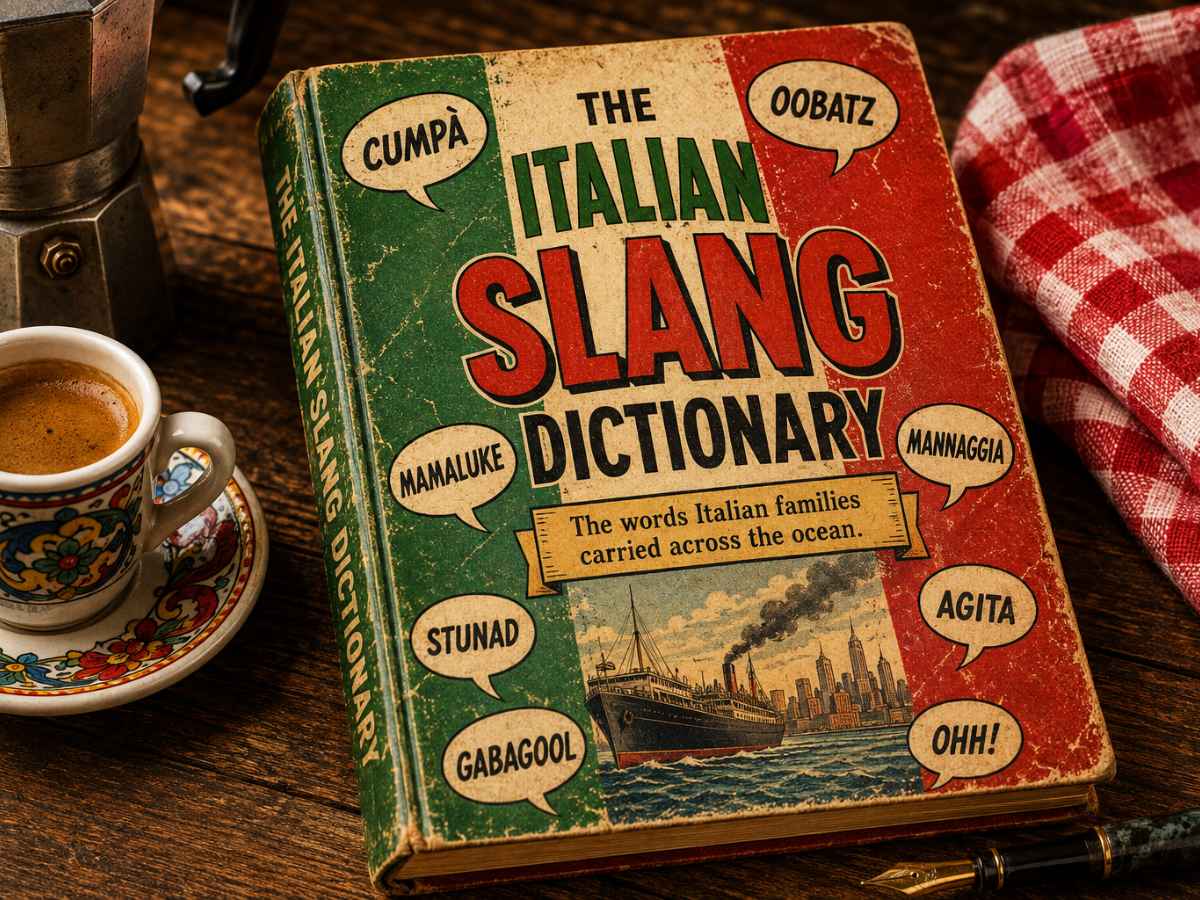
Gabagool, agita, cumpà, stunad — the half-Italian, half-something-else words of the immigrant kitchen. Where they really come from, what they mean, and the Calabrian and Italiese versions you won’t find anywhere else.
If you grew up in an Italian family in North America, you grew up bilingual without realizing it — not in Italian and English, exactly, but in a third language nobody ever named. It was the language where the cold cut was gabagool, the stomachache was agita, and the cousin everyone loved was a little bit stunad. You didn’t learn these words; you absorbed them. And you didn’t find out until much later that they weren’t “real Italian” at all — that if you said gabagool in Rome, you’d get a blank look.
So what are these words? They are the sound of a language in transit — Southern Italian dialects, carried across the ocean, worn smooth by generations who spoke them at home but read and worked in English. They are not mistakes. They are a record of exactly who said them and where they came from. Tap through the cards below to see where each one really comes from, then read on for the story of why they sound the way they do.
The Words You Grew Up With
Italian-American Slang, Card by Card
The mangled, softened, dropped-vowel words of the Italian-American kitchen — and a few pure Calabrian ones from my own family, plus the Italiese words that blended with English. Tap a card to flip it.
Most of these come from Southern Italian dialects, softened by immigration: final vowels drop, hard “c” turns to “g,” “p” softens to “b.” That’s why capicola becomes “gabagool.” The Calabrian words marked in gold are my family’s own.
Free Printable
The words, the names, the whole Italian year.
The slang your grandparents used disappears in a generation. Join the list for a free printable Italian family calendar, and start writing down the words before they fade.
Why Italian-American slang sounds the way it does
The single most important thing to understand about Italian-American slang is that it is not broken Italian — it is Southern Italian dialect. The vast majority of Italian immigrants to North America came from the south: Campania, Calabria, Sicily, Puglia, Abruzzo. They did not speak the standard Tuscan Italian of textbooks. They spoke Neapolitan, Calabrian, Sicilian — languages in their own right, with their own sounds, and those sounds are what survived in the diaspora.
Once you know the patterns, the words stop looking like mistakes and start looking like rules. Three in particular explain almost everything:
- The final vowel drops. Southern dialects clip the last syllable, so prosciutto becomes “prosciutt’,” mozzarella becomes “mutzarell,” ricotta becomes “rigott.” The word ends where the emphasis ends.
- Hard consonants soften. The hard “c” turns to a “g,” the “p” turns to a “b,” the “t” toward a “d.” That is how capicola becomes “gabagool” and ricotta becomes “ree-gott.” Voiceless sounds go voiced.
- The stress shifts and stretches. Vowels open up and lean on the stressed syllable, which is why everything sounds drawn-out and rounded — “ah-JEE-da,” “stoo-NAHD,” “goo-mah.”
Run any of the words through those three rules and you can usually reverse-engineer the “real” Italian underneath. Gabagool is capicola with softened consonants and a dropped ending. Brazhool is braciola. Oobatz is è pazzo — “he’s crazy.” The slang isn’t random; it’s dialect, faithfully preserved by people who kept speaking the way their parents did.
These words aren’t broken Italian. They’re Southern dialect, carried across the ocean and kept alive at the kitchen table long after the textbooks forgot them.
The Calabrian words in my own family
My family is Calabrian — from Carolei and Domanico, in the province of Cosenza — and the Calabrian dialect was always full of its own slang, words that aren’t just clipped Italian but genuinely different. We said juri for flowers, nothing like the standard fiori. A rabbit was a cunigghiu, with that unmistakable double-g Southern sound. You addressed a man directly as signò — a shortened signore. And màmmata simply meant “your mother,” said affectionately, or as the opening move in some good-natured ribbing.
These are the words that don’t make it into the big Italian-American slang lists, because those lists are built on the Neapolitan and Sicilian that dominated New York and New Jersey. The Calabrian ones are quieter, more regional — and if they’re in your family too, they’re worth writing down, because they are the most specific fingerprint of exactly which town your people came from. For more on that, read about finding your Italian town of origin.
Italiese: when the words blended with English (and French)
There is one more layer worth naming: the words that formed when Italian blended directly with the everyday English (and, in bilingual cities like Montreal, French) of the new country. Linguists sometimes call this Italiese — the immigrant dialect that grew up in Italian neighbourhoods across North America, from the church festa to the Sunday visit. It shows up wherever Italian families settled and raised children who lived in two languages at once.
In this immigrant speech, “because” became pecuzz, and half of every sentence started with a pointless mah (“Mah what you talking about?”). People said me I for emphasis — “me I thought it was Saturday” — a direct calque of the Italian habit of doubling the subject. To eat fast was to scoff, from scoffare. And de feast wasn’t a meal at all — it was the parish street festival, the festa, with the procession and the sausages. If you grew up Italian in North America, you spoke some version of this without ever thinking of it as anything other than normal.
The Words Disappear First
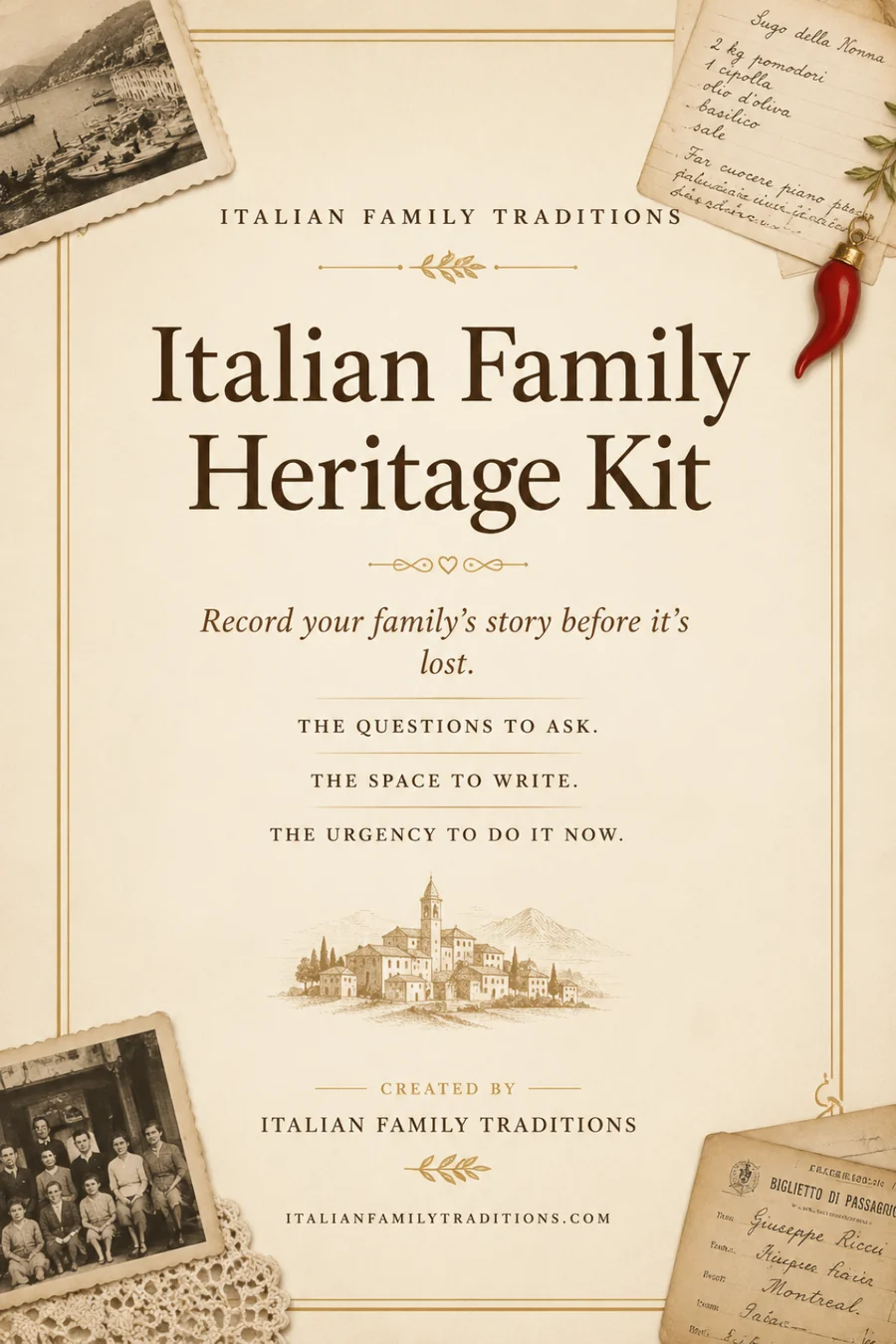
Dialect fades faster than recipes or photos. The words your grandparents used every day can vanish in a single generation if no one writes them down. The Italian Family Heritage Kit gives you the prompts to capture your family’s words, names, sayings, and stories.
Explore the Italian Family Heritage Kit →Italian-American slang words and their meanings
Here is a fuller reference of the most common Italian-American and Italian-Canadian slang words, what they mean, and the Italian or dialect they come from. Spellings vary from family to family — these are written the way they sound.
| Slang | Means | Comes from |
|---|---|---|
| Gabagool | Capicola cold cut | capicola / capocollo |
| Mutzarell | Fresh mozzarella | mozzarella |
| Prosciutt’ | Dry-cured ham | prosciutto |
| Rigott | Ricotta cheese | ricotta |
| Braciol’ | Stuffed meat in sauce | braciola |
| Manigott | Stuffed pasta tubes | manicotti |
| Pastina | Tiny pasta (comfort food) | pastina |
| Agita | Heartburn; stress, anxiety | acido / acidità |
| Stunad | Spacey, dopey | stonato |
| Oobatz | Crazy, nuts | è pazzo (u pazzu) |
| Mannaggia | Damn it! | mannaggia |
| Madonn’ | Good grief! Oh my! | Madonna |
| Ohh! | Hey! Listen! | Southern interjection |
| Waglio | Hey kid, young man | guaglione |
| Cumpà | Godfather; close friend | compare |
| Goomah | Godmother; (slang) mistress | comare |
| Paisan’ | Countryman, one of us | paesano |
| Mamaluke | Lovable fool | mammalucco |
| Chooch | Dummy, jackass | ciuccio (donkey) |
| Signò | Sir, mister | signore (Calabrian) |
| Juri | Flowers | fiori (Calabrian: juri) |
| Cunigghiu | Rabbit | coniglio (Calabrian) |
| Màmmata | Your mother | mammata (Calabrian) |
| Pecuzz | Because | “because” (Italiese) |
| Mah | But (sentence starter) | ma (Italiese) |
| Me I | As for me… | doubled subject (Italiese) |
| Scoff | To wolf down food | scoffare (Italiese) |
| De Feast | The parish street festa | festa (Italiese) |
You grew up speaking a language nobody named — half Southern dialect, half the country your family landed in, all of it holding a place and a people inside a handful of sounds. Gabagool and agita and cumpà aren’t broken Italian; they’re the fingerprint of exactly where your family came from and where they made a new home. Say them to the people who still remember, write down the ones only your family used, and keep them — because when the last person who says them is gone, they’re gone.
Write Down the Words
The slang, the names, the sayings only your family used.
Every family had its own words. The Italian Family Heritage Kit includes 133 guided pages and more than 120 prompts to preserve your family’s dialect, names, recipes, saints, and stories before they fade.
Explore the Heritage Kit — $19.99Instant digital download. Print it and complete it with your family.
The words are one thread in the larger story of what your family carried over. Read about the compare and comare bond behind “cumpà,” how Italian names changed in English, the world of Italian nicknames, and how to record your family’s stories before the words are lost.
FAQ
What is Italian-American slang?
Italian-American slang is the set of words that Italian immigrant families in North America used at home — things like gabagool, agita, stunad, and cumpà. Most of it isn’t standard Italian but Southern Italian dialect (Neapolitan, Calabrian, Sicilian), softened and clipped over generations. The words are dialect faithfully preserved, not broken Italian.
Why do Italian-Americans say “gabagool” instead of “capicola”?
Because of how Southern Italian dialects work. The hard “c” softens to a “g,” and the final vowel drops — so capicola becomes “gabagool.” The same pattern turns prosciutto into “prosciutt’” and ricotta into “rigott.” It reflects the real pronunciation of the southern regions most immigrants came from.
What does “agita” mean?
Agita (ah-JEE-da) means heartburn or indigestion, and by extension the anxiety, stress, or aggravation that gives you that churning feeling. It comes from the Italian acido / acidità (acidity). “You’re giving me agita” means “you’re stressing me out.”
Is Italian-American slang real Italian?
Not standard Italian, but it isn’t made up either. It’s genuine Southern Italian dialect — Neapolitan, Calabrian, Sicilian and others — carried to North America and kept alive at home. A speaker of standard Italian might not recognize “oobatz,” but a Neapolitan would know è pazzo (“he’s crazy”) instantly.
What is “Italiese”?
Italiese is the blend of Italian with the English (and, in bilingual cities like Montreal, French) spoken by Italian immigrant communities across North America. It produced words like pecuzz (because), mah (but), and de feast (the parish festa). It’s a distinct diaspora dialect that grew up in Italian neighbourhoods throughout North America.
What does “cumpà” mean?
Cumpà (from compare) means godfather or, more broadly, a very close family friend — someone bonded to the family through a christening or simply through years of showing up. The female equivalent is comare, often heard as “goomah.” It reflects one of the closest relationships in Italian family life.
Marco Ricci is an Italian-Canadian writer and the grandson of Calabrian immigrants. He created Italian Family Traditions to document the customs, feast days, and family rituals Italian families carried from Italy to North America — and to understand what they actually meant. He is based in Montreal.