Italian Family Traditions
What Is Your Italian Name in English? (Free Finder)
My grandfather was Giovanni. His Italian name in English he would have been John. But he settled in Montreal — so he became Jean. He used it as his main name, the one he gave to French Quebecers, and it fit him, because it made them feel he was one of them. This is the story of what happened to Italian names when families crossed the ocean.
My grandfather was born Giovanni. To the family, to my grandmother, at the dinner table and in the cantina, he was always Giovanni. But he built his life in Montreal, among French Quebecers, and to them he was Jean. He used it as his main name — the one he gave when he met someone new, the one that ended up on his caller ID. And it fit him. When a French Quebecer heard “Jean,” they relaxed a little. It signalled that he understood them, that he had made an effort, that he was — in some small but real way — one of them.
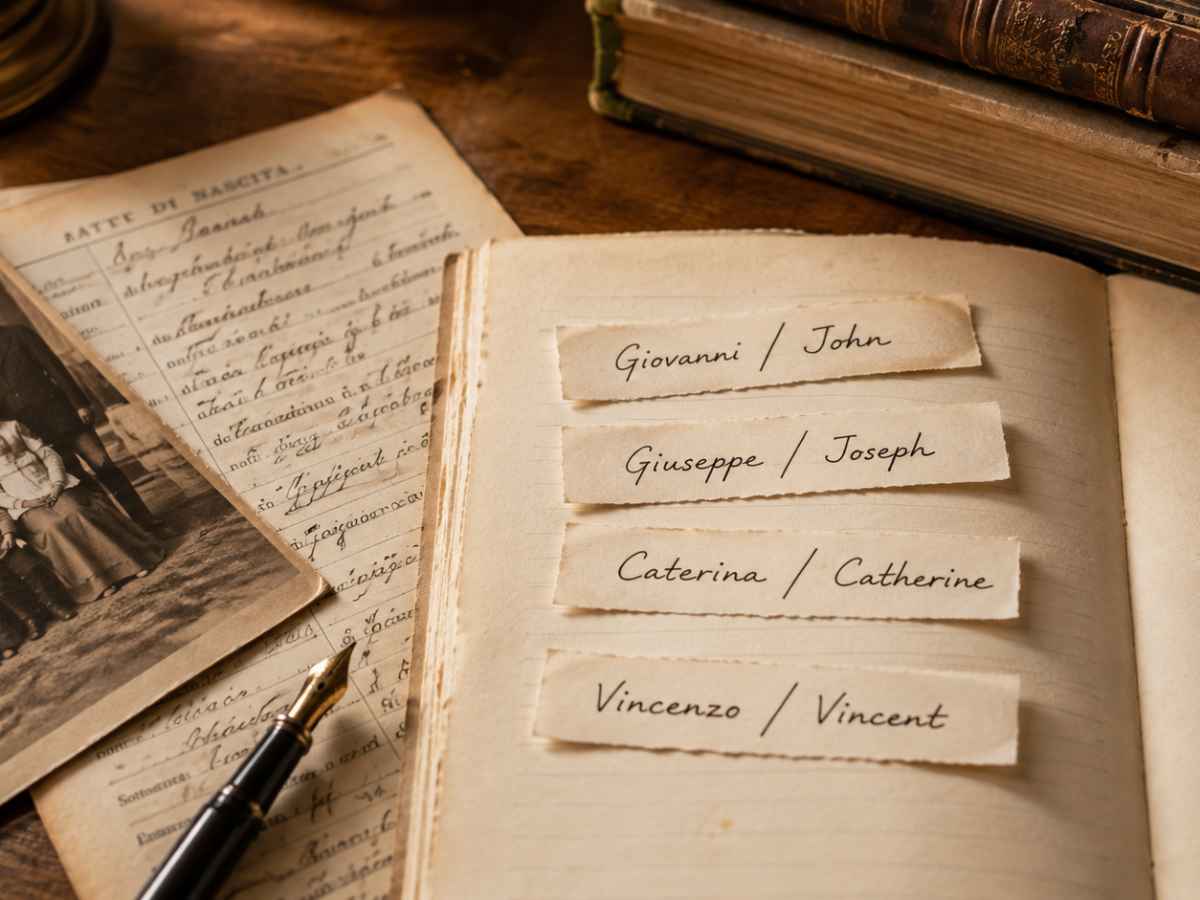
Had he settled in New York or Toronto instead, the same man would have been John. Same name, same person, a different country’s version of him. And this is the thing almost no one tells you about Italian immigrant names: Giovanni didn’t simply become John. He became John or Jean, depending on which ocean-crossing he made — and in a place like Montreal, sometimes both at once.
A name was never just a name for an immigrant. It was a passport into a new culture. Giovanni became Jean not because anyone forced him to, but because a name that fit made the whole hard business of belonging a little easier.
Free Printable
Preserve your family’s names — and their stories.
The names, the versions, the reasons they changed — join the list for a free printable Italian family calendar, and start recording what your family carried across the ocean.
What is your Italian name in English? Find it below
Before the history, the fun part. Enter an Italian first name and the finder will show you its English form, its everyday nickname, and — the part most tools miss — its French Quebec version, the way my grandfather’s Giovanni became Jean. Look up your own Italian name in English, your grandparents’, the whole family.
Italian Family Traditions
What’s Your Italian Name in English?
When Italians crossed the ocean, their names often changed — to English in the U.S. and English Canada, to French in Quebec. Enter an Italian first name to see what it became.
Not sure?
Names didn’t change at Ellis Island, as the myth goes — families changed them, over time, to fit in. These are the most common equivalents; your family’s version may differ.
Why Italian immigrants changed their names
Italian immigrants changed their names for one overriding reason: to belong. In a new country where an Italian name marked you instantly as an outsider — and often as a target for suspicion or prejudice — an anglicized name was a form of protection and a shortcut to acceptance. A Giuseppe who introduced himself as Joe was easier to hire, easier to serve, easier to trust. The name change was rarely about shame in the old country; it was about survival in the new one.
Often the two names lived side by side. A man was Giuseppe at home and Joe at work; Giovanni to his wife and John — or Jean — to his customers. The Italian name held the family, the private world, the old country. The anglicized name did the public work of making a living in a place that didn’t yet know what to do with an Italian. Most immigrants carried both, code-switching between them a dozen times a day without ever thinking of it as remarkable.
And it worked. For my grandfather, “Jean” wasn’t a betrayal of “Giovanni” — it was the same man, translated, meeting a new culture halfway. The name said: I am willing to meet you where you are. In a French Montreal that could be wary of newcomers, that willingness mattered, and people responded to it.
The Ellis Island myth: names weren’t changed at the door
There is a story almost every Italian-American family tells: that an official at Ellis Island, unable to spell or pronounce an Italian surname, simply changed it on the spot — and that is why the family name is what it is today. It is a powerful story. It is also, almost entirely, a myth.
Ellis Island officials did not write down names. They worked from the passenger manifests that had been created at the port of departure — in Naples, in Palermo, in Genoa — by clerks who spoke Italian. Inspectors at Ellis Island were checking arrivals against those existing lists, not inventing new spellings. Many interpreters on the island spoke multiple languages precisely so that names and details could be understood correctly. The image of a harried official carelessly renaming a frightened immigrant makes for a good story, but it is not what happened.
So where did the name changes come from? From the immigrants and their families themselves — gradually, deliberately, over years. A Giuseppe started going by Joe. A family quietly dropped a syllable that Americans always stumbled over. Children born in the new country were given anglicized names from birth. The change was not a single traumatic moment at a border; it was a slow, chosen adaptation, spread across a lifetime and a generation. Which, if anything, makes it a more honest story than the myth — because it means the names weren’t taken from your family. Your family changed them, on purpose, to build a life.
The names weren’t stolen at Ellis Island. Families changed them themselves, slowly, deliberately, to fit into a new country. That isn’t a story of loss. It’s a story of people doing what they had to do to belong.
Montreal was different: John or Jean?
Here is where the Italian-Canadian story splits from the Italian-American one, and where a family like mine had a choice most immigrants never faced. In the United States and in English Canada, the anglicized form was English: Giovanni became John, Giuseppe became Joseph, Vincenzo became Vincent. Simple, one direction.
But an Italian arriving in Montreal landed in a French city inside an English country. There were two cultures to fit into, and two versions of every name to choose from. Giovanni could become John — or Jean. Pietro could be Peter — or Pierre. Stefano could be Steven — or Étienne. Which one you used depended on who you were talking to, what neighbourhood you settled in, and which culture you were trying to join.
My grandfather chose Jean, and chose it deliberately. He was living and working among French Quebecers, and Jean was the name that opened doors there. It told people he had adapted to their culture, not just to a generic “Canadian” one — and in Quebec, that distinction has always mattered. An Italian who became “John” was fitting into English Canada. An Italian who became “Jean” was fitting into Quebec. My grandfather understood the difference, and it served him. The name was a small daily act of belonging to the specific place he had actually chosen to call home.
This is why the naming story of an Italian-Montreal family can never be told the same way as a New York one. The same starting name, Giovanni, branches two different ways depending on which North America you arrived in — and in Montreal, the branch you chose said something about which of the two Canadas you were joining.
The Names, and the Reasons Behind Them
Which of your relatives went by two names? Who chose John, who chose Jean, and why? These decisions fade in a single generation. The Italian Family Heritage Kit gives you the prompts to record your family’s names, versions, and the stories behind them before they’re lost.
Explore the Italian Family Heritage Kit →How the most common Italian names changed
Some names translated cleanly, some changed by sound rather than meaning, and some were simply replaced by whatever nickname stuck. Here are the most common transformations:
| Italian | English (U.S. / English Canada) | French (Quebec) | Everyday |
|---|---|---|---|
| Giovanni | John | Jean | Johnny |
| Giuseppe | Joseph | Joseph | Joe |
| Antonio | Anthony | Antoine | Tony |
| Vincenzo | Vincent | Vincent | Vince |
| Francesco | Frank | François | Frankie |
| Pietro | Peter | Pierre | Pete |
| Luigi | Louis | Louis | Lou |
| Stefano | Steven | Étienne | Steve |
| Alfredo | Alfred | Alfred | Alfie |
| Maria | Mary | Marie | Marie |
| Giuseppina | Josephine | Joséphine | Josie / Pina |
| Concetta | Connie | Concetta | Connie |
Notice the patterns. Some names, like Giuseppe to Joe, changed by shortening. Some, like Pasquale to Patrick, changed by sound rather than meaning — there is no real translation, so a name that sounded similar was adopted. And some, like Concetta to Connie, were simply swallowed by their own nicknames until the original was almost forgotten. Each pattern tells you something about how a family navigated its new home. For the naming traditions these names came from in the first place, read about Italian baby naming traditions and the world of Italian nicknames.
My grandfather was Giovanni at home and Jean to Montreal — and both were completely him. That was the quiet genius of the immigrant name: it let a man belong to two worlds at once, the old country at his own table and the new one at everyone else’s. Giovanni became John in New York and Jean in Montreal, and in the choosing was a whole story about who a family was becoming. Look up your own family’s names, find out who was John and who was Jean — and write down why, while someone still remembers.
Record the Names Before They’re Lost
Who was Giovanni? Who was Jean? Who was John?
Every family has a name that changed — and a reason behind it that disappears in a generation. The Italian Family Heritage Kit includes 133 guided pages and more than 120 prompts to preserve your family’s names, town, recipes, saints, sayings, and stories.
Explore the Heritage Kit — $19.99Instant digital download. Print it and complete it with your family.
The story of your family’s names is part of the larger story of what they carried across the ocean. Read about Italian baby naming traditions, the logic of Italian nicknames, how to trace your family’s town of origin, and how to record your family’s stories before the reasons behind the names are forgotten.
FAQ
What is Giovanni in English?
Giovanni in English is John. In French — and so in Quebec — it is Jean. The everyday nickname was often Johnny. This is one of the clearest examples of how an Italian name could take a different form depending on whether a family settled in the United States and English Canada (John) or in French Quebec (Jean).
What is Giuseppe in English?
Giuseppe in English is Joseph, and almost universally became Joe in everyday use. In French Quebec it remained Joseph. Giuseppe is one of the most heavily anglicized Italian names — a Giuseppe at home was very often simply Joe everywhere else.
Did Italians really change their names at Ellis Island?
No — this is a common myth. Ellis Island officials worked from passenger manifests created at the European port of departure by Italian-speaking clerks, and did not write down or invent names. Many interpreters were on hand specifically to understand names and details correctly. Italian name changes happened later and gradually, chosen by the immigrants and their families themselves to fit into their new country, rather than being imposed at the point of arrival.
Why did Italian immigrants anglicize their names?
Mainly to belong and to avoid prejudice. An obviously Italian name marked a person as an outsider and could be a barrier to work, service, and acceptance. An anglicized name — Joe instead of Giuseppe, John or Jean instead of Giovanni — made daily life easier in a new country. Often both names coexisted: the Italian name at home and within the family, the anglicized name in public and at work.
Why did some Italians in Montreal use French names instead of English?
Because Montreal is a French city, Italian immigrants there often adapted their names to French rather than English — Giovanni became Jean rather than John, Pietro became Pierre, Stefano became Étienne. Using the French form signalled that they had adapted specifically to Quebec culture, which helped them belong among French Quebecers. It is a distinctive feature of the Italian-Canadian experience in Quebec that sets it apart from the Italian-American story.
What are the most common Italian names and their English equivalents?
Common examples include Giovanni (John), Giuseppe (Joseph/Joe), Antonio (Anthony/Tony), Vincenzo (Vincent/Vince), Francesco (Frank), Pietro (Peter), Luigi (Louis/Lou), Maria (Mary), Rosa (Rose), and Caterina (Catherine). Some translate by meaning, some by sound, and some were replaced by a nickname entirely. Use the finder above to look up any Italian name and see its English, everyday, and French Quebec forms.

Marco Ricci is an Italian-Canadian writer and the grandson of Calabrian immigrants. He created Italian Family Traditions to document the customs, feast days, and family rituals Italian families carried from Italy to North America — and to understand what they actually meant. He is based in Montreal.