Italian Family Traditions
Compare and Comare: More Than Italian Godparents
English translated compare as “godfather” and quietly destroyed it in the process. The word never meant the man holding the baby. It meant the relationship between two adults who had agreed, in front of a church and a village, to be responsible for each other for life.
In my family it was said cumpà. Not compare with all four syllables intact, the way a dictionary would have it — cumpà, clipped short, the ending swallowed the way Calabrians swallow the ends of words, landing somewhere between a name, a title and a greeting.
You did not say it about someone. You said it directly to them, and they said it back to you, and that reciprocity was the entire point — although I did not understand that until much later, and only because I went looking.
Ours were my mother’s cousins. Which means our family took a bond that already existed in blood and deliberately tied a second one on top of it, in a church, with a priest present. Belt and suspenders, in a culture that has never entirely trusted that the people you love will be there when you need them, and preferred to make it formal.
And there were others who were not godparents to anybody. Family friends who came around every so often, who were simply called cumpà because that is what they had become — without a baptism, without a ceremony, without anything you could point to on paper. The word did not require documentation. It required only that somebody had proven something.
I asked recently what the obligation actually was. What a compare was really for, underneath the ritual and the titles and the respect. The answer came back in two words.
Someone showing up.
That is the whole institution. Not money, not advice, not godparent duties in the greeting-card sense. Somebody who arrives — at the hospital, at the funeral, at the house when something has gone badly wrong and the phone call goes out at eleven at night. Somebody with no legal obligation to you whatsoever who comes anyway, because decades ago two families stood in a church and agreed that this is what they would be to one another.
Every English-language explanation of compare and comare describes a role at a baptism. Almost none of them mention that the relationship being created was not between an adult and a child, but between two adults — and that it was built to last long after the child in question had grown up, moved away, and forgotten the ceremony entirely.
What compare actually means

A compare is not a godfather. A compare is the godfather considered specifically in his relationship to the child’s father — and the word runs in both directions at once.
This is the detail that collapses the instant you translate it into English. In Italian, the father and the godfather each call the other compare. It is not a title one man holds over a child. It is a name two men call each other, reciprocal and symmetrical, and the feminine comare works identically between the mother and the godmother. The word for the institution itself — the entire social structure sitting underneath the relationship — is comparatico.
English has no word for this. The word itself softened into Italian-American slang over the generations — “cumpà,” worn down from compare until it meant any trusted family friend. The historian Guido Alfani, in his study of spiritual kinship in early-modern Italy, notes that compare, comare and comparatico have no equivalent in modern English and are generally left untranslated by scholars for exactly that reason. The other Romance languages all kept theirs — compérage in French, compadrazgo in Spanish — describing the same institution right across the Catholic Mediterranean.
English did have one, once. The Old English godsib — literally god-sibling, spiritual brother or sister — carried roughly the same meaning. It did not vanish. It decayed. Godsib became gossip, and a word that once described a sacred lifelong alliance now means idle talk over a fence.
There is something almost unbearable about the fact that English took a word meaning “the person bound to me before God for the rest of my life” and gradually turned it into a word meaning chatter. That linguistic decay is not a curiosity or a piece of trivia. It is a record of exactly what happened to the institution itself.
Complicating things further, the words do not mean the same thing everywhere in Italy. Across much of the north, godparents are madrina and padrino, and comare and compare refer instead to the witnesses at a wedding — the best man and the maid of honour. It is in the south, and in the southern diaspora, that compare and comare became the ordinary everyday words for godparents, carried over in dialect and pronounced accordingly: cumpà, cumbà, cummà, depending on which valley the family came from.
The obligations that came with the word
Comparatico was not honorary. It carried duties that were specific, understood by everyone in the village, and enforceable by nothing except the certainty that failing them would follow you for the rest of your life.
The most serious was this: should the child be left without parents, the compare was obliged to take that child into his own home and raise him — because, as one nineteenth-century Italian folklorist recorded it, he had effectively become the child’s father. Should the child die, the compare was obliged to contribute to the funeral expenses. These were not sentiments or gestures. They were understood as debts.
Around that core sat a wider architecture of expectation that anthropologists studying southern Italy have described as a genuine social, economic and political resource. A compare was who you went to for work. For a loan when no bank would look at you twice. For an introduction, a recommendation, a word placed in the right ear. In villages where formal institutions were weak, distant, or actively hostile, comparatico was the infrastructure — a private network of obligation operating precisely where the state did not.
And underneath all of it, the thing my family reduced to two words. Someone showing up. The specific, unglamorous, entirely unenforceable practice of appearing when appearing is difficult — which is, once you strip away the ritual, the only meaningful test any relationship has ever had.
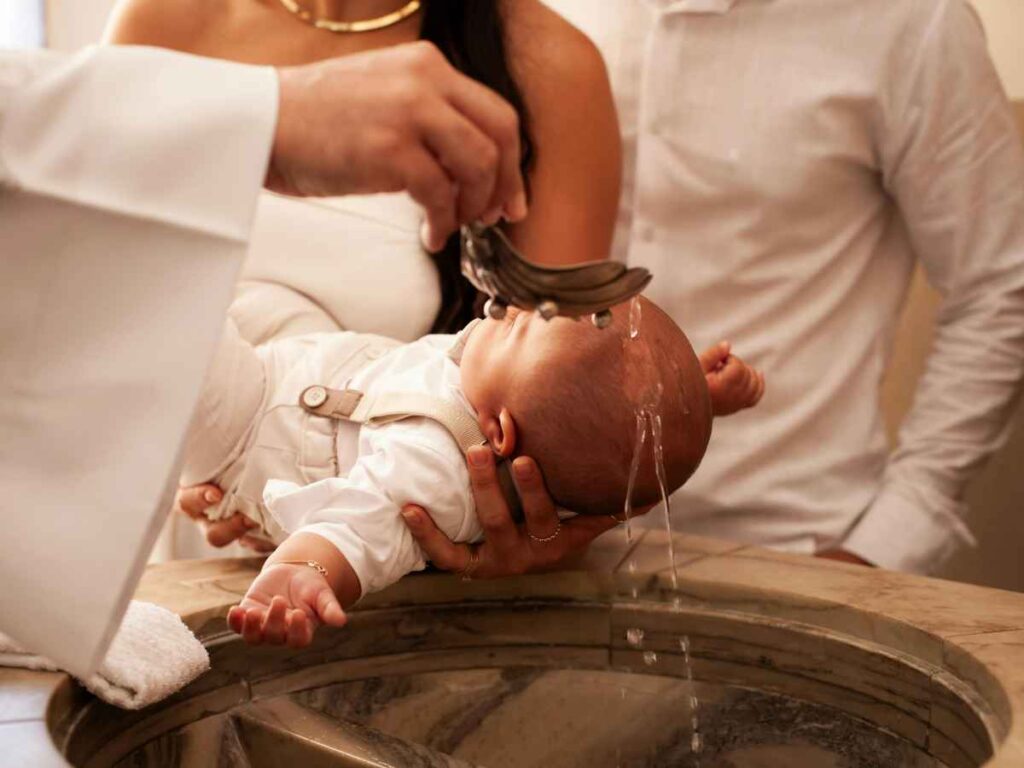
The bond was usually sealed at a baptism, which is why baptisms in Italian families carried a weight that seems disproportionate to anyone watching from outside. The ceremony was never only about the child. It was the moment two families formally became responsible for one another, in public, with a priest as witness — and everybody in the church understood that this was the actual transaction taking place.
Love these Italian traditions?
Get new stories about Italian customs, folk beliefs, and family traditions — plus our free printable calendar of the Italian year.
The comparatico of San Giovanni — no baptism required
In parts of the south you could become compari with no child, no baptism, and no church involved at all — through a bond entrusted directly to Saint John the Baptist.
This is the part of the tradition that almost never appears in English-language writing, and it is the part that reveals what comparatico actually was underneath the Catholic packaging. Known in dialect as u cumpari e sangiuvanni, the practice involved two people standing facing one another and repeating a set formula, entrusting their friendship to the saint. That was the ceremony. From that moment they were compari, and the bond held until death.
It was considered the strongest form of comparatico there was — stronger, in some accounts, than the version created at a baptism — precisely because nothing external produced it. No infant, no family obligation, no social convenience. Two adults simply decided, and invoked a saint to hold them to it. The prerequisite was not kinship. It was a close bond of friendship and deep mutual trust, which is a considerably higher bar than being available on a Sunday.
There were stranger routes in as well, and they are worth setting out plainly.
| How the bond was made | What it involved |
|---|---|
| At a baptism | The standard route. The godfather and the child’s father became compari to one another, and the two families were formally allied from that day |
| At confirmation | A second, separate godparent was chosen — creating another compare bond with another family entirely |
| The comparatico of San Giovanni | Two adults stood facing each other and repeated a formula, entrusting the friendship to the saint. No child, no church, no priest. Binding until death, and considered the strongest form of all |
| Cutting a child’s hair or nails | Performing the first cutting — in some regions in the first or fifth month — created the bond between the adult and the child’s family |
| Piercing a girl’s ears | In some places, piercing a baby girl’s earlobes in her seventh month made you compare to her parents |
| Calling out in danger | If you shouted “Sangiovanni!” to a passer-by — or even to the person attacking you — and they responded, that alone created the bond. A stranger who helped you at your worst moment became your compare for life |
| At a wedding | In much of the north, the wedding witnesses were the compare and comare — and in many families they automatically became godparents to the couple’s first child |
That last row in the middle of the table is the one that stops people. A culture built a legal-grade social institution around the idea that a person who shows up for you at the worst moment of your life is owed something permanent — and it built a word for them, and a saint to enforce it, and made the arrangement binding until one of you was in the ground.
That the saint in question is San Giovanni is not accidental. His feast on 24 June sits at the summer solstice, layered over far older midsummer rites, and across the south it has always been the night for oaths, divination, and bonds made outside the ordinary rules — the night the veil is thin enough for a promise between two people to become something more than a promise. For where it sits in the wider year, see the Italian feast day calendar.
Why compare outranked blood relatives
In traditional Italian family life the baptismal godparents were regarded as ranking above blood relatives — and the titles compare and comare were used, always, as a mark of that rank.
This is difficult for the modern reader to take seriously, because godparenthood across most of the English-speaking world has become a warm formality. A photograph. A card at Christmas. Occasionally a savings bond. In an Italian household, the compare and comare occupied an actual position. You did not use their first name alone. The title was attached permanently, used in front of others, and dropping it would have been a deliberate insult that every person in the room would have registered instantly.
The system extended forward in time as well. In many families the witnesses chosen for a wedding automatically became the godparents of the couple’s first child — which meant that choosing your wedding party was not a matter of sentiment but of selecting the family your family would be permanently allied to. Those obligations were assumed to be binding from the moment they were accepted.
Some families, like mine, chose from inside the blood family anyway. My mother’s cousins. Anthropologists have documented this as a distinct strategy: rather than reaching outward to build a new alliance, you reinforce one that already exists, doubling a bond of blood with a bond of spirit. In a culture that spent centuries watching envy and rivalry corrode families from the inside, that is not redundancy. That is reinforcement.
Who Were Your Family’s Compare?
Most families can no longer name them, or say which side they came from, or explain why those particular people were chosen. The Italian Family Heritage Kit gives you the questions and the space to record the people who were bound to your family, and what they did when it mattered.
Explore the Italian Family Heritage Kit →What the crossing did to the word

Comparatico crossed the ocean intact and then, over roughly three generations, came apart. Not all at once, and not everywhere — but thoroughly.
In the first generation it did not merely survive. It became more important than it had been at home. A study of Calabrian families who migrated to Adelaide in the 1950s and 60s found comparatico operating as a full social network in the new country, deliberately maintained with people from the same village back in Italy, generating exactly the obligations and expectations it always had. In a country where you had no standing, no language, and no institutions willing to help you, a compare was not a charming tradition. He was the system.
The same pattern held across North America. Immigrants clustered by town of origin, and comparatico bound those clusters into something that functioned like an extended family — which is precisely how people found work, housing, and a route through a bureaucracy conducted entirely in a language they did not yet speak. It sat alongside the other traditions that made the crossing and did real, practical work on arrival.
What broke it was success. Once the second generation had English, credentials, banks, unions and lawyers, the practical function of comparatico evaporated. You no longer needed a compare to find work. The obligations became optional — and an obligation that is optional is not an obligation. The word survived the ocean but began doing progressively lighter work, until in popular culture it decayed into goomba: a piece of shorthand slang, faintly comic, thoroughly disconnected from the sacred alliance it originally described.
Twice now, in two different languages, the same thing has happened to this word. Godsib became gossip. Compare became goomba. A word meaning “bound to you before God until death” collapses, in both cases, into something you would say lightly. It is the most precise linguistic record we have of an institution quietly ceasing to be necessary.
Does it still exist?
In diminished form, and in fewer families each decade — but where it survives, it survives in exactly the form that always mattered, stripped of the ceremony and reduced to the obligation.
The lending, the job-finding, the introductions have gone; the diaspora no longer needs them. What remains in the families that kept it is the version my family gave me in two words. Someone showing up. And the honest truth is that this was always the part that mattered — everything else, the formula and the saint and the funeral expenses and the rank above blood relatives, was scaffolding built around it to make sure it actually happened.
My children have compare. Not cousins this time. Good friends of ours, people we trust — which is, when you look at it properly, precisely the criterion the old comparatico di San Giovanni required and the baptismal version frequently did not. No village, no formula, no saint invoked. Just two families deciding that this is what they are to each other, and meaning it.
Three generations, one ocean, two languages, and the word still means what it meant. That is not nothing. Most of what crossed did not make it this far intact.
Ask yourself the practical version of the question, the one that cuts straight through all of the history: if it went badly wrong tonight, who arrives? Not who sends a message. Who gets in the car. Whatever number you just came up with — that is how many compare you actually have, regardless of what anybody was called at any baptism.
What compare was really about
Comparatico looks, from the outside, like an odd piece of Catholic bureaucracy — an extra layer of formality bolted onto a christening. That christening also came with its gifts and keepsakes — the bomboniera handed to guests.
It was the opposite. It was a culture looking clearly at the fact that families are not always enough, that blood does not guarantee anybody will come when you call, and that a person alone in a village with no allies is a person in genuine danger — and then building a formal, public, binding mechanism for manufacturing the people who would come. Not hoping for them. Making them.
That is why the word deserves better than goomba, and why it is worth knowing what your own family meant by it before the last person who used it properly is gone.
For the ceremony where most of these bonds were formed, read about Italian baptism traditions. For the anxieties this whole system was built to guard against, read about invidia and the malocchio. And to record who your family’s compare actually were before the names are lost, read how to record family stories before they’re gone.
In our house it was said cumpà. It meant somebody would show up. Three generations later my children have compare of their own — chosen the old way, for trust rather than blood — and the word still means exactly what it always meant. That is the whole tradition right there.
Which Families Were Bound to Yours?
Record who stood at which baptism, and what they did when it mattered.
Who were your compare and comare? How was the word said in your house? Who showed up when your family needed somebody? The Italian Family Heritage Kit includes 133 guided pages and more than 120 prompts to preserve your family’s people, names, traditions, recipes, remedies, sayings, photographs, and memories.
Explore the Heritage Kit — $19.99Instant digital download. Print it and complete it with your family.
FAQ
What is the difference between compare and padrino?
Padrino is the standard Italian word for godfather and describes his relationship to the godchild. Compare describes the same man in his relationship to the child’s father — and the word is reciprocal, meaning the two men call each other compare. The distinction matters because it reveals what the institution was actually organised around: an alliance between two adults and their families, formalised at a baptism, rather than a role performed for a child. In northern Italy, padrino and madrina remain the standard terms for godparents, while compare and comare more commonly refer to the witnesses at a wedding.
What does comparatico mean?
Comparatico is the name for the institution of spiritual kinship itself — the entire structure of obligations, expectations and relationships created when two families become compari. It has direct equivalents throughout the Catholic Mediterranean, including compadrazgo in Spanish and compérage in French, but no equivalent term exists in modern English, which is why scholars typically leave it untranslated. Anthropologists studying southern Italy have described comparatico as functioning simultaneously as a social, economic and political resource rather than a purely religious one.
What were the actual obligations of a compare?
The most serious obligations were concrete: if the godchild were orphaned, the compare was expected to take the child into his home and raise him, and if the child died, he was expected to contribute to the funeral expenses. Beyond those, the relationship carried broad practical duties — providing work, extending loans, making introductions, and offering protection or advocacy within the community. In villages where formal institutions were weak or inaccessible, comparatico functioned as genuine infrastructure. Underlying all of it was the simplest and least enforceable obligation of all: to appear in person when the other family needed help.
What is the comparatico of San Giovanni?
In parts of southern Italy and Sicily, two people could become compari without any baptism, child, or church ceremony by entrusting their friendship to Saint John the Baptist. The practice, known in dialect as u cumpari e sangiuvanni, required the two individuals to stand facing one another and repeat a set formula, after which the bond was considered binding until death. It was regarded as the strongest form of comparatico precisely because nothing external created it — the sole prerequisite was an existing close friendship and deep mutual trust between two adults who chose one another freely.
Why is compare pronounced “cumpà” in some families?
Because most Italian immigrant families spoke regional dialect at home rather than standard Italian, and southern dialects routinely truncate word endings. Depending on the region of origin the same word appears as cumpà, cumbà, combà or cumpari, with the feminine varying similarly as cummà or cumare. None of these are mispronunciations of standard Italian. They are the authentic forms of the actual language the family spoke, and they are usually the version that survived into the diaspora — because they are the version the children actually heard.
Where does the word “goomba” come from?
Goomba is an Anglicised rendering of the southern Italian dialect pronunciation of compare — cumpà or cumbà — carried into American English through Italian-American communities. Its original meaning was the full spiritual-kinship bond described in this article. Over several generations, as the practical obligations of comparatico became unnecessary in North America, the word drifted into casual slang meaning something closer to “buddy” or “associate,” and was further flattened by film and television portrayals. The decay closely parallels what happened to the Old English godsib, which meant spiritual sibling and became the modern word gossip.
Is comparatico still practised today?
In a substantially reduced form. The economic and practical functions largely disappeared once later generations gained language, education, and access to formal institutions that made a private network of obligation unnecessary. Many families retain the titles and the affection without the binding duties, and in some the words have faded entirely. Where the institution genuinely survives, it typically does so stripped back to its essential obligation — a family bound to yours by choice rather than blood, who can be relied upon to arrive when something has gone seriously wrong.

Marco Ricci is an Italian-Canadian writer and the grandson of Calabrian immigrants. He created Italian Family Traditions to document the customs, feast days, and family rituals Italian families carried from Italy to North America — and to understand what they actually meant. He is based in Montreal.