Italian Family Traditions
Panettone vs. Pandoro: What’s the Difference?
Italy’s two great Christmas cakes, settled once and for all — where each comes from, how they differ, which one is right for you, how to buy a good one, and the proper way to serve them.
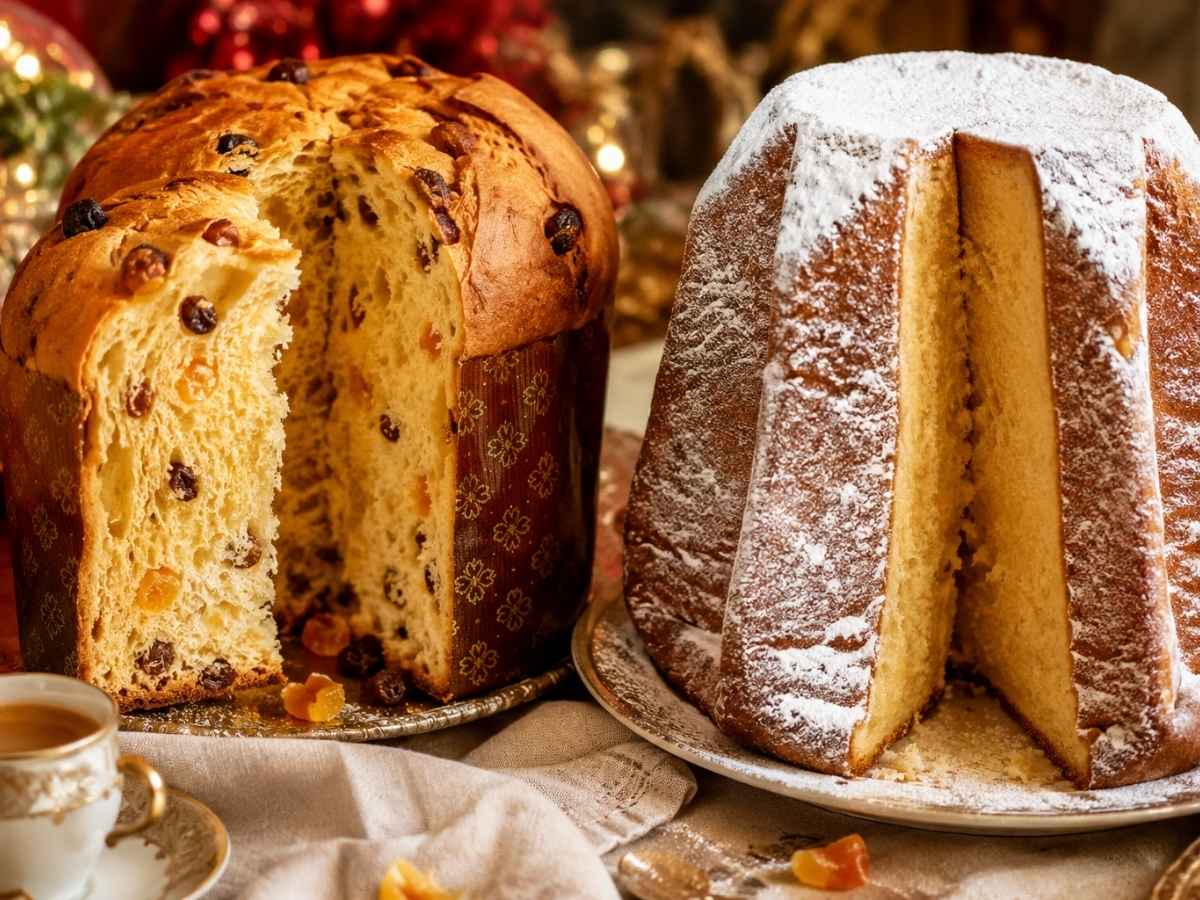
The short answer: panettone is a tall, domed sweet bread from Milan, studded with candied fruit and raisins, with an airy, stringy crumb. Pandoro is a star-shaped, golden cake from Verona with no fruit at all, soft and buttery, and served under a snowfall of powdered sugar. Panettone is fruited and bready; pandoro is plain and cake-like. Both are leavened slowly with natural yeast, both are eaten from Christmas to the Epiphany, and both are protected by Italian law.
Every Italian Christmas table has them, and every Italian family has an opinion. The two boxes appear in the shops from late November — the tall domed panettone and the golden star-shaped pandoro — and somewhere in every household, someone insists one is far better than the other. So what actually separates them? They look similar, they arrive at the same time of year, and they’re often mentioned in the same breath. But they come from different cities, different traditions, and genuinely different recipes.
Here is the honest, point-by-point answer — and a few interactive ways to settle the debate at your own table.
Italy’s Two Christmas Cakes
Panettone vs. Pandoro
Side by side
The two great Italian Christmas breads, compared point for point.
Which one is for you?
Three quick taps and we’ll settle the debate at your table.
How to serve it
The classic Italian ways to enjoy each one. Tap to switch.
However you serve them, both are best shared — sliced at the center of the table, the way an Italian Christmas has always ended.
Free Printable
The whole Italian Christmas, on one calendar.
From San Martino and Santa Lucia to the Feast of the Seven Fishes and La Befana — every feast day of the Italian year on one free printable calendar. Join the list and we’ll send it to you.
What is panettone?
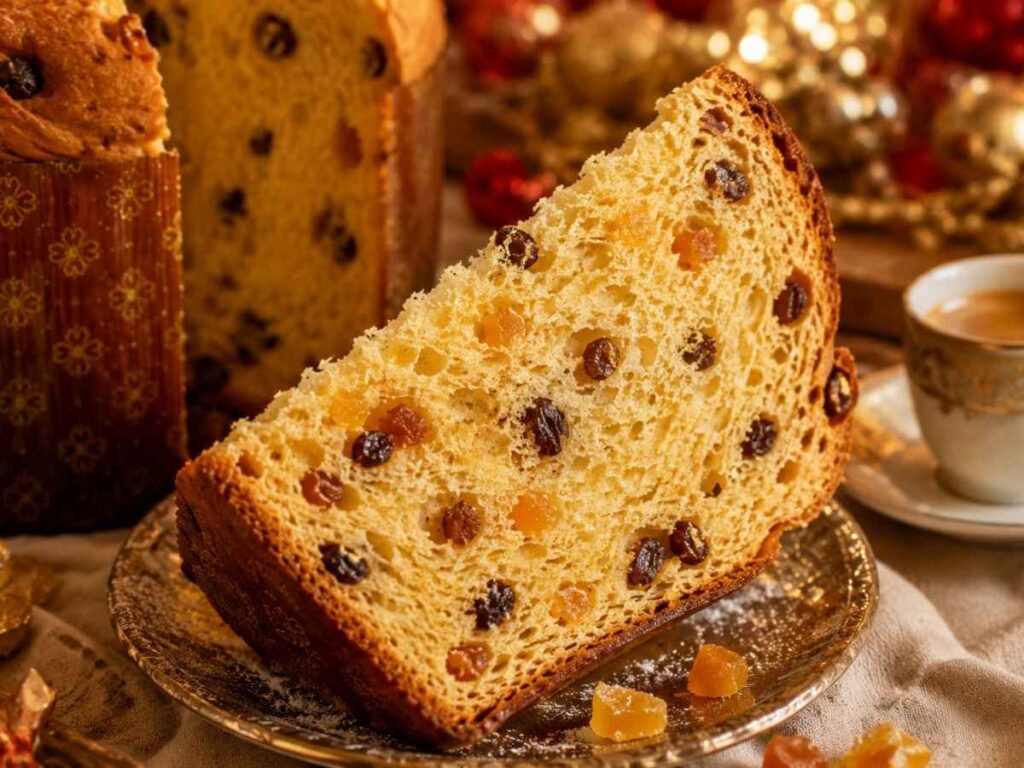
Panettone is the taller of the two — a domed, cupola-shaped sweet bread that originated in Milan. Its defining features are its airy, almost stringy crumb and the candied fruit and raisins studded throughout. Making a true panettone is a slow, difficult process: the dough is leavened with a natural sourdough starter (lievito madre) over many hours, sometimes days, which gives it that characteristic light, pull-apart texture. It is, in a sense, more bread than cake — and a well-made one is a small marvel of baking.
Legends about its origin abound — most tie it to Milan and a tale of a baker named Toni (“pan de Toni,” Toni’s bread) — but what matters is that panettone became the Milanese Christmas bread and spread from there across all of Italy and the world.
The oldest certain record of a Christmas bread like it comes from 1599: an expense register from the Borromeo college in Pavia lists the ingredients for loaves given to students at Christmas. In the eighteenth century Milanese writers were already calling it pan de ton, “luxury bread,” and the first printed recipe appeared in 1853. The name itself comes from the Milanese dialect panattón, “big bread.”
The panettone most of us picture — tall, domed, wrapped in a paper collar — is a twentieth-century creation. In 1919 the Milanese baker Angelo Motta began letting the dough rise three times over almost twenty hours, which produced the tall cupola and the light, feathery crumb. A few years later Gioacchino Alemagna followed with his own version, and the rivalry between the two brands turned panettone from a local specialty into something made by the million and shipped all over the world.
What is pandoro?
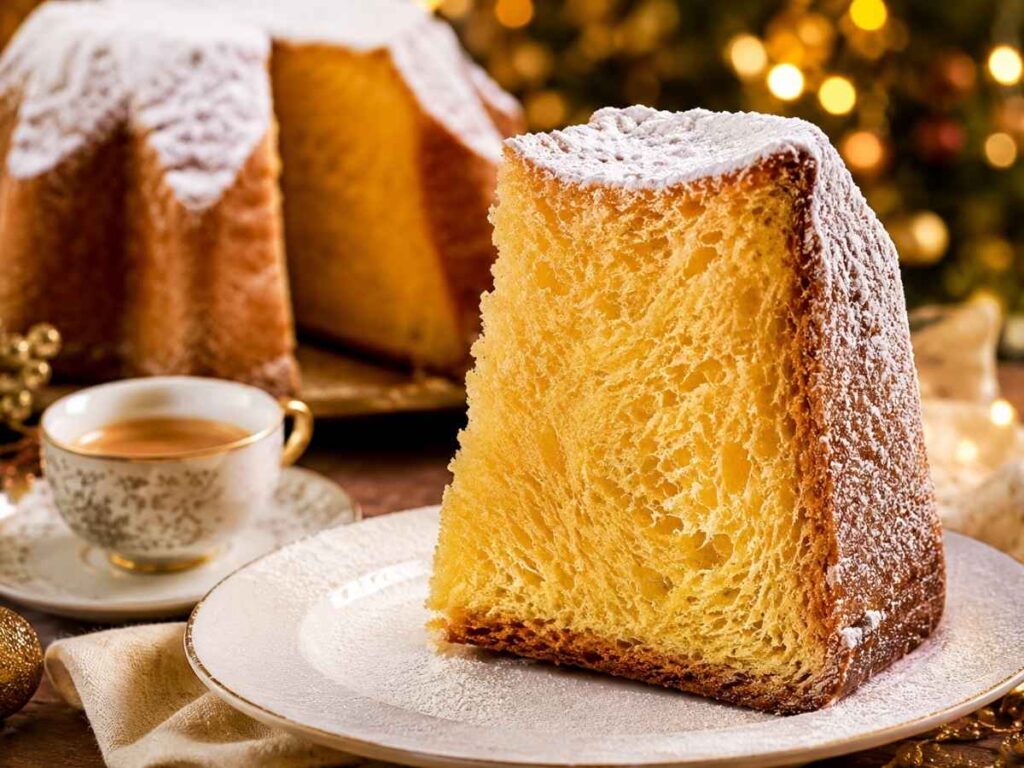
Pandoro — literally “golden bread” — comes from Verona, and it is a different creature entirely. It has no candied fruit, no raisins, nothing studded through it: it is plain, soft, buttery, and rich, closer to a cake than panettone is. Its unmistakable feature is its shape — a tall eight-pointed star, designed so that when sliced horizontally and dusted with powdered sugar, it looks like a snow-covered mountain peak. It is almost always served with a generous shake of powdered sugar, traditionally shaken on inside the bag it comes in.
Where panettone is fruited and bready, pandoro is pure, golden, and tender — the choice for anyone who never liked biting into a piece of candied peel.
Pandoro descends from older Veronese Christmas sweets, especially the nadalin, a flatter, star-shaped cake that Verona had baked for centuries. The modern pandoro was born on October 14, 1894, when the Veronese baker Domenico Melegatti patented his recipe and the tall eight-pointed mould used to bake it — a mould traditionally credited to the Veronese painter Angelo Dall’Oca Bianca. The rich, egg-yolk dough is what gives it its colour, and its name.
Look inside almost any boxed pandoro and you will find a small packet of vanilla-scented powdered sugar. The ritual is to tip the sugar into the bag, close it, and shake the whole cake until it is coated — a job that usually goes to the children.
Panettone is fruited and bready, from Milan. Pandoro is plain and buttery, from Verona. Same season, same shelf — two entirely different traditions.
The main differences, in short
| Panettone | Pandoro | |
|---|---|---|
| City of origin | Milan (Lombardy) | Verona (Veneto) |
| Shape | Tall, domed cupola | Eight-pointed star |
| Texture | Airy, stringy, bread-like | Soft, buttery, cake-like |
| Add-ins | Candied fruit & raisins | None — plain |
| Finish | Served as is | Dusted with powdered sugar |
| Name means | “Big bread” / Toni’s bread | “Golden bread” |
| Classic pairing | Sweet wine, espresso | Mascarpone cream, cocoa |
Which came first?
Panettone is the older tradition, with roots reaching back centuries in Milan. Pandoro is comparatively modern — it was industrialized and popularized in the late 1800s in Verona (the baker Domenico Melegatti patented a version in 1894), though it draws on older Veronese cakes. So while both feel timeless today, panettone is the ancient one and pandoro the elegant nineteenth-century newcomer that grew up beside it.
That age gap explains a lot about their personalities. Panettone carries the weight of a long, rustic bread-making tradition, the slow work of a sourdough starter kept alive from batch to batch. Pandoro was born in the age of the elegant urban pastry shop, refined, golden and buttery — a cake made to impress the drawing room.
Italian law protects both cakes
In Italy, you cannot simply call any domed sweet bread a panettone. A 2005 decree sets out what a product must contain to use the names panettone and pandoro. A true panettone must be made with butter, not other fats, must contain egg yolk, must be leavened with natural yeast, and must be at least 20 percent raisins and candied citrus peel. A true pandoro may use only butter and cocoa butter as its fats, needs egg yolk, and must also be leavened naturally.
This matters when you shop. A cake labelled “panettone” and made in Italy has to meet those rules, which is why the real thing is rich, fragrant and expensive to make. Products that cut corners with vegetable oils or chemical leavening often go by vaguer names, such as “Christmas cake” or “dolce natalizio.”
How to choose a good panettone or pandoro
The stacks of colourful boxes that appear in Italian grocery stores every November vary enormously in quality. A few quick checks make a real difference:
- Read the ingredients. Butter should appear near the top. Avoid cakes made with palm oil, margarine or “vegetable fats.”
- Look for natural leavening. Lievito naturale or lievito madre on the label means a slow sourdough rise, which gives the best flavour and keeps the cake fresh longer.
- Check where it was made. “Made in Italy” means the 2005 rules apply to the name.
- Weigh it in your hand. A good panettone is light for its size; a dense, heavy one has not risen well.
- Consider an artisan bakery. Hand-made panettone from a good Italian pastry shop costs more but is a different experience — more aromatic, moister and with better fruit.
How to serve panettone and pandoro
Both are traditionally eaten at the end of the long Christmas meal, sliced at the table and shared. Panettone is classic with a glass of sweet wine (Moscato d’Asti or vin santo) or simply with coffee; some families lightly toast leftover slices, or serve it with warm zabaione (an egg-and-wine custard), or with crema al mascarpone, a sweetened mascarpone cream. Pandoro is almost always dusted with powdered sugar first, then served plain, or dressed up — split into star-shaped layers with mascarpone cream and berries, or dusted with cocoa. Leftovers of either make an extraordinary French toast the next morning.
How to cut them
Cut panettone vertically, in wedges, like a cake, so every slice gets some of the soft centre and some of the crust. A serrated bread knife keeps the airy crumb from tearing. Cut pandoro horizontally into star-shaped slices. If you rotate each slice a little as you stack them back up, the points fan out into a Christmas tree — fill the layers with mascarpone cream and berries and you have one of the easiest and most striking desserts of the season.
Warm it first
Many Italian families put the panettone near the stove or in a barely warm oven for a few minutes before serving. The gentle heat wakes up the butter and the citrus, and the whole kitchen smells of Christmas. Pandoro is better at room temperature, so the butter is soft but the crumb stays tender.
Both belong to the wider world of the Italian Christmas — the season of feast days, sweets, and family that runs from early December all the way to the Epiphany.
What to do with leftover panettone and pandoro
Italian homes often end the holidays with more cake than anyone can eat, since a panettone or pandoro is one of the most common gifts to bring to a family dinner. Nothing goes to waste:
- French toast. Thick slices dipped in egg and milk and fried in butter. Panettone’s fruit and pandoro’s richness both make it extraordinary.
- Bread pudding. Cubes of panettone baked in a custard of eggs, milk and a little sugar.
- Pandoro tiramisù. Slices of pandoro replace the ladyfingers, soaked in coffee and layered with mascarpone cream.
- Toasted for breakfast. A slice of panettone toasted and spread with butter, with a caffè latte.
- Zuppa inglese, the easy way. Pandoro slices brushed with liqueur and layered with custard.
To keep them fresh, close an opened cake back up in its original plastic bag and keep it in a cool, dry place. A good naturally leavened panettone stays soft for several days after opening; unopened industrial cakes keep for months, so check the date on the box.
When do Italians eat panettone and pandoro?
Both appear in shops in November, but they belong above all to the stretch from Christmas Eve to the Epiphany on January 6, when La Befana closes the season. They are eaten after the big meals, at breakfast with coffee, in the afternoon with friends who drop by, and on New Year’s Eve with a glass of spumante.
In Milan the panettone season has one last chapter. On February 3, the feast of San Biagio, the patron saint of the throat, families eat a slice of panettone saved from Christmas — often blessed in church — to protect against sore throats and colds for the rest of the winter. The saying goes: San Bias el benediss la gola e el nas, “Saint Blaise blesses the throat and the nose.” Shops sell off their last panettoni for the occasion.
In Milan, the last slice of Christmas panettone is saved for February 3 — the feast of San Biagio, protector of the throat.
Panettone and pandoro in Italian-American and Italian-Canadian homes
For Italian families abroad, the panettone box became one of the most recognisable signs that Christmas had arrived. The tall boxes stacked in towers at the Italian grocery, the ribbon handle you carried it by, the one you brought to every house you visited between Christmas and New Year’s — for many families, a panettone was the default gift, the thing you never arrived without. In many homes the sturdy boxes were saved afterwards for storing sewing supplies, photos and Christmas ornaments.
The same thing happened wherever Italians settled. After the great wave of emigration to South America, panettone became a staple of Christmas there too: it is panetón in Peru, which today eats more of it per person than Italy does, and pan dulce in Argentina, where it was popularised by Italian immigrant bakers. In North America, the debate between panettone families and pandoro families is as lively as it is in Milan and Verona.
If your family had a favourite — a particular brand, a particular bakery, a nonna who refused to allow pandoro in the house — that small detail is worth writing down. These are exactly the memories that disappear first, and they are some of the best to pass on. Our list of questions to ask your Italian grandparents is a good place to start.
The other Italian Christmas cakes
Panettone and pandoro are the famous pair, but every region of Italy has its own Christmas sweets, and many families abroad kept those instead:
- Pandolce (Genoa) — a denser, crumblier sweet bread with raisins, pine nuts and candied fruit.
- Panforte (Siena) — a flat, chewy cake of honey, nuts, candied fruit and spices, more like a confection than a bread.
- Panpepato (Central Italy) — a spiced, peppery cousin of panforte, rich with nuts and chocolate.
- Buccellato (Sicily) — a ring of pastry filled with figs, nuts and citrus; Lucca, in Tuscany, has its own very different anise-and-raisin buccellato.
- Torrone — nougat of honey, egg white and almonds or hazelnuts, made in many regions.
- Struffoli (Naples) — tiny fried dough balls in honey and sprinkles, one of the classics on our list of Italian Christmas cookies.
Panettone or pandoro — fruited or plain, Milan or Verona — there’s no wrong answer, only the one your family reaches for first. Both are the taste of an Italian Christmas, sliced at the center of the table and shared. Pick your side, pour something sweet, and pass a slice to the person next to you.
A Gift Beyond the Panettone
The recipes and rituals only your family kept.
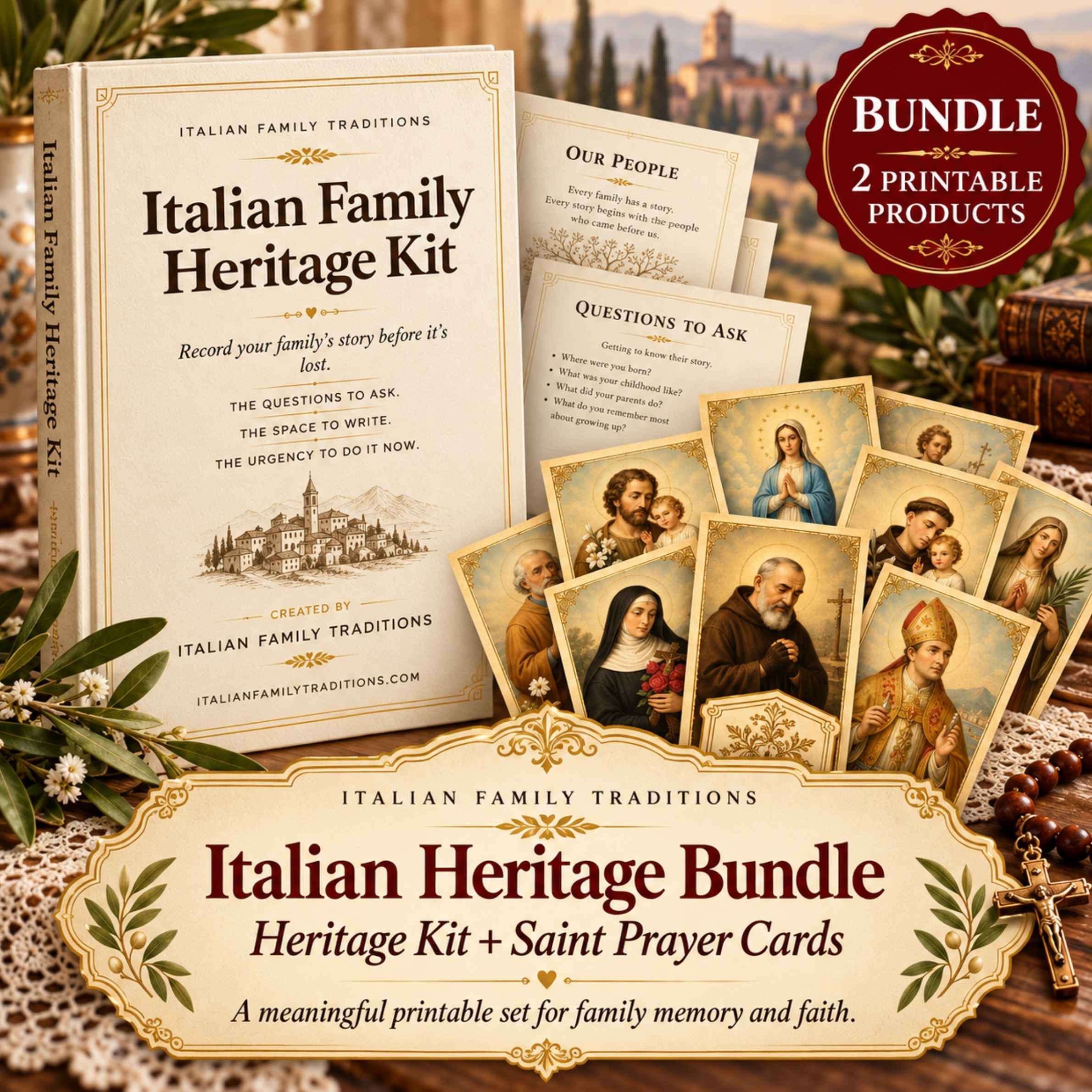
Which cake your family bought, the Vigilia menu, nonna’s cookies — the Italian Heritage Gift Set pairs the 133-page Italian Family Heritage Kit, with more than 120 prompts to record your family’s Christmas and its stories, with 11 printable saint cards with prayers in Italian and English. Ready to print the same day.
Get the Gift Set — $24.99Instant digital download · $29.48 if bought separately · or see the Heritage Kit on its own
More of the Italian Christmas table: the complete guide to Italian Christmas traditions, the Italian Christmas cookie tray, the Feast of the Seven Fishes and La Vigilia on Christmas Eve, the after-dinner game of Tombola, the Feast of Santa Lucia and La Befana that open and close the season, and the Italian Sunday dinner that shaped them all. Looking for a present? See our Italian Christmas gift guide. For the whole season at a glance, see the Italian feast day calendar.
FAQ
What is the difference between panettone and pandoro?
Panettone (from Milan) is a tall, domed sweet bread with an airy texture and candied fruit and raisins. Pandoro (from Verona) is a soft, buttery, star-shaped cake with no fruit, dusted with powdered sugar. Panettone is bread-like and fruited; pandoro is cake-like and plain.
Which is better, panettone or pandoro?
Neither is objectively better — it comes down to taste. Choose panettone if you like candied fruit and an airy, bread-like texture; choose pandoro if you prefer a plain, soft, buttery cake. Many Italian families buy both and settle the debate every year.
Why is pandoro shaped like a star?
Pandoro’s eight-pointed star shape comes from Verona and is designed so that when it’s sliced horizontally and dusted with powdered sugar, it resembles a snow-covered mountain peak — a fitting image for the Christmas season.
Does panettone always have fruit?
Traditional panettone contains candied fruit (often orange and citron) and raisins. However, modern variations exist without fruit, or with chocolate chips instead — but the classic Milanese panettone is defined by its candied fruit and raisins. If you want it plain, pandoro is the traditional fruit-free choice.
How do you serve panettone and pandoro?
Both are sliced and shared at the end of the Christmas meal. Panettone pairs classically with sweet wine (moscato or vin santo) or coffee. Pandoro is dusted with powdered sugar and served plain, or dressed with mascarpone cream, berries, or cocoa. Leftovers of either make excellent French toast.
Which is older, panettone or pandoro?
Panettone. A Christmas bread recorded in 1599 in Pavia is its oldest known ancestor, and the Milanese were eating it long before 1894, when Domenico Melegatti patented the modern pandoro in Verona. Pandoro does draw on older Veronese cakes such as the nadalin.
Is panettone the same as fruitcake?
No. Fruitcake is a dense, heavy cake packed with fruit and nuts. Panettone is a tall, light, yeast-leavened bread with an airy crumb, made with a slow natural starter, and its fruit is scattered through it rather than holding it together.
How long does panettone last?
Unopened, an industrially made panettone or pandoro keeps for months; check the date on the box. Once opened, close it back in its plastic bag and eat it within about a week. Naturally leavened artisan panettone stays soft for several days after opening.
What is the San Biagio panettone tradition?
In Milan, a slice of leftover Christmas panettone is eaten on February 3, the feast of San Biagio (Saint Blaise), patron saint of the throat. It is said to protect against sore throats and colds for the rest of the winter.
What do you drink with panettone?
Classic pairings are a sweet wine such as Moscato d’Asti or vin santo, a glass of spumante on New Year’s Eve, or simply an espresso or caffè latte at breakfast. Pandoro goes especially well with hot chocolate.

Marco Ricci is an Italian-Canadian writer and the grandson of Calabrian immigrants. He created Italian Family Traditions to document the customs, feast days, and family rituals Italian families carried from Italy to North America — and to understand what they actually meant. He is based in Montreal.